Nettle Me, Please!

It’s time to upgrade Definition #3 of “nettle” (to irritate, annoy, or provoke). In my book, nettles offer a lovely antidote to what ails you. 

Of course, you’ve got to handle them carefully. (If you haven’t accidentally been bitten by a stinging nettle plant, maybe you haven’t wandered off the beaten track enough times!)

Last spring I found a big stand of nettles in the untended space above the creek across from my house. With the mild winter, I thought the nettles might have reemerged–and sure enough, I was right.

I’ve been drinking dried nettle tea all winter (sadly not dried by my own hand, but purchased from the bulk bin at my food coop). High time to make some fresh!
IMG_5607 (1024x768)

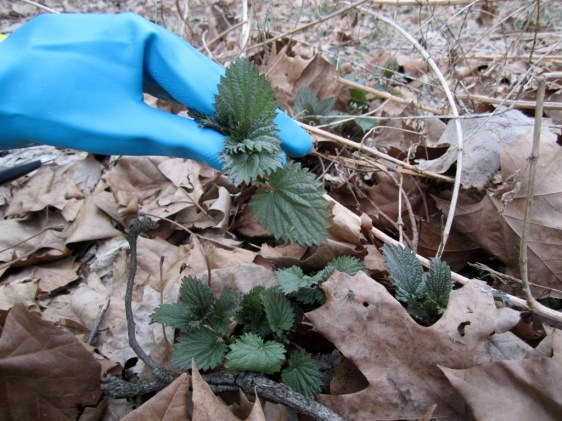
I wear household gloves to snip and prep my nettles.

I also found a few sprigs coming up in a pot dug into the ground in my side yard, where it reseeds itself every year. (I used to have a small nettle plant in the ground, but then it grew into a big nettle plant, and then it reseeded all over the yard and in my neighbor’s grass as well. So it had to go. But so far my little bucketful of stealth nettles (half hidden under a hosta leaf) has not gotten unruly.

It’s an easy enough thing to snip the tops of a nettle plant with kitchen shears. I collect them in a colander, and wash them and pick the leaves off the stems (still wearing my gloves).

IMG_5612 (1024x764)

My herbalist friend Greg Monzel says that the reddish tinge is due to chilly temperatures.

At this point you have a couple choices. You can cook them up as greens, put them on a pizza, bake them in a ravioli, make a pesto, etc. etc. Not that I’ve done any of these things, but I’m inspired by this list.

I’m lazy, so I just make nettle tea and drink it as a tonic.

IMG_5613 (768x1024)

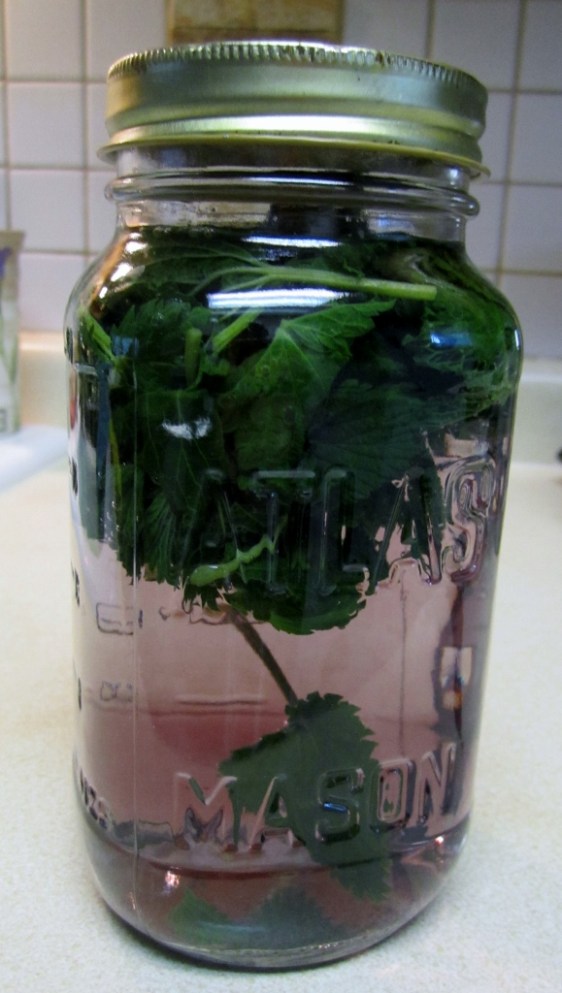
Fill a Mason jar half full of leaves, and you’re nearly there.

When fresh mint is available, I combine the two, and I’ve also had stevia-sweetened nettle tea (using leaves from a stevia plant). But it makes a fine drink all on its own. Rather green-tasting as you can imagine. You can serve it hot in cold weather, or chilled as iced tea in hot weather.
IMG_5619 (579x1024)

Pour nearly-boiling water over the leaves, loosely cap, and let brew for 8-24 hours. Best to drink within a day or so.

Side note: A quick internet search reveals that “self-urtication” (stinging oneself on purpose to relieve arthritis) is a thing.

And my herbalist friend Greg Monzel says that the seeds are one of the only herbs that can restore compromised kidney function. This fact was “discovered by contemporary herbalist David Winston in a moment of plant communication,” according to Greg. I’ve harvested seeds in the fall before, and they make a tasty popcorn seasoning or salad topper.

Another fun fact: nettle fibers can be made into cordage.

The tea itself has too many benefits to list. Actually, I don’t know them all. I just drink it as a pure tonic and health booster, and especially whenever I feel a sinus thing coming on.

So don’t be nettled by this marvelous plant–give it a try!

Garcia’s Gardens

One of the great things about freelancing is coming into contact with the coolest people: farmers.

A story assignment recently took me out to the eastern edge of Marion County to meet Daniel Garcia, proprietor of Garcia’s Gardens. This suburban Lawrence farm takes up most of the Garcia family’s back yard and is overlooked by their neighbors’ subdivision houses.

IMG_5485 (731x1024)

This photo was taken in late fall, showing the crops that Daniel was going to protect through the winter.

“Do you ever wonder if people are looking out their windows at you while you farm?” I asked him when he took me on a midwinter tour of his grounds. We were looking under row covers at salad greens and “the babyest of baby spinach” as he put it.

“I hope so,” he quipped, “because nobody is ever outside, except for the occasional smoker.”

For someone who grew up working in his Mexican-born dad’s huge garden in northwest Indiana, and took a job picking strawberries at age 12, it’s hard to fathom why people would never show their faces outside. “Everybody’s always indoors. It’s weird,” he says with a shrug.

He says some of his neighbors think he’s crazy, but one older couple gets it. “When we first got our chickens,” he says, “they were like, ‘oh I used to tend my chickens and we used to have a big garden.’ I think they really like what I do.”

Chefs and customers like it too. In addition to direct customer sales, Daniel supplies restaurateurs who love his carrots, Asian greens, heirloom tomatoes, and green onions, just to name a few. Because of the size of his enterprise (he farms intensively on about half an acre) he can pay close attention to the quality of his produce.

IMG_5528 (896x1024)

Daniel checking under the hood of his 1940s-era David Bradley two-wheeled tractor.

One of the interesting things about this particular farm is Daniel’s use of a walk-behind David Bradley tractor, which dates back to the 1940s. He says it works like a mechanical mule with tires, and runs on a three-horsepower engine like a lawnmower’s. Just about any farm implement that would be hooked up to a regular tractor has its matching implement for this one-axle machine. Using it to keep weeds at bay allows Daniel to avoid chemical herbicides, which he’s committed to doing.

When I asked him if he felt like he was helping to keep history alive by using the David Bradley, he said, “I think so, a little bit—I hope it’s not like a curse!” He’s one of many organic farmers using this type of tractor—and some use it even for planting seeds.

Daniel takes his produce to the Fishers Winter Market and also sells it through stores like the Good Earth. Spring through fall, he can be found at numerous outlets, including the Irvington Farmers Market, which is where I met him. I believe we bonded over kohlrabi or some such thing, and I was struck by the joy he radiated, standing there in his veggie booth. Here is a man who loves what he does, I thought.

Later I got to meet his sweet family and hang out with them and their dog Gonzo (Gonzo Garcia, love it!). I got to crunch a freshly pulled carrot, and even made off with some delectable chickweed, as I wrote about here.

IMG_5532 (857x1024)

One of the best parts of working at home instead of in a corporation, as he did a few years ago, is more time with his daughters.

I know I’m not alone in appreciating the fact that people like Daniel are out there growing healthy food in innovative ways. Today I learned that Grist Magazine has honored another farmer I met “on the job,” Ben Hartman of Clay Bottom Farm. More on him in a later post!

The Case for Slowing Down

CIMG3550 (1024x768)

Today I’ve been thinking about a “Good Samaritan” experiment. In this study, seminary students were rated for their helpfulness to a man in apparent distress, though they had no idea that he was even part of the experiment.

They were each given an assignment and sent to another building to complete it. On the way each encountered a man slumped in a doorway, moaning in distress.

Some stopped, some didn’t.

Some had been told to prepare a talk about the Good Samaritan, while others had a more generic task. The content of the task did not appear to affect their choice of whether to help the man or not.

What did make the difference was the seminarians’ sense of urgency. The experimenters told some of them that they were already late and should rush to get to the next building. These were far more likely to ignore (even step over!) the man in need.

Those who weren’t in a hurry helped in greater numbers.

Were the nonhelpful seminarians (especially those focused on the topic of the Good Samaritan!) crass hypocrites with zippo compassion? No, they felt pressured to get their central task done, to keep moving. (I don’t know about you, but I’ve definitely been there.)

In fact, according to the article I read, many who did not stop appeared anxious when they entered the second building. Their inner conflict showed up in agitation.

To my mind, this study clearly shows one “unselfish” reason why it’s crucial to S-L-O-W  D-O-W-N the pace of our lives. (Of course, as our sense of separation between ourselves and the larger world breaks down, there’s really no such thing as selfish vs. unselfish. What happens to you happens to me. Witness the subjects’ bodies’ own distress signal.)

In the Western world we are supposed to be hyperefficient and “productive” all the time. We overschedule ourselves in an effort to get more done. Even when I am “off duty” at the end of the day, I’m tempted to keep checking my phone or laptop, to look up one more thing, to multitask when I am theoretically at leisure.

What is the cost of all our rushing around? Distractedness, high blood pressure, anxiety, and more. Meanwhile we live whole days, months, years, barely present to our lives.

Here’s my friend Melody Groothius, mom to two and lover of the world:

I hope I never think that what I’m doing is so important that I can’t stop and acknowledge – my kids, a chance to laugh at a joke (especially a terrible dad joke), a beautiful flower, the sound of a singing bird, the feel of a gentle spring breeze against my face as I step out the door. We’ve all got deadlines and “very important” interviews and articles and things to say but, honestly, those aren’t more important than any of those other things…actually, not really very important at all when I stop to think about it…

We tend to think we will slow down later on…when we get something big done, or go on vacation, or retire. Generally the habit of rushing is so ingrained that it is hard to overturn, even if we make a point of it. It can take a health scare or other personal tragedy to bring us out of our trance of busyness.

But creating some space in our schedule right now—though it will never be rewarded by the dominant cultural story!–is crucial to creating a world worth living in.

I leave you with a “Run Report” by my poet friend Alyssa Chase, who conceives lovely haikus as she takes her daily run, later to post on Facebook.

What’s the good of all I’ve learned? How to schedule peccadilloes, negotiate obsolescence, parse darts? Blue sky answers: Do something else.

Rising

On International Women’s Day, I’m thinking about what it means to be human.

We are in the midst of a rebalancing. The old patriarchal systems are groaning under the weight of their own corruption and perversion.

So we rise. “We are the leaven of this land, and we are on the rise,” says the marvelous artist/activist Jan Phillips.

And this is what it means to be human: to rise, to integrate. The feminine principle is ascendant not just in women, but in all genders. I know this is true because more and more hearts are awakening to our interconnectedness all the time.

We know intuitively, as women have from the beginning of time, that we are all connected. This is why we feel pain in our own bodies when we encounter the pain of the world.

When we hear of record numbers of immigrants crossing our northern border into Quebec seeking asylum, it hurts. When we read of a white rhino killed by poachers in a Paris zoo, our hearts break. Photos of clearcut forests, news of oil pipelines spilling into waterways, awareness of “mother nature on the run” as Neil Young put it—painful.

Our hearts break, over and over. We mend them as best we can—through touch, conversation, nature, meditation, prayer. Only to break again.

kwan yin 1 (759x1024)

Guan Yin, Goddess of Mercy, female Buddha, photographed at a temple in China

We can move swiftly from pain to outrage, which distances us a little, gives us back the upper hand in a way. (If I can find someone to blame, then I don’t have to dwell in heartbreak as long.)

Buddhist teacher Pema Chodron has this to say about that painful place:

When we don’t close off, when we let our hearts break, we discover our kinship with all beings.

Our challenge is to not close our hearts even to those who would do us harm, or do harm to the people and places we love.

I heard a story of an Afghan woman who works to educate girls in Afghanistan. Fundamentalists dislike that, and she’s subject to death threats. One day at a checkpoint she was recognized and pulled out of a car by a group of bearded, turbaned men with guns. The people in the car worried for her life. But she walked back after a half hour of talking with the men, saying, “We can go.”

She stayed open, and refused to see the fundamentalist men as her enemy. It turned out that they wanted an education, just like the young girls she worked with. They had made arrangements to meet outside the mosque for lessons.

The feminine principle is strength and love, strength IN love.

We’ve been schooled to think that the only way to make change is through force, whether physical or psychological or financial. But as the feminine principle shows, change happens in more mysterious ways. Ways that can’t always be predicted or explained.

And if we know that there is truly no separation, then our small human lives have meaning beyond all measure. Nothing we offer in love is ever wasted, no matter how small, because we nourish the new world with our deeds, thoughts, and hearts. What we do (are)—strengthens the good in ways we may never know.

Infinite

admiring_the_galaxy-1024x682

Admiring the Galaxy, By ESO/A. Fitzsimmons – via Wikimedia Commons

I rewatched the original Cosmos series not so long ago, and took down this Carl Sagan gem to share with participants in my Radical Cell(f) Love class:

“It may never be proved, but it’s stirring. Our entire universe, to the farthest galaxy, we are told…is no more than a closed electron…in a far grander universe we can never see. That universe is only an elemental particle…in another still greater universe and so on forever.

Also, every electron in our universe, it is claimed…is an entire miniature cosmos…containing galaxies and stars and life, and electrons.

Every one of those electrons contains a still smaller universe…an infinite regression up and down.”

An entire cosmos within each of the electrons in my body, and myself just a tiny speck in a spinning infinite cosmos.

If I radiate light, who feels it, on what scale?