From “Me too” to “We All”

Last week a flood of “Me too” posts dominated Facebook as women (and a few men) declared ourselves among the recipients of sexual violence.

If some were surprised at the numbers, I’m betting they were men. My guess is that few women have never been sexually harassed, and if we haven’t ourselves been sexually assaulted, someone dear to us has.

One of the heartening and difficult things of this time in our history is the unveiling of the ugly sickness at the core of western industrial society. What’s revealed is the shadow side of the masculine principle—so far out of balance that it assumes ownership of women’s bodies.

We women know what it’s like to feel unsafe just because we walk around in these bodies. At any moment we could be humiliated, coerced, split open.

I wanted to write about a time in my life when this was not the case. The first time I went to a women’s music festival in the woods of western Michigan, where men were not allowed to enter, I walked at night alone for the first time feeling absolutely safe. The sense of freedom and relief overwhelmed me and contrasted sharply with the way I had lived my life up to that day.

Constantly warned by my mother to watch my back—even on the short walk from garage to house. Constantly aware that I could be interfered with on the street. Monitoring where I put my eyes, how I moved my body. Making myself small so as not to be noticed, or faking badassery so as not to be targeted.

Is this how we want our daughters to grow up?

What is the psychic toll?

And, can we white women translate our experience into empathy for people of color? who also by dint of their bodies move through the world imperiled, subject to daily humiliations and threat of violence?

(The leader of a local African-American grassroots group, questioned by security while waiting for his wife outside a public restroom. The young black man who told me he and his friends hear car locks ka-chunking when they walk past a white-driven car. The teenager at the park who left his bike in the bushes because he had no bike lock, prompting white passersby to report him for suspicious activity. The rampant police brutality, and continuing lack of justice in a stacked-deck system.)

My big question is: Can we take our painful experiences and use them as a way to feel into the lives of others we might think of as different from ourselves—the Muslim immigrant, the transgender person, the poor family?

What if we could also feel into the lives of the terrorist, the abuser, the white supremacist, the greedy corporate titan? Is this a bridge too far? I think of Buddhist monk Thich Nhat Hanh writing of his anger, many decades ago, on hearing how pirates victimized Vietnamese refugees escaping their country by flimsy boat. The pirates had raped a young girl and brutalized entire families.

Sitting with his anger, Thich Nhat Hanh eventually imagined his way into the life of a boy growing up in a country with no opportunity. He imagined the circumstances that might lead up to the teenager joining a pirate band where for the first time he felt a sense of belonging. And so on…until through his imaginings, Thich Nhat Hanh felt his heart open again.

Of course, this is a Buddhist monk we’re talking about, but I wonder how we regular mortals could broaden our sense of compassion to include more than we ever thought possible.

Compassion might be like a muscle that gets worked, gradually getting stronger.

It might be like a tree that grows where such a thing seems impossible.

20170928_095742 (768x1024)I believe that there is no separation between us. That I am you and you are me. That everything in me mirrors you and everything in you reflects me.

And as more of the darkness is revealed, it’s just more opportunity to heal.

A Challenge

My heart is heavy. Here in America we have people dying before their time: from fires in Santa Rosa, flooding in Puerto Rico. Bullets in Las Vegas.

(Fires exacerbated by drought linked to climate change. Floods from an extreme weather event that’s part of a pattern linked to climate destabilization. All the while, political corruption keeps the fossil fuels flowing. And political apathy, it seems, keeps Puerto Rico’s plight off the priority list. As far as the bullets…I’m just tired.)

Meanwhile we have whole swathes of our population subject to brutal treatment because of their race. And then being told that they are anti-American for their peaceful, silent form of protest. Never mind that nothing else has moved the needle on police brutality. The ugly face of white supremacy has taken off its mask, emboldened by our bully-in-chief.

I don’t know where to begin to unravel the intertwined injustices and exploitation and alienation that grip our society.

But I don’t want to go numb. Let me not go numb.

I confess I’m not well-read in these arenas, perhaps in part because I myself have not had up-close-and-personal experience with a superstorm (yet?), or a mass shooting (yet?), or racial violence. But I experience myself as part of the collective, and I am affected. I feel increasingly uncomfortable swimming along in my tidy, sheltered life in the face of monumental suffering.

In my last post I wrote about erosion as metaphor for social change. I acknowledged my unearned good fortune. I spoke of my role as a changemaker on a quiet scale.

All true. Yet something about that combination seems too easy, a bridge to complacency. For someone as privileged as myself—born by sheer accident to middle class white Americans with preferential opportunity/credit/housing over black Americans—the cop-outs come a little too quickly.

(The nest egg my parents nurtured through this preferential treatment, they passed on to me in the form of higher education and help buying my first home. Just one example of societal inequity in action, aka The Water We Swim.)

At a recent civic conversation on the historical implications of slavery,* we white folks were challenged to use our power, access, and money to address systemic racism.

I am trying to figure out what that looks like. I feel like a child still learning. So I’ve turned to other voices to school me.

Here’s Layla Saad, speaking to spiritual white women about white supremacy:

Without meaning to, a lot of times nice, well-meaning white women can contribute in a big way to the problems we see because they don’t speak up, or they want to keep things polite, or they think the best thing they can do is just focus on being a loving person rather than ‘getting involved in politics’. This white silence, white privilege and white shame leads to a lot of white complicity in white supremacy…

As a white person, you have the privilege of being able to say, ‘high vibes only’ and ‘I don’t follow the news because it’s too political’ and ‘I just want to focus on love and light’.

I don’t follow the news. I do want to focus on love and light. Which leads me to keep silent on many issues, believing naively, lazily, that emanating love/peace/care is enough.

The cognitive dissonance is rising. I say I care about justice. What does that look like? Bottom line: I need to figure out how to use my platform (such as it is) to talk about injustice much less obliquely.

Here’s Andrae Ranae (who offers a marvelous coaching-as-activism program) on the limits of the self-help industry and why those of us identifying as do-gooders need to bring social justice into our healing work:

Your work could bring massive sustainable change to many lives, families, and communities, but it won’t if you don’t critically look at the social context that you’re working within….

Your isolated happiness and success does not serve anyone, including you. We are not meant to thrive in isolation. We need each other to do well. If there are people down the street from you that are not well, you’re not well. If there are people across the world that aren’t well, you’re not well. If our Earth is not well, we are not well.

Challenge accepted. I want to continue learning and self-reflecting and imperfectly stretching toward wherever this leads.

My current feeling is this: Since any one of us could die at any moment, we’d better get to living now. It’s always been true, but seems even more so these days, in an age of crisis. Far from bringing me down, remembering this gives me courage.

That, and the basic fact I am Light. And so are You.

* Public Conversation on Race, happening the second Sunday of every month (except November). See https://www.racedialogues.org/

Rock Will Wear Away*

I find it helpful, in such fraught times, to consider the largest frame possible. Last week in the desert of southwestern Utah, I learned about erosion, about the effect of water and wind on rock.

From time to time erosion is sudden and dramatic: a rock calves from a cliff and crashes down.

20170927_102616 (768x1024)

Erosion made this arch in Bryce Canyon National Park.

Mostly we don’t see anything happening. The snowmelt in the crevasse, the wind whistling through a canyon, the creek wearing a groove deeper and wider. These forces go about their work of remaking the landscape, without our taking much notice.

20170928_124215 (768x1024)

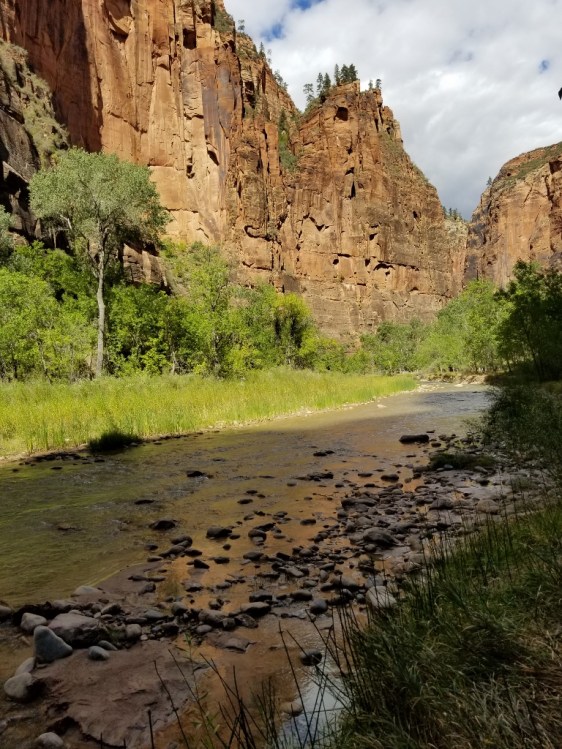
Virgin River continues to shape Zion Canyon in Zion National Park.

There is much we don’t see. The news fixates on big tragedies. The commentators argue their points. The politicos fluff their feathers and brandish their big sticks. Watching, we develop a picture of humanity warped by our brain’s negativity bias and strengthened by the media’s wish to hook us hard.

We don’t see the kitchen table conversations, the neighbors organizing, the hands touching earth that might tell a different story.

It is a function of my extraordinary and undeserved privilege that I am able to go on vacation at all, let alone visit national parks and be at peace in nature. When I think of the inequity that my life is predicated on, it makes me squirm. I don’t think I’m complacent or lazy, yet I have the choice to turn it off, turn away, where others don’t. What does this say about me and my life, my work?

Specifically: Is it OK to pursue creative projects that seem to take eons, at least for me (as we speak I’ve just gotten my manuscript back from my editor and am preparing to dive in again) while social activism goes wanting?

Stephanie Smart’s Dragon Mystic stone reading recently gave me a clue to how to think about this. She uses stones as allies and sources of wisdom. For my mini-reading, I chose a blue purple jasper stone. Her interpretation, in part:

You are like the water in the river bed. You are powerful enough to change the shape of a stone. Yet, you do it in your subtle calm nature. Just as the water slowly flows along in the stream bed…

Trust your calm powerful nature. You are just as much of a change maker as the person on the stage. Yes, YOU ARE A POWERFUL CHANGE MAKER. You, who can change the shape of a stone. You may not ever see the effect of your words or actions, but trust that you are changing the world.

20170926_115559 (768x1024)

Water in the streambed of Taylor Creek, Kolob Canyon.

Here’s what I know for sure: I want to shine a light as bright as possible. Because where does the balance tip? If I feed anger and violence even in my own soul, by ripping into this one small being, I fuel the violence in the world.

In the desert I took photos of lichen, that curious symbiotic amalgam of fungi and algae. Lichen is small and unobtrusive, yet it has the power to turn stone into soil, over time. Here is a collaboration among species, quietly altering The Way Things Are.

20170926_121521 (768x1024)

Lichen, Kolob Canyon

*The title is borrowed from an old song by Meg Christian and Holly Near.