Homegrown “Superfruit”

I saw this item for sale at my food co-op, Pogue’s Run Grocer, and it cracked me up.

Turkish Superfruit! Check it!

White mulberries, a “Turkish Superfruit,” only $5.99 for 4 ounces. What. A. Steal!

Just a week ago I spent a pleasant morning bicycling around the neighborhood with a friend. We stopped to pick from the mulberry trees that grow wild along the creek, meanwhile catching up on each others’ lives.

Mulberries are great in smoothies and crisps, and they are abundant, free, and nutritious (apparently a Superfruit, no less!). My friend and I were delighted with our harvest. Along with the usual purple, we found a white mulberry tree. It might be my imagination, but I always think the white berries are particularly sweet (though a bit less appetizing in appearance).

Superfruit from the hood. Free of charge. Bring your own bucket.

Superfruit from the hood. Free of charge. Bring your own bucket.

I once blogged about how homesteading (even on my modest scale) can make me feel like a chump because of all the extra work it takes to live “simply.” And how other times, I feel the tiniest bit smug, because—look! So much wealth on so little money.

Yeah, this is one of those smug times.

Peaceful Grounds

Monday morning a group of gardeners from the neighborhood had a private tour of Peaceful Grounds, Linda Proffitt’s endeavor at Marion County Fairgrounds, where the county fair is going on. (See my earlier post about her work here.) The vision and scope of this Global Peace Initiatives project astounded and inspired us.

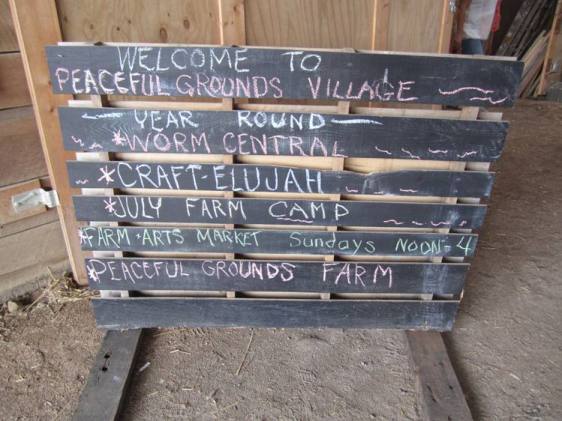
The cattle barn at the Marion County fairgrounds is home to this volunteer-driven initiative.

The cattle barn at the Marion County fairgrounds is home to this volunteer-driven initiative.

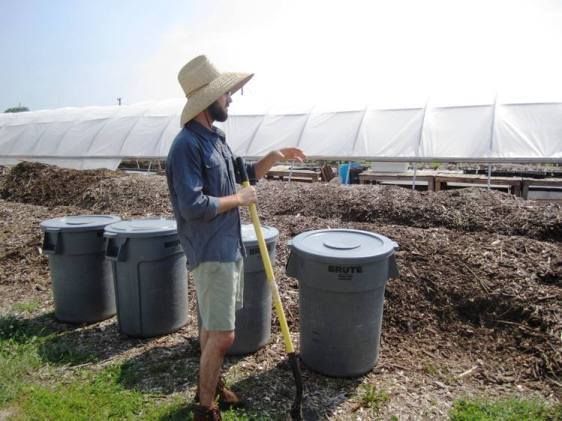
George Marshall, Linda’s intern, showed us around the farm, where mounds of wood chips are not just regular old wood chips but worm habitat.

George

George next to a hoop house that stayed warm all winter from heat given off by decomposition.

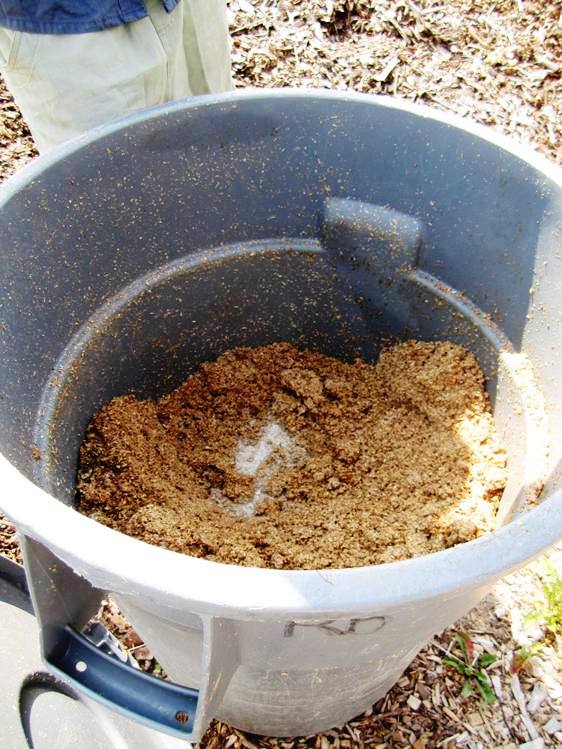
Peaceful Grounds takes beer mash from local brewers like Irvington’s own Black Acre and buries it in mulch to feed the herd of worms.

The spent grain is perfect worm food because barley fits easily into worms' tiny mouths.

The spent grain is perfect worm food because barley fits easily into worms’ tiny mouths.

Hand-painted signs that say “Worms at Work” and “Thank a Worm” testify to the importance of these little red wigglers.

IMG_3617

Digging up some of the underground workers to show us.

Volunteers mix 5 to 15 tons of mash with equal amounts of wood chips each week. Another mound incorporates dehydrated food waste from public hospital Eskenazi Health. Over time, these piles and rows are transformed into a viable medium for garden plants.

George showed us where vegetable and herb starts have been set right into these habitats.

broccoli

Broccoli planted in one of many windrows made by worms doing their work on wood chips and beer mash.

In a nifty closing of the loop, Linda has begun to raise hops to supply local brewers.

A few of Peaceful Grounds volunteer-planted crops.

A few more Peaceful Grounds volunteer-planted crops.

While we were walking down the raised beds (“windrows”) of basil and tomatoes, a fair official came up and asked for Linda. He wanted to introduce her to the people in charge of an elephant exhibit, so she could incorporate elephant dung in the farm operation. (“You never met a lady more excited about poop than Linda,” George joked.)

Inside the cattle barn is where kids and adults can come for hands-on fun with art and agriculture. It’s also where artists like Jamie Locke (another Irvington neighbor) demonstrate mandala making and other crafts—and where young volunteers from Handi-Capable Hands take charge of a gigantic tumbler that sifts the worm compost into two grades of product.

Heidi Unger took this photo of the tumbler, which is named Apollo and was donated by a local farmer who saw Linda on TV.

Heidi Unger took this photo of the tumbler, which is named Apollo and was donated by a local farmer who saw Linda on TV.

We went home with the finer grade, which is basically worm poo, to use as a powerful organic fertilizer. One tablespoon per plant will nourish it through a month, Linda says.

Worm castings make an excellent fertilizer. Now there's a local source!

Worm castings make an excellent fertilizer. Now we have a local source!

Before we left, we learned that Will Allen is going to visit the operation, which is a training outpost for his fabulous Growing Power organization. He will speak at 2pm Saturday and lead a workshop at 4pm, and will also preside over a ribbon cutting ceremony at noon on Sunday, when the Peaceful Grounds Farm and Arts Market kicks off.

IMG_3598I’d love to see more interaction between local urban gardeners and this facility, which is just a stone’s throw from Irvington’s back door. Right now the county fair is in full swing, but the possibilities extend beyond its closing date. Linda is running a Farm Camp for kids starting July 7, and is happy to host volunteers at any time.

By the way, she offered to set me up with an interview with Will Allen. I’m thrilled to meet this man I admire so much. I’m crowdsourcing interview questions. What would you ask the grandfather of urban gardening, if you could?

On the Solstice, Contemplating Home

On the longest day of the year, one week after leaving Playa, I’ve been thinking about all that “home” means to me. I loved Oregon’s pristine natural beauty. But I couldn’t wait to come home and walk the tree-lined streets of my neighborhood. Taking my dog Marley for a walk was high on my list on my first morning back.

It’s not perfect here. There’s litter, unlike in Lake County, OR, and sadly many of the neighborhood ash trees are not treated for emerald ash borer, so they are dying—a distressing sight. Poison ivy is rampant in untended corners. Plus it’s really damned humid. But I still walk along with my heart singing “home,” loving the big sycamores and tulip poplars, enjoying all those daylilies and clematis vines, sampling a mulberry here and there.

And getting the latest scoop. Down the street, my big softie neighbor still has the pit bull who wandered into his yard—the one he swore he wouldn’t keep. Farther on, the retiree who always complimented me on my dog (Lord, how that poodle can prance) tells me he and his wife are moving to a condo after 47 years here, but a young family up the street will be moving in. I learn about another neighbor’s dog’s bout with pneumonia. And so on.

Walking is one of the ways I savor my neighborhood, but it’s not the only way. About the second thing I did that day was ride my bike with Judy to the kickoff of the Irvington Folk Festival, a weeklong extravaganza that opened with an outdoor bluegrass concert. I’m no bluegrass aficionado, though I love a good Rocky Top as much as the next person. What I went for, and got, was the people.

In the crowd were Rosemary, and also Laura, two women who helped me found the Irvington Green Initiative years ago. Also our neighbor Pat, who told us of a possible grant for a native plant/foraging project we’ve been scheming.

We sat with Heidi and Mike, longtime gardening buddies who happened to bike up at the same time as we did, midconcert. Behind us were Jerome and his family. That was fortuitous, because I could update him on our sweetgum tree. (Arborist Jerome has a business called Tree-Centric, which I’ve blogged about before. A few weeks ago he assessed our ailing sweetgum, taking soil samples and cutting away girdling roots. The cost of his professional expertise? A loaf of homebaked bread.)

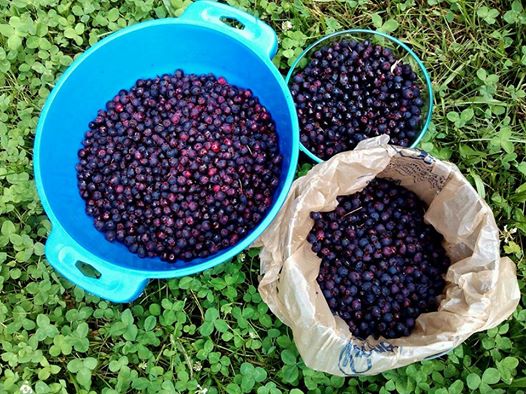
Jerome offered both his strawberry patch and serviceberry grove for picking. Though the strawberries were done, here's the lovely haul of serviceberries my friends and I made that morning.

Jerome offered both his strawberry patch and serviceberry grove for picking. Though the strawberries were done, here’s the lovely haul of serviceberries my friends and I made that morning.

Somehow, over the years, my roots have grown deep in this place. I grieve with friends who lost their 13-year-old German Shepherd, one of a gang of Marley met in the park as a pup. I pick mulberries and serviceberries (some from Jerome’s yard) while chatting with good friends. My yoga buddies welcome me back vociferously. I barter for Thai massage from a neighbor.

All that, plus (last night) hearing local musicians rock out, after eating at the new deli that sources everything it can locally.

How did I get so lucky? I don’t know, but I’ll contemplate the answer while biking to the park for the folk festival’s finale (and, bonus: alternative gift fair).

The Biggest Sky

I’m back from living under the biggest sky ever. Playa,* a retreat for artists, writers, and other creatives, granted me precious time in silence in the midst of a stunning landscape. I have to say, Oregon is my new favorite state (next to Indiana, of course).

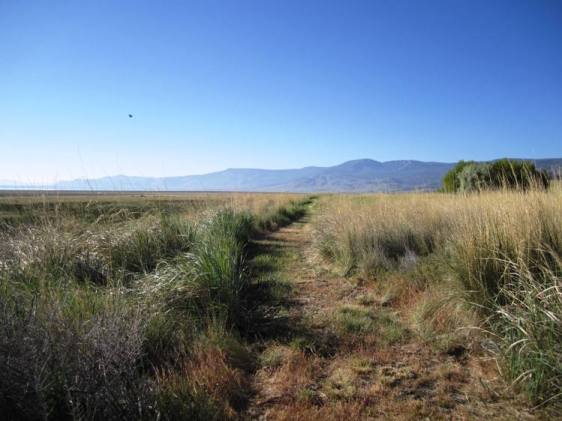
My first morning at Playa, I walked this mown path through the grass.

Morning walk in the high desert.

Morning walk in the high desert.

To my left was Summer Lake, the “playa” (defined as “a temporary lake, or its dry often salty bed, in a desert basin“). To my right, beyond the road, was a smallish mountain range known as Winter Ridge. The vistas pretty much gobsmacked this Midwestern girl.

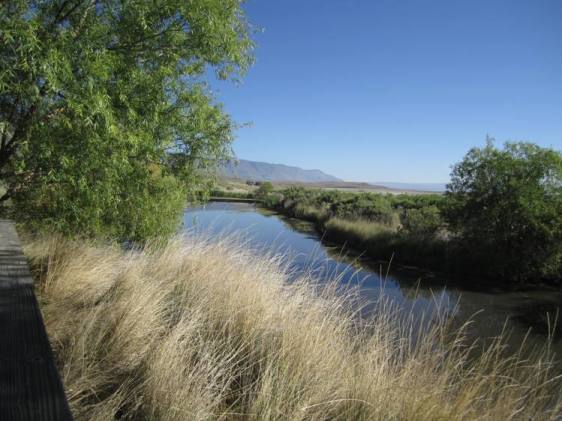
This was the view from my deck. I ate, read, wrote, and practiced yoga outside, shaded by two friendly trees.

My deck looked out over a pond. Who needs TV when you've got birds, dragonflies, jumping fish, and the occasional muskrat to watch?

Who needs TV or Internet when you’ve got birds, dragonflies, jumping fish, and the occasional muskrat to watch?

Pond life provided constant diversion, fodder, and entertainment. The jingles of my avian companions kept me humming all day. (I decided the redwing blackbird says, in French, Bon, vas-y! and in English, Look at meee, yeah!)

Every day I explored my interior and exterior worlds.

Walking on the mud flats.

Walking on the mud flats.

I was (and still am) overwhelmed with gratitude for such a gift.

An unexpected bonus  was connecting with so many incredible people, all in love with the natural world, all devoted to seeking, listening, experimenting, creating. In an upcoming post I will share a little bit about my co-residents, who inspired me almost as much as the wide-open space.

*Are you a writer, artist, naturalist, or researcher who would benefit from time away from routine demands? I would encourage you to apply for a residency at Playa. The program offers a combination of seclusion and conviviality in an absolutely gorgeous desert landscape. You won’t regret it, if you have the chance to go.

All I Cannot Save

Monarch sipping on liatris, by Gene Wilburn, via Flickr Commons.

Monarch sipping on liatris, by Gene Wilburn, via Flickr Commons.

My heart is moved by all I cannot save

So much has been destroyed

I have to cast my lot with those who, age after age,

Perversely, with no extraordinary

Power, reconstitute the world.

—Feminist poet Adrienne Rich

Resilient Communities and People: How Yoga Can Help

Guest post by Gaynell Collier-Magar

Hi everyone! I am so honored to be a guest blogger on Shawndra’s amazing website. Shawndra is one of my Irvington Wellness Center yoga students. She has a beautiful, thoughtful practice, both on and off of the mat. She personifies how yoga can help with resiliency in life.

Yoga is a 5000-year-old tradition of practices (the Eight Limbs) to reduce suffering and still the mind. It is not a religion. However, the practices have been incorporated by many religions: Buddhism, Hinduism, and contemplative Christianity to name a few.

The physical practice or “asana” (“seat”) is meant to create resiliency in the body and mind to enable sitting in meditation for long periods of time. Unfortunately, in the West, the physical practice is often perceived as the path to buns of steel, pretzel poses, and very thin 20-something bodies.

The first lines of the Yoga Sutras state: “Now, the teachings of yoga. Yoga is to still the patternings of consciousness”. The Sutras explain how our habitual ways of thinking create suffering and how we can remedy this.

When we are reimagining a future for our communities, yoga could be a useful tool.

Photo by Jenny Spadafora

Photo by Jenny Spadafora, via Flickr Commons

So how does this happen? In the physical practice, it begins with being in the present moment—in the body and the breath. To get a feel for what I mean, try this:

Notice how you are sitting now. Are you slumping? Good…notice how you feel heavy in your body. Now, sit up straight, feel your bottom sitting in your chair, feel your feet on the floor, and lift your chest. Do you feel any lighter in your body? Slump again and notice. Sit up again and notice. Now close your eyes, put your hands on the tops of your thighs and take three deep, slow breaths. Focus on the exhale.

What was your mind doing? Chances are it wasn’t making a to-do list, obsessing about the person at work who drives you crazy, or yearning after a piece of chocolate. You begin to get a glimpse of the mind becoming more still—an experience that increases in depth and length with further practice.

The practice is to notice what is happening in the present moment, practice non-reaction, and return to the present moment. Neuroscience is showing that these practices literally re-wire the brain.

Two of the liabilities of community work are burnout and lack of fresh ideas. Our ego-driven “monkey mind” robs us of tremendous energy and creativity. As we engage in practices that still the mind, we create a mindspace in which to think outside the box—and the energy to act accordingly.

Photo by TZA, via Flickr Commons

Photo by TZA, via Flickr Commons

We also create a mind that is equanimous and unattached, yet deeply caring. We create a mind that is focused and in the present moment. We create a mind that is resilient.

It is not a leap of consciousness nor faith to realize how resilient minds can create resilient communities. The Buddha said, “All that we are is a result of what we have thought. The mind is everything. What we think we become.”

Gaynell has been a yoga practitioner for over 14 years. She was certified as a Vinyasa yoga instructor in 2009 by Rolf Gates and is a registered yoga teacher with Yoga Alliance. She is certified to teach adaptive yoga to people with physical disabilities, having studied with Matthew Sanford of Mind Body Solutions. She has taught Vinyasa, adaptive, and 12-step recovery yoga classes in Indianapolis and Cozumel, Mexico in Spanish and English. She holds a Bachelor’s Degree in Social Work and owns her own landscaping business, Growing Connection.

Join Gaynell and other terrific instructors at Shine Out Yoga Celebration, July 11-12 in Indianapolis, benefiting Mighty Lotus.
Evidence of the Shift

Final in a series

I’ve often written here about feeling overwhelmed, feeling helpless, feeling despairing. At times it seemed the news was all bad.

The Maldives, one of the island nations imperiled by rising seas. Photo by Nevit Dilman, via Wikimedia Commons.

The Maldives, one of the island nations imperiled by rising seas. Photo by Nevit Dilman, via Wikimedia Commons.

At times I feel besieged by evidence that we as a species are beyond hope. Sometimes all I hear is the lowest common denominator outshouting all reason. Sometimes all I see is fear feeding on fear, a downward spiral with no bottom.

Then along comes a hopeful story of human connection, small but significant.

Bethann was at the zoo with her daughter when she heard a man say, “You heard the one about the two Mexicans?” As it happens, Bethann has adopted two children who are not Caucasian. The man had his own young son with him. Bethann stepped up, with nervous heart, determined to make a difference.

Here’s the story in her own words:

“While at the zoo with Bo this morning, a guy with a toddler (loudly) told a joke that started with ‘How many Mexicans does it take…’ I found a moment when he was separated from his group and pointed to Bo and said ‘See that kid? She’s mine and she’s incredible. I can see you love your kid a lot. But, every time you tell one of those jokes, you teach your kid that it’s OK to treat my kid like crap. And, I am sure you don’t mean to teach your child to hurt others, but that is exactly what you just did there.’ He actually quietly said ‘I understand.’ God willing, there will be one more person on this earth who thinks before he teaches his kid to hate.”

Photo by Debbie L., via Flickr Commons

Photo by Debbie L., via Flickr Commons

How stunning that this man, instead of lashing out or being defensive, very quietly said, “I understand.”

To me this is evidence of the shift that Julia Bystrova of Transition US described, the widespread awakening that is already happening. I see it in the way Bethann stood in her center and spoke quietly but strongly to hold this man accountable. I see it in the way she allowed him room to hear her. I see it in his respectful and surprising response.

What evidence have you encountered of this kind of transformation? I’d love to hear your stories.

Confronting the Shadow

Second in a series

Consciousness shift is one thing, but what do we do about systemic ills?

I asked Julia Bystrova of Transition US about the governmental corruption holding us back from systemic policy-level changes—the big changes we are going to need, if we have a prayer of surviving the linked crises facing us. She had an interesting answer.

She pointed out that a healthy consciousness shift is already manifesting on the local level—witness sensible policy changes in cities all over the country. In LA, for example, a group called Tree People convinced their city that urban forestry is key to watershed management.

Photo by Lida, via Flickr Commons.

Photo by Lida, via Flickr Commons.

More than 1000 mayors have endorsed the US Conference of Mayors Climate Protection Agreement, vowing to reduce carbon emissions in their cities below 1990 levels, in line with the Kyoto Protocol.

And my own city, right smack in the middle of the stolid Midwest, shows some movement. This year we are gaining both a bike share and an electric car share program.

But beyond the local level where we can see real change happening, the picture looks bleak. As Julia put it, much of our larger governmental machine was “hijacked by corporate pirates.” These titans are not interested in seeing communities flourish on a local scale—not when there are profits to be had.

Greed and control are their modus operandi. Their greed is so extreme that they are willingly sacrificing people’s lives. And they’re deliberately sacrificing the life of the planet.

“That’s what we’re up against,” Julia told me. “We’re up against this darkness. It’s very classic, very mythological…It’s like this classic tale (that) I believe we are living out.”

But spiritually awake people can shine a light on the collective shadow. That’s what these madmen, as Julia calls them, represent: our collective shadow. It’s up to us to gain the maturity to stand our ground, in love and compassion, in the presence of this darkness.

In psychological work, the shadow is the unacknowledged, hated part of ourselves that rules our behavior—unless we turn toward it with love.

It’s time to look at such perpetrators in the face, with full awareness, unafraid.

Rebirth, by Jason Samfield, via Flickr Commons.

Rebirth, by Jason Samfield, via Flickr Commons.

Julia believes that more and more of us are reaching this level of awakening. If we confront them from a high level of integrity, institutions entrenched in corrupt power will crumble.

Again, a powerful vision to hold.

Next: Evidence of the shift.