Restoring the Land

IMG_20140110_101420

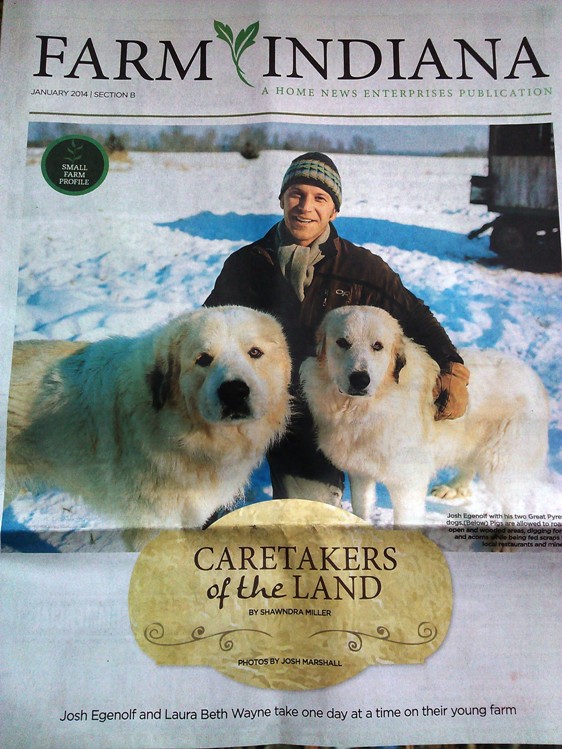
Cover page of my Farm Indiana profile of WE Farm

Dr. Lisa Harris remembers well the first conversation with the young man who would come to farm her land—they talked for hours, almost an entire day. “I was so impressed with how deliberate and thoughtful he was,” she told me.

Dr. Harris is Eskenazi Health’s medical director, a vegetarian with a lifelong interest in eating healthy food. As I learned when I wrote about WE Farm for Farm Indiana, she leases her Owen County property to Josh Egenolf and Laura Beth Wayne’s pastured beef cattle, poultry, and pork operation.

“Most people in the United States do eat meat,” she said. “So if I can be part of something that gives people access to meat from animals that have lived well, it seems like a perfect opportunity.”

Like many of us, Dr. Harris tries to live as lightly as possible, and Josh’s plans to make her land productive really spoke to that goal. “What Josh is doing,” she said, “is in every sense helping to improve the land.” WE Farm’s integrated, rotational grazing plan means the animals work in concert with nature to restore pastureland—all the while sequestering carbon and nitrogen in the soil.

The day I visited the farm last November in preparation for my Farm Indiana story, four happy dogs ran in front of the pickup truck as we drove up the lane to tend the livestock. Owen County is picturesque, with wooded hills and deep valleys. Josh showed me the steep woodlot where the hogs are periodically turned loose to forage for acorns and pawpaws. They also help him clear out understory invasives, just by doing what pigs do.

Breeder pigs enjoying their mineral rations on a frosty November morning.

Breeder pigs enjoying their mineral rations on a frosty November morning.

Josh was raised on a farm just a few miles up the road, and he treasures the richness of his a rural childhood. Giving that experience to his own child (and another on the way) is a big reason why he moved back to the area after pursuing his doctorate in ecology at the University of Georgia.

Also, he wanted to be put what he’d learned there into practice. Agriculture, he told me, has enormous potential for creating meaningful environmental change.

He said, “In 2007 I read The Omnivore’s Dilemma. Before that it never occurred to me that there might be anything troublesome about the way meat was produced, other than animal welfare stuff. That’s very clear to me…you shouldn’t treat your animals poorly. They need to be respected. But it didn’t occur to me that there was a single thing wrong with them eating grain and (even) industrial byproducts.”

He knows that many people still don’t realize the environmental and health issues that accompany feeding grain to meat animals, but a growing customer base tells him how many people value pastured meat. “It’s like an awakening that needs to happen.”

Josh and Laura Beth strive to keep the business as local as possible, keeping close to home in all their dealings. For more on their endeavors, check out my Farm Indiana story and the WE Farm website.

Communal

When the sun comes up on these clear mornings, the sky behind the snowcovered trees tints palest tangerine. There’s a beautiful stillness in a frozen world.

Daybreak in the Arctic Vortex

Daybreak in the Arctic Vortex

Something about going through an extreme weather event is lovely in its communal nature. For the second day we are snowed in. We can’t drive out of our alley, and any outings on foot are necessarily short because of extreme wind chills.

So we’ve been keeping tabs on the goings-on in our little burg via a Facebook neighbors’ group.

The dangerous cold and deep snow have given us a glimpse of just how neighborly people are in our quirky neighborhood. I have seen many a plea for help go answered, and many an unsolicited offer appear. Just now someone offered to pick up items on her way home from work if anyone is in dire need. Earlier there was a shout-out to “the awesome guy driving a Caterpillar bobcat and helping people dig out their cars from the aftermath of the plows.”

Someone even asked for—and got—advice on how to get her dog to do his business in this brutal weather. I didn’t read the entire thread, but apparently it was a hoot, discussing canine toileting habits in great detail.

People are offering safe havens, rides to emergency rooms and shelters, and space heaters for those whose furnaces are on the blink. They’re doing for each other in large and small ways—taking baked goods over, walking each other through the crises of burst pipes and power outages, helping everyone feel less alone.

I’m sure this behavior is replicated in many places, much of it never posted anywhere. I didn’t post that the fellow on the corner shoveled not just his walk but the neighbor’s between us, and the guy on the alley behind us helped clear our driveway, but they did, and I thank them.

Dangerous and beautiful

Dangerous and beautiful

Even though I’m tired of being clenched up from cold, tired of the worry over potentially losing power or the furnace konking out (again), part of me relishes these days, both for the astonishing view out my window and for the weird conviviality online.

Part of me wants to put off snowmelt, with its godawful mud and piles of blackened leftover snow. Part of me never wants this communal experience to end.

To Live Passionately

A writer friend and I were talking this morning about our goals for the new year. She said she had but one resolution for 2014: “Forget fear.” Except she used another, shall we say, more pithy F-word for her intention around fear.

Later, scanning through my notebook from the past few months, I came across this passage from Nov. 7, which followed a week of extreme doldrums:

Tired of being unconscious, but scared to wake up! Yet that fear seems foolish in light of the many ways we could bite the dust—globally/regionally/personally, calamitously/suddenly/slowly—oh so many options for becoming vapor, energy, disembodied once more. [I was thinking of the Oct. 25 earthquake off Japan’s coast near Fukushima, among other things.]

FukushimaIsHere-Sticker_1So keeping that in mind, how do I live? I want to live passionately.

Did you hear about the child for whom Make-a-Wish is transforming San Francisco into Gotham City, so he can be Batkid?

Photo by Bhautik Joshi, via flickr Commons

Photo by Bhautik Joshi, via flickr Commons

You see where I’m going with this. In our dying we become superheroes.

Thinking of the Buddhist injunction to remember the unalterable fact of our own death, I ended up musing: What do we have to lose?—the exact phrase my friend used this morning.

It seems ridiculous to dither about in fear and worry when we could be gone at any moment. And meanwhile all of life is calling us to be a force for good.

So how about it? Shall we create a passionate, conscious, fearless, superheroic 2014?

Reflection

Though we gathered with a few friends the night of the Solstice to welcome the return of the light, the days don’t seem measurably longer yet, and the clouds are hanging low this  afternoon.

As the Irish blogger Bridget put it in her post on the longest night, “We need this period of darkness to recoup our energies…spend time with friends and family…to just be. Soon enough we will feel the need to get our hands in the soil and once again plant the seeds and tend the crops.”

This time of year is tailor-made for reflection and dreaming. The deep darkness, the cold and drear outside, the ending of one cycle and the beginning of another. In the midst of holiday bustle, all I’ve wanted to do is pull a blanket up around my chin and stare out the window with a pen in my hand. Or a book. Or just a cup of tea.

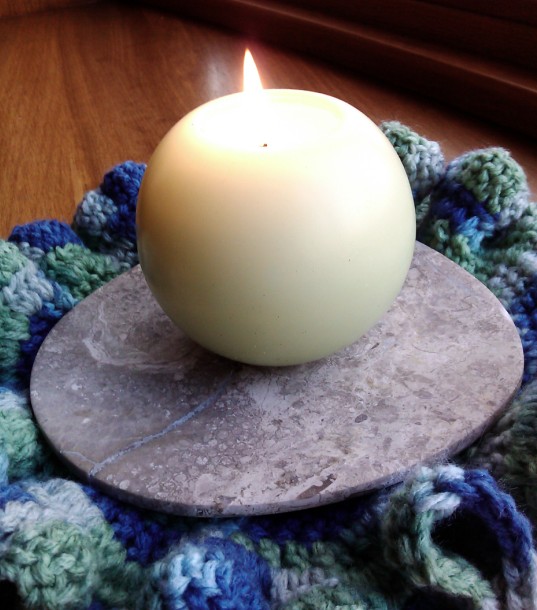
candleOver and over, I find my awareness turning to the heaviness of the physical body and the fact that it really isn’t solid. Neurofeedback researcher Les Fehmi taught me that we are actually just clouds of particles floating in and permeated by a vast space.

And my pen idles. Sometimes more words are not what is needed.

We Are the Same

Not long ago I had conversations with two different poet friends, both about the connective power of the written word.

Shari Wagner said she sees her poems as vehicles for connecting human to nature, living to dead, young to old. Here’s a lovely example of this, her poem about young Orville and Will Wright, and their dream of flight.

Later that same day, Shannon Siegel spoke of writing as a way of “feeling with” someone, as in a Buddhist meditation. She had read a book called The Golden Theme by Brian McDonald. McDonald asserts that the writer’s essential task is to show our commonalities.
By Mike DelGaudio, via Wikimedia Commons

By Mike DelGaudio, via Wikimedia Commons

Shannon sent me this passage from the book:

“Stories are the collective wisdom of everyone who has ever lived. Your job as a storyteller is not simply to entertain…Your job is to let people know that everyone shares their feelings—and that these feelings bind us. Your job is a healing art, and like all healers, you have a responsibility.

Let people know that they are not alone. You must make people understand that we are all the same.”

In a time when our focus is constantly nudged toward what divides us, it is a tonic to understand that yes, everyone on earth has experienced every single emotion that has ever swept through us.

By Kahuroa at en.wikipedia [Public domain], from Wikimedia Commons

By Kahuroa at en.wikipedia [Public domain], from Wikimedia Commons

Here’s Shannon’s poem, stretched out to you. Do you feel it?
oceans within

Sounds of water…sounds of water…sounds of water…
The Long Way, Moitessier

Memories lock selves
in place, deep within
the cells, those
inner chambers.
Recall rises up
like magic, aroused,
liberated in an instant,
a rush, an echo,
a ripple through time,
a feeling, just a feeling,
something I felt once,
something I felt before,
I feel again, I now feel again.
A swell crashes the shore,
then recedes. Waves
ebb, then flow, an ocean
of promise and possibility
rushing through my veins, life
unfolds with a touch,
a whisper perhaps, a word
spoken, a gaze, a persistent
recurrence of what was,
is now is, again, somehow.
Deflecting logic, defying reason,
this heart sings a joyous
song, thrums love’s lyric,
hums a tender entreaty:
Come with me. This
way. Look for me.
Find me.

—Shannon Siegel, (c) 2013

Let Us Discover Our Wealth

Photo by robleto, via flickr Commons

Photo by robleto, via flickr Commons

The opposite of poverty isn’t property. The opposite of both poverty and property is community. For in community we become rich: rich in friends, in neighbours, in colleagues, in comrades, in brothers and sisters.

Together, as a community, we can help ourselves in most of our difficulties. For after all, there are enough people and enough ideas, capabilities and energies to be had. They are only lying fallow, or are stunted and suppressed.

So let us discover our wealth; let us discover our solidarity; let us build up communities; let us take our lives into our own hands, and at long last out of the hands of the people who want to dominate and exploit.

—Theologian Juergen Moltmann

We Can’t Afford Coal

This week I attended a meeting to learn more about Indianapolis Power and Light’s Harding Street plant, the largest industrial polluter in the city. IPL has no plans to retire this 55-year-old coal plant, even though the EPA says it’s responsible for 88 percent of industrial toxic releases in Marion County. The plant’s smokestacks annually release 130 pounds of mercury into the air.

That has a devastating public health impact. One attendee spoke of being an asthma sufferer. “I know what it’s like to struggle to breathe and have to go to the ER…It breaks my heart to think that our power is the reason children have to go through that.”

Photo by Karl Anderson, via flickr Commons.

Photo by Karl Anderson, via flickr Commons.

As I found while researching an Indiana Living Green story about the Beyond Coal movement, poor children are disproportionately affected by coal because of where they live—resulting in learning disabilities, asthma, autism, and lowered IQs. They’re effectively trapped into a cycle of poverty, suffering lifelong difficulties linked to our state’s over-reliance on coal.

Two city maps made the plant’s impact visible. One showed asthma-related ER visits in Marion County, and the other depicted mercury levels in waterways and soil. In both cases it was clear how the neighborhoods northeast of the plant (including my own) are burdened as the prevailing winds blow the pollution our way.

I myself can trace some of my health struggles to these toxins. I moved to this neighborhood in 1996 from northern Indiana. I noticed that I got sick more often, and for longer periods, than I used to. By 2000 I was dealing with chronic illness. The origins were complex, but tests for heavy metal toxicity showed elevated levels of mercury in my body.

“If you love your lungs, get out of Indianapolis,” says a real estate blog, fingering my beloved city as the unhealthiest in the nation because of its poor air quality.

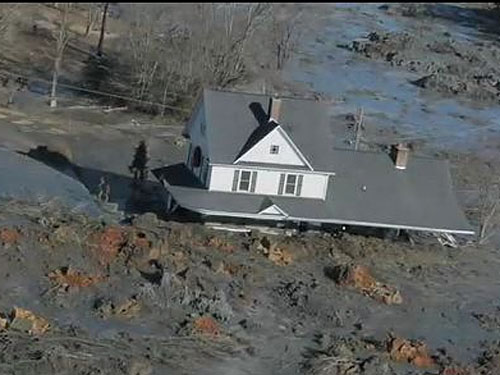
And then there’s the coal ash ponds. A nationwide 2011 EPA study identified 11 high-hazard coal ash ponds. Two of them are at the Harding Street plant. These unlined, aging pits are right next to the White River. I don’t even want to think about what would happen in the event of a major flood. Or if an ash dike ruptures, as happened in Kingston, TN, in 2008.

Knoxville News Pic

A house sits in the coal ash spill near Kingston, TN in Dec. 2008. Photo by Knoxville News Sentinel.

Apparently IPL doesn’t want to think about it either, even after two coal ash spills at its Martinsville plants sent more than 30 million gallons of toxic coal ash into the White River in 2007 and 2008.

Does it have to be this way? No, it doesn’t. Whether you look at it from a public health perspective, a fossil fuel emission perspective, or even through a financial lens, coal is a bad bet. Rate hikes to retrofit the aging plant are a poor use of our money. For inspiration, we can look to neighboring states. Iowa gets 24 percent of its power from wind—with rates similar to ours and no reliability issues.

The Indiana Beyond Coal campaign is all about making our voice heard. If enough people speak with their city councilmen and -women, write letters to the editor, and engage with IPL’s 20-year energy plan, things can change.

As organizer Megan Anderson said, “It’s as simple as getting together and talking to friends and neighbors.”

In Memorium

This week we mourn the passing of a man capable of forgiving the unforgivable and uniting a nation. Nelson Mandela began writing his autobiography in 1974 while imprisoned at Robben Island. Here are some lines from the final pages of Long Walk to Freedom, with scenes from that infamous place.

Robben Island, Cape Town, South Africa. Photo taken by Judy Hostetler during a People to People International trip to South Africa.

Robben Island, Cape Town, South Africa. Photos by Judy Hostetler during a People to People International trip to South Africa.

It was during those long and lonely years that my hunger for the freedom of my own people became a hunger for the freedom of all people, white and black…A man who takes away another man’s freedom is a prisoner of hatred, he is locked behind the bars of prejudice and narrow-mindedness…The oppressed and the oppressor alike are robbed of their humanity.

Nelson Mandela's cell. When he stretched out on the floor he could touch both walls.

Nelson Mandela’s cell. When he stretched out on the floor he could touch both walls.

When I walked out of prison, that was my mission, to liberate the oppressed and the oppressor both. Some say this has now been achieved. But I know that that is not the case. The truth is that we are not yet free, we have merely achieved the freedom to be free, the right not to be oppressed. We have not taken the final step of our journey, but the first step on a longer and even more difficult road.

Looking back across the bay toward Cape Town.

Looking back across the bay toward Cape Town.

For to be free is not merely to cast off one’s chains, but to live in a way that respects and enhances the freedom of others…

Shore of Robben Island

Shore of Robben Island

I have walked that long road to freedom…I have taken a moment here to rest, to steal a view of the glorious vista that surrounds me, to look back on the distance I have come. But I can rest only for a moment, for with freedom come responsibilities, and I dare not linger, for my long walk is not yet ended.

—Nelson Mandela, in Long Walk to Freedom, 1994

And now he is at rest, with the world’s gratitude. Shine on, Mandela.

Eve Ensler on Reconnecting, Re-conjuring and Re-conceiving

A friend recommended Krista Tippett’s recent On Being interview with playwright/performer/social activist Eve Ensler. Last week while preparing food for our Thanksgiving meal, I listened to the unedited podcast. (The interview is full of insights, but I’ve pulled out a few highlights for you here.)

Photo of Eve Ensler by Justin Hoch, via Wikimedia Commons

Photo of Eve Ensler by Justin Hoch, via Wikimedia Commons

Ensler is the genius behind the iconoclastic play “The Vagina Monologues.” Her focus on female physicality and power has led her to some phenomenal projects. For example, in the Congo she helped create a refuge for women and girls surviving gender violence. It’s called City of Joy.

Congolese_woman

Congolese rape survivor. By L. Werchick, via Wikimedia Commons

She’s a much-needed voice for a heart-centered, embodied ethic. I love what she says about the power of reconnecting with our physical selves and each other:

“The more people get plugged back into their bodies, each other, the more impossible it will for us to be dominated and occupied.”

She speaks of being both playful and careful as we begin to reconnect. Most of us are not used to this level of caring for our fellow humans.

“In the same way that we don’t see trees, we don’t see each other. We don’t see how traumatized people are, tender people are. I think sometimes if one were fully awake, one would do nothing in one’s day except stop on the road, on the people you meet, because you would see their pain…We walk past everyone. Sometimes it just crushes my heart.”

When Tippett responds that we don’t stop because we can’t bear letting in that much pain, Ensler notes that others’ pain is part of us already. We can’t avoid it, because we are all one. “So that when you stop to actually acknowledge it, you’re actually allowing it to move as opposed to be frozen in you.”

This reminded me of my energy healer friend Merry Henn-Lecordier, who showed me how to welcome uncomfortable feelings in order to allow their release.

Merry Henn-Lecordier is a trailblazer in the field of energy medicine.

Merry Henn-Lecordier is a trailblazer in the field of energy medicine.

Merry taught me the importance of regularly clearing stuck emotion by speaking directly to it, in love and compassion. For example, I might say something like: Anger, I see you. I feel you. I love you. I understand. I welcome you, anger. I approve of you, and I approve of the circumstances that caused you to be stuck in my energy field. You are welcome here. And I’m ready to move you now. (I modeled this blessing after phrases Merry herself uses.)

Then, again following Merry’s example, I ask for help moving the anger (or overwhelm or despair or anxiety or what-have-you) from my energy field, releasing it and transmuting it into love.

It’s remarkably transformative to do this simple ritual, intending compassion for all my emotional states. The lightness I feel in its wake gives me hope that Ensler could be right when she calls us “people of the second wind.”

“This could be (humanity’s) second wind, but it requires a radical re-conjuring and re-conceiving of the story…And I absolutely believe it’s possible, but enough people have to believe it’s possible and be willing to kind of move with this wind that is trying to come in, trying to pass through us right now.

Ensler’s latest memoir, In the Body of the World, depicting her journey with cancer, is high on my reading list.