Andromeda Galaxy, by Cestomano, via flickr Commons
“What thrilled me the most was the fact that millions of meteors burn up every day as they enter our atmosphere.
As a result, Earth receives 10 tons of dust from outer space.
Not only do we take in the world with each breath, we are inhaling the universe.”
—Terry Tempest Williams, in When Women Were Birds
Category Archives: Books

A Loved World
I heard two interviews in the last few days with Elizabeth Kolbert, author of The Sixth Extinction: An Unnatural History. While listening to the Fresh Air interview I was making pizza. And I must have decided—or the part of my brain that can’t process too much scary information decided—that making pizza required all my faculties, because I kept zoning out.
But I did hear that 25 percent of all mammals on the earth are endangered, and 40 percent of amphibians.
![Photo of critically endangered Panamanian Golden Frog By Tim Vickers [Public domain], via Wikimedia Commons](http://commons.wikimedia.org/wiki/File%3AAtelopus_zeteki_(4).jpg)
Photo of critically endangered Panamanian Golden Frog By Tim Vickers [Public domain], via Wikimedia Commons
No asteroid is to blame this time. The driver for this extinction wave is humankind.
That’s a heavy load to bear, even if I knew it already. With our tailpipe emissions and our moving from continent to continent and our wildly inventive minds, we are rapidly bringing about the demise of millions of species.
The author makes the point that our impact on other species isn’t (always) intentionally malevolent. It’s the very nature of our speedy brains and dextrous hands. It’s the fact that, as Kolbert says, we don’t have to wait for evolution to create change. We just make a tool. Which makes life difficult for creatures that change at the pace of evolution.
What does this mean? I don’t know. It feels bleak. I like to take the long view, the esoteric/spiritual/energetic view that focuses on evolution of souls, a realm beyond the physical. Still, here on the physical plane, it’s a devastating trajectory.
Self-preservation requires that this knowledge fade in and out of my consciousness. I go about my days, doing what I do, worrying about small things. Then it’s like the moment my dad was diagnosed with inoperable, terminal cancer. Suddenly all that trivia fades in importance. I’m pierced by pain. A loved one, a loved world, is in jeopardy.

© Cinc212 | Dreamstime Stock Photos
I don’t know what to do or say in the face of such hideous information. Just the fact of the dwindling numbers of monarch butterflies alone makes me want to weep.
I find myself wanting to check email, check Facebook, call a friend, watch the Olympics. To do anything but stay with this knowledge.
I can say that all things happen for a reason and everything is unfolding exactly as it should and we are holding the light whether we know it or not and we were always meant to get to this point—but is all that just a bandaid for unendurable grief and fear?
___
I wrote the words above last night. Today, I feel different, grateful, open. I took time to sit in love and awareness this morning. It seems the metaphor of a terminal diagnosis fits better than I first realized.
In the face of horrifying news, sometimes there is an opening to the sacred. Suddenly you savor life more than ever. You don’t take anything for granted. You give what you can. You do what you must. Your love expands.
All of Us
Photo by Ginny, via Flickr commons
“The way we are, we are members of each other. All of us. Everything. The difference ain’t in who is a member and who is not, but in who knows it and who don’t.”
—Burley Coulter (a Wendell Berry character I need to get to know)

When Crisis Threatens
Thanks to a review in Permaculture Activist magazine, I found a little book called Small Stories, Big Changes: Agents of Change on the Frontlines of Sustainability. It’s a collection of inspiring voices from the community resilience movement. Each chapter is written by someone actively engaged in the world’s remaking.
Here’s a passage from the very first chapter that gives you a taste.

Goat milking, by V Becker, via flickr Commons
“(A) community of busy farmers, gardeners, goat-milkers, trail-builders, engineers, scientists, windmill climbers and solar installers…have led our society’s journey toward sustainability…
They are leaders because their excitement is stronger than their fear.
Logically, when crisis threatens we need to subdue our fear in order to take constructive action. But taking action also somehow diminishes our fear…Once we get busy we’re not as scared any more.
Perhaps we don’t control the forces changing our climate when we grow a few vegetables, but we do influence those forces, and I think the activity profoundly changes our perspective. The situation immediately seems more manageable when we begin to manage.”
—Bryan Welch, publisher of Mother Earth News
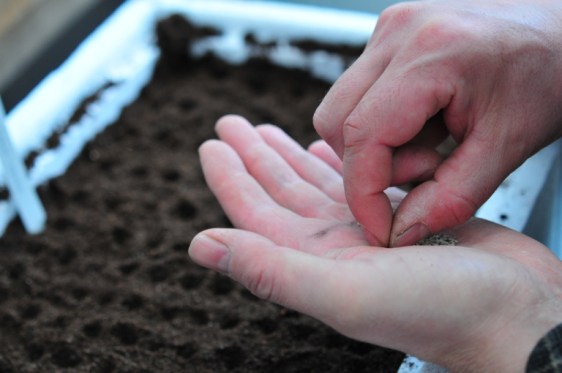
Photo by julochka, via flickr Commons
Have you found this to be true? I have, especially when I’ve gotten “the help of a few believers, supporters, and friends who light the way through the dark nights,” as David Orr describes elsewhere in the book. When I am at my lowest is usually when I’ve fallen away from hands-in-dirt activities for whatever reason, or when I’m feeling isolated. It’s easy to fall into this trap in winter especially.
But when I’m pulling together with neighbors to scheme a project or clean up my block or make a big batch of sauerkraut, I feel ready to face anything.
What about you? I’d love to hear about action you’ve taken—and how it impacts your anxiety level about the state of the world.
In Memorium
This week we mourn the passing of a man capable of forgiving the unforgivable and uniting a nation. Nelson Mandela began writing his autobiography in 1974 while imprisoned at Robben Island. Here are some lines from the final pages of Long Walk to Freedom, with scenes from that infamous place.

Robben Island, Cape Town, South Africa. Photos by Judy Hostetler during a People to People International trip to South Africa.
It was during those long and lonely years that my hunger for the freedom of my own people became a hunger for the freedom of all people, white and black…A man who takes away another man’s freedom is a prisoner of hatred, he is locked behind the bars of prejudice and narrow-mindedness…The oppressed and the oppressor alike are robbed of their humanity.

Nelson Mandela’s cell. When he stretched out on the floor he could touch both walls.
When I walked out of prison, that was my mission, to liberate the oppressed and the oppressor both. Some say this has now been achieved. But I know that that is not the case. The truth is that we are not yet free, we have merely achieved the freedom to be free, the right not to be oppressed. We have not taken the final step of our journey, but the first step on a longer and even more difficult road.

Looking back across the bay toward Cape Town.
For to be free is not merely to cast off one’s chains, but to live in a way that respects and enhances the freedom of others…

Shore of Robben Island
I have walked that long road to freedom…I have taken a moment here to rest, to steal a view of the glorious vista that surrounds me, to look back on the distance I have come. But I can rest only for a moment, for with freedom come responsibilities, and I dare not linger, for my long walk is not yet ended.
—Nelson Mandela, in Long Walk to Freedom, 1994
And now he is at rest, with the world’s gratitude. Shine on, Mandela.
Eve Ensler on Reconnecting, Re-conjuring and Re-conceiving
A friend recommended Krista Tippett’s recent On Being interview with playwright/performer/social activist Eve Ensler. Last week while preparing food for our Thanksgiving meal, I listened to the unedited podcast. (The interview is full of insights, but I’ve pulled out a few highlights for you here.)

Photo of Eve Ensler by Justin Hoch, via Wikimedia Commons
Ensler is the genius behind the iconoclastic play “The Vagina Monologues.” Her focus on female physicality and power has led her to some phenomenal projects. For example, in the Congo she helped create a refuge for women and girls surviving gender violence. It’s called City of Joy.

Congolese rape survivor. By L. Werchick, via Wikimedia Commons
She’s a much-needed voice for a heart-centered, embodied ethic. I love what she says about the power of reconnecting with our physical selves and each other:
“The more people get plugged back into their bodies, each other, the more impossible it will for us to be dominated and occupied.”
She speaks of being both playful and careful as we begin to reconnect. Most of us are not used to this level of caring for our fellow humans.
“In the same way that we don’t see trees, we don’t see each other. We don’t see how traumatized people are, tender people are. I think sometimes if one were fully awake, one would do nothing in one’s day except stop on the road, on the people you meet, because you would see their pain…We walk past everyone. Sometimes it just crushes my heart.”
When Tippett responds that we don’t stop because we can’t bear letting in that much pain, Ensler notes that others’ pain is part of us already. We can’t avoid it, because we are all one. “So that when you stop to actually acknowledge it, you’re actually allowing it to move as opposed to be frozen in you.”
This reminded me of my energy healer friend Merry Henn-Lecordier, who showed me how to welcome uncomfortable feelings in order to allow their release.
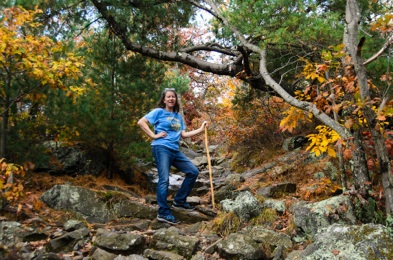
Merry Henn-Lecordier is a trailblazer in the field of energy medicine.
Merry taught me the importance of regularly clearing stuck emotion by speaking directly to it, in love and compassion. For example, I might say something like: Anger, I see you. I feel you. I love you. I understand. I welcome you, anger. I approve of you, and I approve of the circumstances that caused you to be stuck in my energy field. You are welcome here. And I’m ready to move you now. (I modeled this blessing after phrases Merry herself uses.)
Then, again following Merry’s example, I ask for help moving the anger (or overwhelm or despair or anxiety or what-have-you) from my energy field, releasing it and transmuting it into love.
It’s remarkably transformative to do this simple ritual, intending compassion for all my emotional states. The lightness I feel in its wake gives me hope that Ensler could be right when she calls us “people of the second wind.”
“This could be (humanity’s) second wind, but it requires a radical re-conjuring and re-conceiving of the story…And I absolutely believe it’s possible, but enough people have to believe it’s possible and be willing to kind of move with this wind that is trying to come in, trying to pass through us right now.
Ensler’s latest memoir, In the Body of the World, depicting her journey with cancer, is high on my reading list.
Crowd-funding the New Frontier: Radical Mycology
Here’s a chance to support a radical mycology project seeking to put a potent tool for restoration in many more hands. Mushrooms can break down and eliminate some of the most toxic industrial compounds in the world, representing enormous untapped potential for healing our beleaguered planet.
Not to mention the fact that mushrooms are a phenomenal source of protein, potentially boosting community-level food sovereignty.
Be part of this new frontier by funding this resource for would-be radical mycologists, and/or helping to spread the word!
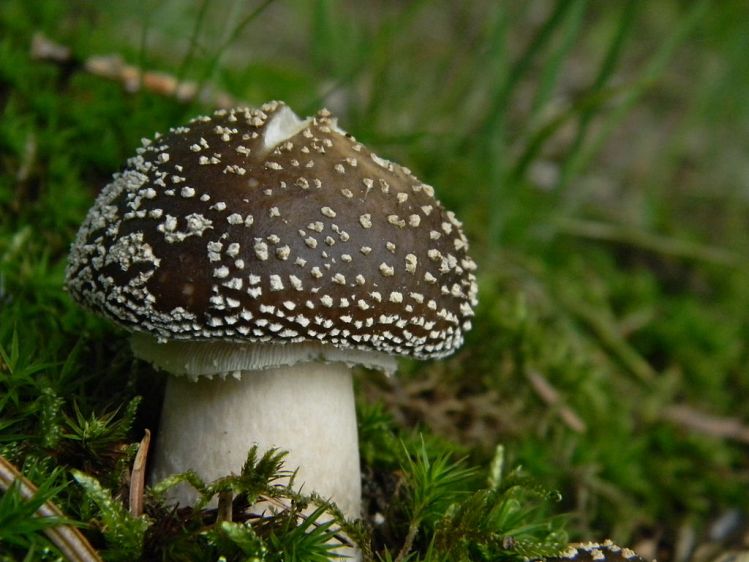
By Alaricmalabry (Own work), via Wikimedia Commons
Below is a note from Peter McCoy, who recently contributed a guest post about the lessons mushrooms have taught him:
The Radical Mycology Book fundraiser is underway! This unique book on the uses of mushrooms and other fungi for personal, societal, and ecological wellbeing will be a powerful resource for the geek and do-gooder inside us all and we are excited to bring this dream to the rest of the world.
You can view the live campaign here:
http://bit.ly/radmycogogoWhether or not you are in a position to donate, one of the most important contributions you can make would be getting more people aware of this fundraiser by emailing your friends and re-posting on your social (mycelial) networks.
Share the campaign on Facebook:
http://bit.ly/rmifbshareOr Tweet it!
http://bit.ly/rmiggtweetThank you so much for contributing to this project and vision!
Mush love!
Peter and The Radical Mycology Collective
To be Fueled by Love
Browsing the shelves of Point Reyes Books last month, I picked up Mary Pipher’s latest book. Her Reviving Ophelia illuminated the struggles of adolescent girls. Now she has a book called The Green Boat: Reviving Ourselves in our Capsized Culture, detailing her progression from despair to activism.
A Nebraskan, Pipher was on the front lines of early campaigns to stop the Keystone XL Pipeline from going through the Sandhills. (Three years later, the pipeline is still in limbo, and has become a symbol of the fossil fuel industry’s disastrous impact on the planet.)

Dismal River, Nebraska Sandhills. Photo by USFWS Mountain Prairie, via Wikimedia Commons
Even before opening it, I knew this book would return me to grounding.
I’d been talking with Richard Heinberg about his book The End of Growth, which describes a trajectory that I understand and yet can’t quite face head-on. Seeing it spelled out and hearing him expound on it left me feeling quite scared.
I know that many are pulling together for a better world. But our governmental policies favor the monied corporations running the show. I was starting to doubt that community action could effect change on that level.
Along comes Pipher, describing an activism that’s joyful and even fun. Example: grandmothers gave weekly “thank you in advance” pies to the Nebraska governor until he agreed to meet. This brand of protesting, fueled by love of the land and concern for tomorrow’s denizens, seems the perfect antidote to despair.
A chapter called All Hands on Deck begins with this quote from Frederick Buechner:
“God calls you to the place where your deep gladness and the world’s deep hunger meet.”
To be glad in the face of the world’s rending sometimes seems impossible. Yet I remember opening the church basement doors on the day of our SkillShare and seeing the space instantly fill with participants, their faces alight with curiosity. I think of the heart-cracking instant when a resonant phrase finds my fingers on the keyboard. I recall the joy of putting a garden trowel in the hands of a preschooler.
There’s an expansiveness when I reflect on these moments, a sense of the heart opening that lifts me from powerlessness.

Explaining vermiculture at the Irvington SkillShare. Photo by Jeff Echols.
Pipher acknowledges the “experts” who downplay the importance of individual actions. They say systemic economic and political changes are necessary to change this trajectory. True enough, but this reasoning is incomplete, says Pipher—for “who is it that is in charge of systemic change?”
She argues that individuals have always been the source of world-changing actions, and what else can one person do but start with herself? And join others in common cause, as did the abolitionists. It’s said that they had no hope of success, at the start.
My small self is quick to tell me what I’m not. I’m no naturalist, no doctor of philosophy, no career activist, no farmer, no wisewoman in a mountain hut. I am just myself. Sometimes I question: What do I have to offer?
I only own this experience, this deep heart of pain and care, grief and fear—and love.
What do I have to offer? All of it. I offer it up.
[More from Mary Pipher: Read her interview on how to wake up and take action on climate change (and stay sane).]
Jerry Needleman: Seeking the Questions
Third in a Series on my Mesa Refuge Cohorts
It is a rare privilege to have sustained contact with a deeply reflective person, someone capable of nurturing reflection in others. Today I am remembering this feeling of spaciousness as I hold a book called An Unknown World: Notes on the Meaning of the Earth, given to me by the author at Mesa Refuge. A philosopher and educator, Jacob Needleman (Jerry, he prefers to be called) enriched my time at the residency enormously.

Jacob (Jerry) Needleman
Jerry was there to work on his next book, and he’s written many. In fact, An Unknown World was penned during an earlier Mesa Refuge residency. I enjoyed getting to know the man behind the bibliography, finding him to be engagingly kind, curious, and funny.
As our senior resident, he occupied a place of honor at our dinner table. I think he enjoyed being the only man among four women who doted on him (and sometimes ribbed him as well).
Jerry’s brand of philosophy is practical, compassionate, accessible, incisive—and quite applicable to the times we are living. Instead of right answers, he seeks the right questions, a refreshing tactic.
In one of our many thought-provoking conversations, he invited us to live the question only we ourselves can answer, which is: “Who am I?” He said that when caught up in a destructive habit, it’s helpful to ask, “Who is the person doing that? Who am I?”
“This question is like a companion throughout your life; it becomes an energy,” he said.
I first opened An Unknown World in my writing shed, with water birds swimming the wind over the marshy expanse outside my window. Jerry had read aloud from this book the previous night—and what he read, his normally quiet voice turning sonorous, riveted me. That passage suggested that humans are channels for “higher influences” that need to be expressed on earth. That without our evolution, “Earth herself could not evolve toward her own greater possibility.”

Photo by Heikenwaelder Hugo, via Wikimedia Commons
And so I read more, hungrily:
“What we and our Mother Earth need, and what has been needed since Man first appeared, is the energy of awakened and awakening men and women…”
“We can hardly imagine what the Earth will offer us in return for its being seen and understood by the whole being of Man. Earth and Nature need this from us more than anything else. And only from this inner transformation of the mind can right action toward nature and the Earth be pursued without ultimately resulting in ‘the same old story’—that is, division, conflict, and violence.”
After I finished this illuminating book, I asked Jerry which of his works to read next, and he suggested Time and the Soul. I asked Bookmamas to order a copy for me. I’m looking forward to diving in. It’s about allowing time to “breathe” in our lives. (Jerry was right in divining that I need to learn this!)
I feel so blessed to have met Jerry. I probably wouldn’t have encountered his work if not for our time together at Mesa Refuge.
A Beautiful Indebtedness
I’ve been reading Rebecca Solnit’s latest resonant book The Faraway Nearby, and every day there’s a new discovery—about writing, about alienation, about the uses of stories. This morning’s passage evoked the web of interrelatedness and care that can happen among neighbors and friends.
In the author’s case, a cancer diagnosis showed her how much goodwill she had banked. People came from everywhere to help her.
She reflects:
“Before money…people didn’t barter, but gave and received as needs and goods ebbed and flowed. They thereby incurred the indebtedness that bound them together, and reciprocated slowly, incompletely, in the ongoing transaction that is a community.”
In some parts of the world, surely this beautiful indebtedness is still the norm. In my neighborhood, it’s making a steady return, in many small ways.
Some intertwined examples from this past week: I put a call out for dill on the Facebook Neighbors Garden page, offering other herbs in exchange. I’d planted dill, but the black swallowtail caterpillars ate every single sprig of it.

Black swallowtail caterpillars enthusiastically chewing through my dill supply earlier this summer
I wasn’t too sad about the loss, knowing the beauty that would come of it—until I saw the enticing baby cucumbers at the farmers market and ended up buying three pounds’ worth. I wanted to make a crock of pickles.
Happily, Amy of Fraudulent Farmgirl fame offered her unused dill. Over the weekend I biked over to harvest some, using most of it for pickling and borscht.
On that same bike trip, I stopped at Laura’s to unload some goodies on her hens. That morning I had cut back my severely cabbage worm-infested collards. I brought over the collard leaves, creepy crawlies and all, for the chickens‘ enjoyment. Laura sent me home with heirloom tomatoes and a photograph of the hens posing for a family portrait.
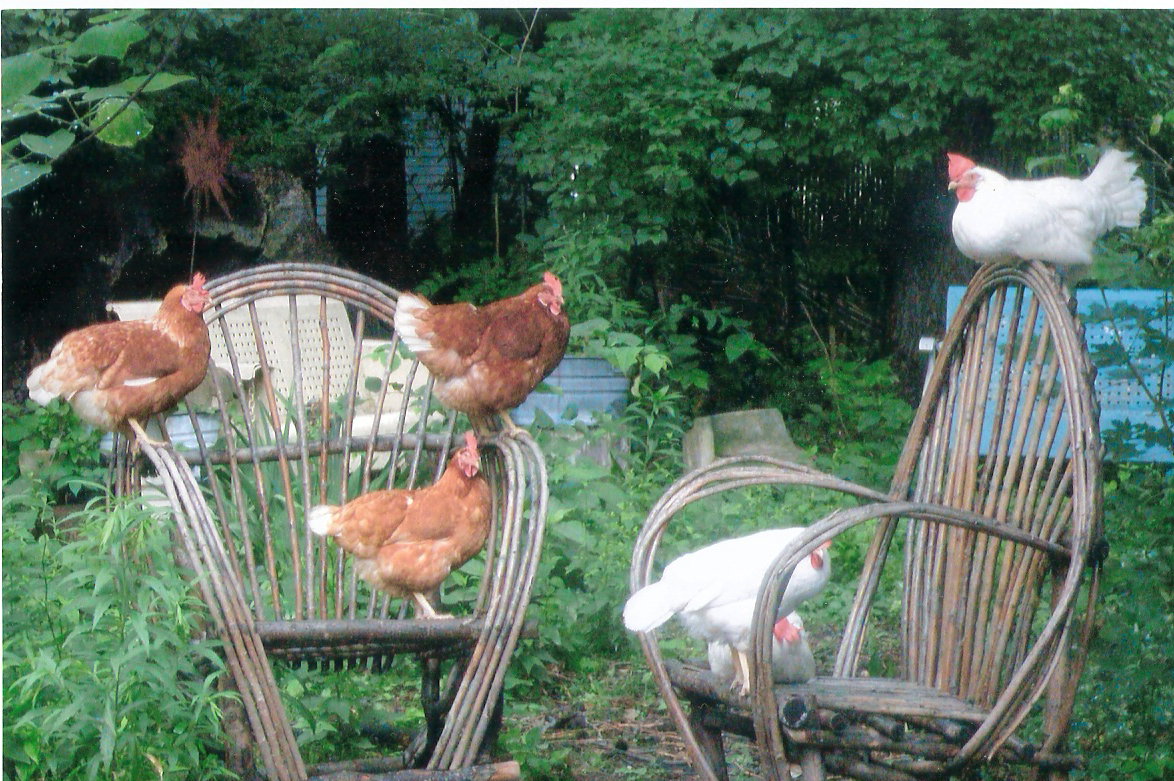
Laura’s contented flock
Today Dawn Facebooked her own plea for dill, and since I had some left, I took it down to her house on my morning dog walk. Dawn put three things into a blue cloth bag of mine that was at her house from some earlier exchange. I came home with:
- a salsa wrap made from her dehydrated tomatoes
- grape juice from another neighbor’s unused Concord grapes (Dawn and I had picked the grapes Monday while catching up on life)
- some maca powder, having mentioned in passing that I’d run out
I promptly put the maca in a green drink, the one I’m sipping right now. It also contains: frozen blueberries (brought back from Michigan by Anna), whey (received from Corinna down the street who makes her own Greek-style yogurt), lettuce (from farmers market), and kale (from my garden).
To add further depth to this web of connection: Laura was the source of my kale seedlings, a late-summer addition to my garden and currently the focal point of my daily worm-picking meditation. I no longer squish or stomp the worms while grimacing and/or squealing. I save them for Laura’s hens. The very hens that supply my eggs.
Writing this, I’m realizing my good fortune: my indebtedness extends even beyond my human neighbors.
What precious debts have you incurred in your community?
 Shawndra Miller