Book Offers a Vision of the Possible

I’ve had this book out from the library the past few weeks, but after test-driving it, I just emailed Kathleen at Bookmamas to ask her to order it for me. It’s a keeper. Here’s my review:

Wendy Tremayne’s The Good Life Lab: Radical Experiments in Hands-on Living gives a powerful example of a reimagined world in the shape of one couple’s desert homesteading adventures.

Prickly pear, an example of the desert bounty gathered by Tremayne. Photo by Jon Sullivan [Public domain], via Wikimedia Commons

Prickly pear, an example of the desert bounty gathered by Tremayne. Photo by Jon Sullivan [Public domain], via Wikimedia Commons

Many of us work toward self-sufficiency (or better, community-wide resilience, broadening the circle from homestead to neighborhood). But we’re hampered by the need to make money to prop up our lifestyles, cutting into the time we have to learn and practice new skills. Wendy and partner Mikey demonstrate what is possible by leaping into a completely new way of life. They cash out their retirement accounts (a prescient move, before the crash) and transplant themselves into Truth or Consequences, NM to build a new life.

And build they do: using waste materials and nature’s bounty, they craft a beautiful, abundant, interconnected home base that allows them to live their deepest values.

In contrast to some “green lifestyle” books that focus on giving up luxuries for the earth’s sake, this book offers an exuberant romp through the reclamation of life’s biggest gifts: time, beauty, creativity, connection, purpose. More than just a memoir, it is an invitation to adopt the “maker” mindset. Tremayne’s lyrical descriptions of the spiritual aspects of this journey, coupled with the gorgeous, whimsical artwork and photographs, make this an inspirational book.

The author (who founded Swap-O-Rama-Rama, a community-based textile repurposing/skill sharing extravaganza) observes, “When all of life is for sale, it is a revolutionary act to become a maker of things.” She describes “life in the waste stream” as the ultimate freedom.

“By relying on waste, on what nature provides, and on ourselves, we gave the world a chance to demonstrate abundance. By becoming makers of things, we let our creativity become a transformative link between the free materials available to us and the finished goods that made our lives better.”

She notes that mistakes are part of this process, and describes combatting the inevitable “I can’t do that” by simply taking the next step. For those of us who consider ourselves less than handy (ahem), the book offers both challenge and a roadmap. The last section, in fact, provides concrete steps toward reclaiming the building blocks of life, covering food, power generation, fuel, and shelter.

The physical book itself embodies the new world by its very design, in which art and joy and utility are married into a brilliant manifesto.

In short: Stop what you are doing and order one now from your local independent bookstore, people!

(Can’t wait till your book arrives? Hungry for more after reading it? Check out Wendy and Mikey’s blog at Holy Scrap.)

Their Courage Becomes our Courage

As I mentioned in a previous post, I recently devoured Frances Moore Lappe’s brilliant new book EcoMind. I now have a clearer sense of the risk people are taking when they first begin to step off Status Quo Railways and change the way they live.

It’s deeply ingrained in each of us as humans to to look and act like everyone else in our tribe. This has been a matter of survival since Day One of our species: Stay with the pack, or perish!

No wonder so many are hesitant to follow a different drumbeat than the dominant culture’s. Lappe cites experiments showing that subjects went along with the wider group’s opinion–even when it went against what they could see with their own eyes.

It can be quite powerful to join a movement, but what if the movement looks fringy and wrong to the people closest to us? It’s a big risk.

That’s where the power of relationship comes in.

Because those same experiments showed that “all it took was one truth-teller to enable people to be true to themselves.”

“Knowing this,” Lappe writes, “we can choose to seek out those who share our passion, those who encourage us to risk for what we believe in.”

In fact, there are neurological changes that take place when we observe others’ actions. “Mirror neurons” in our brains start firing–as if we ourselves were taking those same actions!

In this way the courage of others becomes our courage.

I have had several such exemplars in my life, people who showed me what it means to live a life of passion and integrity, with the lightest of footprints. Here is a photo of one of them, Keith Johnson of Renaissance Farm.

Keith Johnson, sharing the beauty and abundance of Renaissance Farm

Keith Johnson, sharing the beauty and abundance of Renaissance Farm

Keith and his partner Peter Bane (who gave me my introduction to Permaculture) model a generous, resourceful, earth-sustaining way of life. It’s a way of life that will be ever more essential as we face the uncertainties of the future.

The photo above was taken in May when a friend and I drove down to Bloomington for Renaissance Farm’s plant sale. Though it was raining, Keith delighted in showing us the glories of spring on the suburban farmstead. The unveiling of a fig tree was particularly thrilling. As I recall, Keith insisted we take some of his surplus bok choy harvest, and when I swooned over the taste of chocolate mint, he pulled a clump right out of the ground and gave it to me to plant at home.

People like Peter and Keith give us all more faith in our own ability to heal the earth, to live in such abundance that we just have to share.

They offer me (and others like me) the assurance that Deepak Chopra talks about in this quote:

The famous adage is wrong: The journey of a thousand miles doesn’t begin with the first step. It begins with the assurance that you can take the first step. 

Critical Mass

I was talking with a friend recently about the climate crisis. He’s one of the creators of Apocadocs, every day curating news of the major fix(es) we are in, so he’s understandably gloomy much of the time. But for a moment, his usual despairing tone took a different bent.

“I take comfort in flocking behavior,” he said, stating that a flock of birds doesn’t depend on some alpha male to make a decision about which way everyone will move. No: The flock flies in concert, each bird maintaining alignment with each other as they wheel across the sky.

Chris Upson, via Wikimedia Commons

Chris Upson, via Wikimedia Commons

My friend takes this as a hopeful sign that perhaps humans can make a much-needed shift by simply reaching critical mass. “And maybe it’s just 51 percent of us who need to get it, rather than 80 or 90 percent of us.”

Gaining critical mass at 51 percent certainly sounds possible. And perhaps we’re at 50.99 right now.

I’m further encouraged after reading EcoMind: Changing the Way We Think, to Create the World We Want, by the incomparable Frances Moore Lappe. This intensely inspiring (and mindblowing) book deserves its own post. But for now let me just quote this passage that jumped out at me, as it reinforces my friend’s view:

“While animal-behavior experts used to think that it was the dominant leader who made decisions for the whole herd, they’re discovering that it doesn’t always work that way. For instance, red deer, native to Britain, move only when 60 percent of the adults stand up. Whooper swans of northern Europe ‘vote’ by moving their heads, and African buffalo do so by the direction of the females’ gaze.”

By Stefan Ehrbar (Own work), via Wikimedia Commons

By Stefan Ehrbar (Own work), via Wikimedia Commons

How about it? Which way are we looking?

A Precious Gift

Still climbing Staph Hill here, so enjoy a perspective-giving passage from a book called Evolutionary Enlightenment while I recuperate.

“When you think objectively about how much work went into creating your own capacity to have the experience you are having in this very moment—fourteen billion years of hard work—then it might even begin to strike you as immoral to spend too much time sitting around and worrying about the fears and desires of your personal ego.

By ESA/Herschel/PACS/SPIRE/J [Public domain], via Wikimedia Commons

By ESA/Herschel/PACS/SPIRE/J [Public domain], via Wikimedia Commons

Surely the purpose of all that cosmic effort and creativity and positivity—from nothing to energy to light to matter to life to consciousness to you—could not possibly have been just for that.

When you awaken to the evolutionary process and its endless creativity, and you discover how profound and complex the structure of our universe is, you start to recognize and appreciate, at a soul level, what a precious gift it is to be here.

Andrew Cohen

To Shed our Fear

In light of my last post, this quote leapt out at me from the pages of The Blue Sweater, Jacqueline Novogratz’s visionary book. I’ve been a fan of Wangari Maathai since the early 1990s, when I read about her leadership of the Green Belt Movement. This grassroots initiative organizes women in rural Kenya to plant trees, combatting both deforestation and disempowerment.

By Demosh via Wikimedia Commons

The late Wangari Maathai holding a trophy awarded to her by the Kenya National Commission on Human Rights. By Demosh via Wikimedia Commons

“In the course of history, there comes a time
when humanity is called
to shift to a new level of consciousness,
to reach a higher moral ground.

A time when we have to shed our fear and give hope to each other.

That time is now.”

–Kenyan environmental and political activist Wangari Maathai, the first African woman to receive the Nobel Peace Prize

Can We Change Course in Time?

Last week, one day after I heard the author of The Pipeline and the Paradigm speak about the insanity of our fossil fuel-based “business-as-usual” storyline, we reached a chilling milestone.

The CO2 counter on the side of Mauna Loa, which measures parts per million (ppm) of carbon in the atmosphere, tipped past 400. As Bill McKibben wrote, “It’s a grim landmark—it’s been several million years since CO2 reached these levels in the atmosphere.”

Scientists have identified 350ppm as the safest upper limit for a life-sustaining biosphere.

Sam Avery had just told us that we are on the cusp of a new paradigm—moving from the old story, which values living systems only in terms of dollars, to the new, which affirms that living systems are inherently valuable.

Olympia, Washington. Keystone XL Pipeline protest. By Brylie Oxley via Wikimedia Commons

Olympia, Washington. Keystone XL Pipeline protest. By Brylie Oxley via Wikimedia Commons

The Keystone XL Pipeline, which would carry noxious tar sands from Alberta to Texas, is a “pivot point between these two worlds,” he told us. Opening the pipeline would allow the release of enormous levels of carbon—enough to create irreversible climate change.

Depressingly, that 400ppm number is not even indicative of current carbon emissions. There is a 10- to 40-year time lag before we feel the effects of today’s emissions. And greenhouse gases stay for hundreds of thousands of years in the atmosphere.

It’s not only the carbon that is concerning. The 36-inch-diameter pipeline, only one-half inch thick, will be continually abraded by the rough tar sands. When there is a spill—and it’s not if, but when—this stuff behaves differently than crude. It is heavy; it sinks to the bottom of lakes and rivers.

I don’t know about you, but the prospect makes me nauseous. Deepwater Horizon was bad enough. How much more can we foul our nest? (The good folks of Mayflower, AR are dealing with a tar sands spill right now.)

A map showing aquifer thickness of the Ogallala Aquifer with the proposed Keystone XL Pipeline route laid over. Via Wikimedia Commons

A map showing aquifer thickness of the Ogallala Aquifer with the proposed Keystone XL Pipeline route laid over. Via Wikimedia Commons

Avery advocates dramatic action to nudge the new paradigm into being. He’s spreading the message that we can collectively make a different choice.

“We have to believe it to make it happen,” he said, though he admitted that right now, he “might bet against human survival” given the current trajectory.

“We can’t rely on market forces to do it for us,” Avery said. “We’re going to have to decide exactly when and where and how we are going to get off fossil fuels.”

This requires nothing short of evolution—an epic shift in consciousness. It would mean making the decision, globally, to leave carbon underground despite ever-increasing energy demands. To do otherwise is to jeopardize our home and our survival, not to mention the survival of innumerable precious species and ecosystems. Can we change course in time?

Some 50,000 people have pledged to participate in civil disobedience if Keystone is approved. Avery himself, who traveled the pipeline route during his book research, is prepared to “stand between the earth and destruction.”

Who will stand with him?

Pass the Book, Please!

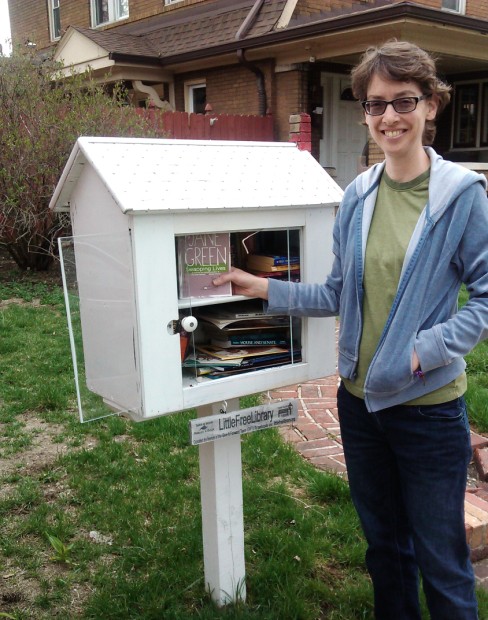
On my walks through the neighborhood I have encountered a curious thing: a little house-shaped structure mounted on a post, with sliding glass doors enclosing one of my favorite things: books!

Little Free Library in my neighborhood

Little Free Library in my neighborhood

It is a Little Free Library, part of a worldwide network designed to cultivate the love of reading by setting up free book exchanges.

Gotta love that. I decided to donate a book and take another home, just for fun. I’d like to say my donation was carefully selected after much intensive soul-searching, Top Ten list-making, and pick-pondering, but the truth is I had just visited Bookmamas, our little independent bookstore, where I was given three advance reading copies of books marked NOT FOR RESALE, so I stuck one of those in.

Putting my book into the mix.

Putting my book into the mix.

The little house-o-books was crammed chock full. Perhaps more people need to stop by and check out the selection.

I came home with a book called Dune Road, by Jane Green. It’s a novel about “divorcee Kit Hargrove (who) has joyfully exchanged the requisite diamond studs and Persian rugs of a Wall Street Widow for a clapboard Cape with sea-green shutters and sprawling impatiens….” Not my usual fare, but hey! I’m open.

Me and my find

Me and my find

I just love the coziness of the little structure, and the community feel of it. I want one in front of my house! (Neighbor-readers out there: do you know if this little library’s stewards made it by hand–or other details about it? No one was home when I knocked–or perhaps they were hiding from the camera phone-wielding/windblown/book-crazy stranger on their doorstep).

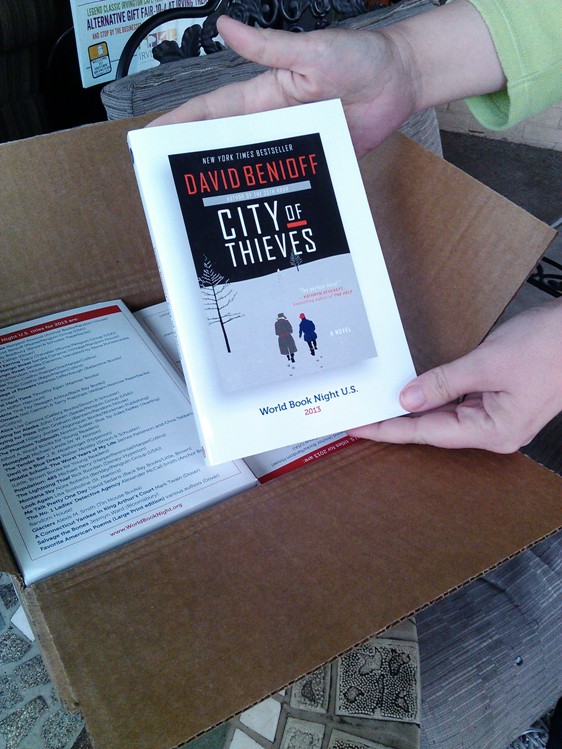
I was just wrapping this post up when the friend working across from me at the coffee shop mentioned that Tuesday is World Book Night, wherein book-lovers sign up to distribute 20 copies of a book–printed and shipped pro bono, with authors foregoing royalties–to people who don’t regularly read. She had ordered a box of books to pass out, so we stopped over at Bookmamas to pick it up.

Special edition books for World Book Night, designated to be given free

Special edition books for World Book Night, designated to be given away

Anyone out there ever participated in a book exchange or giveaway? Are you participating in World Book Night? Chime in and let us know what’s going on in your neck of the woods.

The Shadow Side

Here’s a thought for a gorgeous spring day when the shovel is about as high-tech as I’d like to get.

© Phil Date | Dreamstime Stock Photos

© Phil Date | Dreamstime Stock Photos

For all the successes of Western civilization,
the world has paid a dear price in terms of the most crucial component of existence–
our human spirit.

The shadow side of high technology–

modern warfare
& thoughtless homicide and suicide,
urban blight,
ecological mayhem,
cataclysmic climate change,
polarization of economic resources–

is bad enough.

Much worse, our focus on exponential progress
in science and technology has left many of us

bereft

in the realm of meaning and joy, and of knowing
how our lives fit into the

grand scheme

of existence for all eternity.

From Proof of Heaven, by Eben Alexander

Inspiration from Across the Pond

© Scott Patterson | Dreamstime Stock Photos

© Scott Patterson | Dreamstime Stock Photos

I just found out about a forthcoming book called Stories of the Great Turning, which features first-person accounts of Brits who are transforming their lives in inspiring ways. According to Vala Publishers:

“These are the stories of just a few people who decided to act, in their own lives, in response to the challenges of climate change and environmental degradation, and found their own way to make a difference. They are not stories about celebrities, environmental geeks or gurus but honest accounts from people who…’just got on with it.’

It is a book that takes the question, ‘What can I do?’ and sets out to find some answers using one of our species’ most vital skills: the ability to tell stories in which to spread knowledge, ideas, inspiration and hope.”

Kindred spirits if there ever were. And there’s a foreword by beloved eco-activist Joanna Macy, and I think you know how much I adore her. (“Now is the time to clothe ourselves in our true authority.” –from the Foreword.)

I’m invited to the book launch next month. Exciting! It’s in Bristol, England, so I won’t be there, but still!

A Whole New Earth

Nuvo Newsweekly has published my piece responding to Barbara Kingsolver’s novel Flight Behavior.

“It’s an elegy to the beauty of the familiar world, the world that is soon to be a thing of the past. Kingsolver invites us to begin the process of grieving, embodying that lost beauty in the form of the monarch butterfly…”

© Cinc212 | Dreamstime Stock Photos

© Cinc212 | Dreamstime Stock Photos

Indy-area folks can pick up Nuvo for free, or you can read the rest of the article here.

Have you read the book? What was your response?