Contracting

Recently I spent some blissful days by Crystal Lake in Michigan, thanks to a dear friend’s hospitality.

IMG_6894 (1)

This was the sunset that greeted me on arrival. Photo by Julie Stewart.

The reason for my trip was ostensibly research in nearby Traverse City’s 19th century mental institution. My original plan was to spend just a night or two in the haven of my friend’s company and then head out. (On the way home I wanted to tour a Michigan farm that specializes in teff, on assignment for Acres USA. And since the farm lies halfway between home and Crystal Lake, it made sense to find lodging midway.)

But it turned out that the teff farmers were unavailable during that time, so my grand plan fell through. And I’m so grateful.

I needed those restorative days and nights to rest, integrate, and incubate. After touring the asylum as planned, I turned to my project with a fresh eye. I wrote in stints between riding my friend’s bicycle, lying in the hammock, walking along the lakeside, floating in the crystalline water, and other general deliciousness.

In the mornings I sat at the end of the dock and faced into the wind. The wavelets on the lake and the constant breeze made it feel like I was on a boat, moving steadily forward.

I thought about how we can draw to us exactly what we need, even if it feels like we’re sitting still. If we’re aligned with what wants to be born, it’s less about effort than showing up and paying attention.

Driving home, I saw this truism played out again when an audiobook I was playing refused to work. I finally gave up and turned on the radio, just in time to find a program on NPR that spoke exactly to a dilemma I’d been working out in my story.

Now, this was in a semi-remote part of Michigan, where very few stations were coming through clearly. I marveled that I could hear this piece all the way through to the end as I drove along between the evergreens. The station faded just as the next story began and I came to a well-placed rest area.

When I got back in the car, I tried the audiobook again. You guessed it: This time it worked.

It struck me that this synchronicity was a symptom of alignment, proceeding straight from my placement at the end of that dock, where I had given myself the gift of sitting still.

I forget this all the time. Part of me still believes that I have to make things happen. I was taught to keep on pushing, no matter what. Never mind that time and time again—say in a client session or on a writing jag—I find a larger truth. The “I” that I so cherish steps aside for a bit and lets something bigger take over.

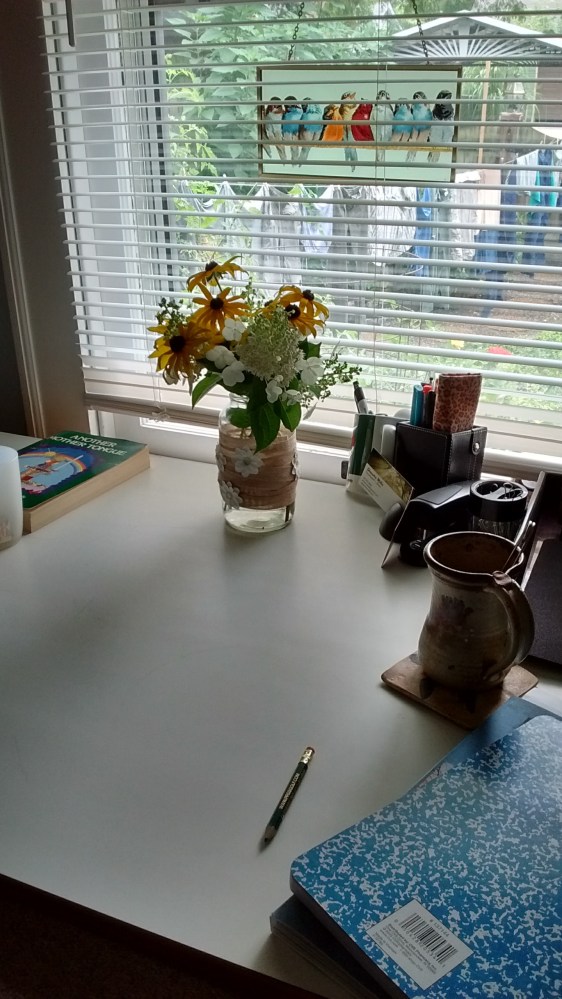
When I came back from Michigan, I longed to sequester myself with my writing. I took over the guest room with its sweet view of the garden out back.
IMG_20170801_134733794_HDR.jpg

I have been spending some time each day there immersed in my work, it’s true. But I still long for more. As the magic of my little Michigan expedition wore off, the usual obligations and distractions started to intrude. I have found myself overbooked and overstimulated.

Earlier this week I dreamt of coaching a pregnant woman through labor. When I woke, I realized that I am in the midst of a contraction. I have thought of “contraction” as a negative, as in “contracted state” opposite “expanded state”—but I understand now that I need to honor my need to contract. I see that turning inward is critical to the process of labor, which is really about so much more than active pushing. I need to allow a natural rhythm to flow.

And I need to pay attention, so I can be ready for those helpful tidbits that come my way as I appear to be sitting still.

In order to cultivate more quiet in my mind and spirit, I plan to sign off social media for the better part of August. This contraction requires that I evaluate every invitation and activity carefully before saying yes. I might not blog much. But I’ll be back.
Microbes: A Love Story

A few years ago my (former) dentist messed up—jabbing a spinning blade into the inside of my cheek while putting the finishing touches on a filling. Yes, I yelled.

She said to her hygienist (after shoving gauze in my mouth, and sort of apologizing), “Let’s get her set up on antibiotics.”

I said (as best I could around the gauze): “No.” Shaking, stunned, but clear.

“But you know your mouth is full of bacteria, and the risk of infection…” She began to lecture.

I realized I was not afraid of my own bacteria, and that I trusted my immune system. I made her understand that I did not want to take antibiotics. No thank you.

Fairly huge moment for someone who had struggled to rebuild her health for so long, who had been subject to catching “everything going around.” I don’t know when exactly it shifted, but I didn’t mistrust my own body anymore.

Among other issues, I had battled candida overgrowth for a decade or so, and had rebuilt my gut flora by consuming vast quantities of sauerkraut. I did NOT want to wipe out the friendly little beasties who had recently recolonized my body to good effect.

At home, using a natural mouthwash that burned the gouged-out place like blazing heck, I spit blood into the sink. My cheek had already begun to blacken and swell. I spent the evening holding my Triple Warmer* meridian points to return my nervous system to its hard-won state of safety and calm.

mouth

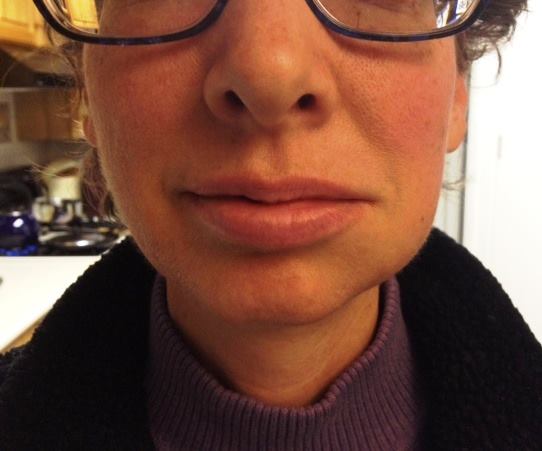
Actual shot of my poor swollen jowl the night of the “incident.” Later my lips turned blue at the corner. It was a good look!

Before bed I whispered to my reflection in the mirror, to my swollen cheek, to my wise cells and crafty microbiome, “Thank you for knowing what to do. Thank you for taking care of me. Thank you for protecting me from infection. I trust you.”

My body responded by healing up tout suite—and further rewarded me by no longer requiring a medication I had begun tapering down.

It might sound wacky to some, but the body responds to our love and care, and I believe that respecting our microbes is critical. I’m now reading I Contain Multitudes: The Microbes Within Us and a Grander View of Life, by Ed Yong, and finding all kinds of fantastic information in its pages.

It is fascinating to learn that only 100 species of bacteria can actually make us sick–the vast majority are either neutral or helpful to us. (Even assisting the immune system! “They educate our immune system, teaching it to tell friend from foe,” Yong writes.)

But there’s still this stigma.

“Microbes are now so commonly associated with dirt and disease that if you show someone the multitudes that live in their mouth, they will probably recoil in disgust,” he writes.

I remember hearing: Your mouth is the dirtiest place on your body! (Apparently the mouth was one of the earliest arenas to undergo bacterial study.)

He later points out that shifting from the viewpoint that “all bacteria must be killed” to “bacteria are our friends and want to help us” is…equally wrong. Bacteria are neutral and have their own agendae. Symbiosis only means “living together,” not necessarily harmonious cooperation.

I get it. There was that tiny bout with MRSA—a naturally occurring bacteria that ordinarily lives under the radar in our nasal tissues. That infection took forever to get gone, and left me with a nickel-sized scar on my leg.

Yong likens our partnership with the microbiome to a relationship that takes work.

Work and love, I say. It can’t hurt. And it might help.

So go ahead. Show your microbes some love.

*governs the adrenals and fight/flight/freeze mechanism

Ruminations on Reverence

I almost did it again. I almost got caught in an old thought pattern, the one that goes: Foolish child, gazing at birds, loving up trees, singing to streams. Have you seen the news? There’s work to do! Wrongs to right! 

Woops, I forgot for a minute. I forgot that wonder and reverence are the very things that bring the old story of separation—source of all the wrongs—to its knees.

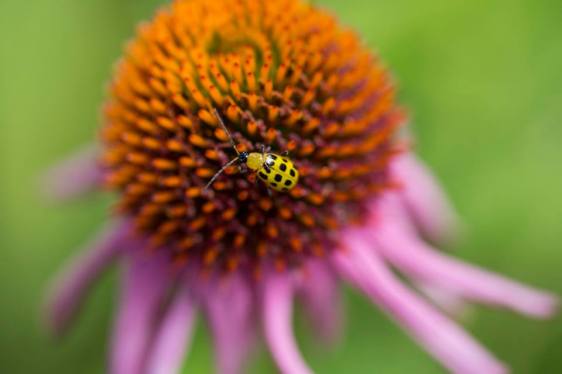
Sara photo 5

Echinacea photo by Sara Long

The last few nights I’ve watched a little bit of a DVD series loaned to me, called Journey of the Universe: Conversations. I didn’t know that reflecting on the grandeur of the universe would be the antidote to this old thought pattern. But when the late Paula Gonzalez (rad scientist nun!) spoke of “falling in love with the world” and how this changes us, I thought, YES.

Here’s a quote from cosmologist Thomas Berry, whose work inspired the series:

“Our relationship with the earth involves something more than pragmatic use, academic understanding, or aesthetic appreciation. A truly human intimacy with the earth and with the entire natural world is needed. Our children should be properly introduced to the world in which they live.”

—From The Dream of the Earth

I am of the ilk of those who can no longer call a companion animal a “pet,” nor a forest “natural resources.” I don’t see the planet as something outside of myself, to be appropriated. That intimacy Berry speaks of…I feel it developing between me and the spaces I love, and by extension the entirety of the world.

In his portion of the series, poet/activist Drew Dellinger says that reverence for the planet extends to all its people (and ourselves). If we begin to sense our place in the unfolding story of the universe, we gain a sense of wholeness and connectedness that forecloses any idea of exploitation or misuse.

Because make no mistake, the injustices perpetrated on indigenous people and people of color are part and parcel of the same old story that “thingifies” a tree or a waterway.

Yes, much work to be done. And where to start? What thread do I follow if I want to untangle some part of the mess? It’s easy to get confused and overwhelmed, lost in despair or anger.

So I go back to the heart of the matter: the story I want to live.

I bow to reverence once more, and give myself over to wonder.

Photo courtesy of Sara Long. Check her photography website out, or follow her on Instagram at @longacres.

Body is Home

Last week a younger friend, 30something, commented in an email that she needed to work on loving her body. In the note she spoke critically of certain body parts, as she has before in conversations. She didn’t like the way this and that looked.

I emailed back a rant. Of the most supportive and loving kind. I wrote:

Every time I hear you critique your body I just want to SHAKE you, I have to say! My gosh, you are stunning! And healthy! In the bloom of life! Your body works great! Fricking enjoy your fabulous body!

OK, cranky bat’s rant over, lol. Just, I really hate the way this culture trains women to despise our bodies when we are so so lovely in all our gorgeous permutations.

And having come through years of being absolutely decrepit, I feel like the important thing—the only thing—is whether or not we feel good in our bodies. If they work for us, if they’re generally free of pain, then hey. Celebrate.

That about sums up my response to women who diss their bodies. Except: After I sent this, I started to notice the slightest bit of hypocrisy.

Yes, I do feel pretty good in my body, and I do appreciate it working. I’ll wear tights to yoga class and not feel self-conscious. I’ll even wear shorts when I haven’t gotten around to shaving my white-and-hairy legs, with their various scars and divots and bruises. (I don’t care about all that. My legs walk great, and pump my bike pedals quite effectively.)

But do I really love this 50-year-old body as unconditionally as I would hope all women would love their bodies? Isn’t my love contingent upon feeling half decent, remaining trim, and staying active?

IMG_3583 (768x1024)

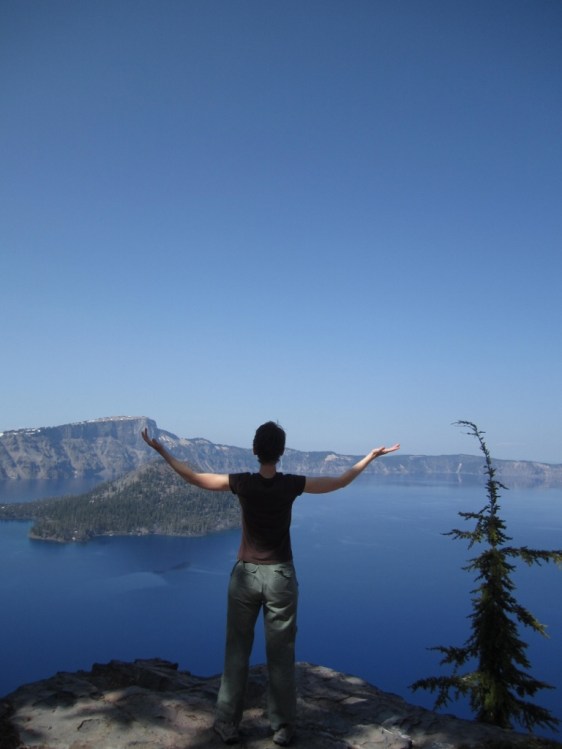
Crater Lake and me. With slight “bat wings” starting to show. (This was a few years ago.)

Back when I was living with chronic illness (the “decrepit” period mentioned mid-rant), I did not love my body much at all. Would I now, if some unexpected health challenge befell me?

Furthermore, why do I sigh at the way my blemish-prone skin is losing its suppleness? Why do I look askance at my newly floppety triceps?

I remember Jan Phillips. last year on a tear at the International Women’s Writing Guild annual conference, grabbing the flesh under her arm and saying, “Don’t waste another minute fussing about THIS.” She wanted us all to focus on getting our creative gifts out there, because “the world needs you.”

I think of Jan whenever I feel a tinge of dislike for my own baby “bat wings.” Jan says don’t worry about it!

Then again, part of loving my body does involve focusing on it—not in a fussy/critical way, but spending time doing what it wants to do. Stretching, walking, dancing, touching, resting, laughing, playing, enjoying good food…

All things that make me feel great. And theoretically make me look great too. Though I stop short of tricep curls and whatnot. So far.

Last night Gaynell ended her yoga class with an invitation, as she often does, to gratitude: “Pause and thank the miracle that is your body. It’s the best and only home that your mind and spirit have.”

That’s the space I want to live in. No matter what, this body is my home.

Weird Kid/Gone Berrying

My plan was to blog about weirdness today. Knowing my weirdness acutely and beginning to embrace it. The afternoon is fine and my neighbor’s mulberry tree beckons and it seems absolute folly to sit here much longer.

So. To make it quick: I have always felt myself to be The Weird Kid. I didn’t eat paste or anything, but I didn’t really speak to anyone either. Not if I could help it.

scan0010

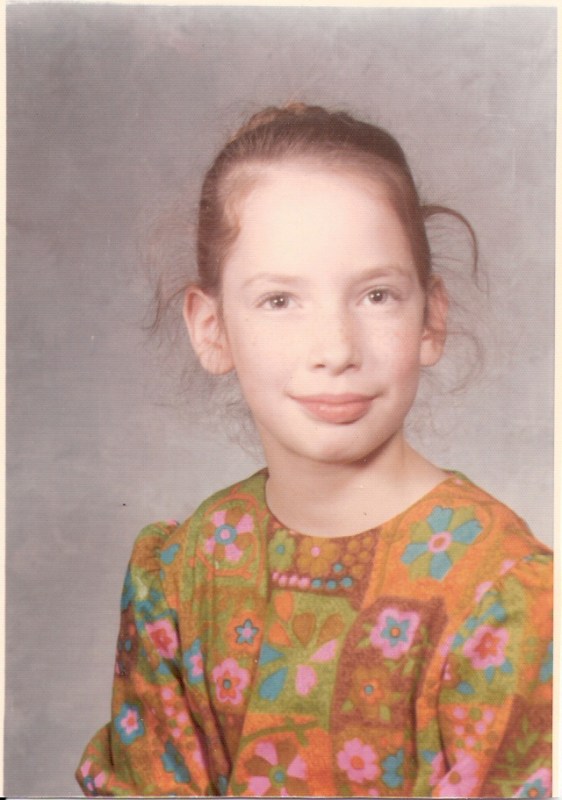
Right, I’ll just leave this here, since I can’t find one with my hair in Laura Ingalls braids and my astigmatic eyes hidden behind goofy spectacles. And big buck teeth sticking out.

I’ve gotten over my shyness for the most part, which does help in navigating life. I expect a certain awkwardness at parties, is all.

But sometimes today, people look at me funny, say when I’m picking mulberries or juneberries by the roadside, or when I’m down on my knees harvesting weeds for a salad. When someone gives me That Look, I want to say, “Honey, this is the least weird thing I do all day.”

I mean, I sit at my computer and string words together for little to no remuneration.

I move energy around with my hands.

I talk to trees and bugs and plants and streams.

I ground people for a living.

On occasion a client or friend will tell me something sensitive and then ask, anxiously, “Is that weird?”

I say, No. As someone whose whole body will jerk when some invisible energetic shift takes place, I’m uniquely qualified to judge, and no.

Or rather, possibly, but with me, you can be as weird as you are. To borrow a Martha Beck maxim.

To my tribe: Embrace the weird. In weird is our strength.

Now I’m off to fill my bucket with mulberries.

Cocooning and Re-Forming

I’ve been cocooning. I’m on a news fast. I don’t check Facebook very often.

It’s just: I’m healthier this way. And I can best hold space for others if I let go of both outrage and fear.

416891927_f619424e86_z

“Feather” by Nathan, via Flickr Creative Commons

Sometimes this might look like disinterest, or disconnection from the political realm that holds sway over so many people’s lives. I recognize that real people will be affected by the decisions coming out of Washington, and most of it won’t be pretty for a lot of us.

But if I rest in equanimity despite all that, I take back power and authority from those who would steal it away. I don’t have to give away my solid, grounded sense of basic OK-ness, no matter what dire outcomes are predicted.

And maybe by staying centered, I can be part of a cadre who will see a way to make real societal change. (I realize that my privilege insulates me from the worst of the proposals, which could have devastating impact. All the more reason to stay focused on transformation, as best I can.)

Instead of following the latest issues around health-care reform, I focus on ways to re-form myself and my approach to my own health and care.

This is something each of us can do. And we can help each other. And we don’t have to wait for anyone else to make that possible. It can happen now and now and now.

Not to oversimplify the real risks to people with major illness, disability, mental illness, and others in danger of falling through the cracks. I appreciate every single person who agitates for the little guy.

Still, surely everyone, regardless of politics, can support empowerment towards personal/community wellbeing. Especially if it costs nothing.

What costs nothing, yet enhances personal/community wellbeing? Some ideas:

  • Following Youtube videos from Lee Holden, who offers chi gong instruction to calm body and mind
  • Connecting with likeminded folks, say at one of Kheprw Institute’s many civic-minded forums and gatherings
  • Offering a smile to a stranger, chat with a neighbor, hug for a friend
  • Noticing beauty
  • Paying attention to one’s inner emotional state, and being kind to it
  • Being kind in general
  • Giving undivided (device-free) attention to a child, an animal, a friend
  • Connecting with my Facebook group, A Transformative Space, where we play with personal/planetary transformation
  • Enjoying deep breaths
  • Dancing
  • Walking in the woods
  • Forgiving someone else or yourself
  • Taking a break from media, or at least social media
  • Your idea here
428063994_dbf94aaada_z

“Cocoon” by Louise LeClerc, via Flickr Creative Commons


My sense is that more of us could benefit from a measure of quiet introspection, even if it’s just for a few quiet moments each day. And certainly all of us could benefit from more real and caring communication.

I would love to hear what you are doing to re-form yourself, whether or not you find yourself cocooning in this fraught political season. Please comment below if you feel so led!

Microscopic Truth

My yoga teacher sometimes says “Feel the hum in your body,” when we are near the close of class.

Do you, ever? Feel that hum? Your energy body. It’s quietly there with you.

Someone told me recently that I have a sort of “presence” that seems to come from being fully in my body. I was honored, and told her that for many years I was NOT in my body. I wouldn’t even have known what that meant.

IMG_3366 (768x1024)

Disembodied

These days I don’t always stay there 100 percent of the time, but I know what it is to feel into my body, to honor its communications. After years of dealing with chronic pain and fatigue, drifting along untethered, I have come home. It’s been a long road, but I now feel like I can trust my body.

Psychiatrist Bessel van der Kolk says, in this podcast:

“…if people are in a constant state of heartbreak and gut-wrench, they do everything to shut down those feelings to their body… And so a very large number of traumatized people…have very cut off relationships to their bodies. They may not feel what’s happening in their bodies… We needed to help people for them to feel safe feeling the sensations in their bodies, to start having a relationship with the life of their organism, as I like to call it.”

As I deepen that relationship, I’ve found myself tuning in closer and finer than ever. Exploring the microscopic truth expressed by my body. I’m noticing, sometimes in the wee hours when I wake up from an intense dream, what it feels like to resist whatever’s coming up. I don’t want to feel the old ball of dread descend on me, or the worry, or the anger, or the grief, and I can feel myself wanting to reject it. Here’s a tightening of my scalp, there’s a clench in my neck, a rigidity about the shoulders.

I’m not resisting even the resistance, but allowing it all in. Instead of shutting down with “No, no, no,” I’m reaching for the “Yes.”

The other night I actually mentally said, “Come in, come in, welcome welcome,” as I acknowledged each layer of sensation and emotion. And just in the acknowledgement, they seemed to melt away.

After all, as my mindfulness teacher used to tell me, “It is already here.” And as the poet Rumi says, “This being human is a guest house.”

I’ve lived long enough to laugh at my habitual patterns now and then. Oh yeah, that ball of dread again, there it is! Oh those worry states, stealing my sleep again! There’s that fear of something that may or may not ever happen… There’s despair, I can hold that one extra gently. There’s that contraction that could easily lead to a headache if I don’t breathe into it now.

Finding compassion for all of it—saying yes to all of it—broadens my capacity for kindness to others and to life itself. And as van der Kolk would say, I own myself fully, which makes me more resilient.

The Case for Slowing Down

CIMG3550 (1024x768)

Today I’ve been thinking about a “Good Samaritan” experiment. In this study, seminary students were rated for their helpfulness to a man in apparent distress, though they had no idea that he was even part of the experiment.

They were each given an assignment and sent to another building to complete it. On the way each encountered a man slumped in a doorway, moaning in distress.

Some stopped, some didn’t.

Some had been told to prepare a talk about the Good Samaritan, while others had a more generic task. The content of the task did not appear to affect their choice of whether to help the man or not.

What did make the difference was the seminarians’ sense of urgency. The experimenters told some of them that they were already late and should rush to get to the next building. These were far more likely to ignore (even step over!) the man in need.

Those who weren’t in a hurry helped in greater numbers.

Were the nonhelpful seminarians (especially those focused on the topic of the Good Samaritan!) crass hypocrites with zippo compassion? No, they felt pressured to get their central task done, to keep moving. (I don’t know about you, but I’ve definitely been there.)

In fact, according to the article I read, many who did not stop appeared anxious when they entered the second building. Their inner conflict showed up in agitation.

To my mind, this study clearly shows one “unselfish” reason why it’s crucial to S-L-O-W  D-O-W-N the pace of our lives. (Of course, as our sense of separation between ourselves and the larger world breaks down, there’s really no such thing as selfish vs. unselfish. What happens to you happens to me. Witness the subjects’ bodies’ own distress signal.)

In the Western world we are supposed to be hyperefficient and “productive” all the time. We overschedule ourselves in an effort to get more done. Even when I am “off duty” at the end of the day, I’m tempted to keep checking my phone or laptop, to look up one more thing, to multitask when I am theoretically at leisure.

What is the cost of all our rushing around? Distractedness, high blood pressure, anxiety, and more. Meanwhile we live whole days, months, years, barely present to our lives.

Here’s my friend Melody Groothius, mom to two and lover of the world:

I hope I never think that what I’m doing is so important that I can’t stop and acknowledge – my kids, a chance to laugh at a joke (especially a terrible dad joke), a beautiful flower, the sound of a singing bird, the feel of a gentle spring breeze against my face as I step out the door. We’ve all got deadlines and “very important” interviews and articles and things to say but, honestly, those aren’t more important than any of those other things…actually, not really very important at all when I stop to think about it…

We tend to think we will slow down later on…when we get something big done, or go on vacation, or retire. Generally the habit of rushing is so ingrained that it is hard to overturn, even if we make a point of it. It can take a health scare or other personal tragedy to bring us out of our trance of busyness.

But creating some space in our schedule right now—though it will never be rewarded by the dominant cultural story!–is crucial to creating a world worth living in.

I leave you with a “Run Report” by my poet friend Alyssa Chase, who conceives lovely haikus as she takes her daily run, later to post on Facebook.

What’s the good of all I’ve learned? How to schedule peccadilloes, negotiate obsolescence, parse darts? Blue sky answers: Do something else.

Rising

On International Women’s Day, I’m thinking about what it means to be human.

We are in the midst of a rebalancing. The old patriarchal systems are groaning under the weight of their own corruption and perversion.

So we rise. “We are the leaven of this land, and we are on the rise,” says the marvelous artist/activist Jan Phillips.

And this is what it means to be human: to rise, to integrate. The feminine principle is ascendant not just in women, but in all genders. I know this is true because more and more hearts are awakening to our interconnectedness all the time.

We know intuitively, as women have from the beginning of time, that we are all connected. This is why we feel pain in our own bodies when we encounter the pain of the world.

When we hear of record numbers of immigrants crossing our northern border into Quebec seeking asylum, it hurts. When we read of a white rhino killed by poachers in a Paris zoo, our hearts break. Photos of clearcut forests, news of oil pipelines spilling into waterways, awareness of “mother nature on the run” as Neil Young put it—painful.

Our hearts break, over and over. We mend them as best we can—through touch, conversation, nature, meditation, prayer. Only to break again.

kwan yin 1 (759x1024)

Guan Yin, Goddess of Mercy, female Buddha, photographed at a temple in China

We can move swiftly from pain to outrage, which distances us a little, gives us back the upper hand in a way. (If I can find someone to blame, then I don’t have to dwell in heartbreak as long.)

Buddhist teacher Pema Chodron has this to say about that painful place:

When we don’t close off, when we let our hearts break, we discover our kinship with all beings.

Our challenge is to not close our hearts even to those who would do us harm, or do harm to the people and places we love.

I heard a story of an Afghan woman who works to educate girls in Afghanistan. Fundamentalists dislike that, and she’s subject to death threats. One day at a checkpoint she was recognized and pulled out of a car by a group of bearded, turbaned men with guns. The people in the car worried for her life. But she walked back after a half hour of talking with the men, saying, “We can go.”

She stayed open, and refused to see the fundamentalist men as her enemy. It turned out that they wanted an education, just like the young girls she worked with. They had made arrangements to meet outside the mosque for lessons.

The feminine principle is strength and love, strength IN love.

We’ve been schooled to think that the only way to make change is through force, whether physical or psychological or financial. But as the feminine principle shows, change happens in more mysterious ways. Ways that can’t always be predicted or explained.

And if we know that there is truly no separation, then our small human lives have meaning beyond all measure. Nothing we offer in love is ever wasted, no matter how small, because we nourish the new world with our deeds, thoughts, and hearts. What we do (are)—strengthens the good in ways we may never know.

Infinite

admiring_the_galaxy-1024x682

Admiring the Galaxy, By ESO/A. Fitzsimmons – via Wikimedia Commons

I rewatched the original Cosmos series not so long ago, and took down this Carl Sagan gem to share with participants in my Radical Cell(f) Love class:

“It may never be proved, but it’s stirring. Our entire universe, to the farthest galaxy, we are told…is no more than a closed electron…in a far grander universe we can never see. That universe is only an elemental particle…in another still greater universe and so on forever.

Also, every electron in our universe, it is claimed…is an entire miniature cosmos…containing galaxies and stars and life, and electrons.

Every one of those electrons contains a still smaller universe…an infinite regression up and down.”

An entire cosmos within each of the electrons in my body, and myself just a tiny speck in a spinning infinite cosmos.

If I radiate light, who feels it, on what scale?