A Field to Fork Market

“In Indiana, we can grow so much of our own food. We really could be sustainable now,” says Kevin Logan, MD. Though we can’t grow mangoes or bananas, he believes we could cultivate everything we need for regional self-sufficiency.

INgredients Field to Fork Market, a new shop he opened in partnership with wife Jacqueline and old friend Tom Wiles, is exerting influence on both supply and demand. To stimulate the market for good clean food, the deli demonstrates how to use local produce like bok choy and spaghetti squash. Meanwhile the proprietors are coordinating with the many farmers and producers capable of feeding our region, in anticipation of the 2014 growing season.

I had the pleasure of talking with the three of them when I wrote this Nuvo piece on the store. It’s located in a refurbished Taco Bell, and full of items grown or produced in Indiana.

Pie pumpkins and gourds from local farmers at INgredients.

Pie pumpkins and gourds from local farmers at INgredients.

“I feel like we’re going to have to get back to community,” Logan says. “And food choices are one way that we do that.”

The trio plan to hold classes on every stage of food growing, storing, cooking, and preserving, to help people gain garden knowhow and kitchen skills. Both fermenting and cheese making classes are in the offing.

All in all this shop is a great addition to community resilience efforts in my town.

Crowd-funding the New Frontier: Radical Mycology

Here’s a chance to support a radical mycology project seeking to put a potent tool for restoration in many more hands. Mushrooms can break down and eliminate some of the most toxic industrial compounds in the world, representing enormous untapped potential for healing our beleaguered planet.

Not to mention the fact that mushrooms are a phenomenal source of protein, potentially boosting community-level food sovereignty.

Be part of this new frontier by funding this resource for would-be radical mycologists, and/or helping to spread the word!

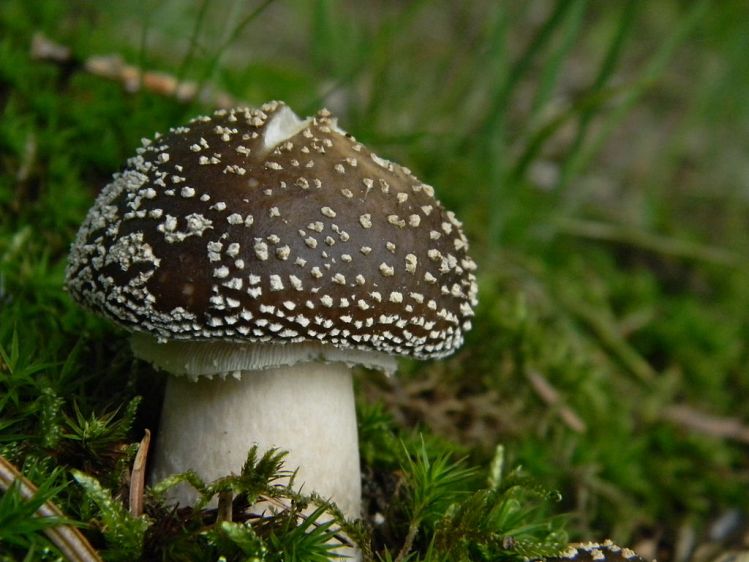
By Alaricmalabry (Own work), via Wikimedia Commons

By Alaricmalabry (Own work), via Wikimedia Commons

Below is a note from Peter McCoy, who recently contributed a guest post about the lessons mushrooms have taught him:

The Radical Mycology Book fundraiser is underway! This unique book on the uses of mushrooms and other fungi for personal, societal, and ecological wellbeing will be a powerful resource for the geek and do-gooder inside us all and we are excited to bring this dream to the rest of the world.

You can view the live campaign here:

http://bit.ly/radmycogogo

Whether or not you are in a position to donate, one of the most important contributions you can make would be getting more people aware of this fundraiser by emailing your friends and re-posting on your social (mycelial) networks.

Share the campaign on Facebook:
http://bit.ly/rmifbshare


Thank you so much for contributing to this project and vision!

Mush love!
Peter and The Radical Mycology Collective

Working with Nature to Sustain Life

There’s a fatal flaw in the traditional definition of sustainability—meeting today’s needs without jeopardizing future generations’ ability to meet their own needs.

The problem? This notion leaves out every species besides homo sapiens.

The truth is, “Human beings don’t sustain shit,” sustainability consultant Brandon Pitcher declares. “Nature sustains us. We fool ourselves into thinking we sustain the planet, but it’s the other way around.”

But Fritjof Capra’s view of sustainability is more integrated:

“A sustainable human community is designed in such a manner that its ways of life, technologies, and social institutions honor, support, and cooperate with nature’s inherent ability to sustain life.”

By Alaricmalabry (Own work), via Wikimedia Commons

By Alaricmalabry (Own work), via Wikimedia Commons

Pitcher, a certified practitioner of ZERI (Zero Emissions Research & Initiatives, a global network seeking solutions to world challenges), spoke at the Irvington Green Hour Tuesday night. He gave two scenarios of solutions patterned after nature’s wisdom.

The Power of Shrooms
The first involves using mushrooms to address multiple issues, such as in the case of an invasive species troubling poverty-stricken parts of Zimbabwe. There water hyacinths choke waterways, to the point that people can’t take their boats down the river, jeopardizing their livelihoods in an area already strained by high rates of HIV.

However, once harvested, dried, and sun-sterilized, this invasive species is ideal food for mushrooms. Villagers take the work on, and native mushrooms thrive on this biomass. Reintroducing mushrooms as a food source demonstrates how tasty and nutritious these powerhouses are—and they can provide enough protein to sustain a community in two to three weeks, Pitcher says.

Mushrooms also figure in food security efforts in Colombia, where the coffee plant forms a substrate for edible fungi. Typically 99.8 percent of coffee is thrown away or burned on its way to our morning cuppa. But “waste” is opportunity.

Coffee Plant, by Jo N, via flickr Commons

Coffee Plant, by Jo N, via flickr Commons

The Wisdom of Water
Pitcher’s second example is a natural way to treat wastewater.

In Indiana, 92 cities, including my hometown, have antiquated combined sewer overflows (CSOs).

Combined sewer overflow effects, by Christopher Zurcher, via flickr Commons

Combined sewer overflow effects, by Christopher Zurcher, via flickr Commons

Never heard of a CSO? You’re lucky. Here whenever it rains a fraction of an inch, raw sewage combines with stormwater runoff and runs straight into waterways. So pathogens and toxic chemicals are dumped into my neighborhood’s Pleasant Run and other sweet little streams.

The remediation plan involves drilling enormous pipes deep underground to hold the excess sewage. To Pitcher, this represents a wasted opportunity—and a sad ignorance about the way water naturally purifies.

“Water does not move in a straight line in nature,” he points out. Its natural flow creates vortexes that clean it. “It’s very ignorant of us to think we can move water through pipes in straight lines and think that water’s going to be healthy.”

An integrated system of rain gardens and wetlands harnesses the power of algae to treat wastewater. In Indy, such a system could have resulted in a decentralized network, providing jobs and clean water in perpetuity, Pitcher believes.

For more information, see the ZERI site, or The Blue Economy—or attend Pitcher’s upcoming  sessions at Trade School Indy.
Forage Ahead!

Today I joined my friend Greg Monzel of Monzel Herbs on one of his terrific plant walks. The rain held off as we tramped the lanes and fields of Distelrath Farms, an urban farm and the source of my weekly CSA allotment.

As an herbalist, Greg focuses these guided tours on both edible and medicinal plants. After you’ve hung around with him for a little while, you get a new appreciation for the things people normally dig out of their gardens. It seems that everywhere under our feet, there’s nourishment and healing.

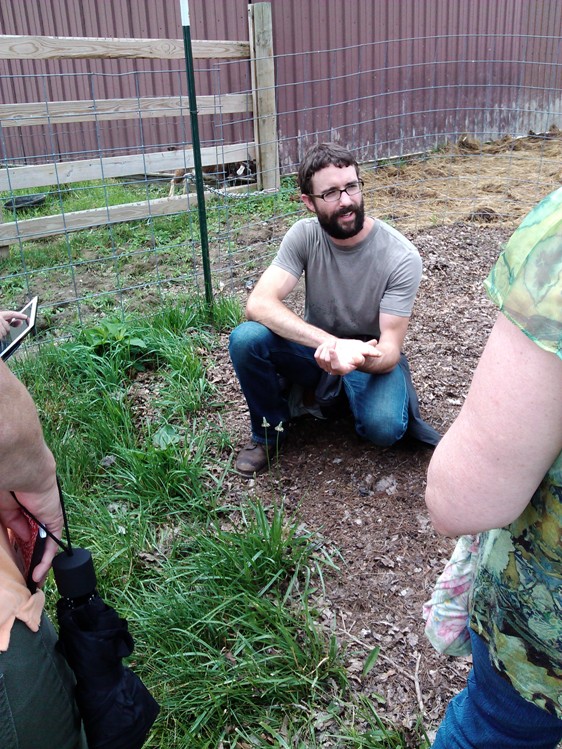
Greg teaches us about plantain and its many uses

Greg teaches us about plantain and its many uses

Plaintain, for example, is good for eczema, wounds, and other skin issues, while its seeds are a “poor man’s psyllium.” I doubt I have the patience to collect its seeds, but I like the idea of whipping up a bunch of leaves in the blender with olive oil to make an infusion. I have some off-and-on rashy stuff on my hands, so I might try that.

Amaranth, drought-tolerant and tasty

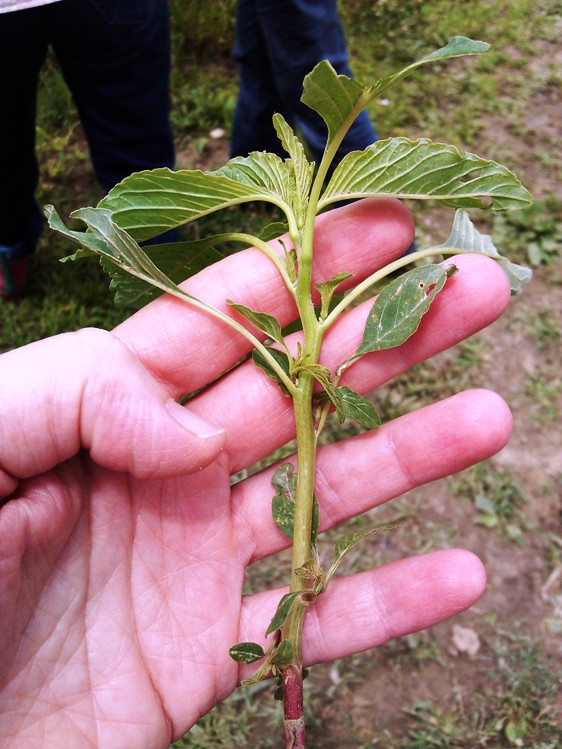
Amaranth, drought-tolerant and tasty

More tasty than the bitter plantain is amaranth. It is an amazingly hardy summer salad green as well as a source of protein-rich “grain” (actually the seeds).

I’ve never collected the seeds, but I adore amaranth as a green. My partner was introduced to it in Tanzania years ago. There it was called red root and sauteed in a dish called Sukuma Weeki.

When the drought hit us last year, amaranth didn’t even notice. So this year I bought amaranth seeds to plant for a steady and convenient supply. As soon as my lettuce is done–any day now–I’m sowing amaranth in preparation for a dryer, hotter July and August. I can almost taste that late summer salad of amaranth and purslane, a heat-loving succulent high in omega-3 fatty acids. Most people pull both as a weed.

Greg, by the way, says weeds are a state of mind. Many of the things we consider noxious weeds were actually brought here because of their usefulness. Now they populate areas where the soil has been disturbed, working as “succession plants” that naturally build soil fertility.

Knotweed, AKA smartweed

Knotweed, AKA smartweed

Here’s knotweed, for example, also known as smartweed. I remember seeing this pretty little bloom in my dad’s raspberry patch and wondering what it was. I learned today that it is in the buckwheat family. Its leaves and seeds are edible and loaded with resveratrol, a potent antioxidant.

And did you know that you can harvest the seeds of the ubiquitous clover and save them in a jar, for indoor sprouting at some later, leaner date? It’s mind-boggling to realize there is free food all around us, even in the city, that could potentially nourish us in good times and bad.

I’ve learned so much from Greg, starting when I interviewed him for an Edible Indy story on gathering wild foods. Though I’m not nearly as experienced as he is, next Friday, July 5, I’ll have a table on foraging at FoodCon IV, a fabulous event that attracts a thousand or more people every year. I’m beyond excited to be part of it.