Time to shout “STOP”…..March Against Monsanto.

“My own reason for supporting this movement is because I believe in freedom. Freedom to grow my own food, food that I feel happy to eat. Freedom to save seeds from the plants that I grow. Freedom to distribute them as I please among other growers. Monsanto wants to curtail these freedoms, because these freedoms don’t put money in their pockets.”

Well said, Bridget.

I’ll be attending the March Against Monsanto in my own town–will you?

bridget's avatarfromacountrycottage

017

On May 25th of this year a great event is happening. Where is it happening?  Everywhere! If you check out  http://www.march-against-monsanto.com   you will find marches organised to protest against the giant corporation that is Monsanto. All over the World marches are scheduled. We must make our feelings felt. Not only to Monsanto but also to our governments, for they are the ones allowing Monsanto to infiltrate our farms, gardens and allottments.

019

Tami Monroe Canal, creator or the now viral Facebook page March Against Monsanto, says she was inspired to start the movement to protect her 2 daughters. “I feel Monsanto threatens their generations health, fertility and longevity. I could’nt sit by idly, waiting for someone else to do something.”

My own reason for supporting this movement is because I believe in freedom. Freedom to grow my own food, food that I feel happy to eat. Freedom to save seeds from the…

View original post 242 more words

In Troubled Times

This morning when I looked out my front window, I saw that the juneberry we planted two years ago was budding. Through the rain I could see the sketch of pale green buds dotting each limb, all the way out to the tips–with the promise of sweet berries contained in each one.

Buds that will open into a white blossom, eventually fruiting into delicious berries

Buds that will open into a white blossom, eventually fruiting into delicious berries

The young tree has made it through two of the hottest summers on record, and those tender buds gave my heavy heart a lift.

We planted it because we wanted to grow fruit on our lot, and we nurtured it with weekly waterings through crippling drought and heat. When the rain barrel went dry, I carried buckets from indoors, saving shower water, cooking water, and the dehumidifier’s daily emptying–occasionally breaking down and stretching the hose across the lawn to let it run for a slow hour.

There’s a passage I like from Buddhist teacher Thich Nhat Hanh, called Interbeing. It begins:

“If you are a poet, you will see clearly that there is a cloud floating in this sheet of paper…”

My tree contains multitudes. It has the memory of picking juneberries with my dad a few years ago, before he got sick, before he died, in the forgotten pocket park wedged between two busy streets. There were three small trees just loaded with juicy wine-colored berries. Dad picked from the high branches and left me the low ones. When the low limbs were picked clean, he pulled the ends of the high branches down so I could reach.

Also part of my tree is Jason, the neighbor who helped dig the hole and position the root ball on planting day. And Jerome, the young man who brought it to us through his work with Keep Indianapolis Beautiful. This year Jerome has parlayed his passion for trees into his own business as a certified arborist, Tree-Centric Solutions–pledging to not only plant, treat, and prune trees, but find uses for wood from trees that can’t be saved.

My juneberry even holds the “woman tree,” an old redbud whose upreaching shape I cherished. I called her that because she always looked so feminine to me. The woman tree was just beyond where the juneberry is now, and she had to come down because half the branches were dead. Taking her out meant we freed up room for a fruiting tree.

Irony: I learned that redbud flowers are edible just after we had ours cut down. I could have decorated so many salads with the woman tree’s bounty. Not only that, but Jerome’s service came too late for her: What I wouldn’t give to have something made from the wood of that beloved redbud!

So all that’s in this juneberry too: my regrets, my ignorance, my wishing things were otherwise. But mostly, these are outshone by pride and hope.

I share all this because in troubled times, sometimes things like this can help: a small tree in the rain, holding memories and care, covered in promise.

Things That Can’t Be Rushed

Those of us who are bathed in technology much of our lives, that is to say most of the Western world by now, have grown accustomed to having everything happen in a hurry. Speed is the ultimate. Efficiency is king.

I am prone to this, feeling impatient with the rate of change.

Even in gardening, I value a relatively quick turnaround: Plant a bunch of lettuce seedlings, and a month later I can be snipping salad from my own raised bed.

But some things take time, and move in a crooked line, and require great patience to see results.

Photographer: Kessner Photography

Photographer: Kessner Photography

I’m reminded of this when I visit a farmer friend who lives in my neighborhood. Her family farm is called Artesian Farm. It’s in the next county over, where Anna and her farm partners raise grassfed beef.

When she talks about farming, she thinks in terms of decades. For example, the process of transitioning the farm to organic—which her parents wanted to do long before there was any infrastructure of support—has barely begun, and the beginning itself is taking years.

It’s been nearly 10 years of preparation, and a very small portion of the crop acreage is just beginning the transition to organic.

To grow corn and beans organically, and to be certified as such, farmers undergo an elaborate process. One of Artesian Farm’s first steps was adding more cattle. It seems an odd thing: what do corn and beans have to do with the beef side of the business?

But Anna explains that crop rotation is key in organic farming. Hay is their chosen rotation crop. “It’s common wisdom that if you grow hay and sell it off your farm, you’re taking all the nutrition off your farm.” So more cattle were needed to make use of the hay.

A 200-page plan has taken about six years to complete. It would cost $2500 to have an outside agency prepare this plan, on top of the $1000 for certifying. Anna opted for the DIY approach.

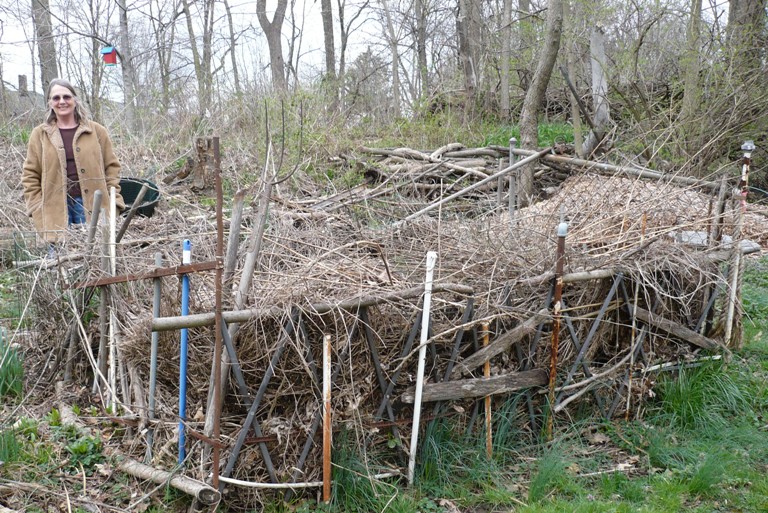
During my visit Anna cuts me some lemon balm, which is near an imposing compost heap about the size of a mobile home. It looks like a small sod house was plunked down in the middle of her modest “back 40.” “How do you turn it?” I ask, thinking of our own compost pile—a midget compared to this—and how it never gets hot enough to kill weed seeds, because we don’t turn it, though we always say we will.

“Oh, I don’t bother turning it. Nature doesn’t turn it, in the woods.”

Anna and her compost bin, which she created “free-hand” with odd broom sticks, twigs, mop handles, rusty pipes, and other finds.

Anna and her compost bin, which she created “free-hand” with odd broom sticks, twigs, mop handles, rusty pipes, and other finds. Photo by Danny Chase.

Walking me back to my car, Anna reflects on the passage of time, how long it takes to make a change, to heal the land, to see results. Those of us who don’t spend as much time with our feet on the soil and hands in the dirt might expect results in a much shorter time frame than the decades that are really required.

Like the compost, like building the humus of the forest floor, there are things that can’t be rushed.

The Shadow Side

Here’s a thought for a gorgeous spring day when the shovel is about as high-tech as I’d like to get.

© Phil Date | Dreamstime Stock Photos

© Phil Date | Dreamstime Stock Photos

For all the successes of Western civilization,
the world has paid a dear price in terms of the most crucial component of existence–
our human spirit.

The shadow side of high technology–

modern warfare
& thoughtless homicide and suicide,
urban blight,
ecological mayhem,
cataclysmic climate change,
polarization of economic resources–

is bad enough.

Much worse, our focus on exponential progress
in science and technology has left many of us

bereft

in the realm of meaning and joy, and of knowing
how our lives fit into the

grand scheme

of existence for all eternity.

From Proof of Heaven, by Eben Alexander

An Appeal Denied

Update: Community Access Television has posted a video of the April 3 Board of Zoning Appeals meeting. Minutes have not been posted on the BZA site yet.

Last night I met up with friends to drive to Bloomington, IN for a Board of Zoning Appeals meeting. We were among 80 others there championing permaculture designers/teachers Peter Bane and Keith Johnson, who were pursuing variances for their small suburban lot. Since last summer, they’ve been mired in a conflict with Monroe County, primarily about placement and square footage of structures at Renaissance Farm.

The main issue was that they didn’t follow proper procedures, but they were under the impression that agricultural buildings are exempt from the process. I won’t go into detail about the legalities as that’s not the purpose of my blog—but you can refer to the meeting materials.
Peter Bane with co-teacher Rhonda Baird laying out a garden path during 2007 permaculture class

Peter Bane with co-teacher Rhonda Baird laying out a garden path, 2007 permaculture class

It was moving to hear the 30-plus testimonies of Peter and Keith’s impact. (I first met Peter in 2007 at a one-day permaculture overview class, and his passion infected me with the need to come right home and plant my entire lot in food.)

The intergenerational crowd was made up of neighbors, IU profs and grads, pastors, farmers, small business owners, a newspaper editor, a City Councilman, and young Bloomington natives who moved away and then returned, largely because they wanted to learn from these luminaries.

Neighbor after neighbor told of the duo’s generosity in sharing both knowledge and produce. Many have started gardening themselves. One said she travels all over the country; when she tells people she lives on the same street as these renowned Permaculture designers, “they are in awe.”

A sampling of comments:

“Everything they are doing is a practical and immediate way of changing the world for the better.”

“They are showing that young people can have a viable future in spite of the climatic, economic, environmental, and other issues facing us.”

“It’s beyond sustainable, it’s regenerative.”

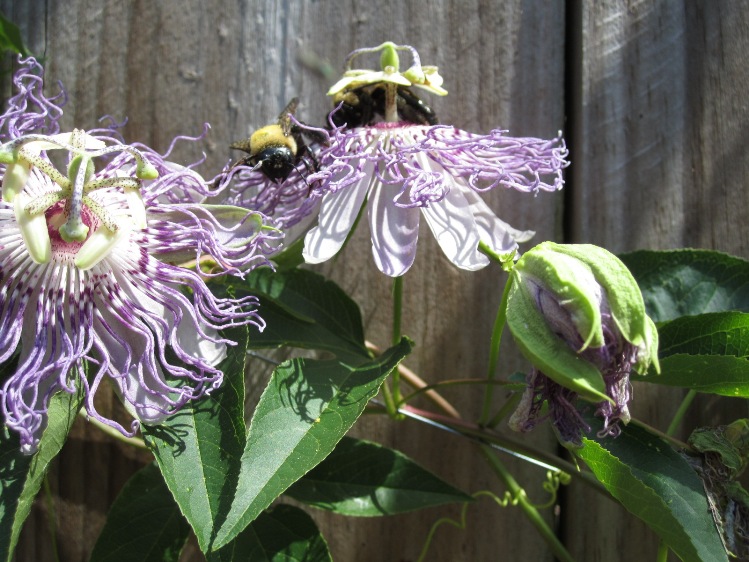
A maypop planted along our fence, one of many plantings inspired by permaculture

A maypop planted along our fence, one of many plantings inspired by Keith and Peter’s work

There seemed to be an understanding in the room, even among officials, that we are at a crossroads. One supporter told them, “I am sympathetic to you who must uphold laws that support suburban sprawl and ignore what the future requires of us.” Another said, “We are living in a world where the rules are changing.” Another warned that big timber, big ag, and mining will dominate rural areas if we don’t change our ways.

But apparently these are not the concerns of a body pledged to oversee existing laws, faulty as they are.

After four hours the board approved all but one variance—a critical one. The barn must be moved about 10 feet from its current position to be in compliance.

It was a shock. Especially after board member Jerry Pittsford, who expressed dismay that Peter and Keith had circumvented the process, had said, “I like rules, but I’m finding very little that tells me the rules need to be followed here.”

There were a number of reasons to approve the variance and only one to deny it—the fact that they did not consult with the county and submit the proper paperwork. Even as the board expressed admiration for Peter and Keith’s work, they could not get past that lapse.

It’s unclear what the next step is for Renaissance Farm, but whatever comes, I hope these two visionaries were bolstered by the outpouring of love and appreciation from neighbors, former students, and admirers.

Not Your Mother’s Flower Show

Update as of March 8: I’ve added a couple things to this post that I didn’t know about yesterday: additional times to hear about backyard chickens, plus a coupon!

Quick commercial break here for those who live in or near Indianapolis. This year’s Flower and Patio Show, running March 9-17 at the Indiana State Fairgrounds, includes a phenomenal new exhibit called The Urban Homestead. Picture a 10,000 square-foot city lot set up right in the middle of the expo hall, complete with chickens, rain barrels, vegetable gardens, and occasionally even sheep.

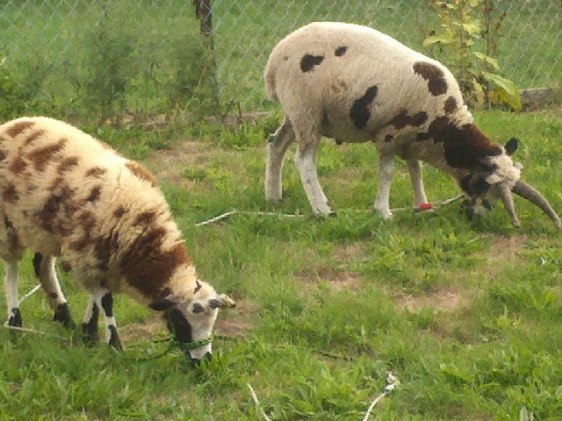
Yep, sheep. “When the grass around the Eco-Cottage grows too tall during the show, sheep from Fruit Loop Acres will be brought in to ‘mow.'”

sheep grazing

Sheep from the Green Shepherd Project, a project of Fruit Loop Acres, graze a city lot. Photo by Sue Spicer.

Other highlights:

Fraudulent Farmgirl Amy Mullen from Spotts Garden Service will present three times:

  • Saturday, March 9: 12:30 p.m. “Food Gardening for Beginners
  • Friday, March 15, 1:00 p.m. “Organic Weed and Pest Control
  • Friday, March 15, 6:00 p.m. “Edible Landscapes
herbs

Herbs growing in a container

Andy Cochran with Circle City Rain Barrels will teach how to build a rain barrel in two sessions:

  • 11:30am Saturday, March 9
  • 11am Sunday, March 10

Nap Town Chickens will be there all week, and there will opportunities to learn how easy it is to keep backyard chickens in three sessions:

  • 1pm Tuesday, March 12 with Andrew Brake of Nap Town Chickens
  • 11am Thursday, March 14 with Maggie Goeglein of Fall Creek Gardens
  • 7pm Saturday, March 16 with Andrew Brake of Nap Town Chickens

All this plus beekeeping, mead making, container gardening, composting, and more. I’m so there!

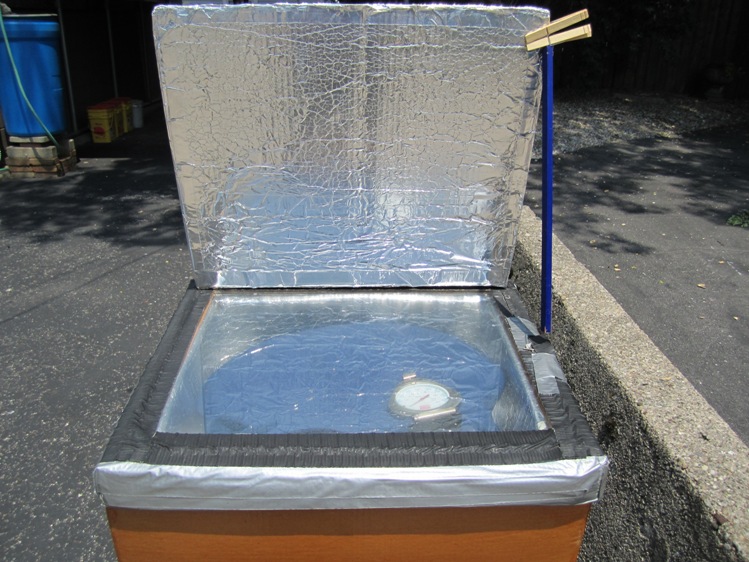
Oh wait, I have to be there: I signed up to be a presenter. I’ll be talking about solar cooking at 1pm Wednesday, March 13, demonstrating how to harness the most plentiful source of energy on earth to do your summer cooking.

We may have snow on the ground now, but in a few short months, this little puppy will be my best friend again.

solar cooker

Solar cooker and rain barrel on my urban homestead

Here is a coupon for $3 off admission to the Flower and Patio Show. Get there, and then come see us at the Urban Homestead exhibit!

And now back to our regularly scheduled programming.