Small Respite

Final in a series

Author Rebecca Solnit writes about how we have changed in the last 20 years, mainly due to online connectivity. We have shorter attention spans. Our time is chopped into bits. We indulge our need for constant updates and check-ins.

She wrote that all this makes deep thinking and reading very difficult to sustain.

And often the habit of seeking external input subverts our inner knowing.

With that in mind, I conducted an experiment in the last weeks of 2013. I took a break from Facebook. I found it instructive—not always comfortable, but interesting.

I find that a quality of inner silence arises when I’m not hooked into an external source of connection. I’m not distracting myself through the random bits of pathos, trivia, deep thoughts, outrage, and silliness that constitute my Facebook feed—so I can face more easily the stuff that needs to be addressed, whether a stuck emotion or a dreaded task.

Back to my conversation with my friend Kate Boyd: She told me she had seen the film Inside Llewyn Davis and was struck by the pace of life pre-Internet. The breathing space of that age.

I had the same experience, and a sadness at what is lost, when I read The Guernsey Literary and Potato Peel Pie Society, which takes place post-World War II. The story unfolds in letters. I mourn the loss of letters.
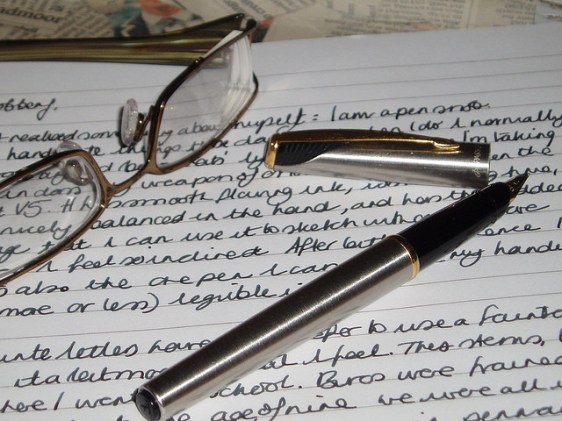
Photo by Cas, via Flickr Commons

Photo by Cas, via Flickr Commons

Much of the story happens on an island, and the main character has long spacious hours in nature. I mourn the loss of time unfettered, disconnected from constant inputs.

There’s no going back, of course. But it helps me to put rules around my Facebooking, even bendable ones: No checking after 9pm. No checking before I get some work done. One day a week cold turkey.

Each Sunday I strive for an Internet-free day, but one day really isn’t enough to touch that sense of quiet. During my self-imposed “FaceBreak” and also during last October’s writing residency at Mesa Refuge, I came closer.

The hours at Mesa Refuge were largely Internet-free. There was no expectation to track anything other than my own thoughts and the work of my cohorts. The main questions were: “Did you break through that block you had last night, did you write your scene, did you get to the place you need to be?”

My writing shed at Mesa Refuge

My writing shed at Mesa Refuge

My time there was about ideas and creativity—and connection to something slower and sweeter than the latest argument or article posted online. Something, dare I say, eternal.

I’m looking forward to two writing retreats this summer that I hope will offer the same sense of spaciousness. And in the meantime, I manage as best I can—carving out Screen-free Sunday as a small respite, bringing some awareness into the mix when I remember to.

I hope this keeps me from having to file “social bankruptcy,” as in this very funny Portlandia clip (that a friend shared on Facebook).

What about you: Do you have techniques that help you deal with information overload? Have you ever taken a break from social media, by choice or necessity? Tell us about it in the comments!
Of Facebook and Firehoses

Part 2 in a series

My friend Kate Boyd and I were recently discussing smartphones and other addictions. Her weakness is checking email on her smartphone. And the little blinking light on my phone does hook me, but my real weakness is distracting myself with Facebook during my workday.

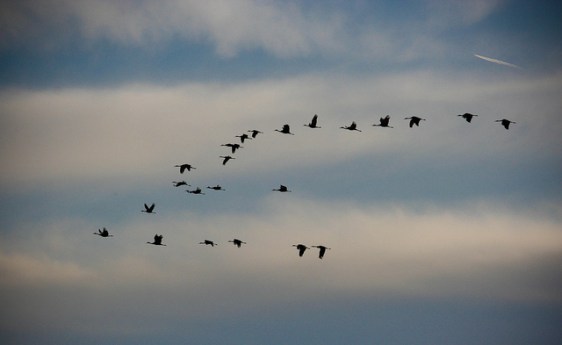
Say I log on to share something cool, like how I just saw some sandhill cranes flying low over my neighborhood.

Photo of sandhill cranes in flight by Jessica Lamirand, via Flickr Commons

Photo of sandhill cranes in flight by Jessica Lamirand, via Flickr Commons

If I’m not vigilant, I’ll spend a half hour reading other people’s posts before I even remember what I came there to say. Once I do post, I have to keep checking back every 10 minutes.

Did anyone comment? Did anyone even “like”? Shall I post an interesting article or quote I’ve come across, or repost someone else’s content, or “like” someone else’s, perhaps post a comment? Then: did anyone else comment on my comments?

Was I witty, was I urbane, did someone love what I said, does anyone out there love me? Am I loveable?

Yes, it pretty much comes down to that, as embarrassing as that is.

Kate reminded me that it’s brain chemistry, not a personal failing, that’s behind the constant reaching for external input. That hit of dopamine. It’s a recipe for addiction.

By John Karakatsanis, via Wikimedia Commons

By John Karakatsanis, via Wikimedia Commons

So, are we just wired to get hooked on Facebook, or whatever our personal weakness might be? Are we strong enough to override the habit, even once in a while?

Kate and I met years ago in a mindfulness class, so we share a common foundation. That training is useful in bringing awareness to habitual (mindless) behavior.

Lately I strive to notice when the itch arises. What am I thinking; what am I feeling? What precipitates the need to find a friendly word online? Often there’s some sense of lack, some uncomfortable feeling, or a wish to delay a task.

My hope is to bring more mindfulness into my relationship with online connectivity. To choose it, deliberately. I read a suggestion somewhere: Take three breaths before engaging in social media. (And I actually thought, Three breaths? I don’t have time for that!)

Wisdom 2.0 author Soren Gordhamer says the key to mindful engagement online is to first take a moment to remember that we are already connected. To really feel this truest connection, one that is not dependent on a touchscreen or a mouse click. Then log on.

Photo by Matthew Montgomery, via Flickr Commons

Photo by Matthew Montgomery, via Flickr Commons

Fair enough. If I remembered to breathe and/or connect to All That Is, it might shift the vibe significantly. (Perhaps the lovability question would be solved once and for all?)

I would still be confronted with major Information Overload once I’m there, however. Not to mention the complaints, tirades, and reports of all that’s wrong with the world.

Then again, the feed could show nothing but sweetness and light, and it would still pose a problem: The sheer volume of input is draining in itself. I find myself skimming everything, flitting from one shiny thing to the next.

We all drink from the firehose now. Facebook or no Facebook, modern life is a firehose. But for me, social media is the breaking point.

I’ve found that there’s no respite unless I carve one out.

Next up: Finding a respite

The Other Face of Facebook

Part 1 in a series

A few months ago I blogged about how fantastic social media can be during an extreme weather event. The Facebook group for my neighborhood was a much-needed source of information, entertainment, and connection during a snowbound week.

It’s true that Facebook enriches my life. My Facebook feed has brought me wisdom, creative expression, long lost friends, writing jobs, amusement, and fascinating news stories, local and global.

But then there’s the other face of Facebook. Take the aforementioned neighbors’ page, which can be quite helpful, not just in a crisis. We’ve returned lost dogs to their owners, rallied to raise money to protect our public art, and urged each other to support small businesses during a grueling winter.

All good. And why is it that seemingly every other day, there’s arguing and accusation and drama all over that page? Why do so many discussions devolve into a pissing contest?

The nutty thing is how compelling it can be, like some kind of reality TV show that’s simultaneously grotesque and addictive. Even though I rarely engage, it’s hard to look away. With Herculean strength I resist the urge to read every argumentative comment thread.

The joke’s on us. I can’t remember where I saw it (probably on Facebook), but someone wondered what a person from the past would think if the smartphone had been foreseen: “Someday, we’ll have a device in our pocket that gives us access to the sum total of human knowledge. We’ll be able to connect instantaneously with anyone, anywhere. And we’ll use it to watch kitty videos and pick fights with strangers.”

Kitty

Obligatory Cute Kitty

(I have friends on the neighbors’ page, but many of the participants are relative strangers, except through their repeated appearance in that forum. Come to think of it, what’s crazier than arguing with strangers? Lurking among the arguing strangers.)

I blame the physiological response that accompanies a “hit” online. There’s a corresponding hit of dopamine. That spells addiction.

Photo by Michael Schlinge, via Flickr Commons

Photo by Michael Schlinge, via Flickr Commons

Still, my energy healer friend Merry Henn has found the Internet to be a partner in healing. “Through Facebook I have found that what I am feeling on a particular day is often being experienced by many others. The Internet is our energetic connection made manifest. It has a collective consciousness, and often the exact resources we need will appear before we even ask for them. Just be aware that prolonged computer exposure scrambles your energies.”

Perhaps it’s all about the intention we set, or the mindfulness with which we seek. Clicking around mindlessly, I sometimes seem more likely to encounter collective fear/unconsciousness than than collective wisdom. Before I know it my energy is in a downward spiral.

But then I’ll see something redemptive, some kindness or insight. Example: musician friend Sean Flora recently pointed out that whenever someone “spouts some godawful crap…there is some kind of hurt behind it.” He noted that in online interaction, it’s harder to remember that a hurt little child is driving the diatribes. He spoke of finding a path to connection and compassion—while recognizing how our own hurts might affect others.

A good thing to remember in both online and face-to-face conversations.

What about you: How do you experience social media forums like Facebook?

Next up: More on social media addiction, and strategies.

Inhaling the Universe

Andromeda Galaxy, by Cestomano, via flickr Commons

Andromeda Galaxy, by Cestomano, via flickr Commons

“What thrilled me the most was the fact that millions of meteors burn up every day as they enter our atmosphere.

As a result, Earth receives 10 tons of dust from outer space.

Not only do we take in the world with each breath, we are inhaling the universe.”

—Terry Tempest Williams, in When Women Were Birds

Nonviolent Communication

Sometimes you hear about a thing over and over, until it seems mandatory to follow up. So it was with Nonviolent Communication (NVC), a process created by Marshall Rosenberg in the 1960s. First I learned that a yoga center offered NVC training sessions. Then I heard of a book group studying Rosenberg’s Nonviolent Communication: A Language of Life. Then a nonprofit’s director told me everyone in her organization is committed to NVC principles.

And this weekend, Trade School Indy offered an NVC class. All I needed to trade was a bundle of dried sage, which we have aplenty. That plus two hours on a Sunday afternoon seemed a reasonable investment. Off I went to finally check it out.

I learned that NVC is more than a nonthreatening communication style. It’s also a way of taking responsibility for yourself. As I practiced the formula (Observe, Feel, Need, Request) while role-playing a conflict, I sensed I was standing on solid ground. I hate confrontation, but NVC makes me view conflict as an opportunity to deepen relationships.

Communication Art Prize, by Fellowship of the Rich, via Flickr Commons

Communication Art, by Fellowship of the Rich, via Flickr Commons

Rather than asserting control over others through demands, manipulation, or bargaining, NVC is all about building connection over time. The idea is that we all have universal basic needs. Our feelings indicate whether these needs are met or unmet.

NVC “has been used between warring tribes and in war-torn countries; in schools, prisons, and corporations, in healthcare, social change, and government institutions; and in intimate personal relationships.” (Is there hope for the Central African Republic, where Muslims are fleeing “ethno-religious cleansing?”)

Mosque and church, by Jonathan Gill, via Flickr Commons

Mosque and church, by Jonathan Gill, via Flickr Commons

I may not be able to do anything about religious wars and other horrors, but I can create more peace in my daily interactions. Here is a (totally hypothetical) confrontation following NVC’s formula:

Observe: I notice there’s a used QTip on the back of the sofa. (Note the passive voice, a writer’s anathema! But useful in this instance, to neutralize the tone.)

Feel: I feel annoyed and disgusted. (Claiming my own feelings instead of the judgmental,“This is a gross habit. You are so inconsiderate!”)

Need: I need a clean environment, and I need consideration. (I’m struggling with how to state this. So much more satisfying to say, “I need you to not leave your medical waste out for me to find!” Any NVC ninjas in the house? Please coach me.)

Request: Would you be willing to throw your QTip away when you’re done?

In NVC’s highest expression, we request connection instead of a behavior change. “Could you tell me how you feel about this?” or “Would you be willing to spend a few minutes talking this through?” But I’ve cut to the chase above, while still (hopefully) avoiding triggering defensiveness in the hypothetical second party.

One of the women in the class called the method “disarming,” at least in role play. I’m curious to try it in real life. It seems to take a lot of hard thinking, even in the simplest of conflicts.

What about you: What tools have you found beneficial in creating peace and building connection?

A Loved World

I heard two interviews in the last few days with Elizabeth Kolbert, author of The Sixth Extinction: An Unnatural History. While listening to the Fresh Air interview I was making pizza. And I must have decided—or the part of my brain that can’t process too much scary information decided—that making pizza required all my faculties, because I kept zoning out.

But I did hear that 25 percent of all mammals on the earth are endangered, and 40 percent of amphibians.

Photo of critically endangered Panamanian Golden Frog By Tim Vickers [Public domain], via Wikimedia Commons

Photo of critically endangered Panamanian Golden Frog By Tim Vickers [Public domain], via Wikimedia Commons

I did hear that the Great Barrier Reef is on track for full-scale collapse, and that we can expect the oceans to eventually look like “the underwater equivalent of a vacant lot.”

No asteroid is to blame this time. The driver for this extinction wave is humankind.

That’s a heavy load to bear, even if I knew it already. With our tailpipe emissions and our moving from continent to continent and our wildly inventive minds, we are rapidly bringing about the demise of millions of species.

The author makes the point that our impact on other species isn’t (always) intentionally malevolent. It’s the very nature of our speedy brains and dextrous hands. It’s the fact that, as Kolbert says, we don’t have to wait for evolution to create change. We just make a tool. Which makes life difficult for creatures that change at the pace of evolution.

What does this mean? I don’t know. It feels bleak. I like to take the long view, the esoteric/spiritual/energetic view that focuses on evolution of souls, a realm beyond the physical. Still, here on the physical plane, it’s a devastating trajectory.

Self-preservation requires that this knowledge fade in and out of my consciousness. I go about my days, doing what I do, worrying about small things. Then it’s like the moment my dad was diagnosed with inoperable, terminal cancer. Suddenly all that trivia fades in importance. I’m pierced by pain. A loved one, a loved world, is in jeopardy.

© Cinc212 | Dreamstime Stock Photos

© Cinc212 | Dreamstime Stock Photos

I don’t know what to do or say in the face of such hideous information. Just the fact of the dwindling numbers of monarch butterflies alone makes me want to weep.

I find myself wanting to check email, check Facebook, call a friend, watch the Olympics. To do anything but stay with this knowledge.

I can say that all things happen for a reason and everything is unfolding exactly as it should and we are holding the light whether we know it or not and we were always meant to get to this point—but is all that just a bandaid for unendurable grief and fear?

___

I wrote the words above last night. Today, I feel different, grateful, open. I took time to sit in love and awareness this morning. It seems the metaphor of a terminal diagnosis fits better than I first realized.

In the face of horrifying news, sometimes there is an opening to the sacred. Suddenly you savor life more than ever. You don’t take anything for granted. You give what you can. You do what you must. Your love expands.

Viva Optimism

Art made by my spouse Judy for our first solar cooker

Art made by my spouse Judy for our first solar cooker

Optimism is a political act. Those who benefit from the status quo are perfectly happy for us to think nothing is going to get any better. In fact, these days, cynicism is obedience.

—Alex Steffen, The Bright Green City, The Sun Magazine

A Whole World Alive

I recently heard Michael Pollan speaking on NPR’s Science Friday show about research into plants’ intelligence. He revealed how mycelium (the vegetative part of fungus) figures into communications among the trees of a forest. (We learned about mycelium earlier in Peter McCoy’s guest post on radical mycology.)

Hyphae (branches of the mycelium) as seen under an overturned log. Photo by TheAlphaWolf (Own work), via Wikimedia Commons

Hyphae (branches of the mycelium) as seen under an overturned log. Photo by TheAlphaWolf (Own work), via Wikimedia Commons

Pollan said:

“The trees in a fir forest are networked, in a very complicated network, held together by the mycelium of mycorrhizal fungi, connect(ing) all the trees in a fir forest. A scientist in British Colombia named Suzanne Simard has studied this. She injects a fir tree with radioactive carbon isotopes, and then using a geiger counter and other devices follows the trail of that carbon.

And what she’s found is astounding! All the trees are connected. They use that network to send information, such as warnings of insect attack. They use that network to send nutrients to their offspring…They can even use that network to trade nutrients with other species…”

Isn’t that miraculous? And I suspect that—as the Wendell Berry quote in my previous post implied—everyone and everything, everywhere, might be invisibly interconnected in a similar way.

If this is true, what harms one, harms all. What uplifts one, uplifts all.

Is this possible? Perhaps. On an energetic level. What I’m talking about is rising above the zero sum game that’s so indoctrinated in us. Making space to see that without all of us being OK, none of us are OK.

We lack instruments fine enough to fully measure the energy field surrounding us (and surrounding every natural thing, every boulder and ant and trout and evergreen, every human and tulip and mountain). But I believe that through this field we have an impact on each other, on the whole of life, every moment we live, whether we know it or not.

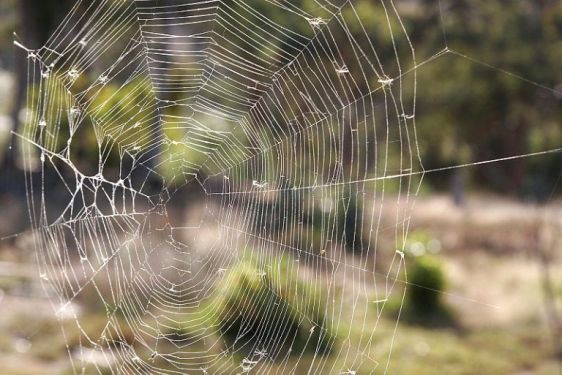
It isn’t possible to live apart from each other. Not truly. The web of life knits us one to another, even if we are unaware of its strands.

Photo by Fir0002/Flagstaffotos, via Wikimedia Commons.

Photo by Fir0002/Flagstaffotos, via Wikimedia Commons.

The ancient sages say that if you pull one thread in the web, the others vibrate.

Quantum physics … the mycelium … the Internet even—all are outer manifestations of this esoteric truth.

For a while now I’ve taken a few moments every morning to ground myself, feeling and seeing my “roots” going deep into the earth. Lately I find myself connecting not just vertically but horizontally, under the earth’s surface, with the mycelium.

There’s a whole world alive under our feet that we don’t usually see. So it is with our energetic world.

Communal

When the sun comes up on these clear mornings, the sky behind the snowcovered trees tints palest tangerine. There’s a beautiful stillness in a frozen world.

Daybreak in the Arctic Vortex

Daybreak in the Arctic Vortex

Something about going through an extreme weather event is lovely in its communal nature. For the second day we are snowed in. We can’t drive out of our alley, and any outings on foot are necessarily short because of extreme wind chills.

So we’ve been keeping tabs on the goings-on in our little burg via a Facebook neighbors’ group.

The dangerous cold and deep snow have given us a glimpse of just how neighborly people are in our quirky neighborhood. I have seen many a plea for help go answered, and many an unsolicited offer appear. Just now someone offered to pick up items on her way home from work if anyone is in dire need. Earlier there was a shout-out to “the awesome guy driving a Caterpillar bobcat and helping people dig out their cars from the aftermath of the plows.”

Someone even asked for—and got—advice on how to get her dog to do his business in this brutal weather. I didn’t read the entire thread, but apparently it was a hoot, discussing canine toileting habits in great detail.

People are offering safe havens, rides to emergency rooms and shelters, and space heaters for those whose furnaces are on the blink. They’re doing for each other in large and small ways—taking baked goods over, walking each other through the crises of burst pipes and power outages, helping everyone feel less alone.

I’m sure this behavior is replicated in many places, much of it never posted anywhere. I didn’t post that the fellow on the corner shoveled not just his walk but the neighbor’s between us, and the guy on the alley behind us helped clear our driveway, but they did, and I thank them.

Dangerous and beautiful

Dangerous and beautiful

Even though I’m tired of being clenched up from cold, tired of the worry over potentially losing power or the furnace konking out (again), part of me relishes these days, both for the astonishing view out my window and for the weird conviviality online.

Part of me wants to put off snowmelt, with its godawful mud and piles of blackened leftover snow. Part of me never wants this communal experience to end.