Localizing the Winery

When is a winery more than a winery? When it contributes to revitalizing a rural community, putting the local economy at the forefront of its mission. Owen Valley Winery, which I discovered on assignment for Farm Indiana, is just such a place.

IMG_20140301_135319

Here’s a look at the piece I wrote for this month’s issue of Farm Indiana.

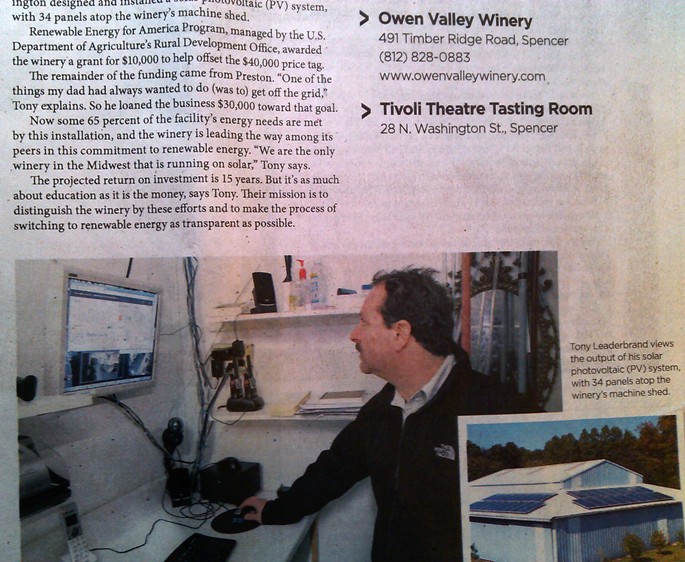
I thoroughly enjoyed my conversation with Tony Leaderbrand (pictured above), who told me the whole story of the family-owned business’s evolution. Aside from their commitment to showcasing Owen County’s locally grown and made products, the winery is unique in another respect. It is the first Midwestern winery to run on solar power.
IMG_20140301_135602

A grant from the Renewable Energy for America Program helped pay for the solar panels that now produce a large portion of the winery’s energy needs.

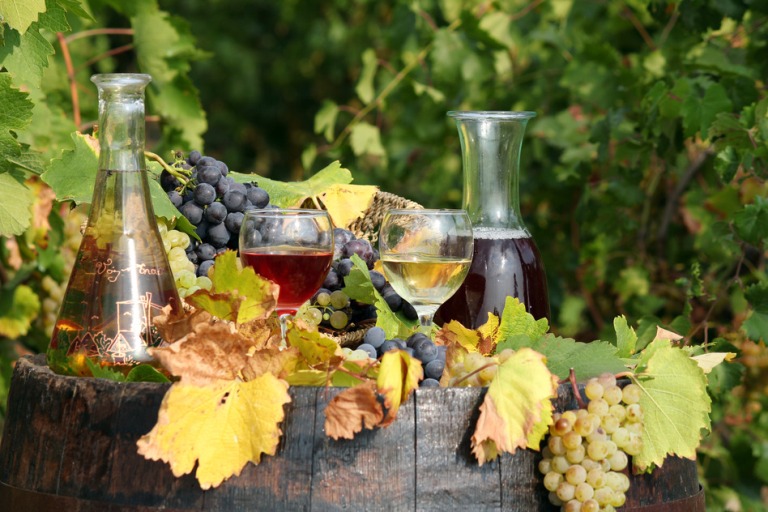
Locally grown persimmons are among the fruits used in Owen Valley Winery’s products. I was moved by stories of people bringing their excess fruit in shoeboxes and buckets every fall to sell to the winery. Tony made me see that winemaking is truly a local ag-based endeavor. (Due to demand for dry wine, they also use some California-grown grapes as well.)
photodune-1133279-wine-s

Photo by groceris, via PhotoDune

Tony told me all about the repurposed items that went into construction of the tasting room and production facility. In fact, the second tasting room is kind of an upcycling project in itself: It’s located in the renovated Tivoli Theatre, a historic building in Spencer, IN.

On a personal note, Tony talked about how eating produce from local farms is a winner both in terms of health benefits and reduced packaging. Not to mention the benefits of keeping dollars circulating in the local community.

“I think there’s such a need for us all to come full circle on purchasing,” he said. “We have to break these old habits of going to these superstores. You’ve got to know where everything you buy comes from.”

You can read the full article here (do a search on Owen Valley Winery to jump to the piece.)

A Lifesized Lego Set for Farmers and Makers

I was invited to visit the Indiana Small Farm Conference this past weekend, and was I ever glad I went. I got to reconnect with some farmer friends and make new connections. I learned about the challenges facing the people who grow our food on a small scale. And of course lunch was delicious, as well it should be with food supplied from local farms and prepared by the stellar whole-foods caterer known as The Juniper Spoon.

But the highlight was a session with a representative from Open Source Ecology. This is a group I’ve had my eye on for a while because of the radical way they are working to take back the building blocks of modern life. The goal is nothing less than a modular, low-cost, DIY “Global Village Construction Set” of 50 machines that would meet the major needs of civilization.

The best part? The plans are all open source, allowing anyone, anywhere, to try them out and make improvements.

The 50 machines, from tractor to 3D printer to wind turbine.

The 50 machines, from tractor to 3D printer to wind turbine.

OSE Construction Manager Chris Reinhart, it turns out, lives just an hour away from me. He calls himself a tinkerer and maker, and holds an architecture degree from Ball State. He is developing plans for a micro-house that could be built by a small group of people in a handful of days, using equipment from the GVCS.

He posts his plans on Facebook and logs his work online for all to see. As a writer I shudder at the prospect of having so many eyes on a work-in-progress, but transparency is the name of the game here. Reinhart says the idea is to “tap the hive mind” and constantly iterate improvements.

Another goal is to standardize workflows. Reinhart explained that a group of 16-20 people could break into smaller teams, each take a module (there’s one for plumbing, one for windows, etc.), and work separately until time to put the construction together. He likened the system to a life-sized Lego set that can be snapped together.

The above TED talk by OSE’s founder, Marcin Jakubowski, talks about how lowering the barriers to farming, building, and manufacturing can unleash human potential. An entrepreneur who wants to start a construction company can jump right in. A household can add a DIY wind turbine and sell energy back to the grid. Farmers can be less dependent on manufacturers.

Think of it: That irritating built-in limitation of purchased gadgets, planned obsolescence, would become a thing of the past as people discover how to build and fix their own machines.

“This is a different model, economically and socially,” Reinhart says. In contrast to a top-down command and control ethos, this bottom-up model empowers many people on the ground, all making and innovating and selling to each other. I love the collaborative “do-it-with-others” spirit of these guys. Go DIWO!

OSE is planning an intensive workshop series to teach people to build six of the 16 machines that have been prototyped so far. For more information, check out this Crash Course on OSE.

Correction: The original blog post indicated that six machines have been prototyped; in actual fact 16 are in prototype phase, and the workshops are being offered on the six most mature designs.

Inhaling the Universe

Andromeda Galaxy, by Cestomano, via flickr Commons

Andromeda Galaxy, by Cestomano, via flickr Commons

“What thrilled me the most was the fact that millions of meteors burn up every day as they enter our atmosphere.

As a result, Earth receives 10 tons of dust from outer space.

Not only do we take in the world with each breath, we are inhaling the universe.”

—Terry Tempest Williams, in When Women Were Birds

Nonviolent Communication

Sometimes you hear about a thing over and over, until it seems mandatory to follow up. So it was with Nonviolent Communication (NVC), a process created by Marshall Rosenberg in the 1960s. First I learned that a yoga center offered NVC training sessions. Then I heard of a book group studying Rosenberg’s Nonviolent Communication: A Language of Life. Then a nonprofit’s director told me everyone in her organization is committed to NVC principles.

And this weekend, Trade School Indy offered an NVC class. All I needed to trade was a bundle of dried sage, which we have aplenty. That plus two hours on a Sunday afternoon seemed a reasonable investment. Off I went to finally check it out.

I learned that NVC is more than a nonthreatening communication style. It’s also a way of taking responsibility for yourself. As I practiced the formula (Observe, Feel, Need, Request) while role-playing a conflict, I sensed I was standing on solid ground. I hate confrontation, but NVC makes me view conflict as an opportunity to deepen relationships.

Communication Art Prize, by Fellowship of the Rich, via Flickr Commons

Communication Art, by Fellowship of the Rich, via Flickr Commons

Rather than asserting control over others through demands, manipulation, or bargaining, NVC is all about building connection over time. The idea is that we all have universal basic needs. Our feelings indicate whether these needs are met or unmet.

NVC “has been used between warring tribes and in war-torn countries; in schools, prisons, and corporations, in healthcare, social change, and government institutions; and in intimate personal relationships.” (Is there hope for the Central African Republic, where Muslims are fleeing “ethno-religious cleansing?”)

Mosque and church, by Jonathan Gill, via Flickr Commons

Mosque and church, by Jonathan Gill, via Flickr Commons

I may not be able to do anything about religious wars and other horrors, but I can create more peace in my daily interactions. Here is a (totally hypothetical) confrontation following NVC’s formula:

Observe: I notice there’s a used QTip on the back of the sofa. (Note the passive voice, a writer’s anathema! But useful in this instance, to neutralize the tone.)

Feel: I feel annoyed and disgusted. (Claiming my own feelings instead of the judgmental,“This is a gross habit. You are so inconsiderate!”)

Need: I need a clean environment, and I need consideration. (I’m struggling with how to state this. So much more satisfying to say, “I need you to not leave your medical waste out for me to find!” Any NVC ninjas in the house? Please coach me.)

Request: Would you be willing to throw your QTip away when you’re done?

In NVC’s highest expression, we request connection instead of a behavior change. “Could you tell me how you feel about this?” or “Would you be willing to spend a few minutes talking this through?” But I’ve cut to the chase above, while still (hopefully) avoiding triggering defensiveness in the hypothetical second party.

One of the women in the class called the method “disarming,” at least in role play. I’m curious to try it in real life. It seems to take a lot of hard thinking, even in the simplest of conflicts.

What about you: What tools have you found beneficial in creating peace and building connection?

A Loved World

I heard two interviews in the last few days with Elizabeth Kolbert, author of The Sixth Extinction: An Unnatural History. While listening to the Fresh Air interview I was making pizza. And I must have decided—or the part of my brain that can’t process too much scary information decided—that making pizza required all my faculties, because I kept zoning out.

But I did hear that 25 percent of all mammals on the earth are endangered, and 40 percent of amphibians.

Photo of critically endangered Panamanian Golden Frog By Tim Vickers [Public domain], via Wikimedia Commons

Photo of critically endangered Panamanian Golden Frog By Tim Vickers [Public domain], via Wikimedia Commons

I did hear that the Great Barrier Reef is on track for full-scale collapse, and that we can expect the oceans to eventually look like “the underwater equivalent of a vacant lot.”

No asteroid is to blame this time. The driver for this extinction wave is humankind.

That’s a heavy load to bear, even if I knew it already. With our tailpipe emissions and our moving from continent to continent and our wildly inventive minds, we are rapidly bringing about the demise of millions of species.

The author makes the point that our impact on other species isn’t (always) intentionally malevolent. It’s the very nature of our speedy brains and dextrous hands. It’s the fact that, as Kolbert says, we don’t have to wait for evolution to create change. We just make a tool. Which makes life difficult for creatures that change at the pace of evolution.

What does this mean? I don’t know. It feels bleak. I like to take the long view, the esoteric/spiritual/energetic view that focuses on evolution of souls, a realm beyond the physical. Still, here on the physical plane, it’s a devastating trajectory.

Self-preservation requires that this knowledge fade in and out of my consciousness. I go about my days, doing what I do, worrying about small things. Then it’s like the moment my dad was diagnosed with inoperable, terminal cancer. Suddenly all that trivia fades in importance. I’m pierced by pain. A loved one, a loved world, is in jeopardy.

© Cinc212 | Dreamstime Stock Photos

© Cinc212 | Dreamstime Stock Photos

I don’t know what to do or say in the face of such hideous information. Just the fact of the dwindling numbers of monarch butterflies alone makes me want to weep.

I find myself wanting to check email, check Facebook, call a friend, watch the Olympics. To do anything but stay with this knowledge.

I can say that all things happen for a reason and everything is unfolding exactly as it should and we are holding the light whether we know it or not and we were always meant to get to this point—but is all that just a bandaid for unendurable grief and fear?

___

I wrote the words above last night. Today, I feel different, grateful, open. I took time to sit in love and awareness this morning. It seems the metaphor of a terminal diagnosis fits better than I first realized.

In the face of horrifying news, sometimes there is an opening to the sacred. Suddenly you savor life more than ever. You don’t take anything for granted. You give what you can. You do what you must. Your love expands.

Portal to the Wider World

“An environment-based education movement―at all levels of education―will help students realize that school isn’t supposed to be a polite form of incarceration, but a portal to the wider world.”

―Richard Louv, author of Last Child in the Woods: Saving Our Children from Nature-Deficit Disorder

A few weeks ago I had the chance to stop in on a special activity at Avon’s Hickory Elementary School. Jen Davies from Avon Outdoor Learning Center—a total rock star in the kids’ eyes—had come to talk minerals. By day’s end 120 children would make the connection between minerals and something they encounter every day, toothpaste.

In each hour-long session, Jen touched on Coke cans’ recyclability, Lunchables’ sodium content, Crest’s new products—and the broad appeal of minty-tasting toothpaste.

Discussing the sodium content of common foods.

Discussing the sodium content of common foods.

Throughout, Jen telegraphed the absolute awesomeness of minerals. These third-graders were right there with her.

This time of year, most of Jen’s work takes place in the classroom, but the Outdoor Learning Center is true to its name in every other season (and on some milder winter days).

Jen Davies leads a group of small learners on a winter outing to catch snowflakes and look at their shapes.

Jen Davies leads a group of small learners on a winter outing to catch snowflakes and look at their shapes. Photo courtesy of Avon OLC.

On seven acres belonging to the Avon School Corporation, students encounter the real-world stuff that makes science, math, and history come alive. Over 9,100 students, parents and faculty members visited the OLC in 2012-13, exploring two miles of trails and habitats spanning prairie, woodland, and wetland. A beehive and 7,000-square foot vegetable garden—tended by a garden club of 85 budding gardeners—offer further learning opportunities.

Back at Hickory Elementary, Jen divided the kids into groups and funneled them to one of four tables to make toothpaste. At one table they measured a half teaspoon calcium carbonate with a quarter teaspoon baking soda, according to the recipe. At the next, they could handle crystals, stones, and a Coke can in the “mineral museum.”

Geologist-in-the-making

Geologist-in-the-making

The final two stations were the most exciting: droppers to add the coloring and flavoring of their choice.

Adding flavoring with help from a volunteer.

Adding flavoring with help from a volunteer.

Would it be tutti-frutti, traditional mint, or maybe cherry, coco-lemon, or some other variation? And what color should it be? Tints of cherries, neon green, and ice blue bloomed in the paper cups.

blue

Blue proved to be a popular color.

Wrapping up, Jen told them, “Minerals are really cool—you might decide on a career using this, where you can do something like make toothpaste.”

When I spoke to her afterward about why she’s so passionate about her work, she told me she wants the children “to see themselves as part of this amazing whole.”

“We are all just circles within connections within circles. We need healthy soil and clean water and clean air to be able to thrive. The choices we make on a daily basis affect not only us but everything around us.”

Sadly, Avon OLC faced major budget cuts in 2011. Jen has been raising money and finding grants to pay her own salary. Late last year word went out that funding had dried up—without help, her position would be gone by this month. Since then several thousand dollars have been raised. It’s enough to keep her, for now, until the end of the school year, but the future is uncertain.

As Jen wrote me in an email, “It’s just so innovatively unusual for a public school district to have such a resource, we are giving it all we have to keep going.  When kids bring me their entire piggy bank, how can I not try everything I can think of?”

Several fundraisers are in the works to keep the center going. Visit the center’s site to see how you can help.

Update: After I posted this, Jen was awarded the 2013 Donald H. Lawson Award for Conservation Education from the Hendricks County Soil & Water Conservation District.

Viva Optimism

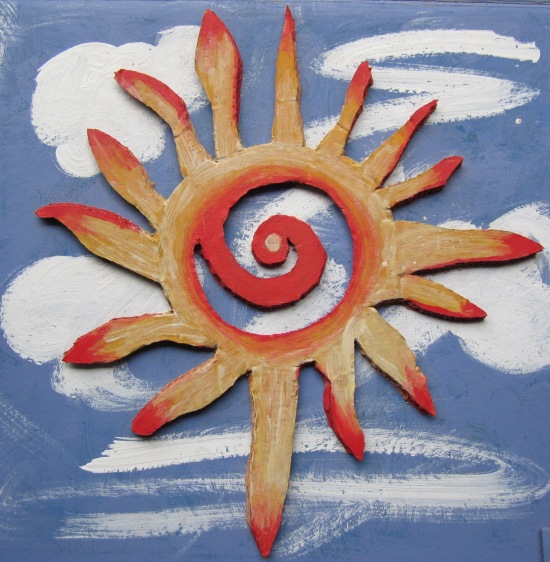
Art made by my spouse Judy for our first solar cooker

Art made by my spouse Judy for our first solar cooker

Optimism is a political act. Those who benefit from the status quo are perfectly happy for us to think nothing is going to get any better. In fact, these days, cynicism is obedience.

—Alex Steffen, The Bright Green City, The Sun Magazine

My Dad, Who Made the World Better, Take 3

Tomorrow, Feb. 2, used to be just Groundhog Day to me. Once I keyed into the seasonal festival days celebrated in ancient times, I knew Feb. 2 as Imbolc—a day to take a walk and look for the first signs of spring.

But now it’s forever associated with my dad, who left this world on Feb. 2, 2012. On that day the snowdrops bloomed and the sandhill cranes flew low. I like to think that his spirit took stock of those harbingers of spring—and that they released him to fly away.

It broke Dad’s heart to leave us, and he hated to leave all his wonderful volunteer work behind. Since his retirement he’d launched all kinds of projects. Possibly the hardest thing to give up was his connection with schoolchildren.

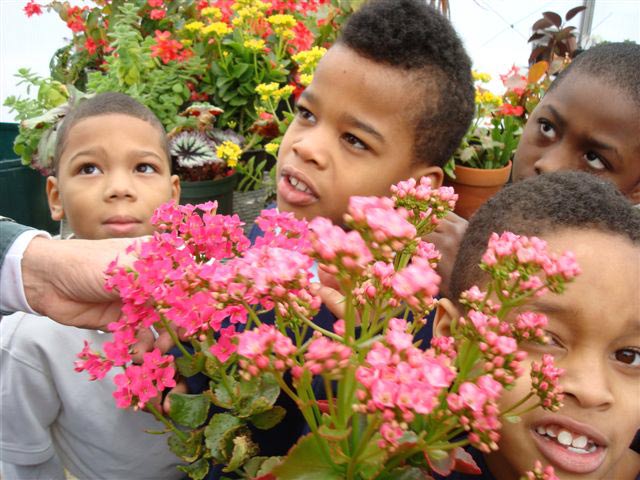
You can't see Dad but you can see how the kids looked at him.

You can’t see Dad but you can see how the kids looked at him.

It all started when he began tending the grounds of Cold Spring School, the environmental education magnet, just because it looked like somebody ought to.

Dad doing what came naturally.

Dad doing what came naturally.

Because he took an interest, he eventually found himself in stewardship of the school’s greenhouse. This was a dream come true for him. (I remember many times in my childhood, he would talk about his dream of putting up a greenhouse.) His passion made it easy to engage the classes who came in for units on seeds, soil, and other such things.

Dad showing grade schoolers the wonders of aloe in the greenhouse.

Dad showing grade schoolers the wonders of aloe in the greenhouse.

After he got sick, when confronted with kudos for his volunteering, Dad liked to say, “I was just having fun.”

Having fun on a wet day at Cold Spring School.

Having fun on a wet day at Cold Spring School.

Just looking at these photos again, I’m swamped with sadness.

No one can fill the void he left. But maybe by having our own brand of fun, we can each take up a tiny spot of it. As the days get imperceptibly longer, what can we bring to the earth, to each other?

Photos courtesy of Friends of Cold Spring School.

A Whole World Alive

I recently heard Michael Pollan speaking on NPR’s Science Friday show about research into plants’ intelligence. He revealed how mycelium (the vegetative part of fungus) figures into communications among the trees of a forest. (We learned about mycelium earlier in Peter McCoy’s guest post on radical mycology.)

Hyphae (branches of the mycelium) as seen under an overturned log. Photo by TheAlphaWolf (Own work), via Wikimedia Commons

Hyphae (branches of the mycelium) as seen under an overturned log. Photo by TheAlphaWolf (Own work), via Wikimedia Commons

Pollan said:

“The trees in a fir forest are networked, in a very complicated network, held together by the mycelium of mycorrhizal fungi, connect(ing) all the trees in a fir forest. A scientist in British Colombia named Suzanne Simard has studied this. She injects a fir tree with radioactive carbon isotopes, and then using a geiger counter and other devices follows the trail of that carbon.

And what she’s found is astounding! All the trees are connected. They use that network to send information, such as warnings of insect attack. They use that network to send nutrients to their offspring…They can even use that network to trade nutrients with other species…”

Isn’t that miraculous? And I suspect that—as the Wendell Berry quote in my previous post implied—everyone and everything, everywhere, might be invisibly interconnected in a similar way.

If this is true, what harms one, harms all. What uplifts one, uplifts all.

Is this possible? Perhaps. On an energetic level. What I’m talking about is rising above the zero sum game that’s so indoctrinated in us. Making space to see that without all of us being OK, none of us are OK.

We lack instruments fine enough to fully measure the energy field surrounding us (and surrounding every natural thing, every boulder and ant and trout and evergreen, every human and tulip and mountain). But I believe that through this field we have an impact on each other, on the whole of life, every moment we live, whether we know it or not.

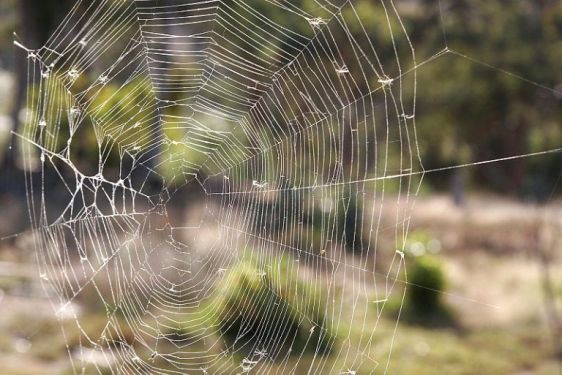
It isn’t possible to live apart from each other. Not truly. The web of life knits us one to another, even if we are unaware of its strands.

Photo by Fir0002/Flagstaffotos, via Wikimedia Commons.

Photo by Fir0002/Flagstaffotos, via Wikimedia Commons.

The ancient sages say that if you pull one thread in the web, the others vibrate.

Quantum physics … the mycelium … the Internet even—all are outer manifestations of this esoteric truth.

For a while now I’ve taken a few moments every morning to ground myself, feeling and seeing my “roots” going deep into the earth. Lately I find myself connecting not just vertically but horizontally, under the earth’s surface, with the mycelium.

There’s a whole world alive under our feet that we don’t usually see. So it is with our energetic world.