A Whole World Alive

I recently heard Michael Pollan speaking on NPR’s Science Friday show about research into plants’ intelligence. He revealed how mycelium (the vegetative part of fungus) figures into communications among the trees of a forest. (We learned about mycelium earlier in Peter McCoy’s guest post on radical mycology.)

Hyphae (branches of the mycelium) as seen under an overturned log. Photo by TheAlphaWolf (Own work), via Wikimedia Commons

Hyphae (branches of the mycelium) as seen under an overturned log. Photo by TheAlphaWolf (Own work), via Wikimedia Commons

Pollan said:

“The trees in a fir forest are networked, in a very complicated network, held together by the mycelium of mycorrhizal fungi, connect(ing) all the trees in a fir forest. A scientist in British Colombia named Suzanne Simard has studied this. She injects a fir tree with radioactive carbon isotopes, and then using a geiger counter and other devices follows the trail of that carbon.

And what she’s found is astounding! All the trees are connected. They use that network to send information, such as warnings of insect attack. They use that network to send nutrients to their offspring…They can even use that network to trade nutrients with other species…”

Isn’t that miraculous? And I suspect that—as the Wendell Berry quote in my previous post implied—everyone and everything, everywhere, might be invisibly interconnected in a similar way.

If this is true, what harms one, harms all. What uplifts one, uplifts all.

Is this possible? Perhaps. On an energetic level. What I’m talking about is rising above the zero sum game that’s so indoctrinated in us. Making space to see that without all of us being OK, none of us are OK.

We lack instruments fine enough to fully measure the energy field surrounding us (and surrounding every natural thing, every boulder and ant and trout and evergreen, every human and tulip and mountain). But I believe that through this field we have an impact on each other, on the whole of life, every moment we live, whether we know it or not.

It isn’t possible to live apart from each other. Not truly. The web of life knits us one to another, even if we are unaware of its strands.
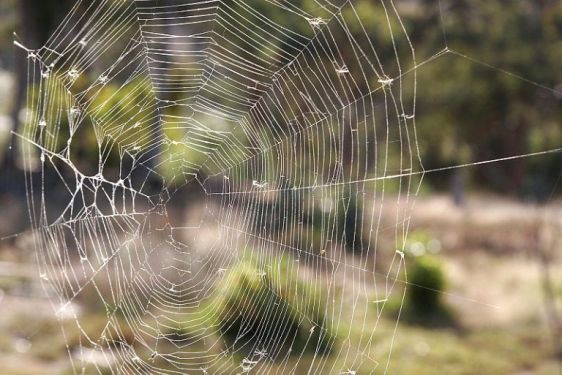
Photo by Fir0002/Flagstaffotos, via Wikimedia Commons.

Photo by Fir0002/Flagstaffotos, via Wikimedia Commons.

The ancient sages say that if you pull one thread in the web, the others vibrate.

Quantum physics … the mycelium … the Internet even—all are outer manifestations of this esoteric truth.

For a while now I’ve taken a few moments every morning to ground myself, feeling and seeing my “roots” going deep into the earth. Lately I find myself connecting not just vertically but horizontally, under the earth’s surface, with the mycelium.

There’s a whole world alive under our feet that we don’t usually see. So it is with our energetic world.

When Crisis Threatens

Thanks to a review in Permaculture Activist magazine, I found a little book called Small Stories, Big Changes: Agents of Change on the Frontlines of Sustainability. It’s a collection of inspiring voices from the community resilience movement. Each chapter is written by someone actively engaged in the world’s remaking.

Here’s a passage from the very first chapter that gives you a taste.

Goat milking, by V Becker, via flickr Commons

Goat milking, by V Becker, via flickr Commons

“(A) community of busy farmers, gardeners, goat-milkers, trail-builders, engineers, scientists, windmill climbers and solar installers…have led our society’s journey toward sustainability…

They are leaders because their excitement is stronger than their fear.

Logically, when crisis threatens we need to subdue our fear in order to take constructive action. But taking action also somehow diminishes our fear…Once we get busy we’re not as scared any more.

Perhaps we don’t control the forces changing our climate when we grow a few vegetables, but we do influence those forces, and I think the activity profoundly changes our perspective. The situation immediately seems more manageable when we begin to manage.”

—Bryan Welch, publisher of Mother Earth News

Photo by julochka, via flickr Commons

Photo by julochka, via flickr Commons

Have you found this to be true? I have, especially when I’ve gotten “the help of a few believers, supporters, and friends who light the way through the dark nights,” as David Orr describes elsewhere in the book. When I am at my lowest is usually when I’ve fallen away from hands-in-dirt activities for whatever reason, or when I’m feeling isolated. It’s easy to fall into this trap in winter especially.

But when I’m pulling together with neighbors to scheme a project or clean up my block or make a big batch of sauerkraut, I feel ready to face anything.

What about you? I’d love to hear about action you’ve taken—and how it impacts your anxiety level about the state of the world.

To Live Passionately

A writer friend and I were talking this morning about our goals for the new year. She said she had but one resolution for 2014: “Forget fear.” Except she used another, shall we say, more pithy F-word for her intention around fear.

Later, scanning through my notebook from the past few months, I came across this passage from Nov. 7, which followed a week of extreme doldrums:

Tired of being unconscious, but scared to wake up! Yet that fear seems foolish in light of the many ways we could bite the dust—globally/regionally/personally, calamitously/suddenly/slowly—oh so many options for becoming vapor, energy, disembodied once more. [I was thinking of the Oct. 25 earthquake off Japan’s coast near Fukushima, among other things.]

FukushimaIsHere-Sticker_1So keeping that in mind, how do I live? I want to live passionately.

Did you hear about the child for whom Make-a-Wish is transforming San Francisco into Gotham City, so he can be Batkid?

Photo by Bhautik Joshi, via flickr Commons

Photo by Bhautik Joshi, via flickr Commons

You see where I’m going with this. In our dying we become superheroes.

Thinking of the Buddhist injunction to remember the unalterable fact of our own death, I ended up musing: What do we have to lose?—the exact phrase my friend used this morning.

It seems ridiculous to dither about in fear and worry when we could be gone at any moment. And meanwhile all of life is calling us to be a force for good.

So how about it? Shall we create a passionate, conscious, fearless, superheroic 2014?

Crowd-funding the New Frontier: Radical Mycology

Here’s a chance to support a radical mycology project seeking to put a potent tool for restoration in many more hands. Mushrooms can break down and eliminate some of the most toxic industrial compounds in the world, representing enormous untapped potential for healing our beleaguered planet.

Not to mention the fact that mushrooms are a phenomenal source of protein, potentially boosting community-level food sovereignty.

Be part of this new frontier by funding this resource for would-be radical mycologists, and/or helping to spread the word!

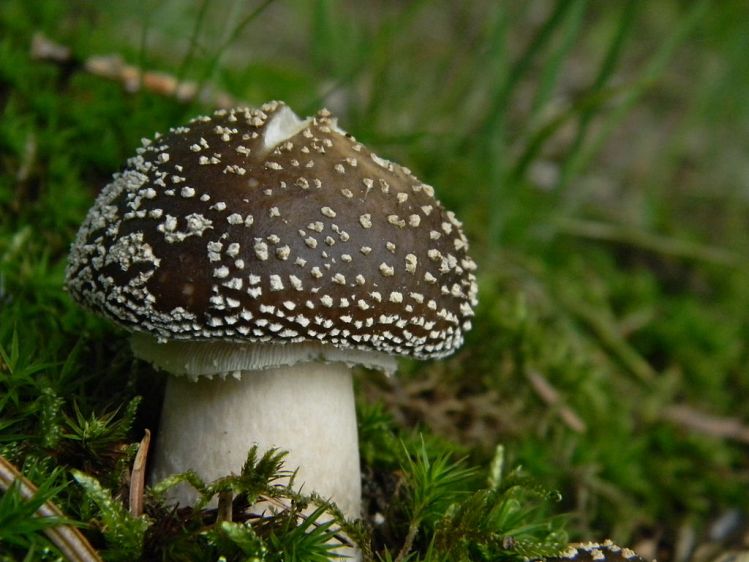
By Alaricmalabry (Own work), via Wikimedia Commons

By Alaricmalabry (Own work), via Wikimedia Commons

Below is a note from Peter McCoy, who recently contributed a guest post about the lessons mushrooms have taught him:

The Radical Mycology Book fundraiser is underway! This unique book on the uses of mushrooms and other fungi for personal, societal, and ecological wellbeing will be a powerful resource for the geek and do-gooder inside us all and we are excited to bring this dream to the rest of the world.

You can view the live campaign here:

http://bit.ly/radmycogogo

Whether or not you are in a position to donate, one of the most important contributions you can make would be getting more people aware of this fundraiser by emailing your friends and re-posting on your social (mycelial) networks.

Share the campaign on Facebook:
http://bit.ly/rmifbshare


Thank you so much for contributing to this project and vision!

Mush love!
Peter and The Radical Mycology Collective

To be Fueled by Love

Browsing the shelves of Point Reyes Books last month, I picked up Mary Pipher’s latest book. Her Reviving Ophelia illuminated the struggles of adolescent girls. Now she has a book called The Green Boat: Reviving Ourselves in our Capsized Culture, detailing her progression from despair to activism.

A Nebraskan, Pipher was on the front lines of early campaigns to stop the Keystone XL Pipeline from going through the Sandhills. (Three years later, the pipeline is still in limbo, and has become a symbol of the fossil fuel industry’s disastrous impact on the planet.)

Dismal River, Nebraska Sandhills. Photo by USFWS Mountain Prairie, via Wikimedia Commons

Dismal River, Nebraska Sandhills. Photo by USFWS Mountain Prairie, via Wikimedia Commons

Even before opening it, I knew this book would return me to grounding.

I’d been talking with Richard Heinberg about his book The End of Growth, which describes a trajectory that I understand and yet can’t quite face head-on. Seeing it spelled out and hearing him expound on it left me feeling quite scared.

I know that many are pulling together for a better world. But our governmental policies favor the monied corporations running the show. I was starting to doubt that community action could effect change on that level.

Along comes Pipher, describing an activism that’s joyful and even fun. Example: grandmothers gave weekly “thank you in advance” pies to the Nebraska governor until he agreed to meet. This brand of protesting, fueled by love of the land and concern for tomorrow’s denizens, seems the perfect antidote to despair.

A chapter called All Hands on Deck begins with this quote from Frederick Buechner:

“God calls you to the place where your deep gladness and the world’s deep hunger meet.”

To be glad in the face of the world’s rending sometimes seems impossible. Yet I remember opening the church basement doors on the day of our SkillShare and seeing the space instantly fill with participants, their faces alight with curiosity. I think of the heart-cracking instant when a resonant phrase finds my fingers on the keyboard. I recall the joy of putting a garden trowel in the hands of a preschooler.

There’s an expansiveness when I reflect on these moments, a sense of the heart opening that lifts me from powerlessness.

Explaining vermiculture at the Irvington SkillShare. Photo by Jeff Echols.

Explaining vermiculture at the Irvington SkillShare. Photo by Jeff Echols.

Pipher acknowledges the “experts” who downplay the importance of individual actions. They say systemic economic and political changes are necessary to change this trajectory. True enough, but this reasoning is incomplete, says Pipher—for “who is it that is in charge of systemic change?”

She argues that individuals have always been the source of world-changing actions, and what else can one person do but start with herself? And join others in common cause, as did the abolitionists. It’s said that they had no hope of success, at the start.

My small self is quick to tell me what I’m not. I’m no naturalist, no doctor of philosophy, no career activist, no farmer, no wisewoman in a mountain hut. I am just myself. Sometimes I question: What do I have to offer?

I only own this experience, this deep heart of pain and care, grief and fear—and love. 

What do I have to offer? All of it. I offer it up.

[More from Mary Pipher: Read her interview on how to wake up and take action on climate change (and stay sane).]

Julia Butterfly Hill: What our Hearts Know

Belated postcard from Hopland, CA: It was a thrill to hear Julia Butterfly Hill speak at the Building Resilient Communities Convergence. This is the woman who spent most of 1998 and 1999 living in the canopy of an ancient redwood tree named Luna. Her extended protest brought attention to the plight of ancient forests and resulted in a three-acre buffer zone around Luna.

Julia Butterfly Hill in 2005, via flickr Creative Commons, by Scott Schumacher

Julia Butterfly Hill in 2005, via flickr Creative Commons, by Scott Schumacher

Now she calls herself a wholistic healthcare practitioner instead of an activist, because she is working on the “disease of disconnect.” What struck me about Julia is how much she embodied a heart-centered ethic. She began by expressing a commitment to affirming “what our hearts know: That we are all one.”

There’s little in our culture that supports the kind of inner transformation needed now. Julia called this era a time of spiritual crisis. “That place inside ourselves that is just ancient and knows only connection is in crisis.”

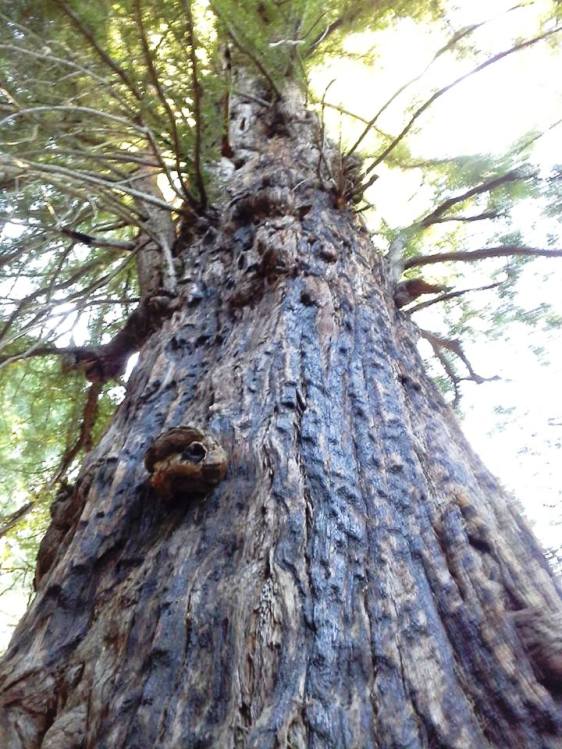
Methuselah, an 1800-year-old redwood in Woodside, CA

Methuselah, an 1800-year-old redwood in Woodside, CA

“What is it going to take to rebirth ourselves in this world where we are?” was her central question. She said it is a courageous act to keep our hearts open, because it means being open to the suffering of beloved creatures, communities, and ecosystems.

I appreciated that she called us to stay aware of our own tendency to rigidity, cautioning: “Any time we are passionate about anything, we are one breath away from being a fundamentalist.”

She invited us to “live so fully and presently in love that there is no room for anything else to exist.” To ask, What would love do in this space? What would love say in this room?

She said we need to bring all our integrity to bear in modeling a positive vision for the world. “We are so good at defining what we are against that what we are against begins to define us.” But it is also crucial to stand firm against wrongdoing. Even the campaigns that failed, she said, she would go back and do again.

It’s a matter of offering ourselves “in loving and joyous service to our world.”

Truly a transformative figure.

Protection

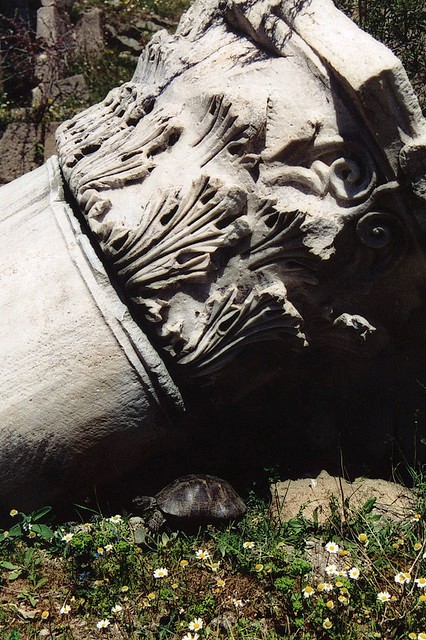
 A turtle among the Roman ruins at Pergamon, Turkey. Photo by Nick Leonard, via flickr Commons


A turtle among the Roman ruins at Pergamon, Turkey. Photo by Nick Leonard, via flickr Commons

Nothing protects us but our constant awareness and rededication to embody our values as much as we possibly can, and to be gentle with ourselves and others when we fail in this.

Michael Lerner

Postcard from Hopland, CA

This weekend was the big Building Resilient Communities Convergence in Hopland, CA. I was excited to be there for part of the action.

A highlight was the mycology skillshare, during which Fungaia Farm‘s Levon Durr demonstrated several methods for home mushroom cultivation.

Teaching how to cultivate oyster mushrooms at home using the stem butt/cardboard technique to grow your own spawn. Sweet!

I didn’t know until recently that shrooms actually are a source of protein. This makes me even more determined to try cultivating my own.

I thought Levon was going to levitate when he got to the part about mycoremediation. His enthusiasm is not misplaced: Mushrooms can clean petroleum from drainage ditches and aid in riparian zone restoration. They even eat heavy metals and bacteria.

The practice of using fungi to clean our beleaguered earth of toxins is one of the most hopeful stories I’ve heard. It is also the subject of an upcoming guest post from Radical Mycology, so stay tuned.

Vacant Lot Becomes Community Space

Guest post by Lisa Boyles

My vision is to give purpose to a vacant lot. Where once stood abandoned houses, there will be a reflection space with a labyrinth and a community art installation.

In June 2013, we brought light to this space on the longest day of the year with a circle gathering and a modified sun salutation series. The children at this gathering helped decorate a stepping stone for the labyrinth entrance.

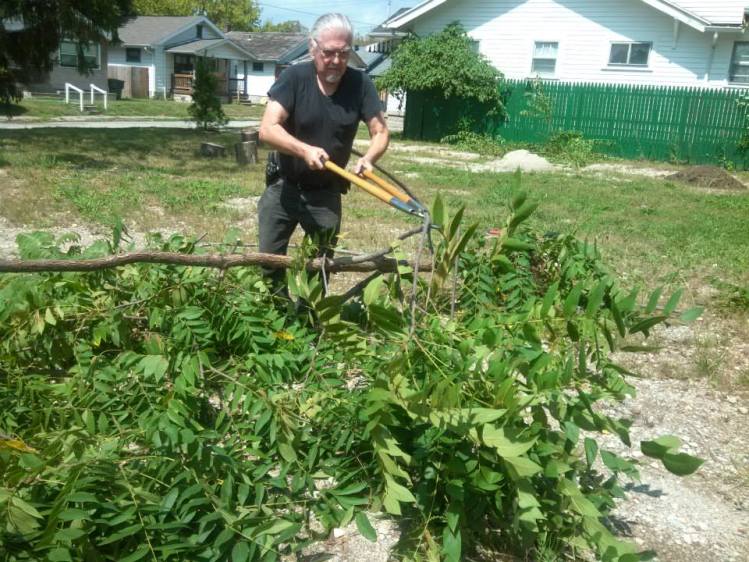
Since the summer, various people have joined me at this lot on the Near Eastside of Indianapolis. We have prepared the ground, moved bricks, unloaded wood, and removed trees. It is enlivening to get in touch with the dirt and have ruddy cheeks from working so hard outside.

Gordon removing an invasive tree.

The transformation from empty lot to Rivoli Park Labyrinth is primarily funded through a community action grant from Peace Learning Center‘s Focus2020 initiative.

The vision of Focus2020 is to create an engaged and inclusive city. I was one of several grant awardees at the beginning of September. The collective effect of these grants will be seen throughout the city over the course of the next year. The Peace Learning Center offers workshops so that more people can become Focus 2020 graduates.

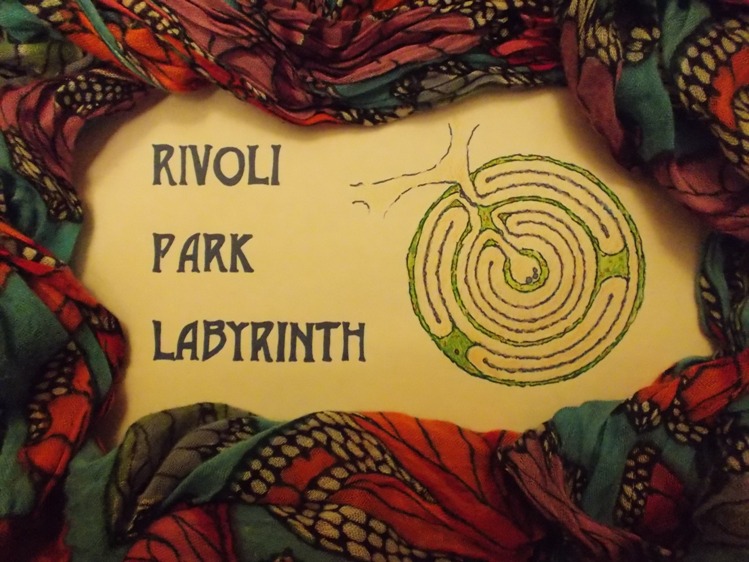
John Ridder of Paxworks: the Labyrinth Shop created the triune focus design of the Rivoli Park Labyrinth.  Logo by Susan Williams Boyles.

John Ridder of Paxworks: the Labyrinth Shop created the triune focus design of the Rivoli Park Labyrinth. Logo by Susan Williams Boyles.

The Rivoli Park Labyrinth project brings the international labyrinth movement to an urban neighborhood setting. Our space will be listed in the worldwide labyrinth locator, putting the eastside of Indianapolis on the labyrinth map.

To offset the often solitary nature of walking a labyrinth, this project also includes a healthy dose of community celebrations. For example, on May 3, 2014, we will celebrate World Labyrinth Day. And workdays at the site include a potluck to celebrate our growing community.

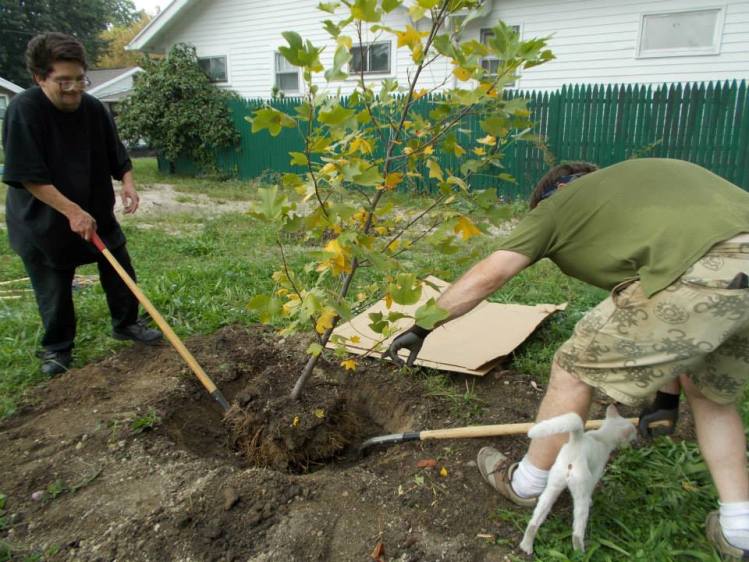
Aaron, James and the neighborhood cat moving a young tree to a new place to make room for the labyrinth.

Aaron, James and the neighborhood cat moving a young tree to make room for the winding path of the labyrinth.

Many partnerships are arising from this effort to give purpose to a vacant lot. One example of that synergy involves the documentation of the upcoming Oct. 10 workday (part of Indy Do Day). A KI EcoCenter videography intern is mentoring another young man that he met through this project. We can’t wait to see their collaborative videography of the workday, when volunteers will place bricks outlining the labyrinth path.

Meanwhile, the soil needs repairing and we plan to use hugelkultur to do it. We’ll mound soil and compost over woody debris and put our plantings on top of that mass. Permaculture designer Katherine Boyles Ogawa says, “Hugelkultur is an ideal method for urban lots where the soils are usually very compacted and often contaminated with heavy metals.”

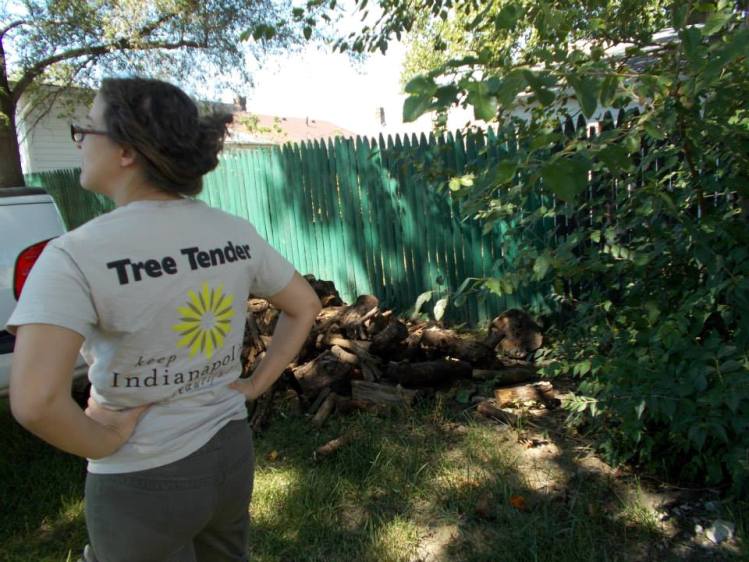
Permaculture designer Katherine supervises unloading of logs for hugelkultur.

Permaculture designer Katherine supervises unloading of logs for hugelkultur.

We hope to eventually make the space into a certified wildlife habitat through the National Wildlife Federation.

Another goal is to display artwork and illustrated quotes along the fence. Panels would be created by special education students at the nearby public school and the art group at Midtown Community Mental Health Center.

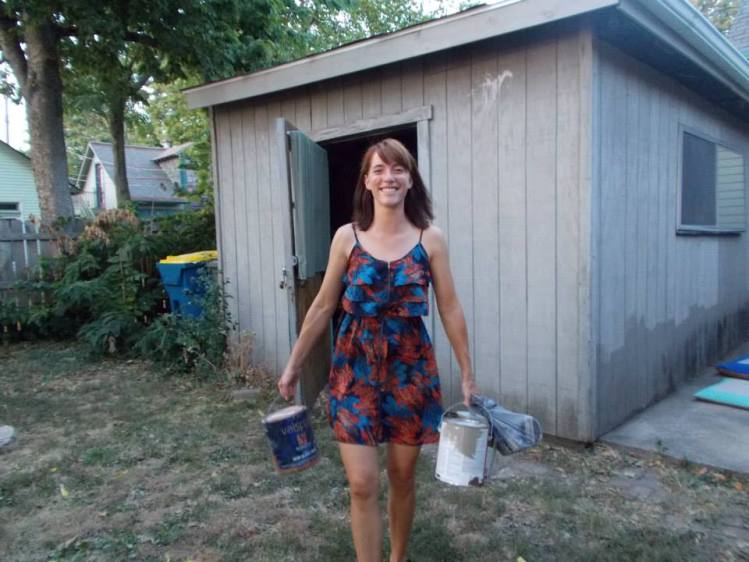
Sarah donating paint for the community art wall

Sarah, a fellow Focus 2020 workshop participant, donating paint for the community art wall.

The community art aspect of the project is being funded through this crowdsourcing site.

We would love to have you join us in celebrating a year of this project coming into being on the summer solstice, June 21, 2014.

Like the Rivoli Park Labyrinth Indianapolis Facebook page to see project news. Join the Rivoli Park Labyrinth community group to collaborate with others and be invited to the annual celebration. We will post monthly featurettes and more detailed updates on our blog.

My Day at School

Yesterday I drove down to Bloomington to spend part of the day with my homeschooling coop friends. These two families use homesteading activities as the basis for their children’s learning, along with traditional math workbooks, writing assignments and the like.

The task of the morning was to prepare cedar limbs to build a spit for cookpots over a campfire. The previous week, the kids had cut branches off the cedar tree, with a goal of being able to climb it. They’d christened it Fort Cicada.

Climbing ropes and nubs of branches make it easier to scale Fort Cicada.

Climbing ropes and nubs of branches make it easier to scale Fort Cicada.

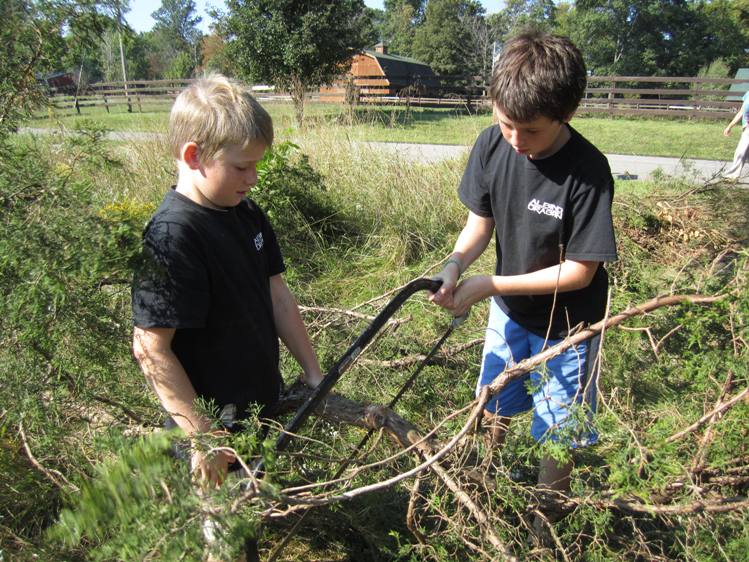
The brushy limbs now needed to be trimmed and the bark removed with a draw knife. The kids coached me on sawing. I can’t remember the last time I sawed something. It’s satisfying to cut right through a branch and have it fall.

Prepping the cedar limbs for use as fence posts and building material

Prepping the cedar limbs for use as fence posts and building material

The draw knife was a revelation. I have never experienced the pleasure of skinning a tree branch with a sharp instrument. I wasn’t sure I was qualified for the work, but the kids taught me well.

Using the draw knife

Using the draw knife

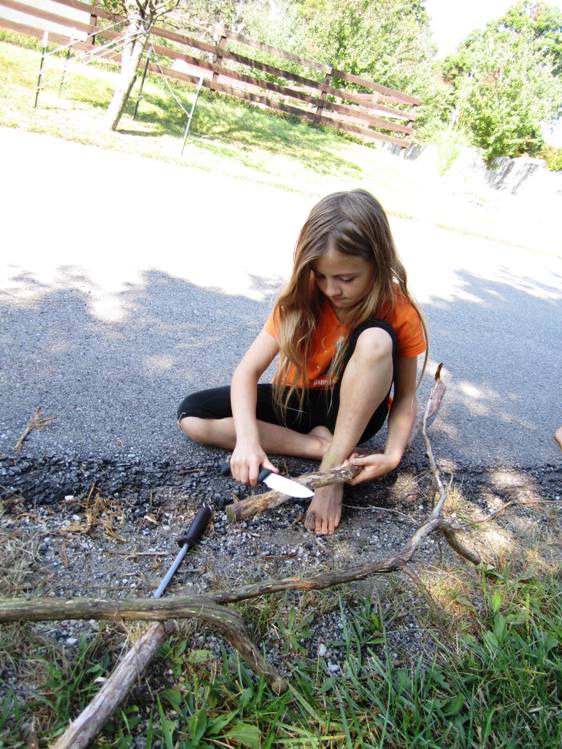
They assured me that they would use a regular knife to shave around the knots where the draw knife caught. Here’s the youngest, working with her knife.

Knife skills

Knife skills

I love how fearless these kids are. I find that my own hands are better suited to a keyboard than a hand tool. Yet, I pulled off a passable job on bark-peeling task.

Proud of my handiwork

Not bad for a beginner

After a while it was time for lunch (fresh-baked bread!) and conversation. I asked the four kids what life would be like if they went to a school where they sat at desks all day. They agreed that they wouldn’t have nearly as much fun and flexibility in their lives, and probably not be as fit. Nor would they spend as much time with their families. On the flip side, they have to schedule activities to connect with larger groups, whereas students in school interact with lots of different kids daily.

Asked how their education is preparing them for adulthood, they pointed to skills like gardening, cooking, and researching solutions to problems.

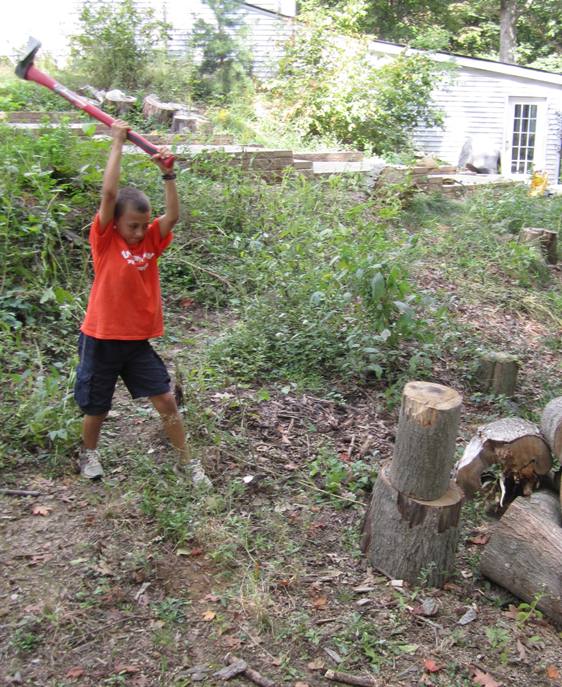
After lunch, it was time to split maple logs and stack wood for the winter’s fuel. This was more fun than I expected. I consider myself something of a pipsqueak—but seeing the kids demonstrate, I thought, why not try?

Demonstrating wood splitting

Demonstrating wood splitting

After numerous tries and tons of pointers from the peanut gallery, I managed to stick the splitting maul in the top of the log. I whapped at it with a mallet till the firewood split with a satisfying crack.

Alas, no one captured the moment on film, but I have the sore muscles to prove it.

All in all it was a great time with lovely people, and felt wonderful to be outside doing real work on a pristine fall day.