KI EcoCenter: Transforming Education

Second in a series on education
KI EcoCenter, or Kheprw Institute, has been making change for nearly a decade in my hometown. In recent years, educator Khalil MwaAfrika came on board the community empowerment center to start an independent school. He was tired of discussing school reform while watching the educational system destroy African-American children, particularly boys.

Khepri, by Jeff Dahl via Wikimedia Commons

Khepri, by Jeff Dahl (GFDL or Creative Commons) via Wikimedia Commons

Instead of reform, he is invested in nothing less than education’s complete transformation. As  mentioned in a previous post, “Kheprw” was an Egyptian god with a scarab beetle head. This beetle was a symbol of rebirth in Egypt—so the center is fittingly named.

KI’s school offers a rigorous program for African-American students. Classes are very small, allowing a high degree of mentorship. Community members interact with the students every day in this intergenerational model.

MwaAfrika emphasizes that igniting a passion for learning is key. Instead of promoting a particular ideology, faculty create space for discourse and dialogue. In that environment the children learn critical thinking skills. They are encouraged to puzzle things out themselves.

In contrast with the traditional school system, here there is no need for the youngsters to feel they must give up their own rich culture in order to succeed.

This issue came up repeatedly at the center’s recent Real Talk Summit on urban education. Because our dominant culture is white/upper middle class, racism is the water we all swim in—leading to schools that don’t believe in children from other races and classes.
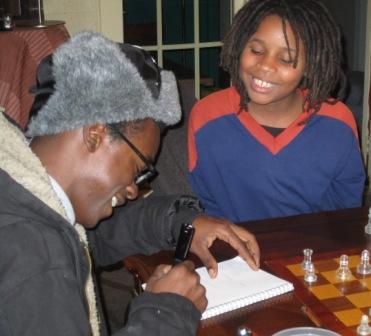
A faculty member and student at KI EcoCenter Community School

A faculty member and student at KI EcoCenter Community School

But KI is different. “We’ve set up an environment where (black students) can be themselves, where they can learn exponentially, where they never have to compromise who they are,” MwaAfrika says.

KI founder Imhotep Adisa notes, “The primary purpose of education is indoctrination. It’s not liberation.”

Part of that indoctrination is the consumerism that is jeopardizing the earth. “We’re at a very ugly place in the history of the planet,” he says. “Regardless of gender, race, and class, the old paradigm has accelerated this…We have to develop new tools for a new paradigm. We have to have the courage to say, ‘That’s not the world we want for ourselves and our children.’”

KI’s adults model that courage every day. Teaching youth to interface with the culture of power while retaining their identity is a critical aspect of their work.

Social enterprises are part of this, as the students work with KI’s bootstrappers (young adults) to develop the skills needed to thrive in a resource-strapped world.

Barrel at left is via KI's Express Yourself Rainbarrels enterprise, with my chosen artwork

Barrel at left is via KI’s Express Yourself Rainbarrels enterprise, with my chosen artwork

Above (at left) is the rainbarrel made by bootstrappers and students for my urban homestead, via the Express Yourself Rainbarrels enterprise. My partner added it to our rain catchment setup, just in time for big rains.

(Indy-area readers, check it out: Save on your water bill, display your artwork, and support a great organization all at the same time.)

Read more about KI’s work in my Indiana Living Green story.

Next: Bloomington’s homeschooling cooperative, exploring the homestead as learning environment.

Pass the Book, Please!

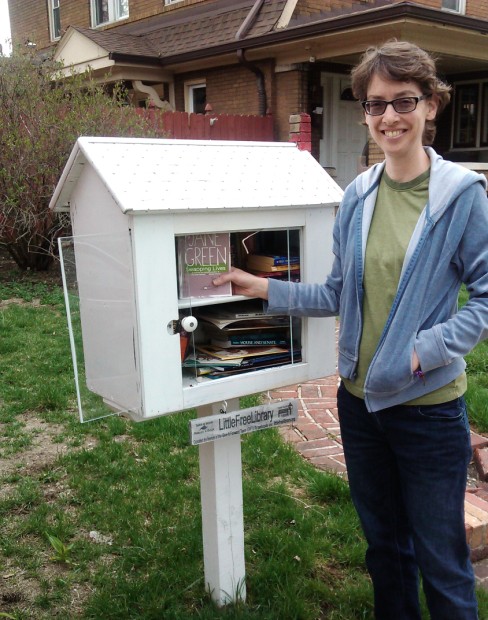
On my walks through the neighborhood I have encountered a curious thing: a little house-shaped structure mounted on a post, with sliding glass doors enclosing one of my favorite things: books!

Little Free Library in my neighborhood

Little Free Library in my neighborhood

It is a Little Free Library, part of a worldwide network designed to cultivate the love of reading by setting up free book exchanges.

Gotta love that. I decided to donate a book and take another home, just for fun. I’d like to say my donation was carefully selected after much intensive soul-searching, Top Ten list-making, and pick-pondering, but the truth is I had just visited Bookmamas, our little independent bookstore, where I was given three advance reading copies of books marked NOT FOR RESALE, so I stuck one of those in.

Putting my book into the mix.

Putting my book into the mix.

The little house-o-books was crammed chock full. Perhaps more people need to stop by and check out the selection.

I came home with a book called Dune Road, by Jane Green. It’s a novel about “divorcee Kit Hargrove (who) has joyfully exchanged the requisite diamond studs and Persian rugs of a Wall Street Widow for a clapboard Cape with sea-green shutters and sprawling impatiens….” Not my usual fare, but hey! I’m open.

Me and my find

Me and my find

I just love the coziness of the little structure, and the community feel of it. I want one in front of my house! (Neighbor-readers out there: do you know if this little library’s stewards made it by hand–or other details about it? No one was home when I knocked–or perhaps they were hiding from the camera phone-wielding/windblown/book-crazy stranger on their doorstep).

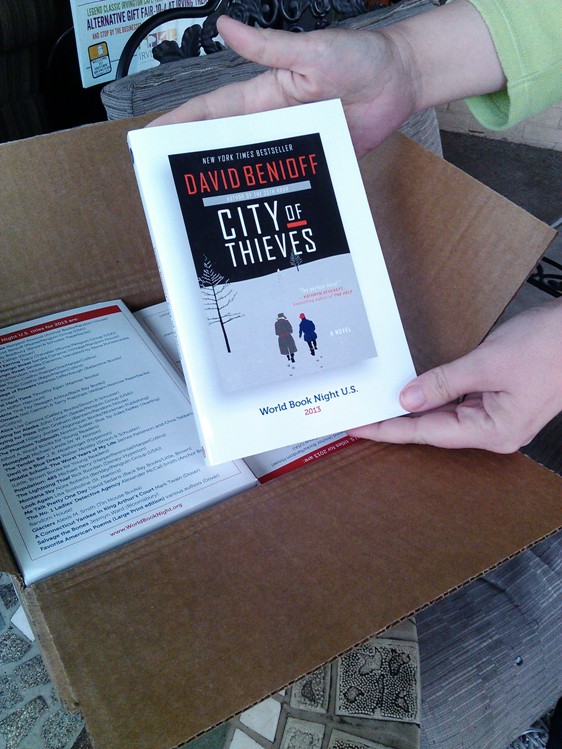
I was just wrapping this post up when the friend working across from me at the coffee shop mentioned that Tuesday is World Book Night, wherein book-lovers sign up to distribute 20 copies of a book–printed and shipped pro bono, with authors foregoing royalties–to people who don’t regularly read. She had ordered a box of books to pass out, so we stopped over at Bookmamas to pick it up.

Special edition books for World Book Night, designated to be given free

Special edition books for World Book Night, designated to be given away

Anyone out there ever participated in a book exchange or giveaway? Are you participating in World Book Night? Chime in and let us know what’s going on in your neck of the woods.

In Troubled Times

This morning when I looked out my front window, I saw that the juneberry we planted two years ago was budding. Through the rain I could see the sketch of pale green buds dotting each limb, all the way out to the tips–with the promise of sweet berries contained in each one.

Buds that will open into a white blossom, eventually fruiting into delicious berries

Buds that will open into a white blossom, eventually fruiting into delicious berries

The young tree has made it through two of the hottest summers on record, and those tender buds gave my heavy heart a lift.

We planted it because we wanted to grow fruit on our lot, and we nurtured it with weekly waterings through crippling drought and heat. When the rain barrel went dry, I carried buckets from indoors, saving shower water, cooking water, and the dehumidifier’s daily emptying–occasionally breaking down and stretching the hose across the lawn to let it run for a slow hour.

There’s a passage I like from Buddhist teacher Thich Nhat Hanh, called Interbeing. It begins:

“If you are a poet, you will see clearly that there is a cloud floating in this sheet of paper…”

My tree contains multitudes. It has the memory of picking juneberries with my dad a few years ago, before he got sick, before he died, in the forgotten pocket park wedged between two busy streets. There were three small trees just loaded with juicy wine-colored berries. Dad picked from the high branches and left me the low ones. When the low limbs were picked clean, he pulled the ends of the high branches down so I could reach.

Also part of my tree is Jason, the neighbor who helped dig the hole and position the root ball on planting day. And Jerome, the young man who brought it to us through his work with Keep Indianapolis Beautiful. This year Jerome has parlayed his passion for trees into his own business as a certified arborist, Tree-Centric Solutions–pledging to not only plant, treat, and prune trees, but find uses for wood from trees that can’t be saved.

My juneberry even holds the “woman tree,” an old redbud whose upreaching shape I cherished. I called her that because she always looked so feminine to me. The woman tree was just beyond where the juneberry is now, and she had to come down because half the branches were dead. Taking her out meant we freed up room for a fruiting tree.

Irony: I learned that redbud flowers are edible just after we had ours cut down. I could have decorated so many salads with the woman tree’s bounty. Not only that, but Jerome’s service came too late for her: What I wouldn’t give to have something made from the wood of that beloved redbud!

So all that’s in this juneberry too: my regrets, my ignorance, my wishing things were otherwise. But mostly, these are outshone by pride and hope.

I share all this because in troubled times, sometimes things like this can help: a small tree in the rain, holding memories and care, covered in promise.

I’ve Got a Tin of Sardines…

…and I’m not afraid to use it!

By jules (Flickr: sardines in a can) via Wikimedia Commons

By jules (Flickr: sardines in a can) via Wikimedia Commons

Actually, I am, a little. I bought the tin weeks ago at the Co-op in hopes of eating lower on the food chain. I have not yet worked up the nerve to peel back that shiny lid and peek inside. I may need a clothespin for my nose when I do. Little fishies can be so…fishy.

But I’m determined to conquer my fear of the little fishies and make them part of my diet. Or at least ingest them once and see if it’s possible to consider…one day…loving them as much as I love salmon. Why? Efficiency of dining, mainly. If I eat a sardine instead of the big fish that eats the sardine–no matter how much more appealing said big fish might be–I reduce my impact.

It seems I know too much. And I can’t un-know what I know. What we eat has consequences. In the case of seafood, overfishing is rampant, and then there’s pollution, climate change, habitat destruction, and ocean acidification. Leaving us with a “system in crisis,” according to the National Geographic.

All that knowledge makes my fallback choice on any restaurant menu, salmon, seem a bit fraught.

Though according to the National Geographic Seafood Decision Guide, salmon–at least wild-caught Alaskan salmon–is actually one of the better choices in the ocean-going protein buffet. It is “abundant, well-managed, and caught or farmed in ocean-friendly ways.” Three cheers for that.

But sardines are equally well rated, equally low in mercury, and equally high in omega-threes. Then there’s the fact that it takes five pounds of forage fish to produce a pound of farm-raised fish. So I still feel bound to try these little fishy-fishes.

By TANAKA Juuyoh Uploaded by Jacopo Werther) via Wikimedia Commons

By TANAKA Juuyoh (Uploaded by Jacopo Werther) via Wikimedia Commons

It strikes me, unpleasantly, that they’re kind of like the worms and grubs of the ocean world. Grubs are food for birds; sardines are food for bigger fish, and for chickens and pigs too.

No matter: I’m sure they’re deelish. (Just like grubs, which, after all, are food for people all over the world. I wrote a piece about that once, and fully expect to one day venture bugward in my dining.)

Helpfully, in the meantime Slow Food International has begun a push for upping human consumption of anchovies, complete with recipe contest. (Nate at the Co-op shook his head at my sardine purchase and advised anchovies next time.)

Oh faithful readers, do you eat sardines or anchovies, those humble fishies known as forage fish? If so, pray, how do you fix them? Give me some ideas to go with Slow Food’s and Rachael Ray’s suggestions. I promise to report back after my first foray into this brave new culinary world.

The Quiet in the Land Gets Loud

Mom had a dream in which I was kidnapped in South America and she spent her retirement money to find me. When found, I had grown so accustomed to living among the jungle people, I didn’t understand why I should keep my breasts covered.

I asked her, are you worried about me exposing myself, perhaps through this new blog? She didn’t think so.

But it’s a perfectly legitimate concern, one I deal with all the time in my own head as I try to rise to the occasion here. My cultural background is Mennonite, and there are a lot of prohibitions against standing out. My Amish forebears were “the quiet in the land,” the “plain people.”

And though less strict than the Amish, Mennonites are still big on humility. We aren’t supposed to shine too much, or get too high on ourselves, or in general stick our necks out too much. There’s safety in the tribe, in being like everyone else.

Lancaster County Amish 02

By it:Utente:TheCadExpert (GFDL or CC-BY-SA-3.0), via Wikimedia Commons

Of course, being “plain” in the Amish sense means that even while everyone looks the same within the tribe, you stand out against the larger culture in a big way. Your dress, your home, your whole way of life is a rebuke of the world’s fancy-yet-empty ways.

Nonconformism is in fact one of the central tenets of the Anabaptist faith, and I absorbed that ethic as a Mennonite child. To be in the world but not of the world—that was the ideal.

Which may be why I naturally view the dominant culture with a critical eye.

Recently I read Seth Godin’s Tribes: We Need You to Lead Us, and it showed me that we all need to be leaders now. It helped me to take my place as such, to step into this somewhat uncomfortable role. Writing is the gift I have to offer, so I write in service of the world I want to manifest–even if it means going against the ancestral voices that tell me to keep my head down.

Over the last several years I’ve led groups in various successful community endeavors, such as the Irvington SkillShare. So claiming “leadership” shouldn’t be such a stretch, but somehow it still is. (As a teen I heard my peers talk about attending “leadership camp,” and I knew I’d sooner tear my toenails out one by one than do such a thing. Leadership was for kids with confidence. Kids who didn’t mind speechifying. Kids who didn’t need to be humble.)

But there’s an urgency about this time, a sense that we need all hands on deck. We can’t afford to shirk that responsibility out of an ingrained belief that it’s dangerous to stick our necks out. We can’t afford “I’m not enough, I’m just a dumb /fill in the blank/.”

Enough of that. It’s time to get in the game. Let the “quiet in the land” get loud.

What’s your gift, and how are you becoming the leader we need today?

Of Specks and Seeds

“If you think you are too small to be effective, you have never been in the dark with a mosquito.” –unknown/various attributions
Seuss

I recently rewatched the animated TV special Horton Hears a Who, some 35 years after I first encountered it, because I wanted to see if a pivotal scene was as I remembered it. Based on the Dr. Seuss book, the DVD has Horton the elephant finding a speck of what appears to be dust, and hearing a voice calling from it. It emerges that the speck is actually a microscopic planet with a whole race of people called the Whos, living in Whoville.

The only one privy to the voice, Horton keeps the speck-planet on a clover blossom and protects it from harm, though his enemies mock him. The voice belongs to a scientist who has built an elaborate machine to carry his voice up through the clouds. Through this apparatus, his voice pierces the planet’s atmosphere and reaches Horton. No one in Whoville believes there’s a world beyond the one they know; no one in Horton’s jungle believes there’s a little world in that speck.

Works as an allegory on so many levels; thank you, Mr. Geisel!

But let’s stick to musing on the power of small things. You know that saying about the mosquito? I’ve thought of numerous corollaries. A splinter. An eyelash out of place. The spark that sets the proverbial forest afire.

Did you know that a little snip of bindweed root in the garden can form an impenetrable mat in the soil, extending roots 30 feet underground?

Or, in a less irritating vein: How about a single seed? Now there’s power.

sunflower seed

Sunflower seed sprouting

In Horton’s case, it turns out that the smallest denizen of Whoville makes the difference. Horton is about to be tortured or possibly killed. The flower will be decimated, the speck lost. The residents of Whoville must make themselves as loud as possible; their fate hinges on being heard. They’re all making as much noise as they can.

The scientist runs through the town, looking for someone who isn’t making noise, someone who could add to the cacophony. He finds a little boy, a toddler really, who is oblivious to Whoville’s peril. He snatches the boy up and implores him to make a sound, any sound, a yap or a yip. The boy deliberates as time ticks and Horton’s antagonists ready his torment. I remember watching this as a child and wanting to yell, Hurry up!

Meanwhile the boy: Should I make a yap? or a yip? Finally, he makes a little yap. The animation has this yap rising into the puffy layer of Seuss’s clouds.

And wouldn’t you know, this is the sound that breaks the barrier. That boy’s tiny little yap punches a hole right in those clouds so all the people’s voices shouting, “We are here, we are here, we are here, we are here!” can stream through and reach the ears of Horton’s disbelieving peers.

Uh-huh.