The 100-Foot Salad

(Or: “Eats Shoots, Blooms, Weeds, and Leaves.”)

You’ve heard of the 100-foot diet? Proponents strive to eat food grown or produced as close to home as possible. Much of the year, that is my goal. And the farmers of central Indiana offer much of what I need, from meat to eggs to dairy to fruits and veggies. There’s even a local oil option now, and certain grains and beans can be sourced locally as well.

This time of year though, I’m enjoying my 100-foot salads.

Every spring I plant salad greens in my Garden Tower and an old salvaged sink. My tradition is to go to the winter farmers market and buy starts from a farmer of my acquaintance, Laura Karr. I wrote about her farm, KG Acres, for this Farm Indiana piece. She was also the source of my perennial sorrel plants, which give a lovely lemony flavor to salads in early spring.

IMG_20170426_191152379 (1024x520)

OK, so the lettuce itself did not originate within 100 feet of my kitchen, but once a plant is in the garden, I claim it.

Even before the lettuce and spinach are ready to eat, I feast on chickweed that grows in my yard. Well, “feast” might be an overstatement: I graze. This succulent little salad green got its own shout-out in a Hoosier Locavore blog post, as the foraged food of the month. In February. Back then I was snitching chickweed from a farmer acquaintance’s fields, but now I have my own little clump growing next to a raised bed, and I pinch off the tips for every salad I make. Yum.

I also have chives (and chive blossoms!) that come back year after year just outside my back door. (The potted chives has developed a modest wintertime Facebook following of sorts, because I post photos of her on snowy days as Lady Chives of the Pillbox Hat, just to be silly.)

IMG_20170209_153449648 (576x1024)

“Lady Chives” in February, with an undignified mullet peeking out from her pillbox hat.

My catnip reseeded itself all over the yard last fall, as did arugula, as did lamb’s quarters. (Don’t think me weird, but I eat catnip leaves in salads. It’s a bit cheesy tasting. And suits my feline nature.) The young lamb’s quarters add pink interest to my salad plate, but I’ll let several of them grow tall  so I can eat them as cooked greens later in the summer. And who doesn’t love the peppery taste of arugula, especially if it’s free?

Pea shoots are another thing showing up my garden, and I think they reseeded themselves from last year’s Austrian winter peas. I am a lazy gardener, but sometimes that pays.

The coolest part of my 100-foot salad, though, lies across the street in a greenspace by the creek.
 

IMG_20170418_165714642 (520x1024)

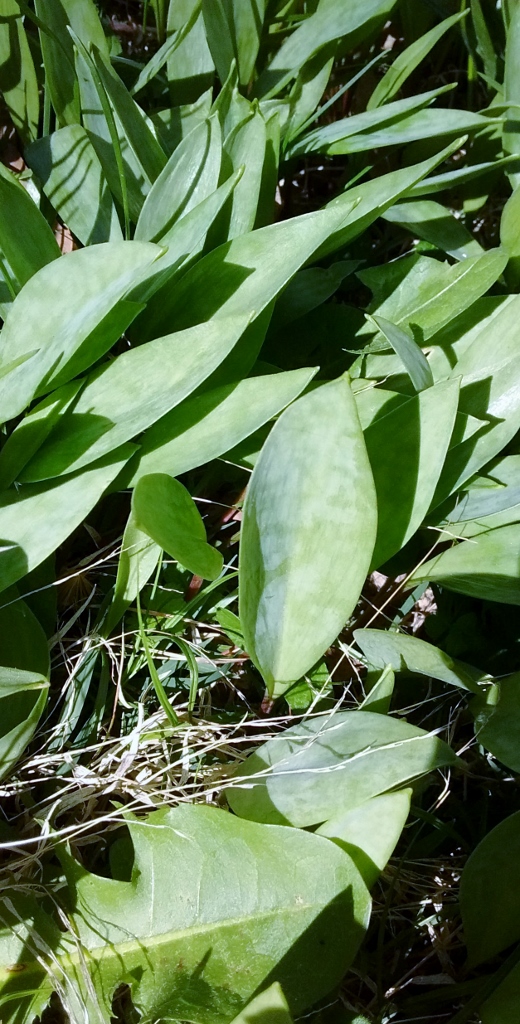
Trout lily, in a photo snapped before my “salad bowl” across the street was mowed by an enterprising neighbor. Dandelion says “Hey, I’m here too!”

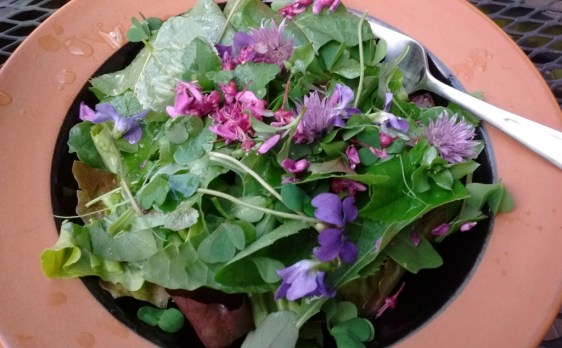
I can pick trout lily, violet flowers, and redbud blooms while they last. Maybe the fleeting nature of these delicacies gives them their aura of specialness. The redbuds are already on the wane, and last weekend a neighbor mowed the greenspace, so my trout lily salads are done for.

IMG_20170418_165835494 (559x1024)

Redbud blooms, the pinkest salad topper ever.

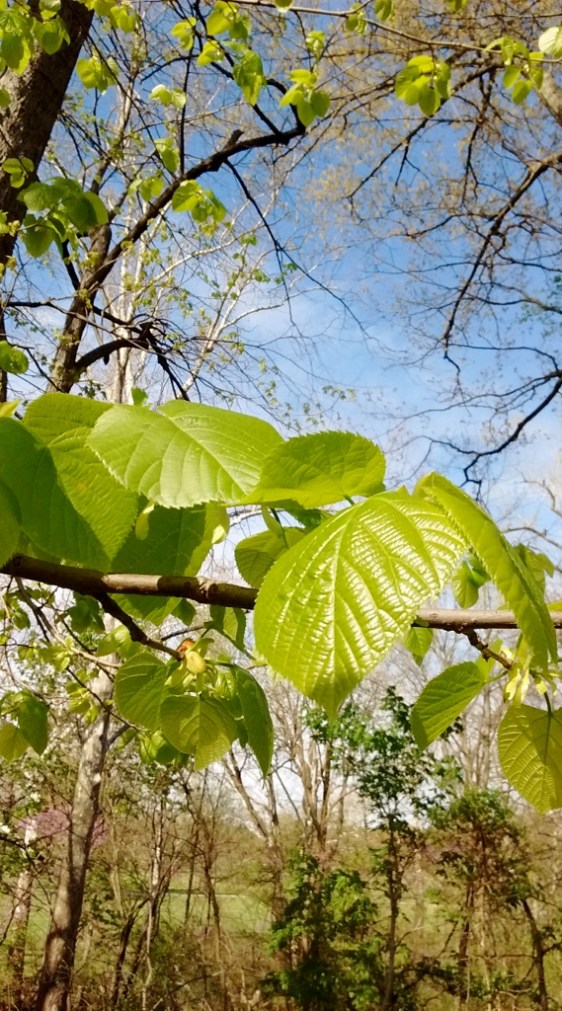
I also love to pick baby leaves off of a basswood (linden) tree over there. There’s something so novel about eating tree leaves in a dinner salad. They’re heartshaped, succulent (if picked small), and delicious.
IMG_20170418_170024600 (569x1024)

Seriously yummy basswood leaves. Later in the summer (actually very soon) it will be hard to find a small leaf this shiny and new on the low branches of “my” tree.

For a while I had sweet Jerusalem artichokes that I dug up in early spring and sliced like water chestnuts, but they’re gone now. But there’s plenty of other wild goodness in my yard and surrounding area. Small dandelion leaves (bitter!) and wood sorrel (tangy!) round out my salad bowl.

IMG_20170426_192308940 (564x1024)

I love to go out foraging with my little colander.

Eating a salad like this nourishes me twice, kind of like Thoreau’s wood chopping warmed him twice. It’s a delicious outing, carrying my colander out into the world to pick nature’s tenderest.
IMG_20170426_193609535 (1024x635)

I give you the 100-foot salad.

Preserving Timeless Arts

Last weekend I had two encounters that felt like variations on a theme.

One was at Kheprw Institute, where we were discussing Charles Eisenstein’s book, The More Beautiful World Our Hearts Know is Possible.  Kheprw co-founder Imhotep Adisa suggested that our over-reliance on technology compromises our more intuitive ways of communicating and knowing.

“Reality is not limited to that one way of knowing,” Im said, speaking of scientific inquiry and measurable phenomena. (Besides: Who determines what’s worth being measured? Who sets up the arbiters, institutions, and gatekeepers of scientific findings?)

It’s definitely possible to communicate instantaneously without benefit of a text. Many of us have had that experience from time to time. And for those of us in the energy work arena, merging with someone else’s energy field is a skill we cultivate.

But the more we rely on texting to do the work of instantaneous communication, Im suggested, the more we atrophy our native abilities.

Speaking for myself, I know that distracting myself through technology can seriously gunk up my intuition. To be quiet and still enough to sense information differently, I have to spend time away from the addictive barrage of information and communication.

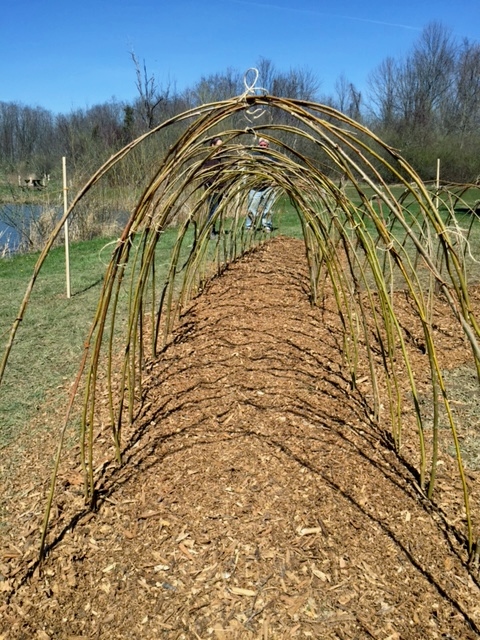
Later it struck me that Im’s words had their parallel in an earlier encounter, with a friend who’s devoted to preserving another dying art: traditional willow weaving. Viki Graber, a fourth-generation willow basket weaver, spent the weekend constructing a living sculpture at Salamonie Reservoir.

IMG_2063 (480x640)

The tunnel will grow thicker and more elaborate with time.

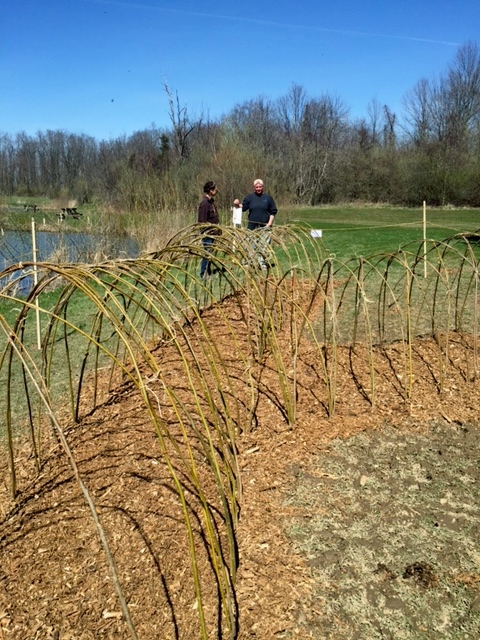
We drove up to see her, and she told us about the project. She received a grant from the Indiana Arts Commission to build living willow structures at three parks this year.

IMG_2064 (480x640)

To make her baskets and sculptures, she grows her own willow bushes—14 different species!—on her property in northern Indiana. For this project though, she harvested wild willow shoots from along the lakeshore. She planted these in the ground about eight inches deep along the muddy bank of a pond, where they should take root. She bent the willow into a tunnel, complete with round windows.

IMG_2065

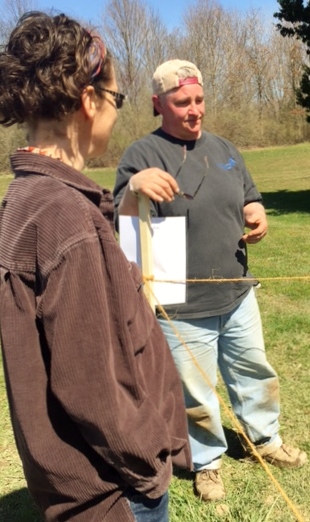
Me and my old friend Viki

For the next few years she will come back to weave new growth into the structure. A true collaboration.

Viki is passionate about sustaining traditional folk art in general (and willow-work in particular). She wants to keep these skills alive and pass them on to the next generation, and she loves to teach others.

As a functional artist, Viki makes beautiful objects that people want to use. Surely we all have the aptitude to create beauty for each other, whether that’s through physical creations or acutely attuned knowing.

Penney Peirce, in her book Frequency, suggests that we are all equally sensitive, with the very human ability to feel and sense and know things instantly. It’s just that some of us are consciously sensitive, and others unconsciously so.

I would add that some of us, like Viki and Im, are consciously invested in preserving useful, beautiful, timeless arts that the dominant culture tends to devalue.

What traditional, lost, or dying arts/skills call to you? Where do you make your mark in preserving ways that aren’t supported by our acquisitive go-go-go culture?

Microscopic Truth

My yoga teacher sometimes says “Feel the hum in your body,” when we are near the close of class.

Do you, ever? Feel that hum? Your energy body. It’s quietly there with you.

Someone told me recently that I have a sort of “presence” that seems to come from being fully in my body. I was honored, and told her that for many years I was NOT in my body. I wouldn’t even have known what that meant.

IMG_3366 (768x1024)

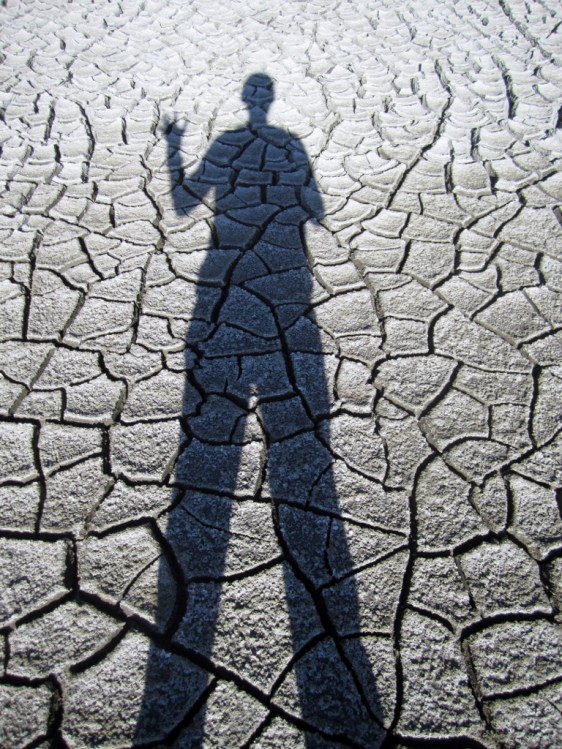
Disembodied

These days I don’t always stay there 100 percent of the time, but I know what it is to feel into my body, to honor its communications. After years of dealing with chronic pain and fatigue, drifting along untethered, I have come home. It’s been a long road, but I now feel like I can trust my body.

Psychiatrist Bessel van der Kolk says, in this podcast:

“…if people are in a constant state of heartbreak and gut-wrench, they do everything to shut down those feelings to their body… And so a very large number of traumatized people…have very cut off relationships to their bodies. They may not feel what’s happening in their bodies… We needed to help people for them to feel safe feeling the sensations in their bodies, to start having a relationship with the life of their organism, as I like to call it.”

As I deepen that relationship, I’ve found myself tuning in closer and finer than ever. Exploring the microscopic truth expressed by my body. I’m noticing, sometimes in the wee hours when I wake up from an intense dream, what it feels like to resist whatever’s coming up. I don’t want to feel the old ball of dread descend on me, or the worry, or the anger, or the grief, and I can feel myself wanting to reject it. Here’s a tightening of my scalp, there’s a clench in my neck, a rigidity about the shoulders.

I’m not resisting even the resistance, but allowing it all in. Instead of shutting down with “No, no, no,” I’m reaching for the “Yes.”

The other night I actually mentally said, “Come in, come in, welcome welcome,” as I acknowledged each layer of sensation and emotion. And just in the acknowledgement, they seemed to melt away.

After all, as my mindfulness teacher used to tell me, “It is already here.” And as the poet Rumi says, “This being human is a guest house.”

I’ve lived long enough to laugh at my habitual patterns now and then. Oh yeah, that ball of dread again, there it is! Oh those worry states, stealing my sleep again! There’s that fear of something that may or may not ever happen… There’s despair, I can hold that one extra gently. There’s that contraction that could easily lead to a headache if I don’t breathe into it now.

Finding compassion for all of it—saying yes to all of it—broadens my capacity for kindness to others and to life itself. And as van der Kolk would say, I own myself fully, which makes me more resilient.