An Appeal Denied

Update: Community Access Television has posted a video of the April 3 Board of Zoning Appeals meeting. Minutes have not been posted on the BZA site yet.

Last night I met up with friends to drive to Bloomington, IN for a Board of Zoning Appeals meeting. We were among 80 others there championing permaculture designers/teachers Peter Bane and Keith Johnson, who were pursuing variances for their small suburban lot. Since last summer, they’ve been mired in a conflict with Monroe County, primarily about placement and square footage of structures at Renaissance Farm.

The main issue was that they didn’t follow proper procedures, but they were under the impression that agricultural buildings are exempt from the process. I won’t go into detail about the legalities as that’s not the purpose of my blog—but you can refer to the meeting materials.
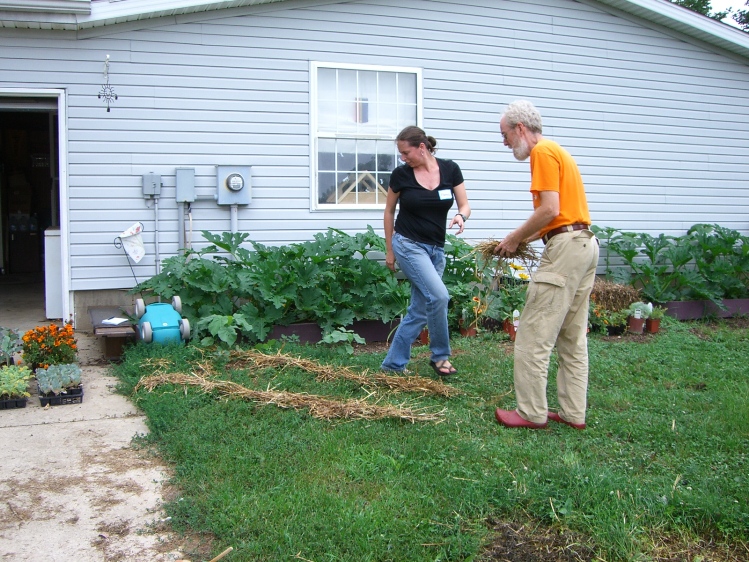
Peter Bane with co-teacher Rhonda Baird laying out a garden path during 2007 permaculture class

Peter Bane with co-teacher Rhonda Baird laying out a garden path, 2007 permaculture class

It was moving to hear the 30-plus testimonies of Peter and Keith’s impact. (I first met Peter in 2007 at a one-day permaculture overview class, and his passion infected me with the need to come right home and plant my entire lot in food.)

The intergenerational crowd was made up of neighbors, IU profs and grads, pastors, farmers, small business owners, a newspaper editor, a City Councilman, and young Bloomington natives who moved away and then returned, largely because they wanted to learn from these luminaries.

Neighbor after neighbor told of the duo’s generosity in sharing both knowledge and produce. Many have started gardening themselves. One said she travels all over the country; when she tells people she lives on the same street as these renowned Permaculture designers, “they are in awe.”

A sampling of comments:

“Everything they are doing is a practical and immediate way of changing the world for the better.”

“They are showing that young people can have a viable future in spite of the climatic, economic, environmental, and other issues facing us.”

“It’s beyond sustainable, it’s regenerative.”
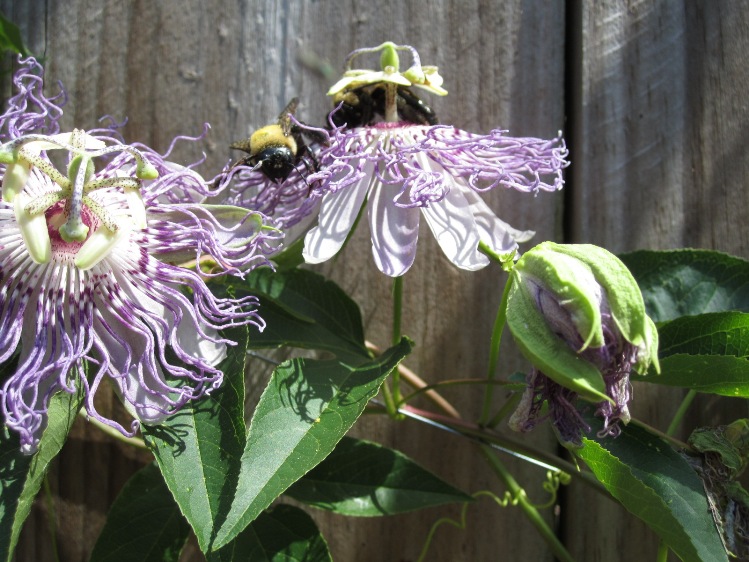
A maypop planted along our fence, one of many plantings inspired by permaculture

A maypop planted along our fence, one of many plantings inspired by Keith and Peter’s work

There seemed to be an understanding in the room, even among officials, that we are at a crossroads. One supporter told them, “I am sympathetic to you who must uphold laws that support suburban sprawl and ignore what the future requires of us.” Another said, “We are living in a world where the rules are changing.” Another warned that big timber, big ag, and mining will dominate rural areas if we don’t change our ways.

But apparently these are not the concerns of a body pledged to oversee existing laws, faulty as they are.

After four hours the board approved all but one variance—a critical one. The barn must be moved about 10 feet from its current position to be in compliance.

It was a shock. Especially after board member Jerry Pittsford, who expressed dismay that Peter and Keith had circumvented the process, had said, “I like rules, but I’m finding very little that tells me the rules need to be followed here.”

There were a number of reasons to approve the variance and only one to deny it—the fact that they did not consult with the county and submit the proper paperwork. Even as the board expressed admiration for Peter and Keith’s work, they could not get past that lapse.

It’s unclear what the next step is for Renaissance Farm, but whatever comes, I hope these two visionaries were bolstered by the outpouring of love and appreciation from neighbors, former students, and admirers.

I’ve Got a Tin of Sardines…

…and I’m not afraid to use it!

By jules (Flickr: sardines in a can) via Wikimedia Commons

By jules (Flickr: sardines in a can) via Wikimedia Commons

Actually, I am, a little. I bought the tin weeks ago at the Co-op in hopes of eating lower on the food chain. I have not yet worked up the nerve to peel back that shiny lid and peek inside. I may need a clothespin for my nose when I do. Little fishies can be so…fishy.

But I’m determined to conquer my fear of the little fishies and make them part of my diet. Or at least ingest them once and see if it’s possible to consider…one day…loving them as much as I love salmon. Why? Efficiency of dining, mainly. If I eat a sardine instead of the big fish that eats the sardine–no matter how much more appealing said big fish might be–I reduce my impact.

It seems I know too much. And I can’t un-know what I know. What we eat has consequences. In the case of seafood, overfishing is rampant, and then there’s pollution, climate change, habitat destruction, and ocean acidification. Leaving us with a “system in crisis,” according to the National Geographic.

All that knowledge makes my fallback choice on any restaurant menu, salmon, seem a bit fraught.

Though according to the National Geographic Seafood Decision Guide, salmon–at least wild-caught Alaskan salmon–is actually one of the better choices in the ocean-going protein buffet. It is “abundant, well-managed, and caught or farmed in ocean-friendly ways.” Three cheers for that.

But sardines are equally well rated, equally low in mercury, and equally high in omega-threes. Then there’s the fact that it takes five pounds of forage fish to produce a pound of farm-raised fish. So I still feel bound to try these little fishy-fishes.

By TANAKA Juuyoh Uploaded by Jacopo Werther) via Wikimedia Commons

By TANAKA Juuyoh (Uploaded by Jacopo Werther) via Wikimedia Commons

It strikes me, unpleasantly, that they’re kind of like the worms and grubs of the ocean world. Grubs are food for birds; sardines are food for bigger fish, and for chickens and pigs too.

No matter: I’m sure they’re deelish. (Just like grubs, which, after all, are food for people all over the world. I wrote a piece about that once, and fully expect to one day venture bugward in my dining.)

Helpfully, in the meantime Slow Food International has begun a push for upping human consumption of anchovies, complete with recipe contest. (Nate at the Co-op shook his head at my sardine purchase and advised anchovies next time.)

Oh faithful readers, do you eat sardines or anchovies, those humble fishies known as forage fish? If so, pray, how do you fix them? Give me some ideas to go with Slow Food’s and Rachael Ray’s suggestions. I promise to report back after my first foray into this brave new culinary world.

Inspiration from Across the Pond

© Scott Patterson | Dreamstime Stock Photos

© Scott Patterson | Dreamstime Stock Photos

I just found out about a forthcoming book called Stories of the Great Turning, which features first-person accounts of Brits who are transforming their lives in inspiring ways. According to Vala Publishers:

“These are the stories of just a few people who decided to act, in their own lives, in response to the challenges of climate change and environmental degradation, and found their own way to make a difference. They are not stories about celebrities, environmental geeks or gurus but honest accounts from people who…’just got on with it.’

It is a book that takes the question, ‘What can I do?’ and sets out to find some answers using one of our species’ most vital skills: the ability to tell stories in which to spread knowledge, ideas, inspiration and hope.”

Kindred spirits if there ever were. And there’s a foreword by beloved eco-activist Joanna Macy, and I think you know how much I adore her. (“Now is the time to clothe ourselves in our true authority.” –from the Foreword.)

I’m invited to the book launch next month. Exciting! It’s in Bristol, England, so I won’t be there, but still!

The Quiet in the Land Gets Loud

Mom had a dream in which I was kidnapped in South America and she spent her retirement money to find me. When found, I had grown so accustomed to living among the jungle people, I didn’t understand why I should keep my breasts covered.

I asked her, are you worried about me exposing myself, perhaps through this new blog? She didn’t think so.

But it’s a perfectly legitimate concern, one I deal with all the time in my own head as I try to rise to the occasion here. My cultural background is Mennonite, and there are a lot of prohibitions against standing out. My Amish forebears were “the quiet in the land,” the “plain people.”

And though less strict than the Amish, Mennonites are still big on humility. We aren’t supposed to shine too much, or get too high on ourselves, or in general stick our necks out too much. There’s safety in the tribe, in being like everyone else.

Lancaster County Amish 02

By it:Utente:TheCadExpert (GFDL or CC-BY-SA-3.0), via Wikimedia Commons

Of course, being “plain” in the Amish sense means that even while everyone looks the same within the tribe, you stand out against the larger culture in a big way. Your dress, your home, your whole way of life is a rebuke of the world’s fancy-yet-empty ways.

Nonconformism is in fact one of the central tenets of the Anabaptist faith, and I absorbed that ethic as a Mennonite child. To be in the world but not of the world—that was the ideal.

Which may be why I naturally view the dominant culture with a critical eye.

Recently I read Seth Godin’s Tribes: We Need You to Lead Us, and it showed me that we all need to be leaders now. It helped me to take my place as such, to step into this somewhat uncomfortable role. Writing is the gift I have to offer, so I write in service of the world I want to manifest–even if it means going against the ancestral voices that tell me to keep my head down.

Over the last several years I’ve led groups in various successful community endeavors, such as the Irvington SkillShare. So claiming “leadership” shouldn’t be such a stretch, but somehow it still is. (As a teen I heard my peers talk about attending “leadership camp,” and I knew I’d sooner tear my toenails out one by one than do such a thing. Leadership was for kids with confidence. Kids who didn’t mind speechifying. Kids who didn’t need to be humble.)

But there’s an urgency about this time, a sense that we need all hands on deck. We can’t afford to shirk that responsibility out of an ingrained belief that it’s dangerous to stick our necks out. We can’t afford “I’m not enough, I’m just a dumb /fill in the blank/.”

Enough of that. It’s time to get in the game. Let the “quiet in the land” get loud.

What’s your gift, and how are you becoming the leader we need today?

Placemaking in the City

It’s hard to imagine right now, with a spring storm threatening to deposit up to 10 inches of snow on us, but in a few weeks my neighborhood will come together for an annual spring cleanup. Volunteers will fan out to pick up a winter’s worth of litter, with the support of Keep Indianapolis Beautiful.

I love my neighborhood for many reasons–one of which is the dedicated cadre of people who work tirelessly to pull us together for the greater good. It’s amazing what this group can pull off: tree plantings, rain gardens, murals, pocket parks, public art projects, greenspaces galore.

A local artist paints a traffic signal box as part of a public art project. Photo by Heidi Unger.

A local artist paints a traffic signal box as part of a public art project.

Working together on projects has meant lots of neighbor-to-neighbor bonding time. When you’re trying to see past your poncho hood to pull soggy candy wrappers from a ditch, the person standing in the rain with you to hold a trash bag open becomes a good pal.

There’s a sense of solidarity and shared ownership, and civic pride out the wazoo. That leads to more ambitious community endeavors, like painting local artists’ designs on all the major intersections’ traffic signal boxes.

Similarly, in my book research I’ve learned of a group called City Repair, out of Portland, OR. This group works to reclaim urban spaces through placemaking. Rather than waiting for someone in charge to come along and “fix” a neighborhood, City Repair takes a DIY approach (or really DIWO – do it with others!).

Placemaking is all about creating gathering spots, or areas that support other community functions–composting, bike parking, safety, resource sharing, etc.  Examples in Portland:

  • public squares
  • meeting houses
  • community kiosks/benches
  • “solar-powered and artistic innovations”

With its emphasis on ecological and artistic transformations, City Repair is an inspiration. Their site offers placemaking resources. Check them out, and let me know what kinds of community endeavors are happening in your neck of the woods.

Postscript: Just as I was finishing this post, I found this great story of transforming a vacant lot into a public space – simply by adding seating.

A Whole New Earth

Nuvo Newsweekly has published my piece responding to Barbara Kingsolver’s novel Flight Behavior.

“It’s an elegy to the beauty of the familiar world, the world that is soon to be a thing of the past. Kingsolver invites us to begin the process of grieving, embodying that lost beauty in the form of the monarch butterfly…”

© Cinc212 | Dreamstime Stock Photos

© Cinc212 | Dreamstime Stock Photos

Indy-area folks can pick up Nuvo for free, or you can read the rest of the article here.

Have you read the book? What was your response?

Toward a More Mindful and Resilient Country

A friend recommended the book A Mindful Nation, by U.S. Congressman Tim Ryan, and I’ve just begun to browse through it. As a student of mindfulness practices, I’m curious how a politician applies these precepts to our national life. Here’s a powerful passage from the first chapter:

Let’s get rid of the phony concept of an America based on materialism, consumerism, and looking out for number one, where financial chicanery is our proudest accomplishment to show the world…

There is no dignity in the idea that anything worthwhile has to be purchased.

It shouldn’t be all that difficult to get us to move beyond this ethos, given how unhappy Americans have become.

If we slow down and find some space away from the daily chatter that tells us how to think, who to be, and what to buy, we can discover our capacity for resilience.

Ryan equates resilience with values like:

  • self-reliance
  • diligence
  • frugality
  • pragmatism
  • hard work
  • innovation
  • community
Pioneer Days. Photo from US National Archives

Pioneer Days. Photo from US National Archives

He calls these, somewhat nostalgically, “the values that made this country great.”

I tend to think more in terms of global citizenry myself, but I think his patriotic slant will have wide appeal, and he does have a point about the hollowness of much of our current national character. Why, he asks, do we collectively rise to the occasion of caring and compassion only in moments of great crisis, such as during and immediately after 9/11? Can we bring this generosity of spirit to our everyday lives?

Ryan believes that a good starting point lies in each of us addressing our personal fears and doubts through the simple practice of paying attention.

I’m curious about this. So let me ask: What place does mindfulness have in your life and work? What place should it have in our national life? And do you think individually bringing kindness to the present moment can change a nation for the better?

What is Community Resilience?

So what do we mean by community resilience, anyway? There are several ways of looking at it.

© Egidijus Mika | Dreamstime Stock Photos

© Egidijus Mika | Dreamstime Stock Photos

1. Community resilience means taking a do-it-with-others (DIWO) response to these threats:

  • global warming
  • food insecurity
  • the end of cheap oil, or “peak oil”
  • economic distress

2. Community resilience is the ability to:

3. Community resilience requires:

4. Resilience differs from sustainability because it presupposes:

5. Resilience and resourcefulness are Siamese twins. The question to ask is, “How do you turn yourself into the resource you need at all times?” –Diop Adisa from KI EcoCenter

6. (Joke) Resilience is code for “we’re screwed.” —Apocadoc Jim Poyser, editor of Indiana Living Green*

*This is actually the PG-rated version of Jim’s definition.

What is your preferred definition of community resilience? And how does your community stack up?

Solar Cooking, the Cookprint, and You

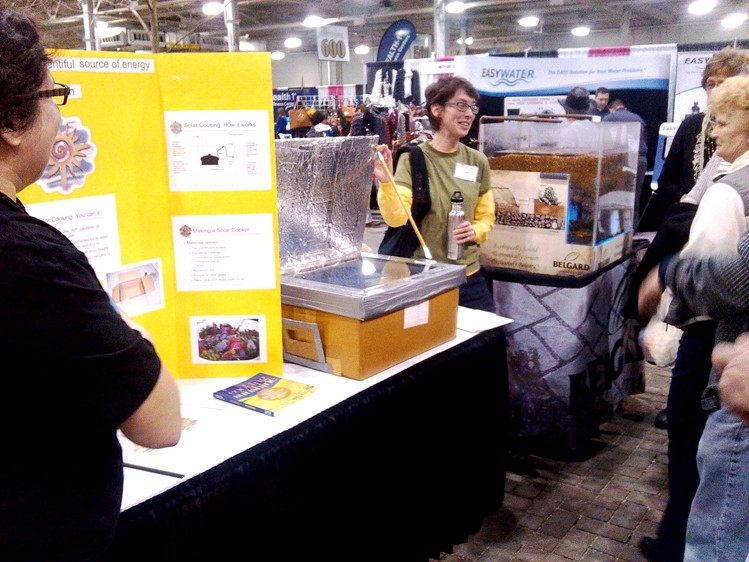
Solar cooker demo at the Flower and Patio Show

Solar cooker demo, Flower and Patio Show

Yesterday I had the chance to bring my well-loved handmade solar cooker to the Urban Homestead exhibit at the Indiana Flower and Patio Show.* I was a little worried that my cooker, made of cardboard, duct tape and aluminum foil, would feel self-conscious in the company of all those gleaming new grills and such. But: We rocked it.

No one seemed to care that the glass has a nice “patina,” as a friend christened the smudges I could not seem to remove with vinegar water. They were too busy peering into it and asking questions about how it works and how it’s made.

This will be my fifth summer of solar cooking. It was a thrill to spend part of a snowy day sharing my cooker with gardener types, a few of whom seemed ready to go right home and make one.

My solar cooker at work

My solar cooker at work

Not only is solar cooking crazy fun, it means we drastically reduce our natural gas use from May to September. And the fact that we can make something so useful from (nearly) all salvaged materials and make it last five years and counting? Well, it kind of feels like getting away with something sneaky.

I’m even prouder of my solar cooker since hearing a radio interview with the author of Cooking Green: Reducing Your Carbon Footprint in the Kitchen, which concerns ways to “shrink your cookprint.”

The local food movement has raised awareness of our “food miles.” But we don’t always consider the impact of another aspect of eating: what we do with the food after we get it home. Anyone who gardens or belongs to a CSA knows that procuring food sustainably is only the first step. Once you have all that produce staring at you, you’ve got to process it. Except for salads, cold soups and the like (raw foodists, holla!), this task generally involves using some form of energy–turning on the burner, heating up the oven, plugging in the crockpot.

I haven’t read the book, so I don’t know if she advocates solar cooking as the ultimate in cookprint reduction. In the interview the author shares tips like this one for pasta-making:

Tip: Bring the water to a boil, then turn the burner off once the pasta is in the covered pot.

gas burnerI imagine pressure cookers are high on her list as well. (Don’t tell my solar cooker, but I’d be lost without my pressure cooker, at least from October through April.)

What about you–have you looked at ways to reduce your “cookprint?” Do you use a solar cooker–or would you like to? Share in the comment section below! (If you’d like more info on solar cooking, contact me for recipes and tips. Find DIY instructions here. You can buy one here–but really, don’t. So easy to make!)

*Still time to check this out if you are in Indy–through March 17. I’m told sheep will be grazing the urban homestead grass at some point in the next few days. Get your coupon here.