A Whole World Alive

I recently heard Michael Pollan speaking on NPR’s Science Friday show about research into plants’ intelligence. He revealed how mycelium (the vegetative part of fungus) figures into communications among the trees of a forest. (We learned about mycelium earlier in Peter McCoy’s guest post on radical mycology.)

Hyphae (branches of the mycelium) as seen under an overturned log. Photo by TheAlphaWolf (Own work), via Wikimedia Commons

Hyphae (branches of the mycelium) as seen under an overturned log. Photo by TheAlphaWolf (Own work), via Wikimedia Commons

Pollan said:

“The trees in a fir forest are networked, in a very complicated network, held together by the mycelium of mycorrhizal fungi, connect(ing) all the trees in a fir forest. A scientist in British Colombia named Suzanne Simard has studied this. She injects a fir tree with radioactive carbon isotopes, and then using a geiger counter and other devices follows the trail of that carbon.

And what she’s found is astounding! All the trees are connected. They use that network to send information, such as warnings of insect attack. They use that network to send nutrients to their offspring…They can even use that network to trade nutrients with other species…”

Isn’t that miraculous? And I suspect that—as the Wendell Berry quote in my previous post implied—everyone and everything, everywhere, might be invisibly interconnected in a similar way.

If this is true, what harms one, harms all. What uplifts one, uplifts all.

Is this possible? Perhaps. On an energetic level. What I’m talking about is rising above the zero sum game that’s so indoctrinated in us. Making space to see that without all of us being OK, none of us are OK.

We lack instruments fine enough to fully measure the energy field surrounding us (and surrounding every natural thing, every boulder and ant and trout and evergreen, every human and tulip and mountain). But I believe that through this field we have an impact on each other, on the whole of life, every moment we live, whether we know it or not.

It isn’t possible to live apart from each other. Not truly. The web of life knits us one to another, even if we are unaware of its strands.
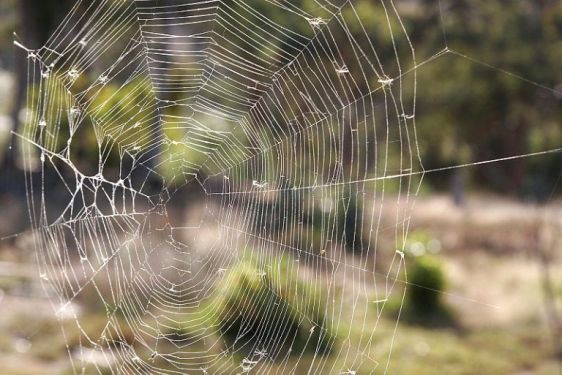
Photo by Fir0002/Flagstaffotos, via Wikimedia Commons.

Photo by Fir0002/Flagstaffotos, via Wikimedia Commons.

The ancient sages say that if you pull one thread in the web, the others vibrate.

Quantum physics … the mycelium … the Internet even—all are outer manifestations of this esoteric truth.

For a while now I’ve taken a few moments every morning to ground myself, feeling and seeing my “roots” going deep into the earth. Lately I find myself connecting not just vertically but horizontally, under the earth’s surface, with the mycelium.

There’s a whole world alive under our feet that we don’t usually see. So it is with our energetic world.

“We Must Care About our Public Spaces”

As promised, here is a followup to last week’s post on the value of public art.

At Foundation East’s artist meet-and-greet I met Irvington resident Holly Combs. She’s half of the husband-and-wife duo who painted several traffic signal boxes around Irvington. While I was talking with her, a neighbor stopped to say that she honked and waved whenever she passed the couple working out in the cold on their boxes.

Holly thanked her, saying, “Do you know what it meant to us when people honked and waved? Yeah, it was cold but we didn’t feel it. When you’re joyful in what you do, you’re not even cold.” Then she handed us each a “You are beautiful” sticker.

That seems to sum up Holly, whose passion is obvious when she speaks of her various projects. For example, Street Styles. It’s a youth program she started that uses street art and graffiti as the foundation for exploring art fundamentals.

With her husband Dave, she also founded the Department of Public Words. DPW’s mission is to put uplifting messages in surprising places, all to tell people “they’re awesome, beautiful, worthy, and wonderful,” as Holly puts it.

They first tried it a few years back when the economy tanked and the Combs’ gallery and art magazine were hard hit.

Photo courtesy of Department of Public Words.

Photo courtesy of Department of Public Words

“When you lose everything, you’re fearless, thinking ‘I can do anything,’” Holly told me. She painted You Are Beautiful in block letters high on a prominent building in the Fountain Square neighborhood because it was a message she herself needed.

Since then they’ve put the same message on a building on East Tenth Street. I pass it often and it never fails to make me smile.

Photo courtesy of Department of Public Words

Photo courtesy of Department of Public Words

Sometimes I’ve walked my dog past the Combs’ house in summer (though I didn’t know it was theirs) to find You Are Beautiful scrawled in chalk on the sidewalk.

The You Are Beautiful campaign is part of a global initiative started by Matthew Hoffman (those stickers were the first manifestation). Right now the couple are raising money to continue inspiring people with positive words all over town.

With Street Styles, Holly works with youth in the juvenile justice system, many of whom have illegally painted graffiti. “I tell my juvenile offenders, ‘You go to jail for doing that and I get paid $100 an hour: who’s the boss?’” She brings the disenfranchised youth into the process of creating street art in hopes of channeling their desire for self-expression.

I asked Holly how she felt about the vandalized signal boxes, since one of theirs was targeted. “Yes, our box got paint poured on it. Just out of meanness. Sad. But I see public art as a conversation with the public,” she told me in a Facebook chat.

One of the Combs' traffic signal boxes. Photo by Vishant Shah.

One of the Combs’ traffic signal boxes. Photo by Vishant Shah.

The offenders in her program say that if a community doesn’t seem to care about a neighborhood, it’s seen as an invitation.

“(We) must care about our public spaces to help encourage others to care about them too. I always say, “Blank walls want me.’”

In fact, my neighborhood started the signal box project after a police officer spoke to our Crimewatch group about Crime Prevention Through Environmental Design (CPTED). Officer Shane Foley talked about CPTED’s landscaping and lighting design principles—and how modifying the built environment can deter criminals.

The group already had a history of litter cleanups and beautification efforts, and CPTED theory made a lot of sense. The traffic signal box art seemed a natural progression.

Another of the Combs' boxes. Photo by Vishant Shah.

Another of the Combs’ boxes. Photo by Vishant Shah.

These boxes belong to the whole community, and no setback is going to slow the public art movement now. With the help of a fundraising campaign, Vishant and cofounder Aaron Story plan to have all the boxes protected with a coat of clear coat by May.

Local artists, funders, and dreamers are invited to contact Foundation East about partnering on future eastside Indy public art projects.

Public Art Unites the Community

Public art is one of those things that’s more than the sum of its parts. Here in my neighborhood, the humble traffic signal box—a four-foot-tall aluminum cabinet that had never before registered on my radar—seems to be the start of something big.

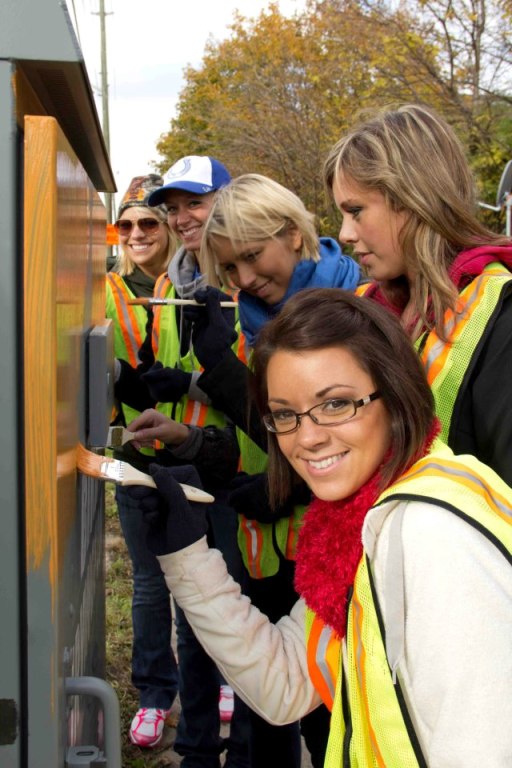
In 2012 I was one of the volunteers painting Irvington’s first seven signal boxes as part of the Great Indy Cleanup.

These Colts cheerleaders helped us get the job done.

These Colts cheerleaders helped us get the job done. Photo by Heidi Unger.

Each design had been submitted by artists like Morgan Hauth, shown here putting finishing touches on one of her pieces.

Touching up

Morgan Hauth touching up. Photo by Heidi Unger.

By 2013, Foundation East, the brainchild of Vishant Shah and Aaron Story, had formed with a goal of transforming eastside Indy neighborhoods through public art. Building on the success of the traffic signal box project, the duo enlisted six artists to paint another round.

Oil painter Rita Spalding at work on one of her signal boxes.

Oil painter Rita Spalding at work on one of her signal boxes. Photo by Charmaine Edwards.

A total of 19 boxes now brighten the main thoroughfares of my community.

Sadly, some disrespectful souls targeted a couple of these landmarks. Two boxes were vandalized early Dec. 31, prompting outrage among neighbors. A third more recently had a bucket of paint splashed on it.

It’s infuriating, but I take my cue from Rita, who has more reason than anyone to be outraged—her luminous painting was among those defaced. She told the Indianapolis Star that morning, “I’m not angry. It just really makes me think about what’s going on in that kid’s life.”

Later that day she wiped off the graffiti. Several neighbors met her at the box to help out if needed, but it turned out to be easier than she expected, because she’d applied a layer of clear coat finish.

Foundation East founders Aaron and Vishant say the outcry shows how important these boxes have become. They invited the community to meet the artists and show their support this week.

I went to the gathering, finding it packed to the gills with neighbors eager to thank the artists and scribble their ideas on a white board. (Paint the water tower, build a vertical garden structure on the library lawn, install a sculpture on my street!)

Many also chipped in for a “clear coat fund” to give all the boxes the same treatment as Rita’s.

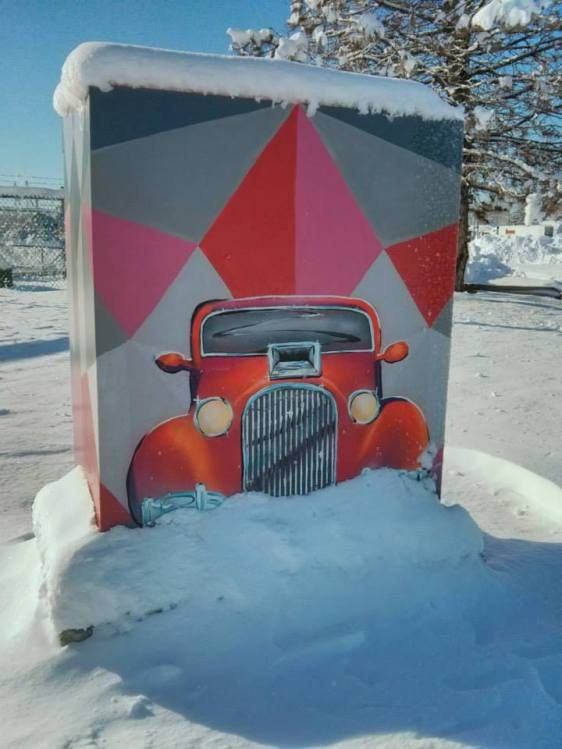
Homage to car culture

Homage to car culture, by Andrew Severns. Follow this artist at @severnscanon. Photo by Vishant Shah.

I talked to several residents there who mentioned Irvington’s history as a hub of creative and intellectual stimulation, with Butler University’s campus located here until 1928. In the 1920s and 30s, a group of acclaimed painters known simply as the Irvington Group drew national attention.

Apparently our neighborhood’s reputation as a quirky haven for eccentrics also dates back 100 years—Irvington is described in an October 1903 Indianapolis Star article as “the classic suburb which has an interesting way of turning up all kinds of freaks and strange things generally.”  (This was before the city grew to swallow up the suburb, but we retain our unique character.)

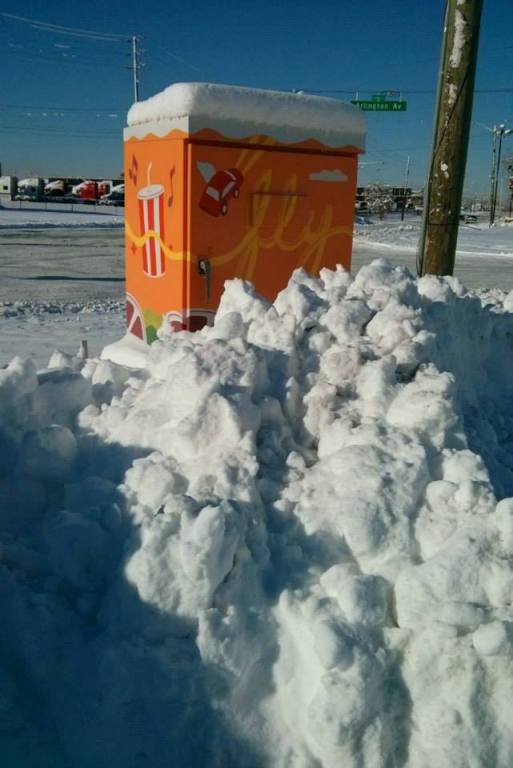
Signal box in Arctic Vortex aftermath

Erin Kelsch’s Signal box in Arctic Vortex aftermath. Photo by Vishant Shah.

Kathleen Angelone, owner of Bookmamas, says that’s exactly the kind of neighborhood she wants—and the art definitely adds to the vibe. “I think public art is vital to any community because it makes it beautiful. It denominates where the community is and gives it character.”

“And it is civilized. I want to live in a civilized community where people are interested in art and music and learning, not just their day to day jobs.”

Tribute to farm heritage

Dave and Holly Combs’ tribute to farm heritage. Photo by Vishant Shah.

Russian-born Svetlana, an oil painter, told me that public art played a role in her childhood desire to paint. “There are statues everywhere in Russia; you’re just surrounded by art,” she said. “That gave me a lot of creativity and imagination.”

Two years ago she moved to Irvington, where color is starting to pop in unexpected places. “I think it’s wonderful that there is art for people to view without going to a museum.”

Aaron and Vishant invite local artists, funders, and dreamers to contact them about partnering on future eastside Indy public art projects.

My next blog post will have more about the role of public art in placemaking, youth engagement, and crime prevention.

Communal

When the sun comes up on these clear mornings, the sky behind the snowcovered trees tints palest tangerine. There’s a beautiful stillness in a frozen world.

Daybreak in the Arctic Vortex

Daybreak in the Arctic Vortex

Something about going through an extreme weather event is lovely in its communal nature. For the second day we are snowed in. We can’t drive out of our alley, and any outings on foot are necessarily short because of extreme wind chills.

So we’ve been keeping tabs on the goings-on in our little burg via a Facebook neighbors’ group.

The dangerous cold and deep snow have given us a glimpse of just how neighborly people are in our quirky neighborhood. I have seen many a plea for help go answered, and many an unsolicited offer appear. Just now someone offered to pick up items on her way home from work if anyone is in dire need. Earlier there was a shout-out to “the awesome guy driving a Caterpillar bobcat and helping people dig out their cars from the aftermath of the plows.”

Someone even asked for—and got—advice on how to get her dog to do his business in this brutal weather. I didn’t read the entire thread, but apparently it was a hoot, discussing canine toileting habits in great detail.

People are offering safe havens, rides to emergency rooms and shelters, and space heaters for those whose furnaces are on the blink. They’re doing for each other in large and small ways—taking baked goods over, walking each other through the crises of burst pipes and power outages, helping everyone feel less alone.

I’m sure this behavior is replicated in many places, much of it never posted anywhere. I didn’t post that the fellow on the corner shoveled not just his walk but the neighbor’s between us, and the guy on the alley behind us helped clear our driveway, but they did, and I thank them.

Dangerous and beautiful

Dangerous and beautiful

Even though I’m tired of being clenched up from cold, tired of the worry over potentially losing power or the furnace konking out (again), part of me relishes these days, both for the astonishing view out my window and for the weird conviviality online.

Part of me wants to put off snowmelt, with its godawful mud and piles of blackened leftover snow. Part of me never wants this communal experience to end.

We Are the Same

Not long ago I had conversations with two different poet friends, both about the connective power of the written word.

Shari Wagner said she sees her poems as vehicles for connecting human to nature, living to dead, young to old. Here’s a lovely example of this, her poem about young Orville and Will Wright, and their dream of flight.

Later that same day, Shannon Siegel spoke of writing as a way of “feeling with” someone, as in a Buddhist meditation. She had read a book called The Golden Theme by Brian McDonald. McDonald asserts that the writer’s essential task is to show our commonalities.
By Mike DelGaudio, via Wikimedia Commons

By Mike DelGaudio, via Wikimedia Commons

Shannon sent me this passage from the book:

“Stories are the collective wisdom of everyone who has ever lived. Your job as a storyteller is not simply to entertain…Your job is to let people know that everyone shares their feelings—and that these feelings bind us. Your job is a healing art, and like all healers, you have a responsibility.

Let people know that they are not alone. You must make people understand that we are all the same.”

In a time when our focus is constantly nudged toward what divides us, it is a tonic to understand that yes, everyone on earth has experienced every single emotion that has ever swept through us.

By Kahuroa at en.wikipedia [Public domain], from Wikimedia Commons

By Kahuroa at en.wikipedia [Public domain], from Wikimedia Commons

Here’s Shannon’s poem, stretched out to you. Do you feel it?
oceans within

Sounds of water…sounds of water…sounds of water…
The Long Way, Moitessier

Memories lock selves
in place, deep within
the cells, those
inner chambers.
Recall rises up
like magic, aroused,
liberated in an instant,
a rush, an echo,
a ripple through time,
a feeling, just a feeling,
something I felt once,
something I felt before,
I feel again, I now feel again.
A swell crashes the shore,
then recedes. Waves
ebb, then flow, an ocean
of promise and possibility
rushing through my veins, life
unfolds with a touch,
a whisper perhaps, a word
spoken, a gaze, a persistent
recurrence of what was,
is now is, again, somehow.
Deflecting logic, defying reason,
this heart sings a joyous
song, thrums love’s lyric,
hums a tender entreaty:
Come with me. This
way. Look for me.
Find me.

—Shannon Siegel, (c) 2013

Let Us Discover Our Wealth

Photo by robleto, via flickr Commons

Photo by robleto, via flickr Commons

The opposite of poverty isn’t property. The opposite of both poverty and property is community. For in community we become rich: rich in friends, in neighbours, in colleagues, in comrades, in brothers and sisters.

Together, as a community, we can help ourselves in most of our difficulties. For after all, there are enough people and enough ideas, capabilities and energies to be had. They are only lying fallow, or are stunted and suppressed.

So let us discover our wealth; let us discover our solidarity; let us build up communities; let us take our lives into our own hands, and at long last out of the hands of the people who want to dominate and exploit.

—Theologian Juergen Moltmann

We Can’t Afford Coal

This week I attended a meeting to learn more about Indianapolis Power and Light’s Harding Street plant, the largest industrial polluter in the city. IPL has no plans to retire this 55-year-old coal plant, even though the EPA says it’s responsible for 88 percent of industrial toxic releases in Marion County. The plant’s smokestacks annually release 130 pounds of mercury into the air.

That has a devastating public health impact. One attendee spoke of being an asthma sufferer. “I know what it’s like to struggle to breathe and have to go to the ER…It breaks my heart to think that our power is the reason children have to go through that.”

Photo by Karl Anderson, via flickr Commons.

Photo by Karl Anderson, via flickr Commons.

As I found while researching an Indiana Living Green story about the Beyond Coal movement, poor children are disproportionately affected by coal because of where they live—resulting in learning disabilities, asthma, autism, and lowered IQs. They’re effectively trapped into a cycle of poverty, suffering lifelong difficulties linked to our state’s over-reliance on coal.

Two city maps made the plant’s impact visible. One showed asthma-related ER visits in Marion County, and the other depicted mercury levels in waterways and soil. In both cases it was clear how the neighborhoods northeast of the plant (including my own) are burdened as the prevailing winds blow the pollution our way.

I myself can trace some of my health struggles to these toxins. I moved to this neighborhood in 1996 from northern Indiana. I noticed that I got sick more often, and for longer periods, than I used to. By 2000 I was dealing with chronic illness. The origins were complex, but tests for heavy metal toxicity showed elevated levels of mercury in my body.

“If you love your lungs, get out of Indianapolis,” says a real estate blog, fingering my beloved city as the unhealthiest in the nation because of its poor air quality.

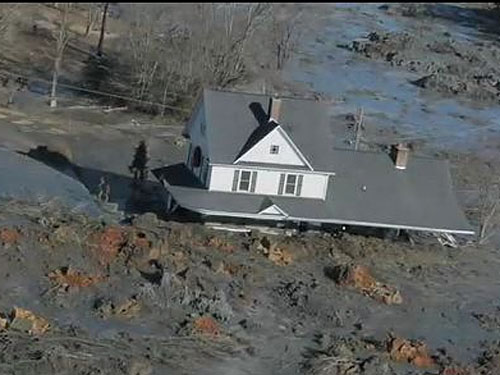
And then there’s the coal ash ponds. A nationwide 2011 EPA study identified 11 high-hazard coal ash ponds. Two of them are at the Harding Street plant. These unlined, aging pits are right next to the White River. I don’t even want to think about what would happen in the event of a major flood. Or if an ash dike ruptures, as happened in Kingston, TN, in 2008.

Knoxville News Pic

A house sits in the coal ash spill near Kingston, TN in Dec. 2008. Photo by Knoxville News Sentinel.

Apparently IPL doesn’t want to think about it either, even after two coal ash spills at its Martinsville plants sent more than 30 million gallons of toxic coal ash into the White River in 2007 and 2008.

Does it have to be this way? No, it doesn’t. Whether you look at it from a public health perspective, a fossil fuel emission perspective, or even through a financial lens, coal is a bad bet. Rate hikes to retrofit the aging plant are a poor use of our money. For inspiration, we can look to neighboring states. Iowa gets 24 percent of its power from wind—with rates similar to ours and no reliability issues.

The Indiana Beyond Coal campaign is all about making our voice heard. If enough people speak with their city councilmen and -women, write letters to the editor, and engage with IPL’s 20-year energy plan, things can change.

As organizer Megan Anderson said, “It’s as simple as getting together and talking to friends and neighbors.”

A Field to Fork Market

“In Indiana, we can grow so much of our own food. We really could be sustainable now,” says Kevin Logan, MD. Though we can’t grow mangoes or bananas, he believes we could cultivate everything we need for regional self-sufficiency.

INgredients Field to Fork Market, a new shop he opened in partnership with wife Jacqueline and old friend Tom Wiles, is exerting influence on both supply and demand. To stimulate the market for good clean food, the deli demonstrates how to use local produce like bok choy and spaghetti squash. Meanwhile the proprietors are coordinating with the many farmers and producers capable of feeding our region, in anticipation of the 2014 growing season.

I had the pleasure of talking with the three of them when I wrote this Nuvo piece on the store. It’s located in a refurbished Taco Bell, and full of items grown or produced in Indiana.

Pie pumpkins and gourds from local farmers at INgredients.

Pie pumpkins and gourds from local farmers at INgredients.

“I feel like we’re going to have to get back to community,” Logan says. “And food choices are one way that we do that.”

The trio plan to hold classes on every stage of food growing, storing, cooking, and preserving, to help people gain garden knowhow and kitchen skills. Both fermenting and cheese making classes are in the offing.

All in all this shop is a great addition to community resilience efforts in my town.