Crowd-funding the New Frontier: Radical Mycology

Here’s a chance to support a radical mycology project seeking to put a potent tool for restoration in many more hands. Mushrooms can break down and eliminate some of the most toxic industrial compounds in the world, representing enormous untapped potential for healing our beleaguered planet.

Not to mention the fact that mushrooms are a phenomenal source of protein, potentially boosting community-level food sovereignty.

Be part of this new frontier by funding this resource for would-be radical mycologists, and/or helping to spread the word!

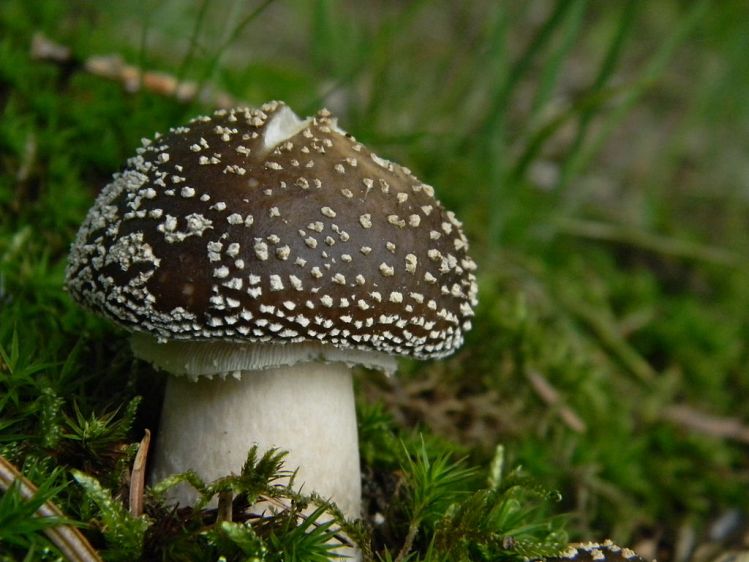
By Alaricmalabry (Own work), via Wikimedia Commons

By Alaricmalabry (Own work), via Wikimedia Commons

Below is a note from Peter McCoy, who recently contributed a guest post about the lessons mushrooms have taught him:

The Radical Mycology Book fundraiser is underway! This unique book on the uses of mushrooms and other fungi for personal, societal, and ecological wellbeing will be a powerful resource for the geek and do-gooder inside us all and we are excited to bring this dream to the rest of the world.

You can view the live campaign here:

http://bit.ly/radmycogogo

Whether or not you are in a position to donate, one of the most important contributions you can make would be getting more people aware of this fundraiser by emailing your friends and re-posting on your social (mycelial) networks.

Share the campaign on Facebook:
http://bit.ly/rmifbshare


Thank you so much for contributing to this project and vision!

Mush love!
Peter and The Radical Mycology Collective

Gail Needleman: We Are Not Monads

Second in a Series on my Mesa Refuge Cohorts

Gail Needleman came to Mesa Refuge to sort through years of notes.

Photo by Brandon Geisbrecht, via flickr Commons

Photo by Brandon Geisbrecht, via flickr Commons

A pianist and university professor, Gail was working on a book based on her musings and observations about music. Music not as some optional add-on, or the product of a professional, but absolutely essential to our souls. She sequestered herself in the upper room and got to it.

I have to say I was itching to be a mouse in her pocket, because I love sorting through tidbits and insights.

Her advice to writers: Do not make notes in tiny notebooks; you will regret it later. (She teasingly scolded me for my habit of scribbling in a little notebook, but I love my wee notebooks!)

An interview she gave to Works and Conversations magazine is called Music is Something You Do. In it she mourns the trend toward music as performance instead of communal expression—effectively cutting us off from the healing power of our own voices.

She says it’s quite a modern idea to experience the self as a “monad,” a self-contained unit, separate from others. “And music, the most communal of human activities or arts, becomes those billboards with the person with the iPod dancing to music that no one else can hear.”

Photo by Thomas Neilsen, via flickr Commons

Photo by Thomas Nielsen, via flickr Commons

I love her story of the children’s game “Lemonade,” a call and response song-game. It includes the line “Give us some—don’t be afraid” before the child in the middle pretends to pour lemonade, and the others gather around and hold up their cups. Gail thinks this is about breaking the barrier between individual and group.

“It was just a very simple example of how in making music together, the barriers between people go down…We’re armored most of the time, even to ourselves, but certainly to others.”

Gail brought a dry wit and down-to-earth sensibility to our dinner table conversations. Her warmth and wisdom made me treasure her presence. One evening she advised us younger women, all prone to burnout from taking on too much, that “just because you can do something, doesn’t mean you must.” She told of a time when she was in charge of an event and had many demands on her. The line she used, which I intend to borrow, was “Is this a question only I can answer?”

One night when we gathered by the woodstove, she sang a beautiful song that had us all mesmerized, especially her smitten husband.

Jerry and Gail Needleman on our last evening as Mesa Refuge residents

Jerry and Gail Needleman on our last evening as Mesa Refuge residents

It’s almost impossible to write about Gail without mentioning husband Jerry (philosophy professor Jacob Needleman, also in residence), and vice versa. The two are so clearly and completely meant for each other. It’s beautiful to see the love and trust between them—not to mention their lively sense of fun. Each seems to be the other’s biggest fan.

On the last evening she read from her work in progress, which she had been so reticent about discussing, and again held us spellbound. Her handwritten pages were pure poetry. I can’t wait for her book.

Sierra Murdoch, Writing the Gritty Truth

First in a Series on my Mesa Refuge Cohorts

Here’s a young writer to watch: Sierra Murdoch.

I met Sierra at Mesa Refuge, where we shared meals, stories, laughs, and a love of tea trays. We commiserated about the perils of writing, and encouraged each other to keep going. She inspired me with her focus and stamina—often the first one to get to work in the morning and last one still at it after supper.

Sierra Murdoch. Photo taken at writing residency, Banff Centre for the Arts, 2012.

Sierra Murdoch. Photo taken at writing residency, Banff Centre for the Arts, 2012.

Her project was a long article about a childhood cancer cluster in a small Nevada town. She conducted extensive research in the months leading up to our time at Mesa Refuge.

Sierra’s first foray into journalism was as a 2009-10 Middlebury Fellow in Environmental Journalism. For a little over a year, she lived in Wise County, VA, where more than a third of the county had been stripped by mountaintop removal coal mining. Sierra wrote about retired union coal miners fighting mountaintop removal, which was polluting wells, causing flooding, and destroying forests and streams.

Mountaintop Removal, Wise County, VA, via flickr Commons. Photo by David Hoffman

Mountaintop Removal, Wise County, VA, via flickr Commons. Photo by David Hoffman

Since 2011, she’s been on staff at High Country News, a well-respected magazine about the environment of the American West. Her biggest project there, and also for The Atlantic, chronicled the economic and social impacts of oil development on a Native American tribe living in the middle of the Bakken oil field—and a growing culture of violence against women there.

“I’m most drawn to communities living in extracted landscapes,” she says.

We had many conversations, but one in particular stands out. I told Sierra how much I admire activists who hold the line against things like mountaintop removal. The same goes for journalists like her who write about tough stuff, the gritty truth.

I sometimes feel guilty that I write feel-good stories of people building the new world while corporate giants prey on vulnerable communities and ecosystems. Aren’t I sort of slacking, happily profiling what’s going right, when there are so many wrongdoings to be exposed? Do I need to spend more time on a bullhorn instead of a cozy little blog?

But Sierra had a different take on it. She pointed out that the feel-good stories are nourishing not only to “the movement,” but also to people deeply invested in the status quo. These folks are usually turned off by angry protests. They might associate corporate actions with jobs and a way of life. So they feel threatened by protesters, disgusted with media attention.

Photo by D.D. Meighen, via flickr Commons

Photo by D.D. Meighen, via flickr Commons

“But the coal miner’s wife might like to go to the farmers market,” Sierra said. “She might want to garden, and she might like to be involved in community projects too.” Perhaps hearing about a group quietly working toward greater community resilience will bring her into the tribe. (Surely we need all stripes of people in this tribe now.)

This made me feel better.

Sierra is thoughtful, disciplined, kind, and curious—traits that make an excellent journalist. She radiates integrity. I can imagine that her subjects would trust her implicitly.

I look forward to watching her accomplish great things in years to come.

Radical Fungi Are My Favorite Teachers

Guest Post by Peter McCoy

When I get asked why I started the Radical Mycology project, I often say that it was to share the lessons that mushrooms have taught me.

Turkey tail logs

Turkey tail logs

Since I started studying mushrooms as a teenager, I have always seen mycology (the study of fungal biology) as an endlessly fascinating and thought-provoking science. Whether I am using them as a nutritious food source or as a potent medicine, I am always honored to taste their wonderful flavors and alluring textures. Hunting mushrooms in the woods, I love to watch them grow, knowing that they are cleaning the forest soil, protecting plants from disease, and turning decaying matter into fresh topsoil so new plants can thrive.

And using them as remediators, I am awed by the mushrooms’ ability to break down and eliminate some of the most toxic industrial compounds in the world.

Grassroots Bioeremediation workshop with Leila Darwish at the Radical Mycology Convergence

Grassroots Bioremediation workshop with Leila Darwish at the Radical Mycology Convergence

Seeing how the densely branched mycelial networks of mushrooms share nutrients among plants, I also find a wonderful example for humans to follow when working to collaborate with their communities. Further, the incredible spore loads that mushrooms drop in the fall are designed to adapt to any given environment, demonstrating the ability to adjust to challenges and remain resilient during hard times.

These same attributes provide a model for how humans can best relate to each other, whether on a personal or societal level. By mimicking mushroom mycelium, cooperative businesses and housing projects work more efficiently by spreading out tasks and networking with affiliated organizations.

Fungi are also highly symbiotic with most organisms on the planet, so we find, yet again, the importance of collaboration among creatures throughout the fungal kingdom. In essence, fungi act in countless ways as grand harmonizers of the Earth, something that humans can aspire toward to live in balance with their surroundings.

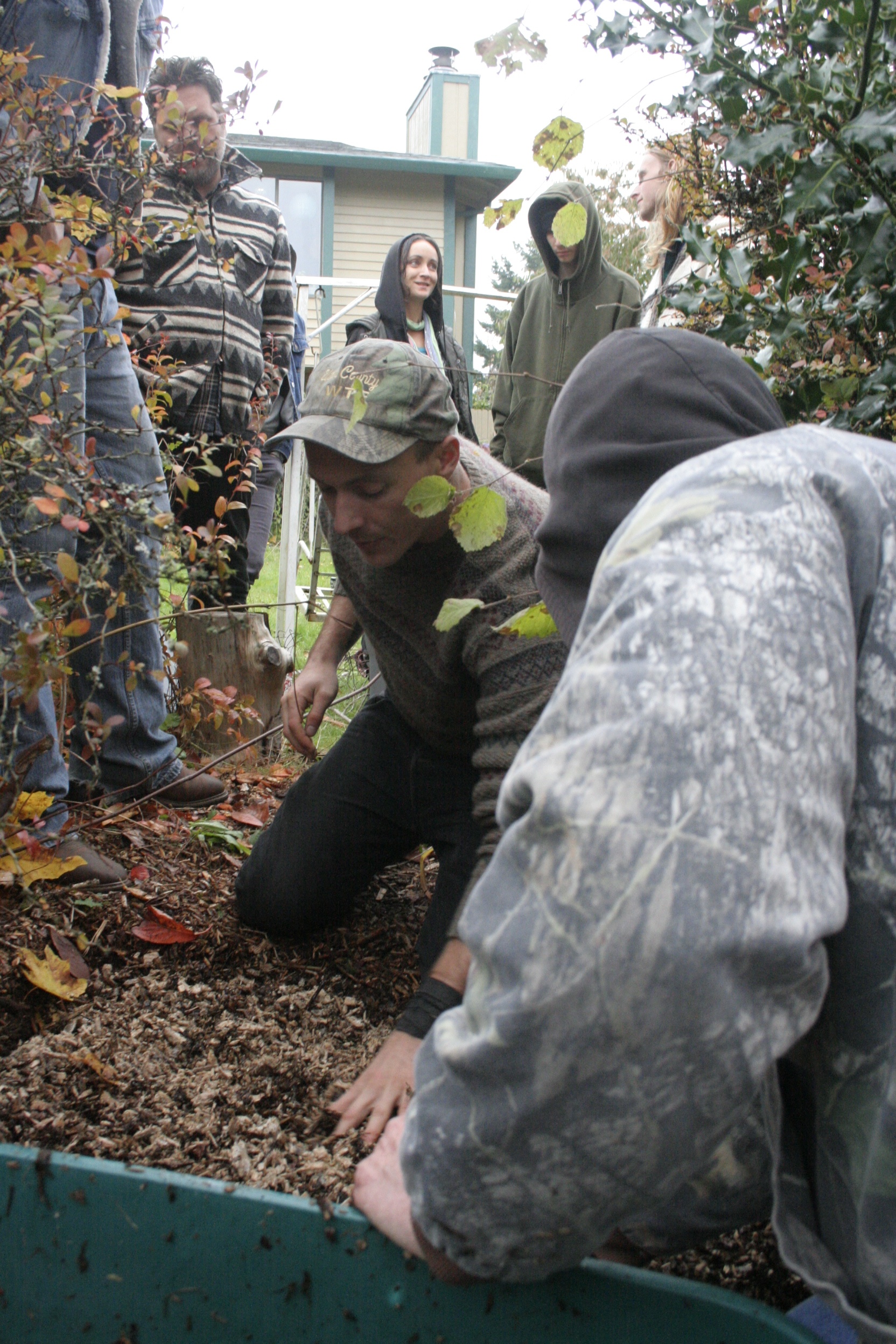
King Stropharia bed installation at Peter's Mushroom Cultivation & Application Course in Olympia, WA

King Stropharia bed installation at Peter’s Mushroom Cultivation & Application Course in Olympia, WA

The Radical Mycology project revolves around just this philosophy: that by studying, working with, and learning from the fungal kingdom, humans can best find solutions to problems of personal, societal, and ecological health. To this end Radical Mycology has put a lot of energy into providing free education to the public on the benefits of fungi.

Our website (radicalmycology.com) is a database of all things mycological. We offer two free publications we have written, Radical Mycology and Mushroom Cultivation For Remediation, as well as instructional videos and protocols for mushroom cultivation.

Nameko Bed installation at Demeter's Permaculture Garden in Olympia, WA

Nameko Bed installation at Demeter’s Permaculture Garden in Olympia, WA

We organize regular multi-day events on mushroom cultivation and its practical applications (the Radical Mycology Convergences), with another being planned for the spring of 2014. And since 2011, two Radical Mycology-inspired volunteer clubs have sprung up in San Francisco, CA and Olympia, WA. These groups teach free workshops about simple and practical mushroom cultivation and community resilience.

The next and biggest project for Radical Mycology is writing a book exploring the theory, practice, and applications of mushrooms for personal, societal, and ecological change. We are currently in the midst of an Indiegogo crowdfunding campaign to fund the book. Our campaign page will soon be up and running. Stop by the Radical Mycology website to learn more about our work.

Update: The Radical Mycology Book fundraiser is underway! This unique book on the uses of mushrooms and other fungi for personal, societal, and ecological wellbeing will be a powerful resource for the geek and do-gooder inside us all and we are excited to bring this dream to the rest of the world.

You can view the live campaign here:

http://bit.ly/radmycogogo

Our Mailman Louis

From the neighborhood resilience files: Over on the Irvington Development Organization website, I recently guest blogged about our mailman Louis, who is absolute treasure.

Our mailman Louis, the superhero

Our mailman Louis, the superhero

Excerpt:

I think of Louis as a secret superhero ever since I heard that he tried to chase down a kid he caught kicking in a neighbor’s back door. I don’t know what color his tights are, or what exact powers he possesses, but I think he might keep his cape in that mailbag he carries.

Check out the IDO site to read the full post.

Vacant Lot Becomes Community Space

Guest post by Lisa Boyles

My vision is to give purpose to a vacant lot. Where once stood abandoned houses, there will be a reflection space with a labyrinth and a community art installation.

In June 2013, we brought light to this space on the longest day of the year with a circle gathering and a modified sun salutation series. The children at this gathering helped decorate a stepping stone for the labyrinth entrance.

Since the summer, various people have joined me at this lot on the Near Eastside of Indianapolis. We have prepared the ground, moved bricks, unloaded wood, and removed trees. It is enlivening to get in touch with the dirt and have ruddy cheeks from working so hard outside.

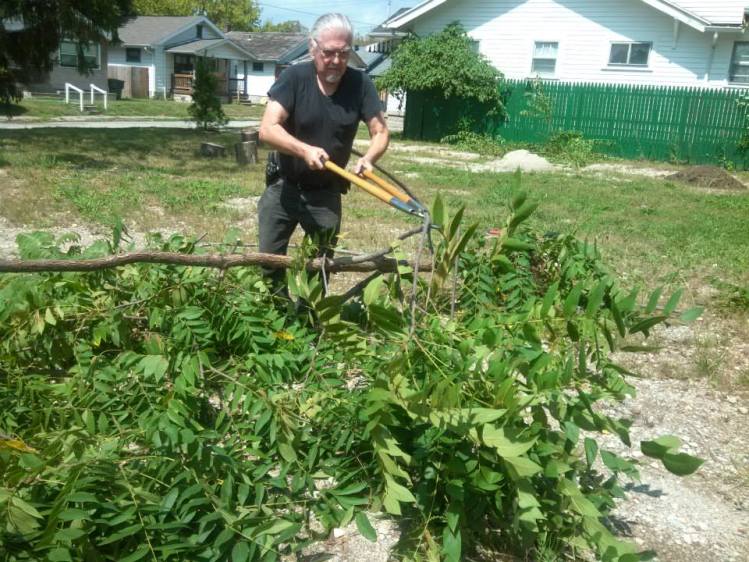
Gordon removing an invasive tree.

The transformation from empty lot to Rivoli Park Labyrinth is primarily funded through a community action grant from Peace Learning Center‘s Focus2020 initiative.

The vision of Focus2020 is to create an engaged and inclusive city. I was one of several grant awardees at the beginning of September. The collective effect of these grants will be seen throughout the city over the course of the next year. The Peace Learning Center offers workshops so that more people can become Focus 2020 graduates.

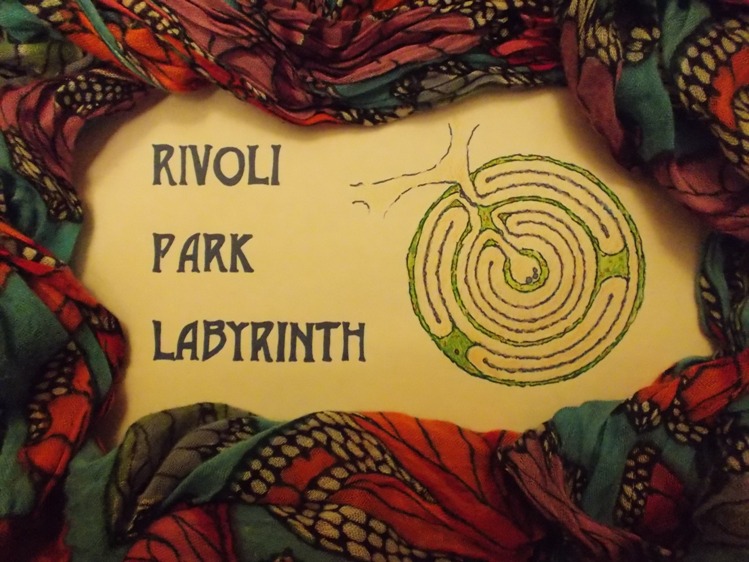
John Ridder of Paxworks: the Labyrinth Shop created the triune focus design of the Rivoli Park Labyrinth.  Logo by Susan Williams Boyles.

John Ridder of Paxworks: the Labyrinth Shop created the triune focus design of the Rivoli Park Labyrinth. Logo by Susan Williams Boyles.

The Rivoli Park Labyrinth project brings the international labyrinth movement to an urban neighborhood setting. Our space will be listed in the worldwide labyrinth locator, putting the eastside of Indianapolis on the labyrinth map.

To offset the often solitary nature of walking a labyrinth, this project also includes a healthy dose of community celebrations. For example, on May 3, 2014, we will celebrate World Labyrinth Day. And workdays at the site include a potluck to celebrate our growing community.

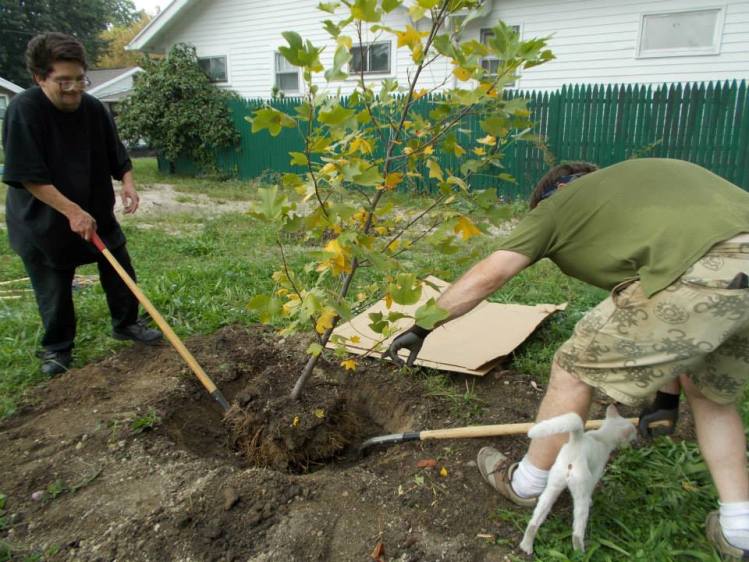
Aaron, James and the neighborhood cat moving a young tree to a new place to make room for the labyrinth.

Aaron, James and the neighborhood cat moving a young tree to make room for the winding path of the labyrinth.

Many partnerships are arising from this effort to give purpose to a vacant lot. One example of that synergy involves the documentation of the upcoming Oct. 10 workday (part of Indy Do Day). A KI EcoCenter videography intern is mentoring another young man that he met through this project. We can’t wait to see their collaborative videography of the workday, when volunteers will place bricks outlining the labyrinth path.

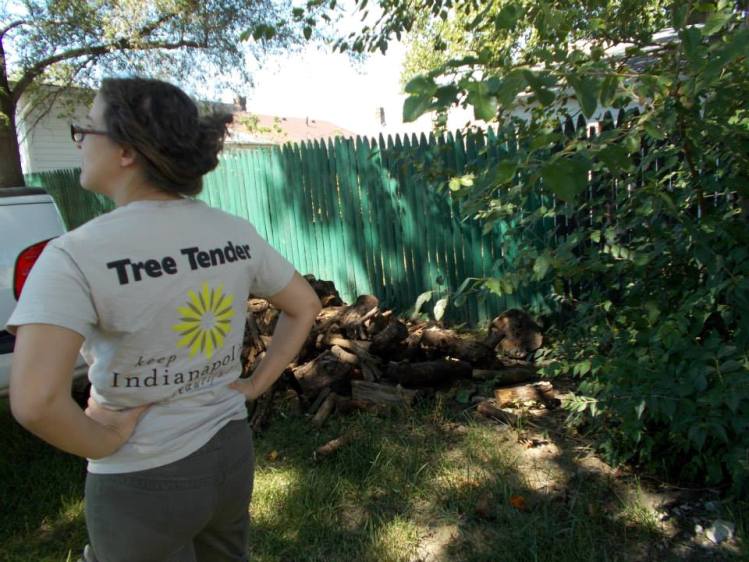
Meanwhile, the soil needs repairing and we plan to use hugelkultur to do it. We’ll mound soil and compost over woody debris and put our plantings on top of that mass. Permaculture designer Katherine Boyles Ogawa says, “Hugelkultur is an ideal method for urban lots where the soils are usually very compacted and often contaminated with heavy metals.”

Permaculture designer Katherine supervises unloading of logs for hugelkultur.

Permaculture designer Katherine supervises unloading of logs for hugelkultur.

We hope to eventually make the space into a certified wildlife habitat through the National Wildlife Federation.

Another goal is to display artwork and illustrated quotes along the fence. Panels would be created by special education students at the nearby public school and the art group at Midtown Community Mental Health Center.

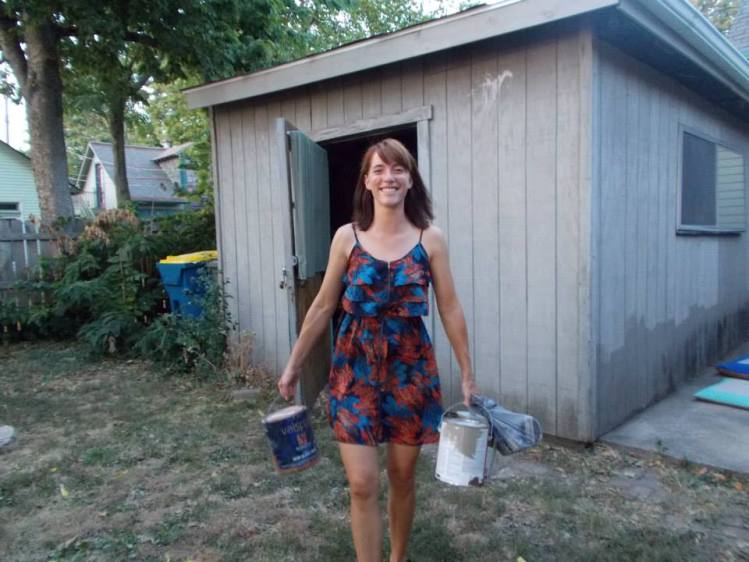
Sarah donating paint for the community art wall

Sarah, a fellow Focus 2020 workshop participant, donating paint for the community art wall.

The community art aspect of the project is being funded through this crowdsourcing site.

We would love to have you join us in celebrating a year of this project coming into being on the summer solstice, June 21, 2014.

Like the Rivoli Park Labyrinth Indianapolis Facebook page to see project news. Join the Rivoli Park Labyrinth community group to collaborate with others and be invited to the annual celebration. We will post monthly featurettes and more detailed updates on our blog.

My Dad, Who Made the World Better, Take 2

ScannedImageRecently I was going through some old files when I found a back issue of the Mennonite Weekly Review, with an article about my dad on the front page. Back in 2003, the periodical had taken notice of a “silent dialogue” he’d started about a controversial subject.

I remember it well. When his sign protesting the war met with surreptitious changes, altering its meaning, his response was characteristic of him as both a mental health worker and a Mennonite. Instead of shutting down, he sought more engagement.

In late winter of 2003, the US-led invasion of Iraq prompted Dad to place a sandwich board sign in the front yard. One side read “The Nations Say No to War” and the other said “The Whole World is Watching.” (Originally he’d worn this placard at a protest march.)

At some point that spring, someone took a pen to these antiwar sentiments, flipping the meaning with the addition of a few letters.

ScannedImage-2Dad didn’t get mad. Instead, he decided to invite passersby to participate in the commentary. He posted a blank sign, attached a permanent marker, and waited. The sign became an anonymous forum for the neighborhood to share a range of deep feelings about war.

Back in the day, at Goshen College, we had the opinion board, where anyone could scribble their random two cents. Entertaining, enlightening, enraging at times, the content was a freewheeling snapshot of campus controversies and dilemmas. Dad’s more targeted opinion board showed the diverse positions among his neighbors: concern for slain children, desire to stand behind both military and government, gratitude for free speech, comparison to Vietnam, prayers for peace, and so on.

The safety of that anonymous pen reminds me a bit of today’s comment threads online, where faceless speakers can quickly turn meanspirited. For the most part in Dad’s case, the discussion was civil, though passions were clearly high. He posted a thank-you note after the white space was full to the edges, and took the sign down.

After he was diagnosed with terminal cancer in 2011, he began to go through decades of accumulated belongings and papers. We searched for the yard signs in the basement, but they didn’t turn up, and I’m not sure there are any photographs. I was happy to find this somewhat crumpled record of his bridge-building efforts.

ScannedImage-3I lost a precious father and friend upon his death, and my family will never be the same. But this clipping reminds me that the wider community is also poorer for his absence.

A Week in the Life, Irvington-style

Last week, I realized how much I rely on my neighborhood for commerce, entertainment, exercise, and other essentials. To wit:

Tuesday morning I took part in the Writing Habit, a weekly mini-retreat for writers put on by Urban Plot in the library of a local church. With two other writers tapping away on their keyboards, I cranked out some verbiage.

Kitley finds writing more taxing than stalking sparrows. Sometimes I agree.

Kitley finds writing more taxing than stalking sparrows. Sometimes I agree.

In the evening I walked two blocks to Dairy Queen (OK, it’s not locally owned, but a business in our own little plaza). My neighbor had called a meeting, sweetening the deal with ice cream. We were there to explore teaming the Irvington Green Initiative and a budding arts initiative with local organizations like Trade School Indy to share admin/event/classroom space sometime in the future. An intriguing possibility.

Wednesday, before sunup, I went to earlybird piyo (Pilates/yoga fusion) at Irvington Wellness Center, my favorite place for yoga and other such pursuits. In the afternoon, I biked over to meet a writer friend at Starbucks (because our old haunt, Lazy Daze Coffeehouse, tragically closed this summer).

I walked from there to Help My Mac Plus, where I found a refurbished MacBook Air with my name on it. A stunning development, given how terminally conflicted I am about gadgets and the resources they require. I had just begun to put out feelers for a lightweight laptop for my upcoming research trip/ writers’ residency. I’m thrilled with my find, awarding myself double bonus points for supporting a local business and avoiding buying new.

Thursday evening it was back to Irvington Wellness for yoga class, taught by another Irvingtonian (I inquired after her hens, as one does here).

Friday evening was the highlight. First we went out to eat with a friend at local eatery Legend, where the owners know us by name and the food is delicious. Then to see Delta Duo and friends perform at Bookmamas in the Underground 9.

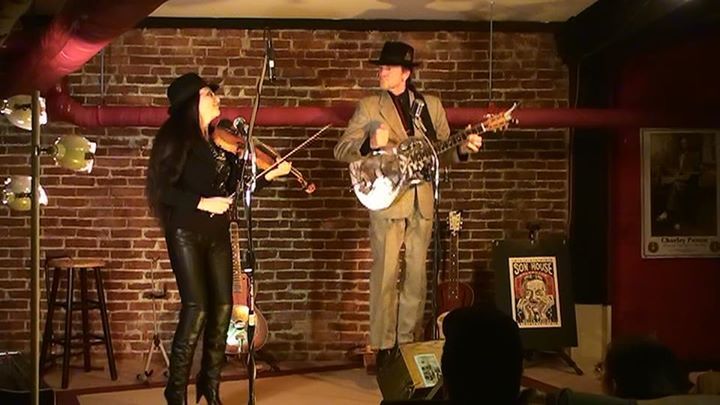
JJ plays a resonator slide guitar in the style used by Delta bluesmen of the 1930s. Irina's violin accompaniment is haunting.

JJ plays a resonator slide guitar in the style used by Delta bluesmen of the 1930s. Irina’s violin accompaniment is haunting. Photo courtesy of the Delta Duo.

Two local singer/songwriters kicked it off, after which the headliners laid it down. Delta Duo pairs JJ the Chicago-born bluesman with Irina the classically trained Russian violinist for a sound like none other. Suffice to say this monthly show will be a priority from now on. (Bonus: no cover charge.)

But the weekend wasn’t over yet. Saturday after supper, Judy and I rode our bikes to our new neighborhood ice cream shop Wyliepalooza, then popped in on old friends to catch up.

And Sunday was the farmers market. Judy and I biked over, bought bread and produce, and ran into several friends, including the aforementioned JJ and Irina.

This is the third mention of ice cream in this post. Confession: I actually can't eat ice cream! Wish I could!

This is the third mention of ice cream in this post. Confession: I actually can’t eat ice cream. Wish I could!

In short, it was a great week to be an Irvingtonian. What’s new in your neighborhood?

Calling All Lifelong Learners

Continuing an intermittent series on education
“Crazies only need apply,” jokes Blaire Huntley, speaking of Trade School of Indianapolis’s call for teachers. Previous “crazies” taught such varied topics as law, nail art, beekeeping, creative writing, bookbinding, public speaking, yoga, and even cuddling.

Making this curriculum even more unique: not one cent changes hands. Instead, teachers request items and services in trade for their tutelage.
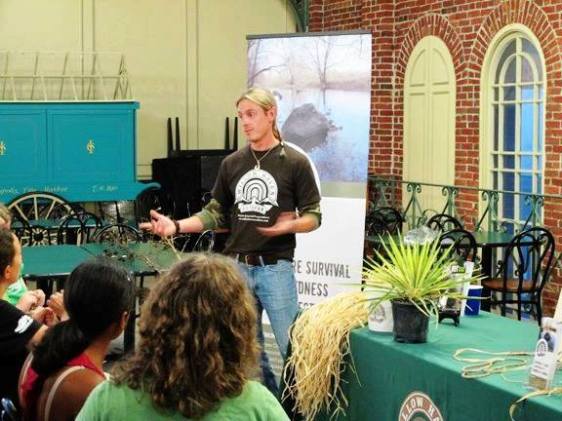
I took this class last fall: Primitive Natural Cordage with Creek Stewart of Willow Haven Outdoor.

I took this class last fall: Primitive Natural Cordage with Creek Stewart of Willow Haven Outdoor. All it cost me was the stalk of a yucca plant.

TSI is part of a barter-for-knowledge network anchored by Trade School New York, which Blaire encountered when she lived in New York City.

Though she worked eight jobs in NYC and was way too busy to take classes, when she moved to Indy, she brought along her love of learning—and the seed of an idea. Why not start a Trade School in her adopted city? Now, she says, she feels like “the smartest person in the world,” because she gets to learn from so many passionate, creative teachers.

The community embraced the model wholeheartedly. “As people are learning about us, once they know about it, they want to be involved,” says co-founder Brittany West. In the year since its launch, TSI has offered 80 classes. For the fall 2013 semester (October-November), already a record 40 classes have been proposed, and the window to apply is still open.

Compared to other Trade Schools worldwide (there are now 50), “we are always the one with the most classes going on,” says Blaire.

TSI is also one of the few such schools so far sustained without funding. Both women work for free, devoting their off-work hours to coordinating, publicizing, and attending sessions. Classroom space is donated in several venues, including Indy’s Kitchen, where cooking classes are extremely popular.

Art of Indian Cuisine at Indy's Kitchen

Art of Indian Cuisine at Indy’s Kitchen. New this semester: teachers can request items on behalf of an organization. For example, the fall Indian cooking class will be offered in exchange for donations for Gleaners Food Bank.

Brittany says the philosophy behind TSI, that “education should be accessible to everyone,” is a powerful notion. “I love that I can bring an apple or a bag of oranges in exchange for learning these great things.”

People engage with each other differently when payment is made in nonmonetary gifts instead of cash, the women say. It creates a shared experience and a deepened sense of connection.

Blaire and Brittany are looking to crowdfund classroom space for a permanent TSI home, potentially shared with other likeminded community organizations. They envision tripling the number of classes, and offering daytime sessions as well as their current evening classes.

Instructors of Backpacking 101

Instructors of Backpacking 101

Are you a lifelong learner, or someone with a skill to share? Have you experienced the fun of bypassing the money economy and found that you’ve made a deeper connection as a result? Then check out the following:

1.) Go to TSI’s Kickstarter grant appeal (great incentives!) and give what you can before Aug. 31.

2.) (For locals) Plan to attend TSI’s one-year anniversary party September 5, featuring a swap-and-trade area, teacher meet-and-greets, live music, and complimentary Sun King beer.

3.) Propose a class! “We believe everyone has something to offer, so no fancy degrees or certificates required.”

Photos courtesy of Trade School of Indianapolis
Elders Building a Healthier Future

They meet in Chase Legacy Center’s art room every Thursday for herbal tea and the deeper refreshment of conversation. Known as WeAct (When Elders Act, Communities Thrive), the group began as a natural living discussion circle, and evolved into a discussion/action group.

The weekly gathering of elders is convened by the decidedly youthful Greg Monzel. Today he’s harvested Echinacea and mint from the herb garden tended by the group just outside. With curved shears, he snips the big healthy blooms and fragrant leaves into a blue teakettle as people stroll in.

An herbalist, Greg offers his prodigious knowledge of wildcrafting and permaculture, but participants have a wealth of information too. The discussion moves in spirals, touching on plant medicine, gardening, and other homespun topics.

We explore the identification and uses of lamb’s quarters, with one member noting that this “weed” is high in iron. From another participant, we get the inside scoop on Distelrath Farms’ new cooperative model, which allows the farmer more time to pursue his mission: educating children.

From another, we learn of Taj Mahal’s original plan to be a farmer, and why he changed his mind: “He couldn’t figure out how you could keep from being poisoned by putting poison on the ground.” We lament the way conventional agriculture wages war on the land.

Comfrey root bearing a smile

Greg produces a section of comfrey root dug from his garden. A terrifically tough—and useful—plant, comfrey’s roots extend some 40 feet underground. He cuts the root into tiny pieces to send home with everyone. Each garden can benefit from nutrients pulled up from the depths.

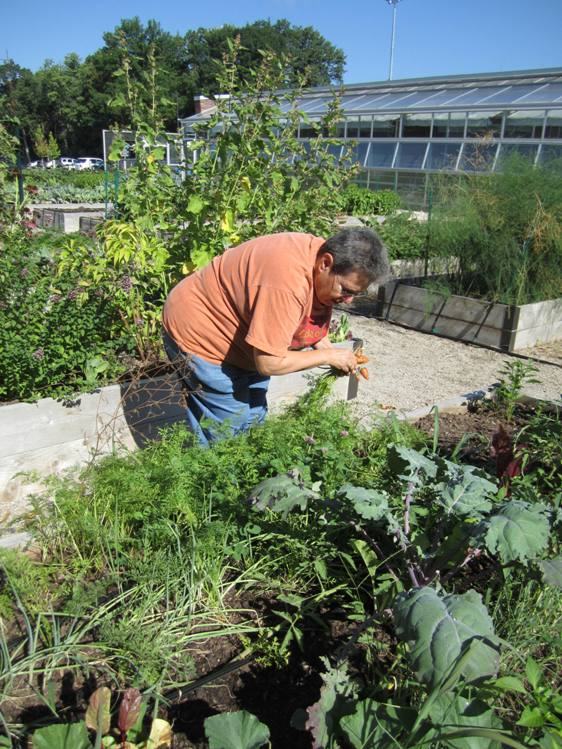
After a while we take cups of bright-tasting tea outdoors to the raised beds designated for WeAct use. There’s the excitement of lifting carrots from the earth. We discuss uses of borage and alfalfa, remedies for mildew, and where to buy a hori hori. Greg urges us to take dill seeds and coriander seeds to plant or eat.

The sky is deep cloudless blue for the first time in days. We stand in the sunshine enjoying the cool morning breeze. It’s the kind of moment that you wish could last all day, and in fact Greg says it is the high point of his week. Too soon, the group disperses.

Harvesting carrots from WeAct's group vegetable bed

Harvesting carrots from WeAct’s shared vegetable bed

Though we don’t visit it on this day, WeAct also maintains a vegetable plot on the adjoining vocational high school campus near the Colonel’s Cupboard, a student-run restaurant. The group supports the school’s horticulture and culinary programs in gardening and preparing homegrown produce.

From the mission statement: “WeAct is an activist organization of elders (and elders in training) who meet weekly for continuing education and community engagement…We consider anyone age 50 and over an elder, though the group is also open to elders in training who may be under 50.”

Among the goals:

  • to reaffirm the wisdom of community elders
  • to advocate for the right to home-grown nutrition
  • to create awareness of community resilience and natural balance

How are the elders (and elders-in-training) in your community manifesting a healthy vision for the future?