Sharing Summer’s Abundance and Summer’s Work

You never know what might result from posting a request on Facebook. The other day I asked our neighborhood Facebook gardeners’ group if anyone would take my zucchini in exchange for peppers. Because really, how many zukes does one household need? This led to the idea of a veggie swap ‘n share. So I invited any interested gardeners to bring their surplus over yesterday for some trading.

Only a couple folks showed up, but it was just right, and no doubt more will come in the future.
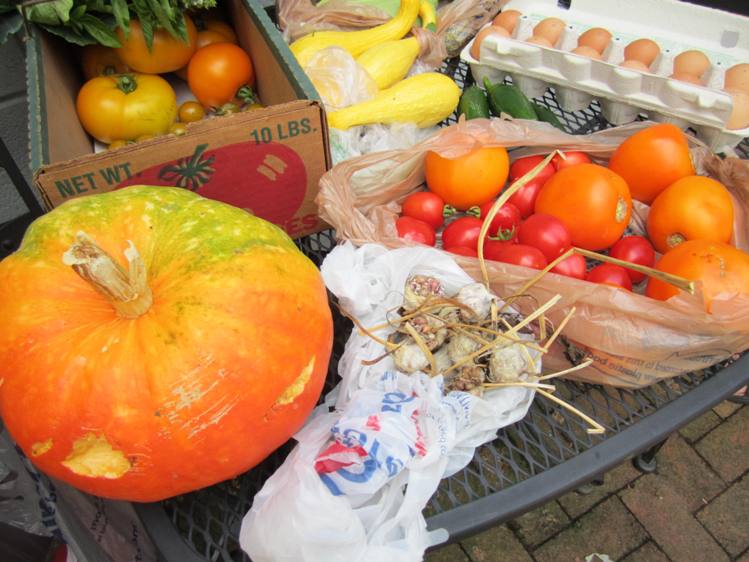
Summer's abundance shared at the veggie swap.

Summer’s abundance shared at the veggie swap. (The eggs are a side deal.)

Julie brought heirloom tomatoes, the only thing she grows. I was thrilled to take some off her hands, since mine are ripening ever so slowly after initially falling prey to blossom end rot. Her cherry tomato variety is called Doctor and rivals my beloved Sungold for sweetness.

As the most ambitious gardener among us, Laura brought a slightly squirrel-chewed pumpkin that needed to be harvested because of an issue with the vine. She had also just picked yellow squash, collards, basil, and more lovely heirloom tomatoes, including a variety called Principe Borghese, reputed to be great for drying. (I’m happy to say these are in my dehydrator as we speak.)

Collards and basil straight from the garden.

Collards and basil straight from the garden.

I offered the aforementioned Zucchini Explosion, specifically a variety called Cordello, as well as some jalapenos and various herbs. Laura went home with catnip for her kitties (sorry Kitley and Maggie!), sage, and rosemary.

Funny how these things all work out and people go away happy to try something new. I think swapping could be habit-forming.

Clowning with Cabbage

Clowning with cabbage at last year’s kraut party

On a related note, last summer our kitchen was home base for group preserving efforts, loosely connected to our community garden. With polka music on Pandora, we shredded up several heads of cabbage and packed them in crocks at the Kraut Party.
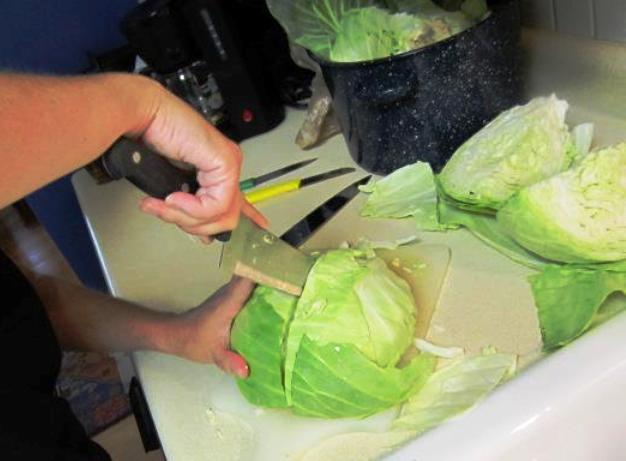
Kraut Party Action

Kraut Party Action

Later in the season we switched the sound track to the Three Tenors and Andrea Bocelli at the Pesto Party.

And a couple of us got together to make a gazillion varieties of salsa as well, to share with the community at a Salsa Party.

When you try to cook and preserve seasonal produce, summer can be a crazy time, especially if some of the produce comes from your own garden. Most of us don’t live in the kind of multigenerational households that were the rule back in the day. So we don’t have the built-in helpers that our foremothers did. It can get lonesome, toiling away in your kitchen on your own.

So it’s been great fun to turn some of that work into social events.

There’s talk of another Pesto Party, and maybe even a group effort to “put up sweet corn,” as my people say. We can get a boatload of sweet corn from one of our many local growers and just go to town.

Hm. What musical genre would work for a Corn Party?

Building a “Better Block”

Something’s happening this weekend that strikes me as just the kind of grassroots change that we so need right now.

It’s called Better Block, a one-day transformation of a city block into a living demonstration of a walkable, vibrant neighborhood center. A Better Block allows communities to experience a “complete streets” buildout process. People can develop “pop-up businesses” to show the potential revitalization that goes along with such an effort.

I read about my hometown’s expression of the movement in this Nuvo article, Real Time Urban Renewal, written by IUPUI grad student Ashley Kimmel. This Saturday from noon to 5pm, the Better Block event will “convert one block of the (East Washington Street) corridor into a vision for the future: a living scale model of how the street could look, feel and be cared for by the neighborhood.”

The benefits? According to the article, such an event:

  • moves beyond simply conceptualizing development to a three-dimensional encounter with possibilities,
  • “focuses on the ground-level experience rather than the top-down aerial map,”
  • offers an inexpensive way to use existing resources toward urban planning, and
  • creates the opportunity to open storefronts and reconfigure travel lanes “on a small, testable scale.”

With the immediate feedback available in this cost-efficient study, it seems like the motivation would be high to make the one-day experience a reality in the not-so-distant future. Why wait?

Neighborhood cleanup on the Pennsy. Photo by Heidi Unger.

Neighborhood cleanup on the Pennsy. Photo by Heidi Unger.

I recognize this plucky can-do spirit. It’s alive and well in my own community, where this weekend a group of neighbors will be building a new greenspace adjacent to the Pennsy Trail.

It’s the same chutzpah that drives City Repair in Portland, OR, where volunteers transform intersections, create community gathering places, and enrich civic life through public art.

I’m betting it’s happening in more neighborhoods than we realize. How about yours?

The Mighty Will Fall

In just a few hours the March Against Monsanto begins here in Indianapolis. On the march’s worldwide Facebook page, New Zealand, Australia and Japan are already representing. At last count nearly 300,000 people in 58 countries worldwide were committed to taking a stand today.

Why march? Pick your reason.

  • We march for freedom and self-determination in the face of Monsanto’s monopoly over the world’s food supply.
  • We march to protect both human health and the earth we love from dangerous genetically modified organisms.
  • We march to refute the insane notion that it is possible to patent life.
  • We march to protest the insidious cronyism in the U.S. government, where ex-Monsanto executives are in charge of ensuring the safety of what we ingest–and are designing laws that make Monsanto basically immune to any legal counterattack.

One of my sheroes, Vandana Shiva, says it all in this video.

I’ve said “we”–but disappointingly, my body is not yet back in marching shape. My marching will have to be done through these pixels, and through the seeds I plant and save, and through the petitions and letters I sign, the calls I make.

Funny thing: I thought I was brought down by something tiny, the fangs of a wee arachnid. Turns out it was something even smaller, the lowly bacterium.

More accurately, bacteria. That is, a community of bacterium. Right? My medical consult is sleeping at the moment, but I think that is right. A community of teeny tiny organisms has brought me pretty much to a standstill.

By Mkaercher, via Wikimedia Commons

By Mkaercher, via Wikimedia Commons

Do the words “small but mighty” come to mind?

What I take from this is the strength of the collective. Monsanto may be monied, powerful, backed by government insiders, seemingly invincible–but WE have each other. We have our passion and our deep concern for the future. We have our love, as Shiva says, for “freedom and democracy, love for the Earth, the soil, the seed.”

All of which gives us the capacity to fan out and fell this giant.

Let’s do this thing.

Time to shout “STOP”…..March Against Monsanto.

“My own reason for supporting this movement is because I believe in freedom. Freedom to grow my own food, food that I feel happy to eat. Freedom to save seeds from the plants that I grow. Freedom to distribute them as I please among other growers. Monsanto wants to curtail these freedoms, because these freedoms don’t put money in their pockets.”

Well said, Bridget.

I’ll be attending the March Against Monsanto in my own town–will you?

bridget's avatarfromacountrycottage

017

On May 25th of this year a great event is happening. Where is it happening?  Everywhere! If you check out  http://www.march-against-monsanto.com   you will find marches organised to protest against the giant corporation that is Monsanto. All over the World marches are scheduled. We must make our feelings felt. Not only to Monsanto but also to our governments, for they are the ones allowing Monsanto to infiltrate our farms, gardens and allottments.

019

Tami Monroe Canal, creator or the now viral Facebook page March Against Monsanto, says she was inspired to start the movement to protect her 2 daughters. “I feel Monsanto threatens their generations health, fertility and longevity. I could’nt sit by idly, waiting for someone else to do something.”

My own reason for supporting this movement is because I believe in freedom. Freedom to grow my own food, food that I feel happy to eat. Freedom to save seeds from the…

View original post 242 more words

Living Below the Line

My friend Cathy has been posting on Facebook this week about her experience participating in a challenge called Live Below the Line. For five days, she and her fundraising team are limiting what they spend on food to $1.50 a day.

The idea is to create awareness of the plight of 1.4 billion people all over the world who live in extreme poverty—people who must cover not just food but basic necessities with the equivalent of $1.50 per day.

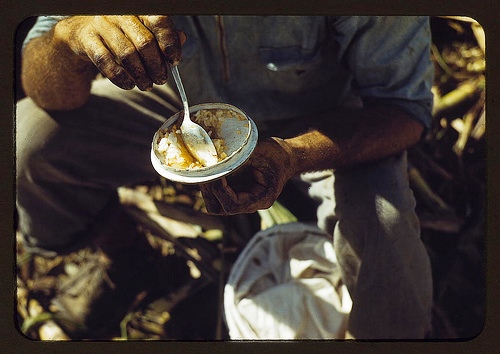
Rice in a lunch of plantation worker

Rice in a lunch of plantation worker

The Global Poverty Project is the organizer, and they’ve partnered with U.S. charities fighting hunger and poverty around the globe. My friend and her group have chosen to raise money for CARE.

According to the site, Live Below the Line is running in the US, UK, and Australia simultaneously, with more than 20,000 people participating.

Cathy reports that this is the second year she’s participated in the challenge. “I found it such a powerful experience that I did it again. The lack of choice and the mental aspect are far worse than the reality of the food itself or serious hunger.” Her Facebook posts show how the eye-opening experience can increase a sense of gratitude and compassion:

  • Today I cannot help on reflecting how easy my life is overall. I cooked the rice in the rice cooker after rinsing it with my filtered water that I had to walk nowhere to retrieve. I soaked my beans overnight in filtered water and then cooked them on my gas stove with the mere twist of my wrist required to turn it on…
  • I felt a bit hungry after lunch. I have to be conscious of how much I eat so that I do not run out. Yes, I am a tad ashamed to admit, I have threatened my family members not to dare touch any of my rice or beans. Imagine if so little actually had to feed my family.
  • Today I had minor obsessions with the bananas and yogurt, both appeared so enticing. It did make me think about those whose livelihoods depend on the fruit and vegetables they grow—but must sell in order to make the meager income they provide.

Having empathy with people in vastly different circumstances is surely one of the things that is going to save all of us. In Cathy’s words:

“I am humbled by how easy my life is, simply by virtue of where I was born. Unfair. This week is about experiencing, raising awareness, and helping fund hand-ups—not hand-outs. If you are so inclined, please donate to CARE.”

Wake Up the Earth

Way back in 1979, disparate groups in the Boston neighborhood of Jamaica Plain rallied to protest an eight-lane highway extension that would have cut right through the community. The successful campaign made Jamaica Plain the first place in the entire country to stop such an “improvement.”

Since then, every first Saturday in May, the community has come together at Southwest Corridor Park, the location of the thwarted highway, for the Wake Up the Earth Festival and Parade. The event—happening this Saturday—celebrates what’s possible when people of many traditions, cultures, ages, and beliefs unite.

Spontaneous Celebrations organizes the Wake Up the Earth Festival and Parade every year, but the community makes it happen.

Spontaneous Celebrations organizes the Wake Up the Earth Festival and Parade every year, but the community makes it happen.

Organized by Jamaica Plain’s arts and cultural center Spontaneous Celebrations, the May Day celebration is based on English agrarian traditions. The phrase “Wake Up the Earth” originates from ancient beliefs about rousing the earth to ensure a good harvest.

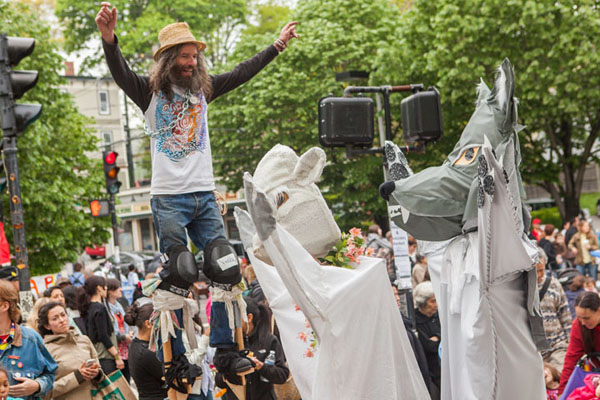
Spontaneous Celebrations’ program director Mark Pelletier described the opening festivities like this: Two processions form before the festival starts, a dual parade symbolizing bringing the two sides of the tracks together. After winding through the streets—separate colorful processions of stilt walkers, giant puppets, musical ensembles, and revelers of all ages—the parade converges at high noon at an intersection at the top of a hill. Everyone marches down toward the park together.

Revelers in the Wake Up the Earth Parade

Revelers in the Wake Up the Earth Parade

There paraders gather in a large circle, and the musicians find a mutual rhythm. The drummers sort out which beat to follow “and it rages along nicely,” Mark told me, “and then there’s everybody standing there facing one another.” I like to picture the various cultural groups in the urban neighborhood all decked out, everyone grinning at each other across the circle.

When the circle dissipates, about 10,000 people will partake of a smorgasbord of participatory fun over the next six hours.

Pageantry and puppetry abound at the Wake Up the Earth Festival

Pageantry and puppetry abound at the Wake Up the Earth Festival

Attendees can play on cardboard slides made from refrigerator boxes, or take part in the all-day drum circle. There’s a “wake up the body” area where people of all ages and shapes practice yoga. There’s an enchanted puppet forest, an amphitheatre with “homegrown circus stuff,” and of course music from every corner (seven stages!). Some 70 crafts vendors offer strictly handcrafted goods, and 25 food vendors sell cuisine from all over the world.

Every nonprofit in the community has a table at the festival, marrying jubilant celebration to civic engagement. It’s a day that brings just about everybody from Jamaica Plain out in a zany, colorful, spectacular celebration of culture and connectedness.

For Dutch-born Femke Rosenbaum, organizer of the very first Wake Up the Earth, this unleashing of imagination is her vision made manifest. “It was always my dream to involve the community in creating the festivals—not to just show up one day, but really to be the creators of it,” she told me.

Co-creation is a beautiful thing, especially in tough times. How does your community come together in celebration?

Images courtesy of Lucie Wicker Photography.

Meet the Mudgirls

I’m always intrigued by people who are able to take the more complicated aspects of modern life into their own hands. Maybe that’s because outside of your basic paring knife and garden trowel, my own hands are pretty fumbly. The realm of natural building just amazes me.

Round Cob House Built by the Mudgirls

Round cob house built by the Mudgirls

Natural building involves using materials occurring in nature (and sometimes recycled materials) to construct homes and outbuildings. For example, back in Too Many Tons I posted a video featuring a DIY builder from Indiana making bricks from mud. Materials are sourced locally—perhaps clay from a neighbor who’s digging a pond, sand from a nearby excavation, straw from a local farmer.

Recently I discovered a British Columbia-based women’s collective specializing in cob building (using a mix of clay and straw). Meet the Mudgirls.

The Mudgirls are a collective of women builders on the west coast of British Columbia, Canada

The Mudgirls are a collective of women builders on the west coast of British Columbia, Canada

For the past seven years they’ve worked together as independent builders, doing seasonal work throughout the Vancouver Island area. Though they started with only about 10 days of work in the early years, many now make their main summer income from this work.

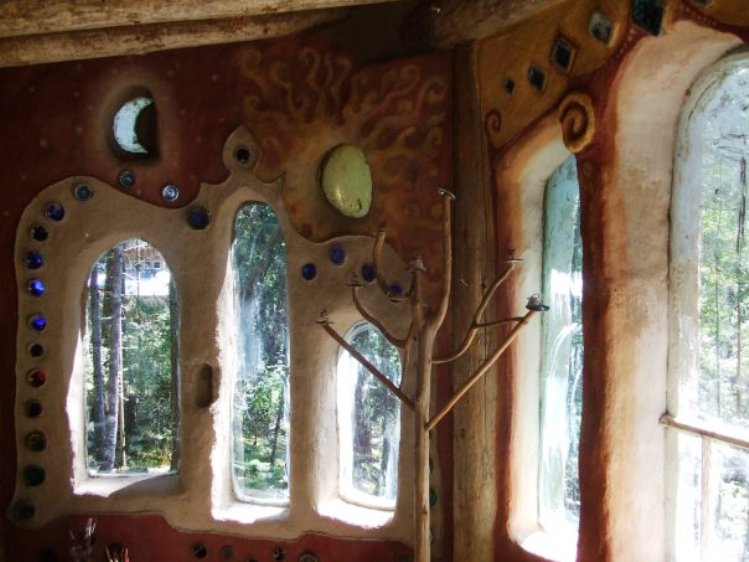
They’ve build cob ovens, cabins, sheds, fences, and outhouses. They also take their craft into conventional homes, using earthen plaster with beautiful results.

Interior of a Mudgirl-built home.

Interior of a Mudgirl-built home.

As a consensus-run group, they are trailblazing in other ways as well, showing a more egalitarian way to operate than the dominant paradigm’s business-as-usual. And they offer workshops at the most affordable rates in North America ($200 or less).

Mudgirl Rose Dickson, one of the founding members, was drawn to the collective because of her outlook as a feminist/environmentalist/artist. From the photos,* it’s clear that the Mudgirls’ work offers a creative outlet.

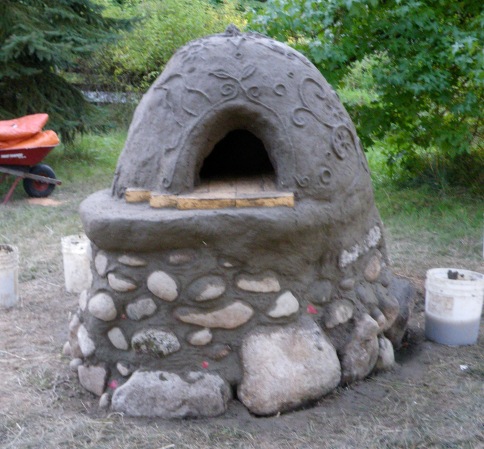
Cob Oven Made by Mudgirls

Cob oven made by Mudgirls

And these round structures are built to last, as witnessed by many such homes in England, still standing hundreds of years after their construction.

Not too long ago, a four-ton tree fell on a Mudgirl-built cob house—crashing through a bump-up of windows and earthen plaster and stopping at the cob wall. Rose reports, “No cracks in the wall from impact, and the guy who came to clear it off said a wooden house would have been crushed by the tree.”

A four-ton tree fell on this Mudgirl-built cob home, stopping at the cob wall

A tree fell on this Mudgirl-built cob home, stopping at the cob wall

Cob building is physically demanding and sometimes uncomfortable work (imagine a chilly spring day when you’re working in cold mud from sunup to sundown). But Rose relishes the chance to be outside, away from a desk, making something with her hands in the company of her dearest friends.

Mudgirls at work

Mudgirls at work

“If the weather’s cold, it can be kind of miserable,” she admits. “But if you’ve got a couple friends there who you’ve known for years and you’re joking and laughing, it makes it. That’s actually one key with natural building is the community. It takes more time, so the labor is a factor. But that’s part of why people do it together.”

This strikes me as the ultimate in do-it-with-others (DIWO). Has anyone out there had experience with communal natural building? I’d love to hear about it.

*Photos provided by Mudgirls.

Pass the Book, Please!

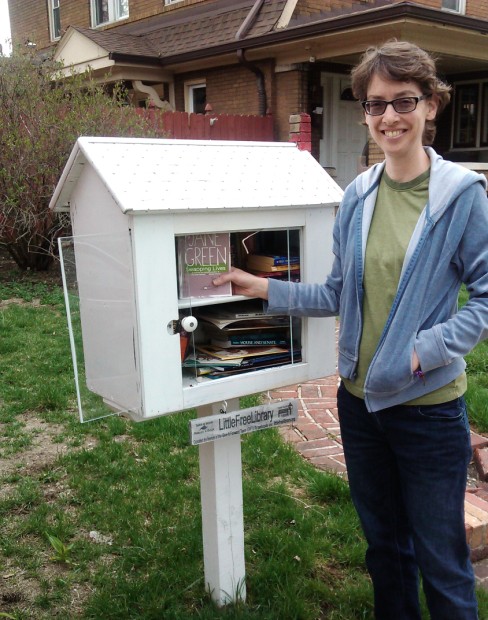
On my walks through the neighborhood I have encountered a curious thing: a little house-shaped structure mounted on a post, with sliding glass doors enclosing one of my favorite things: books!

Little Free Library in my neighborhood

Little Free Library in my neighborhood

It is a Little Free Library, part of a worldwide network designed to cultivate the love of reading by setting up free book exchanges.

Gotta love that. I decided to donate a book and take another home, just for fun. I’d like to say my donation was carefully selected after much intensive soul-searching, Top Ten list-making, and pick-pondering, but the truth is I had just visited Bookmamas, our little independent bookstore, where I was given three advance reading copies of books marked NOT FOR RESALE, so I stuck one of those in.

Putting my book into the mix.

Putting my book into the mix.

The little house-o-books was crammed chock full. Perhaps more people need to stop by and check out the selection.

I came home with a book called Dune Road, by Jane Green. It’s a novel about “divorcee Kit Hargrove (who) has joyfully exchanged the requisite diamond studs and Persian rugs of a Wall Street Widow for a clapboard Cape with sea-green shutters and sprawling impatiens….” Not my usual fare, but hey! I’m open.

Me and my find

Me and my find

I just love the coziness of the little structure, and the community feel of it. I want one in front of my house! (Neighbor-readers out there: do you know if this little library’s stewards made it by hand–or other details about it? No one was home when I knocked–or perhaps they were hiding from the camera phone-wielding/windblown/book-crazy stranger on their doorstep).

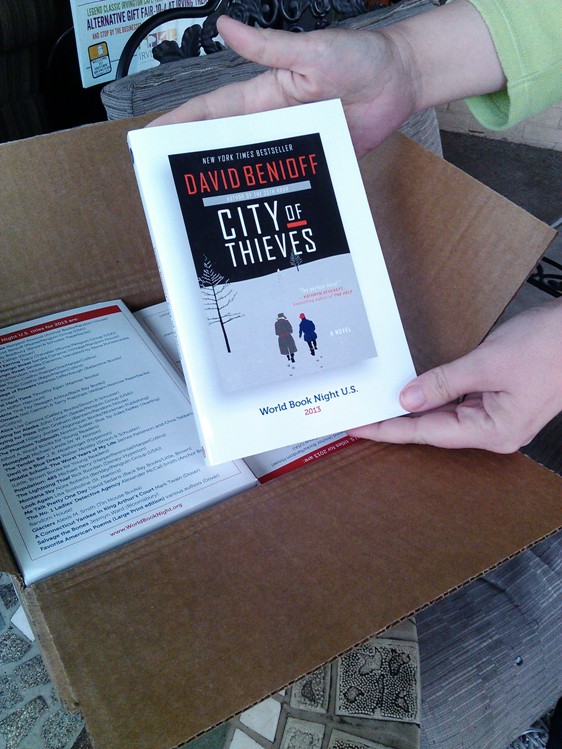
I was just wrapping this post up when the friend working across from me at the coffee shop mentioned that Tuesday is World Book Night, wherein book-lovers sign up to distribute 20 copies of a book–printed and shipped pro bono, with authors foregoing royalties–to people who don’t regularly read. She had ordered a box of books to pass out, so we stopped over at Bookmamas to pick it up.

Special edition books for World Book Night, designated to be given free

Special edition books for World Book Night, designated to be given away

Anyone out there ever participated in a book exchange or giveaway? Are you participating in World Book Night? Chime in and let us know what’s going on in your neck of the woods.

KI EcoCenter Leading in the Green Economy

A local community group near and dear to my heart will be represented at a national event next week. The executive director of Indy’s own KI EcoCenter, also known as Kheprw Institute, will be among the presenters at the Good Jobs, Green Jobs 2013 Conference in Washington, D.C.

About KI: When I first visited, I learned that “Kheprw” is a reference to an Egyptian god represented by a man with a scarab beetle head. The scarab beetle was a symbol of rebirth in ancient Egypt.

It seems a fitting title for this community empowerment center, which works at the intersection of social justice and environmental stewardship in the heart of an economically distressed neighborhood. Here it’s all about nurturing an ecologically sound way of life while creating economic opportunity through community engagement. The programming includes an eco-film series, job creation panels, open mic nights, youth empowerment events, and so much more.

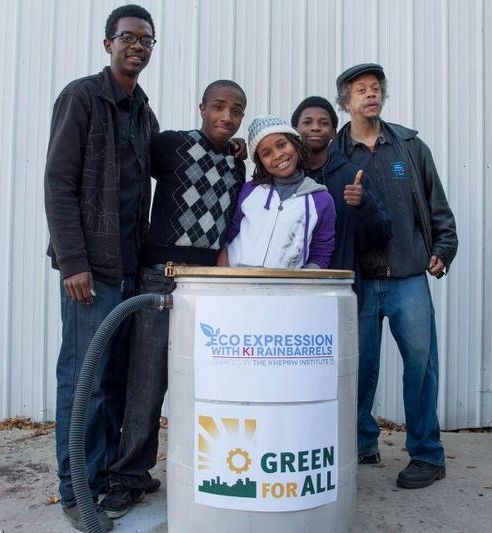
Mat, Rasul, Asli, William, and Imhotep show off an Express Yourself Rainbarrel

Young people in the KI school and mentorship program gain critical thinking skills as they practice social entrepreneurship.

I’ve met many of KI’s children and young adults and they’re not just tomorrow’s leaders—they’re today’s. They know firsthand that with the help of your community, your creativity, and your drive, you can make something from nothing. They’ve built garden beds and aquaponics tanks. They’ve started a paint store, a web services/graphic design enterprise, and a fair trade coffee shop. KI’s work has inculcated in them the confidence and skills they need to navigate the relationship-based economy—whether the goal is a money-maker or a service project or, better yet, both at once.

About the Conference: The theme for the three-day conference is “Let’s Get to Work: Climate Change, Infrastructure and Innovation.” Over 80 workshops will illuminate the possibilities of job creation through green infrastructure. (How refreshing: You mean we don’t have to unleash holy hell in the form of Canadian tar sands in the name of “job creation”?)

KI’s director Imhotep Adisa is a panelist for a workshop highlighting successful sustainable water infrastructure projects. He’ll share KI’s experience in the green economy and its latest social enterprise, Express Yourself Rainbarrels. (I absolutely love this project: The KI crew will customize a rainbarrel with your logo, design, or photograph. I can’t wait to see mine!)

I’ve written a piece for Indiana Living Green about the center that will be out next month. In the meantime, check out this video featuring their work. (Start at minute 3:50 for the segment on KI).

An Appeal Denied

Update: Community Access Television has posted a video of the April 3 Board of Zoning Appeals meeting. Minutes have not been posted on the BZA site yet.

Last night I met up with friends to drive to Bloomington, IN for a Board of Zoning Appeals meeting. We were among 80 others there championing permaculture designers/teachers Peter Bane and Keith Johnson, who were pursuing variances for their small suburban lot. Since last summer, they’ve been mired in a conflict with Monroe County, primarily about placement and square footage of structures at Renaissance Farm.

The main issue was that they didn’t follow proper procedures, but they were under the impression that agricultural buildings are exempt from the process. I won’t go into detail about the legalities as that’s not the purpose of my blog—but you can refer to the meeting materials.

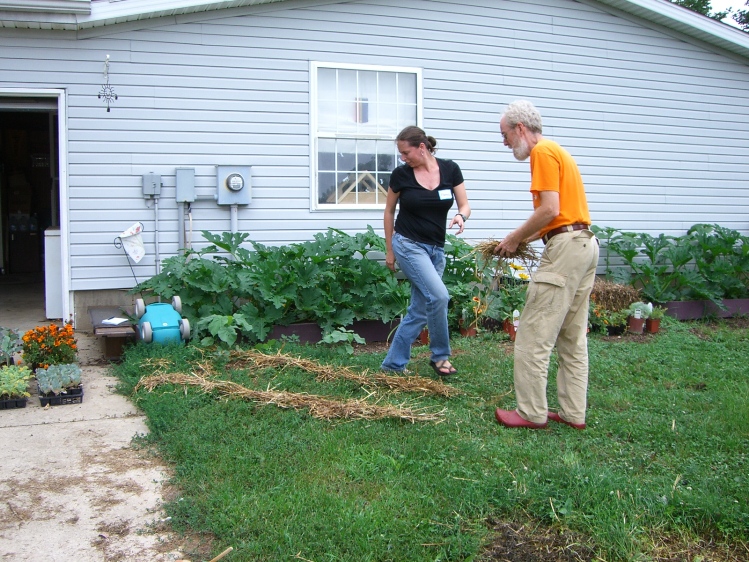
Peter Bane with co-teacher Rhonda Baird laying out a garden path during 2007 permaculture class

Peter Bane with co-teacher Rhonda Baird laying out a garden path, 2007 permaculture class

It was moving to hear the 30-plus testimonies of Peter and Keith’s impact. (I first met Peter in 2007 at a one-day permaculture overview class, and his passion infected me with the need to come right home and plant my entire lot in food.)

The intergenerational crowd was made up of neighbors, IU profs and grads, pastors, farmers, small business owners, a newspaper editor, a City Councilman, and young Bloomington natives who moved away and then returned, largely because they wanted to learn from these luminaries.

Neighbor after neighbor told of the duo’s generosity in sharing both knowledge and produce. Many have started gardening themselves. One said she travels all over the country; when she tells people she lives on the same street as these renowned Permaculture designers, “they are in awe.”

A sampling of comments:

“Everything they are doing is a practical and immediate way of changing the world for the better.”

“They are showing that young people can have a viable future in spite of the climatic, economic, environmental, and other issues facing us.”

“It’s beyond sustainable, it’s regenerative.”

A maypop planted along our fence, one of many plantings inspired by permaculture

A maypop planted along our fence, one of many plantings inspired by Keith and Peter’s work

There seemed to be an understanding in the room, even among officials, that we are at a crossroads. One supporter told them, “I am sympathetic to you who must uphold laws that support suburban sprawl and ignore what the future requires of us.” Another said, “We are living in a world where the rules are changing.” Another warned that big timber, big ag, and mining will dominate rural areas if we don’t change our ways.

But apparently these are not the concerns of a body pledged to oversee existing laws, faulty as they are.

After four hours the board approved all but one variance—a critical one. The barn must be moved about 10 feet from its current position to be in compliance.

It was a shock. Especially after board member Jerry Pittsford, who expressed dismay that Peter and Keith had circumvented the process, had said, “I like rules, but I’m finding very little that tells me the rules need to be followed here.”

There were a number of reasons to approve the variance and only one to deny it—the fact that they did not consult with the county and submit the proper paperwork. Even as the board expressed admiration for Peter and Keith’s work, they could not get past that lapse.

It’s unclear what the next step is for Renaissance Farm, but whatever comes, I hope these two visionaries were bolstered by the outpouring of love and appreciation from neighbors, former students, and admirers.