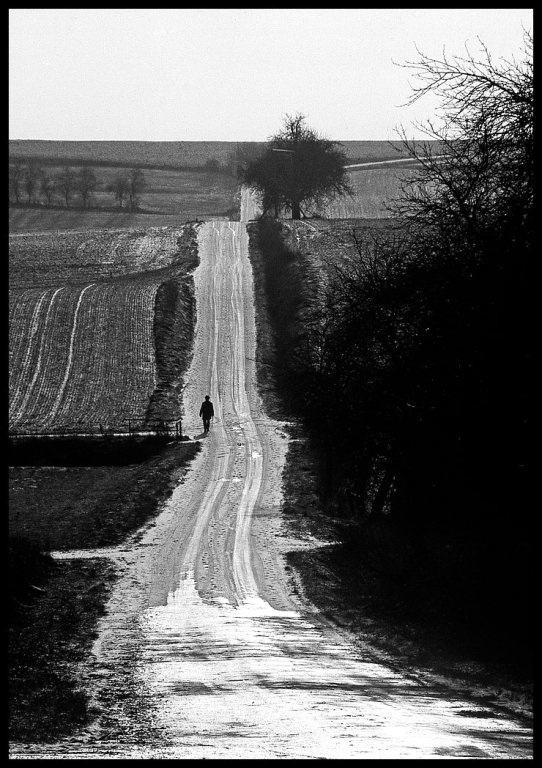
Long Journey Home, by Phil Richards, via Flickr Commons
One day you finally knew
what you had to do, and began,
though the voices around you
kept shouting
their bad advice—
—from “The Journey,” a poem by Mary Oliver
Long Journey Home, by Phil Richards, via Flickr Commons
One day you finally knew
what you had to do, and began,
though the voices around you
kept shouting
their bad advice—
—from “The Journey,” a poem by Mary Oliver
Today is International Permaculture Day. Guest blogger Thomas Tlusty wrote the following piece exploring his connection to Permaculture, and its power.
Guest Post by Thomas Tlusty, founding partner of The Garden Tower Project
Two years ago, I saw sketches of a device that I felt certain had the potential to revolutionize urban agriculture. I had long been interested in the economics and environmental impact of our food system. So the design piqued my curiosity and unleashed my desire to have a positive impact in my own lifetime.

The Garden Tower is a water-saving, worm-friendly, uber-productive vertical gardening aid.
Since that fateful reveal, my life has been transformed. The Garden Tower Project reignited my passion, and I began rethinking current food production/distribution models. My eyes were opened to the plethora of pioneers, visionaries and everyday folks who are practicing, teaching, and studying Permaculture and sustainable farming/lifestyles.
I am inspired by those who inspire others. I’m thinking of luminaries like Bill Mollison, David Holmgren, and Will Allen. I’m also thinking of many less well-known but still pivotal figures, such as:
I am a relative newcomer to this work. Yet I feel a kinship with those who aspire to build community and develop our inherent natural resources in a straightforward manner.
I’m troubled by the unbinding of our culture from its roots. Western civilization is “circling the drain” as we surpass our fragile planet’s carrying capacity (in our current mode of operation).
Permaculture (to me) represents an entirely sane alternative to the path on which we find ourselves today. Permaculture principles contain not only the seeds of hope but a catalyst for change. In practice, these concepts could improve the lives of untold millions and positively influence the course of our future on this planet.
I find hope in people working together in communities, sharing education and experience. And teaching our children well is our first and best hope.
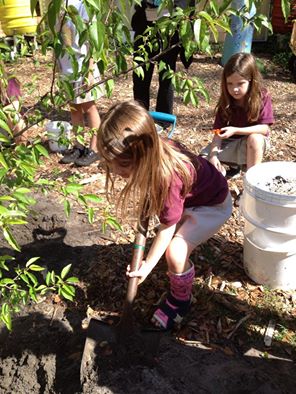
Our Hope For Mending a Broken Future: A child at Learning Gate Community School in Lutz, Florida, prepares soil despite the cast on her leg. Instructor: Cissy Brady Stanko
Permaculture engenders ideas and conversations around topics like environmental science, vermiculture, organic gardening, eco-art, and eco-psychology. And connections grounded in Permaculture positively transcend any political, socio-economic, racial, or gender barriers that have been erected in the past or could possibly be constructed in the future.
In my endeavors, I have developed friendships through online Permaculture forums and related Facebook pages. The connections range from the casual and conversational to the inspirational and uplifting. Together they raise me from the deep morass that had grown like a thick moss over my heart’s desire.
I’m now acting on a long-felt wish to accomplish something meaningful and utterly critical: addressing our outdated and increasingly toxic food production/distribution system. Without action and intent, habits will remain the same. Permaculture shows us the way to a very different future.
Thomas Tlusty was raised in Lombard, IL. Thomas was active in social justice and interested in food issues from a young age. In his late teens to early twenties, he worked at the Chicago Board of Trade (in Agricultural Commodities) for a leading grain exporter. The Ellettsville, IN resident has been a practicing Certified Natural Health Professional and is currently an Active Isolated Stretching Therapist in private practice. Thomas is a founding partner in the Garden Tower Project.

Photo by Mark Notarim, via Flickr Commons
“People ought to support mitigation and adaptation within their own line of work…If you’re a butcher, baker, ballerina, banker, or a plumber, envision yourself as the post-fossil-fuel version of yourself, and get right after it.
So…stop co-operating with the status quo. Stop collaborating. Stop being afraid and stop feeling helpless. Just stop all that and start living by entirely other means.”
—Bruce Sterling, from WorldChanging
Guest post by Anna Welch
Anna Welch is a farmer in Rush County, Indiana. With her husband and business partner, she owns Fields of Agape, growing organic grain, beans, and seed. Now she’s working to establish a cooperative mill in Carthage that would allow many more organic and transitional farmers to bring their products to niche markets. After we had a conversation about some of the barriers she’s faced, she sent me this reflection.
I think of the many times I wanted to quit, that it felt impossible to go forward with the limited resources and lack of support around me. I’ve been through periods of deep depression, anger, hopelessness, and resentment. I’ve been humbled many times over since committing my life to stewardship of the land and its fruit.
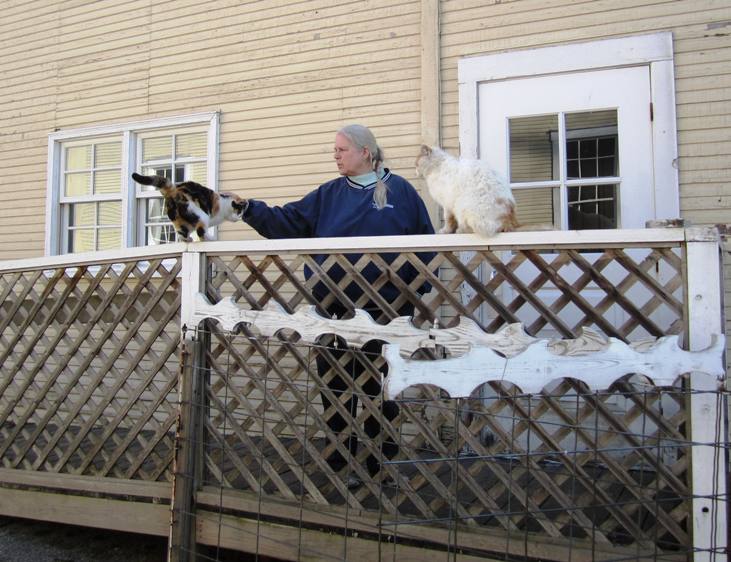
Anna Welch with friends at the entrance of the Carthage Mill. The historic Tweedy Lumber Mill is now the site of a sustainable ag business incubator.
I had two choices: quit and return to the workforce, or retreat to a place of rest, and pray, reflect, journal, and wait to see who or what changed around me. Someone spoke words of encouragement, or a visitor stopped by the Carthage Mill and said how this place is necessary and will come to pass.
One of my greatest encouragers here at Carthage was my friend Allen, who came daily with his dog Rusty. The first day he stopped by, I was cleaning golden flax seed. He heard the machine and the gate was open, so he stopped. I’m so glad he did.
Allen had Lou Gehrig’s disease, but every day he drove his wheelchair on a route around Carthage, observing bean and corn fields, enjoying wildlife, and stopping by the mill, his favorite place. He worked the Alaskan pipeline in his younger years and lived in a teepee in Montana. He loved the mill, and he encouraged me to keep doing what I was doing.
I realized that if Allen could be in the state he was in and encourage me, then I needed to think outside of myself and look at what I could do to make a difference. Allen died this past October, and I officially formed The Carthage Mill, LLC with help from Hoosier Organic Marketing Education. I know he is pleased.
Regardless of the negative circumstances that we may be facing, there is always hope, always a divine purpose awaiting each of us—if we can turn our focus away from self and focus on those around us, on what needs exist, then determine what gifts and resources we have to overcome the challenge, or to serve someone. Nothing can stop us from fulfilling our purpose if we are on the right path.
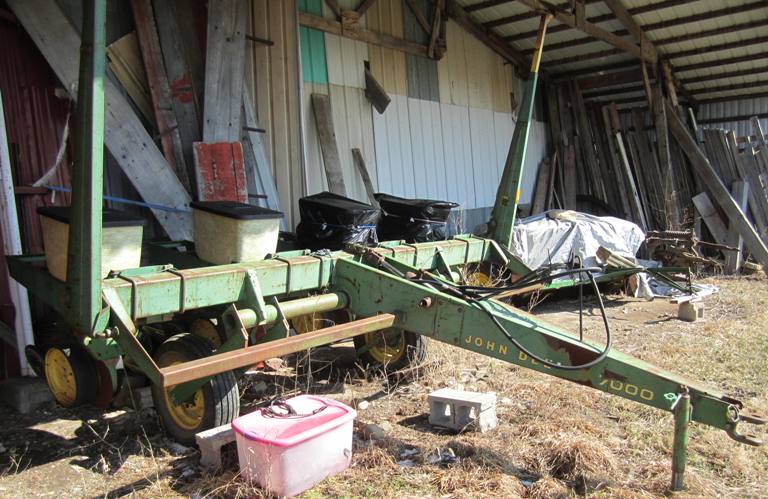
Equipment used to plant Fields of Agape grain and beans.
I have found that the success in life is how we learn to handle adversity and challenges. If we can grasp how to press on through adversity with humility and unconditional love for others (regardless of how they treat us), we will find our way.
When we find like-minded people whose passion is a good fit with our own, whose hearts are for others, then within that group each person can reach their potential quicker.
Encouragement, sharing of resources, being driven by the passion to serve rather than by personal gain—all of this brings about magnificent changes in communities large and small.
I’m never going to stop believing that it can happen.
As the Intergovernmental Panel on Climate Change gathers in Japan to finalize their report on the status of global warming, I’m thinking about hope. Hope as choice and saving grace. Here’s a piece I wrote some time back.
My spouse and I recently watched a library DVD of the HBO series Enlightened, in which Laura Dern plays a woman seeking to expose the wrongdoing of her corporate employer.

Photo by manyhighways.com, via Flickr Commons
The show is a mix of humor and pathos and drama, with the main character, Amy Jellicoe, revealed as both tender-hearted and colossally insensitive. She’s self-centered, obnoxious, impulsive—and, at times, luminous in her dreaming of a different world.
By the last episode, Dern’s character has discovered the cost of being a whistleblower, having lost her job and her love interest. The last blow comes when Amy’s mother says she is no longer welcome to live in her house.
The final scene finds her knocking at the door of her ex-husband Levi, who knows her best. Sitting next to Levi on his front stoop, Amy asks him, “Am I crazy?”
What a question. I’ve asked it of myself so many times. Am I crazy to think that this world can transform, that we can evolve as a species? Am I crazy to believe that we can pull each other to a higher vibration—one that would usher in a new era of equity and resilience?
Am I insane to believe that we can still thrive, even in the face of this terrible and seemingly irreversible mess we’ve made?
In the final words of the series, Levi, played by Luke Wilson, turns to her and says, “No.”
He says, “You’re just full of hope. You got more hope than most people do.”
He tells her, “It’s a beautiful thing to have a little hope for the world, you know?”

Photo by ZeHawk, via Flickr Commons
I’ve come to believe that to be hopeful is rarely foolish, or naïve, or crazy. Or if it is all of those, perhaps it doesn’t matter.
Hope is a choice I make for the sake of my own soul and soul of the world, for the health of those around me. I regularly renew my decision to be a holder of hope.
I choose to believe that it’s possible to live in such a way that doesn’t steal from the impoverished on the other side of the world, that doesn’t rape the earth. I choose to envision the possibility of healing this beleaguered planet.
Maybe I am crazy.
But I still believe. This better world is on its way.
Tomorrow, Feb. 2, used to be just Groundhog Day to me. Once I keyed into the seasonal festival days celebrated in ancient times, I knew Feb. 2 as Imbolc—a day to take a walk and look for the first signs of spring.
But now it’s forever associated with my dad, who left this world on Feb. 2, 2012. On that day the snowdrops bloomed and the sandhill cranes flew low. I like to think that his spirit took stock of those harbingers of spring—and that they released him to fly away.
It broke Dad’s heart to leave us, and he hated to leave all his wonderful volunteer work behind. Since his retirement he’d launched all kinds of projects. Possibly the hardest thing to give up was his connection with schoolchildren.
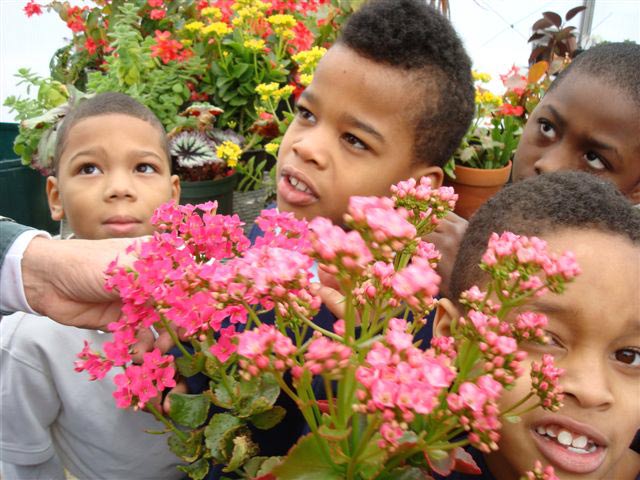
You can’t see Dad but you can see how the kids looked at him.
It all started when he began tending the grounds of Cold Spring School, the environmental education magnet, just because it looked like somebody ought to.

Dad doing what came naturally.
Because he took an interest, he eventually found himself in stewardship of the school’s greenhouse. This was a dream come true for him. (I remember many times in my childhood, he would talk about his dream of putting up a greenhouse.) His passion made it easy to engage the classes who came in for units on seeds, soil, and other such things.

Dad showing grade schoolers the wonders of aloe in the greenhouse.
After he got sick, when confronted with kudos for his volunteering, Dad liked to say, “I was just having fun.”

Having fun on a wet day at Cold Spring School.
Just looking at these photos again, I’m swamped with sadness.
No one can fill the void he left. But maybe by having our own brand of fun, we can each take up a tiny spot of it. As the days get imperceptibly longer, what can we bring to the earth, to each other?
Photos courtesy of Friends of Cold Spring School.
This week we mourn the passing of a man capable of forgiving the unforgivable and uniting a nation. Nelson Mandela began writing his autobiography in 1974 while imprisoned at Robben Island. Here are some lines from the final pages of Long Walk to Freedom, with scenes from that infamous place.

Robben Island, Cape Town, South Africa. Photos by Judy Hostetler during a People to People International trip to South Africa.
It was during those long and lonely years that my hunger for the freedom of my own people became a hunger for the freedom of all people, white and black…A man who takes away another man’s freedom is a prisoner of hatred, he is locked behind the bars of prejudice and narrow-mindedness…The oppressed and the oppressor alike are robbed of their humanity.

Nelson Mandela’s cell. When he stretched out on the floor he could touch both walls.
When I walked out of prison, that was my mission, to liberate the oppressed and the oppressor both. Some say this has now been achieved. But I know that that is not the case. The truth is that we are not yet free, we have merely achieved the freedom to be free, the right not to be oppressed. We have not taken the final step of our journey, but the first step on a longer and even more difficult road.

Looking back across the bay toward Cape Town.
For to be free is not merely to cast off one’s chains, but to live in a way that respects and enhances the freedom of others…

Shore of Robben Island
I have walked that long road to freedom…I have taken a moment here to rest, to steal a view of the glorious vista that surrounds me, to look back on the distance I have come. But I can rest only for a moment, for with freedom come responsibilities, and I dare not linger, for my long walk is not yet ended.
—Nelson Mandela, in Long Walk to Freedom, 1994
And now he is at rest, with the world’s gratitude. Shine on, Mandela.
A friend recommended Krista Tippett’s recent On Being interview with playwright/performer/social activist Eve Ensler. Last week while preparing food for our Thanksgiving meal, I listened to the unedited podcast. (The interview is full of insights, but I’ve pulled out a few highlights for you here.)

Photo of Eve Ensler by Justin Hoch, via Wikimedia Commons
Ensler is the genius behind the iconoclastic play “The Vagina Monologues.” Her focus on female physicality and power has led her to some phenomenal projects. For example, in the Congo she helped create a refuge for women and girls surviving gender violence. It’s called City of Joy.

Congolese rape survivor. By L. Werchick, via Wikimedia Commons
She’s a much-needed voice for a heart-centered, embodied ethic. I love what she says about the power of reconnecting with our physical selves and each other:
“The more people get plugged back into their bodies, each other, the more impossible it will for us to be dominated and occupied.”
She speaks of being both playful and careful as we begin to reconnect. Most of us are not used to this level of caring for our fellow humans.
“In the same way that we don’t see trees, we don’t see each other. We don’t see how traumatized people are, tender people are. I think sometimes if one were fully awake, one would do nothing in one’s day except stop on the road, on the people you meet, because you would see their pain…We walk past everyone. Sometimes it just crushes my heart.”
When Tippett responds that we don’t stop because we can’t bear letting in that much pain, Ensler notes that others’ pain is part of us already. We can’t avoid it, because we are all one. “So that when you stop to actually acknowledge it, you’re actually allowing it to move as opposed to be frozen in you.”
This reminded me of my energy healer friend Merry Henn-Lecordier, who showed me how to welcome uncomfortable feelings in order to allow their release.
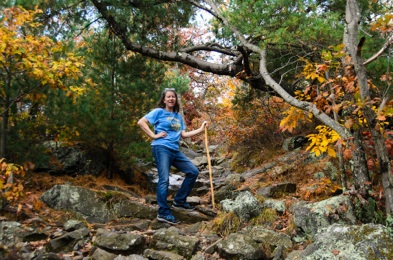
Merry Henn-Lecordier is a trailblazer in the field of energy medicine.
Merry taught me the importance of regularly clearing stuck emotion by speaking directly to it, in love and compassion. For example, I might say something like: Anger, I see you. I feel you. I love you. I understand. I welcome you, anger. I approve of you, and I approve of the circumstances that caused you to be stuck in my energy field. You are welcome here. And I’m ready to move you now. (I modeled this blessing after phrases Merry herself uses.)
Then, again following Merry’s example, I ask for help moving the anger (or overwhelm or despair or anxiety or what-have-you) from my energy field, releasing it and transmuting it into love.
It’s remarkably transformative to do this simple ritual, intending compassion for all my emotional states. The lightness I feel in its wake gives me hope that Ensler could be right when she calls us “people of the second wind.”
“This could be (humanity’s) second wind, but it requires a radical re-conjuring and re-conceiving of the story…And I absolutely believe it’s possible, but enough people have to believe it’s possible and be willing to kind of move with this wind that is trying to come in, trying to pass through us right now.
Ensler’s latest memoir, In the Body of the World, depicting her journey with cancer, is high on my reading list.
Browsing the shelves of Point Reyes Books last month, I picked up Mary Pipher’s latest book. Her Reviving Ophelia illuminated the struggles of adolescent girls. Now she has a book called The Green Boat: Reviving Ourselves in our Capsized Culture, detailing her progression from despair to activism.
A Nebraskan, Pipher was on the front lines of early campaigns to stop the Keystone XL Pipeline from going through the Sandhills. (Three years later, the pipeline is still in limbo, and has become a symbol of the fossil fuel industry’s disastrous impact on the planet.)

Dismal River, Nebraska Sandhills. Photo by USFWS Mountain Prairie, via Wikimedia Commons
Even before opening it, I knew this book would return me to grounding.
I’d been talking with Richard Heinberg about his book The End of Growth, which describes a trajectory that I understand and yet can’t quite face head-on. Seeing it spelled out and hearing him expound on it left me feeling quite scared.
I know that many are pulling together for a better world. But our governmental policies favor the monied corporations running the show. I was starting to doubt that community action could effect change on that level.
Along comes Pipher, describing an activism that’s joyful and even fun. Example: grandmothers gave weekly “thank you in advance” pies to the Nebraska governor until he agreed to meet. This brand of protesting, fueled by love of the land and concern for tomorrow’s denizens, seems the perfect antidote to despair.
A chapter called All Hands on Deck begins with this quote from Frederick Buechner:
“God calls you to the place where your deep gladness and the world’s deep hunger meet.”
To be glad in the face of the world’s rending sometimes seems impossible. Yet I remember opening the church basement doors on the day of our SkillShare and seeing the space instantly fill with participants, their faces alight with curiosity. I think of the heart-cracking instant when a resonant phrase finds my fingers on the keyboard. I recall the joy of putting a garden trowel in the hands of a preschooler.
There’s an expansiveness when I reflect on these moments, a sense of the heart opening that lifts me from powerlessness.

Explaining vermiculture at the Irvington SkillShare. Photo by Jeff Echols.
Pipher acknowledges the “experts” who downplay the importance of individual actions. They say systemic economic and political changes are necessary to change this trajectory. True enough, but this reasoning is incomplete, says Pipher—for “who is it that is in charge of systemic change?”
She argues that individuals have always been the source of world-changing actions, and what else can one person do but start with herself? And join others in common cause, as did the abolitionists. It’s said that they had no hope of success, at the start.
My small self is quick to tell me what I’m not. I’m no naturalist, no doctor of philosophy, no career activist, no farmer, no wisewoman in a mountain hut. I am just myself. Sometimes I question: What do I have to offer?
I only own this experience, this deep heart of pain and care, grief and fear—and love.
What do I have to offer? All of it. I offer it up.
[More from Mary Pipher: Read her interview on how to wake up and take action on climate change (and stay sane).]
Belated postcard from Hopland, CA: It was a thrill to hear Julia Butterfly Hill speak at the Building Resilient Communities Convergence. This is the woman who spent most of 1998 and 1999 living in the canopy of an ancient redwood tree named Luna. Her extended protest brought attention to the plight of ancient forests and resulted in a three-acre buffer zone around Luna.

Julia Butterfly Hill in 2005, via flickr Creative Commons, by Scott Schumacher
Now she calls herself a wholistic healthcare practitioner instead of an activist, because she is working on the “disease of disconnect.” What struck me about Julia is how much she embodied a heart-centered ethic. She began by expressing a commitment to affirming “what our hearts know: That we are all one.”
There’s little in our culture that supports the kind of inner transformation needed now. Julia called this era a time of spiritual crisis. “That place inside ourselves that is just ancient and knows only connection is in crisis.”
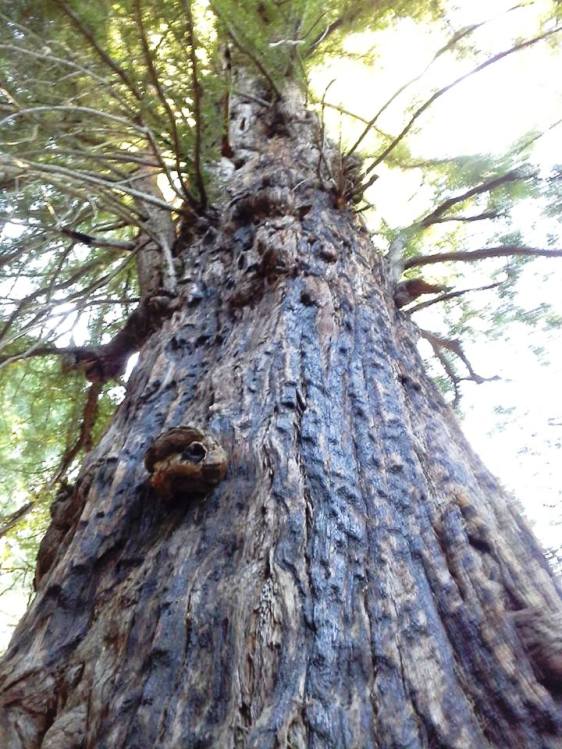
Methuselah, an 1800-year-old redwood in Woodside, CA
“What is it going to take to rebirth ourselves in this world where we are?” was her central question. She said it is a courageous act to keep our hearts open, because it means being open to the suffering of beloved creatures, communities, and ecosystems.
I appreciated that she called us to stay aware of our own tendency to rigidity, cautioning: “Any time we are passionate about anything, we are one breath away from being a fundamentalist.”
She invited us to “live so fully and presently in love that there is no room for anything else to exist.” To ask, What would love do in this space? What would love say in this room?
She said we need to bring all our integrity to bear in modeling a positive vision for the world. “We are so good at defining what we are against that what we are against begins to define us.” But it is also crucial to stand firm against wrongdoing. Even the campaigns that failed, she said, she would go back and do again.
It’s a matter of offering ourselves “in loving and joyous service to our world.”
Truly a transformative figure.
 Shawndra Miller