Placemaking in the City

It’s hard to imagine right now, with a spring storm threatening to deposit up to 10 inches of snow on us, but in a few weeks my neighborhood will come together for an annual spring cleanup. Volunteers will fan out to pick up a winter’s worth of litter, with the support of Keep Indianapolis Beautiful.

I love my neighborhood for many reasons–one of which is the dedicated cadre of people who work tirelessly to pull us together for the greater good. It’s amazing what this group can pull off: tree plantings, rain gardens, murals, pocket parks, public art projects, greenspaces galore.

A local artist paints a traffic signal box as part of a public art project. Photo by Heidi Unger.

A local artist paints a traffic signal box as part of a public art project.

Working together on projects has meant lots of neighbor-to-neighbor bonding time. When you’re trying to see past your poncho hood to pull soggy candy wrappers from a ditch, the person standing in the rain with you to hold a trash bag open becomes a good pal.

There’s a sense of solidarity and shared ownership, and civic pride out the wazoo. That leads to more ambitious community endeavors, like painting local artists’ designs on all the major intersections’ traffic signal boxes.

Similarly, in my book research I’ve learned of a group called City Repair, out of Portland, OR. This group works to reclaim urban spaces through placemaking. Rather than waiting for someone in charge to come along and “fix” a neighborhood, City Repair takes a DIY approach (or really DIWO – do it with others!).

Placemaking is all about creating gathering spots, or areas that support other community functions–composting, bike parking, safety, resource sharing, etc.  Examples in Portland:

  • public squares
  • meeting houses
  • community kiosks/benches
  • “solar-powered and artistic innovations”

With its emphasis on ecological and artistic transformations, City Repair is an inspiration. Their site offers placemaking resources. Check them out, and let me know what kinds of community endeavors are happening in your neck of the woods.

Postscript: Just as I was finishing this post, I found this great story of transforming a vacant lot into a public space – simply by adding seating.

Toward a More Mindful and Resilient Country

A friend recommended the book A Mindful Nation, by U.S. Congressman Tim Ryan, and I’ve just begun to browse through it. As a student of mindfulness practices, I’m curious how a politician applies these precepts to our national life. Here’s a powerful passage from the first chapter:

Let’s get rid of the phony concept of an America based on materialism, consumerism, and looking out for number one, where financial chicanery is our proudest accomplishment to show the world…

There is no dignity in the idea that anything worthwhile has to be purchased.

It shouldn’t be all that difficult to get us to move beyond this ethos, given how unhappy Americans have become.

If we slow down and find some space away from the daily chatter that tells us how to think, who to be, and what to buy, we can discover our capacity for resilience.

Ryan equates resilience with values like:

  • self-reliance
  • diligence
  • frugality
  • pragmatism
  • hard work
  • innovation
  • community
Pioneer Days. Photo from US National Archives

Pioneer Days. Photo from US National Archives

He calls these, somewhat nostalgically, “the values that made this country great.”

I tend to think more in terms of global citizenry myself, but I think his patriotic slant will have wide appeal, and he does have a point about the hollowness of much of our current national character. Why, he asks, do we collectively rise to the occasion of caring and compassion only in moments of great crisis, such as during and immediately after 9/11? Can we bring this generosity of spirit to our everyday lives?

Ryan believes that a good starting point lies in each of us addressing our personal fears and doubts through the simple practice of paying attention.

I’m curious about this. So let me ask: What place does mindfulness have in your life and work? What place should it have in our national life? And do you think individually bringing kindness to the present moment can change a nation for the better?

Of Specks and Seeds

“If you think you are too small to be effective, you have never been in the dark with a mosquito.” –unknown/various attributions
Seuss

I recently rewatched the animated TV special Horton Hears a Who, some 35 years after I first encountered it, because I wanted to see if a pivotal scene was as I remembered it. Based on the Dr. Seuss book, the DVD has Horton the elephant finding a speck of what appears to be dust, and hearing a voice calling from it. It emerges that the speck is actually a microscopic planet with a whole race of people called the Whos, living in Whoville.

The only one privy to the voice, Horton keeps the speck-planet on a clover blossom and protects it from harm, though his enemies mock him. The voice belongs to a scientist who has built an elaborate machine to carry his voice up through the clouds. Through this apparatus, his voice pierces the planet’s atmosphere and reaches Horton. No one in Whoville believes there’s a world beyond the one they know; no one in Horton’s jungle believes there’s a little world in that speck.

Works as an allegory on so many levels; thank you, Mr. Geisel!

But let’s stick to musing on the power of small things. You know that saying about the mosquito? I’ve thought of numerous corollaries. A splinter. An eyelash out of place. The spark that sets the proverbial forest afire.

Did you know that a little snip of bindweed root in the garden can form an impenetrable mat in the soil, extending roots 30 feet underground?

Or, in a less irritating vein: How about a single seed? Now there’s power.

sunflower seed

Sunflower seed sprouting

In Horton’s case, it turns out that the smallest denizen of Whoville makes the difference. Horton is about to be tortured or possibly killed. The flower will be decimated, the speck lost. The residents of Whoville must make themselves as loud as possible; their fate hinges on being heard. They’re all making as much noise as they can.

The scientist runs through the town, looking for someone who isn’t making noise, someone who could add to the cacophony. He finds a little boy, a toddler really, who is oblivious to Whoville’s peril. He snatches the boy up and implores him to make a sound, any sound, a yap or a yip. The boy deliberates as time ticks and Horton’s antagonists ready his torment. I remember watching this as a child and wanting to yell, Hurry up!

Meanwhile the boy: Should I make a yap? or a yip? Finally, he makes a little yap. The animation has this yap rising into the puffy layer of Seuss’s clouds.

And wouldn’t you know, this is the sound that breaks the barrier. That boy’s tiny little yap punches a hole right in those clouds so all the people’s voices shouting, “We are here, we are here, we are here, we are here!” can stream through and reach the ears of Horton’s disbelieving peers.

Uh-huh.

Too Many Tons

There’s a moment in Barbara Kingsolver’s devastating new novel, Flight Behavior, where the protagonist realizes the craziness built into our globalized economy. Dellarobia and her husband are in the dollar store, trying to buy a “real Christmas” for their children on $50. Every toy is Chinese-made, plastic, and depressingly cheesy. She tries to find something, anything, that won’t fall apart immediately, and muses:

“There had to be armies of factory workers making this slapdash stuff, underpaid people cranking out things for underpaid people to buy and use up, living their lives mostly to cancel each other out.”

I recently learned something horrifying from this video featuring Society for Organizational Learning founder Peter Senge: It takes a ton of raw materials each day to sustain the American lifestyle. Per person.

extraction

© David Coleman | Dreamstime Stock Photos

I don’t know about you, but it guts me to envision a ton of earthly extraction happening on my behalf—today, tomorrow, and the next day and the next, until the whole house of cards collapses. Or until we demand something different.

Do we really need to buy into this waste?

All that energy that goes into making money to be able to buy stuff? If we could divert a fraction of that into work that sustains us, we might see the merry-go-round start to slow.

I met a young mother recently who had made some changes after asking herself, “Why am I spending money to buy food when I could grow my own? Money doesn’t grow on trees, but food does.” Visionary Charles Eisenstein, Radical Homemaker Shannon Hayes, and countless others have said it: It’s time to rethink, regroup, relocalize.

My partner is cutting her workplace hours this year to spend more time gardening and making things. These projects enrich her life and leave something tangible, and they mean—yes!—fewer trips to the store to buy goods made or grown by someone else.

Sure, we still do our share of purchasing. We’re not immune to the consumer culture. I just got my very first smartphone, after all, with much gnashing of teeth. But we are coming to see ourselves less as consumers and more as small-scale producers, or self-provisioners, or urban farmers. The more we make, produce, grow, and repair with our own hands, the less money we require to live.

One group is working in a big way to break the cycle. Open Source Ecology was started by a young farmer who was frustrated by repeated tractor breakdowns. It bothered him that corporations keep their designs secret and build obsolescence into their products. So he decided to take matters into his own hands.

Now he’s working with others to develop 50 industrial machines to cover every need of a local-level sustainable economy. The open source part is revolutionary: Their designs are available for anyone to use and adapt.

Here’s a three-minute video showing how it all works. There’s a builder from Indiana using one of the machines to make bricks. I love this!

Build yourself. | Tristan Copley Smith from Focus Forward Films on Vimeo.

What about you—how are you slowing the merry-go-round?

A New Narrative

Welcome to my blog!

I admit I have had my reservations about jumping (back) into the blogosphere. Do we really need one more blog clamoring at us in this noisy world?

But there are so many overwhelming issues staring us in the face every day: climate change, resource depletion, species loss, overpopulation, economic strife, deforestation, dying oceans, diminishing water, crumbling infrastructures, an insane food system. These seemingly insurmountable problems add up to a runaway freight train of cataclysm. What gets lost in the clamor is stories of people taking meaningful action–just when we most need to hear their voices.

My research on the community resilience movement has shown me that people everywhere are working to make things better. And not only does the wider society need to know about this, but those of us bucking the system desperately need to hear from other people on this road. There’s a deep hunger to connect with the bigger movement.

Farmers Market SkillShare

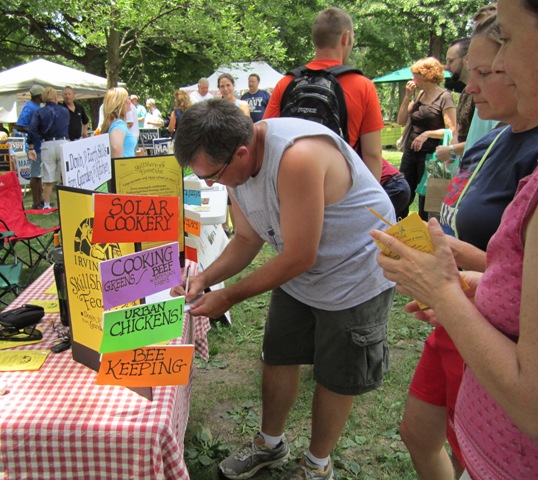
Building community at the Irvington Farmers Market

Speaking for myself, being in community is one key to keeping my spirits up in this age of crisis. I can find that connection with a handful of trusted neighbors gathered at my local brew pub for the Irvington Green Initiative’s monthly Green Hour. I can find it with some 40,000 strangers, marching in the Forward on Climate rally in DC.

It heals me to talk with people who share similar concerns. It energizes me to hear what they are doing to “sweep their little corner” as a friend puts it. It seems natural to put some of this exciting stuff in a public forum for others to enjoy.

It also seems critical to counter the potential futures we are shown in so many books and movies.

The vision of life on a burned out earth drives each of us into fear whether we’re conscious of it or not. On some level we all know that without our life support system—this precious planet—we are doomed. Every movie or novel that shows a dystopian world of hardship reinforces our terror. It’s an emotion that can drive us into walled-up bunkers, whether physical or emotional. Fear shuts down hope and creativity—two things we need in abundance right now.

But there is another focus we can hold: that of cooperation, of compassion, of joining together in a grand and timely mobilization of energies. What if we were to unleash all our creativity, letting go of the need to hold one “right” way? What if we focused on what connects instead of divides? We could leap into this possibility: that together, we can make radical changes that remake the world.

The goal of this site is to show how people are turning their attention to what works, or what might work, instead of focusing on what’s irrevocably broken. There’s no shortage of brilliance in the human spirit—the force that brought us the iPad, the genome map, the Hubble Telecope.

No, there’s no shortage of mental power. Ask anyone who’s stayed up all night worrying about where we might be headed.

What we do lack is vision, a new narrative. That’s where this site comes in. Join me. I hope you’ll feel free to comment on my blog or contact me here with your thoughts and feedback. I hope to hear your stories.