This is Humanity

Charles Eisenstein, in this interview, challenges me to something more radical than empathy. What if we believe everything we read and hear? Not in the sense of “That’s Absolute Truth,” but in the sense of: This is what’s real for this person.

It’s a difficult assignment, because it requires giving up being right. But practicing it would open up the potential for new learning.

What life circumstances could I imagine that would give rise to the various stories I hear? What enculturation/emotions/experiences underlie people’s opinions? Or the scenarios being played out, which are expressions of the stories people know to be true?

What stories must be firmly in place for so many African-Americans to be brutalized and killed at the hands of authorities, so often with impunity?

As this writer posits, “America has conditioned society to regard us (African-Americans) as beasts, superhuman, faster, and stronger. So when we are killed, it’s easy to rationalize and accept.”

That’s one possible story. A painful one. Giving rise to the need for all of us to say, unequivocally, Black Lives Matter.

This morning in meditation I saw a flower with countless small petals. One bloom, many petals: This is humanity. A flower doesn’t have to be told that it’s insanity to pluck out some petals. It is all one whole, one body.

IMG_4950 (853x1024)

From my journal after one such shooting:

Is it possible that I carry all the permutations of humanity in my cells, in a more literal way than I ever imagined?

What if: I am the police officer who killed the black teenager. And I am the teenager who died. I am the crowd that formed. I am the mother. I am the judge, the jury, the media, the Facebook storm, the Twittersphere.

All of these are within me and I must must must love them now. The young woman wanting to smash up stores in anger. The older folks grieving. The Fox News people spinning. The truckers in the truck stop, the teens at the mall, the babies in wombs ready to be born into a quaking world. The deflection. The pain. The heartache. The horror.

The fear. Everywhere fear. I am that. And I must love that.

I am the return, too. The opening.

Can we imagine a story that would solidify our shared humanity, and our mutuality, and our need for everyone to feel safe and respected as they walk through the world?
Guest Post on Kindness

Today’s guest post is by my friend Heather Horst, and fits right in with a campaign by Indy Holistic Hub to spread kindness in December. #GetYourKindnessOn is the hashtag we are using to shine a light on compassionate acts we encounter. (I’ve found it quite uplifting, during these fractious days, to tune my radar to kindness. If we watch for compassion, nourish it, and spread it, we can’t help but magnify light.)

Guest post by Heather Horst

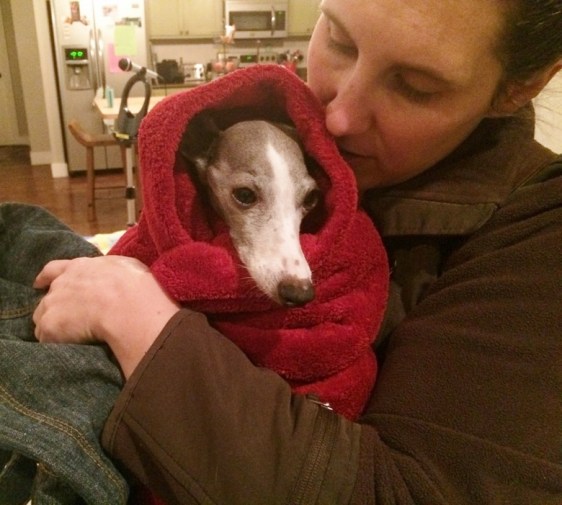
Lately I’ve been fostering a dog who is both gravely ill and incredibly sweet. Her name is Joy, and she’s pictured here.

Joy and Heather (780x701)

Joy and Heather

I’ve also been called out to do massage therapy during a friend’s labor and delivery. Between the two, there has been so much kindness. I’ve experienced so much support in caring for Joy. I’ve witnessed so much kindness and care for my brave friend as she worked hard to bring her baby into the world.

When I glance from my real life to national and world news, it’s culture shock. Because I’m not hearing about kindness. I’m hearing about brutality and a turning-away from the suffering of others, a turning-away from one’s own humanity.

I don’t accept that this is our true nature. It feels like a brokenness, a wound, an illness.

I trust that kindness is our true nature. That one day so many of us will be healed by (and healed to) kindness. So many of us will heal that when brutality or callousness appears among us, we will recognize it as an aberration.

We will surround it and heal it and not give it weapons or money or media attention.

…when brutality or callousness appears among us, we will recognize it as an aberration. We will surround it and heal it and not give it weapons or money or media attention.

I trust that kindness is our true nature. To those of you who have been carrying out these many kindnesses — THANK YOU! You heal my heart.

Heather is a nurse, a massage therapist, a spinstress of hula hoops and an amateur urban farmer. She lives, works, and plays in Goshen, Indiana.


What’s Already Here

This week in yoga class we opened our arms wide and bowed in surrender.

6427108983_8c8777c9d0_z

How I feel in yoga class at Irvington Wellness Center. Photo by Mitchell Joyce, via flickr Commons

Our teacher, Gaynell Collier-Magar, invited us to open in gratitude for the extraordinary privilege of experiencing what’s already here. We stood as trees with arms outstretched and my fingertips brushed the hand of Joyce at my left. Then later, lying back in a spinal twist, my fingers contacted Scott’s on my right. Each student deep in our space but connecting with the other.

The goodwill and warmth created in that space fed me, like it does every week.

And not just because they sang Happy Birthday to me before class. (“It’s not just a yoga class, it’s a community,” Gaynell said, and she’s right.)

She led us in half sun salutations, invoking joy as we raised our arms high, surrender as we opened our arms and bowed, equanimity as we rose halfway with hands on shins, surrender again as we folded to the floor, joy again as we rose to circle-sweep our arms high, and finally connection with the sacred as we rested our hands in prayer position at our hearts.

Yeah, it’s that kind of class. The kind where you know you’re just really lucky to be able to sit and breathe in awareness—even though the same breath walks in with you, and you could easily(?) contact it any old time.

In this studio I often tremble in release while holding postures, and even if I don’t understand it on a conscious level, I know that things are moving through me. Sometimes I cry. I cried this time while crimped into a half pigeon posture, leg folded under my torso, forehead on the floor, listening to Donna De Lory sing of being a sanctuary.

The tears came again in a forward bend while the song Mercy poured over us.

“One by one, could we turn it around,” etc. It slayed me. The longing, the heartfelt wish for healing of the world. For everyone to feel joy, surrender, equanimity, surrender, joy, connection.

What more is there than that?

To Radiate

Sometimes it feels like so many words are written and said, so much bandwidth devoted to opinions and theories and arguments, that adding more verbiage to the hubbub is a worthless activity.

The word “radiate” came to me this morning. As a writer, I’m prone to writing, of course, but sometimes it seems more important to just…radiate.

Consider the migrant crisis. It hurts to look at it. I don’t know what to do. I feel guilty for the comparative triviality of my day-to-day concerns. In the wee hours, at my worst, I sometimes wonder if it’s shameful to feel happy and carefree when so many are suffering. I sometimes feel ashamed of the worries that plague me, because my life is as easy and free as anyone could imagine.

When this happens, as soon I remember to, at 3 or 4am, I take up a spiritual practice based on a Hawaiian system for healing. It involves holding suffering people in my heart while mentally repeating the phrases: “I take full responsibility. Please forgive me. I love you. Thank you.” I learned about this process first from my friend and mentor Dawn Ryan, then from a book called Zero Limits, by Joe Vitale

The idea is to take responsibility for everything in our lives, because everyone is connected. Some say “I’m sorry” instead of the first phrase, but I prefer “I take full responsibility,” and it’s how Dawn originally taught me.

This mantra gives me somewhere to channel my concern, at the very least. At the most, it clears the way for new insights and promptings to action. Or perhaps just for a few more hours’ sleep, which puts me in a clearer space to do my work in the world. (Which I so question in those dark hours, wondering about its value.)

Saying these words and sending light? It’s not nothing. Though it’s impossible to quantify, I suspect that the shift from guilt/shame to love/light has a real impact, and not just on me. IMG_20150717_110506238In any case, these last few days, riding my bike or walking my dog in the sunshine, I can’t hold back a sense of exhilaration, pure happiness. I don’t want to. A friend told me that my happiness lifts her when she’s hit a rough spot in her own life.

So here’s to radiating.

Living Proof

Yesterday at Rivoli Park Labyrinth, I met up with a riotous party of plants, insects, and birds.

The park, which formed on a vacant lot thanks to community organizer Lisa Boyles, has gotten overgrown this rainy summer—but it is also a haven for life.

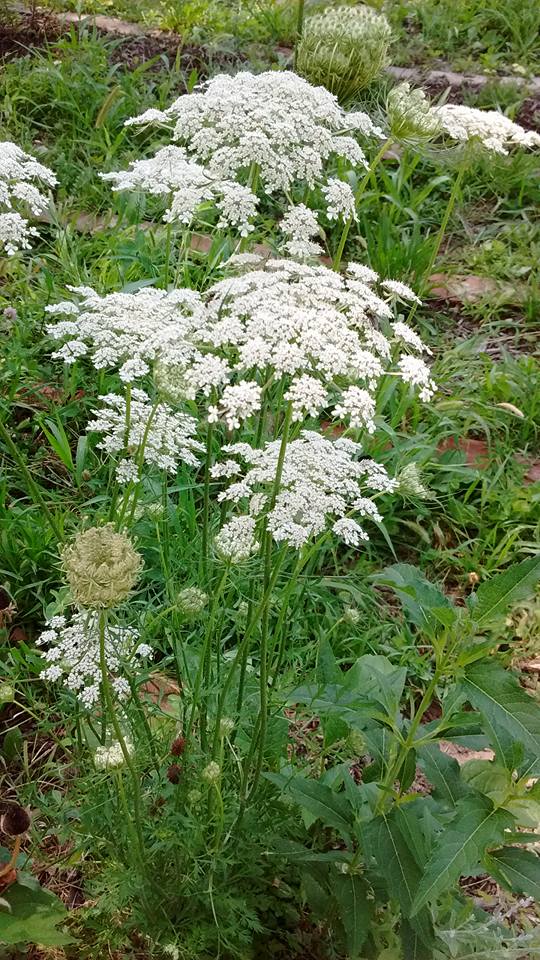
"Queen Anne’s Lace provides beneficial nectar to insects during this dry part of the summer when they don’t have many options. Caterpillars of the Eastern Black Swallowtail butterfly eat the leaves, bees and other insects drink the nectar, and predatory insects, such as the Green Lacewing, come to Queen Anne’s Lace to attack prey, such as aphids" according to Chiot's Run. (Click photo for more.)

“Queen Anne’s Lace provides beneficial nectar to insects… Caterpillars of the Eastern Black Swallowtail butterfly eat the leaves… and predatory insects come to Queen Anne’s Lace to attack prey,” according to Chiot’s Run. (Click photo for more.)

Some plants we call weeds and others we call ornamentals. Some we consider natives, wildflowers, edibles, or another elevated status. Some we designate as invasive, others as desirable.

What I realized yesterday: These divisions are more important to humans than the rest of nature, which seeks its own balance.

The plants called “weeds” are the ones we pull out. Still, the grasshoppers, bees, and spiders find food and shelter on plants of all stripes. They are the epitome of nonjudgment, our guides in an insectile anti-labeling initiative.

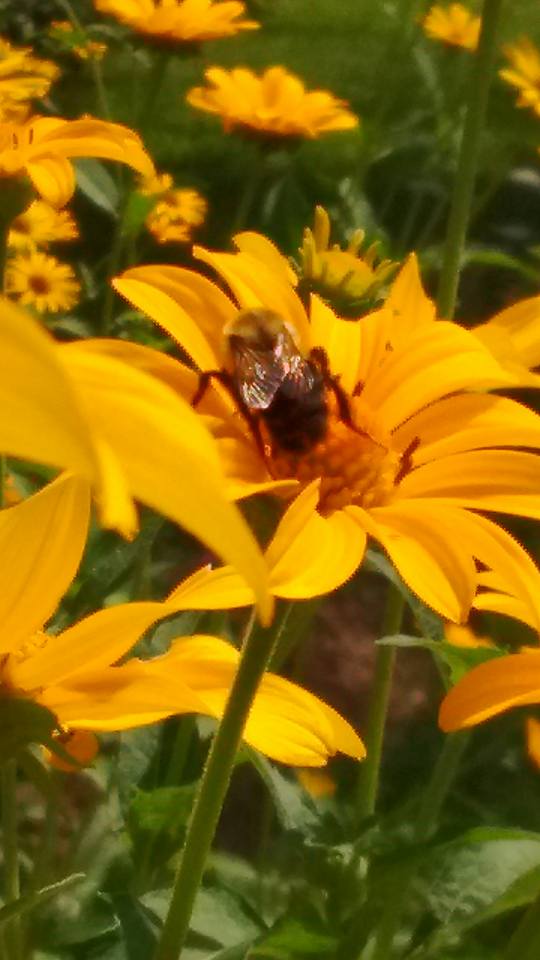
Friendly pollinator

Friendly pollinator

So often I am quick to judge something good or bad.

Just now I went to strike that sentence, gauging it too trite! As testament to my new commitment to allowing things to be messy and imperfect, I am leaving it there.

Lisa and I talked about this very thing: In my writing, I declared my intent to finish my book while letting go of the need for it to be “perfect, balanced, and comprehensive.” Lisa swept her arm toward the “weedy” labyrinth and said, “Here’s living proof that a project doesn’t have to be perfect—just look at it!”

What I saw: voluptuous plants abuzz with happy pollinators. Abundant living entities in ongoing conversation, all encircling the glorious hibiscus at the center. The idea of perfection doesn’t really apply when we’re partnering with life, does it? So it can be with writing.

I told Lisa that the labyrinth didn’t have to reach some ideal in order to be a marvelous contribution to the community. Uh, hello. Maybe I should write that down and stick it on my computer monitor.

Repeat after me: We don’t have to reach some ideal in order to be a marvelous contribution!

The Urban Forest

Holly Jones grew up considering trees as relatives. A Native American (“though I might not look like it!”) she sees the world populated with winged people, creeping people, branching people. “A lot of different people are considered sacred in my circle.”

As director of the Indiana Urban Forest Council, she brings that sense of interconnection to her advocacy.

Holly spoke to a group of treehuggers in my neighborhood this week at the Irvington Green Hour.

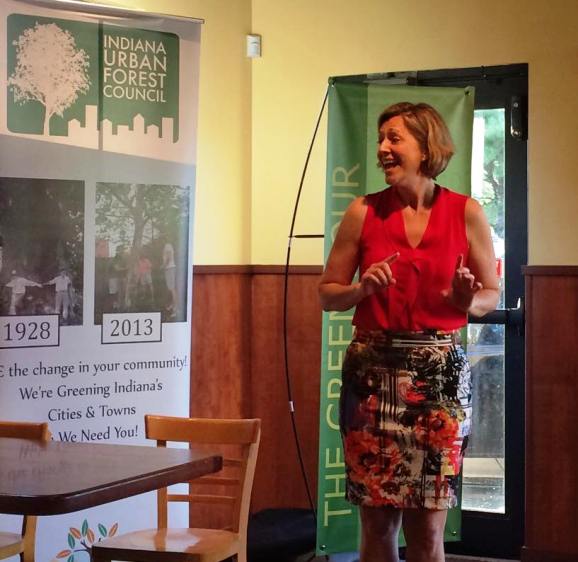
Holly Jones at the Indiana Urban Tree Council

Holly Jones at the Indiana Urban Tree Council. Photo by Jeff Echols.

She asked us to consider the sounds we might take for granted, the chickadee’s call and other songs of the urban forest. “These sounds are a part of you whether you realize it or not,” she said. “And these sounds are quietly going away.”

With landscapes devoted to specimen plants that hail from a completely different part of the world, it’s no wonder that native species are struggling. Jones said a turnaround will require a different mentality than purchasing random flowering plants from the big box store. Choosing native plants is the only way to feed and shelter the insects and birds that evolved alongside them.

Basically, the foundation of life is in our hands, even we urbanites sitting here on our postage-stamp lots.

“If you want to see life happen, and magic happen, that takes time,” she said, telling the story of planting her first rain garden. As the plants matured, her sense of wonder expanded beyond expectation. “I had to go out and get new guide books! There were so many new species I’d never seen before.”

Holly told us that trees offer their biggest bloom when they’re dying. Some might point to the prolific blooms and deny that a tree’s under stress (from climate change, insect infestation, or pollution) but that’s not the case. “That tree’s giving it all she’s got. She’s saying, ‘It’s my last chance to get my seed out there.’”

In a state where 98 percent of our forests are gone, caring for the remaining trees is essential. Street trees give back 600 times what we invest, with the biggest return coming after the first 10 years.

Average lifespan of a street tree? Seven years.

There are ways to cost-calculate a tree’s service to humans. My streetside sycamore, according to the National Tree Benefit Calculator, will do all this in 2015:

  • intercept 2,015 gallons of stormwater runoff
  • raise the property value by $47
  • conserve 55 Kilowatt / hours of electricity for cooling
  • absorb pollutants through its leaves, while releasing oxygen
  • reduce atmospheric carbon by 299 pounds

According to the model, this adds up to $68 in annual benefits provided by my 11-inch diameter sycamore.

By Jakec, via Wikimedia Commons

Photo by Jakec, via Wikimedia Commons

Considering that the tree is 40-plus years old, according to this site, that’s a significant dollar amount over its lifespan.

This is all great information for people who need numbers to support a pro-tree position. And it’s not even counting some of the benefits Holly spoke of at the Green Hour. Higher percentage tree canopies correlate to greater health, better school grades, improved sense of community, and more.

To my mind, though, the unquantifiable might be the most powerful thing of all. Trees are wise, restful, gracious spirits. They root deep and stretch high, giving them access to information we humans are not privy to. This sycamore’s presence in my life is a gift.

And that’s just one tree among the urban forest that I love so much.

Want to take action? For locals, here are some ideas:

The Ground Rules

Meet “renegade researcher” Nance Klehm. She’s on a mission to transform our thinking about waste—and to transform our waste into healthy soil.

Reader_Nance_Klehm_3174

Nance Klehm

I first met Nance at last October’s Radical Mycology Convergence, which she hosted on her rural land in Illinois. She divides her time between rural and urban—growing native trees, plants, and mushrooms on her land, and nurturing innovative community projects in Chicago.

As a fifth generation horticulturist, she has a passion for working in partnership with nature and enjoying the abundance that results. She has worked on graywater systems, humanure, and soil fertility for years, both in the U.S. and abroad. She was even invited to Haiti to assist with composting toilets after the devastating 2010 earthquake.

She works on composting policy at the state and local level, and teaches “Composting 401” to people who really want to get down and dirty.

“When people say, ‘what’s possible?’ I’ve done it,” she told me. “I have photographs and data and anecdotal experience from living in Chicago for 25 years.” She envisions a widespread scale-up of composting efforts that would shift how cities handle sanitation.

Nancy removing husks from walnuts grown in her food forest.

Nance removing husks from walnuts grown in her food forest.

Recently she was the featured guest on the Root Simple Podcast, talking about her work with community bioremediation in Chicago.

The project, called The Ground Rules, has multiple community-run soil centers working on bioremediation. Urban soils are often contaminated with heavy metals and other toxins. Klehm and her volunteers are addressing this problem by diverting waste into compost.

By bicycle and truck, they pick up discards from restaurants and businesses: uneaten food, vegetable trimmings, and paper towels, for example. Nearby soil centers are where they convert this “slop” into a high-powered soil amendment.

"It's crazy fun to work with food slop," says Nancy.

“It’s crazy fun to work with food slop,” Nance says.

The waste is kept local, put to work in service of the longterm goal of remediating the soil. Bacteria in the compost help to break down inorganic chemicals. The teams also use plants and fungi to help with this goal. So, four biological kingdoms—animal, bacterial, fungal, and plant—partner in this vision.

Here’s a great video about the project:

The Ground Rules from nance klehm on Vimeo.

Nance has a book due out this fall, based on her conversations with others invested in the life of the soil. (Note: It isn’t only farmers who care about the ground under our feet!)

Currently she’s writing a manual for others interested in community bioremediation. She blends practical, technical information with anecdotes from the soil centers, because they are all different. Each site has its own issues and challenges. Nance says the social component of this work is the trickiest part, so it’s important to address that along with the how-to aspect.

She’s running a crowdfunding campaign to support this important work. Any small amount helps.

And of course, if you’re in Chicago, consider volunteering. If you want to hang with fun and funky folks while learning a whole bucketload about advanced composting, she would welcome you, I’m sure!

Update: For more on The Ground Rules project, check out my Acres USA profile of Nance Klehm.

“What the World Needs”

I can always tell when I’m overloaded with the news; that’s when I start to despair. So much mess to clean up. It seems ridiculously tangled-up and tiresome, painful to look at.

In my own state we are attempting to disentangle from newly passed legislation designed to show my GLBT brothers and sisters that we are not welcome. Elsewhere, of course, there’s worse news. In Kenya suicide bombers caused untold anguish. In California the drought is now so severe that the governor mandated water restrictions. Then there’s the German pilot who decided to fly a planeful of people into the side of a mountain. For what?

Time to turn off NPR. When I get overwhelmed, this timeless advice from theologian Howard Thurman is a comfort:

“Don’t ask yourself what the world needs. Ask yourself what makes you come alive and then go do that. Because what the world needs is people who have come alive.”

By psyberartist (amaryllis  Uploaded by russavia) via Wikimedia Commons

By psyberartist (amaryllis Uploaded by russavia) via Wikimedia Commons

Definitely the needs of the world are bottomless, and the conflicts seem never-ending. So this question is a good barometer, an antidote to paralysis: What renews my heart? For me it is things like making meaning, being of service in small ways, reflecting, putting some hard-won learnings to use for others.

Sometimes, though, all that seems ever so small, and the question becomes: How do we renew ourselves, in this season of renewal, to continue with our chosen work?

Then a member of my extended family gives me a tremendous gift. She tells me that she regularly shares my reflections with her four teenagers. Some years back when I coauthored a book called Sudden Spirit: A Book of Holy Moments, she started the tradition of reading aloud from this work and discussing it with her children. Now that the kids are older, she’ll print thought-provoking blog posts and passages (mine among them) and ask them to initial when they’ve read them.

You can bet I was touched when I heard that! (And maybe she had told me before but I forgot; sometimes it’s hard for me to receive stuff like this.)

Knowing this totally refuels me. Because so much of what I do is basically invisible, it’s hard to know what kind of impact I’m having. But apparently, my little musings are helping the next generation of leaders.

Note to self: Remember to tell people I appreciate their work! (I think I’ll start with Roy Ballard and Michael Morrow, the men behind Hoosier Harvest Market. This online virtual farmers market brings me lovely salad greens, eggs, quail eggs, apples and so on—all locally grown and delivered to order to a business near my home.)

Because maybe it’s less a matter of renewing ourselves than renewing each other. Maybe then we can remember what exactly it is that makes us come alive, and have the courage to pursue it. Who in your life could use some of that fuel?

The Reimagining

Scott Russell Sanders, one of Indiana’s sagest voices for social and ecological justice, led a workshop Sunday called Writing While the World Burns.* His books, from Writing from the Center to A Conservationist Manifesto, have inspired me and countless other readers.

Before I even read the workshop description, I knew I needed to be there.

Untitled

I wasn’t disappointed. Scott has a generosity, thoughtfulness, and grace about him that may be a product of his years, or perhaps he’s just built that way. He brought together a disparate group of deeply passionate people and got us talking about where our work and lives fit into the bigger picture.

I know I’ve been on a bit of a Wendell Berry kick of late, but Scott’s the one who gave a Berry quote as context for that exercise:

“The significance—and ultimately the quality—of the work we do is determined by our understanding of the story in which we are taking part.”

Where do we fit? What is our important piece of the puzzle?

In my case, my larger story has to do with lighting the Lights—spreading the word about the tremendous work being done on so many fronts. And not only that, but being a Light, in my own small way.

Earth Hour moment at home - Córdoba Argentina

In fact, “story” is an apt word, because I see all of these efforts as a grand transition to the Story of Reunion (in Charles Eisenstein’s words)—leaving the defunct Story of Separation behind.

As writers, Scott told us, (and as teachers, artists, visionaries, and the like) we enlarge people’s vision of what’s possible. We write a new language that can supplant that tired old ethic of economic gain at any cost. We expand people’s understanding of humanity by sharing our knowledge of those they might consider “other.”

In short, we reimagine the world, and invite others to join us.

*Many thanks to the Indiana Writers Center for offering this tremendous workshop.

The More Beautiful World

I’ve been savoring Charles Eisenstein’s book, The More Beautiful World Our Hearts Know is Possible. It’s affirming, challenging, stimulating, surprising—and filled with wisdom for this age of crisis. Nature in my hands Shared cultural myths make up the “Story of the People,” the beliefs we all hold about the way the world works. Eisenstein notes that the old story is beginning to crumble as we see institution after institution unveiled as unworkable, untenable. He shows how this old Story of Separation—based on control, force, domination, competition, and scarcity—informs everything we see: the prison system, food system, educational system, money system—not to mention religious institutions, childrearing practices, and even activist organizations.

Even the medical establishment’s treatment of illness is based on this model, where bacteria is the enemy we need to conquer to save our own skin. (Never mind that 90 percent of the cells that make up a human are actually bacteria and fungi!)

This overarching cultural myth—that we are separate from each other and the rest of nature, inhabiting a hostile universe built on random accident and competition—is the source of much pain, violence, despair, and exploitation.

But the old story is beginning to fall away as a new Story of Connection takes its place. This transition is far from complete, Eisenstein says. And the time between stories is fraught. Many of the institutions are revealing their true natures in horrifying ways, and our usual tactics seem useless in the face of the horror. That’s because the tactics are also made of that old story. Compelling people to change by force or ridicule, demonizing institutions and leaders as evil, even rushing to action or response before the best path is clear—these are all born from a model that won’t work anymore.

Meditation

“The situation on Earth today is too dire for us to act from habit—to reenact again and again the same kinds of solutions that brought us to our present extremity. Where does the wisdom to act in entirely new ways come from? It comes from nowhere, from the void; it comes from inaction.”

That passage is one of many that resonate with me, especially since I’ve been spending so much time in that void he mentions. Sometimes I worry that by the time I emerge from this cocoon the world will have been fracked to death. That urgency to stop such horrors is real, but we need to reach deeper than action. Our task is to create something new that leaves these old systems and tactics in the dust. We need to make a whole new world, based on the vision of connectedness. NJ - Montclair: Montclair Art Museum - Earth Mother Eisenstein brings up the ebb and flow of the birth process. Much of the time the mother is not pushing, but resting. When the time to push comes, the urge is unstoppable. But the push comes in its time, and not before.

“Can you imagine saying to her, ‘Don’t stop now! You have to make an effort. What happens if the urge doesn’t arise again? You can’t just push when you feel like it!'”

The question is, what are we gestating? What kind of world wants to be born?