“We Must Care About our Public Spaces”

As promised, here is a followup to last week’s post on the value of public art.

At Foundation East’s artist meet-and-greet I met Irvington resident Holly Combs. She’s half of the husband-and-wife duo who painted several traffic signal boxes around Irvington. While I was talking with her, a neighbor stopped to say that she honked and waved whenever she passed the couple working out in the cold on their boxes.

Holly thanked her, saying, “Do you know what it meant to us when people honked and waved? Yeah, it was cold but we didn’t feel it. When you’re joyful in what you do, you’re not even cold.” Then she handed us each a “You are beautiful” sticker.

That seems to sum up Holly, whose passion is obvious when she speaks of her various projects. For example, Street Styles. It’s a youth program she started that uses street art and graffiti as the foundation for exploring art fundamentals.

With her husband Dave, she also founded the Department of Public Words. DPW’s mission is to put uplifting messages in surprising places, all to tell people “they’re awesome, beautiful, worthy, and wonderful,” as Holly puts it.

They first tried it a few years back when the economy tanked and the Combs’ gallery and art magazine were hard hit.

Photo courtesy of Department of Public Words.

Photo courtesy of Department of Public Words

“When you lose everything, you’re fearless, thinking ‘I can do anything,’” Holly told me. She painted You Are Beautiful in block letters high on a prominent building in the Fountain Square neighborhood because it was a message she herself needed.

Since then they’ve put the same message on a building on East Tenth Street. I pass it often and it never fails to make me smile.

Photo courtesy of Department of Public Words

Photo courtesy of Department of Public Words

Sometimes I’ve walked my dog past the Combs’ house in summer (though I didn’t know it was theirs) to find You Are Beautiful scrawled in chalk on the sidewalk.

The You Are Beautiful campaign is part of a global initiative started by Matthew Hoffman (those stickers were the first manifestation). Right now the couple are raising money to continue inspiring people with positive words all over town.

With Street Styles, Holly works with youth in the juvenile justice system, many of whom have illegally painted graffiti. “I tell my juvenile offenders, ‘You go to jail for doing that and I get paid $100 an hour: who’s the boss?’” She brings the disenfranchised youth into the process of creating street art in hopes of channeling their desire for self-expression.

I asked Holly how she felt about the vandalized signal boxes, since one of theirs was targeted. “Yes, our box got paint poured on it. Just out of meanness. Sad. But I see public art as a conversation with the public,” she told me in a Facebook chat.

One of the Combs' traffic signal boxes. Photo by Vishant Shah.

One of the Combs’ traffic signal boxes. Photo by Vishant Shah.

The offenders in her program say that if a community doesn’t seem to care about a neighborhood, it’s seen as an invitation.

“(We) must care about our public spaces to help encourage others to care about them too. I always say, “Blank walls want me.’”

In fact, my neighborhood started the signal box project after a police officer spoke to our Crimewatch group about Crime Prevention Through Environmental Design (CPTED). Officer Shane Foley talked about CPTED’s landscaping and lighting design principles—and how modifying the built environment can deter criminals.

The group already had a history of litter cleanups and beautification efforts, and CPTED theory made a lot of sense. The traffic signal box art seemed a natural progression.

Another of the Combs' boxes. Photo by Vishant Shah.

Another of the Combs’ boxes. Photo by Vishant Shah.

These boxes belong to the whole community, and no setback is going to slow the public art movement now. With the help of a fundraising campaign, Vishant and cofounder Aaron Story plan to have all the boxes protected with a coat of clear coat by May.

Local artists, funders, and dreamers are invited to contact Foundation East about partnering on future eastside Indy public art projects.
Public Art Unites the Community

Public art is one of those things that’s more than the sum of its parts. Here in my neighborhood, the humble traffic signal box—a four-foot-tall aluminum cabinet that had never before registered on my radar—seems to be the start of something big.

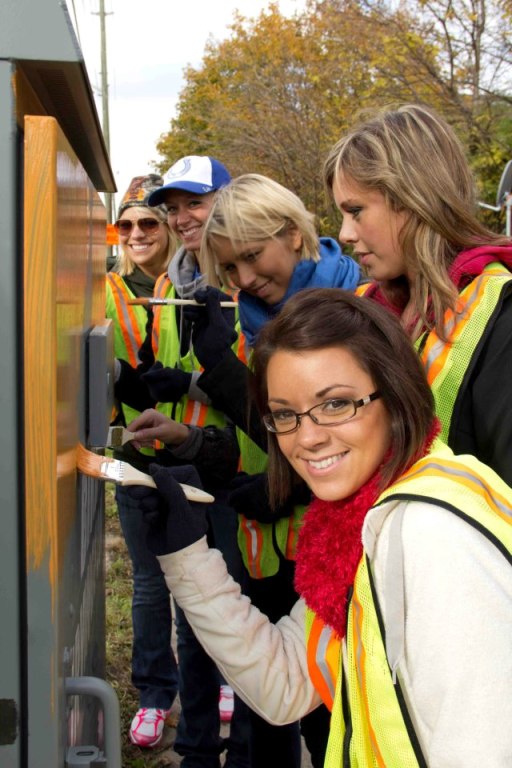
In 2012 I was one of the volunteers painting Irvington’s first seven signal boxes as part of the Great Indy Cleanup.

These Colts cheerleaders helped us get the job done.

These Colts cheerleaders helped us get the job done. Photo by Heidi Unger.

Each design had been submitted by artists like Morgan Hauth, shown here putting finishing touches on one of her pieces.

Touching up

Morgan Hauth touching up. Photo by Heidi Unger.

By 2013, Foundation East, the brainchild of Vishant Shah and Aaron Story, had formed with a goal of transforming eastside Indy neighborhoods through public art. Building on the success of the traffic signal box project, the duo enlisted six artists to paint another round.

Oil painter Rita Spalding at work on one of her signal boxes.

Oil painter Rita Spalding at work on one of her signal boxes. Photo by Charmaine Edwards.

A total of 19 boxes now brighten the main thoroughfares of my community.

Sadly, some disrespectful souls targeted a couple of these landmarks. Two boxes were vandalized early Dec. 31, prompting outrage among neighbors. A third more recently had a bucket of paint splashed on it.

It’s infuriating, but I take my cue from Rita, who has more reason than anyone to be outraged—her luminous painting was among those defaced. She told the Indianapolis Star that morning, “I’m not angry. It just really makes me think about what’s going on in that kid’s life.”

Later that day she wiped off the graffiti. Several neighbors met her at the box to help out if needed, but it turned out to be easier than she expected, because she’d applied a layer of clear coat finish.

Foundation East founders Aaron and Vishant say the outcry shows how important these boxes have become. They invited the community to meet the artists and show their support this week.

I went to the gathering, finding it packed to the gills with neighbors eager to thank the artists and scribble their ideas on a white board. (Paint the water tower, build a vertical garden structure on the library lawn, install a sculpture on my street!)

Many also chipped in for a “clear coat fund” to give all the boxes the same treatment as Rita’s.

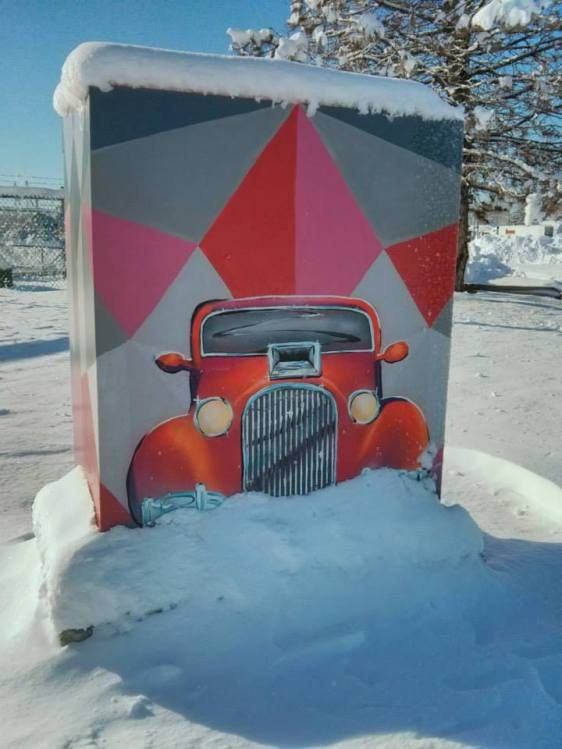
Homage to car culture

Homage to car culture, by Andrew Severns. Follow this artist at @severnscanon. Photo by Vishant Shah.

I talked to several residents there who mentioned Irvington’s history as a hub of creative and intellectual stimulation, with Butler University’s campus located here until 1928. In the 1920s and 30s, a group of acclaimed painters known simply as the Irvington Group drew national attention.

Apparently our neighborhood’s reputation as a quirky haven for eccentrics also dates back 100 years—Irvington is described in an October 1903 Indianapolis Star article as “the classic suburb which has an interesting way of turning up all kinds of freaks and strange things generally.”  (This was before the city grew to swallow up the suburb, but we retain our unique character.)

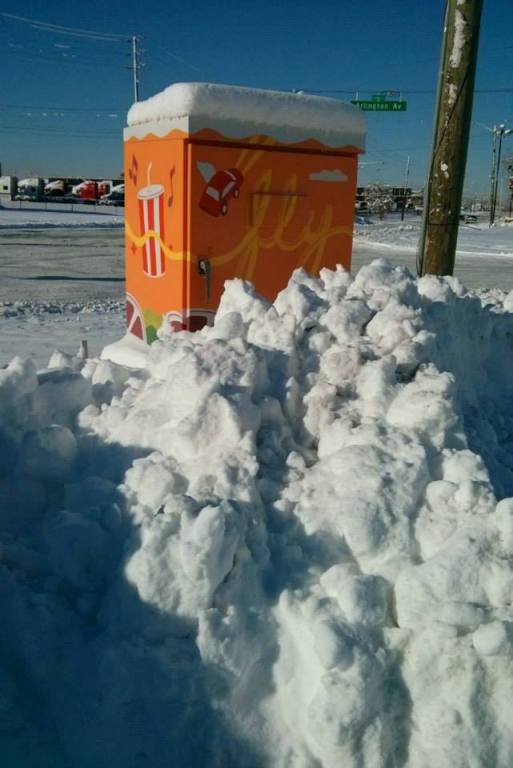
Signal box in Arctic Vortex aftermath

Erin Kelsch’s Signal box in Arctic Vortex aftermath. Photo by Vishant Shah.

Kathleen Angelone, owner of Bookmamas, says that’s exactly the kind of neighborhood she wants—and the art definitely adds to the vibe. “I think public art is vital to any community because it makes it beautiful. It denominates where the community is and gives it character.”

“And it is civilized. I want to live in a civilized community where people are interested in art and music and learning, not just their day to day jobs.”

Tribute to farm heritage

Dave and Holly Combs’ tribute to farm heritage. Photo by Vishant Shah.

Russian-born Svetlana, an oil painter, told me that public art played a role in her childhood desire to paint. “There are statues everywhere in Russia; you’re just surrounded by art,” she said. “That gave me a lot of creativity and imagination.”

Two years ago she moved to Irvington, where color is starting to pop in unexpected places. “I think it’s wonderful that there is art for people to view without going to a museum.”

Aaron and Vishant invite local artists, funders, and dreamers to contact them about partnering on future eastside Indy public art projects.

My next blog post will have more about the role of public art in placemaking, youth engagement, and crime prevention.

When Crisis Threatens

Thanks to a review in Permaculture Activist magazine, I found a little book called Small Stories, Big Changes: Agents of Change on the Frontlines of Sustainability. It’s a collection of inspiring voices from the community resilience movement. Each chapter is written by someone actively engaged in the world’s remaking.

Here’s a passage from the very first chapter that gives you a taste.

Goat milking, by V Becker, via flickr Commons

Goat milking, by V Becker, via flickr Commons

“(A) community of busy farmers, gardeners, goat-milkers, trail-builders, engineers, scientists, windmill climbers and solar installers…have led our society’s journey toward sustainability…

They are leaders because their excitement is stronger than their fear.

Logically, when crisis threatens we need to subdue our fear in order to take constructive action. But taking action also somehow diminishes our fear…Once we get busy we’re not as scared any more.

Perhaps we don’t control the forces changing our climate when we grow a few vegetables, but we do influence those forces, and I think the activity profoundly changes our perspective. The situation immediately seems more manageable when we begin to manage.”

—Bryan Welch, publisher of Mother Earth News

Photo by julochka, via flickr Commons

Photo by julochka, via flickr Commons

Have you found this to be true? I have, especially when I’ve gotten “the help of a few believers, supporters, and friends who light the way through the dark nights,” as David Orr describes elsewhere in the book. When I am at my lowest is usually when I’ve fallen away from hands-in-dirt activities for whatever reason, or when I’m feeling isolated. It’s easy to fall into this trap in winter especially.

But when I’m pulling together with neighbors to scheme a project or clean up my block or make a big batch of sauerkraut, I feel ready to face anything.

What about you? I’d love to hear about action you’ve taken—and how it impacts your anxiety level about the state of the world.

To Live Passionately

A writer friend and I were talking this morning about our goals for the new year. She said she had but one resolution for 2014: “Forget fear.” Except she used another, shall we say, more pithy F-word for her intention around fear.

Later, scanning through my notebook from the past few months, I came across this passage from Nov. 7, which followed a week of extreme doldrums:

Tired of being unconscious, but scared to wake up! Yet that fear seems foolish in light of the many ways we could bite the dust—globally/regionally/personally, calamitously/suddenly/slowly—oh so many options for becoming vapor, energy, disembodied once more. [I was thinking of the Oct. 25 earthquake off Japan’s coast near Fukushima, among other things.]

FukushimaIsHere-Sticker_1So keeping that in mind, how do I live? I want to live passionately.

Did you hear about the child for whom Make-a-Wish is transforming San Francisco into Gotham City, so he can be Batkid?

Photo by Bhautik Joshi, via flickr Commons

Photo by Bhautik Joshi, via flickr Commons

You see where I’m going with this. In our dying we become superheroes.

Thinking of the Buddhist injunction to remember the unalterable fact of our own death, I ended up musing: What do we have to lose?—the exact phrase my friend used this morning.

It seems ridiculous to dither about in fear and worry when we could be gone at any moment. And meanwhile all of life is calling us to be a force for good.

So how about it? Shall we create a passionate, conscious, fearless, superheroic 2014?

We Can’t Afford Coal

This week I attended a meeting to learn more about Indianapolis Power and Light’s Harding Street plant, the largest industrial polluter in the city. IPL has no plans to retire this 55-year-old coal plant, even though the EPA says it’s responsible for 88 percent of industrial toxic releases in Marion County. The plant’s smokestacks annually release 130 pounds of mercury into the air.

That has a devastating public health impact. One attendee spoke of being an asthma sufferer. “I know what it’s like to struggle to breathe and have to go to the ER…It breaks my heart to think that our power is the reason children have to go through that.”

Photo by Karl Anderson, via flickr Commons.

Photo by Karl Anderson, via flickr Commons.

As I found while researching an Indiana Living Green story about the Beyond Coal movement, poor children are disproportionately affected by coal because of where they live—resulting in learning disabilities, asthma, autism, and lowered IQs. They’re effectively trapped into a cycle of poverty, suffering lifelong difficulties linked to our state’s over-reliance on coal.

Two city maps made the plant’s impact visible. One showed asthma-related ER visits in Marion County, and the other depicted mercury levels in waterways and soil. In both cases it was clear how the neighborhoods northeast of the plant (including my own) are burdened as the prevailing winds blow the pollution our way.

I myself can trace some of my health struggles to these toxins. I moved to this neighborhood in 1996 from northern Indiana. I noticed that I got sick more often, and for longer periods, than I used to. By 2000 I was dealing with chronic illness. The origins were complex, but tests for heavy metal toxicity showed elevated levels of mercury in my body.

“If you love your lungs, get out of Indianapolis,” says a real estate blog, fingering my beloved city as the unhealthiest in the nation because of its poor air quality.

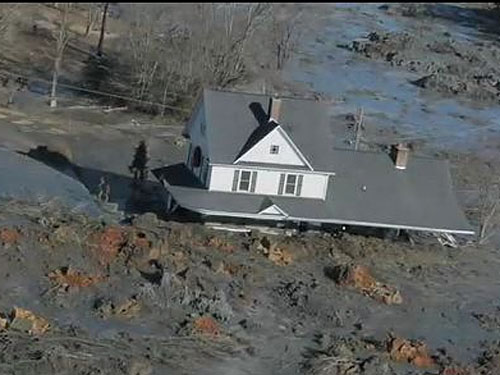
And then there’s the coal ash ponds. A nationwide 2011 EPA study identified 11 high-hazard coal ash ponds. Two of them are at the Harding Street plant. These unlined, aging pits are right next to the White River. I don’t even want to think about what would happen in the event of a major flood. Or if an ash dike ruptures, as happened in Kingston, TN, in 2008.

Knoxville News Pic

A house sits in the coal ash spill near Kingston, TN in Dec. 2008. Photo by Knoxville News Sentinel.

Apparently IPL doesn’t want to think about it either, even after two coal ash spills at its Martinsville plants sent more than 30 million gallons of toxic coal ash into the White River in 2007 and 2008.

Does it have to be this way? No, it doesn’t. Whether you look at it from a public health perspective, a fossil fuel emission perspective, or even through a financial lens, coal is a bad bet. Rate hikes to retrofit the aging plant are a poor use of our money. For inspiration, we can look to neighboring states. Iowa gets 24 percent of its power from wind—with rates similar to ours and no reliability issues.

The Indiana Beyond Coal campaign is all about making our voice heard. If enough people speak with their city councilmen and -women, write letters to the editor, and engage with IPL’s 20-year energy plan, things can change.

As organizer Megan Anderson said, “It’s as simple as getting together and talking to friends and neighbors.”

Eve Ensler on Reconnecting, Re-conjuring and Re-conceiving

A friend recommended Krista Tippett’s recent On Being interview with playwright/performer/social activist Eve Ensler. Last week while preparing food for our Thanksgiving meal, I listened to the unedited podcast. (The interview is full of insights, but I’ve pulled out a few highlights for you here.)

Photo of Eve Ensler by Justin Hoch, via Wikimedia Commons

Photo of Eve Ensler by Justin Hoch, via Wikimedia Commons

Ensler is the genius behind the iconoclastic play “The Vagina Monologues.” Her focus on female physicality and power has led her to some phenomenal projects. For example, in the Congo she helped create a refuge for women and girls surviving gender violence. It’s called City of Joy.

Congolese_woman

Congolese rape survivor. By L. Werchick, via Wikimedia Commons

She’s a much-needed voice for a heart-centered, embodied ethic. I love what she says about the power of reconnecting with our physical selves and each other:

“The more people get plugged back into their bodies, each other, the more impossible it will for us to be dominated and occupied.”

She speaks of being both playful and careful as we begin to reconnect. Most of us are not used to this level of caring for our fellow humans.

“In the same way that we don’t see trees, we don’t see each other. We don’t see how traumatized people are, tender people are. I think sometimes if one were fully awake, one would do nothing in one’s day except stop on the road, on the people you meet, because you would see their pain…We walk past everyone. Sometimes it just crushes my heart.”

When Tippett responds that we don’t stop because we can’t bear letting in that much pain, Ensler notes that others’ pain is part of us already. We can’t avoid it, because we are all one. “So that when you stop to actually acknowledge it, you’re actually allowing it to move as opposed to be frozen in you.”

This reminded me of my energy healer friend Merry Henn-Lecordier, who showed me how to welcome uncomfortable feelings in order to allow their release.

Merry Henn-Lecordier is a trailblazer in the field of energy medicine.

Merry Henn-Lecordier is a trailblazer in the field of energy medicine.

Merry taught me the importance of regularly clearing stuck emotion by speaking directly to it, in love and compassion. For example, I might say something like: Anger, I see you. I feel you. I love you. I understand. I welcome you, anger. I approve of you, and I approve of the circumstances that caused you to be stuck in my energy field. You are welcome here. And I’m ready to move you now. (I modeled this blessing after phrases Merry herself uses.)

Then, again following Merry’s example, I ask for help moving the anger (or overwhelm or despair or anxiety or what-have-you) from my energy field, releasing it and transmuting it into love.

It’s remarkably transformative to do this simple ritual, intending compassion for all my emotional states. The lightness I feel in its wake gives me hope that Ensler could be right when she calls us “people of the second wind.”

“This could be (humanity’s) second wind, but it requires a radical re-conjuring and re-conceiving of the story…And I absolutely believe it’s possible, but enough people have to believe it’s possible and be willing to kind of move with this wind that is trying to come in, trying to pass through us right now.

Ensler’s latest memoir, In the Body of the World, depicting her journey with cancer, is high on my reading list.

Crowd-funding the New Frontier: Radical Mycology

Here’s a chance to support a radical mycology project seeking to put a potent tool for restoration in many more hands. Mushrooms can break down and eliminate some of the most toxic industrial compounds in the world, representing enormous untapped potential for healing our beleaguered planet.

Not to mention the fact that mushrooms are a phenomenal source of protein, potentially boosting community-level food sovereignty.

Be part of this new frontier by funding this resource for would-be radical mycologists, and/or helping to spread the word!

By Alaricmalabry (Own work), via Wikimedia Commons

By Alaricmalabry (Own work), via Wikimedia Commons

Below is a note from Peter McCoy, who recently contributed a guest post about the lessons mushrooms have taught him:

The Radical Mycology Book fundraiser is underway! This unique book on the uses of mushrooms and other fungi for personal, societal, and ecological wellbeing will be a powerful resource for the geek and do-gooder inside us all and we are excited to bring this dream to the rest of the world.

You can view the live campaign here:

http://bit.ly/radmycogogo

Whether or not you are in a position to donate, one of the most important contributions you can make would be getting more people aware of this fundraiser by emailing your friends and re-posting on your social (mycelial) networks.

Share the campaign on Facebook:
http://bit.ly/rmifbshare


Thank you so much for contributing to this project and vision!

Mush love!
Peter and The Radical Mycology Collective

To be Fueled by Love

Browsing the shelves of Point Reyes Books last month, I picked up Mary Pipher’s latest book. Her Reviving Ophelia illuminated the struggles of adolescent girls. Now she has a book called The Green Boat: Reviving Ourselves in our Capsized Culture, detailing her progression from despair to activism.

A Nebraskan, Pipher was on the front lines of early campaigns to stop the Keystone XL Pipeline from going through the Sandhills. (Three years later, the pipeline is still in limbo, and has become a symbol of the fossil fuel industry’s disastrous impact on the planet.)

Dismal River, Nebraska Sandhills. Photo by USFWS Mountain Prairie, via Wikimedia Commons

Dismal River, Nebraska Sandhills. Photo by USFWS Mountain Prairie, via Wikimedia Commons

Even before opening it, I knew this book would return me to grounding.

I’d been talking with Richard Heinberg about his book The End of Growth, which describes a trajectory that I understand and yet can’t quite face head-on. Seeing it spelled out and hearing him expound on it left me feeling quite scared.

I know that many are pulling together for a better world. But our governmental policies favor the monied corporations running the show. I was starting to doubt that community action could effect change on that level.

Along comes Pipher, describing an activism that’s joyful and even fun. Example: grandmothers gave weekly “thank you in advance” pies to the Nebraska governor until he agreed to meet. This brand of protesting, fueled by love of the land and concern for tomorrow’s denizens, seems the perfect antidote to despair.

A chapter called All Hands on Deck begins with this quote from Frederick Buechner:

“God calls you to the place where your deep gladness and the world’s deep hunger meet.”

To be glad in the face of the world’s rending sometimes seems impossible. Yet I remember opening the church basement doors on the day of our SkillShare and seeing the space instantly fill with participants, their faces alight with curiosity. I think of the heart-cracking instant when a resonant phrase finds my fingers on the keyboard. I recall the joy of putting a garden trowel in the hands of a preschooler.

There’s an expansiveness when I reflect on these moments, a sense of the heart opening that lifts me from powerlessness.

Explaining vermiculture at the Irvington SkillShare. Photo by Jeff Echols.

Explaining vermiculture at the Irvington SkillShare. Photo by Jeff Echols.

Pipher acknowledges the “experts” who downplay the importance of individual actions. They say systemic economic and political changes are necessary to change this trajectory. True enough, but this reasoning is incomplete, says Pipher—for “who is it that is in charge of systemic change?”

She argues that individuals have always been the source of world-changing actions, and what else can one person do but start with herself? And join others in common cause, as did the abolitionists. It’s said that they had no hope of success, at the start.

My small self is quick to tell me what I’m not. I’m no naturalist, no doctor of philosophy, no career activist, no farmer, no wisewoman in a mountain hut. I am just myself. Sometimes I question: What do I have to offer?

I only own this experience, this deep heart of pain and care, grief and fear—and love. 

What do I have to offer? All of it. I offer it up.

[More from Mary Pipher: Read her interview on how to wake up and take action on climate change (and stay sane).]

Three Luminaries: Hopkins, Hemenway, Heinberg

While in northern California I had the chance to meet three powerful voices in the movement for positive change. Call them the Three H’s, or Tres Hermanos.

Hermano One, Richard Heinberg of the Post-Carbon Institute, schooled me about the inevitability of a global economic crash. This eventuality is currently held at bay in part by the dubious practice of quantitative easing. (No, I don’t really know how that works, but apparently governments and banks are creating money out of thin air to prop up our ailing economic system.)

When asked how he stayed grounded, immersed as he is in researching the unraveling of life as we know it, he spoke of living with gratitude. He spends time in precious company and places. He plays the violin a couple hours a day, and tends his garden and chickens.

Richard Heinberg in his garden, photographed by Nicolas Boullosa, via Flickr Commons

Richard Heinberg in his garden, photographed by Nicolas Boullosa, via Flickr Commons

Heinberg has been the bearer of bad news for years now, absorbing and presenting material that would leave me immobilized if I were in his shoes. He takes a balanced perspective, noting, “We need to talk about the potential benefits of reorganizing our material economy and doing more with less, and having more cooperation, and sharing and voluntarism—all of those things are good and make life better, more interesting, more fun.”

“And yet, at the end of the day it’s going to be a materially less opulent way of life, bottom line.”

In light of that trajectory, Hermano Two, Toby Hemenway, reined me in from fear mode by sharing the robustness of permaculture-based solutions. He echoed Heinberg on the most basic, square one action, no matter what happens next: Get to know your neighbors.

That means now, not in some perfect future living situation. He told me, “People say, “Someday I’m going to move to a community where I’m going to do that’ (live sustainably). And you’re already in a community right here, with your neighbors.”

Permaculture instructor Toby Hemenway, with Buddha, in his garden.

Permaculture instructor Toby Hemenway, with Buddha, in his garden.

Far better than a theoretical “someday” eco-topia is identifying and building that community right here, where we are. It can start as simply as: “Who will walk my dog when I’m gone? Who will help me water my garden when I’m sick?”

Taking the concept of community even further was Hermano Three, Rob Hopkins.  He spoke of hearing Heinberg speak about the end of growth a few years ago and feeling galvanized to take action. He wanted his fellow permaculturists to join him, but instead “found that lots of permaculture people are very happy living up little misty lanes making chairs out of sticks.”

He wanted more. He wanted to get moving, spread the word. Out of this urgency was born the Transition Town movement.

Rob Hopkins. Photo by Tulane Publications, via Flickr Commons.

Rob Hopkins. Photo by Tulane Publications, via Flickr Commons.

These are groups that aren’t waiting for permission, but instead starting where they are to build a new, localized economy (the REconomy). There’s tremendous energy in this movement. It may not always be called Transition. It may not get much press. But it’s rolling like a wave across the globe.

For more info, check out Hopkins’ book The Power of Just Doing Stuff,  Hemenway’s Gaia’s Garden, and Heinberg’s eye-opening End of Growth.

Sierra Murdoch, Writing the Gritty Truth

First in a Series on my Mesa Refuge Cohorts

Here’s a young writer to watch: Sierra Murdoch.

I met Sierra at Mesa Refuge, where we shared meals, stories, laughs, and a love of tea trays. We commiserated about the perils of writing, and encouraged each other to keep going. She inspired me with her focus and stamina—often the first one to get to work in the morning and last one still at it after supper.

Sierra Murdoch. Photo taken at writing residency, Banff Centre for the Arts, 2012.

Sierra Murdoch. Photo taken at writing residency, Banff Centre for the Arts, 2012.

Her project was a long article about a childhood cancer cluster in a small Nevada town. She conducted extensive research in the months leading up to our time at Mesa Refuge.

Sierra’s first foray into journalism was as a 2009-10 Middlebury Fellow in Environmental Journalism. For a little over a year, she lived in Wise County, VA, where more than a third of the county had been stripped by mountaintop removal coal mining. Sierra wrote about retired union coal miners fighting mountaintop removal, which was polluting wells, causing flooding, and destroying forests and streams.

Mountaintop Removal, Wise County, VA, via flickr Commons. Photo by David Hoffman

Mountaintop Removal, Wise County, VA, via flickr Commons. Photo by David Hoffman

Since 2011, she’s been on staff at High Country News, a well-respected magazine about the environment of the American West. Her biggest project there, and also for The Atlantic, chronicled the economic and social impacts of oil development on a Native American tribe living in the middle of the Bakken oil field—and a growing culture of violence against women there.

“I’m most drawn to communities living in extracted landscapes,” she says.

We had many conversations, but one in particular stands out. I told Sierra how much I admire activists who hold the line against things like mountaintop removal. The same goes for journalists like her who write about tough stuff, the gritty truth.

I sometimes feel guilty that I write feel-good stories of people building the new world while corporate giants prey on vulnerable communities and ecosystems. Aren’t I sort of slacking, happily profiling what’s going right, when there are so many wrongdoings to be exposed? Do I need to spend more time on a bullhorn instead of a cozy little blog?

But Sierra had a different take on it. She pointed out that the feel-good stories are nourishing not only to “the movement,” but also to people deeply invested in the status quo. These folks are usually turned off by angry protests. They might associate corporate actions with jobs and a way of life. So they feel threatened by protesters, disgusted with media attention.

Photo by D.D. Meighen, via flickr Commons

Photo by D.D. Meighen, via flickr Commons

“But the coal miner’s wife might like to go to the farmers market,” Sierra said. “She might want to garden, and she might like to be involved in community projects too.” Perhaps hearing about a group quietly working toward greater community resilience will bring her into the tribe. (Surely we need all stripes of people in this tribe now.)

This made me feel better.

Sierra is thoughtful, disciplined, kind, and curious—traits that make an excellent journalist. She radiates integrity. I can imagine that her subjects would trust her implicitly.

I look forward to watching her accomplish great things in years to come.