My Garden Tower, One Month Later

It’s been about a month since Judy and I planted our Garden Tower. I last posted about it the day we picked it up from the Good Earth. Time for a post showing the progression.

After some discussion we sited the barrel just outside our back door. We had to sacrifice a few cabbage and collard plants to clear out the space, but it’s the best spot for it. The light color of the siding will reflect light for the plants growing on the back side (though one friend insists we need to innovate some sort of lazy susan apparatus to be able to spin the whole barrel around!)

Filling the Barrel

Filling the Barrel

One of the things I love most about the Garden Tower is its built-in worm composting. I could hardly wait to put saved-up kitchen scraps in there. We also added some semi-decomposed stuff from the compost pile to jump start it.
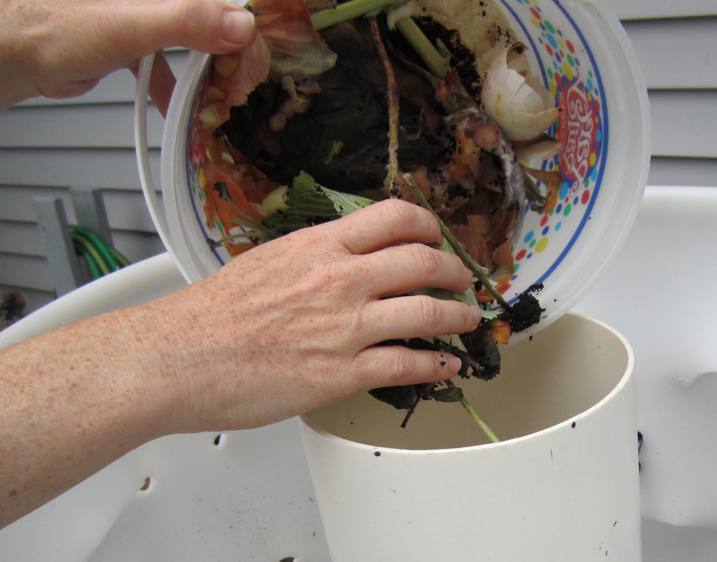
Adding vegetable matter to the center tube

Adding vegetable matter to the center tube

I bought red wigglers at a feed-and-seed shop, and there were also worms in the soil mix since we used some of our own sifted compost.

Just a handful of worms is enough: they reproduce rapidly.

Just a handful of worms is enough: they reproduce rapidly.

I had soaked seeds in water overnight to give them a head start. It was great fun poking them into the soil.

Planting Little Marvel peas on the more shaded side.

Planting Little Marvel peas on the more shaded side.

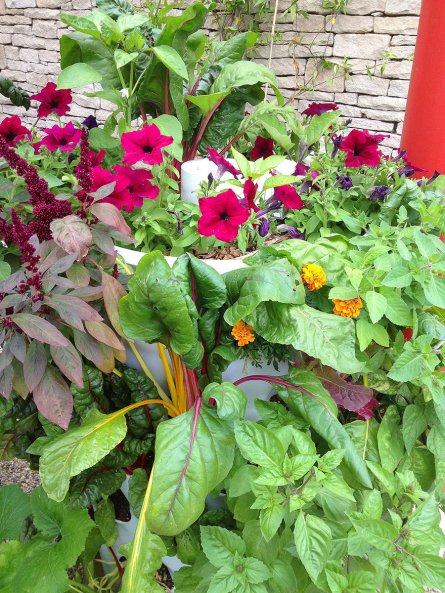
Plants scavenged from friends and a local nursery helped round it out.

I bought a couple of bell pepper plants that looked like they might survive, and this gorgeous Genovese basil. I also planted parsley starts around the back and a tomato sucker that a gardener friend rooted.

I bought a couple of bell pepper plants that looked like they might survive, and this gorgeous Genovese basil. I also planted parsley starts around the back and a tomato sucker that a gardener friend rooted.

Soon the seeds started to sprout.
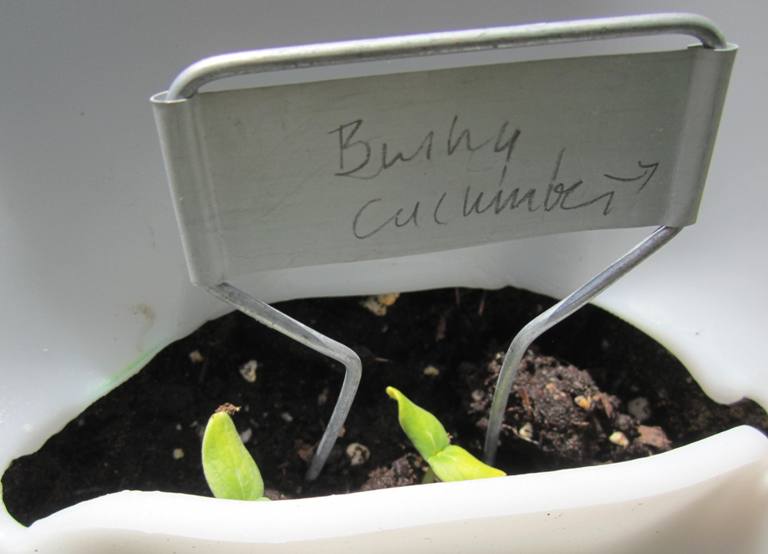
Cucumbers were first to sprout. I don't know if I'll get any cukes having planted them late in the season, but it's fun trying.

Cucumbers were first to sprout. I don’t know if I’ll get any cukes having planted them late in the season, but it’s fun trying.

It was like springtime in July.
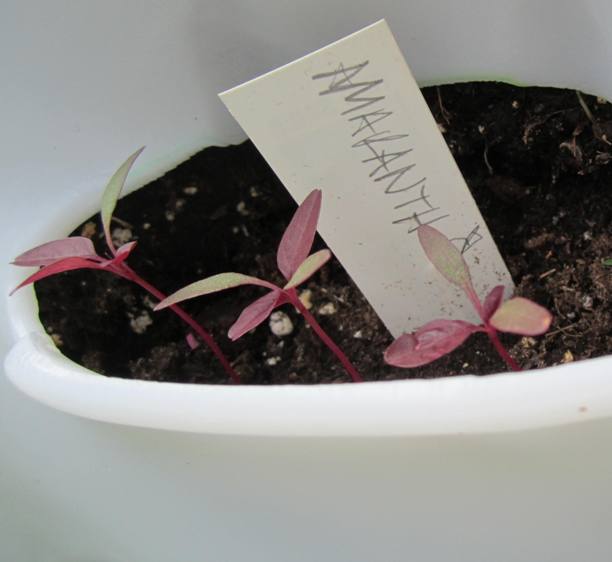
Really excited about the amaranth!

Really excited about the amaranth!

After a couple weeks it looked like this. (The cat loves hanging out in the cool shade underneath the tower.)
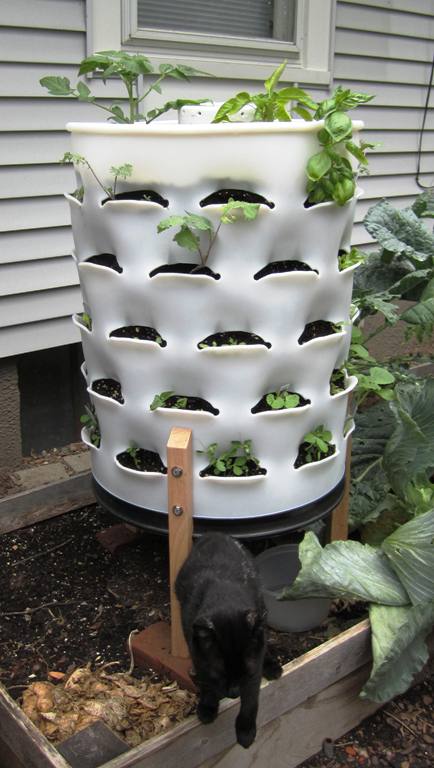
About 2 weeks after planting.

About 2 weeks after planting.

Today it looks like this!
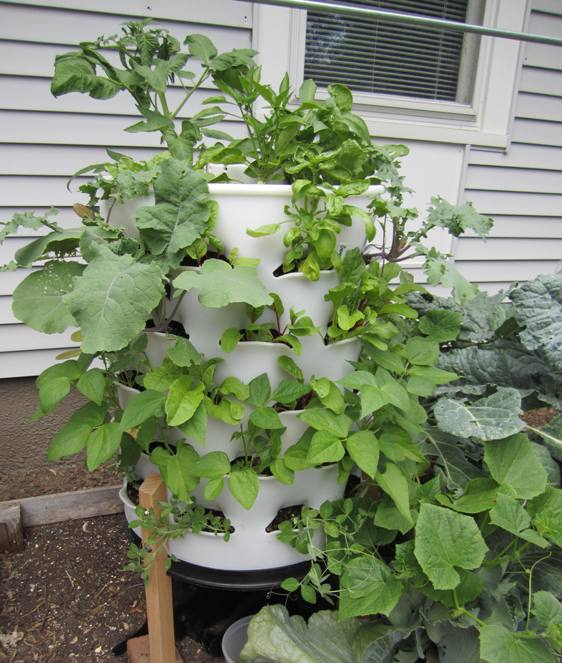
Check out the cucumber vines, lower right. (And yes that is a cat under there.)

Check out the cucumber vines, lower right. (And yes that is a cat under there.)

The tomato “sucker” has suckers of its own now, and soon I’ll have to stake it. I’ve harvested basil, parsley, and a few thinnings of the greens. The worms have been chewing through their food, so in a few months I’ll have a different kind of harvest—worm castings.

We’re thinking of rigging up some sort of covering to extend the season. I hope we can keep snipping kale and chard into the winter.

I love my Garden Tower. Of course, it is not necessary to purchase this product to have a similar vertical garden. “You just need a blow torch and a two-by-four,” says one plucky friend. That seems a little more than I want to do, but this Garden Sack design looks to be a good DIY alternative.

Building Resilience One Vertical Garden at a Time

At FoodCon I met two of the people behind the innovative Bloomington-based Garden Tower Project. Check out their garden-in-a-barrel design with built-in worm composting. Up to 50 plants can be planted in this unique vertical garden.

Garden Tower on Planting Day

Garden Tower on Planting Day

The center tube is perforated down the entire length, allowing red wiggler worms to travel between the compost tube and the soil. Kitchen waste goes into the center tube and turns into compost and worm castings. Bonus: The protection of the soil in the barrel means the worms can survive through the winter.

How genius is that–worm composting right in your container garden?
Finished compost, with happy worms

Finished compost, with happy worms

From the website:

“In an era of rapidly rising food prices and industrial farming practices that strip our food of nutrients essential for good health, we believe the Garden Tower is one small step in empowering people towards their own food security.”
The company hopes to nurture a community of growers. They’ll soon launch GrowingCircles.org as a space for networking and collaboration among those with an interest in the Garden Tower Project’s mission. The goal is expanding food self-sufficiency, promoting homegrown vegetables and herbs that are:
  • organic
  • non-GMO
  • low-input
  • ecologically sustainable

Tom Tlusty tells me that the Garden Tower’s unique design capitalizes on “evaporative cooling and a large thermal mass”–making it possible to plant in hot temperatures normally prohibitive in a traditional garden plot.

So… it’s not too late to start gardening this season!

Top view of the Garden Tower.

Top view of the Garden Tower.

I’m so excited about this design that I ordered my own Garden Tower, and I’m picking it up from the Good Earth later today. I’m psyched to sow some crops I didn’t have room for, like beans and carrots. I’ll also scour local garden centers for leftover seedlings (probably quite sad and stressed by now, but maybe a little TLC would bring them along).

It’s nearly time to start fall crops, like kale, lettuce, peas, and spinach. That’s something I always intend to do and never seem to manage in the thick of late summer. But this is the year, with my sweet new protected microclimate as incentive.

Plus I’ll finally have livestock on my homestead, if only in the form of worms. I’m in heaven!

Time to harvest from the Garden Tower

Time to harvest from the Garden Tower

The only drawback I can see is the need for potting soil to ensure that the growing medium is not compacted in the barrel. I hate buying bagged soil for so many reasons. I’ve seen recipes for homemade potting soil. But being eager to jump in, I probably will break down and purchase. (If you’ve found a good peat-free variety available on the market, please leave it in the comments.)

The inventors believe their design will allow people of all abilities to garden in any clime. According to Garden Tower users in the arid Grand Canyon region, this model results in immense water savings. Tom says they used ten times less water with the Garden Tower than their traditional plot or raised bed.

Really can’t wait to dig in!

All photos courtesy of The Garden Tower Project.

Things That Can’t Be Rushed

Those of us who are bathed in technology much of our lives, that is to say most of the Western world by now, have grown accustomed to having everything happen in a hurry. Speed is the ultimate. Efficiency is king.

I am prone to this, feeling impatient with the rate of change.

Even in gardening, I value a relatively quick turnaround: Plant a bunch of lettuce seedlings, and a month later I can be snipping salad from my own raised bed.

But some things take time, and move in a crooked line, and require great patience to see results.

Photographer: Kessner Photography

Photographer: Kessner Photography

I’m reminded of this when I visit a farmer friend who lives in my neighborhood. Her family farm is called Artesian Farm. It’s in the next county over, where Anna and her farm partners raise grassfed beef.

When she talks about farming, she thinks in terms of decades. For example, the process of transitioning the farm to organic—which her parents wanted to do long before there was any infrastructure of support—has barely begun, and the beginning itself is taking years.

It’s been nearly 10 years of preparation, and a very small portion of the crop acreage is just beginning the transition to organic.

To grow corn and beans organically, and to be certified as such, farmers undergo an elaborate process. One of Artesian Farm’s first steps was adding more cattle. It seems an odd thing: what do corn and beans have to do with the beef side of the business?

But Anna explains that crop rotation is key in organic farming. Hay is their chosen rotation crop. “It’s common wisdom that if you grow hay and sell it off your farm, you’re taking all the nutrition off your farm.” So more cattle were needed to make use of the hay.

A 200-page plan has taken about six years to complete. It would cost $2500 to have an outside agency prepare this plan, on top of the $1000 for certifying. Anna opted for the DIY approach.

During my visit Anna cuts me some lemon balm, which is near an imposing compost heap about the size of a mobile home. It looks like a small sod house was plunked down in the middle of her modest “back 40.” “How do you turn it?” I ask, thinking of our own compost pile—a midget compared to this—and how it never gets hot enough to kill weed seeds, because we don’t turn it, though we always say we will.

“Oh, I don’t bother turning it. Nature doesn’t turn it, in the woods.”

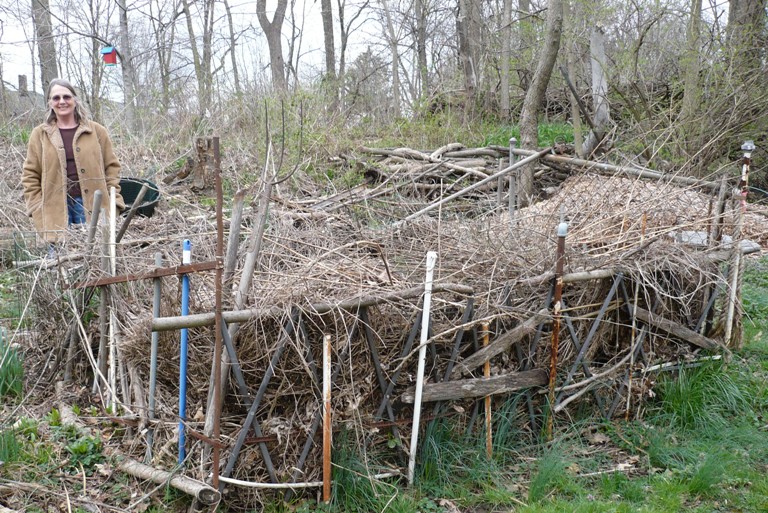
Anna and her compost bin, which she created “free-hand” with odd broom sticks, twigs, mop handles, rusty pipes, and other finds.

Anna and her compost bin, which she created “free-hand” with odd broom sticks, twigs, mop handles, rusty pipes, and other finds. Photo by Danny Chase.

Walking me back to my car, Anna reflects on the passage of time, how long it takes to make a change, to heal the land, to see results. Those of us who don’t spend as much time with our feet on the soil and hands in the dirt might expect results in a much shorter time frame than the decades that are really required.

Like the compost, like building the humus of the forest floor, there are things that can’t be rushed.