Relocalizing the Food System

I love writing stories about food and farming. The people I meet are so passionate about their work. Almost everyone I interview is invested in reforming the broken food system. Bonus: They give me tasty things to eat.

Here’s a rundown of the treats I’ve sampled just in the past few weeks.

  • Cissy, a woman who’s long been the vanguard of Indiana’s organic movement, gave me some intensely flavorful pickles she made from cucumbers raised in her kitchen garden. I washed it down a glass of homemade kombucha that couldn’t be beat.
  • Jim, a farmer in Owen County, sent me home with a bunch of carrots he pulled from the wet earth like a late winter miracle.
  • Anna, a farmer in Rush County, gave me a huge jar of rolled wheat that her cooperative had grown and milled. (I used some in banana bread I baked for my weekly writing date—my writer buddies pronounced it wonderful.)
Checking out a display of LocalFolks Foods at Moore Corner Store while on assignment

Checking out a display of LocalFolks Foods at Moore Corner Store while on assignment

And a couple weeks ago, at Moore Corner Store, proprietor Jasen Moore offered me a taste of ketchup made by Indiana’s own LocalFolks Foods.

I’m no ketchup connoisseur, and in fact we never purchase it. But if I were a fan of this most American of condiments, I would never buy a national brand again. LocalFolks’ is sweetened with sugar, not the genetically modified scariness that comprises high-fructose corn syrup.

I happened to be in the natural food store when Hoosier Microgreens’ Alex Sulanke came along to introduce his product. So I got to munch uber-fresh sprouts of radish, cabbage, kale, arugula, and mustard from “the smallest farm in Indiana” (120 square feet).

Moore Corner Store is in the business of connecting small farmers and food entrepreneurs to the consumer. Though its hours are limited at present, this shop and others like it fill a critical role in relocalizing our food system.

For Jasen and his wife Sara, Moore Corner Store is more than just a business. It’s a mission. Jasen told me the enterprise arose out of concern for the state of our economy. Big box stores have fragmented communities and hurt the little guy.
Moore2“But a store like this…supports the local economy, minimizes carbon footprint, puts actual nutritious food on your plate, and it’s close to home.” The Moores live just up the street from the shop, though both must spend time elsewhere to make ends meet.

I just saw a documentary called Down to Earth in which the iconoclastic farmer Joel Salatin (made famous in Michael Pollan’s Omnivore’s Dilemma) made an important point: Your purchase of a farmer’s product might be the thing that keeps that farm afloat another week.

Is it worth changing our habits to spend a little more of our money at a farmers’ market or a shop like the Moores’? I would say yes. What about you? Have you connected with a small farmer, producer, or locally owned shop lately?

Check out my piece on Moore Corner Store here.

A Loved World

I heard two interviews in the last few days with Elizabeth Kolbert, author of The Sixth Extinction: An Unnatural History. While listening to the Fresh Air interview I was making pizza. And I must have decided—or the part of my brain that can’t process too much scary information decided—that making pizza required all my faculties, because I kept zoning out.

But I did hear that 25 percent of all mammals on the earth are endangered, and 40 percent of amphibians.

Photo of critically endangered Panamanian Golden Frog By Tim Vickers [Public domain], via Wikimedia Commons

Photo of critically endangered Panamanian Golden Frog By Tim Vickers [Public domain], via Wikimedia Commons

I did hear that the Great Barrier Reef is on track for full-scale collapse, and that we can expect the oceans to eventually look like “the underwater equivalent of a vacant lot.”

No asteroid is to blame this time. The driver for this extinction wave is humankind.

That’s a heavy load to bear, even if I knew it already. With our tailpipe emissions and our moving from continent to continent and our wildly inventive minds, we are rapidly bringing about the demise of millions of species.

The author makes the point that our impact on other species isn’t (always) intentionally malevolent. It’s the very nature of our speedy brains and dextrous hands. It’s the fact that, as Kolbert says, we don’t have to wait for evolution to create change. We just make a tool. Which makes life difficult for creatures that change at the pace of evolution.

What does this mean? I don’t know. It feels bleak. I like to take the long view, the esoteric/spiritual/energetic view that focuses on evolution of souls, a realm beyond the physical. Still, here on the physical plane, it’s a devastating trajectory.

Self-preservation requires that this knowledge fade in and out of my consciousness. I go about my days, doing what I do, worrying about small things. Then it’s like the moment my dad was diagnosed with inoperable, terminal cancer. Suddenly all that trivia fades in importance. I’m pierced by pain. A loved one, a loved world, is in jeopardy.

© Cinc212 | Dreamstime Stock Photos

© Cinc212 | Dreamstime Stock Photos

I don’t know what to do or say in the face of such hideous information. Just the fact of the dwindling numbers of monarch butterflies alone makes me want to weep.

I find myself wanting to check email, check Facebook, call a friend, watch the Olympics. To do anything but stay with this knowledge.

I can say that all things happen for a reason and everything is unfolding exactly as it should and we are holding the light whether we know it or not and we were always meant to get to this point—but is all that just a bandaid for unendurable grief and fear?

___

I wrote the words above last night. Today, I feel different, grateful, open. I took time to sit in love and awareness this morning. It seems the metaphor of a terminal diagnosis fits better than I first realized.

In the face of horrifying news, sometimes there is an opening to the sacred. Suddenly you savor life more than ever. You don’t take anything for granted. You give what you can. You do what you must. Your love expands.

Portal to the Wider World

“An environment-based education movement―at all levels of education―will help students realize that school isn’t supposed to be a polite form of incarceration, but a portal to the wider world.”

―Richard Louv, author of Last Child in the Woods: Saving Our Children from Nature-Deficit Disorder

A few weeks ago I had the chance to stop in on a special activity at Avon’s Hickory Elementary School. Jen Davies from Avon Outdoor Learning Center—a total rock star in the kids’ eyes—had come to talk minerals. By day’s end 120 children would make the connection between minerals and something they encounter every day, toothpaste.

In each hour-long session, Jen touched on Coke cans’ recyclability, Lunchables’ sodium content, Crest’s new products—and the broad appeal of minty-tasting toothpaste.

Discussing the sodium content of common foods.

Discussing the sodium content of common foods.

Throughout, Jen telegraphed the absolute awesomeness of minerals. These third-graders were right there with her.

This time of year, most of Jen’s work takes place in the classroom, but the Outdoor Learning Center is true to its name in every other season (and on some milder winter days).

Jen Davies leads a group of small learners on a winter outing to catch snowflakes and look at their shapes.

Jen Davies leads a group of small learners on a winter outing to catch snowflakes and look at their shapes. Photo courtesy of Avon OLC.

On seven acres belonging to the Avon School Corporation, students encounter the real-world stuff that makes science, math, and history come alive. Over 9,100 students, parents and faculty members visited the OLC in 2012-13, exploring two miles of trails and habitats spanning prairie, woodland, and wetland. A beehive and 7,000-square foot vegetable garden—tended by a garden club of 85 budding gardeners—offer further learning opportunities.

Back at Hickory Elementary, Jen divided the kids into groups and funneled them to one of four tables to make toothpaste. At one table they measured a half teaspoon calcium carbonate with a quarter teaspoon baking soda, according to the recipe. At the next, they could handle crystals, stones, and a Coke can in the “mineral museum.”

Geologist-in-the-making

Geologist-in-the-making

The final two stations were the most exciting: droppers to add the coloring and flavoring of their choice.

Adding flavoring with help from a volunteer.

Adding flavoring with help from a volunteer.

Would it be tutti-frutti, traditional mint, or maybe cherry, coco-lemon, or some other variation? And what color should it be? Tints of cherries, neon green, and ice blue bloomed in the paper cups.

blue

Blue proved to be a popular color.

Wrapping up, Jen told them, “Minerals are really cool—you might decide on a career using this, where you can do something like make toothpaste.”

When I spoke to her afterward about why she’s so passionate about her work, she told me she wants the children “to see themselves as part of this amazing whole.”

“We are all just circles within connections within circles. We need healthy soil and clean water and clean air to be able to thrive. The choices we make on a daily basis affect not only us but everything around us.”

Sadly, Avon OLC faced major budget cuts in 2011. Jen has been raising money and finding grants to pay her own salary. Late last year word went out that funding had dried up—without help, her position would be gone by this month. Since then several thousand dollars have been raised. It’s enough to keep her, for now, until the end of the school year, but the future is uncertain.

As Jen wrote me in an email, “It’s just so innovatively unusual for a public school district to have such a resource, we are giving it all we have to keep going.  When kids bring me their entire piggy bank, how can I not try everything I can think of?”

Several fundraisers are in the works to keep the center going. Visit the center’s site to see how you can help.

Update: After I posted this, Jen was awarded the 2013 Donald H. Lawson Award for Conservation Education from the Hendricks County Soil & Water Conservation District.

Viva Optimism

Art made by my spouse Judy for our first solar cooker

Art made by my spouse Judy for our first solar cooker

Optimism is a political act. Those who benefit from the status quo are perfectly happy for us to think nothing is going to get any better. In fact, these days, cynicism is obedience.

—Alex Steffen, The Bright Green City, The Sun Magazine

My Dad, Who Made the World Better, Take 3

Tomorrow, Feb. 2, used to be just Groundhog Day to me. Once I keyed into the seasonal festival days celebrated in ancient times, I knew Feb. 2 as Imbolc—a day to take a walk and look for the first signs of spring.

But now it’s forever associated with my dad, who left this world on Feb. 2, 2012. On that day the snowdrops bloomed and the sandhill cranes flew low. I like to think that his spirit took stock of those harbingers of spring—and that they released him to fly away.

It broke Dad’s heart to leave us, and he hated to leave all his wonderful volunteer work behind. Since his retirement he’d launched all kinds of projects. Possibly the hardest thing to give up was his connection with schoolchildren.

You can't see Dad but you can see how the kids looked at him.

You can’t see Dad but you can see how the kids looked at him.

It all started when he began tending the grounds of Cold Spring School, the environmental education magnet, just because it looked like somebody ought to.

Dad doing what came naturally.

Dad doing what came naturally.

Because he took an interest, he eventually found himself in stewardship of the school’s greenhouse. This was a dream come true for him. (I remember many times in my childhood, he would talk about his dream of putting up a greenhouse.) His passion made it easy to engage the classes who came in for units on seeds, soil, and other such things.

Dad showing grade schoolers the wonders of aloe in the greenhouse.

Dad showing grade schoolers the wonders of aloe in the greenhouse.

After he got sick, when confronted with kudos for his volunteering, Dad liked to say, “I was just having fun.”

Having fun on a wet day at Cold Spring School.

Having fun on a wet day at Cold Spring School.

Just looking at these photos again, I’m swamped with sadness.

No one can fill the void he left. But maybe by having our own brand of fun, we can each take up a tiny spot of it. As the days get imperceptibly longer, what can we bring to the earth, to each other?

Photos courtesy of Friends of Cold Spring School.

When Crisis Threatens

Thanks to a review in Permaculture Activist magazine, I found a little book called Small Stories, Big Changes: Agents of Change on the Frontlines of Sustainability. It’s a collection of inspiring voices from the community resilience movement. Each chapter is written by someone actively engaged in the world’s remaking.

Here’s a passage from the very first chapter that gives you a taste.

Goat milking, by V Becker, via flickr Commons

Goat milking, by V Becker, via flickr Commons

“(A) community of busy farmers, gardeners, goat-milkers, trail-builders, engineers, scientists, windmill climbers and solar installers…have led our society’s journey toward sustainability…

They are leaders because their excitement is stronger than their fear.

Logically, when crisis threatens we need to subdue our fear in order to take constructive action. But taking action also somehow diminishes our fear…Once we get busy we’re not as scared any more.

Perhaps we don’t control the forces changing our climate when we grow a few vegetables, but we do influence those forces, and I think the activity profoundly changes our perspective. The situation immediately seems more manageable when we begin to manage.”

—Bryan Welch, publisher of Mother Earth News

Photo by julochka, via flickr Commons

Photo by julochka, via flickr Commons

Have you found this to be true? I have, especially when I’ve gotten “the help of a few believers, supporters, and friends who light the way through the dark nights,” as David Orr describes elsewhere in the book. When I am at my lowest is usually when I’ve fallen away from hands-in-dirt activities for whatever reason, or when I’m feeling isolated. It’s easy to fall into this trap in winter especially.

But when I’m pulling together with neighbors to scheme a project or clean up my block or make a big batch of sauerkraut, I feel ready to face anything.

What about you? I’d love to hear about action you’ve taken—and how it impacts your anxiety level about the state of the world.

Restoring the Land

IMG_20140110_101420

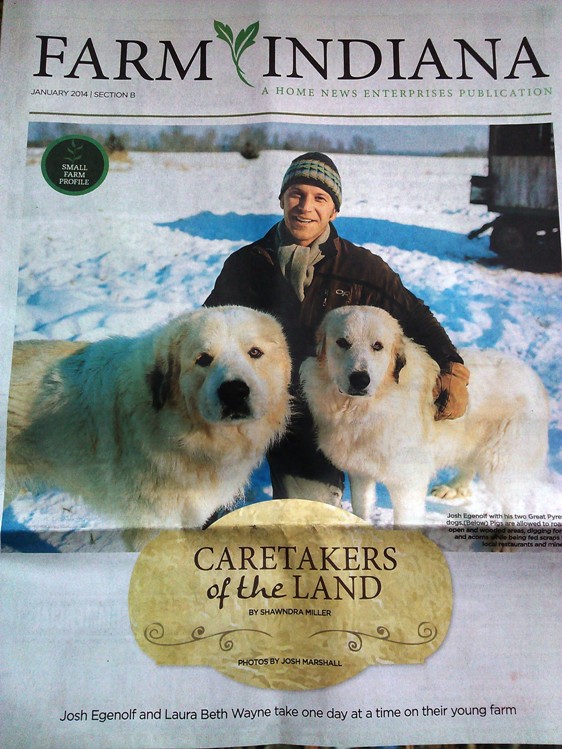
Cover page of my Farm Indiana profile of WE Farm

Dr. Lisa Harris remembers well the first conversation with the young man who would come to farm her land—they talked for hours, almost an entire day. “I was so impressed with how deliberate and thoughtful he was,” she told me.

Dr. Harris is Eskenazi Health’s medical director, a vegetarian with a lifelong interest in eating healthy food. As I learned when I wrote about WE Farm for Farm Indiana, she leases her Owen County property to Josh Egenolf and Laura Beth Wayne’s pastured beef cattle, poultry, and pork operation.

“Most people in the United States do eat meat,” she said. “So if I can be part of something that gives people access to meat from animals that have lived well, it seems like a perfect opportunity.”

Like many of us, Dr. Harris tries to live as lightly as possible, and Josh’s plans to make her land productive really spoke to that goal. “What Josh is doing,” she said, “is in every sense helping to improve the land.” WE Farm’s integrated, rotational grazing plan means the animals work in concert with nature to restore pastureland—all the while sequestering carbon and nitrogen in the soil.

The day I visited the farm last November in preparation for my Farm Indiana story, four happy dogs ran in front of the pickup truck as we drove up the lane to tend the livestock. Owen County is picturesque, with wooded hills and deep valleys. Josh showed me the steep woodlot where the hogs are periodically turned loose to forage for acorns and pawpaws. They also help him clear out understory invasives, just by doing what pigs do.

Breeder pigs enjoying their mineral rations on a frosty November morning.

Breeder pigs enjoying their mineral rations on a frosty November morning.

Josh was raised on a farm just a few miles up the road, and he treasures the richness of his a rural childhood. Giving that experience to his own child (and another on the way) is a big reason why he moved back to the area after pursuing his doctorate in ecology at the University of Georgia.

Also, he wanted to be put what he’d learned there into practice. Agriculture, he told me, has enormous potential for creating meaningful environmental change.

He said, “In 2007 I read The Omnivore’s Dilemma. Before that it never occurred to me that there might be anything troublesome about the way meat was produced, other than animal welfare stuff. That’s very clear to me…you shouldn’t treat your animals poorly. They need to be respected. But it didn’t occur to me that there was a single thing wrong with them eating grain and (even) industrial byproducts.”

He knows that many people still don’t realize the environmental and health issues that accompany feeding grain to meat animals, but a growing customer base tells him how many people value pastured meat. “It’s like an awakening that needs to happen.”

Josh and Laura Beth strive to keep the business as local as possible, keeping close to home in all their dealings. For more on their endeavors, check out my Farm Indiana story and the WE Farm website.

We Can’t Afford Coal

This week I attended a meeting to learn more about Indianapolis Power and Light’s Harding Street plant, the largest industrial polluter in the city. IPL has no plans to retire this 55-year-old coal plant, even though the EPA says it’s responsible for 88 percent of industrial toxic releases in Marion County. The plant’s smokestacks annually release 130 pounds of mercury into the air.

That has a devastating public health impact. One attendee spoke of being an asthma sufferer. “I know what it’s like to struggle to breathe and have to go to the ER…It breaks my heart to think that our power is the reason children have to go through that.”

Photo by Karl Anderson, via flickr Commons.

Photo by Karl Anderson, via flickr Commons.

As I found while researching an Indiana Living Green story about the Beyond Coal movement, poor children are disproportionately affected by coal because of where they live—resulting in learning disabilities, asthma, autism, and lowered IQs. They’re effectively trapped into a cycle of poverty, suffering lifelong difficulties linked to our state’s over-reliance on coal.

Two city maps made the plant’s impact visible. One showed asthma-related ER visits in Marion County, and the other depicted mercury levels in waterways and soil. In both cases it was clear how the neighborhoods northeast of the plant (including my own) are burdened as the prevailing winds blow the pollution our way.

I myself can trace some of my health struggles to these toxins. I moved to this neighborhood in 1996 from northern Indiana. I noticed that I got sick more often, and for longer periods, than I used to. By 2000 I was dealing with chronic illness. The origins were complex, but tests for heavy metal toxicity showed elevated levels of mercury in my body.

“If you love your lungs, get out of Indianapolis,” says a real estate blog, fingering my beloved city as the unhealthiest in the nation because of its poor air quality.

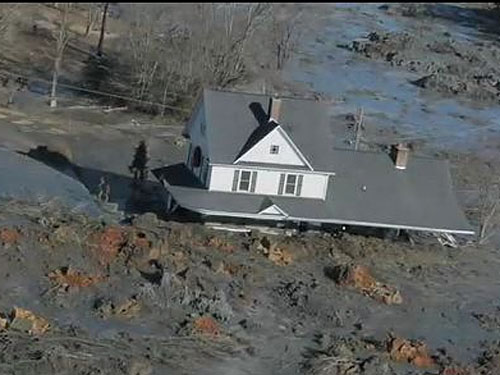
And then there’s the coal ash ponds. A nationwide 2011 EPA study identified 11 high-hazard coal ash ponds. Two of them are at the Harding Street plant. These unlined, aging pits are right next to the White River. I don’t even want to think about what would happen in the event of a major flood. Or if an ash dike ruptures, as happened in Kingston, TN, in 2008.

Knoxville News Pic

A house sits in the coal ash spill near Kingston, TN in Dec. 2008. Photo by Knoxville News Sentinel.

Apparently IPL doesn’t want to think about it either, even after two coal ash spills at its Martinsville plants sent more than 30 million gallons of toxic coal ash into the White River in 2007 and 2008.

Does it have to be this way? No, it doesn’t. Whether you look at it from a public health perspective, a fossil fuel emission perspective, or even through a financial lens, coal is a bad bet. Rate hikes to retrofit the aging plant are a poor use of our money. For inspiration, we can look to neighboring states. Iowa gets 24 percent of its power from wind—with rates similar to ours and no reliability issues.

The Indiana Beyond Coal campaign is all about making our voice heard. If enough people speak with their city councilmen and -women, write letters to the editor, and engage with IPL’s 20-year energy plan, things can change.

As organizer Megan Anderson said, “It’s as simple as getting together and talking to friends and neighbors.”

Eve Ensler on Reconnecting, Re-conjuring and Re-conceiving

A friend recommended Krista Tippett’s recent On Being interview with playwright/performer/social activist Eve Ensler. Last week while preparing food for our Thanksgiving meal, I listened to the unedited podcast. (The interview is full of insights, but I’ve pulled out a few highlights for you here.)

Photo of Eve Ensler by Justin Hoch, via Wikimedia Commons

Photo of Eve Ensler by Justin Hoch, via Wikimedia Commons

Ensler is the genius behind the iconoclastic play “The Vagina Monologues.” Her focus on female physicality and power has led her to some phenomenal projects. For example, in the Congo she helped create a refuge for women and girls surviving gender violence. It’s called City of Joy.

Congolese_woman

Congolese rape survivor. By L. Werchick, via Wikimedia Commons

She’s a much-needed voice for a heart-centered, embodied ethic. I love what she says about the power of reconnecting with our physical selves and each other:

“The more people get plugged back into their bodies, each other, the more impossible it will for us to be dominated and occupied.”

She speaks of being both playful and careful as we begin to reconnect. Most of us are not used to this level of caring for our fellow humans.

“In the same way that we don’t see trees, we don’t see each other. We don’t see how traumatized people are, tender people are. I think sometimes if one were fully awake, one would do nothing in one’s day except stop on the road, on the people you meet, because you would see their pain…We walk past everyone. Sometimes it just crushes my heart.”

When Tippett responds that we don’t stop because we can’t bear letting in that much pain, Ensler notes that others’ pain is part of us already. We can’t avoid it, because we are all one. “So that when you stop to actually acknowledge it, you’re actually allowing it to move as opposed to be frozen in you.”

This reminded me of my energy healer friend Merry Henn-Lecordier, who showed me how to welcome uncomfortable feelings in order to allow their release.

Merry Henn-Lecordier is a trailblazer in the field of energy medicine.

Merry Henn-Lecordier is a trailblazer in the field of energy medicine.

Merry taught me the importance of regularly clearing stuck emotion by speaking directly to it, in love and compassion. For example, I might say something like: Anger, I see you. I feel you. I love you. I understand. I welcome you, anger. I approve of you, and I approve of the circumstances that caused you to be stuck in my energy field. You are welcome here. And I’m ready to move you now. (I modeled this blessing after phrases Merry herself uses.)

Then, again following Merry’s example, I ask for help moving the anger (or overwhelm or despair or anxiety or what-have-you) from my energy field, releasing it and transmuting it into love.

It’s remarkably transformative to do this simple ritual, intending compassion for all my emotional states. The lightness I feel in its wake gives me hope that Ensler could be right when she calls us “people of the second wind.”

“This could be (humanity’s) second wind, but it requires a radical re-conjuring and re-conceiving of the story…And I absolutely believe it’s possible, but enough people have to believe it’s possible and be willing to kind of move with this wind that is trying to come in, trying to pass through us right now.

Ensler’s latest memoir, In the Body of the World, depicting her journey with cancer, is high on my reading list.

A Field to Fork Market

“In Indiana, we can grow so much of our own food. We really could be sustainable now,” says Kevin Logan, MD. Though we can’t grow mangoes or bananas, he believes we could cultivate everything we need for regional self-sufficiency.

INgredients Field to Fork Market, a new shop he opened in partnership with wife Jacqueline and old friend Tom Wiles, is exerting influence on both supply and demand. To stimulate the market for good clean food, the deli demonstrates how to use local produce like bok choy and spaghetti squash. Meanwhile the proprietors are coordinating with the many farmers and producers capable of feeding our region, in anticipation of the 2014 growing season.

I had the pleasure of talking with the three of them when I wrote this Nuvo piece on the store. It’s located in a refurbished Taco Bell, and full of items grown or produced in Indiana.

Pie pumpkins and gourds from local farmers at INgredients.

Pie pumpkins and gourds from local farmers at INgredients.

“I feel like we’re going to have to get back to community,” Logan says. “And food choices are one way that we do that.”

The trio plan to hold classes on every stage of food growing, storing, cooking, and preserving, to help people gain garden knowhow and kitchen skills. Both fermenting and cheese making classes are in the offing.

All in all this shop is a great addition to community resilience efforts in my town.