Crowd-funding the New Frontier: Radical Mycology

Here’s a chance to support a radical mycology project seeking to put a potent tool for restoration in many more hands. Mushrooms can break down and eliminate some of the most toxic industrial compounds in the world, representing enormous untapped potential for healing our beleaguered planet.

Not to mention the fact that mushrooms are a phenomenal source of protein, potentially boosting community-level food sovereignty.

Be part of this new frontier by funding this resource for would-be radical mycologists, and/or helping to spread the word!

By Alaricmalabry (Own work), via Wikimedia Commons

By Alaricmalabry (Own work), via Wikimedia Commons

Below is a note from Peter McCoy, who recently contributed a guest post about the lessons mushrooms have taught him:

The Radical Mycology Book fundraiser is underway! This unique book on the uses of mushrooms and other fungi for personal, societal, and ecological wellbeing will be a powerful resource for the geek and do-gooder inside us all and we are excited to bring this dream to the rest of the world.

You can view the live campaign here:

http://bit.ly/radmycogogo

Whether or not you are in a position to donate, one of the most important contributions you can make would be getting more people aware of this fundraiser by emailing your friends and re-posting on your social (mycelial) networks.

Share the campaign on Facebook:
http://bit.ly/rmifbshare


Thank you so much for contributing to this project and vision!

Mush love!
Peter and The Radical Mycology Collective

To be Fueled by Love

Browsing the shelves of Point Reyes Books last month, I picked up Mary Pipher’s latest book. Her Reviving Ophelia illuminated the struggles of adolescent girls. Now she has a book called The Green Boat: Reviving Ourselves in our Capsized Culture, detailing her progression from despair to activism.

A Nebraskan, Pipher was on the front lines of early campaigns to stop the Keystone XL Pipeline from going through the Sandhills. (Three years later, the pipeline is still in limbo, and has become a symbol of the fossil fuel industry’s disastrous impact on the planet.)

Dismal River, Nebraska Sandhills. Photo by USFWS Mountain Prairie, via Wikimedia Commons

Dismal River, Nebraska Sandhills. Photo by USFWS Mountain Prairie, via Wikimedia Commons

Even before opening it, I knew this book would return me to grounding.

I’d been talking with Richard Heinberg about his book The End of Growth, which describes a trajectory that I understand and yet can’t quite face head-on. Seeing it spelled out and hearing him expound on it left me feeling quite scared.

I know that many are pulling together for a better world. But our governmental policies favor the monied corporations running the show. I was starting to doubt that community action could effect change on that level.

Along comes Pipher, describing an activism that’s joyful and even fun. Example: grandmothers gave weekly “thank you in advance” pies to the Nebraska governor until he agreed to meet. This brand of protesting, fueled by love of the land and concern for tomorrow’s denizens, seems the perfect antidote to despair.

A chapter called All Hands on Deck begins with this quote from Frederick Buechner:

“God calls you to the place where your deep gladness and the world’s deep hunger meet.”

To be glad in the face of the world’s rending sometimes seems impossible. Yet I remember opening the church basement doors on the day of our SkillShare and seeing the space instantly fill with participants, their faces alight with curiosity. I think of the heart-cracking instant when a resonant phrase finds my fingers on the keyboard. I recall the joy of putting a garden trowel in the hands of a preschooler.

There’s an expansiveness when I reflect on these moments, a sense of the heart opening that lifts me from powerlessness.

Explaining vermiculture at the Irvington SkillShare. Photo by Jeff Echols.

Explaining vermiculture at the Irvington SkillShare. Photo by Jeff Echols.

Pipher acknowledges the “experts” who downplay the importance of individual actions. They say systemic economic and political changes are necessary to change this trajectory. True enough, but this reasoning is incomplete, says Pipher—for “who is it that is in charge of systemic change?”

She argues that individuals have always been the source of world-changing actions, and what else can one person do but start with herself? And join others in common cause, as did the abolitionists. It’s said that they had no hope of success, at the start.

My small self is quick to tell me what I’m not. I’m no naturalist, no doctor of philosophy, no career activist, no farmer, no wisewoman in a mountain hut. I am just myself. Sometimes I question: What do I have to offer?

I only own this experience, this deep heart of pain and care, grief and fear—and love. 

What do I have to offer? All of it. I offer it up.

[More from Mary Pipher: Read her interview on how to wake up and take action on climate change (and stay sane).]

Jerry Needleman: Seeking the Questions

Third in a Series on my Mesa Refuge Cohorts

It is a rare privilege to have sustained contact with a deeply reflective person, someone capable of nurturing reflection in others. Today I am remembering this feeling of spaciousness as I hold a book called An Unknown World: Notes on the Meaning of the Earth, given to me by the author at Mesa Refuge. A philosopher and educator, Jacob Needleman (Jerry, he prefers to be called) enriched my time at the residency enormously.

Jacob (Jerry) Needleman

Jacob (Jerry) Needleman

Jerry was there to work on his next book, and he’s written many. In fact, An Unknown World was penned during an earlier Mesa Refuge residency. I enjoyed getting to know the man behind the bibliography, finding him to be engagingly kind, curious, and funny.

As our senior resident, he occupied a place of honor at our dinner table. I think he enjoyed being the only man among four women who doted on him (and sometimes ribbed him as well).

Jerry’s brand of philosophy is practical, compassionate, accessible, incisive—and quite applicable to the times we are living. Instead of right answers, he seeks the right questions, a refreshing tactic.

In one of our many thought-provoking conversations, he invited us to live the question only we ourselves can answer, which is: “Who am I?” He said that when caught up in a destructive habit, it’s helpful to ask, “Who is the person doing that? Who am I?”

“This question is like a companion throughout your life; it becomes an energy,” he said.

I first opened An Unknown World in my writing shed, with water birds swimming the wind over the marshy expanse outside my window. Jerry had read aloud from this book the previous night—and what he read, his normally quiet voice turning sonorous, riveted me. That passage suggested that humans are channels for “higher influences” that need to be expressed on earth. That without our evolution, “Earth herself could not evolve toward her own greater possibility.”

Photo by Heikenwaelder Hugo, via Wikimedia Commons

Photo by Heikenwaelder Hugo, via Wikimedia Commons

And so I read more, hungrily:

“What we and our Mother Earth need, and what has been needed since Man first appeared, is the energy of awakened and awakening men and women…”

“We can hardly imagine what the Earth will offer us in return for its being seen and understood by the whole being of Man. Earth and Nature need this from us more than anything else. And only from this inner transformation of the mind can right action toward nature and the Earth be pursued without ultimately resulting in ‘the same old story’—that is, division, conflict, and violence.”

After I finished this illuminating book, I asked Jerry which of his works to read next, and he suggested Time and the Soul. I asked Bookmamas to order a copy for me. I’m looking forward to diving in. It’s about allowing time to “breathe” in our lives. (Jerry was right in divining that I need to learn this!)

I feel so blessed to have met Jerry. I probably wouldn’t have encountered his work if not for our time together at Mesa Refuge.

Sierra Murdoch, Writing the Gritty Truth

First in a Series on my Mesa Refuge Cohorts

Here’s a young writer to watch: Sierra Murdoch.

I met Sierra at Mesa Refuge, where we shared meals, stories, laughs, and a love of tea trays. We commiserated about the perils of writing, and encouraged each other to keep going. She inspired me with her focus and stamina—often the first one to get to work in the morning and last one still at it after supper.

Sierra Murdoch. Photo taken at writing residency, Banff Centre for the Arts, 2012.

Sierra Murdoch. Photo taken at writing residency, Banff Centre for the Arts, 2012.

Her project was a long article about a childhood cancer cluster in a small Nevada town. She conducted extensive research in the months leading up to our time at Mesa Refuge.

Sierra’s first foray into journalism was as a 2009-10 Middlebury Fellow in Environmental Journalism. For a little over a year, she lived in Wise County, VA, where more than a third of the county had been stripped by mountaintop removal coal mining. Sierra wrote about retired union coal miners fighting mountaintop removal, which was polluting wells, causing flooding, and destroying forests and streams.

Mountaintop Removal, Wise County, VA, via flickr Commons. Photo by David Hoffman

Mountaintop Removal, Wise County, VA, via flickr Commons. Photo by David Hoffman

Since 2011, she’s been on staff at High Country News, a well-respected magazine about the environment of the American West. Her biggest project there, and also for The Atlantic, chronicled the economic and social impacts of oil development on a Native American tribe living in the middle of the Bakken oil field—and a growing culture of violence against women there.

“I’m most drawn to communities living in extracted landscapes,” she says.

We had many conversations, but one in particular stands out. I told Sierra how much I admire activists who hold the line against things like mountaintop removal. The same goes for journalists like her who write about tough stuff, the gritty truth.

I sometimes feel guilty that I write feel-good stories of people building the new world while corporate giants prey on vulnerable communities and ecosystems. Aren’t I sort of slacking, happily profiling what’s going right, when there are so many wrongdoings to be exposed? Do I need to spend more time on a bullhorn instead of a cozy little blog?

But Sierra had a different take on it. She pointed out that the feel-good stories are nourishing not only to “the movement,” but also to people deeply invested in the status quo. These folks are usually turned off by angry protests. They might associate corporate actions with jobs and a way of life. So they feel threatened by protesters, disgusted with media attention.

Photo by D.D. Meighen, via flickr Commons

Photo by D.D. Meighen, via flickr Commons

“But the coal miner’s wife might like to go to the farmers market,” Sierra said. “She might want to garden, and she might like to be involved in community projects too.” Perhaps hearing about a group quietly working toward greater community resilience will bring her into the tribe. (Surely we need all stripes of people in this tribe now.)

This made me feel better.

Sierra is thoughtful, disciplined, kind, and curious—traits that make an excellent journalist. She radiates integrity. I can imagine that her subjects would trust her implicitly.

I look forward to watching her accomplish great things in years to come.

Julia Butterfly Hill: What our Hearts Know

Belated postcard from Hopland, CA: It was a thrill to hear Julia Butterfly Hill speak at the Building Resilient Communities Convergence. This is the woman who spent most of 1998 and 1999 living in the canopy of an ancient redwood tree named Luna. Her extended protest brought attention to the plight of ancient forests and resulted in a three-acre buffer zone around Luna.

Julia Butterfly Hill in 2005, via flickr Creative Commons, by Scott Schumacher

Julia Butterfly Hill in 2005, via flickr Creative Commons, by Scott Schumacher

Now she calls herself a wholistic healthcare practitioner instead of an activist, because she is working on the “disease of disconnect.” What struck me about Julia is how much she embodied a heart-centered ethic. She began by expressing a commitment to affirming “what our hearts know: That we are all one.”

There’s little in our culture that supports the kind of inner transformation needed now. Julia called this era a time of spiritual crisis. “That place inside ourselves that is just ancient and knows only connection is in crisis.”

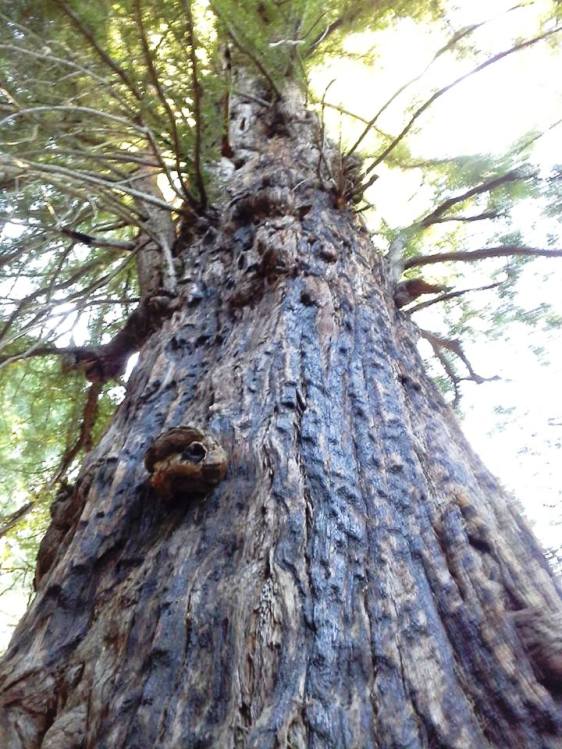
Methuselah, an 1800-year-old redwood in Woodside, CA

Methuselah, an 1800-year-old redwood in Woodside, CA

“What is it going to take to rebirth ourselves in this world where we are?” was her central question. She said it is a courageous act to keep our hearts open, because it means being open to the suffering of beloved creatures, communities, and ecosystems.

I appreciated that she called us to stay aware of our own tendency to rigidity, cautioning: “Any time we are passionate about anything, we are one breath away from being a fundamentalist.”

She invited us to “live so fully and presently in love that there is no room for anything else to exist.” To ask, What would love do in this space? What would love say in this room?

She said we need to bring all our integrity to bear in modeling a positive vision for the world. “We are so good at defining what we are against that what we are against begins to define us.” But it is also crucial to stand firm against wrongdoing. Even the campaigns that failed, she said, she would go back and do again.

It’s a matter of offering ourselves “in loving and joyous service to our world.”

Truly a transformative figure.

Respite

I’m back from Mesa Refuge,* where I had 10 days to write, read, reflect, and draw inward. It was heavenly to leave the smartphone in a drawer for most of that time, and to let my social media accounts languish.

It was a time of exploration. I explored through my writing every day, starting early in the morning and working late into the night in my private writing shed. From this window I spied deer, quail, rabbits, hummingbirds, juncos, redtailed hawks, vultures, egrets, white pelicans, and many other waterbirds and songbirds I couldn’t identify.

My writing shed  overlooked a Tomales Bay tidal estuary, where San Andreas fault lies.

The shed overlooks a Tomales Bay tidal estuary. San Andreas fault runs through this wetland. Mesa Refuge is “a place for writing on the edge”–and this shed is situated on the edge of the North American Plate, looking across to the Pacific Plate.

I explored the nearby town of Point Reyes Station. Not one but two yoga studios serve the tiny populace, and the farmers market brings everyone out each Saturday.

Point Reyes Station Farmers Market

Point Reyes Station Farmers Market

And once I ventured out in a borrowed pickup truck to one of the many wild places near the refuge.

Path to Abbott's Lagoon, Point Reyes National Seashore

Path to Abbott’s Lagoon, Point Reyes National Seashore

This was one of my favorite days.

Abbott's Lagoon

Abbott’s Lagoon

I relished the solitude and quiet that are so rare in workaday life. It felt like a privilege.

Beyond Abbott's Lagoon: The Pacific.

Beyond Abbott’s Lagoon: The Pacific.

But there was conviviality along with the solitude. I spent many of the evenings in conversation with the brilliant writers who were in residence with me. In coming weeks I plan to feature each of these writers and their crucial work.

I also decided to spend some time sitting in nature each day, now that I’m home. Here in my city, the hummingbirds are long gone and there are no dramatic cliffs or hypnotic ocean waves, but the leaves are turning and the songbirds are still as vociferous as ever. Heartland beauty may be subtler than West Coast beauty, but it still fills me.

*Are you a nonfiction writer whose work touches on nature, economics, and social justice? I would encourage you to apply for a residency at Mesa Refuge. It is a phenomenal place to write.

Radical Fungi Are My Favorite Teachers

Guest Post by Peter McCoy

When I get asked why I started the Radical Mycology project, I often say that it was to share the lessons that mushrooms have taught me.

Turkey tail logs

Turkey tail logs

Since I started studying mushrooms as a teenager, I have always seen mycology (the study of fungal biology) as an endlessly fascinating and thought-provoking science. Whether I am using them as a nutritious food source or as a potent medicine, I am always honored to taste their wonderful flavors and alluring textures. Hunting mushrooms in the woods, I love to watch them grow, knowing that they are cleaning the forest soil, protecting plants from disease, and turning decaying matter into fresh topsoil so new plants can thrive.

And using them as remediators, I am awed by the mushrooms’ ability to break down and eliminate some of the most toxic industrial compounds in the world.
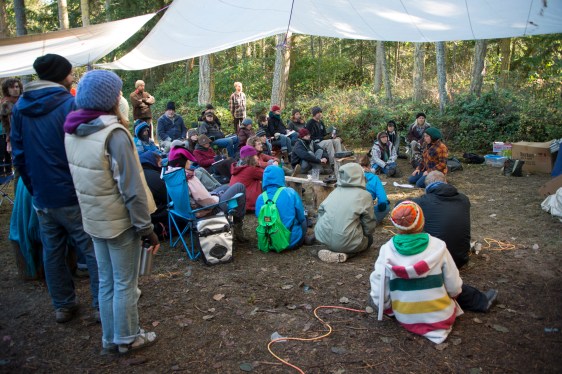
Grassroots Bioeremediation workshop with Leila Darwish at the Radical Mycology Convergence

Grassroots Bioremediation workshop with Leila Darwish at the Radical Mycology Convergence

Seeing how the densely branched mycelial networks of mushrooms share nutrients among plants, I also find a wonderful example for humans to follow when working to collaborate with their communities. Further, the incredible spore loads that mushrooms drop in the fall are designed to adapt to any given environment, demonstrating the ability to adjust to challenges and remain resilient during hard times.

These same attributes provide a model for how humans can best relate to each other, whether on a personal or societal level. By mimicking mushroom mycelium, cooperative businesses and housing projects work more efficiently by spreading out tasks and networking with affiliated organizations.

Fungi are also highly symbiotic with most organisms on the planet, so we find, yet again, the importance of collaboration among creatures throughout the fungal kingdom. In essence, fungi act in countless ways as grand harmonizers of the Earth, something that humans can aspire toward to live in balance with their surroundings.
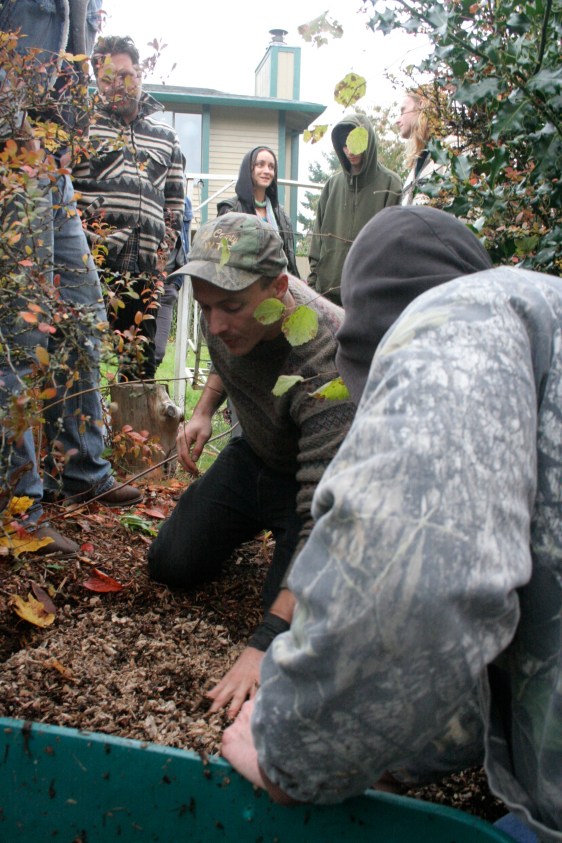
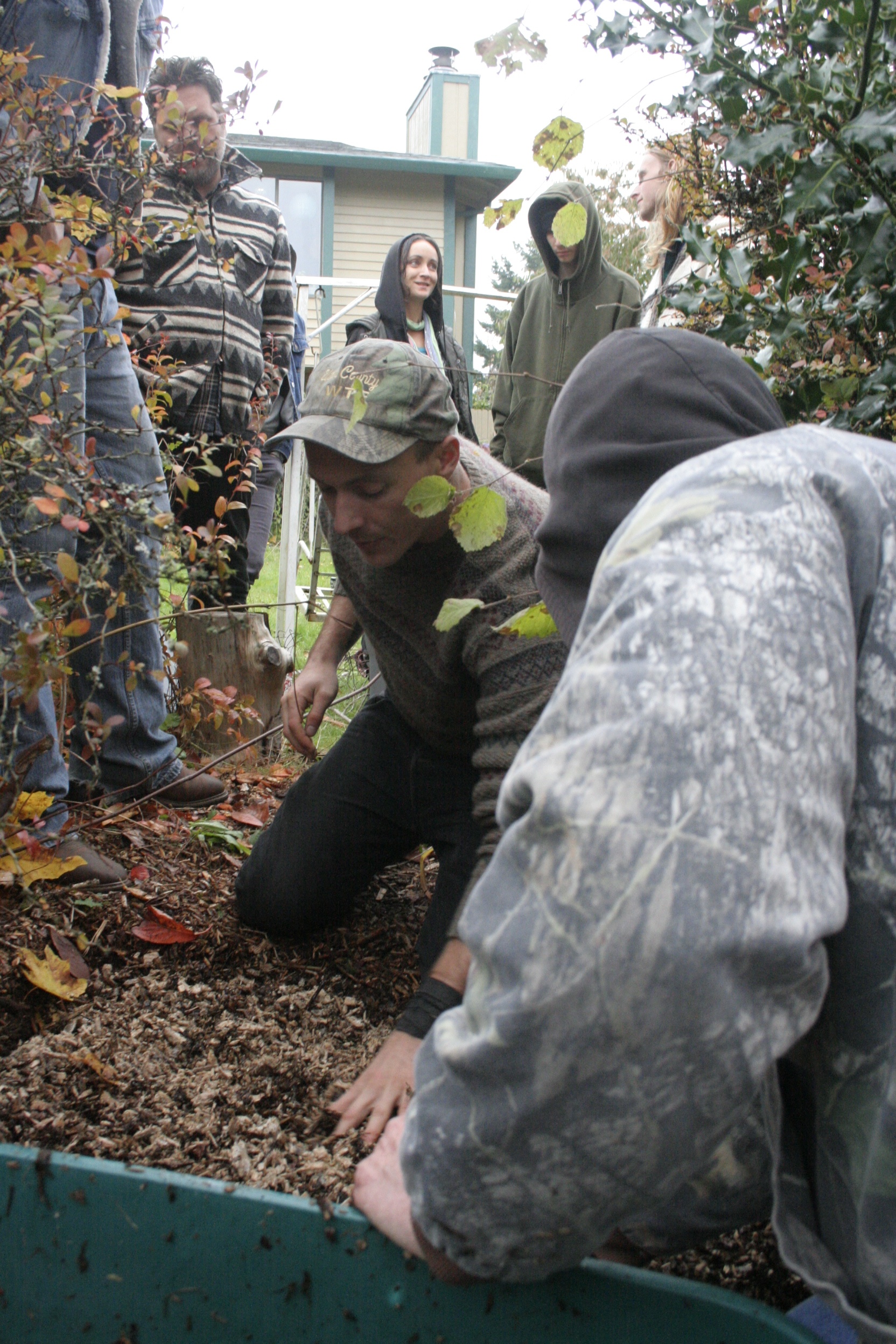
King Stropharia bed installation at Peter's Mushroom Cultivation & Application Course in Olympia, WA

King Stropharia bed installation at Peter’s Mushroom Cultivation & Application Course in Olympia, WA

The Radical Mycology project revolves around just this philosophy: that by studying, working with, and learning from the fungal kingdom, humans can best find solutions to problems of personal, societal, and ecological health. To this end Radical Mycology has put a lot of energy into providing free education to the public on the benefits of fungi.

Our website (radicalmycology.com) is a database of all things mycological. We offer two free publications we have written, Radical Mycology and Mushroom Cultivation For Remediation, as well as instructional videos and protocols for mushroom cultivation.

Nameko Bed installation at Demeter's Permaculture Garden in Olympia, WA

Nameko Bed installation at Demeter’s Permaculture Garden in Olympia, WA

We organize regular multi-day events on mushroom cultivation and its practical applications (the Radical Mycology Convergences), with another being planned for the spring of 2014. And since 2011, two Radical Mycology-inspired volunteer clubs have sprung up in San Francisco, CA and Olympia, WA. These groups teach free workshops about simple and practical mushroom cultivation and community resilience.

The next and biggest project for Radical Mycology is writing a book exploring the theory, practice, and applications of mushrooms for personal, societal, and ecological change. We are currently in the midst of an Indiegogo crowdfunding campaign to fund the book. Our campaign page will soon be up and running. Stop by the Radical Mycology website to learn more about our work.

Update: The Radical Mycology Book fundraiser is underway! This unique book on the uses of mushrooms and other fungi for personal, societal, and ecological wellbeing will be a powerful resource for the geek and do-gooder inside us all and we are excited to bring this dream to the rest of the world.

You can view the live campaign here:

http://bit.ly/radmycogogo
Stealing the Future

Photo credit: Kim Seng, via flickr Commons

Photo credit: Kim Seng, via flickr Commons

At present, we are stealing the future, selling it in the present, and calling it GDP. We can just as easily have a future that is based on healing the future instead of stealing it.

Paul Hawken, Commencement Address, University of Portland, 2009

Protection

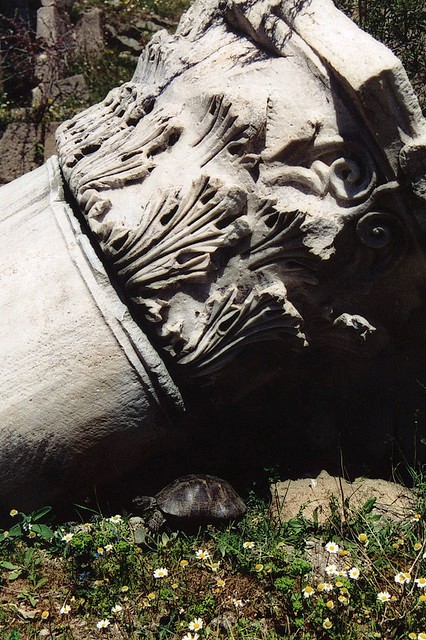
 A turtle among the Roman ruins at Pergamon, Turkey. Photo by Nick Leonard, via flickr Commons


A turtle among the Roman ruins at Pergamon, Turkey. Photo by Nick Leonard, via flickr Commons

Nothing protects us but our constant awareness and rededication to embody our values as much as we possibly can, and to be gentle with ourselves and others when we fail in this.

Michael Lerner

Postcard from Hopland, CA

This weekend was the big Building Resilient Communities Convergence in Hopland, CA. I was excited to be there for part of the action.

A highlight was the mycology skillshare, during which Fungaia Farm‘s Levon Durr demonstrated several methods for home mushroom cultivation.

Teaching how to cultivate oyster mushrooms at home using the stem butt/cardboard technique to grow your own spawn. Sweet!

I didn’t know until recently that shrooms actually are a source of protein. This makes me even more determined to try cultivating my own.

I thought Levon was going to levitate when he got to the part about mycoremediation. His enthusiasm is not misplaced: Mushrooms can clean petroleum from drainage ditches and aid in riparian zone restoration. They even eat heavy metals and bacteria.

The practice of using fungi to clean our beleaguered earth of toxins is one of the most hopeful stories I’ve heard. It is also the subject of an upcoming guest post from Radical Mycology, so stay tuned.