Localizing the Winery

When is a winery more than a winery? When it contributes to revitalizing a rural community, putting the local economy at the forefront of its mission. Owen Valley Winery, which I discovered on assignment for Farm Indiana, is just such a place.

IMG_20140301_135319

Here’s a look at the piece I wrote for this month’s issue of Farm Indiana.

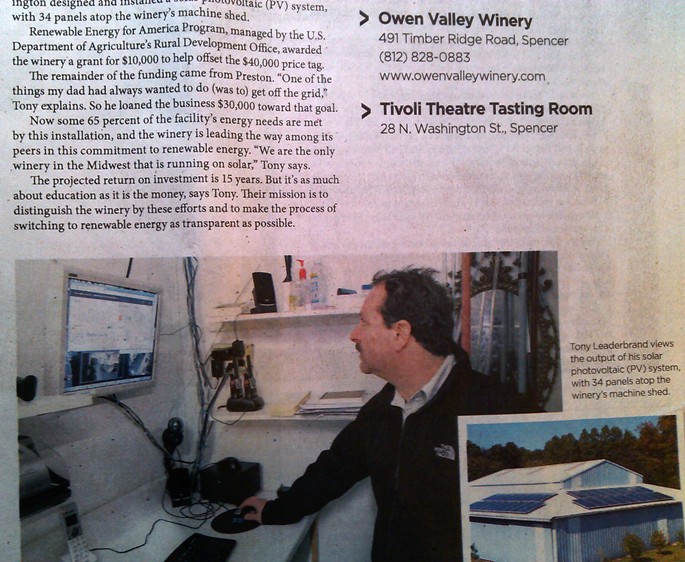
I thoroughly enjoyed my conversation with Tony Leaderbrand (pictured above), who told me the whole story of the family-owned business’s evolution. Aside from their commitment to showcasing Owen County’s locally grown and made products, the winery is unique in another respect. It is the first Midwestern winery to run on solar power.
IMG_20140301_135602

A grant from the Renewable Energy for America Program helped pay for the solar panels that now produce a large portion of the winery’s energy needs.

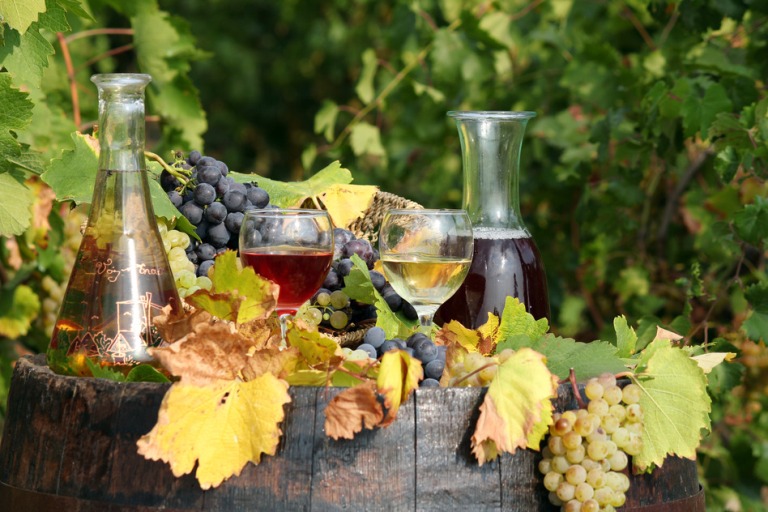
Locally grown persimmons are among the fruits used in Owen Valley Winery’s products. I was moved by stories of people bringing their excess fruit in shoeboxes and buckets every fall to sell to the winery. Tony made me see that winemaking is truly a local ag-based endeavor. (Due to demand for dry wine, they also use some California-grown grapes as well.)
photodune-1133279-wine-s

Photo by groceris, via PhotoDune

Tony told me all about the repurposed items that went into construction of the tasting room and production facility. In fact, the second tasting room is kind of an upcycling project in itself: It’s located in the renovated Tivoli Theatre, a historic building in Spencer, IN.

On a personal note, Tony talked about how eating produce from local farms is a winner both in terms of health benefits and reduced packaging. Not to mention the benefits of keeping dollars circulating in the local community.

“I think there’s such a need for us all to come full circle on purchasing,” he said. “We have to break these old habits of going to these superstores. You’ve got to know where everything you buy comes from.”

You can read the full article here (do a search on Owen Valley Winery to jump to the piece.)

A Lifesized Lego Set for Farmers and Makers

I was invited to visit the Indiana Small Farm Conference this past weekend, and was I ever glad I went. I got to reconnect with some farmer friends and make new connections. I learned about the challenges facing the people who grow our food on a small scale. And of course lunch was delicious, as well it should be with food supplied from local farms and prepared by the stellar whole-foods caterer known as The Juniper Spoon.

But the highlight was a session with a representative from Open Source Ecology. This is a group I’ve had my eye on for a while because of the radical way they are working to take back the building blocks of modern life. The goal is nothing less than a modular, low-cost, DIY “Global Village Construction Set” of 50 machines that would meet the major needs of civilization.

The best part? The plans are all open source, allowing anyone, anywhere, to try them out and make improvements.

The 50 machines, from tractor to 3D printer to wind turbine.

The 50 machines, from tractor to 3D printer to wind turbine.

OSE Construction Manager Chris Reinhart, it turns out, lives just an hour away from me. He calls himself a tinkerer and maker, and holds an architecture degree from Ball State. He is developing plans for a micro-house that could be built by a small group of people in a handful of days, using equipment from the GVCS.

He posts his plans on Facebook and logs his work online for all to see. As a writer I shudder at the prospect of having so many eyes on a work-in-progress, but transparency is the name of the game here. Reinhart says the idea is to “tap the hive mind” and constantly iterate improvements.

Another goal is to standardize workflows. Reinhart explained that a group of 16-20 people could break into smaller teams, each take a module (there’s one for plumbing, one for windows, etc.), and work separately until time to put the construction together. He likened the system to a life-sized Lego set that can be snapped together.

The above TED talk by OSE’s founder, Marcin Jakubowski, talks about how lowering the barriers to farming, building, and manufacturing can unleash human potential. An entrepreneur who wants to start a construction company can jump right in. A household can add a DIY wind turbine and sell energy back to the grid. Farmers can be less dependent on manufacturers.

Think of it: That irritating built-in limitation of purchased gadgets, planned obsolescence, would become a thing of the past as people discover how to build and fix their own machines.

“This is a different model, economically and socially,” Reinhart says. In contrast to a top-down command and control ethos, this bottom-up model empowers many people on the ground, all making and innovating and selling to each other. I love the collaborative “do-it-with-others” spirit of these guys. Go DIWO!

OSE is planning an intensive workshop series to teach people to build six of the 16 machines that have been prototyped so far. For more information, check out this Crash Course on OSE.

Correction: The original blog post indicated that six machines have been prototyped; in actual fact 16 are in prototype phase, and the workshops are being offered on the six most mature designs.

Portal to the Wider World

“An environment-based education movement―at all levels of education―will help students realize that school isn’t supposed to be a polite form of incarceration, but a portal to the wider world.”

―Richard Louv, author of Last Child in the Woods: Saving Our Children from Nature-Deficit Disorder

A few weeks ago I had the chance to stop in on a special activity at Avon’s Hickory Elementary School. Jen Davies from Avon Outdoor Learning Center—a total rock star in the kids’ eyes—had come to talk minerals. By day’s end 120 children would make the connection between minerals and something they encounter every day, toothpaste.

In each hour-long session, Jen touched on Coke cans’ recyclability, Lunchables’ sodium content, Crest’s new products—and the broad appeal of minty-tasting toothpaste.

Discussing the sodium content of common foods.

Discussing the sodium content of common foods.

Throughout, Jen telegraphed the absolute awesomeness of minerals. These third-graders were right there with her.

This time of year, most of Jen’s work takes place in the classroom, but the Outdoor Learning Center is true to its name in every other season (and on some milder winter days).

Jen Davies leads a group of small learners on a winter outing to catch snowflakes and look at their shapes.

Jen Davies leads a group of small learners on a winter outing to catch snowflakes and look at their shapes. Photo courtesy of Avon OLC.

On seven acres belonging to the Avon School Corporation, students encounter the real-world stuff that makes science, math, and history come alive. Over 9,100 students, parents and faculty members visited the OLC in 2012-13, exploring two miles of trails and habitats spanning prairie, woodland, and wetland. A beehive and 7,000-square foot vegetable garden—tended by a garden club of 85 budding gardeners—offer further learning opportunities.

Back at Hickory Elementary, Jen divided the kids into groups and funneled them to one of four tables to make toothpaste. At one table they measured a half teaspoon calcium carbonate with a quarter teaspoon baking soda, according to the recipe. At the next, they could handle crystals, stones, and a Coke can in the “mineral museum.”

Geologist-in-the-making

Geologist-in-the-making

The final two stations were the most exciting: droppers to add the coloring and flavoring of their choice.

Adding flavoring with help from a volunteer.

Adding flavoring with help from a volunteer.

Would it be tutti-frutti, traditional mint, or maybe cherry, coco-lemon, or some other variation? And what color should it be? Tints of cherries, neon green, and ice blue bloomed in the paper cups.

blue

Blue proved to be a popular color.

Wrapping up, Jen told them, “Minerals are really cool—you might decide on a career using this, where you can do something like make toothpaste.”

When I spoke to her afterward about why she’s so passionate about her work, she told me she wants the children “to see themselves as part of this amazing whole.”

“We are all just circles within connections within circles. We need healthy soil and clean water and clean air to be able to thrive. The choices we make on a daily basis affect not only us but everything around us.”

Sadly, Avon OLC faced major budget cuts in 2011. Jen has been raising money and finding grants to pay her own salary. Late last year word went out that funding had dried up—without help, her position would be gone by this month. Since then several thousand dollars have been raised. It’s enough to keep her, for now, until the end of the school year, but the future is uncertain.

As Jen wrote me in an email, “It’s just so innovatively unusual for a public school district to have such a resource, we are giving it all we have to keep going.  When kids bring me their entire piggy bank, how can I not try everything I can think of?”

Several fundraisers are in the works to keep the center going. Visit the center’s site to see how you can help.

Update: After I posted this, Jen was awarded the 2013 Donald H. Lawson Award for Conservation Education from the Hendricks County Soil & Water Conservation District.

When Crisis Threatens

Thanks to a review in Permaculture Activist magazine, I found a little book called Small Stories, Big Changes: Agents of Change on the Frontlines of Sustainability. It’s a collection of inspiring voices from the community resilience movement. Each chapter is written by someone actively engaged in the world’s remaking.

Here’s a passage from the very first chapter that gives you a taste.

Goat milking, by V Becker, via flickr Commons

Goat milking, by V Becker, via flickr Commons

“(A) community of busy farmers, gardeners, goat-milkers, trail-builders, engineers, scientists, windmill climbers and solar installers…have led our society’s journey toward sustainability…

They are leaders because their excitement is stronger than their fear.

Logically, when crisis threatens we need to subdue our fear in order to take constructive action. But taking action also somehow diminishes our fear…Once we get busy we’re not as scared any more.

Perhaps we don’t control the forces changing our climate when we grow a few vegetables, but we do influence those forces, and I think the activity profoundly changes our perspective. The situation immediately seems more manageable when we begin to manage.”

—Bryan Welch, publisher of Mother Earth News

Photo by julochka, via flickr Commons

Photo by julochka, via flickr Commons

Have you found this to be true? I have, especially when I’ve gotten “the help of a few believers, supporters, and friends who light the way through the dark nights,” as David Orr describes elsewhere in the book. When I am at my lowest is usually when I’ve fallen away from hands-in-dirt activities for whatever reason, or when I’m feeling isolated. It’s easy to fall into this trap in winter especially.

But when I’m pulling together with neighbors to scheme a project or clean up my block or make a big batch of sauerkraut, I feel ready to face anything.

What about you? I’d love to hear about action you’ve taken—and how it impacts your anxiety level about the state of the world.

Restoring the Land

IMG_20140110_101420

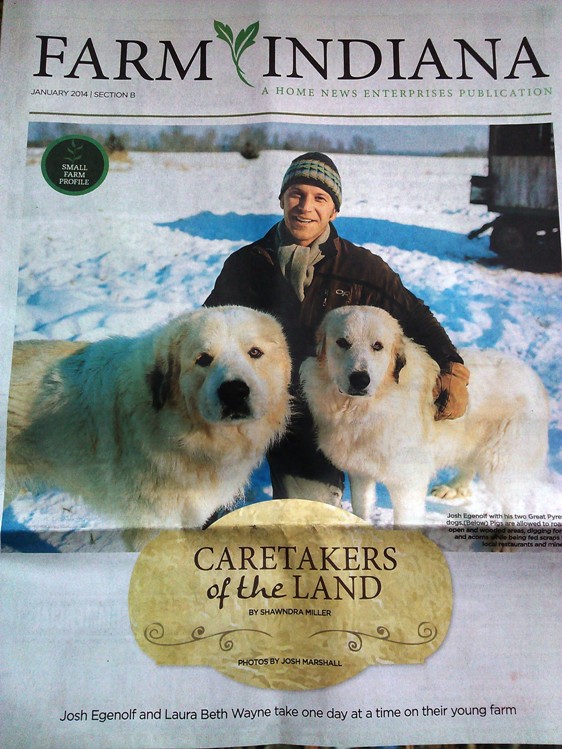
Cover page of my Farm Indiana profile of WE Farm

Dr. Lisa Harris remembers well the first conversation with the young man who would come to farm her land—they talked for hours, almost an entire day. “I was so impressed with how deliberate and thoughtful he was,” she told me.

Dr. Harris is Eskenazi Health’s medical director, a vegetarian with a lifelong interest in eating healthy food. As I learned when I wrote about WE Farm for Farm Indiana, she leases her Owen County property to Josh Egenolf and Laura Beth Wayne’s pastured beef cattle, poultry, and pork operation.

“Most people in the United States do eat meat,” she said. “So if I can be part of something that gives people access to meat from animals that have lived well, it seems like a perfect opportunity.”

Like many of us, Dr. Harris tries to live as lightly as possible, and Josh’s plans to make her land productive really spoke to that goal. “What Josh is doing,” she said, “is in every sense helping to improve the land.” WE Farm’s integrated, rotational grazing plan means the animals work in concert with nature to restore pastureland—all the while sequestering carbon and nitrogen in the soil.

The day I visited the farm last November in preparation for my Farm Indiana story, four happy dogs ran in front of the pickup truck as we drove up the lane to tend the livestock. Owen County is picturesque, with wooded hills and deep valleys. Josh showed me the steep woodlot where the hogs are periodically turned loose to forage for acorns and pawpaws. They also help him clear out understory invasives, just by doing what pigs do.

Breeder pigs enjoying their mineral rations on a frosty November morning.

Breeder pigs enjoying their mineral rations on a frosty November morning.

Josh was raised on a farm just a few miles up the road, and he treasures the richness of his a rural childhood. Giving that experience to his own child (and another on the way) is a big reason why he moved back to the area after pursuing his doctorate in ecology at the University of Georgia.

Also, he wanted to be put what he’d learned there into practice. Agriculture, he told me, has enormous potential for creating meaningful environmental change.

He said, “In 2007 I read The Omnivore’s Dilemma. Before that it never occurred to me that there might be anything troublesome about the way meat was produced, other than animal welfare stuff. That’s very clear to me…you shouldn’t treat your animals poorly. They need to be respected. But it didn’t occur to me that there was a single thing wrong with them eating grain and (even) industrial byproducts.”

He knows that many people still don’t realize the environmental and health issues that accompany feeding grain to meat animals, but a growing customer base tells him how many people value pastured meat. “It’s like an awakening that needs to happen.”

Josh and Laura Beth strive to keep the business as local as possible, keeping close to home in all their dealings. For more on their endeavors, check out my Farm Indiana story and the WE Farm website.

A Field to Fork Market

“In Indiana, we can grow so much of our own food. We really could be sustainable now,” says Kevin Logan, MD. Though we can’t grow mangoes or bananas, he believes we could cultivate everything we need for regional self-sufficiency.

INgredients Field to Fork Market, a new shop he opened in partnership with wife Jacqueline and old friend Tom Wiles, is exerting influence on both supply and demand. To stimulate the market for good clean food, the deli demonstrates how to use local produce like bok choy and spaghetti squash. Meanwhile the proprietors are coordinating with the many farmers and producers capable of feeding our region, in anticipation of the 2014 growing season.

I had the pleasure of talking with the three of them when I wrote this Nuvo piece on the store. It’s located in a refurbished Taco Bell, and full of items grown or produced in Indiana.

Pie pumpkins and gourds from local farmers at INgredients.

Pie pumpkins and gourds from local farmers at INgredients.

“I feel like we’re going to have to get back to community,” Logan says. “And food choices are one way that we do that.”

The trio plan to hold classes on every stage of food growing, storing, cooking, and preserving, to help people gain garden knowhow and kitchen skills. Both fermenting and cheese making classes are in the offing.

All in all this shop is a great addition to community resilience efforts in my town.

Crowd-funding the New Frontier: Radical Mycology

Here’s a chance to support a radical mycology project seeking to put a potent tool for restoration in many more hands. Mushrooms can break down and eliminate some of the most toxic industrial compounds in the world, representing enormous untapped potential for healing our beleaguered planet.

Not to mention the fact that mushrooms are a phenomenal source of protein, potentially boosting community-level food sovereignty.

Be part of this new frontier by funding this resource for would-be radical mycologists, and/or helping to spread the word!

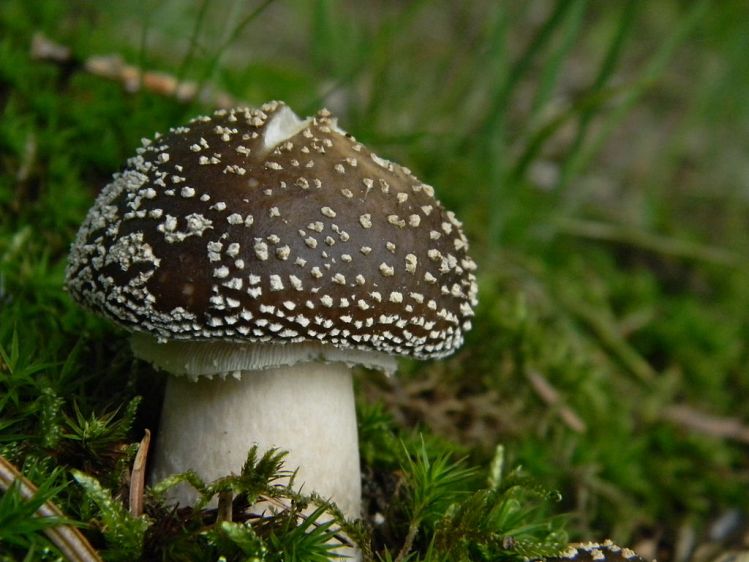
By Alaricmalabry (Own work), via Wikimedia Commons

By Alaricmalabry (Own work), via Wikimedia Commons

Below is a note from Peter McCoy, who recently contributed a guest post about the lessons mushrooms have taught him:

The Radical Mycology Book fundraiser is underway! This unique book on the uses of mushrooms and other fungi for personal, societal, and ecological wellbeing will be a powerful resource for the geek and do-gooder inside us all and we are excited to bring this dream to the rest of the world.

You can view the live campaign here:

http://bit.ly/radmycogogo

Whether or not you are in a position to donate, one of the most important contributions you can make would be getting more people aware of this fundraiser by emailing your friends and re-posting on your social (mycelial) networks.

Share the campaign on Facebook:
http://bit.ly/rmifbshare


Thank you so much for contributing to this project and vision!

Mush love!
Peter and The Radical Mycology Collective

Respite

I’m back from Mesa Refuge,* where I had 10 days to write, read, reflect, and draw inward. It was heavenly to leave the smartphone in a drawer for most of that time, and to let my social media accounts languish.

It was a time of exploration. I explored through my writing every day, starting early in the morning and working late into the night in my private writing shed. From this window I spied deer, quail, rabbits, hummingbirds, juncos, redtailed hawks, vultures, egrets, white pelicans, and many other waterbirds and songbirds I couldn’t identify.

My writing shed  overlooked a Tomales Bay tidal estuary, where San Andreas fault lies.

The shed overlooks a Tomales Bay tidal estuary. San Andreas fault runs through this wetland. Mesa Refuge is “a place for writing on the edge”–and this shed is situated on the edge of the North American Plate, looking across to the Pacific Plate.

I explored the nearby town of Point Reyes Station. Not one but two yoga studios serve the tiny populace, and the farmers market brings everyone out each Saturday.

Point Reyes Station Farmers Market

Point Reyes Station Farmers Market

And once I ventured out in a borrowed pickup truck to one of the many wild places near the refuge.

Path to Abbott's Lagoon, Point Reyes National Seashore

Path to Abbott’s Lagoon, Point Reyes National Seashore

This was one of my favorite days.

Abbott's Lagoon

Abbott’s Lagoon

I relished the solitude and quiet that are so rare in workaday life. It felt like a privilege.

Beyond Abbott's Lagoon: The Pacific.

Beyond Abbott’s Lagoon: The Pacific.

But there was conviviality along with the solitude. I spent many of the evenings in conversation with the brilliant writers who were in residence with me. In coming weeks I plan to feature each of these writers and their crucial work.

I also decided to spend some time sitting in nature each day, now that I’m home. Here in my city, the hummingbirds are long gone and there are no dramatic cliffs or hypnotic ocean waves, but the leaves are turning and the songbirds are still as vociferous as ever. Heartland beauty may be subtler than West Coast beauty, but it still fills me.

*Are you a nonfiction writer whose work touches on nature, economics, and social justice? I would encourage you to apply for a residency at Mesa Refuge. It is a phenomenal place to write.

Radical Fungi Are My Favorite Teachers

Guest Post by Peter McCoy

When I get asked why I started the Radical Mycology project, I often say that it was to share the lessons that mushrooms have taught me.

Turkey tail logs

Turkey tail logs

Since I started studying mushrooms as a teenager, I have always seen mycology (the study of fungal biology) as an endlessly fascinating and thought-provoking science. Whether I am using them as a nutritious food source or as a potent medicine, I am always honored to taste their wonderful flavors and alluring textures. Hunting mushrooms in the woods, I love to watch them grow, knowing that they are cleaning the forest soil, protecting plants from disease, and turning decaying matter into fresh topsoil so new plants can thrive.

And using them as remediators, I am awed by the mushrooms’ ability to break down and eliminate some of the most toxic industrial compounds in the world.

Grassroots Bioeremediation workshop with Leila Darwish at the Radical Mycology Convergence

Grassroots Bioremediation workshop with Leila Darwish at the Radical Mycology Convergence

Seeing how the densely branched mycelial networks of mushrooms share nutrients among plants, I also find a wonderful example for humans to follow when working to collaborate with their communities. Further, the incredible spore loads that mushrooms drop in the fall are designed to adapt to any given environment, demonstrating the ability to adjust to challenges and remain resilient during hard times.

These same attributes provide a model for how humans can best relate to each other, whether on a personal or societal level. By mimicking mushroom mycelium, cooperative businesses and housing projects work more efficiently by spreading out tasks and networking with affiliated organizations.

Fungi are also highly symbiotic with most organisms on the planet, so we find, yet again, the importance of collaboration among creatures throughout the fungal kingdom. In essence, fungi act in countless ways as grand harmonizers of the Earth, something that humans can aspire toward to live in balance with their surroundings.

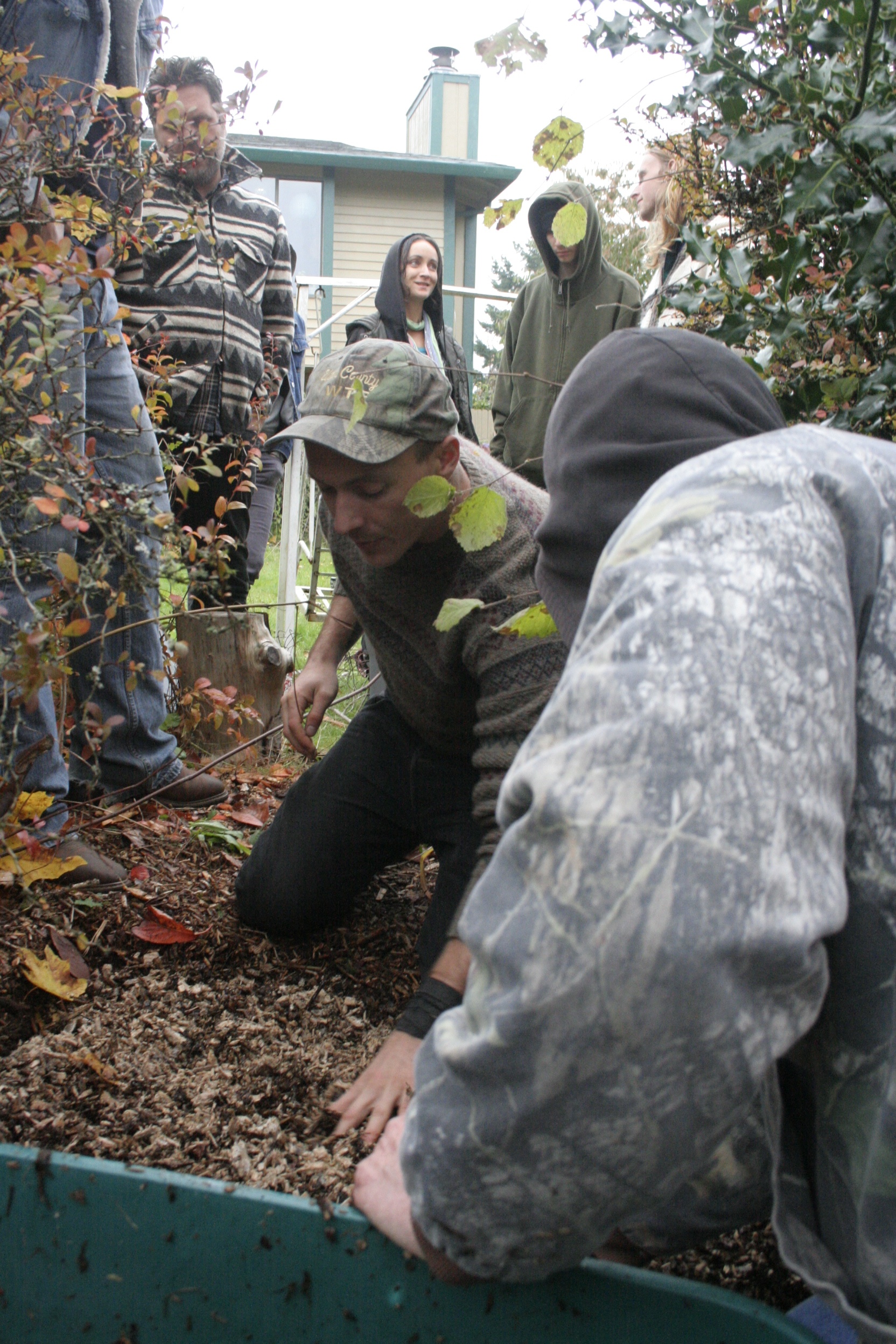
King Stropharia bed installation at Peter's Mushroom Cultivation & Application Course in Olympia, WA

King Stropharia bed installation at Peter’s Mushroom Cultivation & Application Course in Olympia, WA

The Radical Mycology project revolves around just this philosophy: that by studying, working with, and learning from the fungal kingdom, humans can best find solutions to problems of personal, societal, and ecological health. To this end Radical Mycology has put a lot of energy into providing free education to the public on the benefits of fungi.

Our website (radicalmycology.com) is a database of all things mycological. We offer two free publications we have written, Radical Mycology and Mushroom Cultivation For Remediation, as well as instructional videos and protocols for mushroom cultivation.

Nameko Bed installation at Demeter's Permaculture Garden in Olympia, WA

Nameko Bed installation at Demeter’s Permaculture Garden in Olympia, WA

We organize regular multi-day events on mushroom cultivation and its practical applications (the Radical Mycology Convergences), with another being planned for the spring of 2014. And since 2011, two Radical Mycology-inspired volunteer clubs have sprung up in San Francisco, CA and Olympia, WA. These groups teach free workshops about simple and practical mushroom cultivation and community resilience.

The next and biggest project for Radical Mycology is writing a book exploring the theory, practice, and applications of mushrooms for personal, societal, and ecological change. We are currently in the midst of an Indiegogo crowdfunding campaign to fund the book. Our campaign page will soon be up and running. Stop by the Radical Mycology website to learn more about our work.

Update: The Radical Mycology Book fundraiser is underway! This unique book on the uses of mushrooms and other fungi for personal, societal, and ecological wellbeing will be a powerful resource for the geek and do-gooder inside us all and we are excited to bring this dream to the rest of the world.

You can view the live campaign here:

http://bit.ly/radmycogogo

Postcard from Hopland, CA

This weekend was the big Building Resilient Communities Convergence in Hopland, CA. I was excited to be there for part of the action.

A highlight was the mycology skillshare, during which Fungaia Farm‘s Levon Durr demonstrated several methods for home mushroom cultivation.

Teaching how to cultivate oyster mushrooms at home using the stem butt/cardboard technique to grow your own spawn. Sweet!

I didn’t know until recently that shrooms actually are a source of protein. This makes me even more determined to try cultivating my own.

I thought Levon was going to levitate when he got to the part about mycoremediation. His enthusiasm is not misplaced: Mushrooms can clean petroleum from drainage ditches and aid in riparian zone restoration. They even eat heavy metals and bacteria.

The practice of using fungi to clean our beleaguered earth of toxins is one of the most hopeful stories I’ve heard. It is also the subject of an upcoming guest post from Radical Mycology, so stay tuned.