Vacant Lot Becomes Community Space

Guest post by Lisa Boyles

My vision is to give purpose to a vacant lot. Where once stood abandoned houses, there will be a reflection space with a labyrinth and a community art installation.

In June 2013, we brought light to this space on the longest day of the year with a circle gathering and a modified sun salutation series. The children at this gathering helped decorate a stepping stone for the labyrinth entrance.

Since the summer, various people have joined me at this lot on the Near Eastside of Indianapolis. We have prepared the ground, moved bricks, unloaded wood, and removed trees. It is enlivening to get in touch with the dirt and have ruddy cheeks from working so hard outside.
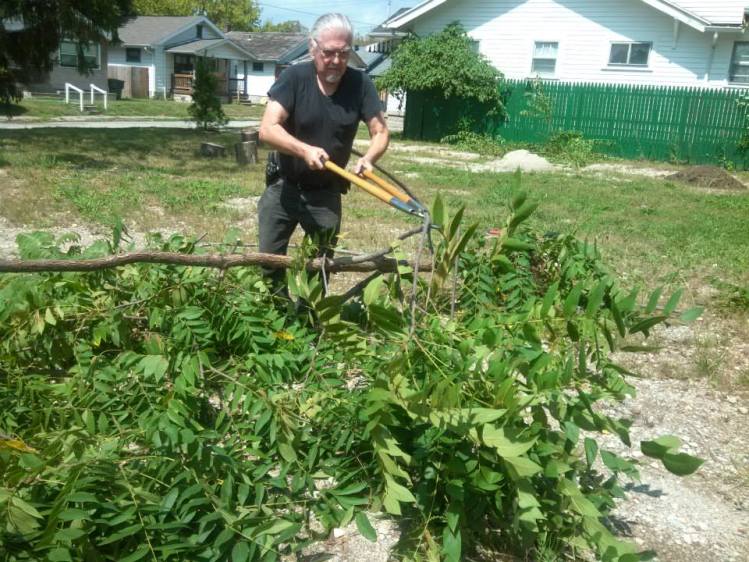
Gordon removing an invasive tree.

The transformation from empty lot to Rivoli Park Labyrinth is primarily funded through a community action grant from Peace Learning Center‘s Focus2020 initiative.

The vision of Focus2020 is to create an engaged and inclusive city. I was one of several grant awardees at the beginning of September. The collective effect of these grants will be seen throughout the city over the course of the next year. The Peace Learning Center offers workshops so that more people can become Focus 2020 graduates.
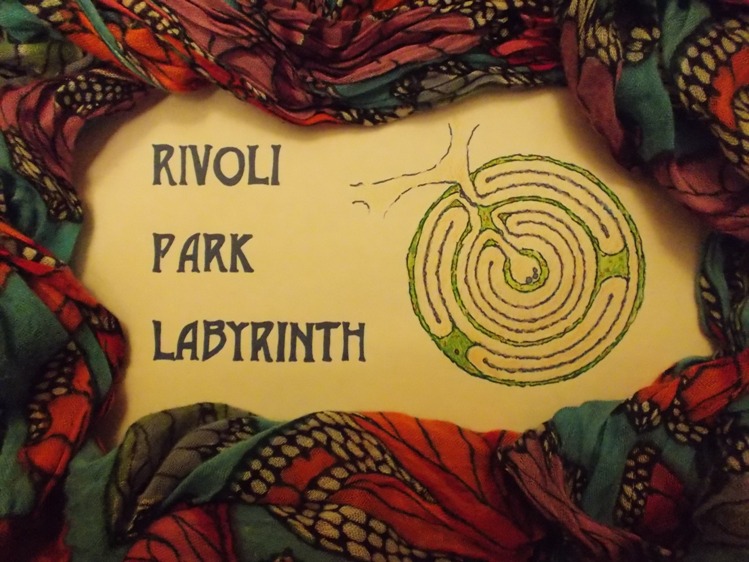
John Ridder of Paxworks: the Labyrinth Shop created the triune focus design of the Rivoli Park Labyrinth.  Logo by Susan Williams Boyles.

John Ridder of Paxworks: the Labyrinth Shop created the triune focus design of the Rivoli Park Labyrinth. Logo by Susan Williams Boyles.

The Rivoli Park Labyrinth project brings the international labyrinth movement to an urban neighborhood setting. Our space will be listed in the worldwide labyrinth locator, putting the eastside of Indianapolis on the labyrinth map.

To offset the often solitary nature of walking a labyrinth, this project also includes a healthy dose of community celebrations. For example, on May 3, 2014, we will celebrate World Labyrinth Day. And workdays at the site include a potluck to celebrate our growing community.
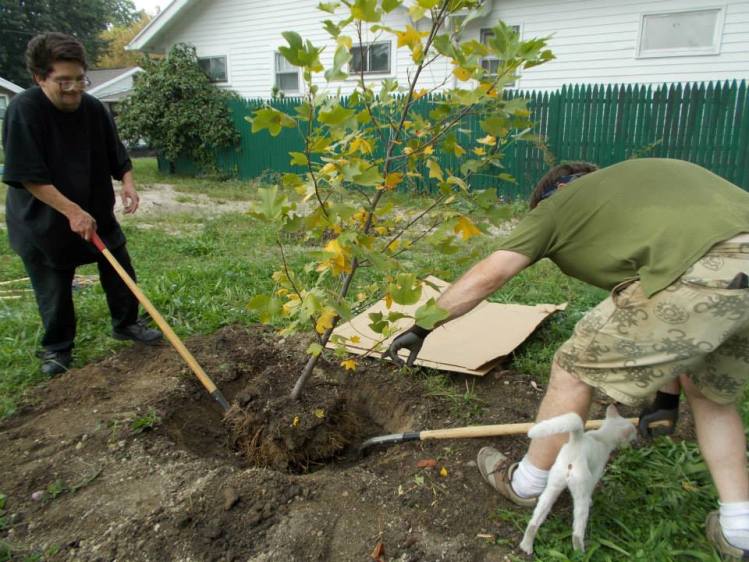
Aaron, James and the neighborhood cat moving a young tree to a new place to make room for the labyrinth.

Aaron, James and the neighborhood cat moving a young tree to make room for the winding path of the labyrinth.

Many partnerships are arising from this effort to give purpose to a vacant lot. One example of that synergy involves the documentation of the upcoming Oct. 10 workday (part of Indy Do Day). A KI EcoCenter videography intern is mentoring another young man that he met through this project. We can’t wait to see their collaborative videography of the workday, when volunteers will place bricks outlining the labyrinth path.

Meanwhile, the soil needs repairing and we plan to use hugelkultur to do it. We’ll mound soil and compost over woody debris and put our plantings on top of that mass. Permaculture designer Katherine Boyles Ogawa says, “Hugelkultur is an ideal method for urban lots where the soils are usually very compacted and often contaminated with heavy metals.”
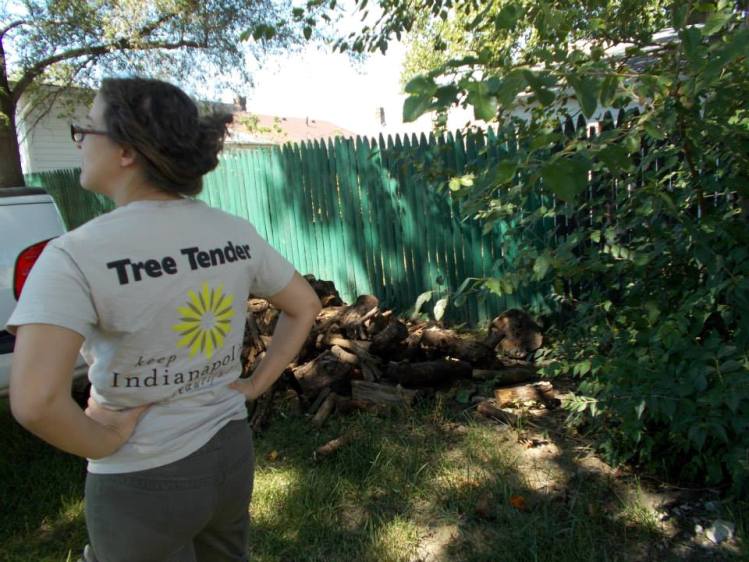
Permaculture designer Katherine supervises unloading of logs for hugelkultur.

Permaculture designer Katherine supervises unloading of logs for hugelkultur.

We hope to eventually make the space into a certified wildlife habitat through the National Wildlife Federation.

Another goal is to display artwork and illustrated quotes along the fence. Panels would be created by special education students at the nearby public school and the art group at Midtown Community Mental Health Center.
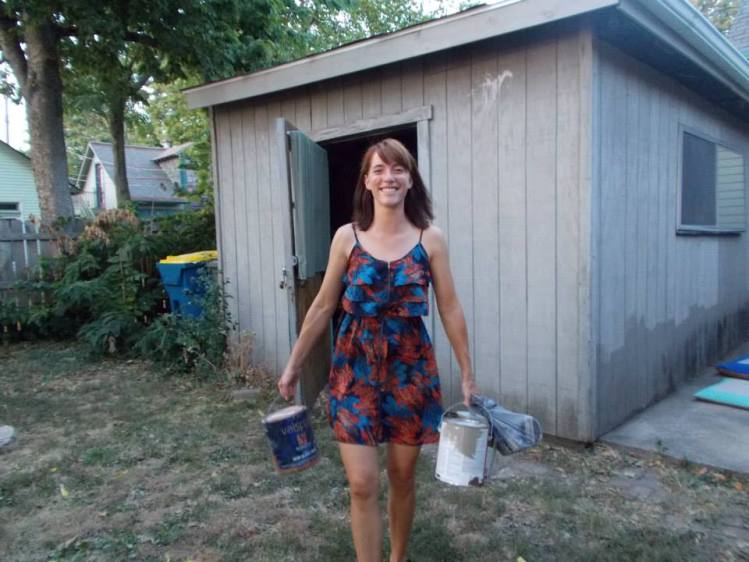
Sarah donating paint for the community art wall

Sarah, a fellow Focus 2020 workshop participant, donating paint for the community art wall.

The community art aspect of the project is being funded through this crowdsourcing site.

We would love to have you join us in celebrating a year of this project coming into being on the summer solstice, June 21, 2014.

Like the Rivoli Park Labyrinth Indianapolis Facebook page to see project news. Join the Rivoli Park Labyrinth community group to collaborate with others and be invited to the annual celebration. We will post monthly featurettes and more detailed updates on our blog.
Drawing the Line

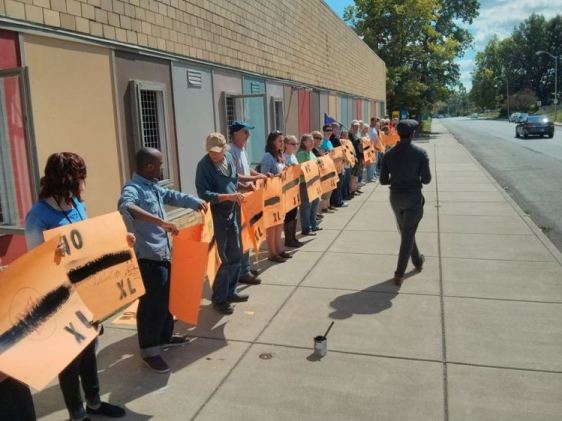
Saturday I took part in a local expression of a nationwide day of action, 350.org’s Draw the Line. About 40 of us came out to demonstrate resistance to the proposed Keystone XL pipeline.

KI EcoCenter hosted the Indy event in partnership with Earth Charter Indiana. These two stellar groups both work at the intersection of environmental, social, and economic concerns.

Photo by KI EcoCenter

Photo by KI EcoCenter

Alvin, one of the organizers, started us off with a wholistic assessment of what we were about: creating a new world, beyond the issue of the pipeline or tar sands or even fossil fuels.

“Keystone XL is a symbol of the past…We’re saying no, we want something different for our world,” Alvin said.

In the ensuing discussion, there was talk of reining in corporate greed, making companies pay the true cost of production, reforming the way election campaigns are financed, and other policy changes.

But many people brought up the need for internal as well as external shifts. How are we making the old reality obsolete by creating a new reality, as Buckminster Fuller advised?

Photo by KI EcoCenter

Photo by KI EcoCenter

Some of the insights:

We need to build a united movement that encompasses social justice, because climate change disproportionately affects the poorest of the poor. —Rosemary

We have to shift away from the value we put on money. Companies value money and profits more than our own lives. We have to focus on the intangible side of life, such as happiness that comes from having a healthy place to live. —Keenan

Photo by KI EcoCenter

Photo by KI EcoCenter

The problem stems from the idea of separation—that we’re separate from each other, separate from the earth, separate from the animals. But we are one. —Marion

We need to change the definition of the good life. —Tom

We need to take responsibility for what we carry within so we don’t pollute the world with negativity. Anything inside us that fears and hates is that which is in common with what is feared. It’s important to notice—because when you notice things, they lose power. —Phoebe

Photo by KI EcoCenter

Photo by KI EcoCenter

At the end of the discussion, we lined up outside the center with signs we had made, and a KI EcoCenter intern drew a black line across to represent our line in the (tar) sands.

Though I much prefer creating the new world to protesting what needs to fall away, I do believe it’s important to stand up and be counted. I’m glad Indy was represented in the movement, however small our number. And we didn’t stand alone. These photos of the line’s reach (into hundreds of cities, drawn by thousands of activists) at 350.org’s flickr stream are inspiring.

Indestructible

Here’s the mother of the modern environmental movement, on the importance of nurturing children’s connection with the natural world.

Boy scout photographing nature at the Edwin B. Forsythe National Wildlife Refuge. Photo credit: USFWS, via flickr Commons

Boy scout photographing nature at the Edwin B. Forsythe National Wildlife Refuge. Photo credit: USFWS, via flickr Commons

“If I had influence with the good fairy who is supposed to preside over the christening of all children

I should ask that her gift to each child in the world

be a sense of wonder so indestructible

that it would last throughout life,

as an unfailing antidote against the boredom and disenchantments of later years,

the sterile preoccupation with things that are artificial,

the alienation

from the sources of our strength.”

—Rachel Carson, The Sense of Wonder, 1956

From Dismemberment to Oneness

Rebecca Solnit, on how leprosy numbs the extremities so that sufferers don’t realize when they are damaging their own tissues:

“The disease strangles nerves, kills off feeling, and what you cannot feel you cannot take care of.”

She speaks of a kind of dismemberment, of patients who feel no pain, so they injure themselves, even blind themselves.

She quotes a missionary doctor: “One of the boys said to me, “My hands and feet don’t feel part of me. They are like tools I can use. But they aren’t really me. I can see them, but in my mind they are dead.'”

Reading, it struck me that this statement could also sum up the dominant cultural attitude toward our own earth home. Though we belong to her and she to us, for so long we’ve disowned her, exploiting her riches as just so many dead “resources.”

We’ve been operating under the delusion that we are separate from the biosphere and the myriad life forms that share it—and separate from each other too. The results are catastrophic. If we lack feeling for each other, the soil under our feet, the waters that flow, and the skies above, we won’t consider these worthwhile of care.

"Holding Hands," by Paige Shoemaker, via Flickr Creative Commons

“Holding Hands,” by Paige Shoemaker, via Flickr Creative Commons

But perhaps that’s changing now, bit by bit.

More and more of us are waking up to our empathetic selves. We’re feeling a kinship not just with other humans but with the earth herself. We’re re-membering our entire human family and our deep connection to the planet that holds us.

I think of the empathy displayed by Antoinette Tuff as she disarmed a young mentally ill man bent on violence in her school. In the midst of her fear, this bookkeeper found a way to connect with the young would-be shooter, seeing him as a hurting soul. Her ability to reach him on a human level may have averted a major tragedy.

Meanwhile, this summer a group has been tracing the route of the Keystone XL Pipeline in the Great Plains. The pipeline, as I posted in May, would allow the release of enormous levels of carbon—enough to create irreversible climate change.

Trans Canada Keystone Oil Pipeline, by shannonpatrick17, via Flickr Creative Commons

Trans Canada Keystone Oil Pipeline, by shannonpatrick17, via Flickr Creative Commons

Taking both a physical and a spiritual journey through the heart of North America, Compassionate Earth Walk aims to nourish the earth, while inviting all humans to return to oneness in the community of life.

From the story on Resilience.org:

“We walk in response to climate change and in gratitude for the earth which has given freely to us for so long. We walk as an act of healing both symbolic and literal, including healing of the walkers, the land, the communities impacted by the pipeline, and the whole human consciousness of separation.”

No more numbness. No more dismemberment. The pain of our suffering planet and fellow earthlings might be difficult to face, but feeling it means we’re awake. It means we can care.

A Beautiful Indebtedness

I’ve been reading Rebecca Solnit’s latest resonant book The Faraway Nearby, and every day there’s a new discovery—about writing, about alienation, about the uses of stories. This morning’s passage evoked the web of interrelatedness and care that can happen among neighbors and friends.

In the author’s case, a cancer diagnosis showed her how much goodwill she had banked. People came from everywhere to help her.

She reflects:

“Before money…people didn’t barter, but gave and received as needs and goods ebbed and flowed. They thereby incurred the indebtedness that bound them together, and reciprocated slowly, incompletely, in the ongoing transaction that is a community.”

In some parts of the world, surely this beautiful indebtedness is still the norm. In my neighborhood, it’s making a steady return, in many small ways.

Some intertwined examples from this past week: I put a call out for dill on the Facebook Neighbors Garden page, offering other herbs in exchange. I’d planted dill, but the black swallowtail caterpillars ate every single sprig of it.

Black swallowtail caterpillars happily chewing up my dill earlier this summer

Black swallowtail caterpillars enthusiastically chewing through my dill supply earlier this summer

I wasn’t too sad about the loss, knowing the beauty that would come of it—until I saw the enticing baby cucumbers at the farmers market and ended up buying three pounds’ worth. I wanted to make a crock of pickles.

Happily, Amy of Fraudulent Farmgirl fame offered her unused dill. Over the weekend I biked over to harvest some, using most of it for pickling and borscht.

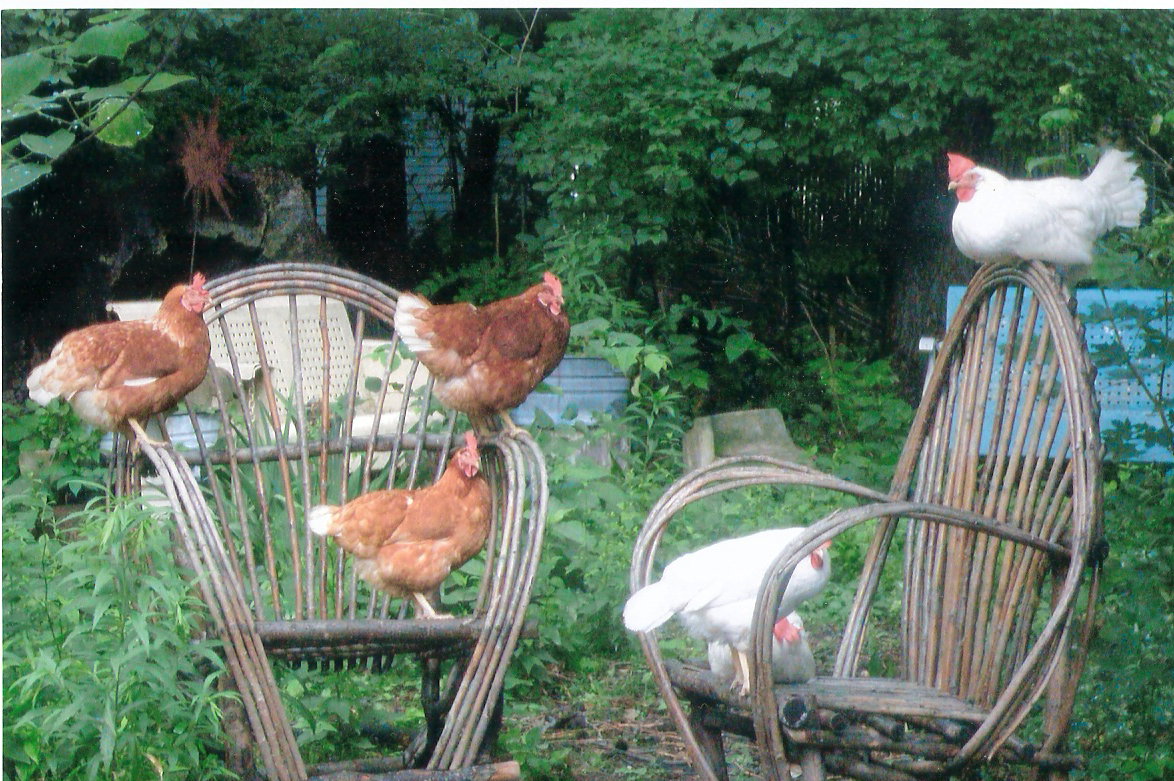
On that same bike trip, I stopped at Laura’s to unload some goodies on her hens. That morning I had cut back my severely cabbage worm-infested collards. I brought over the collard leaves, creepy crawlies and all, for the chickens‘ enjoyment. Laura sent me home with heirloom tomatoes and a photograph of the hens posing for a family portrait.

Laura's contented flock

Laura’s contented flock

Today Dawn Facebooked her own plea for dill, and since I had some left, I took it down to her house on my morning dog walk. Dawn put three things into a blue cloth bag of mine that was at her house from some earlier exchange. I came home with:

  • a salsa wrap made from her dehydrated tomatoes
  • grape juice from another neighbor’s unused Concord grapes (Dawn and I had picked the grapes Monday while catching up on life)
  • some maca powder, having mentioned in passing that I’d run out

I promptly put the maca in a green drink, the one I’m sipping right now. It also contains: frozen blueberries (brought back from Michigan by Anna), whey (received from Corinna down the street who makes her own Greek-style yogurt), lettuce (from farmers market), and kale (from my garden).

To add further depth to this web of connection: Laura was the source of my kale seedlings, a late-summer addition to my garden and currently the focal point of my daily worm-picking meditation. I no longer squish or stomp the worms while grimacing and/or squealing. I save them for Laura’s hens. The very hens that supply my eggs.

Writing this, I’m realizing my good fortune: my indebtedness extends even beyond my human neighbors.

What precious debts have you incurred in your community?

Book Offers a Vision of the Possible

I’ve had this book out from the library the past few weeks, but after test-driving it, I just emailed Kathleen at Bookmamas to ask her to order it for me. It’s a keeper. Here’s my review:

Wendy Tremayne’s The Good Life Lab: Radical Experiments in Hands-on Living gives a powerful example of a reimagined world in the shape of one couple’s desert homesteading adventures.

Prickly pear, an example of the desert bounty gathered by Tremayne. Photo by Jon Sullivan [Public domain], via Wikimedia Commons

Prickly pear, an example of the desert bounty gathered by Tremayne. Photo by Jon Sullivan [Public domain], via Wikimedia Commons

Many of us work toward self-sufficiency (or better, community-wide resilience, broadening the circle from homestead to neighborhood). But we’re hampered by the need to make money to prop up our lifestyles, cutting into the time we have to learn and practice new skills. Wendy and partner Mikey demonstrate what is possible by leaping into a completely new way of life. They cash out their retirement accounts (a prescient move, before the crash) and transplant themselves into Truth or Consequences, NM to build a new life.

And build they do: using waste materials and nature’s bounty, they craft a beautiful, abundant, interconnected home base that allows them to live their deepest values.

In contrast to some “green lifestyle” books that focus on giving up luxuries for the earth’s sake, this book offers an exuberant romp through the reclamation of life’s biggest gifts: time, beauty, creativity, connection, purpose. More than just a memoir, it is an invitation to adopt the “maker” mindset. Tremayne’s lyrical descriptions of the spiritual aspects of this journey, coupled with the gorgeous, whimsical artwork and photographs, make this an inspirational book.

The author (who founded Swap-O-Rama-Rama, a community-based textile repurposing/skill sharing extravaganza) observes, “When all of life is for sale, it is a revolutionary act to become a maker of things.” She describes “life in the waste stream” as the ultimate freedom.

“By relying on waste, on what nature provides, and on ourselves, we gave the world a chance to demonstrate abundance. By becoming makers of things, we let our creativity become a transformative link between the free materials available to us and the finished goods that made our lives better.”

She notes that mistakes are part of this process, and describes combatting the inevitable “I can’t do that” by simply taking the next step. For those of us who consider ourselves less than handy (ahem), the book offers both challenge and a roadmap. The last section, in fact, provides concrete steps toward reclaiming the building blocks of life, covering food, power generation, fuel, and shelter.

The physical book itself embodies the new world by its very design, in which art and joy and utility are married into a brilliant manifesto.

In short: Stop what you are doing and order one now from your local independent bookstore, people!

(Can’t wait till your book arrives? Hungry for more after reading it? Check out Wendy and Mikey’s blog at Holy Scrap.)

On Being Rooted

A summer memory: The question my dad asked me when he got home from work, if it had rained earlier in the day. “Did it rain hard enough to get wet under the trees?”

Always, the answer was a shrug. I didn’t have much patience for Dad’s concerns. Watering wilty plants, pulling weeds, noticing—those were his purview, not mine.

Now I find myself checking, whenever it rains, whether the earth is wet under the trees.

ChivesAnd when I come home from a week away, my eye is immediately drawn to what’s changed in the landscape. “Oh, the daylilies are blooming,” I might be heard to say, slowing to see orange blossoms in a neighbor’s flower bed. It’s the kind of comment that would have made roll my eyes in my youth.

It is different as an adult, living in one place for a long time. You come to feel an ownership not just of your yard but your entire street, the tree canopy above the neighborhood, the pavement, the dirt itself. Even if you don’t know all your neighbors, you smile at the faces you know, and regard warily those you don’t. You want the best for your little corner, so you pick up litter and throw it in the nearest receptacle, you pick up after your dog, you try to keep the storm drains free of debris.

At least that’s how it is with me and my neighborhood.

And my partner and I love where we live. We don’t plan to leave; we’ve settled in more and more each year. It’s true our yard has its limitations: We can’t keep ducks. We have only so much sunlight for our garden beds. We have no room to try hugelkultur.

But over the years, the source of our sustenance has expanded to include the broader community.

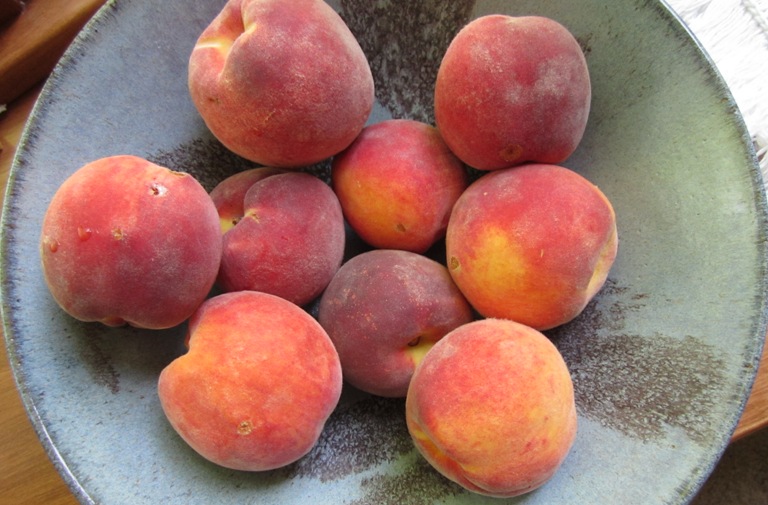
PeachesI buy eggs each week from a chicken-keeping neighbor, who also shares fruit from her orchard. Last year we tended a community garden, and this year we’re experimenting with straw bale gardening on a friend’s property. And one of my favorite activities is to forage for food along my street. I bring home salad greens and berries by the bucketful. (“Nature’s candy,” I hear my Dad’s voice saying, and sometimes say myself, gobbling mulberries.)

There’s a lovely rootedness to this life. I guess it’s possible to live for years in one place and never meet the neighbors, never put a hand into the soil, never sit outside. People drive into an attached garage and disappear into a house that serves as…what? a haven for the inner circle? a locus of entertainment? a fortress against the world?

That seems so sad to me, a kind of disembodiment—though I too appreciate a haven, crave entertainment, and need security. But to live only inside the house sounds like a terribly constrained existence, no matter what kind of diverting electronics are humming within its walls.

Dad used to spend every long summer evening outdoors puttering. It was a mystery what he did out there. As an adult I understand. He was tending, noticing, relating. Getting rooted.

Time to Touch the Earth

Over at the ever-inspiring Root Simple, there’s a great post extolling the virtues of going barefoot. Mrs. Homegrown, aka Kelly Coyne, decries the way we force our feet into little hard boxes instead of letting them directly mediate the surface below.

She offers steps for learning “fox walking.” It’s a form of mindful walking where your feet become your antennae.

I have a friend who does this intuitively. Recently when she and I picked strawberries together, she kicked off her shoes to navigate the strawberry patch–which was a veritable thicket of growth, with thistles poking up here and there. I did not join her in shoelessness, but I admired her mindful treading.

Here’s beloved poet Mary Oliver taking it even further:

Deep in the woods, I tried walking on all fours. I did it for an hour or so, through thickets, across a field, down to a cranberry bog. I don’t think anyone saw me! At the end, I was exhausted and sore, but I had seen the world from the level of the grasses, the first bursting growth of trees, declivities, lumps, slopes, rivulets, gashes, open spaces.

I was some slow old fox, wandering, breathing, hitching along, lying down finally at the edge of the bog, under the swirling rickrack of the trees.

—From “Staying Alive” in Blue Pastures

The swirling rickrack of the trees. I just love her.

I’m off for a much-needed woods ramble. My head is full of worries about desertification, GMOs, and the destruction of carbon sequestering peat bogs in Ireland. I need to step away and touch the earth.

Perhaps I will shuck my shoes. And if you see someone on her hands and knees, just blow a kiss and keep going.

Where We Rarely Dwell

In my quest to be an engaged citizen, urban homesteader, radical homemaker, contributor to household coffers, writer, etc., I can get trapped in a life of busyness. I have so many goals. My days are full of checking the clock as I push myself to be more productive, to mark things off my  lists. (Yes, I have more than one list.)

One week before I fell ill, I was advised to take some unscheduled time every week. I never got the chance to try this radical experiment—because soon I was pretty much glued to the couch, in a haze of pain and exhaustion, just trying to get through my days. And even then, chafing at all that was left undone.

My cat Maggie enjoyed the couch time immensely.

My cat Maggie enjoyed the couch time immensely.

This is a typical pattern for me—I have to be forced to slow down. I suspect it’s not uncommon in our hyperproductive Western culture, this need to be sick or injured before we grant ourselves rest.

So when I listened to intuitive Lee Harris‘s monthly energy forecast this week, and heard him talk about slowing down, I had to laugh—it was so on-target. He said we must stop rushing about and go inside the body, where we rarely dwell. We’re so stimulated all the time that we don’t really know our inner selves.

And that’s a loss.

I like to think I’m fairly good at this: after all, I’ve studied mindfulness meditation! I practice yoga! I’ve done all kinds of personal healing! Yet, the fast track always, always hooks me, and I give short shrift to my dreamy, drifty side—until I have no other choice.

Harris says, “The ‘driving masculine’ side is not what we are needing as a world anymore. We have been hearing this for years, but it’s hard for us to change the program.”

I guess that’s why it takes enforced couch time before I can stop being so terribly driven.

Recently on a Transition US call about creating new stories, one of the panelists said something powerful: That we get tripped up if we try to remake the world in the context of an old, outdated story—meaning looking through the lens of competition, judgment, conflict, scarcity, and domination.

I’m reminded of the wisdom feminist poet Audre Lorde offered years ago: “The master’s tools will never dismantle the master’s house.” She was referring to racism and homophobia in the women’s movement, but it applies here too. How can we transcend the dominant culture’s destructiveness if we’re working from that old script—if we are subjugating our inner knowing (available only in stillness) to this constant striving and acting?

Stillness

Stillness

How, though—this is always my dilemma—how do I get important work done without this driven side of myself? Is there a new way of being that allows both the focus to finish (so satisfying: to finish!) and the freedom to swim about, aimlessly dreaming?

Perhaps, instead of a driver archetype, I could assume the gardener archetype. Cultivate change instead of push it. Would that work? What do you think?