A Precious Gift

Still climbing Staph Hill here, so enjoy a perspective-giving passage from a book called Evolutionary Enlightenment while I recuperate.

“When you think objectively about how much work went into creating your own capacity to have the experience you are having in this very moment—fourteen billion years of hard work—then it might even begin to strike you as immoral to spend too much time sitting around and worrying about the fears and desires of your personal ego.

By ESA/Herschel/PACS/SPIRE/J [Public domain], via Wikimedia Commons

By ESA/Herschel/PACS/SPIRE/J [Public domain], via Wikimedia Commons

Surely the purpose of all that cosmic effort and creativity and positivity—from nothing to energy to light to matter to life to consciousness to you—could not possibly have been just for that.

When you awaken to the evolutionary process and its endless creativity, and you discover how profound and complex the structure of our universe is, you start to recognize and appreciate, at a soul level, what a precious gift it is to be here.

Andrew Cohen

“To Spend my Days Serving”

I’ve been felled by a Brown Recluse spider bite or possibly a boil-gone-bad (staph infection), and no I won’t share a photo of the wound. I wouldn’t inflict that on anyone–except my crazy herbalist, who delights in such things.

Being a little less mobile than usual has given me a chance to catch up on my reading, at least in theory. I have a whole trayful of publications and other reading material I never seem to get to, and on top of the pile was the March-April issue of Branches Magazine. Ironically, it was themed Best Medicine (as is the current issue). The very first piece stopped me cold. I wish I could link to it but the periodical does not maintain online versions of articles.

“The Best Medicine: Joyful Living” is a first-person essay by David Forsell, president of Keep Indianapolis Beautiful, an action-oriented powerhouse here in my hometown. Think tree plantings and neighborhood cleanups, communities given resources and support to beautify their surroundings. My little juneberry tree who lifted my spirits the day after the Boston bombings? It came from that organization.

Forsell has a rare form of cancer that is “slow but relentless,” and he recently recovered from his 13th surgery to remove yet another tumor. He writes of the example of his mother, who had the same illness, and the search for meaning in the midst of physical suffering. Awareness of his mortality, he writes, has spurred him to make the most of his limited and precious time.

And isn’t this something we all might keep in mind–the certainty of our death–to live a more meaningful life?

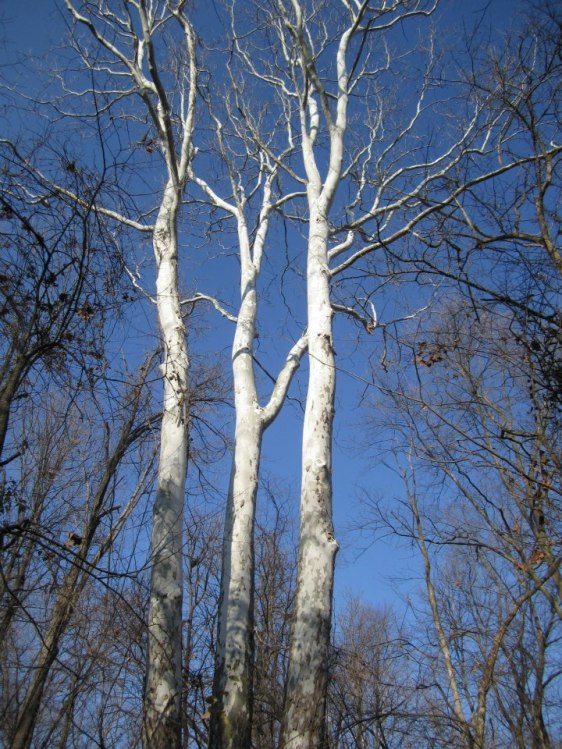
Sycamores in November

Sycamores in November

Forsell came to the Irvington Green Hour last summer to talk about trees with a bunch of us treehugger types, all of us concerned about the impact of the drought. I remember being struck by his authenticity and gentleness.

Here is a quote from this powerful essay:

“In more than two decades marked by surgeries and reminders of my mortality, I have realized I want to spend my days serving: having joy, and hoping I can help others have it too. I want to…heal that which is beautiful but broken or scarred or neglected or compromised in this world….”

He goes on to say that while he may not be able to stop the cancer, it is within his power to help heal the world.

There’s no greater gift than that.
Living Below the Line

My friend Cathy has been posting on Facebook this week about her experience participating in a challenge called Live Below the Line. For five days, she and her fundraising team are limiting what they spend on food to $1.50 a day.

The idea is to create awareness of the plight of 1.4 billion people all over the world who live in extreme poverty—people who must cover not just food but basic necessities with the equivalent of $1.50 per day.

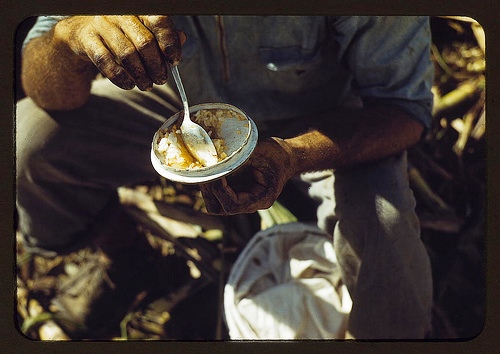
Rice in a lunch of plantation worker

Rice in a lunch of plantation worker

The Global Poverty Project is the organizer, and they’ve partnered with U.S. charities fighting hunger and poverty around the globe. My friend and her group have chosen to raise money for CARE.

According to the site, Live Below the Line is running in the US, UK, and Australia simultaneously, with more than 20,000 people participating.

Cathy reports that this is the second year she’s participated in the challenge. “I found it such a powerful experience that I did it again. The lack of choice and the mental aspect are far worse than the reality of the food itself or serious hunger.” Her Facebook posts show how the eye-opening experience can increase a sense of gratitude and compassion:

  • Today I cannot help on reflecting how easy my life is overall. I cooked the rice in the rice cooker after rinsing it with my filtered water that I had to walk nowhere to retrieve. I soaked my beans overnight in filtered water and then cooked them on my gas stove with the mere twist of my wrist required to turn it on…
  • I felt a bit hungry after lunch. I have to be conscious of how much I eat so that I do not run out. Yes, I am a tad ashamed to admit, I have threatened my family members not to dare touch any of my rice or beans. Imagine if so little actually had to feed my family.
  • Today I had minor obsessions with the bananas and yogurt, both appeared so enticing. It did make me think about those whose livelihoods depend on the fruit and vegetables they grow—but must sell in order to make the meager income they provide.

Having empathy with people in vastly different circumstances is surely one of the things that is going to save all of us. In Cathy’s words:

“I am humbled by how easy my life is, simply by virtue of where I was born. Unfair. This week is about experiencing, raising awareness, and helping fund hand-ups—not hand-outs. If you are so inclined, please donate to CARE.”

Birthing a New Story

Does it ever seem to you like an age of innocence is past? I’ve been thinking about this since reading Charles Eisenstein’s brilliant article, 2013: The Space Between Stories.

He describes a nostalgia for the cultural myth of his youth, “a world in which there was nothing wrong with soda pop, in which the Superbowl was important, in which the world’s greatest democracy was bringing democracy to the world, in which science was going to make life better and better. Life made sense.”

By Simon Q from United Kingdom (Rusting Sherman Hull Uploaded by High Contrast) via Wikimedia Commons

By Simon Q from United Kingdom (Rusting Sherman Hull Uploaded by High Contrast) via Wikimedia Commons

He talks about how we used to believe that the good folks in charge had things all under control, but of course it’s clear now that isn’t true. Our eyes are opening. We can’t ignore the perpetuation of global poverty and extreme inequity. We’re waking up, painfully, to the destruction wrought in the name of commerce and greed. We see that things are falling apart, and the institutions and experts we used to trust are not going to fix it.

And we can never get back to that old cultural story. We’re birthing the new story now, but we’re in a between-time. Our lack of shared cultural myth makes this a turbulent and often frightening time, with the extreme death throes of the old story showing us the worst of the worst.

Or that’s what Eisenstein thinks anyway, and it rings true for me.

Joanna Macy says it this way:

This is a dark time filled with suffering, as old systems and previous certainties come apart.

Like living cells in a larger body, we feel the trauma of our world. It is natural and even healthy that we do, for it shows we are still vitally linked in the web of life. So don’t be afraid of the grief you may feel, or of the anger or fear: these responses arise, not from some private pathology, but from the depths of our mutual belonging.

Bow to your pain for the world when it makes itself felt, and honor it as testimony to our interconnectedness.

So instead of running from our pain in this chaotic between-time, we can turn toward it, with compassion. We can grieve what’s passing away, mourn what’s lost to us forever. We can acknowledge the emotions that arise as we awaken, even the ones we’ve been taught are best kept locked down.

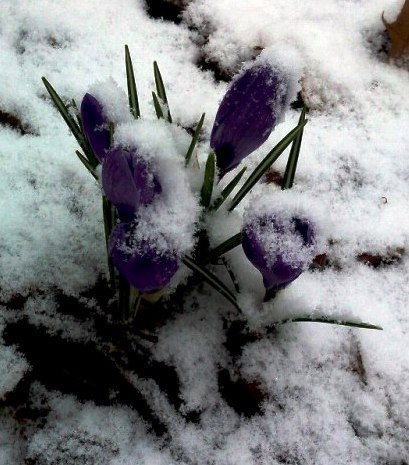
Crocus blooms under snow

Crocus blooms under snow

Instead of cutting off the feeling parts of ourselves, we can invite our whole selves to help dream the new story.

What story shall we create?

On Earth Day and Every Day

“The eyes of the future are looking back at us and they are praying for us to see beyond our own time. They are kneeling with clasped hands that we might act with restraint, leaving room for the life that is destined to come.

We have it within our power to create merciful acts.”

— naturalist and author Terry Tempest Williams

Cheselden_t36_prayer(Thanks to Orion Kriegman of Jamaica Plain New Economy Transition for bringing this quote by one of my favorite authors to my attention.)

Toward a More Mindful and Resilient Country

A friend recommended the book A Mindful Nation, by U.S. Congressman Tim Ryan, and I’ve just begun to browse through it. As a student of mindfulness practices, I’m curious how a politician applies these precepts to our national life. Here’s a powerful passage from the first chapter:

Let’s get rid of the phony concept of an America based on materialism, consumerism, and looking out for number one, where financial chicanery is our proudest accomplishment to show the world…

There is no dignity in the idea that anything worthwhile has to be purchased.

It shouldn’t be all that difficult to get us to move beyond this ethos, given how unhappy Americans have become.

If we slow down and find some space away from the daily chatter that tells us how to think, who to be, and what to buy, we can discover our capacity for resilience.

Ryan equates resilience with values like:

  • self-reliance
  • diligence
  • frugality
  • pragmatism
  • hard work
  • innovation
  • community
Pioneer Days. Photo from US National Archives

Pioneer Days. Photo from US National Archives

He calls these, somewhat nostalgically, “the values that made this country great.”

I tend to think more in terms of global citizenry myself, but I think his patriotic slant will have wide appeal, and he does have a point about the hollowness of much of our current national character. Why, he asks, do we collectively rise to the occasion of caring and compassion only in moments of great crisis, such as during and immediately after 9/11? Can we bring this generosity of spirit to our everyday lives?

Ryan believes that a good starting point lies in each of us addressing our personal fears and doubts through the simple practice of paying attention.

I’m curious about this. So let me ask: What place does mindfulness have in your life and work? What place should it have in our national life? And do you think individually bringing kindness to the present moment can change a nation for the better?