A Whole World Alive

I recently heard Michael Pollan speaking on NPR’s Science Friday show about research into plants’ intelligence. He revealed how mycelium (the vegetative part of fungus) figures into communications among the trees of a forest. (We learned about mycelium earlier in Peter McCoy’s guest post on radical mycology.)

Hyphae (branches of the mycelium) as seen under an overturned log. Photo by TheAlphaWolf (Own work), via Wikimedia Commons

Hyphae (branches of the mycelium) as seen under an overturned log. Photo by TheAlphaWolf (Own work), via Wikimedia Commons

Pollan said:

“The trees in a fir forest are networked, in a very complicated network, held together by the mycelium of mycorrhizal fungi, connect(ing) all the trees in a fir forest. A scientist in British Colombia named Suzanne Simard has studied this. She injects a fir tree with radioactive carbon isotopes, and then using a geiger counter and other devices follows the trail of that carbon.

And what she’s found is astounding! All the trees are connected. They use that network to send information, such as warnings of insect attack. They use that network to send nutrients to their offspring…They can even use that network to trade nutrients with other species…”

Isn’t that miraculous? And I suspect that—as the Wendell Berry quote in my previous post implied—everyone and everything, everywhere, might be invisibly interconnected in a similar way.

If this is true, what harms one, harms all. What uplifts one, uplifts all.

Is this possible? Perhaps. On an energetic level. What I’m talking about is rising above the zero sum game that’s so indoctrinated in us. Making space to see that without all of us being OK, none of us are OK.

We lack instruments fine enough to fully measure the energy field surrounding us (and surrounding every natural thing, every boulder and ant and trout and evergreen, every human and tulip and mountain). But I believe that through this field we have an impact on each other, on the whole of life, every moment we live, whether we know it or not.

It isn’t possible to live apart from each other. Not truly. The web of life knits us one to another, even if we are unaware of its strands.
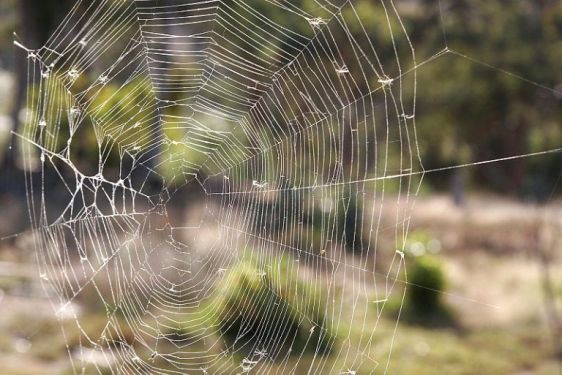
Photo by Fir0002/Flagstaffotos, via Wikimedia Commons.

Photo by Fir0002/Flagstaffotos, via Wikimedia Commons.

The ancient sages say that if you pull one thread in the web, the others vibrate.

Quantum physics … the mycelium … the Internet even—all are outer manifestations of this esoteric truth.

For a while now I’ve taken a few moments every morning to ground myself, feeling and seeing my “roots” going deep into the earth. Lately I find myself connecting not just vertically but horizontally, under the earth’s surface, with the mycelium.

There’s a whole world alive under our feet that we don’t usually see. So it is with our energetic world.
Crowd-funding the New Frontier: Radical Mycology

Here’s a chance to support a radical mycology project seeking to put a potent tool for restoration in many more hands. Mushrooms can break down and eliminate some of the most toxic industrial compounds in the world, representing enormous untapped potential for healing our beleaguered planet.

Not to mention the fact that mushrooms are a phenomenal source of protein, potentially boosting community-level food sovereignty.

Be part of this new frontier by funding this resource for would-be radical mycologists, and/or helping to spread the word!

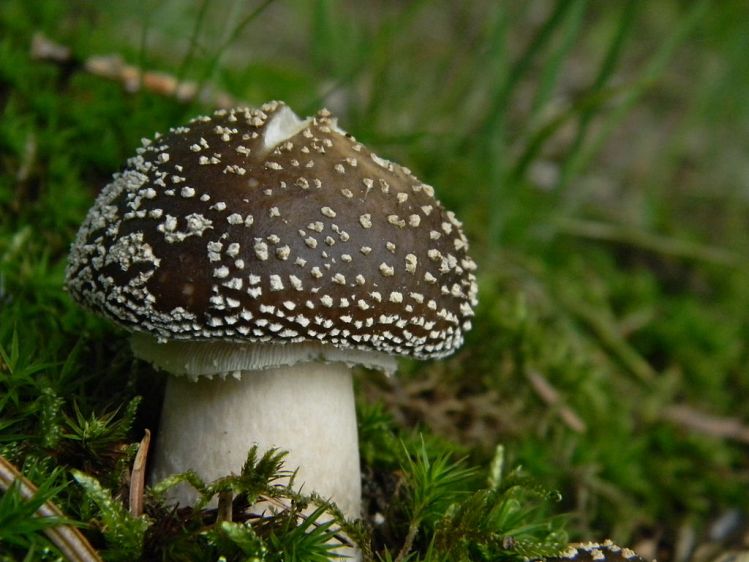
By Alaricmalabry (Own work), via Wikimedia Commons

By Alaricmalabry (Own work), via Wikimedia Commons

Below is a note from Peter McCoy, who recently contributed a guest post about the lessons mushrooms have taught him:

The Radical Mycology Book fundraiser is underway! This unique book on the uses of mushrooms and other fungi for personal, societal, and ecological wellbeing will be a powerful resource for the geek and do-gooder inside us all and we are excited to bring this dream to the rest of the world.

You can view the live campaign here:

http://bit.ly/radmycogogo

Whether or not you are in a position to donate, one of the most important contributions you can make would be getting more people aware of this fundraiser by emailing your friends and re-posting on your social (mycelial) networks.

Share the campaign on Facebook:
http://bit.ly/rmifbshare


Thank you so much for contributing to this project and vision!

Mush love!
Peter and The Radical Mycology Collective

Radical Fungi Are My Favorite Teachers

Guest Post by Peter McCoy

When I get asked why I started the Radical Mycology project, I often say that it was to share the lessons that mushrooms have taught me.

Turkey tail logs

Turkey tail logs

Since I started studying mushrooms as a teenager, I have always seen mycology (the study of fungal biology) as an endlessly fascinating and thought-provoking science. Whether I am using them as a nutritious food source or as a potent medicine, I am always honored to taste their wonderful flavors and alluring textures. Hunting mushrooms in the woods, I love to watch them grow, knowing that they are cleaning the forest soil, protecting plants from disease, and turning decaying matter into fresh topsoil so new plants can thrive.

And using them as remediators, I am awed by the mushrooms’ ability to break down and eliminate some of the most toxic industrial compounds in the world.

Grassroots Bioeremediation workshop with Leila Darwish at the Radical Mycology Convergence

Grassroots Bioremediation workshop with Leila Darwish at the Radical Mycology Convergence

Seeing how the densely branched mycelial networks of mushrooms share nutrients among plants, I also find a wonderful example for humans to follow when working to collaborate with their communities. Further, the incredible spore loads that mushrooms drop in the fall are designed to adapt to any given environment, demonstrating the ability to adjust to challenges and remain resilient during hard times.

These same attributes provide a model for how humans can best relate to each other, whether on a personal or societal level. By mimicking mushroom mycelium, cooperative businesses and housing projects work more efficiently by spreading out tasks and networking with affiliated organizations.

Fungi are also highly symbiotic with most organisms on the planet, so we find, yet again, the importance of collaboration among creatures throughout the fungal kingdom. In essence, fungi act in countless ways as grand harmonizers of the Earth, something that humans can aspire toward to live in balance with their surroundings.

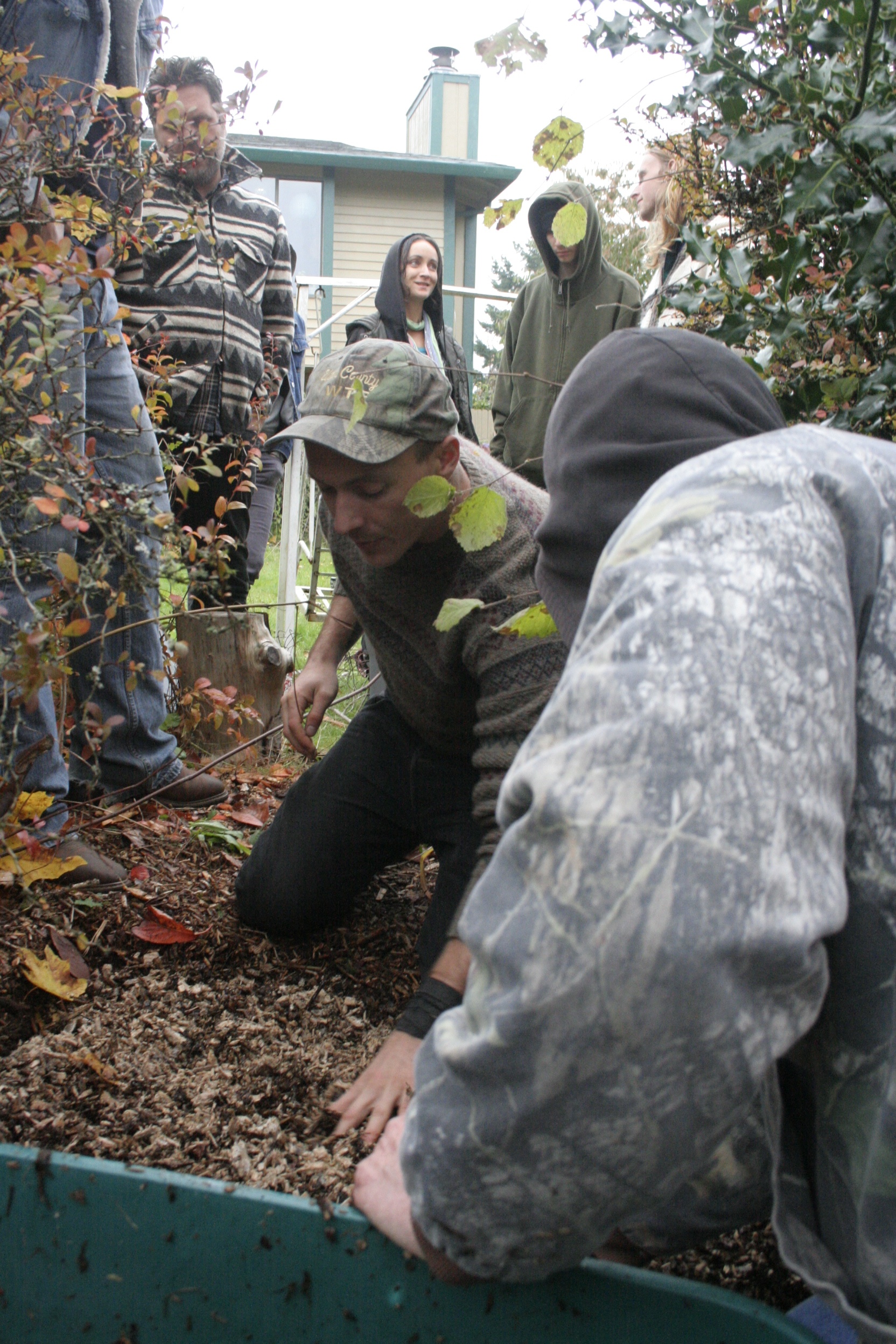
King Stropharia bed installation at Peter's Mushroom Cultivation & Application Course in Olympia, WA

King Stropharia bed installation at Peter’s Mushroom Cultivation & Application Course in Olympia, WA

The Radical Mycology project revolves around just this philosophy: that by studying, working with, and learning from the fungal kingdom, humans can best find solutions to problems of personal, societal, and ecological health. To this end Radical Mycology has put a lot of energy into providing free education to the public on the benefits of fungi.

Our website (radicalmycology.com) is a database of all things mycological. We offer two free publications we have written, Radical Mycology and Mushroom Cultivation For Remediation, as well as instructional videos and protocols for mushroom cultivation.

Nameko Bed installation at Demeter's Permaculture Garden in Olympia, WA

Nameko Bed installation at Demeter’s Permaculture Garden in Olympia, WA

We organize regular multi-day events on mushroom cultivation and its practical applications (the Radical Mycology Convergences), with another being planned for the spring of 2014. And since 2011, two Radical Mycology-inspired volunteer clubs have sprung up in San Francisco, CA and Olympia, WA. These groups teach free workshops about simple and practical mushroom cultivation and community resilience.

The next and biggest project for Radical Mycology is writing a book exploring the theory, practice, and applications of mushrooms for personal, societal, and ecological change. We are currently in the midst of an Indiegogo crowdfunding campaign to fund the book. Our campaign page will soon be up and running. Stop by the Radical Mycology website to learn more about our work.

Update: The Radical Mycology Book fundraiser is underway! This unique book on the uses of mushrooms and other fungi for personal, societal, and ecological wellbeing will be a powerful resource for the geek and do-gooder inside us all and we are excited to bring this dream to the rest of the world.

You can view the live campaign here:

http://bit.ly/radmycogogo

Postcard from Hopland, CA

This weekend was the big Building Resilient Communities Convergence in Hopland, CA. I was excited to be there for part of the action.

A highlight was the mycology skillshare, during which Fungaia Farm‘s Levon Durr demonstrated several methods for home mushroom cultivation.

Teaching how to cultivate oyster mushrooms at home using the stem butt/cardboard technique to grow your own spawn. Sweet!

I didn’t know until recently that shrooms actually are a source of protein. This makes me even more determined to try cultivating my own.

I thought Levon was going to levitate when he got to the part about mycoremediation. His enthusiasm is not misplaced: Mushrooms can clean petroleum from drainage ditches and aid in riparian zone restoration. They even eat heavy metals and bacteria.

The practice of using fungi to clean our beleaguered earth of toxins is one of the most hopeful stories I’ve heard. It is also the subject of an upcoming guest post from Radical Mycology, so stay tuned.