Vacant Lot Becomes Community Space

Guest post by Lisa Boyles

My vision is to give purpose to a vacant lot. Where once stood abandoned houses, there will be a reflection space with a labyrinth and a community art installation.

In June 2013, we brought light to this space on the longest day of the year with a circle gathering and a modified sun salutation series. The children at this gathering helped decorate a stepping stone for the labyrinth entrance.

Since the summer, various people have joined me at this lot on the Near Eastside of Indianapolis. We have prepared the ground, moved bricks, unloaded wood, and removed trees. It is enlivening to get in touch with the dirt and have ruddy cheeks from working so hard outside.
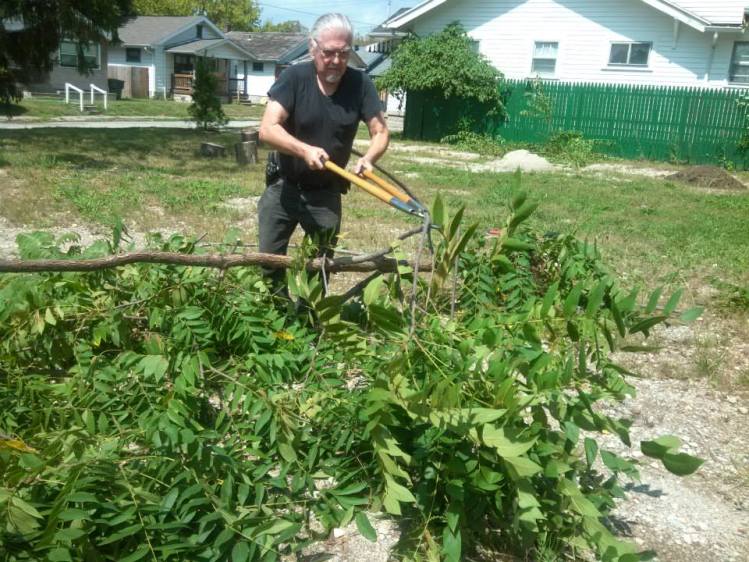
Gordon removing an invasive tree.

The transformation from empty lot to Rivoli Park Labyrinth is primarily funded through a community action grant from Peace Learning Center‘s Focus2020 initiative.

The vision of Focus2020 is to create an engaged and inclusive city. I was one of several grant awardees at the beginning of September. The collective effect of these grants will be seen throughout the city over the course of the next year. The Peace Learning Center offers workshops so that more people can become Focus 2020 graduates.
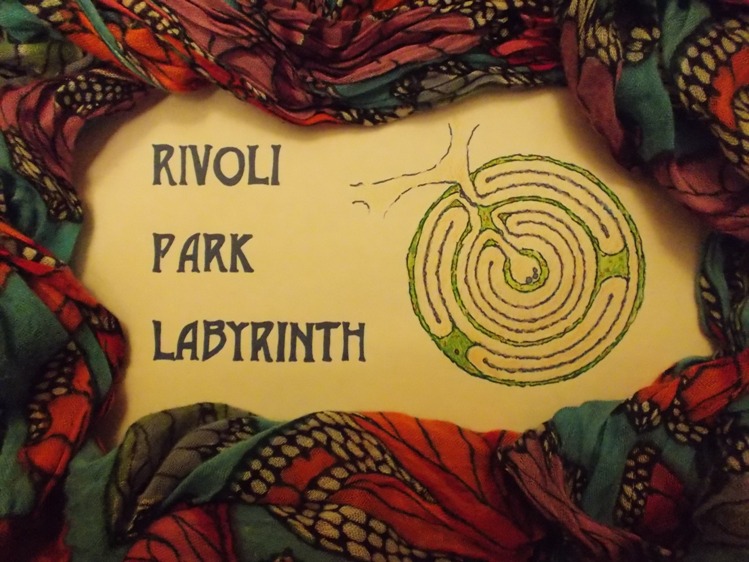
John Ridder of Paxworks: the Labyrinth Shop created the triune focus design of the Rivoli Park Labyrinth.  Logo by Susan Williams Boyles.

John Ridder of Paxworks: the Labyrinth Shop created the triune focus design of the Rivoli Park Labyrinth. Logo by Susan Williams Boyles.

The Rivoli Park Labyrinth project brings the international labyrinth movement to an urban neighborhood setting. Our space will be listed in the worldwide labyrinth locator, putting the eastside of Indianapolis on the labyrinth map.

To offset the often solitary nature of walking a labyrinth, this project also includes a healthy dose of community celebrations. For example, on May 3, 2014, we will celebrate World Labyrinth Day. And workdays at the site include a potluck to celebrate our growing community.
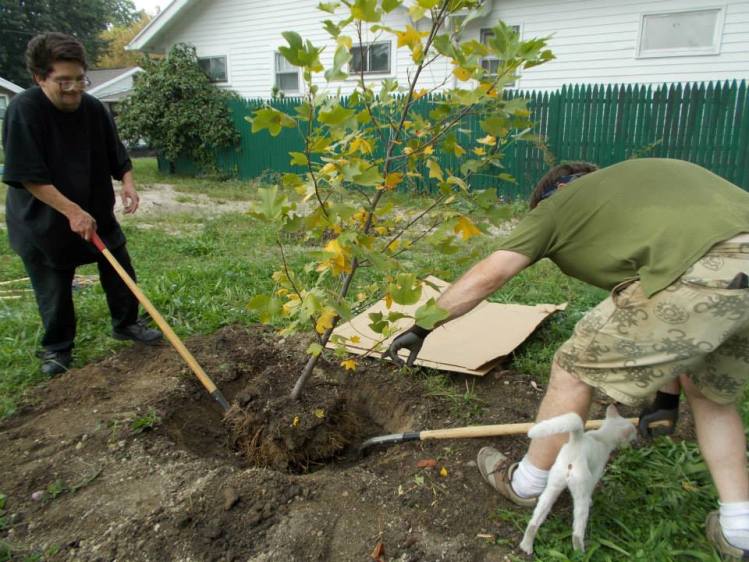
Aaron, James and the neighborhood cat moving a young tree to a new place to make room for the labyrinth.

Aaron, James and the neighborhood cat moving a young tree to make room for the winding path of the labyrinth.

Many partnerships are arising from this effort to give purpose to a vacant lot. One example of that synergy involves the documentation of the upcoming Oct. 10 workday (part of Indy Do Day). A KI EcoCenter videography intern is mentoring another young man that he met through this project. We can’t wait to see their collaborative videography of the workday, when volunteers will place bricks outlining the labyrinth path.

Meanwhile, the soil needs repairing and we plan to use hugelkultur to do it. We’ll mound soil and compost over woody debris and put our plantings on top of that mass. Permaculture designer Katherine Boyles Ogawa says, “Hugelkultur is an ideal method for urban lots where the soils are usually very compacted and often contaminated with heavy metals.”
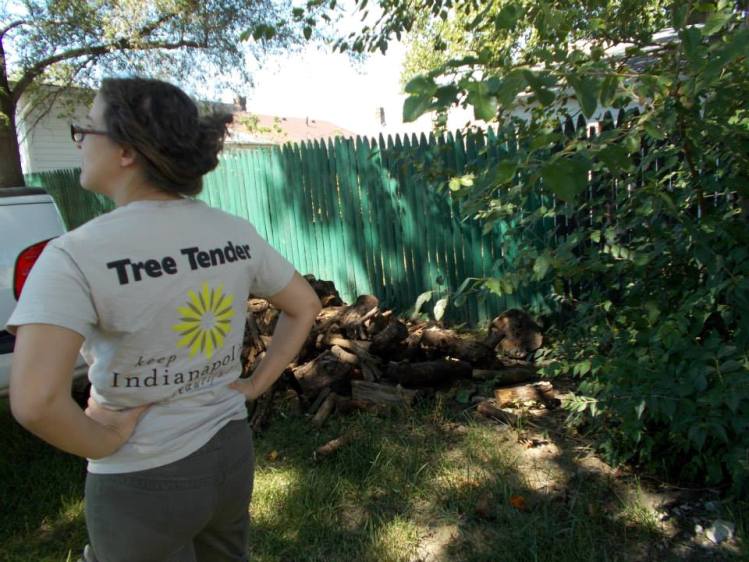
Permaculture designer Katherine supervises unloading of logs for hugelkultur.

Permaculture designer Katherine supervises unloading of logs for hugelkultur.

We hope to eventually make the space into a certified wildlife habitat through the National Wildlife Federation.

Another goal is to display artwork and illustrated quotes along the fence. Panels would be created by special education students at the nearby public school and the art group at Midtown Community Mental Health Center.
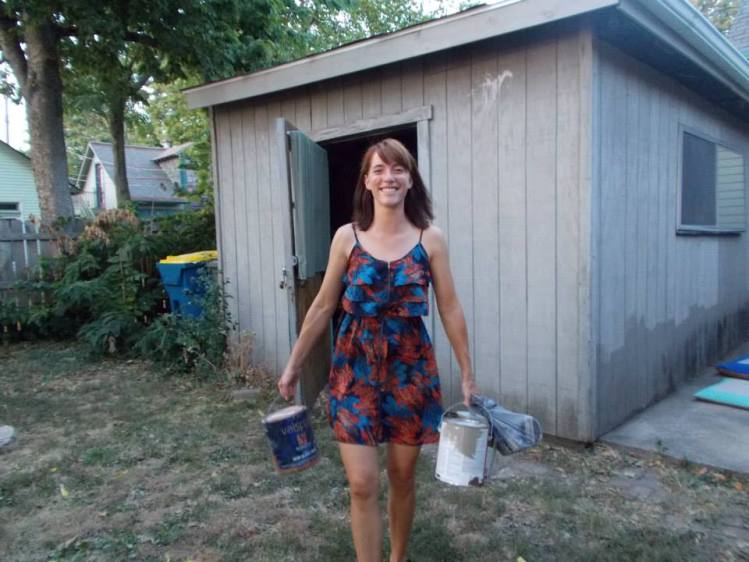
Sarah donating paint for the community art wall

Sarah, a fellow Focus 2020 workshop participant, donating paint for the community art wall.

The community art aspect of the project is being funded through this crowdsourcing site.

We would love to have you join us in celebrating a year of this project coming into being on the summer solstice, June 21, 2014.

Like the Rivoli Park Labyrinth Indianapolis Facebook page to see project news. Join the Rivoli Park Labyrinth community group to collaborate with others and be invited to the annual celebration. We will post monthly featurettes and more detailed updates on our blog.

Garden Tower Update: Mistakes Were Made

Time for an update on our vertical gardening project. When last I posted about the Garden Tower, everything was growing robustly and looking smart.

I hate to say it, but that was kind of the high point of the season. The plants have not grown as vigorously as I’d hoped since that photo session.

Our Garden Tower in mid-September: Not bad but not great. And this is its good side.

Our Garden Tower in mid-September: Not bad but not great. And this is its good side.

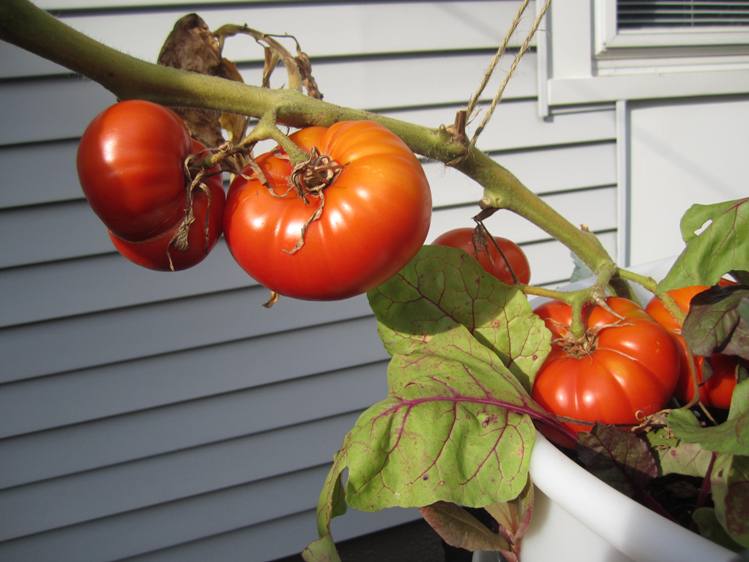
Today there are five tomatoes just about ready to pick, but the plant looks pitiful. I cut off most of the grim stuff a few weeks ago.

Not sure what kind of maters these are; the plant was a sucker from a friend's tomato patch, and she didn't label it.

Not sure what kind of maters these are; the plant was a sucker from a friend’s tomato patch, and she didn’t label it.

On the bright side, we’ve had several cucumbers, as well as snippings of basil, parsley, and kale. I’ve also harvested a few small beets from the top (with lovely greens)—and more are still growing.

The peppers have produced some sad little specimens, but then again we didn’t expect much, having planted them so late in the summer. I was excited to see peas and green beans, till I realized that the yield was going to be quite lean, barely a handful each. I guess one would need to plant almost a whole tower of legumes to get a “crop.”

Sadly the plants have just not grown very robustly. But the Tower setup isn’t to blame. My mistakes:

  • I planted immediately after filling the barrel with the soil mixture. When I watered everything in, the soil sank a couple inches. This caused the plantings in the side holes to become quite leggy as they reached for sunlight. In retrospect, I probably should have watered well first, allowed everything to settle, and then planted. That might have given them a better start.

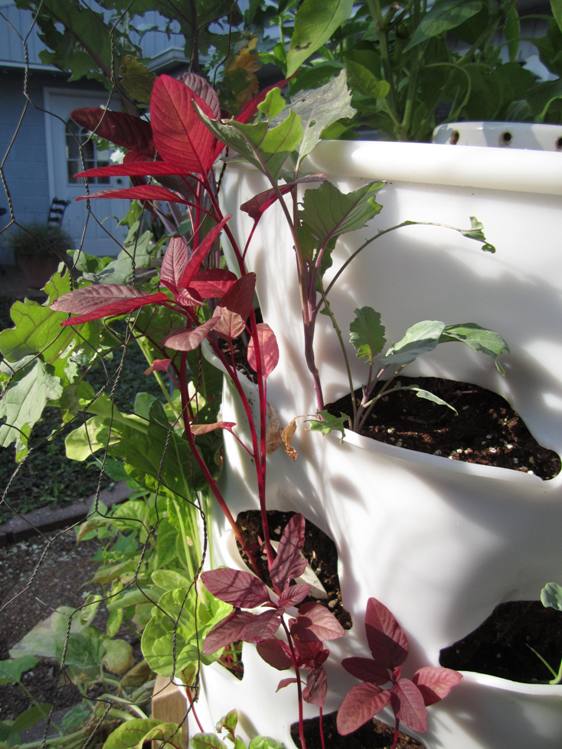
    Leggy amaranth and kohlrabi

    Leggy amaranth and kohlrabi

  • I neglected to apply the weekly liquid fertilizer suggested by the literature that came with the barrel. Said literature was buried on my desk until recently. Oops. (After the first month this is supposed to be unnecessary as the worms do their work. But I imagine that fertilizing during those first crucial weeks would have given the plants a needed boost.)
  • I overcrowded the side pockets, planting more than one seed. I told myself I would remove all but the strongest seedling later, and I did some thinning, but not nearly enough. I just didn’t have the heart to do it. I bet they would have grown bigger with less competition.

    Overcrowded chard

    Overcrowded chard

  • I overfilled the center tube with veggie scraps at the very beginning: In my excitement over this new worm farming adventure, I filled it to the top instead of to the suggested one-third level. I don’t know if this was a factor or not. (We’ll see how it goes when we harvest worm castings!)

One point of pride: my daily hand picking of cabbage worms at the height of their infestation seems to have saved my kale plants. However, it was too late for the kohlrabi and cabbages, which have not progressed beyond seedling size. I’m told that an application of Bt and some ladybugs would eliminate these little munchers, so we’ll keep that in mind for next year.

It may have been another misstep to mix our compost into the potting soil, given how much trouble we’ve had with diseases in our tomato plants. I hated to see the tomato transplant succumb to the same yellowing and crispy leaves we’ve had the last several years in our regular beds. But: no blossom end rot; the tomatoes themselves are so far looking luscious.

We can’t do anything about the soil, short of dumping it out and starting over, and I’m not willing to do that. But the other issues are all learning points for the next growing season. With gardeners, it’s all about next year!

My Day at School

Yesterday I drove down to Bloomington to spend part of the day with my homeschooling coop friends. These two families use homesteading activities as the basis for their children’s learning, along with traditional math workbooks, writing assignments and the like.

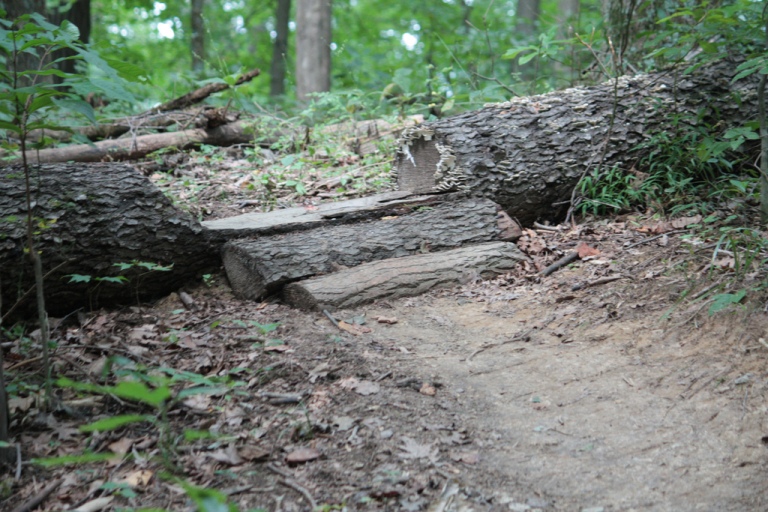
The task of the morning was to prepare cedar limbs to build a spit for cookpots over a campfire. The previous week, the kids had cut branches off the cedar tree, with a goal of being able to climb it. They’d christened it Fort Cicada.

Climbing ropes and nubs of branches make it easier to scale Fort Cicada.

Climbing ropes and nubs of branches make it easier to scale Fort Cicada.

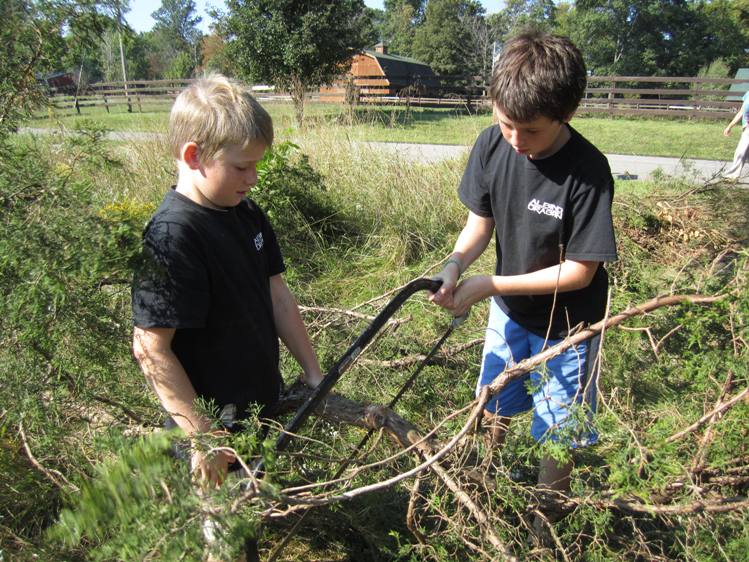
The brushy limbs now needed to be trimmed and the bark removed with a draw knife. The kids coached me on sawing. I can’t remember the last time I sawed something. It’s satisfying to cut right through a branch and have it fall.

Prepping the cedar limbs for use as fence posts and building material

Prepping the cedar limbs for use as fence posts and building material

The draw knife was a revelation. I have never experienced the pleasure of skinning a tree branch with a sharp instrument. I wasn’t sure I was qualified for the work, but the kids taught me well.

Using the draw knife

Using the draw knife

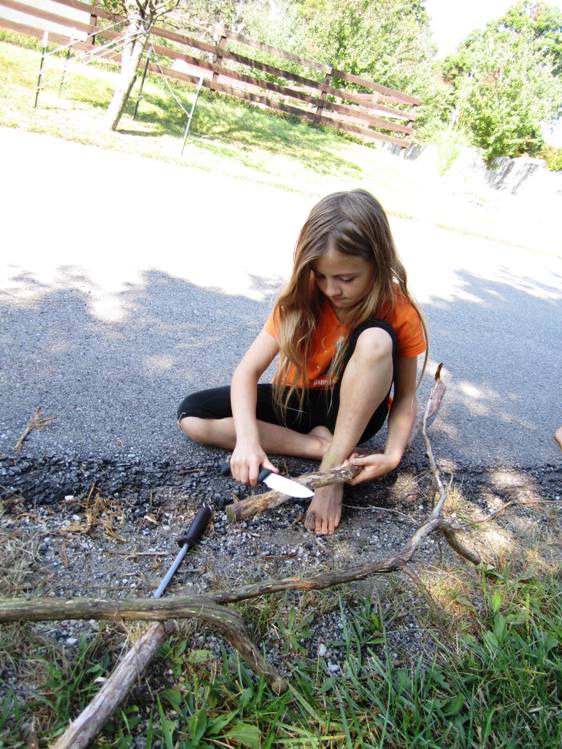
They assured me that they would use a regular knife to shave around the knots where the draw knife caught. Here’s the youngest, working with her knife.

Knife skills

Knife skills

I love how fearless these kids are. I find that my own hands are better suited to a keyboard than a hand tool. Yet, I pulled off a passable job on bark-peeling task.

Proud of my handiwork

Not bad for a beginner

After a while it was time for lunch (fresh-baked bread!) and conversation. I asked the four kids what life would be like if they went to a school where they sat at desks all day. They agreed that they wouldn’t have nearly as much fun and flexibility in their lives, and probably not be as fit. Nor would they spend as much time with their families. On the flip side, they have to schedule activities to connect with larger groups, whereas students in school interact with lots of different kids daily.

Asked how their education is preparing them for adulthood, they pointed to skills like gardening, cooking, and researching solutions to problems.

After lunch, it was time to split maple logs and stack wood for the winter’s fuel. This was more fun than I expected. I consider myself something of a pipsqueak—but seeing the kids demonstrate, I thought, why not try?

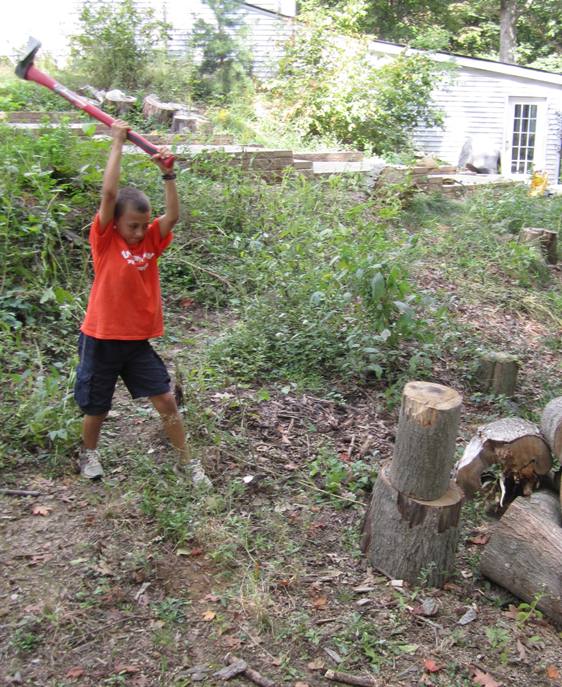
Demonstrating wood splitting

Demonstrating wood splitting

After numerous tries and tons of pointers from the peanut gallery, I managed to stick the splitting maul in the top of the log. I whapped at it with a mallet till the firewood split with a satisfying crack.

Alas, no one captured the moment on film, but I have the sore muscles to prove it.

All in all it was a great time with lovely people, and felt wonderful to be outside doing real work on a pristine fall day.

Working with Nature to Sustain Life

There’s a fatal flaw in the traditional definition of sustainability—meeting today’s needs without jeopardizing future generations’ ability to meet their own needs.

The problem? This notion leaves out every species besides homo sapiens.

The truth is, “Human beings don’t sustain shit,” sustainability consultant Brandon Pitcher declares. “Nature sustains us. We fool ourselves into thinking we sustain the planet, but it’s the other way around.”

But Fritjof Capra’s view of sustainability is more integrated:

“A sustainable human community is designed in such a manner that its ways of life, technologies, and social institutions honor, support, and cooperate with nature’s inherent ability to sustain life.”

By Alaricmalabry (Own work), via Wikimedia Commons

By Alaricmalabry (Own work), via Wikimedia Commons

Pitcher, a certified practitioner of ZERI (Zero Emissions Research & Initiatives, a global network seeking solutions to world challenges), spoke at the Irvington Green Hour Tuesday night. He gave two scenarios of solutions patterned after nature’s wisdom.

The Power of Shrooms
The first involves using mushrooms to address multiple issues, such as in the case of an invasive species troubling poverty-stricken parts of Zimbabwe. There water hyacinths choke waterways, to the point that people can’t take their boats down the river, jeopardizing their livelihoods in an area already strained by high rates of HIV.

However, once harvested, dried, and sun-sterilized, this invasive species is ideal food for mushrooms. Villagers take the work on, and native mushrooms thrive on this biomass. Reintroducing mushrooms as a food source demonstrates how tasty and nutritious these powerhouses are—and they can provide enough protein to sustain a community in two to three weeks, Pitcher says.

Mushrooms also figure in food security efforts in Colombia, where the coffee plant forms a substrate for edible fungi. Typically 99.8 percent of coffee is thrown away or burned on its way to our morning cuppa. But “waste” is opportunity.

Coffee Plant, by Jo N, via flickr Commons

Coffee Plant, by Jo N, via flickr Commons

The Wisdom of Water
Pitcher’s second example is a natural way to treat wastewater.

In Indiana, 92 cities, including my hometown, have antiquated combined sewer overflows (CSOs).

Combined sewer overflow effects, by Christopher Zurcher, via flickr Commons

Combined sewer overflow effects, by Christopher Zurcher, via flickr Commons

Never heard of a CSO? You’re lucky. Here whenever it rains a fraction of an inch, raw sewage combines with stormwater runoff and runs straight into waterways. So pathogens and toxic chemicals are dumped into my neighborhood’s Pleasant Run and other sweet little streams.

The remediation plan involves drilling enormous pipes deep underground to hold the excess sewage. To Pitcher, this represents a wasted opportunity—and a sad ignorance about the way water naturally purifies.

“Water does not move in a straight line in nature,” he points out. Its natural flow creates vortexes that clean it. “It’s very ignorant of us to think we can move water through pipes in straight lines and think that water’s going to be healthy.”

An integrated system of rain gardens and wetlands harnesses the power of algae to treat wastewater. In Indy, such a system could have resulted in a decentralized network, providing jobs and clean water in perpetuity, Pitcher believes.

For more information, see the ZERI site, or The Blue Economy—or attend Pitcher’s upcoming  sessions at Trade School Indy.

Indestructible

Here’s the mother of the modern environmental movement, on the importance of nurturing children’s connection with the natural world.

Boy scout photographing nature at the Edwin B. Forsythe National Wildlife Refuge. Photo credit: USFWS, via flickr Commons

Boy scout photographing nature at the Edwin B. Forsythe National Wildlife Refuge. Photo credit: USFWS, via flickr Commons

“If I had influence with the good fairy who is supposed to preside over the christening of all children

I should ask that her gift to each child in the world

be a sense of wonder so indestructible

that it would last throughout life,

as an unfailing antidote against the boredom and disenchantments of later years,

the sterile preoccupation with things that are artificial,

the alienation

from the sources of our strength.”

—Rachel Carson, The Sense of Wonder, 1956

A Week in the Life, Irvington-style

Last week, I realized how much I rely on my neighborhood for commerce, entertainment, exercise, and other essentials. To wit:

Tuesday morning I took part in the Writing Habit, a weekly mini-retreat for writers put on by Urban Plot in the library of a local church. With two other writers tapping away on their keyboards, I cranked out some verbiage.

Kitley finds writing more taxing than stalking sparrows. Sometimes I agree.

Kitley finds writing more taxing than stalking sparrows. Sometimes I agree.

In the evening I walked two blocks to Dairy Queen (OK, it’s not locally owned, but a business in our own little plaza). My neighbor had called a meeting, sweetening the deal with ice cream. We were there to explore teaming the Irvington Green Initiative and a budding arts initiative with local organizations like Trade School Indy to share admin/event/classroom space sometime in the future. An intriguing possibility.

Wednesday, before sunup, I went to earlybird piyo (Pilates/yoga fusion) at Irvington Wellness Center, my favorite place for yoga and other such pursuits. In the afternoon, I biked over to meet a writer friend at Starbucks (because our old haunt, Lazy Daze Coffeehouse, tragically closed this summer).

I walked from there to Help My Mac Plus, where I found a refurbished MacBook Air with my name on it. A stunning development, given how terminally conflicted I am about gadgets and the resources they require. I had just begun to put out feelers for a lightweight laptop for my upcoming research trip/ writers’ residency. I’m thrilled with my find, awarding myself double bonus points for supporting a local business and avoiding buying new.

Thursday evening it was back to Irvington Wellness for yoga class, taught by another Irvingtonian (I inquired after her hens, as one does here).

Friday evening was the highlight. First we went out to eat with a friend at local eatery Legend, where the owners know us by name and the food is delicious. Then to see Delta Duo and friends perform at Bookmamas in the Underground 9.

JJ plays a resonator slide guitar in the style used by Delta bluesmen of the 1930s. Irina's violin accompaniment is haunting.

JJ plays a resonator slide guitar in the style used by Delta bluesmen of the 1930s. Irina’s violin accompaniment is haunting. Photo courtesy of the Delta Duo.

Two local singer/songwriters kicked it off, after which the headliners laid it down. Delta Duo pairs JJ the Chicago-born bluesman with Irina the classically trained Russian violinist for a sound like none other. Suffice to say this monthly show will be a priority from now on. (Bonus: no cover charge.)

But the weekend wasn’t over yet. Saturday after supper, Judy and I rode our bikes to our new neighborhood ice cream shop Wyliepalooza, then popped in on old friends to catch up.

And Sunday was the farmers market. Judy and I biked over, bought bread and produce, and ran into several friends, including the aforementioned JJ and Irina.

This is the third mention of ice cream in this post. Confession: I actually can't eat ice cream! Wish I could!

This is the third mention of ice cream in this post. Confession: I actually can’t eat ice cream. Wish I could!

In short, it was a great week to be an Irvingtonian. What’s new in your neighborhood?

From Dismemberment to Oneness

Rebecca Solnit, on how leprosy numbs the extremities so that sufferers don’t realize when they are damaging their own tissues:

“The disease strangles nerves, kills off feeling, and what you cannot feel you cannot take care of.”

She speaks of a kind of dismemberment, of patients who feel no pain, so they injure themselves, even blind themselves.

She quotes a missionary doctor: “One of the boys said to me, “My hands and feet don’t feel part of me. They are like tools I can use. But they aren’t really me. I can see them, but in my mind they are dead.'”

Reading, it struck me that this statement could also sum up the dominant cultural attitude toward our own earth home. Though we belong to her and she to us, for so long we’ve disowned her, exploiting her riches as just so many dead “resources.”

We’ve been operating under the delusion that we are separate from the biosphere and the myriad life forms that share it—and separate from each other too. The results are catastrophic. If we lack feeling for each other, the soil under our feet, the waters that flow, and the skies above, we won’t consider these worthwhile of care.

"Holding Hands," by Paige Shoemaker, via Flickr Creative Commons

“Holding Hands,” by Paige Shoemaker, via Flickr Creative Commons

But perhaps that’s changing now, bit by bit.

More and more of us are waking up to our empathetic selves. We’re feeling a kinship not just with other humans but with the earth herself. We’re re-membering our entire human family and our deep connection to the planet that holds us.

I think of the empathy displayed by Antoinette Tuff as she disarmed a young mentally ill man bent on violence in her school. In the midst of her fear, this bookkeeper found a way to connect with the young would-be shooter, seeing him as a hurting soul. Her ability to reach him on a human level may have averted a major tragedy.

Meanwhile, this summer a group has been tracing the route of the Keystone XL Pipeline in the Great Plains. The pipeline, as I posted in May, would allow the release of enormous levels of carbon—enough to create irreversible climate change.

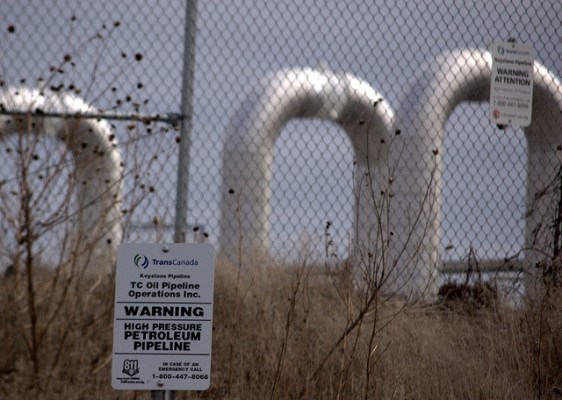
Trans Canada Keystone Oil Pipeline, by shannonpatrick17, via Flickr Creative Commons

Trans Canada Keystone Oil Pipeline, by shannonpatrick17, via Flickr Creative Commons

Taking both a physical and a spiritual journey through the heart of North America, Compassionate Earth Walk aims to nourish the earth, while inviting all humans to return to oneness in the community of life.

From the story on Resilience.org:

“We walk in response to climate change and in gratitude for the earth which has given freely to us for so long. We walk as an act of healing both symbolic and literal, including healing of the walkers, the land, the communities impacted by the pipeline, and the whole human consciousness of separation.”

No more numbness. No more dismemberment. The pain of our suffering planet and fellow earthlings might be difficult to face, but feeling it means we’re awake. It means we can care.

To Be Hopeful in Bad Times

Howard Zinn, by Jim from Stevens Point, WI, USA, via Wikimedia Commons

Howard Zinn, by Jim from Stevens Point, WI, USA, via Wikimedia Commons

On this Labor Day, here’s a quote from a celebrated historian, the voice of the common people.

“To be hopeful in bad times is not just foolishly romantic. It is based on the fact that human history is a history not only of cruelty but also of compassion, sacrifice, courage, kindness.

What we choose to emphasize in this complex history will determine our lives. If we see only the worst, it destroys our capacity to do something. If we remember those times and places—and there are so many—where people have behaved magnificently, this gives us the energy to act, and at least the possibility of sending this spinning top of a world in a different direction.

And if we do act, in however small a way, we don’t have to wait for some grand utopian future. The future is an infinite succession of presents, and to live now as we think human beings should live, in defiance of all that is bad around us, is itself a marvelous victory.”

—Howard Zinn, from You Can’t Be Neutral On A Moving Train, 1994

A Beautiful Indebtedness

I’ve been reading Rebecca Solnit’s latest resonant book The Faraway Nearby, and every day there’s a new discovery—about writing, about alienation, about the uses of stories. This morning’s passage evoked the web of interrelatedness and care that can happen among neighbors and friends.

In the author’s case, a cancer diagnosis showed her how much goodwill she had banked. People came from everywhere to help her.

She reflects:

“Before money…people didn’t barter, but gave and received as needs and goods ebbed and flowed. They thereby incurred the indebtedness that bound them together, and reciprocated slowly, incompletely, in the ongoing transaction that is a community.”

In some parts of the world, surely this beautiful indebtedness is still the norm. In my neighborhood, it’s making a steady return, in many small ways.

Some intertwined examples from this past week: I put a call out for dill on the Facebook Neighbors Garden page, offering other herbs in exchange. I’d planted dill, but the black swallowtail caterpillars ate every single sprig of it.

Black swallowtail caterpillars happily chewing up my dill earlier this summer

Black swallowtail caterpillars enthusiastically chewing through my dill supply earlier this summer

I wasn’t too sad about the loss, knowing the beauty that would come of it—until I saw the enticing baby cucumbers at the farmers market and ended up buying three pounds’ worth. I wanted to make a crock of pickles.

Happily, Amy of Fraudulent Farmgirl fame offered her unused dill. Over the weekend I biked over to harvest some, using most of it for pickling and borscht.

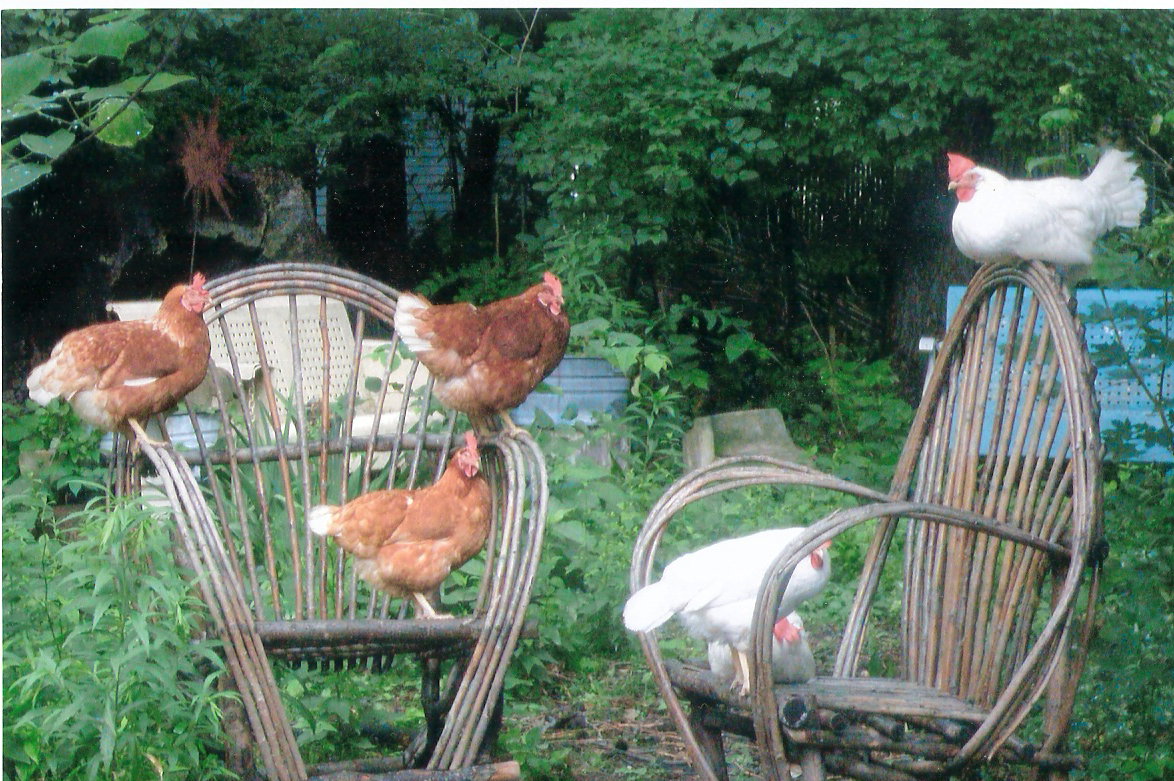
On that same bike trip, I stopped at Laura’s to unload some goodies on her hens. That morning I had cut back my severely cabbage worm-infested collards. I brought over the collard leaves, creepy crawlies and all, for the chickens‘ enjoyment. Laura sent me home with heirloom tomatoes and a photograph of the hens posing for a family portrait.

Laura's contented flock

Laura’s contented flock

Today Dawn Facebooked her own plea for dill, and since I had some left, I took it down to her house on my morning dog walk. Dawn put three things into a blue cloth bag of mine that was at her house from some earlier exchange. I came home with:

  • a salsa wrap made from her dehydrated tomatoes
  • grape juice from another neighbor’s unused Concord grapes (Dawn and I had picked the grapes Monday while catching up on life)
  • some maca powder, having mentioned in passing that I’d run out

I promptly put the maca in a green drink, the one I’m sipping right now. It also contains: frozen blueberries (brought back from Michigan by Anna), whey (received from Corinna down the street who makes her own Greek-style yogurt), lettuce (from farmers market), and kale (from my garden).

To add further depth to this web of connection: Laura was the source of my kale seedlings, a late-summer addition to my garden and currently the focal point of my daily worm-picking meditation. I no longer squish or stomp the worms while grimacing and/or squealing. I save them for Laura’s hens. The very hens that supply my eggs.

Writing this, I’m realizing my good fortune: my indebtedness extends even beyond my human neighbors.

What precious debts have you incurred in your community?