Sing Light

At the International Women’s Writing Guild‘s annual conference, I was drawn to a spiritual warriorship workshop. Here I found women both tender and fierce. From various spiritual backgrounds, we all were seeking to keep our hearts open in the face of the world’s pain. We meditated together, read, wrote and shed tears together.

One day the reading was Wendell Berry’s haunting  Work Song Part 2: A Vision, which speaks of “a long time after we are dead” when “memory will grow into legend, legend into song, song into sacrament.” The future, and what it might look like, if we are wise.

IMG_3691 (767x1024)

Our writing prompt was : What I want to sing into this world is…

Here’s what came from that free write. (Read Wendell’s marvelous poem first!)

What I want to sing into this world is…
That we must breathe our despair and eat our fear. Then allow the alchemy of respiration, digestion, and elimination to work on our pain and terror until a new thing emerges on this earth. I want to sing a song of light—and yet allow darkness to be felt and seen. (Without awareness of what is hard and mean and forced, we forget the impoverished place that births our better future.) Sing light that doesn’t fear the dark but turns toward it, welcoming the whole story of our unfolding humanity. Find a way to rock the darkness like a neglected child, to give it the kind of love it’s never known.


And you: What do you want to sing into this world?

I’ll Meet You There

“It’s been a long time since I felt that sense of wholeness,” she told me. “Just to reconnect to something spiritual feels incredible.” I’d just talked her through a grounding and expanding meditation, one that I use myself to connect to Source.

Sunlight. Revisited.

Photo by Rishi Bandopadhay, via Flickr Creative Commons

This young woman was one of about 30 I worked with Tuesday night at a collaborative “Art and Insight” event. Other participants, upon opening their eyes, said they felt themselves floating, or they gained perspective over their petty concerns, or they felt as refreshed as if they’d had a nice long sleep.

Guiding people to spaciousness was a gift to my own energy. I thought I might feel drained afterward, doing so many consecutive mini-interventions—but instead, I was on a high. (The only thing that would have increased my high? If I’d had time to enjoy my beautiful collaborators’ offerings—spirit animal readings by Elizabeth Camp of Zen Within and reiki from Amy Barr of The Healing Room. Not to mention henna by Carrie of Eastside Gypsies. Next time!)

This work makes me so happy. I never expected to find a vocation that felt as natural as writing. But I love sharing ways that people can regain their footing in a rocky world.

So many of us are walking around in trauma these days as we face up to our collective shadow. Nothing seems certain anymore; institutions that once appeared solid are crumbling one by one. It can feel, as intuitive Lee Harris once put it, like we have lost our handrail.

In troubled times, it’s so helpful to reach out to each other, reach down to the earth, reach beyond to the cosmos, and experience ourselves as intertwined with All That Is.

IMG_3593 (1024x766)

That sense of interconnectedness is what helps me return to a space of possibility and openness instead of shutting down.

I used to consider this kind of thing “self-care,” which seems to relegate it to the “optional, somewhat privileged” category of activities, on a par with green drinks and Pilates. Certainly not mission-critical, like the shovel-in-dirt projects that remake the world.

However, I see now that the world is made up of people on a path, and that clearing out and opening up on an individual level is absolutely critical if we want to thrive here. Before the remaking of the world comes the reimagining, which can’t happen with eyes that see the same old way.

So how do we build a new world—safer, saner, more compassionate, more just, peaceful, resilient? There are so many problems, so many slippery arguments. There’s so much shouting, so much pain.

We can start by opening our hearts and looking into each other’s eyes.

Or in preparation for that, we can look at a flower, or a beetle, or a cat, or a tree.

in shade best

Or in preparation for that, we can feel the marvel of our lungs filling with air as we draw breath.

We can start anywhere. Sweep our little corner.

Out beyond ideas of wrongdoing and rightdoing, there is a field. I will meet you there.

—Rumi

Note: Please sign up for my e-newsletter if you want to receive notices of upcoming similar events. And consider joining me at Empath 101, where I will share energetic tools to manage sensitivity.

Releasing the “Story”

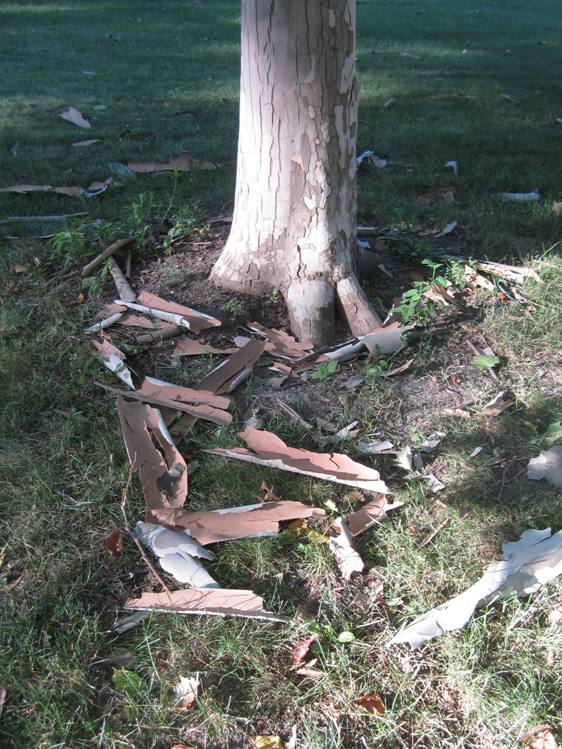
A sycamore on my street in the process of shedding its bark

A sycamore on my street in the process of shedding its bark

When the sycamores in my neighborhood begin their annual shedding, I always ask myself, what do I need to release this year to speed my growth?

Perhaps I need to examine the story that constantly loops through my brain. I’m sure some of it can fall away like bark sloughed off a tree trunk.

The ground under the trees is strewn with their old skin.

The ground under the trees is strewn with their old skin.

Zen teacher Norman Fischer speaks to this point eloquently.

“We take our point of view so much for granted, as if the world were really as we see it.

But it doesn’t take much analysis to recognize that our way of seeing the world is simply an old unexamined habit, so strong, so convincing, and so unconscious we don’t even see it as a habit.

How many times have we been absolutely sure about someone’s motivations and later discovered that we were completely wrong? How many times have we gotten upset about something that turned out to have been nothing?

Perspective

Perspective

Our perceptions and opinions are often quite off the mark. The world may not be as we think it is. In fact, it is virtually certain that it is not.”

—from Training in Compassion

Resilient Communities and People: How Yoga Can Help

Guest post by Gaynell Collier-Magar

Hi everyone! I am so honored to be a guest blogger on Shawndra’s amazing website. Shawndra is one of my Irvington Wellness Center yoga students. She has a beautiful, thoughtful practice, both on and off of the mat. She personifies how yoga can help with resiliency in life.

Yoga is a 5000-year-old tradition of practices (the Eight Limbs) to reduce suffering and still the mind. It is not a religion. However, the practices have been incorporated by many religions: Buddhism, Hinduism, and contemplative Christianity to name a few.

The physical practice or “asana” (“seat”) is meant to create resiliency in the body and mind to enable sitting in meditation for long periods of time. Unfortunately, in the West, the physical practice is often perceived as the path to buns of steel, pretzel poses, and very thin 20-something bodies.

The first lines of the Yoga Sutras state: “Now, the teachings of yoga. Yoga is to still the patternings of consciousness”. The Sutras explain how our habitual ways of thinking create suffering and how we can remedy this.

When we are reimagining a future for our communities, yoga could be a useful tool.

Photo by Jenny Spadafora

Photo by Jenny Spadafora, via Flickr Commons

So how does this happen? In the physical practice, it begins with being in the present moment—in the body and the breath. To get a feel for what I mean, try this:

Notice how you are sitting now. Are you slumping? Good…notice how you feel heavy in your body. Now, sit up straight, feel your bottom sitting in your chair, feel your feet on the floor, and lift your chest. Do you feel any lighter in your body? Slump again and notice. Sit up again and notice. Now close your eyes, put your hands on the tops of your thighs and take three deep, slow breaths. Focus on the exhale.

What was your mind doing? Chances are it wasn’t making a to-do list, obsessing about the person at work who drives you crazy, or yearning after a piece of chocolate. You begin to get a glimpse of the mind becoming more still—an experience that increases in depth and length with further practice.

The practice is to notice what is happening in the present moment, practice non-reaction, and return to the present moment. Neuroscience is showing that these practices literally re-wire the brain.

Two of the liabilities of community work are burnout and lack of fresh ideas. Our ego-driven “monkey mind” robs us of tremendous energy and creativity. As we engage in practices that still the mind, we create a mindspace in which to think outside the box—and the energy to act accordingly.

Photo by TZA, via Flickr Commons

Photo by TZA, via Flickr Commons

We also create a mind that is equanimous and unattached, yet deeply caring. We create a mind that is focused and in the present moment. We create a mind that is resilient.

It is not a leap of consciousness nor faith to realize how resilient minds can create resilient communities. The Buddha said, “All that we are is a result of what we have thought. The mind is everything. What we think we become.”

Gaynell has been a yoga practitioner for over 14 years. She was certified as a Vinyasa yoga instructor in 2009 by Rolf Gates and is a registered yoga teacher with Yoga Alliance. She is certified to teach adaptive yoga to people with physical disabilities, having studied with Matthew Sanford of Mind Body Solutions. She has taught Vinyasa, adaptive, and 12-step recovery yoga classes in Indianapolis and Cozumel, Mexico in Spanish and English. She holds a Bachelor’s Degree in Social Work and owns her own landscaping business, Growing Connection.

Join Gaynell and other terrific instructors at Shine Out Yoga Celebration, July 11-12 in Indianapolis, benefiting Mighty Lotus.
Yoga: Leading with the Heart

I’ve practiced yoga for many years, starting in my 20s. My practice fell off in my 30s, around the time my health went wonky. For a long stretch, whenever I attended a class or practiced at home, the result was exhaustion and pain.

But in the last several years I’ve come back to yoga as I’ve rebuilt my health. Now I see my weekly Irvington Wellness Center class with Gaynell Collier-Magar as one of the pillars of my spiritual and physical self-care regimen.

Photo by Lyn Talley, via flickr Commons

Not a picture from our class. Photo by Lyn Talley, via flickr Commons

In Gaynell’s classes, you won’t find that punctilious solemnity that infects some yoga classes. She teaches with a lightness and authenticity that nourishes all comers. And she brings her whole self to teaching. I love that she doesn’t take herself too seriously. Nor does she shy away from the spiritual underpinnings of yogic practice.

Week after week, she nudges us to experience the support of unseen energies around us, to feel into our physical bodies and the air around them.

As we move into a standing posture, Gaynell might say something like, “Lead with your heart; allow your heart to move toward the wall…and now [a smile in her voice], loosening the grip with which you normally hold your life, raise your arms overhead.” Which makes us laugh in self-recognition while carefully forming our bodies into the shape she models.

Photo by Ariane, via flickr Commons

Not a picture of our class or anyone I know. Photo by Ariane, via flickr Commons.

Sometimes it takes stillness to open us to the love that’s all around us. It happened in last week’s class when I found myself holding a posture called the Half Pigeon. This pose has us fold the torso over a bent knee while stretched out face-down on the mat.

Gaynell queues up her play lists with care, and for this extended hold of Half Pigeon, she played a song celebrating the Divine Mother. The vocalist sang her tribute with piercing simplicity. With my forehead pressed to the mat, I felt tears well up from deep inside.

In previous years I might have cried in yoga classes out of grief, out of frustration, out of anger at my body (or at the instructor). Sometimes I cried from plain old weariness and physical pain.

But my heart is full now, and my body and spirit feel replete. My tears are not expressions of hurt. I weep because I feel steeped in love and gratitude.

Photo by Nicolas L., via flickr Commons

Photo by Nicolas L., via flickr Commons

Have you felt that—that opening in your heart center like a flower’s petals unfurling? I hope you have. I wish it for everyone.

I used to believe (or part of me shouted loudly enough to make me think I should believe) that an open heart was less essential than, say, large dramatic projects. It was the outer stuff that would change the world, not the inner.

Now I tend to think that this infusion of love is foundational to any external work, and that any worldchanging shift must manifest on both an internal and an external level.

Gaynell’s own writing will take a turn on this blog in coming weeks. Stay tuned to learn her perspective on how yoga supports resilient communities.