Catching Abundance

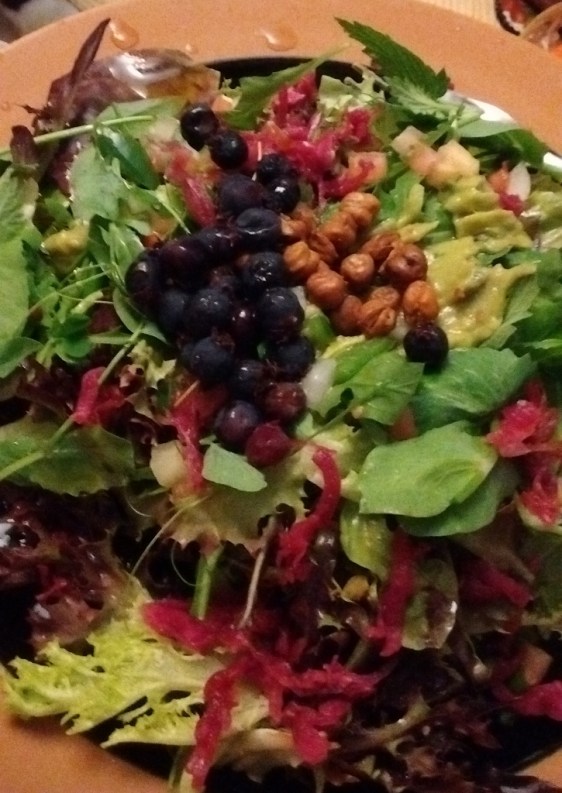
One day early in June, I looked down at my salad plate and realized my good fortune.
IMG_20160613_203841863 (725x1024)

The abundant salad

I saw that an incredible number of friends and acquaintances had contributed to my meal. Here were lettuces I’d purchased as seedlings from a farmer friend. Serviceberries I’d picked from a neighbor’s tree. Roasted chickpeas given to me by another neighbor, and guacamole from yet another neighbor. I dressed it with a drizzle of superspecialyummo high-end olive oil that another neighbor-friend gave me, along with beet kraut from local fermenters Fermenti Artisan.

I mean, seriously now.

And that’s not even mentioning the contributions of all the nonhuman cocreators of my food, the bees and tiny bugs, the sunshine and rain and minerals and fungi and soil itself.

IMG_20160609_200830515 (576x1024)

Dan’s tree was loaded. Enough for birds and neighbors to enjoy, while still filling his freezer.

This time of year especially, the sheer plenitude just delights. That is, if we let it.

Nance Klehm of The Ground Rules calls it “catching abundance”—the idea that our job is to show up and appreciate, and make use of, what we are freely given.

IMG_20160626_185540693 (1024x576)

I picked these yesterday. Blackberries, red raspberries, wild black raspberries, mulberries, and a couple Alpine strawberries.

It can be food, but it can be other things too. Recently I’ve felt grateful for an abundance of ideas, an abundance of encouragement and support, an abundance of beauty, on and on.

One night, at bedtime, I saw the quarter moon reflected in my neighbor’s window. I let myself be awed.

Gratitude opens the door to awe and wonder, two emotions that promote loving-kindness, so essential in this jaded age. (This article posits that “chronic awe deprivation has had a hand in … making us more individualistic, more self-focused, more materialistic and less connected to others… We need to actively seek out awe-inspiring moments in our everyday lives.”)

Contacting this state then, which I also call spaciousness, is not just the icing on the cake. It may be the entire smorgasbord.

Saturday I took a space at a wellness expo, where I asked people where they encounter spaciousness, or what it means to them. Many generously contributed to my inquiry, as you can see.

IMG_20160627_135622548 (1024x668)

I invited people to contemplate spaciousness and add a thought to this board. I caught an abundance of responses!

A few of the answers:

  • Expansion ♥
  • In the green of nature
  • Simplicity
  • Freedom to be me!
  • Contentment ♥
  • Awareness
  • Love!
  • Open heart ♥
  • Unlimited
  • The stillness inside of myself

And my personal favorite, a drawing of a tree. (Yes! Thank you, Tree!)

I bow in gratitude to the people willing to scribble something for me, and to those willing to pause a bit longer and try out my uber-short meditation for grounding and expanding. What a privilege to encounter so many openhearted souls.

What about you? What is your experience of spaciousness,  or where do you encounter awe and wonder? Are you catching the abundance in your life?

My Dad, Who Made the World Better, Take 4

Father’s Day. Let me tell you about my dad, if you didn’t know him.

My dad loved all things plant. Out on a walk, he’d look down, the better to identify the plants at his feet. During his social worker years, he spent as much of his off hours as possible outdoors, tending his raspberry beds, vegetable garden, and native plantings. As a retiree he had time to participate in all kinds of projects that fit his passion, and he was never happier.

One of the pleasures of being the daughter of such a man is introducing myself as “Donovan’s daughter” to his many friends and co-conspirators. Recently I interviewed a “FOD” (friend of Dad) for an article I was writing. I knew Dad had done some volunteer work with this organization, Central Indiana Land Trust. At the end of the phone conversation I mentioned Dad’s name.

The response in my earpiece was immediate. Cliff Chapman, the organization’s executive director, said, “Oh, Donovan! I loved Donovan!”

He started to tell me stories. How Dad was the only one who came out for the first volunteer work day at a nature preserve called Oliver’s Woods. With two feet of snow on the ground, Dad and Cliff together tackled the first bush honeysuckle (an invasive plant that kills off native plants). It was “the size of a VW beetle,” Cliff said.

Since then over 1500 volunteers have cleared a dozen acres of bush honeysuckle. They used to have to wield a hedge trimmers just to be able to drive up the lane. Now native plants are starting to flourish there. Though the site is not open to the public yet, it is on its way.

Cliff still remembers that very first cut that started everything off.

He told me another story that is just so Dad:

“One of the things he had me do—it was when he was in home hospice care and I went to see him—he said, ‘Hey there’s this plant I’ve planted, it’s got a whole bunch of seeds, and I’d love to see these seeds go to good use.’ So I got a big old bag and collected the seeds and went back in and showed him, and told him I would scatter them somewhere special.”

Chapman planted the seeds—sea oats—along the White River at Oliver’s Woods. He started another stand of sea oats from plugs under a big tree along the lane. He says he always thinks of my dad when he sees those grasses waving.

“Some people are different than other people,” he told me. “He really cared about those things, like he really wanted those seeds to be planted.”

Here is a clump of sea oats in my yard that (if memory serves) originated from Dad. Sometime soon I hope to visit Oliver’s Woods, but in the meantime I will find him near at hand, and be grateful.

IMG_20160619_191638076 (1024x734)

Magnify Love

Do your little bit of good where you are; it’s those little bits of good put together that overwhelm the world.

—Desmond Tutu

Here in the U.S., we’re feeling the reverberations of yet another mass shooting. Some call it the deadliest in our nation’s history. Even as I unplug from the news cycle, I’m energetically affected by the pain and anguish, the anger and fear.

Sadness is mostly what I feel when I think of the shooting. When I remember to, I turn toward the sadness, feel it in my body, notice the wish to numb it, alongside the urge to amass information in support of my personal philosophy about these types of tragedies.

I “embrace, allow, include,” as I’ve been coached in mindfulness training. I open up room for all my responses and attend to them with kindness. In that space I can consider right action.

All of which gives me more compassion for others on their own path.

I like to believe that humanity is evolving in a positive direction, appearances (seemingly) to the contrary. The horrible things that happen always grab our focus, fuel our outrage. It’s the same with the inflammatory things said by some pundits and politicians: Our attention gets hooked by ugly things that seem to confirm the awfulness of everything. And the ugliness magnifies.

A wise yoga/meditation instructor recently reminded me that our brains are wired to notice the snake amidst the flowers. Danger! Alert! We fixate on the negative. It’s biological.

Flower (1024x768)

No snake, just flower.

Mindfulness meditation creates an opening for a new practice to emerge. It offers a brief space—the length of a breath—in which we can begin to choose.

I wonder: what if we train our attention on something other than the horror? Not to look away blithely denying injustice, but turning toward the little acts of love and solidarity, small exchanges of soul happening every day. Is it a copout, born of privilege, to even suggest such a thing? Or is it an opening?

Some schools of Buddhism teach that the material world is nothing other than a construct of mind. What mind do I wish to inhabit?

Illusion (768x1024)

What do I choose to magnify with my attention?

We’re Walking Ecosystems: Notes on Collaboration

Lately I’ve been thinking about collaboration. I envision a world where nations, geographic regions, cities, neighborhoods, and affinity groups find an ease and flow in working together.

11285902014_240074a727_z

Photo credit Michael Mayer, via Flickr Creative Commons

Maybe it seems pie-in-the-sky, but we have a model for that kind of collaboration. It’s right here, as close as our own skin. Modern science now confirms that the human body is a collaboration in itself.

Some 90 percent of our cells are—get this—not human. They’re bacterial, or fungal, or even viral. Don’t be afraid! They mean us no harm. We’re their habitat. A walking community. A microbiome.

If we keep balance within the community of our cells—I’m talking happy bacteria and fungi here—we generally enjoy good health, and recover from illness more quickly.

This Brainscape article explains it all so well—the ecosystems within us, each with their own unique microorganisms. These wee “microbiota” do all kinds of things for us in exchange for giving them a suitable environment to thrive. They help with digestion, brain activity, and immune function, just for starters.

Most curiously, our mitochondria—an organelle within cells that is responsible for converting digested food into energy—contains DNA that is…not human. “These organelles came from outside of us, down a separate evolutionary path.”

17104540588_afc2a615dc_z

Mitochondria (red) are organelles found in most cells. They generate a cell’s chemical energy. Credit: NICHD/U. Manor, via Flickr Creative Commons

At the microscopic level, human life depends on a symbiotic relationship.

From the article:

“When Charles Darwin wrote On the Origin of Species, the dominant theory soon came to be survival of the fittest: a rat race for domination and survival. But both of these examples — mitochondria and our internal biota — point toward another means by which life thrives and evolves: symbiosis.”

I find that fascinating, and also telling.

Of course, zoom in tighter on the cells of our body—and what are they? Whirling clouds of particles. There’s nothing solid to us.

We’re made of space, basically. Our lives reliant on organisms we have always vilified or at the very least, ignored.

Knowing that, is it possible to see the human community in a different way?