Forage Ahead!

Today I joined my friend Greg Monzel of Monzel Herbs on one of his terrific plant walks. The rain held off as we tramped the lanes and fields of Distelrath Farms, an urban farm and the source of my weekly CSA allotment.

As an herbalist, Greg focuses these guided tours on both edible and medicinal plants. After you’ve hung around with him for a little while, you get a new appreciation for the things people normally dig out of their gardens. It seems that everywhere under our feet, there’s nourishment and healing.
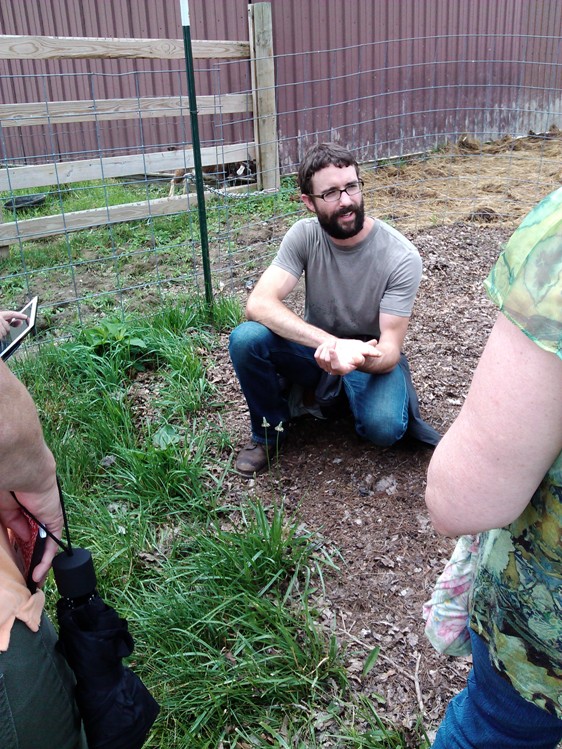
Greg teaches us about plantain and its many uses

Greg teaches us about plantain and its many uses

Plaintain, for example, is good for eczema, wounds, and other skin issues, while its seeds are a “poor man’s psyllium.” I doubt I have the patience to collect its seeds, but I like the idea of whipping up a bunch of leaves in the blender with olive oil to make an infusion. I have some off-and-on rashy stuff on my hands, so I might try that.
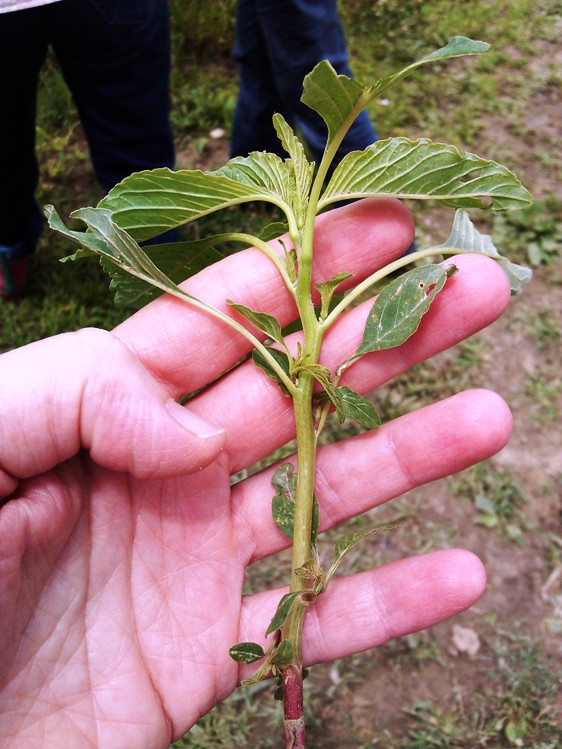
Amaranth, drought-tolerant and tasty

Amaranth, drought-tolerant and tasty

More tasty than the bitter plantain is amaranth. It is an amazingly hardy summer salad green as well as a source of protein-rich “grain” (actually the seeds).

I’ve never collected the seeds, but I adore amaranth as a green. My partner was introduced to it in Tanzania years ago. There it was called red root and sauteed in a dish called Sukuma Weeki.

When the drought hit us last year, amaranth didn’t even notice. So this year I bought amaranth seeds to plant for a steady and convenient supply. As soon as my lettuce is done–any day now–I’m sowing amaranth in preparation for a dryer, hotter July and August. I can almost taste that late summer salad of amaranth and purslane, a heat-loving succulent high in omega-3 fatty acids. Most people pull both as a weed.

Greg, by the way, says weeds are a state of mind. Many of the things we consider noxious weeds were actually brought here because of their usefulness. Now they populate areas where the soil has been disturbed, working as “succession plants” that naturally build soil fertility.

Knotweed, AKA smartweed

Knotweed, AKA smartweed

Here’s knotweed, for example, also known as smartweed. I remember seeing this pretty little bloom in my dad’s raspberry patch and wondering what it was. I learned today that it is in the buckwheat family. Its leaves and seeds are edible and loaded with resveratrol, a potent antioxidant.

And did you know that you can harvest the seeds of the ubiquitous clover and save them in a jar, for indoor sprouting at some later, leaner date? It’s mind-boggling to realize there is free food all around us, even in the city, that could potentially nourish us in good times and bad.

I’ve learned so much from Greg, starting when I interviewed him for an Edible Indy story on gathering wild foods. Though I’m not nearly as experienced as he is, next Friday, July 5, I’ll have a table on foraging at FoodCon IV, a fabulous event that attracts a thousand or more people every year. I’m beyond excited to be part of it.

On Being Rooted

A summer memory: The question my dad asked me when he got home from work, if it had rained earlier in the day. “Did it rain hard enough to get wet under the trees?”

Always, the answer was a shrug. I didn’t have much patience for Dad’s concerns. Watering wilty plants, pulling weeds, noticing—those were his purview, not mine.

Now I find myself checking, whenever it rains, whether the earth is wet under the trees.

ChivesAnd when I come home from a week away, my eye is immediately drawn to what’s changed in the landscape. “Oh, the daylilies are blooming,” I might be heard to say, slowing to see orange blossoms in a neighbor’s flower bed. It’s the kind of comment that would have made roll my eyes in my youth.

It is different as an adult, living in one place for a long time. You come to feel an ownership not just of your yard but your entire street, the tree canopy above the neighborhood, the pavement, the dirt itself. Even if you don’t know all your neighbors, you smile at the faces you know, and regard warily those you don’t. You want the best for your little corner, so you pick up litter and throw it in the nearest receptacle, you pick up after your dog, you try to keep the storm drains free of debris.

At least that’s how it is with me and my neighborhood.

And my partner and I love where we live. We don’t plan to leave; we’ve settled in more and more each year. It’s true our yard has its limitations: We can’t keep ducks. We have only so much sunlight for our garden beds. We have no room to try hugelkultur.

But over the years, the source of our sustenance has expanded to include the broader community.

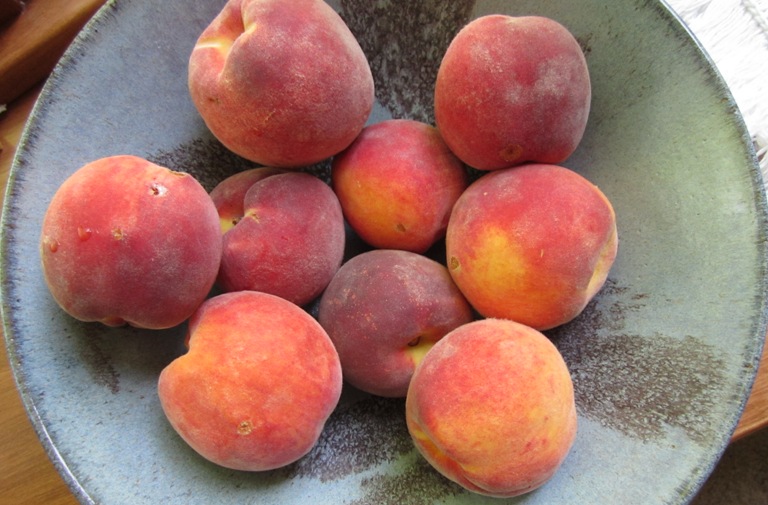
PeachesI buy eggs each week from a chicken-keeping neighbor, who also shares fruit from her orchard. Last year we tended a community garden, and this year we’re experimenting with straw bale gardening on a friend’s property. And one of my favorite activities is to forage for food along my street. I bring home salad greens and berries by the bucketful. (“Nature’s candy,” I hear my Dad’s voice saying, and sometimes say myself, gobbling mulberries.)

There’s a lovely rootedness to this life. I guess it’s possible to live for years in one place and never meet the neighbors, never put a hand into the soil, never sit outside. People drive into an attached garage and disappear into a house that serves as…what? a haven for the inner circle? a locus of entertainment? a fortress against the world?

That seems so sad to me, a kind of disembodiment—though I too appreciate a haven, crave entertainment, and need security. But to live only inside the house sounds like a terribly constrained existence, no matter what kind of diverting electronics are humming within its walls.

Dad used to spend every long summer evening outdoors puttering. It was a mystery what he did out there. As an adult I understand. He was tending, noticing, relating. Getting rooted.

Time to Touch the Earth

Over at the ever-inspiring Root Simple, there’s a great post extolling the virtues of going barefoot. Mrs. Homegrown, aka Kelly Coyne, decries the way we force our feet into little hard boxes instead of letting them directly mediate the surface below.

She offers steps for learning “fox walking.” It’s a form of mindful walking where your feet become your antennae.

I have a friend who does this intuitively. Recently when she and I picked strawberries together, she kicked off her shoes to navigate the strawberry patch–which was a veritable thicket of growth, with thistles poking up here and there. I did not join her in shoelessness, but I admired her mindful treading.

Here’s beloved poet Mary Oliver taking it even further:

Deep in the woods, I tried walking on all fours. I did it for an hour or so, through thickets, across a field, down to a cranberry bog. I don’t think anyone saw me! At the end, I was exhausted and sore, but I had seen the world from the level of the grasses, the first bursting growth of trees, declivities, lumps, slopes, rivulets, gashes, open spaces.

I was some slow old fox, wandering, breathing, hitching along, lying down finally at the edge of the bog, under the swirling rickrack of the trees.

—From “Staying Alive” in Blue Pastures

The swirling rickrack of the trees. I just love her.

I’m off for a much-needed woods ramble. My head is full of worries about desertification, GMOs, and the destruction of carbon sequestering peat bogs in Ireland. I need to step away and touch the earth.

Perhaps I will shuck my shoes. And if you see someone on her hands and knees, just blow a kiss and keep going.

My Dad, Who Made the World Better

Father’s Day meant a pilgrimage to a few places special to my Dad, who died last year. His handprints are all over this town, but I chose a couple places with personal meaning:

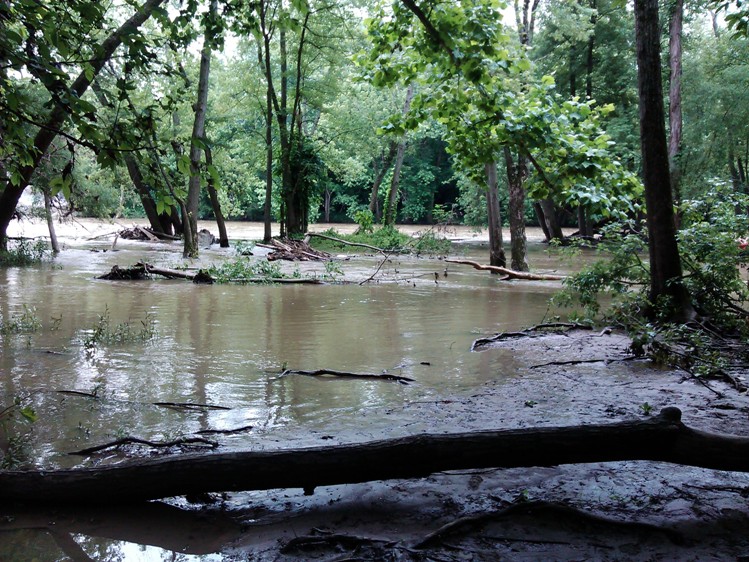
1. Holliday Park, down by the river. Because he used to take the grandkids out into the water with a seine to see what they could catch. Also, he kayaked that river many a time. (Once with me. I was not in the best shape then, and he ended up tying a rope to my kayak and towing me into the wind, all the way back to our put-in place.)

IMG_20130616_161417

The water is not this muddy and high in my memories of Dad taking the grandkids out. All the rain lately.

2. Holliday Park Nature Center. Just to visit his brick.

We honored Dad with this walkway brick at Holliday Park Nature Center on his retirement.

We honored Dad with this walkway brick at Holliday Park Nature Center on his retirement.

3. A pocket park where he and I picked juneberries. Sweet memory. I picked yesterday in his honor.

In truth, Dad is ghosting about the edges of nearly every blog post I write. I see him in the anonymous man in the Keystone Pipeline protest photo—he used to wear that kind of cap, and he marched for important causes. I see him in Keith Johnson, sharing his passion for the natural world.

And I see him in David Forsell, facing death too soon, knowing that what counts is giving back.

A few months before he died, he received the Hoosier Environmental Council ‘s Land Steward of the Year award for his volunteer work (though “work” is a misnomer—he often said, “I’m just having fun.”) A sampling of his fun:

  • He started a multi-year restoration project to return Indiana State Museum’s Turner Gardens to Indiana native prairie (still going on now).
  • At Cold Spring School, he was “chief gardener” and caretaker of the greenhouse, introducing grade schoolers to the marvels of the garden.
  • He took student groups on rafting trips, and led them on tours of natural places.
  • He spearheaded Indiana Native Plant and Wildflower Society’s Letha’s Youth Outdoors Fund, funding field trips to get schoolchildren out into nature.
My dad at the kitchen sink. You can't tell but he's wearing his favorite "Life is Good" Shirt, the one with the dog wearing the backpack.

My dad at the kitchen sink in 2010. Strong as an ox. You can’t tell but he’s wearing his favorite “Life is Good” shirt.

Now and then my mail brings evidence of his impact, and it always makes me happy and sad. Two examples:

From Friends of Cold Spring School: The fifth-graders have adopted the prairie he led students in planting around “Mr. Donovan’s Greenhouse.”

From Indiana Native Plant and Wildflower Society: At Dad’s urging, a Gary-area nonprofit working with urban youth applied for funds to visit the Indiana Dunes National Lakeshore—a wild place largely unexplored by these kids (who live less than a mile away!). The funding allowed 40 young people to experience the beauty of this national park.

I remember when he met these folks and encouraged them to seek funding. It was at the Hoosier Environmental Council luncheon where he received the award. He was quite frail by then, but still networking, still advocating for kids and nature. It didn’t matter that the title of INPAWS “Youth Outreach chair” had long since passed to someone else.

That’s my Dad to a T. Sure do miss him.

Addendum: I forgot to include this recent piece published in the Boiler Journal, describing a day soon after he was diagnosed with terminal cancer.

Where We Rarely Dwell

In my quest to be an engaged citizen, urban homesteader, radical homemaker, contributor to household coffers, writer, etc., I can get trapped in a life of busyness. I have so many goals. My days are full of checking the clock as I push myself to be more productive, to mark things off my  lists. (Yes, I have more than one list.)

One week before I fell ill, I was advised to take some unscheduled time every week. I never got the chance to try this radical experiment—because soon I was pretty much glued to the couch, in a haze of pain and exhaustion, just trying to get through my days. And even then, chafing at all that was left undone.

My cat Maggie enjoyed the couch time immensely.

My cat Maggie enjoyed the couch time immensely.

This is a typical pattern for me—I have to be forced to slow down. I suspect it’s not uncommon in our hyperproductive Western culture, this need to be sick or injured before we grant ourselves rest.

So when I listened to intuitive Lee Harris‘s monthly energy forecast this week, and heard him talk about slowing down, I had to laugh—it was so on-target. He said we must stop rushing about and go inside the body, where we rarely dwell. We’re so stimulated all the time that we don’t really know our inner selves.

And that’s a loss.

I like to think I’m fairly good at this: after all, I’ve studied mindfulness meditation! I practice yoga! I’ve done all kinds of personal healing! Yet, the fast track always, always hooks me, and I give short shrift to my dreamy, drifty side—until I have no other choice.

Harris says, “The ‘driving masculine’ side is not what we are needing as a world anymore. We have been hearing this for years, but it’s hard for us to change the program.”

I guess that’s why it takes enforced couch time before I can stop being so terribly driven.

Recently on a Transition US call about creating new stories, one of the panelists said something powerful: That we get tripped up if we try to remake the world in the context of an old, outdated story—meaning looking through the lens of competition, judgment, conflict, scarcity, and domination.

I’m reminded of the wisdom feminist poet Audre Lorde offered years ago: “The master’s tools will never dismantle the master’s house.” She was referring to racism and homophobia in the women’s movement, but it applies here too. How can we transcend the dominant culture’s destructiveness if we’re working from that old script—if we are subjugating our inner knowing (available only in stillness) to this constant striving and acting?

Stillness

Stillness

How, though—this is always my dilemma—how do I get important work done without this driven side of myself? Is there a new way of being that allows both the focus to finish (so satisfying: to finish!) and the freedom to swim about, aimlessly dreaming?

Perhaps, instead of a driver archetype, I could assume the gardener archetype. Cultivate change instead of push it. Would that work? What do you think?

Their Courage Becomes our Courage

As I mentioned in a previous post, I recently devoured Frances Moore Lappe’s brilliant new book EcoMind. I now have a clearer sense of the risk people are taking when they first begin to step off Status Quo Railways and change the way they live.

It’s deeply ingrained in each of us as humans to to look and act like everyone else in our tribe. This has been a matter of survival since Day One of our species: Stay with the pack, or perish!

No wonder so many are hesitant to follow a different drumbeat than the dominant culture’s. Lappe cites experiments showing that subjects went along with the wider group’s opinion–even when it went against what they could see with their own eyes.

It can be quite powerful to join a movement, but what if the movement looks fringy and wrong to the people closest to us? It’s a big risk.

That’s where the power of relationship comes in.

Because those same experiments showed that “all it took was one truth-teller to enable people to be true to themselves.”

“Knowing this,” Lappe writes, “we can choose to seek out those who share our passion, those who encourage us to risk for what we believe in.”

In fact, there are neurological changes that take place when we observe others’ actions. “Mirror neurons” in our brains start firing–as if we ourselves were taking those same actions!

In this way the courage of others becomes our courage.

I have had several such exemplars in my life, people who showed me what it means to live a life of passion and integrity, with the lightest of footprints. Here is a photo of one of them, Keith Johnson of Renaissance Farm.

Keith Johnson, sharing the beauty and abundance of Renaissance Farm

Keith Johnson, sharing the beauty and abundance of Renaissance Farm

Keith and his partner Peter Bane (who gave me my introduction to Permaculture) model a generous, resourceful, earth-sustaining way of life. It’s a way of life that will be ever more essential as we face the uncertainties of the future.

The photo above was taken in May when a friend and I drove down to Bloomington for Renaissance Farm’s plant sale. Though it was raining, Keith delighted in showing us the glories of spring on the suburban farmstead. The unveiling of a fig tree was particularly thrilling. As I recall, Keith insisted we take some of his surplus bok choy harvest, and when I swooned over the taste of chocolate mint, he pulled a clump right out of the ground and gave it to me to plant at home.

People like Peter and Keith give us all more faith in our own ability to heal the earth, to live in such abundance that we just have to share.

They offer me (and others like me) the assurance that Deepak Chopra talks about in this quote:

The famous adage is wrong: The journey of a thousand miles doesn’t begin with the first step. It begins with the assurance that you can take the first step. 

Building a “Better Block”

Something’s happening this weekend that strikes me as just the kind of grassroots change that we so need right now.

It’s called Better Block, a one-day transformation of a city block into a living demonstration of a walkable, vibrant neighborhood center. A Better Block allows communities to experience a “complete streets” buildout process. People can develop “pop-up businesses” to show the potential revitalization that goes along with such an effort.

I read about my hometown’s expression of the movement in this Nuvo article, Real Time Urban Renewal, written by IUPUI grad student Ashley Kimmel. This Saturday from noon to 5pm, the Better Block event will “convert one block of the (East Washington Street) corridor into a vision for the future: a living scale model of how the street could look, feel and be cared for by the neighborhood.”

The benefits? According to the article, such an event:

  • moves beyond simply conceptualizing development to a three-dimensional encounter with possibilities,
  • “focuses on the ground-level experience rather than the top-down aerial map,”
  • offers an inexpensive way to use existing resources toward urban planning, and
  • creates the opportunity to open storefronts and reconfigure travel lanes “on a small, testable scale.”

With the immediate feedback available in this cost-efficient study, it seems like the motivation would be high to make the one-day experience a reality in the not-so-distant future. Why wait?

Neighborhood cleanup on the Pennsy. Photo by Heidi Unger.

Neighborhood cleanup on the Pennsy. Photo by Heidi Unger.

I recognize this plucky can-do spirit. It’s alive and well in my own community, where this weekend a group of neighbors will be building a new greenspace adjacent to the Pennsy Trail.

It’s the same chutzpah that drives City Repair in Portland, OR, where volunteers transform intersections, create community gathering places, and enrich civic life through public art.

I’m betting it’s happening in more neighborhoods than we realize. How about yours?

Critical Mass

I was talking with a friend recently about the climate crisis. He’s one of the creators of Apocadocs, every day curating news of the major fix(es) we are in, so he’s understandably gloomy much of the time. But for a moment, his usual despairing tone took a different bent.

“I take comfort in flocking behavior,” he said, stating that a flock of birds doesn’t depend on some alpha male to make a decision about which way everyone will move. No: The flock flies in concert, each bird maintaining alignment with each other as they wheel across the sky.

Chris Upson, via Wikimedia Commons

Chris Upson, via Wikimedia Commons

My friend takes this as a hopeful sign that perhaps humans can make a much-needed shift by simply reaching critical mass. “And maybe it’s just 51 percent of us who need to get it, rather than 80 or 90 percent of us.”

Gaining critical mass at 51 percent certainly sounds possible. And perhaps we’re at 50.99 right now.

I’m further encouraged after reading EcoMind: Changing the Way We Think, to Create the World We Want, by the incomparable Frances Moore Lappe. This intensely inspiring (and mindblowing) book deserves its own post. But for now let me just quote this passage that jumped out at me, as it reinforces my friend’s view:

“While animal-behavior experts used to think that it was the dominant leader who made decisions for the whole herd, they’re discovering that it doesn’t always work that way. For instance, red deer, native to Britain, move only when 60 percent of the adults stand up. Whooper swans of northern Europe ‘vote’ by moving their heads, and African buffalo do so by the direction of the females’ gaze.”

By Stefan Ehrbar (Own work), via Wikimedia Commons

By Stefan Ehrbar (Own work), via Wikimedia Commons

How about it? Which way are we looking?

Real Simple

Still wobbling through Staphland. So here is a bit I dusted off from the archives of Shawndra ravings, for your reading pleasure. Back to the couch.

Some years back this magazine Real Simple caught my eye in the checkout lane at Kroger. Its thickness approximated that of the phone book of the small town where I went to college. It was unlike me to put it in my cart, but I  was attracted by the silky cover, I suppose.

By Jim Clark, via Wikimedia Commons

By Jim Clark, via Wikimedia Commons

Because I remember that cover to this day. It was a tableau of succulent blueberries. Inside were “real simple” ideas for augmenting someone’s perfect life: Make blueberry tea cakes the size of dolly dishes for your brunch guests! Weave a wreath from wheat purchased at such-and-such online store! Festoon it with dried wildflowers you’ve sprayed with hairspray, for colors that last! And so on.

Not one project within those pages would do anything but complicate life. The crafts were Martha Stewart-level hard, the recipes were full of fussy ingredients, and the whole magazine was a waste of $4.95.

Hmph, I thought, I’ll show you real simple.

Call me crazy, but say “real simple” to me and I don’t think of spending oodles of time piping mint icing onto chocolate chip cupcakes. I don’t envision sewing clunky wooden beads onto the placket of my earth-toned Nehru shirt. I don’t have time for fussiness.

But I realize that what I do in the name of the simple life may seem a bit on the fussy side, to people with different priorities. I operate on the premise that the less money I need to live on, the wealthier I am. This leads me down some curious roads.

Here I am leaning way into a wild bramble, getting all scratched up to reach one more black raspberry for my little bucketful.

Or here I am washing onion skins and celery tops to save in a big Ziploc bag in the freezer, for a future stock-making escapade.

Or here I am standing over the stove on a 90-degree August day, stirring sugar into grape pulp—having picked the grapes from my neighbors’ fence—and waiting for the precise moment when it turns to jam, seemingly many sweaty hours later.

There are times I feel rather smug about my gardening and homesteading efforts. Like when homegrown produce turns into a meal made a soleil “for mere pennies!”

Other times, I just feel like a chump. Lugging buckets of water from here to there in 100-degree heat, for example, while my neighbors up the street lounge by their in-ground pool.

Remember that TV show featuring two famous-for-being-rich-and-famous young women who attempted to live among farm folk? It was called The Simple Life. The opener showed the starlets in overalls, with straw in their hair and dirt on their faces, looking aggrieved.

I guess the fun was in watching the high-class duo learn that the simple life ain’t easy. So true, even on my own modest homestead here in town.

Still.

Wouldn’t trade it for a slick magazine.

A Precious Gift

Still climbing Staph Hill here, so enjoy a perspective-giving passage from a book called Evolutionary Enlightenment while I recuperate.

“When you think objectively about how much work went into creating your own capacity to have the experience you are having in this very moment—fourteen billion years of hard work—then it might even begin to strike you as immoral to spend too much time sitting around and worrying about the fears and desires of your personal ego.

By ESA/Herschel/PACS/SPIRE/J [Public domain], via Wikimedia Commons

By ESA/Herschel/PACS/SPIRE/J [Public domain], via Wikimedia Commons

Surely the purpose of all that cosmic effort and creativity and positivity—from nothing to energy to light to matter to life to consciousness to you—could not possibly have been just for that.

When you awaken to the evolutionary process and its endless creativity, and you discover how profound and complex the structure of our universe is, you start to recognize and appreciate, at a soul level, what a precious gift it is to be here.

Andrew Cohen