Wake Up the Earth

Way back in 1979, disparate groups in the Boston neighborhood of Jamaica Plain rallied to protest an eight-lane highway extension that would have cut right through the community. The successful campaign made Jamaica Plain the first place in the entire country to stop such an “improvement.”

Since then, every first Saturday in May, the community has come together at Southwest Corridor Park, the location of the thwarted highway, for the Wake Up the Earth Festival and Parade. The event—happening this Saturday—celebrates what’s possible when people of many traditions, cultures, ages, and beliefs unite.

Spontaneous Celebrations organizes the Wake Up the Earth Festival and Parade every year, but the community makes it happen.

Spontaneous Celebrations organizes the Wake Up the Earth Festival and Parade every year, but the community makes it happen.

Organized by Jamaica Plain’s arts and cultural center Spontaneous Celebrations, the May Day celebration is based on English agrarian traditions. The phrase “Wake Up the Earth” originates from ancient beliefs about rousing the earth to ensure a good harvest.

Spontaneous Celebrations’ program director Mark Pelletier described the opening festivities like this: Two processions form before the festival starts, a dual parade symbolizing bringing the two sides of the tracks together. After winding through the streets—separate colorful processions of stilt walkers, giant puppets, musical ensembles, and revelers of all ages—the parade converges at high noon at an intersection at the top of a hill. Everyone marches down toward the park together.
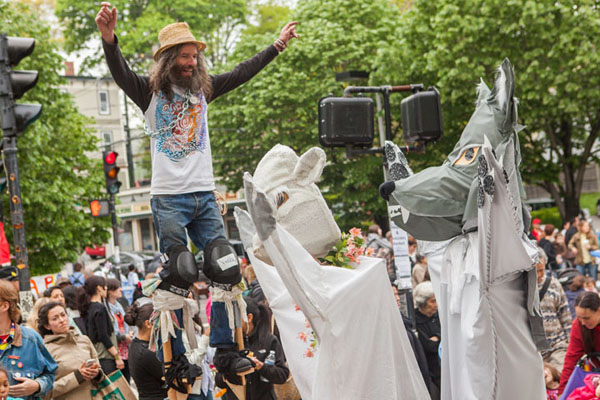
Revelers in the Wake Up the Earth Parade

Revelers in the Wake Up the Earth Parade

There paraders gather in a large circle, and the musicians find a mutual rhythm. The drummers sort out which beat to follow “and it rages along nicely,” Mark told me, “and then there’s everybody standing there facing one another.” I like to picture the various cultural groups in the urban neighborhood all decked out, everyone grinning at each other across the circle.

When the circle dissipates, about 10,000 people will partake of a smorgasbord of participatory fun over the next six hours.

Pageantry and puppetry abound at the Wake Up the Earth Festival

Pageantry and puppetry abound at the Wake Up the Earth Festival

Attendees can play on cardboard slides made from refrigerator boxes, or take part in the all-day drum circle. There’s a “wake up the body” area where people of all ages and shapes practice yoga. There’s an enchanted puppet forest, an amphitheatre with “homegrown circus stuff,” and of course music from every corner (seven stages!). Some 70 crafts vendors offer strictly handcrafted goods, and 25 food vendors sell cuisine from all over the world.

Every nonprofit in the community has a table at the festival, marrying jubilant celebration to civic engagement. It’s a day that brings just about everybody from Jamaica Plain out in a zany, colorful, spectacular celebration of culture and connectedness.

For Dutch-born Femke Rosenbaum, organizer of the very first Wake Up the Earth, this unleashing of imagination is her vision made manifest. “It was always my dream to involve the community in creating the festivals—not to just show up one day, but really to be the creators of it,” she told me.

Co-creation is a beautiful thing, especially in tough times. How does your community come together in celebration?

Images courtesy of Lucie Wicker Photography.

Birthing a New Story

Does it ever seem to you like an age of innocence is past? I’ve been thinking about this since reading Charles Eisenstein’s brilliant article, 2013: The Space Between Stories.

He describes a nostalgia for the cultural myth of his youth, “a world in which there was nothing wrong with soda pop, in which the Superbowl was important, in which the world’s greatest democracy was bringing democracy to the world, in which science was going to make life better and better. Life made sense.”

By Simon Q from United Kingdom (Rusting Sherman Hull Uploaded by High Contrast) via Wikimedia Commons

By Simon Q from United Kingdom (Rusting Sherman Hull Uploaded by High Contrast) via Wikimedia Commons

He talks about how we used to believe that the good folks in charge had things all under control, but of course it’s clear now that isn’t true. Our eyes are opening. We can’t ignore the perpetuation of global poverty and extreme inequity. We’re waking up, painfully, to the destruction wrought in the name of commerce and greed. We see that things are falling apart, and the institutions and experts we used to trust are not going to fix it.

And we can never get back to that old cultural story. We’re birthing the new story now, but we’re in a between-time. Our lack of shared cultural myth makes this a turbulent and often frightening time, with the extreme death throes of the old story showing us the worst of the worst.

Or that’s what Eisenstein thinks anyway, and it rings true for me.

Joanna Macy says it this way:

This is a dark time filled with suffering, as old systems and previous certainties come apart.

Like living cells in a larger body, we feel the trauma of our world. It is natural and even healthy that we do, for it shows we are still vitally linked in the web of life. So don’t be afraid of the grief you may feel, or of the anger or fear: these responses arise, not from some private pathology, but from the depths of our mutual belonging.

Bow to your pain for the world when it makes itself felt, and honor it as testimony to our interconnectedness.

So instead of running from our pain in this chaotic between-time, we can turn toward it, with compassion. We can grieve what’s passing away, mourn what’s lost to us forever. We can acknowledge the emotions that arise as we awaken, even the ones we’ve been taught are best kept locked down.

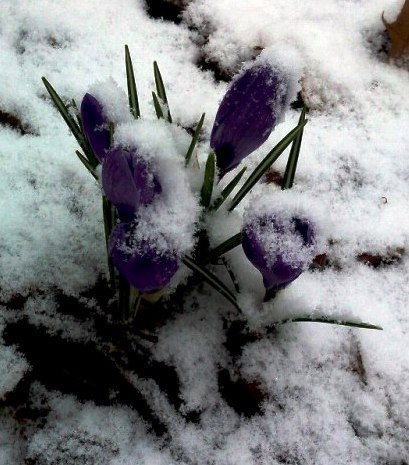
Crocus blooms under snow

Crocus blooms under snow

Instead of cutting off the feeling parts of ourselves, we can invite our whole selves to help dream the new story.

What story shall we create?

Meet the Mudgirls

I’m always intrigued by people who are able to take the more complicated aspects of modern life into their own hands. Maybe that’s because outside of your basic paring knife and garden trowel, my own hands are pretty fumbly. The realm of natural building just amazes me.

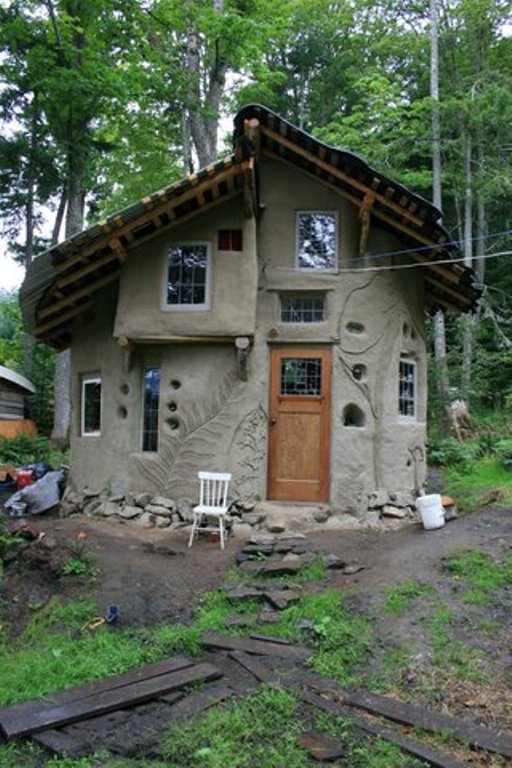
Round Cob House Built by the Mudgirls

Round cob house built by the Mudgirls

Natural building involves using materials occurring in nature (and sometimes recycled materials) to construct homes and outbuildings. For example, back in Too Many Tons I posted a video featuring a DIY builder from Indiana making bricks from mud. Materials are sourced locally—perhaps clay from a neighbor who’s digging a pond, sand from a nearby excavation, straw from a local farmer.

Recently I discovered a British Columbia-based women’s collective specializing in cob building (using a mix of clay and straw). Meet the Mudgirls.

The Mudgirls are a collective of women builders on the west coast of British Columbia, Canada

The Mudgirls are a collective of women builders on the west coast of British Columbia, Canada

For the past seven years they’ve worked together as independent builders, doing seasonal work throughout the Vancouver Island area. Though they started with only about 10 days of work in the early years, many now make their main summer income from this work.

They’ve build cob ovens, cabins, sheds, fences, and outhouses. They also take their craft into conventional homes, using earthen plaster with beautiful results.

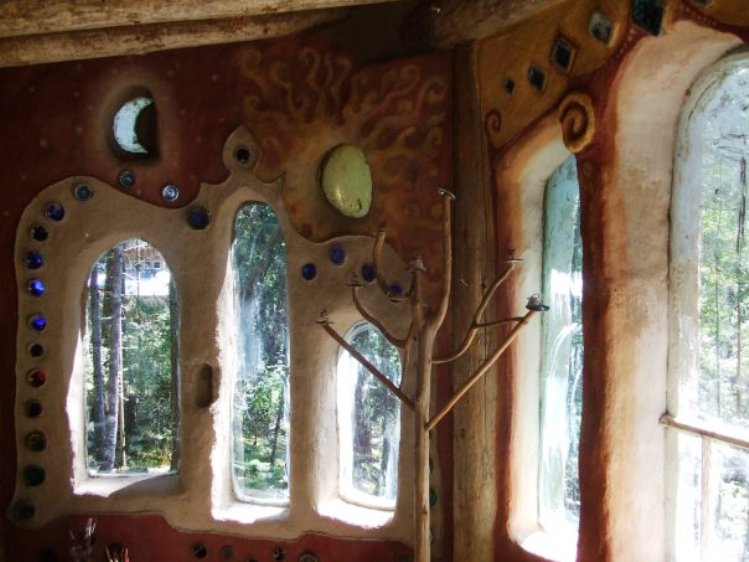
Interior of a Mudgirl-built home.

Interior of a Mudgirl-built home.

As a consensus-run group, they are trailblazing in other ways as well, showing a more egalitarian way to operate than the dominant paradigm’s business-as-usual. And they offer workshops at the most affordable rates in North America ($200 or less).

Mudgirl Rose Dickson, one of the founding members, was drawn to the collective because of her outlook as a feminist/environmentalist/artist. From the photos,* it’s clear that the Mudgirls’ work offers a creative outlet.

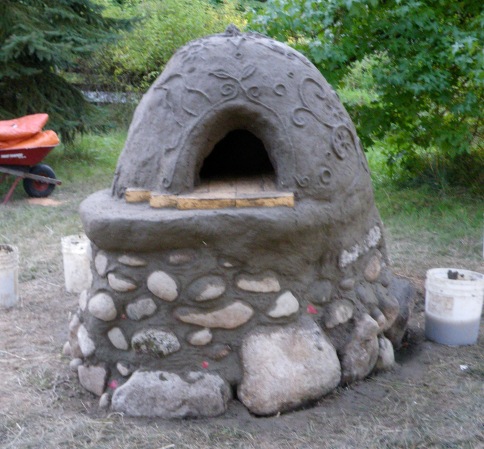
Cob Oven Made by Mudgirls

Cob oven made by Mudgirls

And these round structures are built to last, as witnessed by many such homes in England, still standing hundreds of years after their construction.

Not too long ago, a four-ton tree fell on a Mudgirl-built cob house—crashing through a bump-up of windows and earthen plaster and stopping at the cob wall. Rose reports, “No cracks in the wall from impact, and the guy who came to clear it off said a wooden house would have been crushed by the tree.”

A four-ton tree fell on this Mudgirl-built cob home, stopping at the cob wall

A tree fell on this Mudgirl-built cob home, stopping at the cob wall

Cob building is physically demanding and sometimes uncomfortable work (imagine a chilly spring day when you’re working in cold mud from sunup to sundown). But Rose relishes the chance to be outside, away from a desk, making something with her hands in the company of her dearest friends.

Mudgirls at work

Mudgirls at work

“If the weather’s cold, it can be kind of miserable,” she admits. “But if you’ve got a couple friends there who you’ve known for years and you’re joking and laughing, it makes it. That’s actually one key with natural building is the community. It takes more time, so the labor is a factor. But that’s part of why people do it together.”

This strikes me as the ultimate in do-it-with-others (DIWO). Has anyone out there had experience with communal natural building? I’d love to hear about it.

*Photos provided by Mudgirls.

On Earth Day and Every Day

“The eyes of the future are looking back at us and they are praying for us to see beyond our own time. They are kneeling with clasped hands that we might act with restraint, leaving room for the life that is destined to come.

We have it within our power to create merciful acts.”

— naturalist and author Terry Tempest Williams

Cheselden_t36_prayer(Thanks to Orion Kriegman of Jamaica Plain New Economy Transition for bringing this quote by one of my favorite authors to my attention.)

Pass the Book, Please!

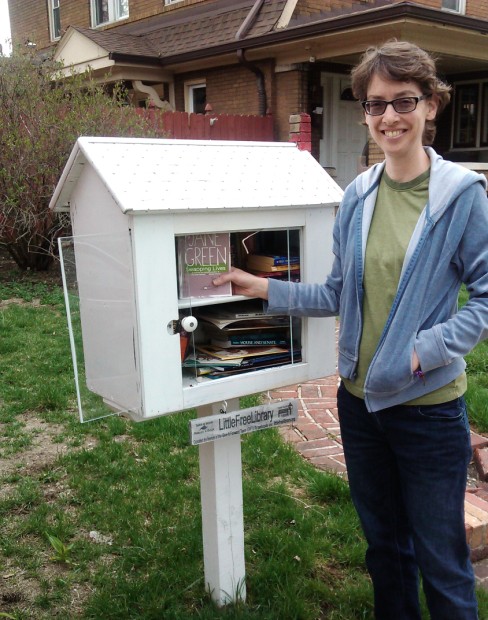
On my walks through the neighborhood I have encountered a curious thing: a little house-shaped structure mounted on a post, with sliding glass doors enclosing one of my favorite things: books!

Little Free Library in my neighborhood

Little Free Library in my neighborhood

It is a Little Free Library, part of a worldwide network designed to cultivate the love of reading by setting up free book exchanges.

Gotta love that. I decided to donate a book and take another home, just for fun. I’d like to say my donation was carefully selected after much intensive soul-searching, Top Ten list-making, and pick-pondering, but the truth is I had just visited Bookmamas, our little independent bookstore, where I was given three advance reading copies of books marked NOT FOR RESALE, so I stuck one of those in.

Putting my book into the mix.

Putting my book into the mix.

The little house-o-books was crammed chock full. Perhaps more people need to stop by and check out the selection.

I came home with a book called Dune Road, by Jane Green. It’s a novel about “divorcee Kit Hargrove (who) has joyfully exchanged the requisite diamond studs and Persian rugs of a Wall Street Widow for a clapboard Cape with sea-green shutters and sprawling impatiens….” Not my usual fare, but hey! I’m open.

Me and my find

Me and my find

I just love the coziness of the little structure, and the community feel of it. I want one in front of my house! (Neighbor-readers out there: do you know if this little library’s stewards made it by hand–or other details about it? No one was home when I knocked–or perhaps they were hiding from the camera phone-wielding/windblown/book-crazy stranger on their doorstep).

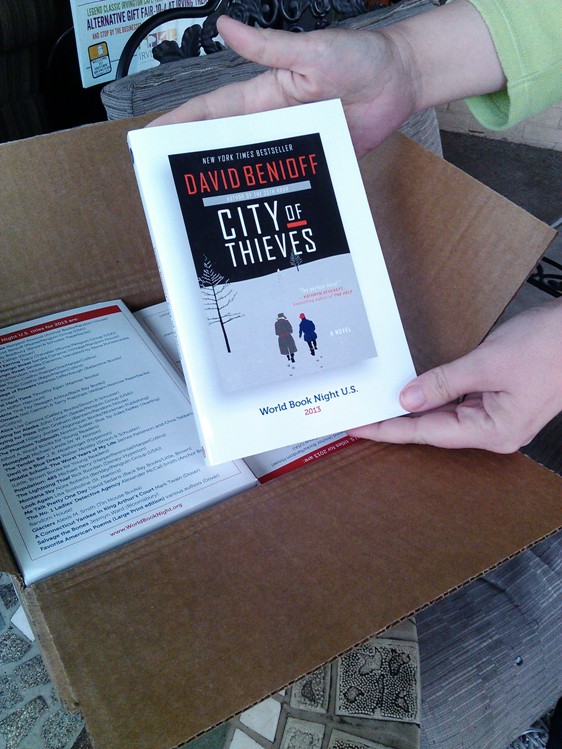
I was just wrapping this post up when the friend working across from me at the coffee shop mentioned that Tuesday is World Book Night, wherein book-lovers sign up to distribute 20 copies of a book–printed and shipped pro bono, with authors foregoing royalties–to people who don’t regularly read. She had ordered a box of books to pass out, so we stopped over at Bookmamas to pick it up.

Special edition books for World Book Night, designated to be given free

Special edition books for World Book Night, designated to be given away

Anyone out there ever participated in a book exchange or giveaway? Are you participating in World Book Night? Chime in and let us know what’s going on in your neck of the woods.

In Troubled Times

This morning when I looked out my front window, I saw that the juneberry we planted two years ago was budding. Through the rain I could see the sketch of pale green buds dotting each limb, all the way out to the tips–with the promise of sweet berries contained in each one.

Buds that will open into a white blossom, eventually fruiting into delicious berries

Buds that will open into a white blossom, eventually fruiting into delicious berries

The young tree has made it through two of the hottest summers on record, and those tender buds gave my heavy heart a lift.

We planted it because we wanted to grow fruit on our lot, and we nurtured it with weekly waterings through crippling drought and heat. When the rain barrel went dry, I carried buckets from indoors, saving shower water, cooking water, and the dehumidifier’s daily emptying–occasionally breaking down and stretching the hose across the lawn to let it run for a slow hour.

There’s a passage I like from Buddhist teacher Thich Nhat Hanh, called Interbeing. It begins:

“If you are a poet, you will see clearly that there is a cloud floating in this sheet of paper…”

My tree contains multitudes. It has the memory of picking juneberries with my dad a few years ago, before he got sick, before he died, in the forgotten pocket park wedged between two busy streets. There were three small trees just loaded with juicy wine-colored berries. Dad picked from the high branches and left me the low ones. When the low limbs were picked clean, he pulled the ends of the high branches down so I could reach.

Also part of my tree is Jason, the neighbor who helped dig the hole and position the root ball on planting day. And Jerome, the young man who brought it to us through his work with Keep Indianapolis Beautiful. This year Jerome has parlayed his passion for trees into his own business as a certified arborist, Tree-Centric Solutions–pledging to not only plant, treat, and prune trees, but find uses for wood from trees that can’t be saved.

My juneberry even holds the “woman tree,” an old redbud whose upreaching shape I cherished. I called her that because she always looked so feminine to me. The woman tree was just beyond where the juneberry is now, and she had to come down because half the branches were dead. Taking her out meant we freed up room for a fruiting tree.

Irony: I learned that redbud flowers are edible just after we had ours cut down. I could have decorated so many salads with the woman tree’s bounty. Not only that, but Jerome’s service came too late for her: What I wouldn’t give to have something made from the wood of that beloved redbud!

So all that’s in this juneberry too: my regrets, my ignorance, my wishing things were otherwise. But mostly, these are outshone by pride and hope.

I share all this because in troubled times, sometimes things like this can help: a small tree in the rain, holding memories and care, covered in promise.

Things That Can’t Be Rushed

Those of us who are bathed in technology much of our lives, that is to say most of the Western world by now, have grown accustomed to having everything happen in a hurry. Speed is the ultimate. Efficiency is king.

I am prone to this, feeling impatient with the rate of change.

Even in gardening, I value a relatively quick turnaround: Plant a bunch of lettuce seedlings, and a month later I can be snipping salad from my own raised bed.

But some things take time, and move in a crooked line, and require great patience to see results.

Photographer: Kessner Photography

Photographer: Kessner Photography

I’m reminded of this when I visit a farmer friend who lives in my neighborhood. Her family farm is called Artesian Farm. It’s in the next county over, where Anna and her farm partners raise grassfed beef.

When she talks about farming, she thinks in terms of decades. For example, the process of transitioning the farm to organic—which her parents wanted to do long before there was any infrastructure of support—has barely begun, and the beginning itself is taking years.

It’s been nearly 10 years of preparation, and a very small portion of the crop acreage is just beginning the transition to organic.

To grow corn and beans organically, and to be certified as such, farmers undergo an elaborate process. One of Artesian Farm’s first steps was adding more cattle. It seems an odd thing: what do corn and beans have to do with the beef side of the business?

But Anna explains that crop rotation is key in organic farming. Hay is their chosen rotation crop. “It’s common wisdom that if you grow hay and sell it off your farm, you’re taking all the nutrition off your farm.” So more cattle were needed to make use of the hay.

A 200-page plan has taken about six years to complete. It would cost $2500 to have an outside agency prepare this plan, on top of the $1000 for certifying. Anna opted for the DIY approach.

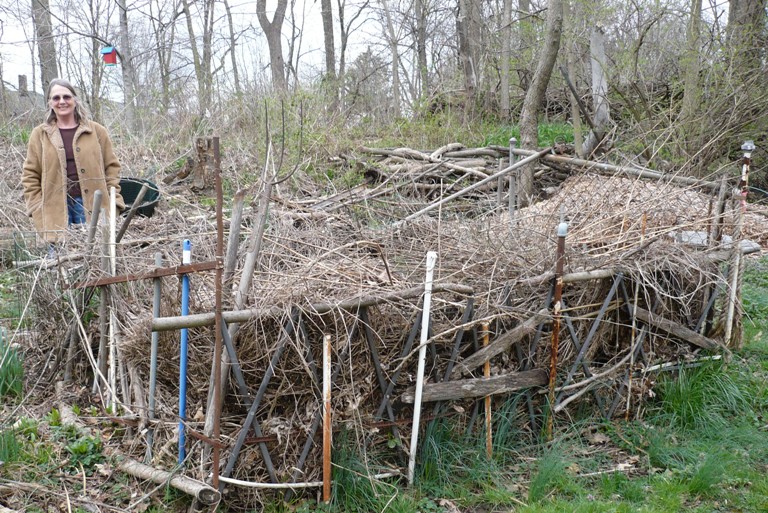
During my visit Anna cuts me some lemon balm, which is near an imposing compost heap about the size of a mobile home. It looks like a small sod house was plunked down in the middle of her modest “back 40.” “How do you turn it?” I ask, thinking of our own compost pile—a midget compared to this—and how it never gets hot enough to kill weed seeds, because we don’t turn it, though we always say we will.

“Oh, I don’t bother turning it. Nature doesn’t turn it, in the woods.”

Anna and her compost bin, which she created “free-hand” with odd broom sticks, twigs, mop handles, rusty pipes, and other finds.

Anna and her compost bin, which she created “free-hand” with odd broom sticks, twigs, mop handles, rusty pipes, and other finds. Photo by Danny Chase.

Walking me back to my car, Anna reflects on the passage of time, how long it takes to make a change, to heal the land, to see results. Those of us who don’t spend as much time with our feet on the soil and hands in the dirt might expect results in a much shorter time frame than the decades that are really required.

Like the compost, like building the humus of the forest floor, there are things that can’t be rushed.

KI EcoCenter Leading in the Green Economy

A local community group near and dear to my heart will be represented at a national event next week. The executive director of Indy’s own KI EcoCenter, also known as Kheprw Institute, will be among the presenters at the Good Jobs, Green Jobs 2013 Conference in Washington, D.C.

About KI: When I first visited, I learned that “Kheprw” is a reference to an Egyptian god represented by a man with a scarab beetle head. The scarab beetle was a symbol of rebirth in ancient Egypt.

It seems a fitting title for this community empowerment center, which works at the intersection of social justice and environmental stewardship in the heart of an economically distressed neighborhood. Here it’s all about nurturing an ecologically sound way of life while creating economic opportunity through community engagement. The programming includes an eco-film series, job creation panels, open mic nights, youth empowerment events, and so much more.

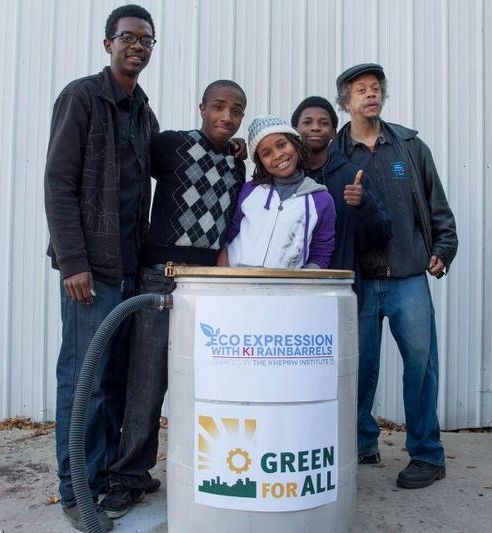
Mat, Rasul, Asli, William, and Imhotep show off an Express Yourself Rainbarrel

Young people in the KI school and mentorship program gain critical thinking skills as they practice social entrepreneurship.

I’ve met many of KI’s children and young adults and they’re not just tomorrow’s leaders—they’re today’s. They know firsthand that with the help of your community, your creativity, and your drive, you can make something from nothing. They’ve built garden beds and aquaponics tanks. They’ve started a paint store, a web services/graphic design enterprise, and a fair trade coffee shop. KI’s work has inculcated in them the confidence and skills they need to navigate the relationship-based economy—whether the goal is a money-maker or a service project or, better yet, both at once.

About the Conference: The theme for the three-day conference is “Let’s Get to Work: Climate Change, Infrastructure and Innovation.” Over 80 workshops will illuminate the possibilities of job creation through green infrastructure. (How refreshing: You mean we don’t have to unleash holy hell in the form of Canadian tar sands in the name of “job creation”?)

KI’s director Imhotep Adisa is a panelist for a workshop highlighting successful sustainable water infrastructure projects. He’ll share KI’s experience in the green economy and its latest social enterprise, Express Yourself Rainbarrels. (I absolutely love this project: The KI crew will customize a rainbarrel with your logo, design, or photograph. I can’t wait to see mine!)

I’ve written a piece for Indiana Living Green about the center that will be out next month. In the meantime, check out this video featuring their work. (Start at minute 3:50 for the segment on KI).

The Shadow Side

Here’s a thought for a gorgeous spring day when the shovel is about as high-tech as I’d like to get.

© Phil Date | Dreamstime Stock Photos

© Phil Date | Dreamstime Stock Photos

For all the successes of Western civilization,
the world has paid a dear price in terms of the most crucial component of existence–
our human spirit.

The shadow side of high technology–

modern warfare
& thoughtless homicide and suicide,
urban blight,
ecological mayhem,
cataclysmic climate change,
polarization of economic resources–

is bad enough.

Much worse, our focus on exponential progress
in science and technology has left many of us

bereft

in the realm of meaning and joy, and of knowing
how our lives fit into the

grand scheme

of existence for all eternity.

From Proof of Heaven, by Eben Alexander