Radical Fungi Are My Favorite Teachers

Guest Post by Peter McCoy

When I get asked why I started the Radical Mycology project, I often say that it was to share the lessons that mushrooms have taught me.

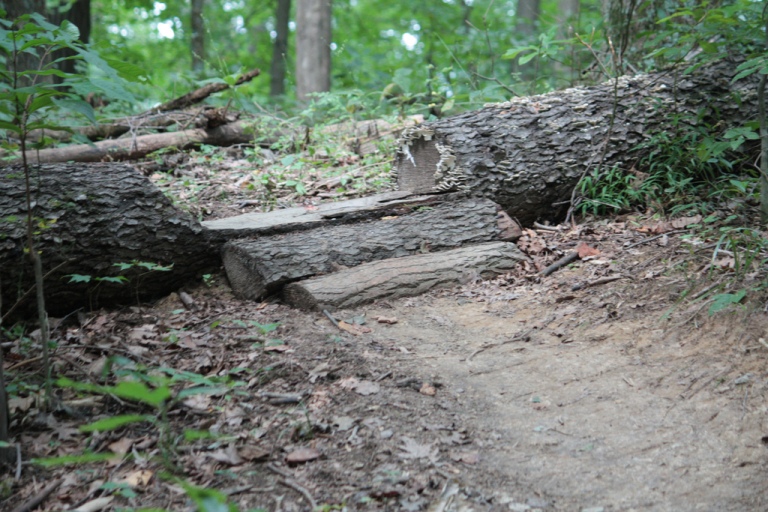
Turkey tail logs

Turkey tail logs

Since I started studying mushrooms as a teenager, I have always seen mycology (the study of fungal biology) as an endlessly fascinating and thought-provoking science. Whether I am using them as a nutritious food source or as a potent medicine, I am always honored to taste their wonderful flavors and alluring textures. Hunting mushrooms in the woods, I love to watch them grow, knowing that they are cleaning the forest soil, protecting plants from disease, and turning decaying matter into fresh topsoil so new plants can thrive.

And using them as remediators, I am awed by the mushrooms’ ability to break down and eliminate some of the most toxic industrial compounds in the world.

Grassroots Bioeremediation workshop with Leila Darwish at the Radical Mycology Convergence

Grassroots Bioremediation workshop with Leila Darwish at the Radical Mycology Convergence

Seeing how the densely branched mycelial networks of mushrooms share nutrients among plants, I also find a wonderful example for humans to follow when working to collaborate with their communities. Further, the incredible spore loads that mushrooms drop in the fall are designed to adapt to any given environment, demonstrating the ability to adjust to challenges and remain resilient during hard times.

These same attributes provide a model for how humans can best relate to each other, whether on a personal or societal level. By mimicking mushroom mycelium, cooperative businesses and housing projects work more efficiently by spreading out tasks and networking with affiliated organizations.

Fungi are also highly symbiotic with most organisms on the planet, so we find, yet again, the importance of collaboration among creatures throughout the fungal kingdom. In essence, fungi act in countless ways as grand harmonizers of the Earth, something that humans can aspire toward to live in balance with their surroundings.
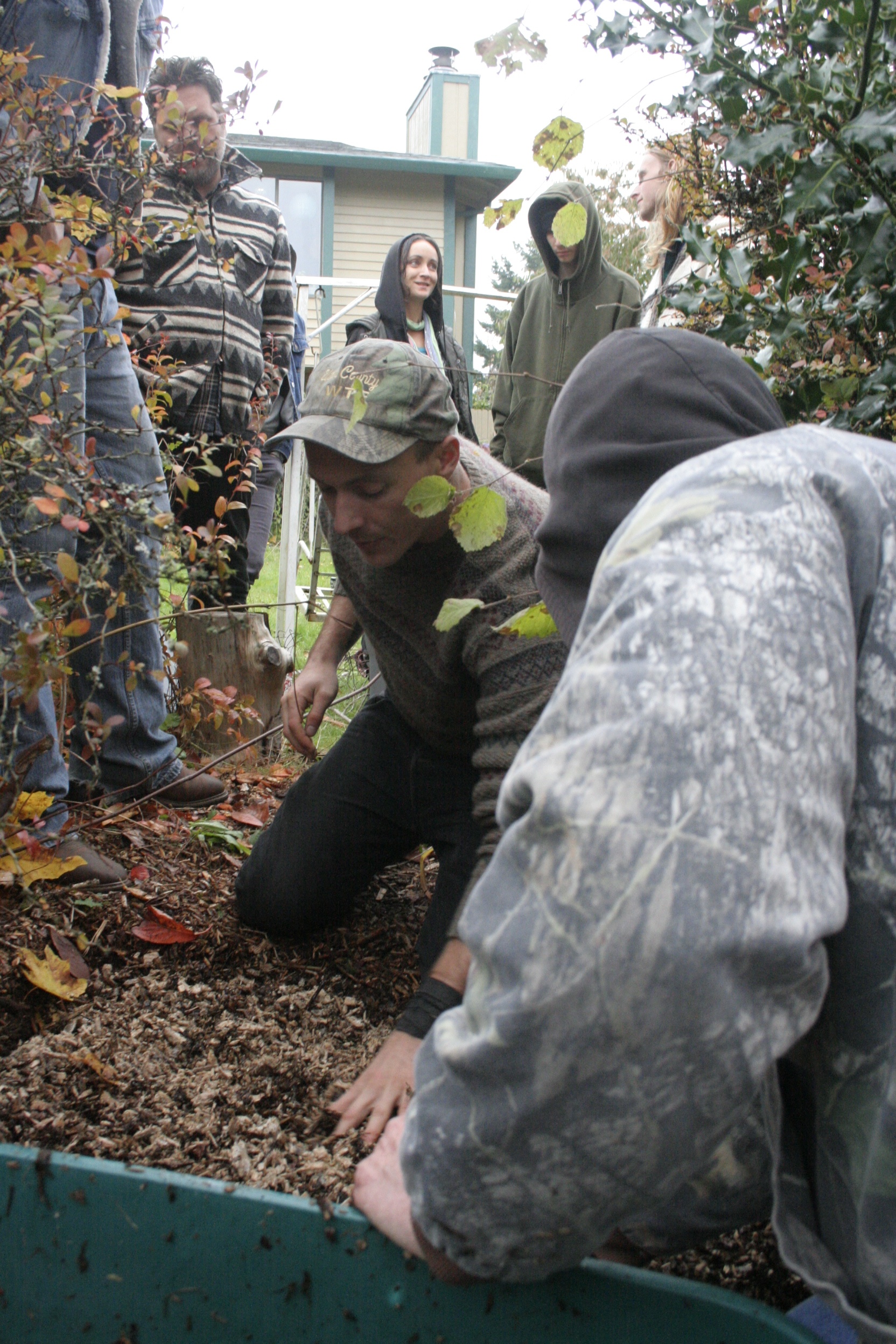
King Stropharia bed installation at Peter's Mushroom Cultivation & Application Course in Olympia, WA

King Stropharia bed installation at Peter’s Mushroom Cultivation & Application Course in Olympia, WA

The Radical Mycology project revolves around just this philosophy: that by studying, working with, and learning from the fungal kingdom, humans can best find solutions to problems of personal, societal, and ecological health. To this end Radical Mycology has put a lot of energy into providing free education to the public on the benefits of fungi.

Our website (radicalmycology.com) is a database of all things mycological. We offer two free publications we have written, Radical Mycology and Mushroom Cultivation For Remediation, as well as instructional videos and protocols for mushroom cultivation.

Nameko Bed installation at Demeter's Permaculture Garden in Olympia, WA

Nameko Bed installation at Demeter’s Permaculture Garden in Olympia, WA

We organize regular multi-day events on mushroom cultivation and its practical applications (the Radical Mycology Convergences), with another being planned for the spring of 2014. And since 2011, two Radical Mycology-inspired volunteer clubs have sprung up in San Francisco, CA and Olympia, WA. These groups teach free workshops about simple and practical mushroom cultivation and community resilience.

The next and biggest project for Radical Mycology is writing a book exploring the theory, practice, and applications of mushrooms for personal, societal, and ecological change. We are currently in the midst of an Indiegogo crowdfunding campaign to fund the book. Our campaign page will soon be up and running. Stop by the Radical Mycology website to learn more about our work.

Update: The Radical Mycology Book fundraiser is underway! This unique book on the uses of mushrooms and other fungi for personal, societal, and ecological wellbeing will be a powerful resource for the geek and do-gooder inside us all and we are excited to bring this dream to the rest of the world.

You can view the live campaign here:

http://bit.ly/radmycogogo

Postcard from Hopland, CA

This weekend was the big Building Resilient Communities Convergence in Hopland, CA. I was excited to be there for part of the action.

A highlight was the mycology skillshare, during which Fungaia Farm‘s Levon Durr demonstrated several methods for home mushroom cultivation.

Teaching how to cultivate oyster mushrooms at home using the stem butt/cardboard technique to grow your own spawn. Sweet!

I didn’t know until recently that shrooms actually are a source of protein. This makes me even more determined to try cultivating my own.

I thought Levon was going to levitate when he got to the part about mycoremediation. His enthusiasm is not misplaced: Mushrooms can clean petroleum from drainage ditches and aid in riparian zone restoration. They even eat heavy metals and bacteria.

The practice of using fungi to clean our beleaguered earth of toxins is one of the most hopeful stories I’ve heard. It is also the subject of an upcoming guest post from Radical Mycology, so stay tuned.

Indestructible

Here’s the mother of the modern environmental movement, on the importance of nurturing children’s connection with the natural world.

Boy scout photographing nature at the Edwin B. Forsythe National Wildlife Refuge. Photo credit: USFWS, via flickr Commons

Boy scout photographing nature at the Edwin B. Forsythe National Wildlife Refuge. Photo credit: USFWS, via flickr Commons

“If I had influence with the good fairy who is supposed to preside over the christening of all children

I should ask that her gift to each child in the world

be a sense of wonder so indestructible

that it would last throughout life,

as an unfailing antidote against the boredom and disenchantments of later years,

the sterile preoccupation with things that are artificial,

the alienation

from the sources of our strength.”

—Rachel Carson, The Sense of Wonder, 1956

To Be Hopeful in Bad Times

Howard Zinn, by Jim from Stevens Point, WI, USA, via Wikimedia Commons

Howard Zinn, by Jim from Stevens Point, WI, USA, via Wikimedia Commons

On this Labor Day, here’s a quote from a celebrated historian, the voice of the common people.

“To be hopeful in bad times is not just foolishly romantic. It is based on the fact that human history is a history not only of cruelty but also of compassion, sacrifice, courage, kindness.

What we choose to emphasize in this complex history will determine our lives. If we see only the worst, it destroys our capacity to do something. If we remember those times and places—and there are so many—where people have behaved magnificently, this gives us the energy to act, and at least the possibility of sending this spinning top of a world in a different direction.

And if we do act, in however small a way, we don’t have to wait for some grand utopian future. The future is an infinite succession of presents, and to live now as we think human beings should live, in defiance of all that is bad around us, is itself a marvelous victory.”

—Howard Zinn, from You Can’t Be Neutral On A Moving Train, 1994

Book Offers a Vision of the Possible

I’ve had this book out from the library the past few weeks, but after test-driving it, I just emailed Kathleen at Bookmamas to ask her to order it for me. It’s a keeper. Here’s my review:

Wendy Tremayne’s The Good Life Lab: Radical Experiments in Hands-on Living gives a powerful example of a reimagined world in the shape of one couple’s desert homesteading adventures.

Prickly pear, an example of the desert bounty gathered by Tremayne. Photo by Jon Sullivan [Public domain], via Wikimedia Commons

Prickly pear, an example of the desert bounty gathered by Tremayne. Photo by Jon Sullivan [Public domain], via Wikimedia Commons

Many of us work toward self-sufficiency (or better, community-wide resilience, broadening the circle from homestead to neighborhood). But we’re hampered by the need to make money to prop up our lifestyles, cutting into the time we have to learn and practice new skills. Wendy and partner Mikey demonstrate what is possible by leaping into a completely new way of life. They cash out their retirement accounts (a prescient move, before the crash) and transplant themselves into Truth or Consequences, NM to build a new life.

And build they do: using waste materials and nature’s bounty, they craft a beautiful, abundant, interconnected home base that allows them to live their deepest values.

In contrast to some “green lifestyle” books that focus on giving up luxuries for the earth’s sake, this book offers an exuberant romp through the reclamation of life’s biggest gifts: time, beauty, creativity, connection, purpose. More than just a memoir, it is an invitation to adopt the “maker” mindset. Tremayne’s lyrical descriptions of the spiritual aspects of this journey, coupled with the gorgeous, whimsical artwork and photographs, make this an inspirational book.

The author (who founded Swap-O-Rama-Rama, a community-based textile repurposing/skill sharing extravaganza) observes, “When all of life is for sale, it is a revolutionary act to become a maker of things.” She describes “life in the waste stream” as the ultimate freedom.

“By relying on waste, on what nature provides, and on ourselves, we gave the world a chance to demonstrate abundance. By becoming makers of things, we let our creativity become a transformative link between the free materials available to us and the finished goods that made our lives better.”

She notes that mistakes are part of this process, and describes combatting the inevitable “I can’t do that” by simply taking the next step. For those of us who consider ourselves less than handy (ahem), the book offers both challenge and a roadmap. The last section, in fact, provides concrete steps toward reclaiming the building blocks of life, covering food, power generation, fuel, and shelter.

The physical book itself embodies the new world by its very design, in which art and joy and utility are married into a brilliant manifesto.

In short: Stop what you are doing and order one now from your local independent bookstore, people!

(Can’t wait till your book arrives? Hungry for more after reading it? Check out Wendy and Mikey’s blog at Holy Scrap.)

Finding Refuge

Some days you wake up thinking, What is the point of any of this? Why do I self-inflict all this work, all these expectations? Your writing feels stale, your tasks stretch before you like so much drudgery, your paperwork piles to the ceiling.

And you think: I will never, ever catch up. I will never move through the world without this exhaustion. I will never be able to fully focus on my writing the way I need to.

Then a note appears in your inbox from a woman you contacted months ago. You mailed her your application in slim hope of gaining entry to a selective writers’ retreat miles away. The first words in this email are “I am delighted to inform you…” You read the note again. And again.

And the whole sky can’t contain your gratitude.

By Frank Schulenburg, via Wikimedia Commons

Tomales Bay, which is overlooked by Mesa Refuge from its bluff. Photo by Frank Schulenburg, via Wikimedia Commons.

For two weeks in October, I will reside with two other writers at Mesa Refuge, a retreat for people exploring the intersections of nature, economics, and social equity.

It’s a precious gift—a chance to dive deep.

“The landscape of sky, marsh, and bay flowing to the sea helped concentrate my mind. I loved the quiet. I loved the wild garden overlooking the wetlands below and the hundreds of birds circling above. It is rare and wonderful to feel so quietly cared for—so completely supported and encouraged.”

—former resident Chris Desser

Some of the authors I admire most have found the solitude and focus here to create their transformative books: Michael Pollan. Terry Tempest Williams. Frances Moore Lappé. Natalie Goldberg.

These are writers whose work has changed my life. There are no words adequate to express how honored I am to gain a place in this residency program.

And what a thrill to get this tweet from an alumna today:

Already I feel renewed by a beneficent universe.

Advice for Writing and Living

I’m home from the Midwest Writers Workshop, where the keynote speaker, mystery writer Hank Phillippi Ryan, shared “What I wish someone would have told me.”

By Kartikay Sahay via Flickr Creative Commons

By Kartikay Sahay via Flickr Creative Commons

The advice was writing-related, from how to deal with solitude (“You write alone, but you are not alone”) to the inevitability of self-doubt (“Before you burn your manuscript, make a copy.”) Still, I was struck by how much of her guidance also applies to those of us invested in the critical work of remaking the world.

First up: mention was made of the classic Bird by Bird by Anne Lamott. In which Anne’s brother, in grade school, waits to begin a report till the night before it is due. The topic? Birds of North America.

Not surprisingly, he comes nearly unglued in panic. Their father, a writer, counsels him, “Just take it bird by bird, buddy. Bird by bird.”

Then there’s this:

“What would you attempt to do if you knew you could not fail? Do that. Be brave.”

And finally, the need to be happy, to love what you are doing, and to enjoy the place where you find yourself. “This race goes to the stubborn and bullheaded, but it’s also wise to have a good time.”

I was planning to discourse on how these nuggets inform the life of a hopeful thrivalist, but my brain is pretty much a mashed potato right now. So how about this instead:

Discuss.

Lessons from Sugar Man

The documentary Searching for Sugar Man came up in conversation with friends last night. If you haven’t seen this Oscar-winning gem, go immediately to your preferred film source and get it. (Immediately after you finish reading this!)

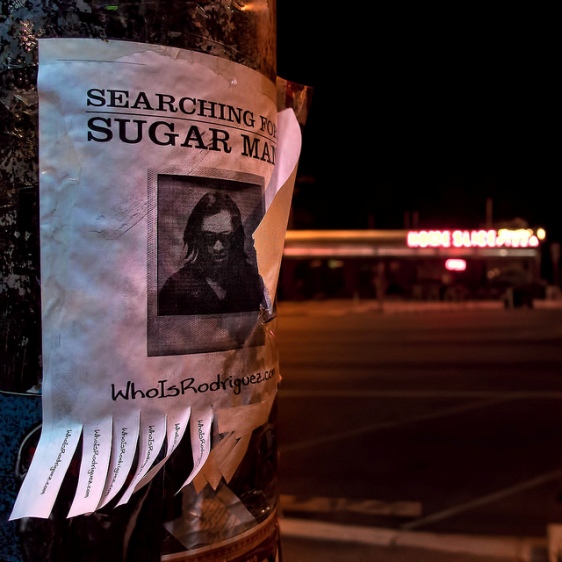
Photo by David Ingram

Photo by David Ingram, via Flickr Creative Commons

I won’t give too much away, because the joy of this film is experiencing the discovery. In brief: Rodriguez, a Detroit musician whose lyrics and style rivaled Dylan’s, made two records in the early 70s. Both flopped. End of story—as far as anyone knew in the U.S.

But in sequestered South Africa, where apartheid had a stranglehold, his anti-establishment message galvanized a generation. There Rodriguez became a superstar—and a mystery. Rumors circulated about a dramatic onstage suicide, involving self-immolation or a gun. Because South Africa was cut off from the rest of the world, in those pre-Internet days, there was little to go on. Who was he, and how did he die?

The story unfolds from there.

In our case, the film sparked a discussion about the impossibility of ever knowing the impact of your deeds.

Clayton said he recently talked with his young son about what it means to be a good person, and how important it is to get off your duff and do something. “You can’t just sit around your house and say you’re a good person. You have to get out and make a positive effort.”

And it doesn’t matter if you fail, because the simple fact of your trying may inspire someone else, Clayton believes.

To my mind, “positive effort” could be as simple as a kind word or smile. We don’t know how these little things might bolster someone facing an inward darkness, or outward danger.

I seem to write about this often: that acts we think of as small actually have great power. Most of us, living our lives in defined spaces, consider our influence very small. Our lives seem circumscribed by smallness; we go to and fro, following our routines, taking care of the details that make up a life.

We may feel that we are too insignificant to make a difference in the fate of our planet and our race.

Yet everyone can do small things with great love, and who can know the ripple effect? Especially if we work in tandem with others.

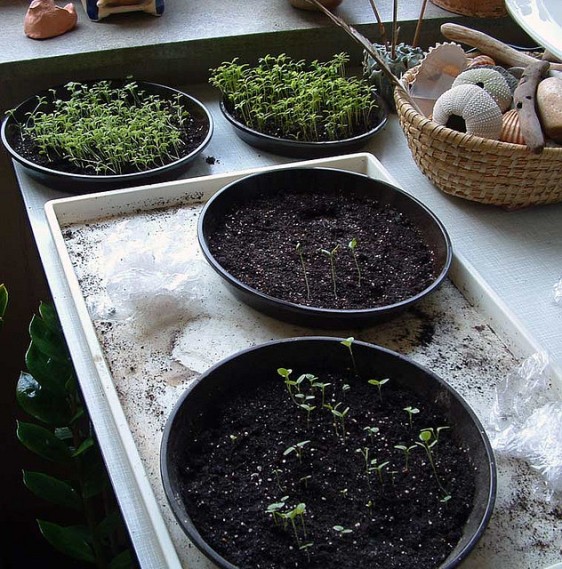
Photo by Lisuebie, via Flickr Creative Commons

Photo by Lisuebie, via Flickr Creative Commons

The row we plant might be just the encouragement our elderly neighbor needs to start seeds on a windowsill. Which might nudge her granddaughter to visit a farmers market and buy a farmer’s tomatoes, and one of those funny-looking squashes while she’s at it. Maybe she’ll come back in ensuing weeks and bring her children and a friend, buying more locally grown food. Which shows the farmer that his produce is desired, and keeps him from throwing in the towel after a tough summer.

Think about it.

(And seriously, see the film. Then watch the “making of” extra. If you’ve ever been so discouraged that you nearly gave up a dream, you’ll connect to the story behind the film.)

My Dad, Who Made the World Better

Father’s Day meant a pilgrimage to a few places special to my Dad, who died last year. His handprints are all over this town, but I chose a couple places with personal meaning:

1. Holliday Park, down by the river. Because he used to take the grandkids out into the water with a seine to see what they could catch. Also, he kayaked that river many a time. (Once with me. I was not in the best shape then, and he ended up tying a rope to my kayak and towing me into the wind, all the way back to our put-in place.)

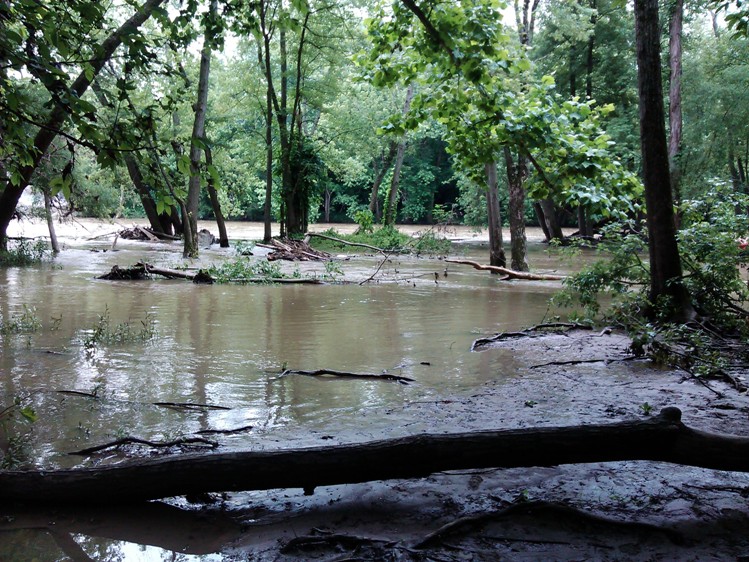
IMG_20130616_161417

The water is not this muddy and high in my memories of Dad taking the grandkids out. All the rain lately.

2. Holliday Park Nature Center. Just to visit his brick.

We honored Dad with this walkway brick at Holliday Park Nature Center on his retirement.

We honored Dad with this walkway brick at Holliday Park Nature Center on his retirement.

3. A pocket park where he and I picked juneberries. Sweet memory. I picked yesterday in his honor.

In truth, Dad is ghosting about the edges of nearly every blog post I write. I see him in the anonymous man in the Keystone Pipeline protest photo—he used to wear that kind of cap, and he marched for important causes. I see him in Keith Johnson, sharing his passion for the natural world.

And I see him in David Forsell, facing death too soon, knowing that what counts is giving back.

A few months before he died, he received the Hoosier Environmental Council ‘s Land Steward of the Year award for his volunteer work (though “work” is a misnomer—he often said, “I’m just having fun.”) A sampling of his fun:

  • He started a multi-year restoration project to return Indiana State Museum’s Turner Gardens to Indiana native prairie (still going on now).
  • At Cold Spring School, he was “chief gardener” and caretaker of the greenhouse, introducing grade schoolers to the marvels of the garden.
  • He took student groups on rafting trips, and led them on tours of natural places.
  • He spearheaded Indiana Native Plant and Wildflower Society’s Letha’s Youth Outdoors Fund, funding field trips to get schoolchildren out into nature.
My dad at the kitchen sink. You can't tell but he's wearing his favorite "Life is Good" Shirt, the one with the dog wearing the backpack.

My dad at the kitchen sink in 2010. Strong as an ox. You can’t tell but he’s wearing his favorite “Life is Good” shirt.

Now and then my mail brings evidence of his impact, and it always makes me happy and sad. Two examples:

From Friends of Cold Spring School: The fifth-graders have adopted the prairie he led students in planting around “Mr. Donovan’s Greenhouse.”

From Indiana Native Plant and Wildflower Society: At Dad’s urging, a Gary-area nonprofit working with urban youth applied for funds to visit the Indiana Dunes National Lakeshore—a wild place largely unexplored by these kids (who live less than a mile away!). The funding allowed 40 young people to experience the beauty of this national park.

I remember when he met these folks and encouraged them to seek funding. It was at the Hoosier Environmental Council luncheon where he received the award. He was quite frail by then, but still networking, still advocating for kids and nature. It didn’t matter that the title of INPAWS “Youth Outreach chair” had long since passed to someone else.

That’s my Dad to a T. Sure do miss him.

Addendum: I forgot to include this recent piece published in the Boiler Journal, describing a day soon after he was diagnosed with terminal cancer.