Working with Nature to Sustain Life

There’s a fatal flaw in the traditional definition of sustainability—meeting today’s needs without jeopardizing future generations’ ability to meet their own needs.

The problem? This notion leaves out every species besides homo sapiens.

The truth is, “Human beings don’t sustain shit,” sustainability consultant Brandon Pitcher declares. “Nature sustains us. We fool ourselves into thinking we sustain the planet, but it’s the other way around.”

But Fritjof Capra’s view of sustainability is more integrated:

“A sustainable human community is designed in such a manner that its ways of life, technologies, and social institutions honor, support, and cooperate with nature’s inherent ability to sustain life.”

By Alaricmalabry (Own work), via Wikimedia Commons

By Alaricmalabry (Own work), via Wikimedia Commons

Pitcher, a certified practitioner of ZERI (Zero Emissions Research & Initiatives, a global network seeking solutions to world challenges), spoke at the Irvington Green Hour Tuesday night. He gave two scenarios of solutions patterned after nature’s wisdom.

The Power of Shrooms
The first involves using mushrooms to address multiple issues, such as in the case of an invasive species troubling poverty-stricken parts of Zimbabwe. There water hyacinths choke waterways, to the point that people can’t take their boats down the river, jeopardizing their livelihoods in an area already strained by high rates of HIV.

However, once harvested, dried, and sun-sterilized, this invasive species is ideal food for mushrooms. Villagers take the work on, and native mushrooms thrive on this biomass. Reintroducing mushrooms as a food source demonstrates how tasty and nutritious these powerhouses are—and they can provide enough protein to sustain a community in two to three weeks, Pitcher says.

Mushrooms also figure in food security efforts in Colombia, where the coffee plant forms a substrate for edible fungi. Typically 99.8 percent of coffee is thrown away or burned on its way to our morning cuppa. But “waste” is opportunity.

Coffee Plant, by Jo N, via flickr Commons

Coffee Plant, by Jo N, via flickr Commons

The Wisdom of Water
Pitcher’s second example is a natural way to treat wastewater.

In Indiana, 92 cities, including my hometown, have antiquated combined sewer overflows (CSOs).

Combined sewer overflow effects, by Christopher Zurcher, via flickr Commons

Combined sewer overflow effects, by Christopher Zurcher, via flickr Commons

Never heard of a CSO? You’re lucky. Here whenever it rains a fraction of an inch, raw sewage combines with stormwater runoff and runs straight into waterways. So pathogens and toxic chemicals are dumped into my neighborhood’s Pleasant Run and other sweet little streams.

The remediation plan involves drilling enormous pipes deep underground to hold the excess sewage. To Pitcher, this represents a wasted opportunity—and a sad ignorance about the way water naturally purifies.

“Water does not move in a straight line in nature,” he points out. Its natural flow creates vortexes that clean it. “It’s very ignorant of us to think we can move water through pipes in straight lines and think that water’s going to be healthy.”

An integrated system of rain gardens and wetlands harnesses the power of algae to treat wastewater. In Indy, such a system could have resulted in a decentralized network, providing jobs and clean water in perpetuity, Pitcher believes.

For more information, see the ZERI site, or The Blue Economy—or attend Pitcher’s upcoming  sessions at Trade School Indy.

From Dismemberment to Oneness

Rebecca Solnit, on how leprosy numbs the extremities so that sufferers don’t realize when they are damaging their own tissues:

“The disease strangles nerves, kills off feeling, and what you cannot feel you cannot take care of.”

She speaks of a kind of dismemberment, of patients who feel no pain, so they injure themselves, even blind themselves.

She quotes a missionary doctor: “One of the boys said to me, “My hands and feet don’t feel part of me. They are like tools I can use. But they aren’t really me. I can see them, but in my mind they are dead.'”

Reading, it struck me that this statement could also sum up the dominant cultural attitude toward our own earth home. Though we belong to her and she to us, for so long we’ve disowned her, exploiting her riches as just so many dead “resources.”

We’ve been operating under the delusion that we are separate from the biosphere and the myriad life forms that share it—and separate from each other too. The results are catastrophic. If we lack feeling for each other, the soil under our feet, the waters that flow, and the skies above, we won’t consider these worthwhile of care.

"Holding Hands," by Paige Shoemaker, via Flickr Creative Commons

“Holding Hands,” by Paige Shoemaker, via Flickr Creative Commons

But perhaps that’s changing now, bit by bit.

More and more of us are waking up to our empathetic selves. We’re feeling a kinship not just with other humans but with the earth herself. We’re re-membering our entire human family and our deep connection to the planet that holds us.

I think of the empathy displayed by Antoinette Tuff as she disarmed a young mentally ill man bent on violence in her school. In the midst of her fear, this bookkeeper found a way to connect with the young would-be shooter, seeing him as a hurting soul. Her ability to reach him on a human level may have averted a major tragedy.

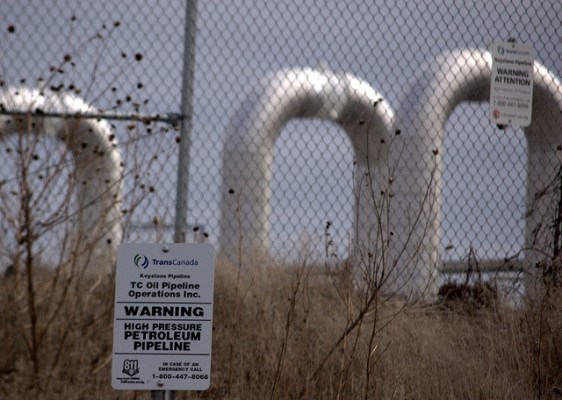
Meanwhile, this summer a group has been tracing the route of the Keystone XL Pipeline in the Great Plains. The pipeline, as I posted in May, would allow the release of enormous levels of carbon—enough to create irreversible climate change.

Trans Canada Keystone Oil Pipeline, by shannonpatrick17, via Flickr Creative Commons

Trans Canada Keystone Oil Pipeline, by shannonpatrick17, via Flickr Creative Commons

Taking both a physical and a spiritual journey through the heart of North America, Compassionate Earth Walk aims to nourish the earth, while inviting all humans to return to oneness in the community of life.

From the story on Resilience.org:

“We walk in response to climate change and in gratitude for the earth which has given freely to us for so long. We walk as an act of healing both symbolic and literal, including healing of the walkers, the land, the communities impacted by the pipeline, and the whole human consciousness of separation.”

No more numbness. No more dismemberment. The pain of our suffering planet and fellow earthlings might be difficult to face, but feeling it means we’re awake. It means we can care.

To Be Hopeful in Bad Times

Howard Zinn, by Jim from Stevens Point, WI, USA, via Wikimedia Commons

Howard Zinn, by Jim from Stevens Point, WI, USA, via Wikimedia Commons

On this Labor Day, here’s a quote from a celebrated historian, the voice of the common people.

“To be hopeful in bad times is not just foolishly romantic. It is based on the fact that human history is a history not only of cruelty but also of compassion, sacrifice, courage, kindness.

What we choose to emphasize in this complex history will determine our lives. If we see only the worst, it destroys our capacity to do something. If we remember those times and places—and there are so many—where people have behaved magnificently, this gives us the energy to act, and at least the possibility of sending this spinning top of a world in a different direction.

And if we do act, in however small a way, we don’t have to wait for some grand utopian future. The future is an infinite succession of presents, and to live now as we think human beings should live, in defiance of all that is bad around us, is itself a marvelous victory.”

—Howard Zinn, from You Can’t Be Neutral On A Moving Train, 1994

A Beautiful Indebtedness

I’ve been reading Rebecca Solnit’s latest resonant book The Faraway Nearby, and every day there’s a new discovery—about writing, about alienation, about the uses of stories. This morning’s passage evoked the web of interrelatedness and care that can happen among neighbors and friends.

In the author’s case, a cancer diagnosis showed her how much goodwill she had banked. People came from everywhere to help her.

She reflects:

“Before money…people didn’t barter, but gave and received as needs and goods ebbed and flowed. They thereby incurred the indebtedness that bound them together, and reciprocated slowly, incompletely, in the ongoing transaction that is a community.”

In some parts of the world, surely this beautiful indebtedness is still the norm. In my neighborhood, it’s making a steady return, in many small ways.

Some intertwined examples from this past week: I put a call out for dill on the Facebook Neighbors Garden page, offering other herbs in exchange. I’d planted dill, but the black swallowtail caterpillars ate every single sprig of it.

Black swallowtail caterpillars happily chewing up my dill earlier this summer

Black swallowtail caterpillars enthusiastically chewing through my dill supply earlier this summer

I wasn’t too sad about the loss, knowing the beauty that would come of it—until I saw the enticing baby cucumbers at the farmers market and ended up buying three pounds’ worth. I wanted to make a crock of pickles.

Happily, Amy of Fraudulent Farmgirl fame offered her unused dill. Over the weekend I biked over to harvest some, using most of it for pickling and borscht.

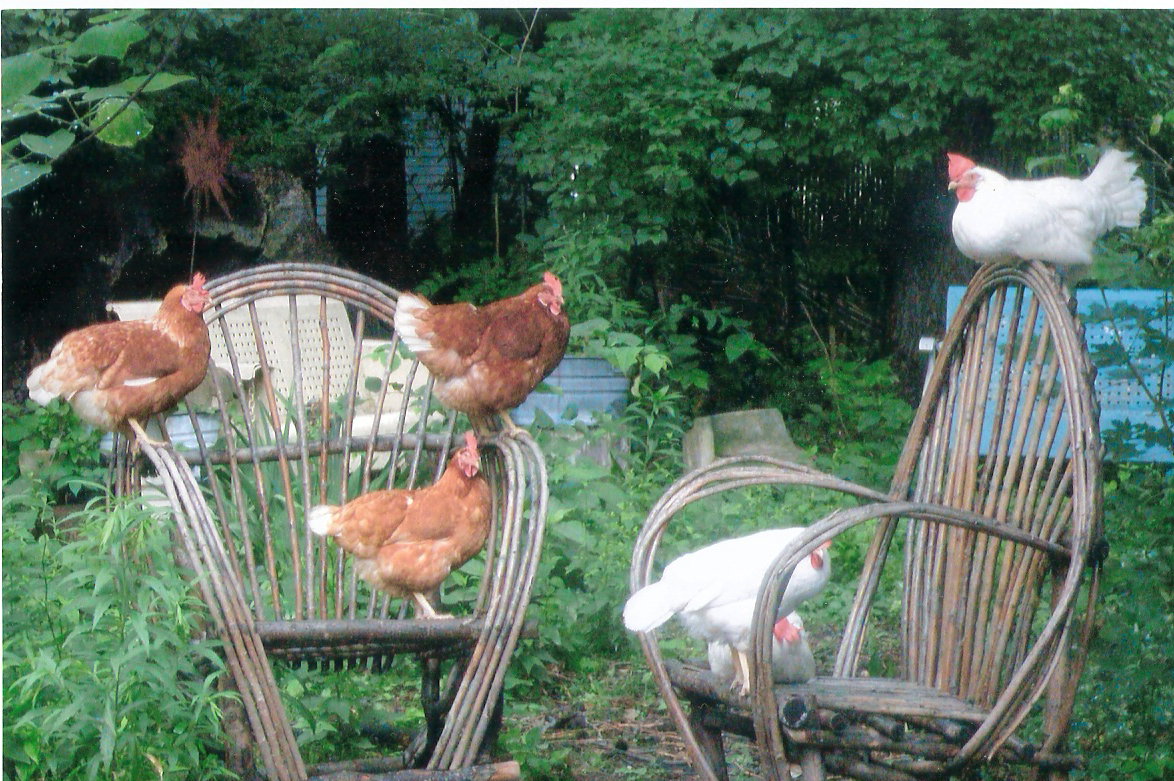
On that same bike trip, I stopped at Laura’s to unload some goodies on her hens. That morning I had cut back my severely cabbage worm-infested collards. I brought over the collard leaves, creepy crawlies and all, for the chickens‘ enjoyment. Laura sent me home with heirloom tomatoes and a photograph of the hens posing for a family portrait.

Laura's contented flock

Laura’s contented flock

Today Dawn Facebooked her own plea for dill, and since I had some left, I took it down to her house on my morning dog walk. Dawn put three things into a blue cloth bag of mine that was at her house from some earlier exchange. I came home with:

  • a salsa wrap made from her dehydrated tomatoes
  • grape juice from another neighbor’s unused Concord grapes (Dawn and I had picked the grapes Monday while catching up on life)
  • some maca powder, having mentioned in passing that I’d run out

I promptly put the maca in a green drink, the one I’m sipping right now. It also contains: frozen blueberries (brought back from Michigan by Anna), whey (received from Corinna down the street who makes her own Greek-style yogurt), lettuce (from farmers market), and kale (from my garden).

To add further depth to this web of connection: Laura was the source of my kale seedlings, a late-summer addition to my garden and currently the focal point of my daily worm-picking meditation. I no longer squish or stomp the worms while grimacing and/or squealing. I save them for Laura’s hens. The very hens that supply my eggs.

Writing this, I’m realizing my good fortune: my indebtedness extends even beyond my human neighbors.

What precious debts have you incurred in your community?

To a Young Cicada

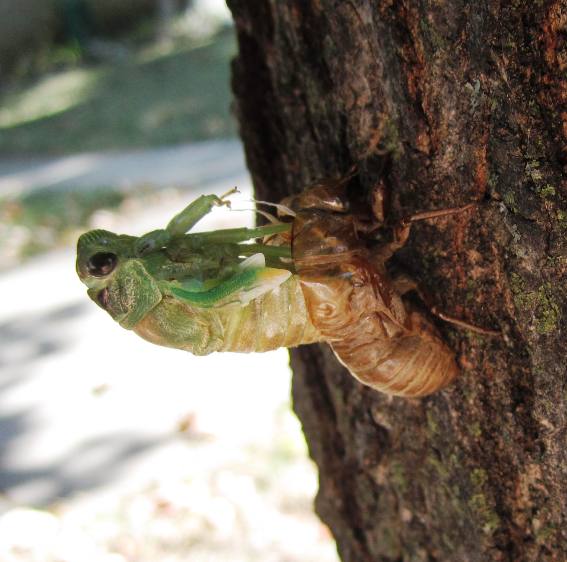
I looked for you today. There on the trunk of the maple tree, surrounded by the carapaces of your siblings, you’d been left behind. You were still unzipping your old skin and squeezing out. I saw your convulsive twitch, your jointed limbs, your staring eyes. Your struggle to be born. Your excruciating vulnerability in the moment of leaving your armor.

top viewI know you from your song, the vibrating sine wave soundtrack of every August of my life. Your evening crescendo drowns out human words spoken under the trees.

cicada shell

I know you from your shell, the source of childhood torment. Yesterday I picked one off a raspberry with shivering fingers, reliving the horror of such husks left by a prankster brother: on my pillow, my bookshelf, my lightswitch.

I know you from your rare jittering bounce on the ground, a curiosity for the dog, an opportunity for the cat. And once you turned up at my back door after I wrote a poem in which you starred. You looked at me as if to say, You rang?

cicadaBut I’ve never seen you like this, in the act of slow-motion vaulting into your new shape.

for blogDoes it hurt, this freeze-frame backflip into airborne freedom? It looks like it would hurt.

Maybe it hurts like a numbed limb awakening, the flow of blood returning. A rightness in the pain. A sensing that what comes next is flight.

Do you look back at that exoskeleton that used to house you, once you’ve finally juddered free? That hull too small to contain you? No. The buzzing symphony pulls you up to the treetops. You ready your instrument.

Releasing and Emerging

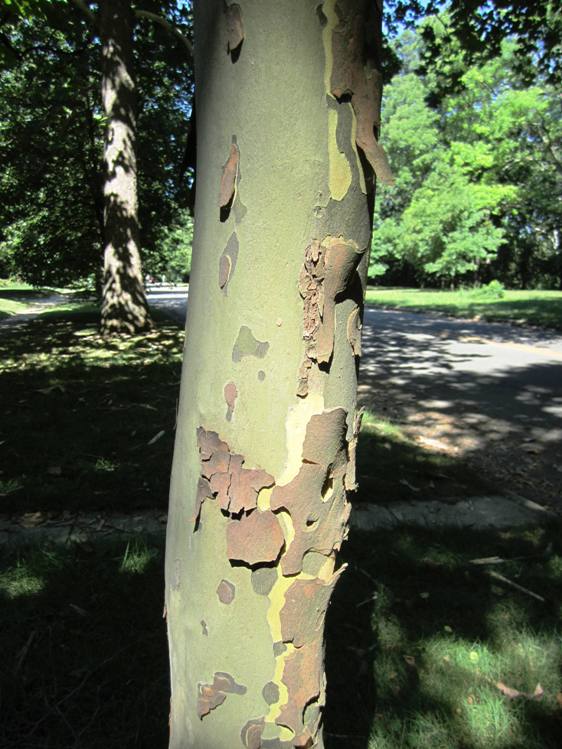
Along my street, the sycamores are shedding. Great scrolls of bark pile in drifts around each trunk’s base. The new “skin” is a tender green. It’s like the trees have hit a sudden growth spurt.

Seeing this always makes me wonder what I myself need to release in order to grow.

Sycamore in process of shedding

Sycamore in process of shedding

Lately I’ve been thinking about the concept of emergence, introduced to me by an Ohio group called Simply Living. Emergence happens when networks form around a common vision, allowing powerful social change movements to arise seemingly overnight. Witness the local food movement.

The term also appears in Marjorie Kelly’s book Owning Our Future: The Emerging Ownership Revolution. She contrasts the phenomenon with top-down policies imposed on a community. Instead, change emerges organically at the local level, rooted in community need.

Once again, it’s trusting the power of smallness.

Simply Living notes that emergence requires “staying present with the work at hand, yet paying attention to emerging opportunities.”

It’s a tough thing to discern, in both working groups and in individual endeavors. Clearly we can’t do everything. What to pursue, what to leave aside? Which brings me back to those sycamores.

My own life has taken a few twists of late, leading to surprises and unexpected opportunities—emergence on the microcosmic scale.

Two examples.

I didn’t expect to take on a new cat just now. He appeared on the block, scared and wounded, spatting with the other neighborhood roustabouts. I befriended him, took him for veterinary attention and a certain necessary procedure.

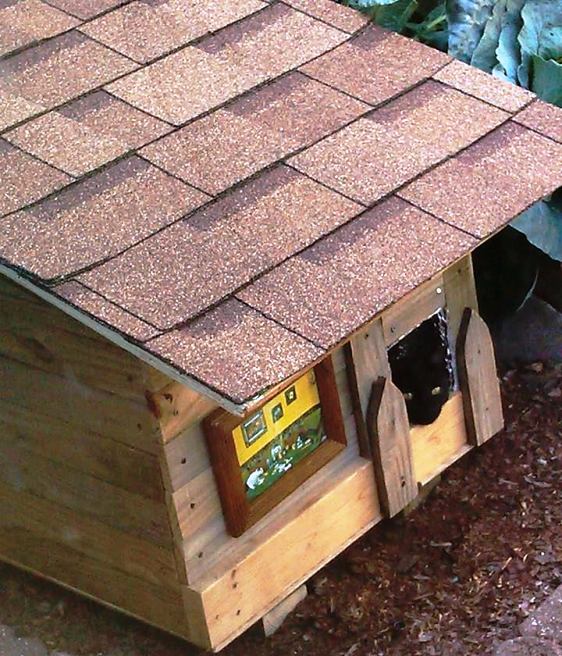
Note the cats playing poker in the "picture window."

Note the cats playing poker in the “picture window.”

Now Kitley’s fully claimed me—and the little house Judy built for him using (mostly) upcycled materials. He can’t come indoors due to her allergies, so she made him a bachelor pad that’s the envy of the entire Feline Nation, or should be. He lifts my heart, racing up to me to touch noses when I’m puttering outside. He makes me laugh when I’m caught in some bleak mental loop of my own making. And then I’m renewed.

I wouldn’t have thought of keeping him as an outdoor kitty, if not for a friend’s chance comment about home-built cat shelters.

Then there was FoodCon. I was a last minute pinch hitter with foraging and solar cookery tables, which led to a friend recommending me to the organizer of Bluegrass Bioneers. Suddenly I’m a teacher in the “reskilling” portion of the weekend. (Happening Oct. 25-27 in Louisville, KY. Psyched!)

More difficult is the paring away. As I embrace emerging opportunities, I must also release what no longer serves, whether it be plans, possessions, or projects.

I’ve always hated that I can’t do every single project that draws me. “Life constantly reaches out into novelty,” says physicist and systems theorist Fritjof Capra. It also prunes away what is no longer needed. I’m working on allowing space for these twin aspects of growth in my own life.

And you? What’s emerging for you and your community?

Time to Touch the Earth

Over at the ever-inspiring Root Simple, there’s a great post extolling the virtues of going barefoot. Mrs. Homegrown, aka Kelly Coyne, decries the way we force our feet into little hard boxes instead of letting them directly mediate the surface below.

She offers steps for learning “fox walking.” It’s a form of mindful walking where your feet become your antennae.

I have a friend who does this intuitively. Recently when she and I picked strawberries together, she kicked off her shoes to navigate the strawberry patch–which was a veritable thicket of growth, with thistles poking up here and there. I did not join her in shoelessness, but I admired her mindful treading.

Here’s beloved poet Mary Oliver taking it even further:

Deep in the woods, I tried walking on all fours. I did it for an hour or so, through thickets, across a field, down to a cranberry bog. I don’t think anyone saw me! At the end, I was exhausted and sore, but I had seen the world from the level of the grasses, the first bursting growth of trees, declivities, lumps, slopes, rivulets, gashes, open spaces.

I was some slow old fox, wandering, breathing, hitching along, lying down finally at the edge of the bog, under the swirling rickrack of the trees.

—From “Staying Alive” in Blue Pastures

The swirling rickrack of the trees. I just love her.

I’m off for a much-needed woods ramble. My head is full of worries about desertification, GMOs, and the destruction of carbon sequestering peat bogs in Ireland. I need to step away and touch the earth.

Perhaps I will shuck my shoes. And if you see someone on her hands and knees, just blow a kiss and keep going.

Where We Rarely Dwell

In my quest to be an engaged citizen, urban homesteader, radical homemaker, contributor to household coffers, writer, etc., I can get trapped in a life of busyness. I have so many goals. My days are full of checking the clock as I push myself to be more productive, to mark things off my  lists. (Yes, I have more than one list.)

One week before I fell ill, I was advised to take some unscheduled time every week. I never got the chance to try this radical experiment—because soon I was pretty much glued to the couch, in a haze of pain and exhaustion, just trying to get through my days. And even then, chafing at all that was left undone.

My cat Maggie enjoyed the couch time immensely.

My cat Maggie enjoyed the couch time immensely.

This is a typical pattern for me—I have to be forced to slow down. I suspect it’s not uncommon in our hyperproductive Western culture, this need to be sick or injured before we grant ourselves rest.

So when I listened to intuitive Lee Harris‘s monthly energy forecast this week, and heard him talk about slowing down, I had to laugh—it was so on-target. He said we must stop rushing about and go inside the body, where we rarely dwell. We’re so stimulated all the time that we don’t really know our inner selves.

And that’s a loss.

I like to think I’m fairly good at this: after all, I’ve studied mindfulness meditation! I practice yoga! I’ve done all kinds of personal healing! Yet, the fast track always, always hooks me, and I give short shrift to my dreamy, drifty side—until I have no other choice.

Harris says, “The ‘driving masculine’ side is not what we are needing as a world anymore. We have been hearing this for years, but it’s hard for us to change the program.”

I guess that’s why it takes enforced couch time before I can stop being so terribly driven.

Recently on a Transition US call about creating new stories, one of the panelists said something powerful: That we get tripped up if we try to remake the world in the context of an old, outdated story—meaning looking through the lens of competition, judgment, conflict, scarcity, and domination.

I’m reminded of the wisdom feminist poet Audre Lorde offered years ago: “The master’s tools will never dismantle the master’s house.” She was referring to racism and homophobia in the women’s movement, but it applies here too. How can we transcend the dominant culture’s destructiveness if we’re working from that old script—if we are subjugating our inner knowing (available only in stillness) to this constant striving and acting?

Stillness

Stillness

How, though—this is always my dilemma—how do I get important work done without this driven side of myself? Is there a new way of being that allows both the focus to finish (so satisfying: to finish!) and the freedom to swim about, aimlessly dreaming?

Perhaps, instead of a driver archetype, I could assume the gardener archetype. Cultivate change instead of push it. Would that work? What do you think?

“To Spend my Days Serving”

I’ve been felled by a Brown Recluse spider bite or possibly a boil-gone-bad (staph infection), and no I won’t share a photo of the wound. I wouldn’t inflict that on anyone–except my crazy herbalist, who delights in such things.

Being a little less mobile than usual has given me a chance to catch up on my reading, at least in theory. I have a whole trayful of publications and other reading material I never seem to get to, and on top of the pile was the March-April issue of Branches Magazine. Ironically, it was themed Best Medicine (as is the current issue). The very first piece stopped me cold. I wish I could link to it but the periodical does not maintain online versions of articles.

“The Best Medicine: Joyful Living” is a first-person essay by David Forsell, president of Keep Indianapolis Beautiful, an action-oriented powerhouse here in my hometown. Think tree plantings and neighborhood cleanups, communities given resources and support to beautify their surroundings. My little juneberry tree who lifted my spirits the day after the Boston bombings? It came from that organization.

Forsell has a rare form of cancer that is “slow but relentless,” and he recently recovered from his 13th surgery to remove yet another tumor. He writes of the example of his mother, who had the same illness, and the search for meaning in the midst of physical suffering. Awareness of his mortality, he writes, has spurred him to make the most of his limited and precious time.

And isn’t this something we all might keep in mind–the certainty of our death–to live a more meaningful life?

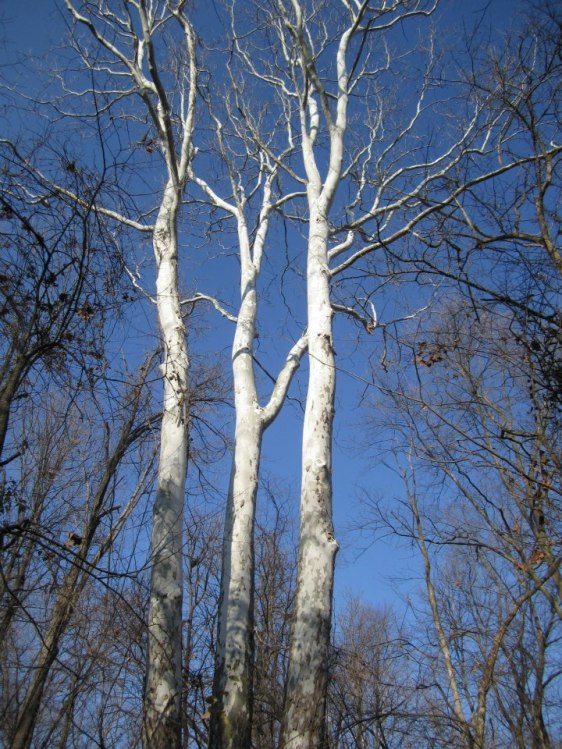
Sycamores in November

Sycamores in November

Forsell came to the Irvington Green Hour last summer to talk about trees with a bunch of us treehugger types, all of us concerned about the impact of the drought. I remember being struck by his authenticity and gentleness.

Here is a quote from this powerful essay:

“In more than two decades marked by surgeries and reminders of my mortality, I have realized I want to spend my days serving: having joy, and hoping I can help others have it too. I want to…heal that which is beautiful but broken or scarred or neglected or compromised in this world….”

He goes on to say that while he may not be able to stop the cancer, it is within his power to help heal the world.

There’s no greater gift than that.

Can We Change Course in Time?

Last week, one day after I heard the author of The Pipeline and the Paradigm speak about the insanity of our fossil fuel-based “business-as-usual” storyline, we reached a chilling milestone.

The CO2 counter on the side of Mauna Loa, which measures parts per million (ppm) of carbon in the atmosphere, tipped past 400. As Bill McKibben wrote, “It’s a grim landmark—it’s been several million years since CO2 reached these levels in the atmosphere.”

Scientists have identified 350ppm as the safest upper limit for a life-sustaining biosphere.

Sam Avery had just told us that we are on the cusp of a new paradigm—moving from the old story, which values living systems only in terms of dollars, to the new, which affirms that living systems are inherently valuable.

Olympia, Washington. Keystone XL Pipeline protest. By Brylie Oxley via Wikimedia Commons

Olympia, Washington. Keystone XL Pipeline protest. By Brylie Oxley via Wikimedia Commons

The Keystone XL Pipeline, which would carry noxious tar sands from Alberta to Texas, is a “pivot point between these two worlds,” he told us. Opening the pipeline would allow the release of enormous levels of carbon—enough to create irreversible climate change.

Depressingly, that 400ppm number is not even indicative of current carbon emissions. There is a 10- to 40-year time lag before we feel the effects of today’s emissions. And greenhouse gases stay for hundreds of thousands of years in the atmosphere.

It’s not only the carbon that is concerning. The 36-inch-diameter pipeline, only one-half inch thick, will be continually abraded by the rough tar sands. When there is a spill—and it’s not if, but when—this stuff behaves differently than crude. It is heavy; it sinks to the bottom of lakes and rivers.

I don’t know about you, but the prospect makes me nauseous. Deepwater Horizon was bad enough. How much more can we foul our nest? (The good folks of Mayflower, AR are dealing with a tar sands spill right now.)

A map showing aquifer thickness of the Ogallala Aquifer with the proposed Keystone XL Pipeline route laid over. Via Wikimedia Commons

A map showing aquifer thickness of the Ogallala Aquifer with the proposed Keystone XL Pipeline route laid over. Via Wikimedia Commons

Avery advocates dramatic action to nudge the new paradigm into being. He’s spreading the message that we can collectively make a different choice.

“We have to believe it to make it happen,” he said, though he admitted that right now, he “might bet against human survival” given the current trajectory.

“We can’t rely on market forces to do it for us,” Avery said. “We’re going to have to decide exactly when and where and how we are going to get off fossil fuels.”

This requires nothing short of evolution—an epic shift in consciousness. It would mean making the decision, globally, to leave carbon underground despite ever-increasing energy demands. To do otherwise is to jeopardize our home and our survival, not to mention the survival of innumerable precious species and ecosystems. Can we change course in time?

Some 50,000 people have pledged to participate in civil disobedience if Keystone is approved. Avery himself, who traveled the pipeline route during his book research, is prepared to “stand between the earth and destruction.”

Who will stand with him?