Sing Light

At the International Women’s Writing Guild‘s annual conference, I was drawn to a spiritual warriorship workshop. Here I found women both tender and fierce. From various spiritual backgrounds, we all were seeking to keep our hearts open in the face of the world’s pain. We meditated together, read, wrote and shed tears together.

One day the reading was Wendell Berry’s haunting  Work Song Part 2: A Vision, which speaks of “a long time after we are dead” when “memory will grow into legend, legend into song, song into sacrament.” The future, and what it might look like, if we are wise.

IMG_3691 (767x1024)

Our writing prompt was : What I want to sing into this world is…

Here’s what came from that free write. (Read Wendell’s marvelous poem first!)

What I want to sing into this world is…
That we must breathe our despair and eat our fear. Then allow the alchemy of respiration, digestion, and elimination to work on our pain and terror until a new thing emerges on this earth. I want to sing a song of light—and yet allow darkness to be felt and seen. (Without awareness of what is hard and mean and forced, we forget the impoverished place that births our better future.) Sing light that doesn’t fear the dark but turns toward it, welcoming the whole story of our unfolding humanity. Find a way to rock the darkness like a neglected child, to give it the kind of love it’s never known.


And you: What do you want to sing into this world?

I’ll Meet You There

“It’s been a long time since I felt that sense of wholeness,” she told me. “Just to reconnect to something spiritual feels incredible.” I’d just talked her through a grounding and expanding meditation, one that I use myself to connect to Source.

Sunlight. Revisited.

Photo by Rishi Bandopadhay, via Flickr Creative Commons

This young woman was one of about 30 I worked with Tuesday night at a collaborative “Art and Insight” event. Other participants, upon opening their eyes, said they felt themselves floating, or they gained perspective over their petty concerns, or they felt as refreshed as if they’d had a nice long sleep.

Guiding people to spaciousness was a gift to my own energy. I thought I might feel drained afterward, doing so many consecutive mini-interventions—but instead, I was on a high. (The only thing that would have increased my high? If I’d had time to enjoy my beautiful collaborators’ offerings—spirit animal readings by Elizabeth Camp of Zen Within and reiki from Amy Barr of The Healing Room. Not to mention henna by Carrie of Eastside Gypsies. Next time!)

This work makes me so happy. I never expected to find a vocation that felt as natural as writing. But I love sharing ways that people can regain their footing in a rocky world.

So many of us are walking around in trauma these days as we face up to our collective shadow. Nothing seems certain anymore; institutions that once appeared solid are crumbling one by one. It can feel, as intuitive Lee Harris once put it, like we have lost our handrail.

In troubled times, it’s so helpful to reach out to each other, reach down to the earth, reach beyond to the cosmos, and experience ourselves as intertwined with All That Is.

IMG_3593 (1024x766)

That sense of interconnectedness is what helps me return to a space of possibility and openness instead of shutting down.

I used to consider this kind of thing “self-care,” which seems to relegate it to the “optional, somewhat privileged” category of activities, on a par with green drinks and Pilates. Certainly not mission-critical, like the shovel-in-dirt projects that remake the world.

However, I see now that the world is made up of people on a path, and that clearing out and opening up on an individual level is absolutely critical if we want to thrive here. Before the remaking of the world comes the reimagining, which can’t happen with eyes that see the same old way.

So how do we build a new world—safer, saner, more compassionate, more just, peaceful, resilient? There are so many problems, so many slippery arguments. There’s so much shouting, so much pain.

We can start by opening our hearts and looking into each other’s eyes.

Or in preparation for that, we can look at a flower, or a beetle, or a cat, or a tree.

in shade best

Or in preparation for that, we can feel the marvel of our lungs filling with air as we draw breath.

We can start anywhere. Sweep our little corner.

Out beyond ideas of wrongdoing and rightdoing, there is a field. I will meet you there.

—Rumi

Note: Please sign up for my e-newsletter if you want to receive notices of upcoming similar events. And consider joining me at Empath 101, where I will share energetic tools to manage sensitivity.
This is Humanity

Charles Eisenstein, in this interview, challenges me to something more radical than empathy. What if we believe everything we read and hear? Not in the sense of “That’s Absolute Truth,” but in the sense of: This is what’s real for this person.

It’s a difficult assignment, because it requires giving up being right. But practicing it would open up the potential for new learning.

What life circumstances could I imagine that would give rise to the various stories I hear? What enculturation/emotions/experiences underlie people’s opinions? Or the scenarios being played out, which are expressions of the stories people know to be true?

What stories must be firmly in place for so many African-Americans to be brutalized and killed at the hands of authorities, so often with impunity?

As this writer posits, “America has conditioned society to regard us (African-Americans) as beasts, superhuman, faster, and stronger. So when we are killed, it’s easy to rationalize and accept.”

That’s one possible story. A painful one. Giving rise to the need for all of us to say, unequivocally, Black Lives Matter.

This morning in meditation I saw a flower with countless small petals. One bloom, many petals: This is humanity. A flower doesn’t have to be told that it’s insanity to pluck out some petals. It is all one whole, one body.

IMG_4950 (853x1024)

From my journal after one such shooting:

Is it possible that I carry all the permutations of humanity in my cells, in a more literal way than I ever imagined?

What if: I am the police officer who killed the black teenager. And I am the teenager who died. I am the crowd that formed. I am the mother. I am the judge, the jury, the media, the Facebook storm, the Twittersphere.

All of these are within me and I must must must love them now. The young woman wanting to smash up stores in anger. The older folks grieving. The Fox News people spinning. The truckers in the truck stop, the teens at the mall, the babies in wombs ready to be born into a quaking world. The deflection. The pain. The heartache. The horror.

The fear. Everywhere fear. I am that. And I must love that.

I am the return, too. The opening.

Can we imagine a story that would solidify our shared humanity, and our mutuality, and our need for everyone to feel safe and respected as they walk through the world?

Magnify Love

Do your little bit of good where you are; it’s those little bits of good put together that overwhelm the world.

—Desmond Tutu

Here in the U.S., we’re feeling the reverberations of yet another mass shooting. Some call it the deadliest in our nation’s history. Even as I unplug from the news cycle, I’m energetically affected by the pain and anguish, the anger and fear.

Sadness is mostly what I feel when I think of the shooting. When I remember to, I turn toward the sadness, feel it in my body, notice the wish to numb it, alongside the urge to amass information in support of my personal philosophy about these types of tragedies.

I “embrace, allow, include,” as I’ve been coached in mindfulness training. I open up room for all my responses and attend to them with kindness. In that space I can consider right action.

All of which gives me more compassion for others on their own path.

I like to believe that humanity is evolving in a positive direction, appearances (seemingly) to the contrary. The horrible things that happen always grab our focus, fuel our outrage. It’s the same with the inflammatory things said by some pundits and politicians: Our attention gets hooked by ugly things that seem to confirm the awfulness of everything. And the ugliness magnifies.

A wise yoga/meditation instructor recently reminded me that our brains are wired to notice the snake amidst the flowers. Danger! Alert! We fixate on the negative. It’s biological.

Flower (1024x768)

No snake, just flower.

Mindfulness meditation creates an opening for a new practice to emerge. It offers a brief space—the length of a breath—in which we can begin to choose.

I wonder: what if we train our attention on something other than the horror? Not to look away blithely denying injustice, but turning toward the little acts of love and solidarity, small exchanges of soul happening every day. Is it a copout, born of privilege, to even suggest such a thing? Or is it an opening?

Some schools of Buddhism teach that the material world is nothing other than a construct of mind. What mind do I wish to inhabit?

Illusion (768x1024)

What do I choose to magnify with my attention?

We’re Walking Ecosystems: Notes on Collaboration

Lately I’ve been thinking about collaboration. I envision a world where nations, geographic regions, cities, neighborhoods, and affinity groups find an ease and flow in working together.

11285902014_240074a727_z

Photo credit Michael Mayer, via Flickr Creative Commons

Maybe it seems pie-in-the-sky, but we have a model for that kind of collaboration. It’s right here, as close as our own skin. Modern science now confirms that the human body is a collaboration in itself.

Some 90 percent of our cells are—get this—not human. They’re bacterial, or fungal, or even viral. Don’t be afraid! They mean us no harm. We’re their habitat. A walking community. A microbiome.

If we keep balance within the community of our cells—I’m talking happy bacteria and fungi here—we generally enjoy good health, and recover from illness more quickly.

This Brainscape article explains it all so well—the ecosystems within us, each with their own unique microorganisms. These wee “microbiota” do all kinds of things for us in exchange for giving them a suitable environment to thrive. They help with digestion, brain activity, and immune function, just for starters.

Most curiously, our mitochondria—an organelle within cells that is responsible for converting digested food into energy—contains DNA that is…not human. “These organelles came from outside of us, down a separate evolutionary path.”

17104540588_afc2a615dc_z

Mitochondria (red) are organelles found in most cells. They generate a cell’s chemical energy. Credit: NICHD/U. Manor, via Flickr Creative Commons

At the microscopic level, human life depends on a symbiotic relationship.

From the article:

“When Charles Darwin wrote On the Origin of Species, the dominant theory soon came to be survival of the fittest: a rat race for domination and survival. But both of these examples — mitochondria and our internal biota — point toward another means by which life thrives and evolves: symbiosis.”

I find that fascinating, and also telling.

Of course, zoom in tighter on the cells of our body—and what are they? Whirling clouds of particles. There’s nothing solid to us.

We’re made of space, basically. Our lives reliant on organisms we have always vilified or at the very least, ignored.

Knowing that, is it possible to see the human community in a different way?

Hiatus!

Time to make official what’s been in the works for a few weeks months now. I’m putting the blog on hiatus for at least the first quarter of 2016. It’s time to retool everything on my to-do list to align better with my current focus (or foci?).

In a nutshell: My work is moving more into the healing arts arena, while I continue to write nonfiction. In both of these areas, I’m part of an ever-growing “Team,” as author Martha Beck calls it—working to bring about a new Story of Connection.

Photo by Michael Lokner, via Flickr Creative Commons

Photo by Michael Lokner, via Flickr Creative Commons

I see energy work as a way to raise our collective vibration, which we need to do—at least if we’re going to birth a  new and resilient future. So I’m getting certified in ThetaHealing, one of the energy techniques I practice.

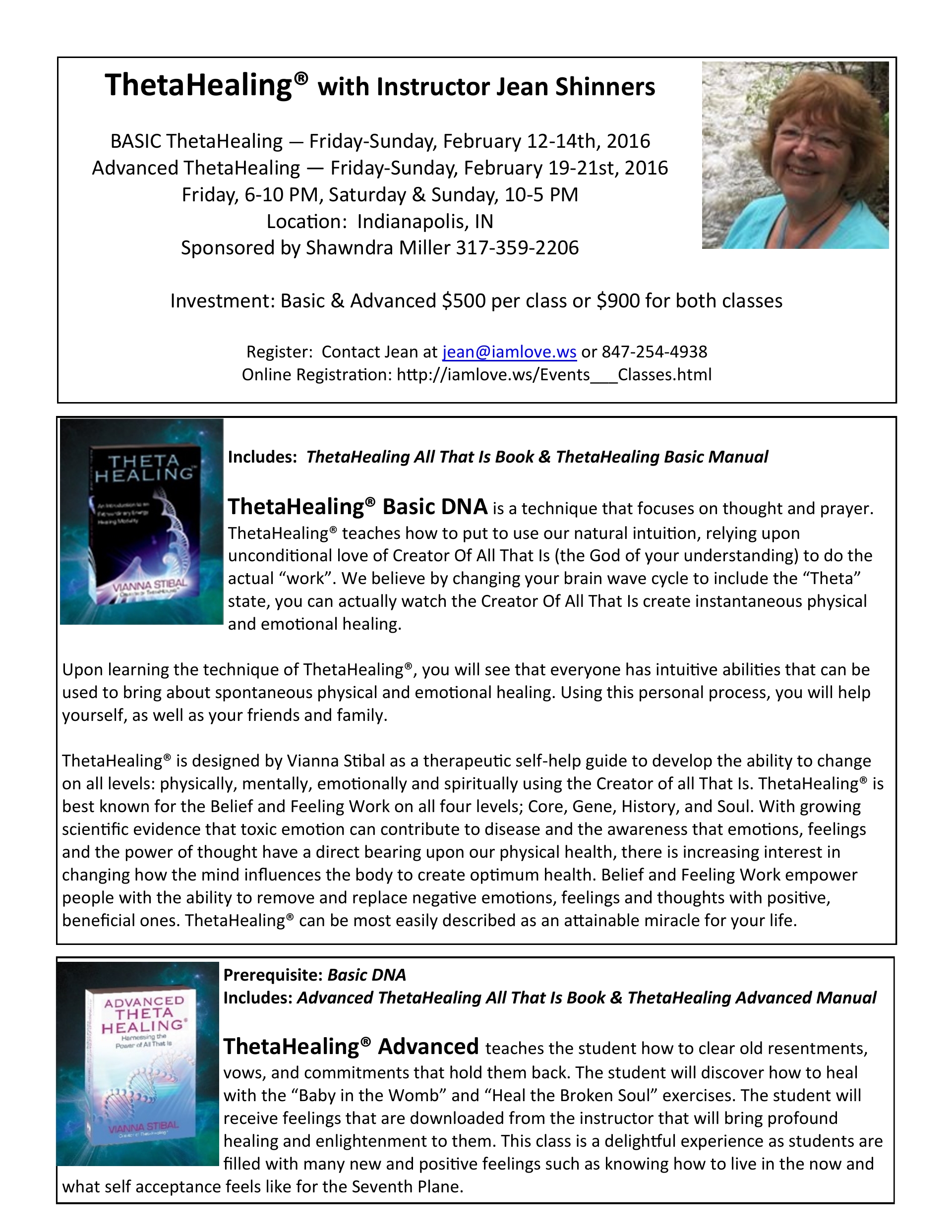
Here is a workshop series I’m bringing to Indy in February. If you’re interested in joining me, which would be lovely, you can sign up at instructor Jean Shinners’ website.ThetaHealing Flier

I have a series of smaller workshops planned for the coming months in Indianapolis. The first one, Empath 101, will cover how manage being “so dang empathic,” as one of my empath friends puts it.

If you’d like to have a heads-up on these opportunities, or to learn more about my work, please sign up for my (revamped) e-newsletter.

It Can Be Shifted

I heard a Robert Bly poem on The Writer’s Almanac a few months ago that seemed to speak to our times. Called “Keeping Quiet,” it speaks of childhood “whoppings in the woodshed” living into the present. Bly declares that “every war is some violence in childhood coming closer” and that “it doesn’t change.”

What happened to us that we can never speak about, the poem says, leads us to perpetrate the same cruelty on others.

Fair point, and even more interesting in light of research on epigenetics and genetic memory. From what I understand, traumas that our ancestors experienced can actually impact our own DNA. For example, those whose ancestors lived through famine may be genetically predisposed to store more fat.

In my own work on the energetic level, I have found that we can carry inherited and ancestral emotions, beliefs, and traumas.

But I don’t agree when Bly declares that this pattern won’t change because it has been going on for thousands of years. How to change it: by loving the entire past that accompanied us in our arrival on the earth.

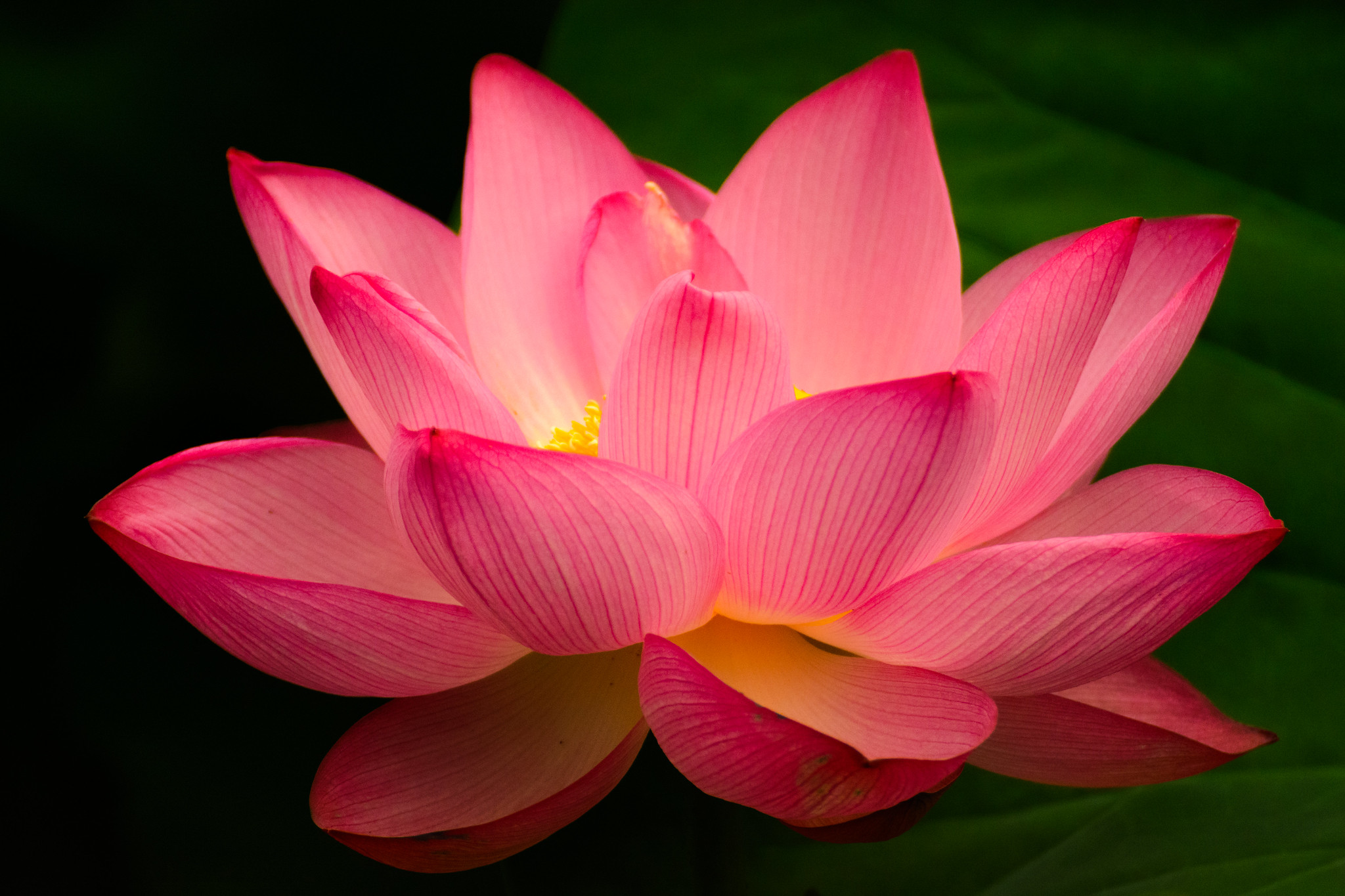
Lotus Flower

Photo by Yoshikazu Takada, via flickr Creative Commons

Those things we try to divorce and deny? They are exactly the things that return again and again, to snap at our heels, smack us down in the dirt, keep us unconsciously lashing out and “otherizing” those we see as different. Not a healthy pattern, but it can be shifted.

What if we strove to love those old hurts instead—and not just our own but all of our ancestors’ secret pain as well?

A tall order perhaps, but I believe that we are a tall people. Humanity at large. We have the ability to stretch and grow, to evolve.

I want to believe that we have a future here, that doesn’t give sole survivorship to the last person shouting (or shooting).

To Radiate

Sometimes it feels like so many words are written and said, so much bandwidth devoted to opinions and theories and arguments, that adding more verbiage to the hubbub is a worthless activity.

The word “radiate” came to me this morning. As a writer, I’m prone to writing, of course, but sometimes it seems more important to just…radiate.

Consider the migrant crisis. It hurts to look at it. I don’t know what to do. I feel guilty for the comparative triviality of my day-to-day concerns. In the wee hours, at my worst, I sometimes wonder if it’s shameful to feel happy and carefree when so many are suffering. I sometimes feel ashamed of the worries that plague me, because my life is as easy and free as anyone could imagine.

When this happens, as soon I remember to, at 3 or 4am, I take up a spiritual practice based on a Hawaiian system for healing. It involves holding suffering people in my heart while mentally repeating the phrases: “I take full responsibility. Please forgive me. I love you. Thank you.” I learned about this process first from my friend and mentor Dawn Ryan, then from a book called Zero Limits, by Joe Vitale

The idea is to take responsibility for everything in our lives, because everyone is connected. Some say “I’m sorry” instead of the first phrase, but I prefer “I take full responsibility,” and it’s how Dawn originally taught me.

This mantra gives me somewhere to channel my concern, at the very least. At the most, it clears the way for new insights and promptings to action. Or perhaps just for a few more hours’ sleep, which puts me in a clearer space to do my work in the world. (Which I so question in those dark hours, wondering about its value.)

Saying these words and sending light? It’s not nothing. Though it’s impossible to quantify, I suspect that the shift from guilt/shame to love/light has a real impact, and not just on me. IMG_20150717_110506238In any case, these last few days, riding my bike or walking my dog in the sunshine, I can’t hold back a sense of exhilaration, pure happiness. I don’t want to. A friend told me that my happiness lifts her when she’s hit a rough spot in her own life.

So here’s to radiating.

Living Proof

Yesterday at Rivoli Park Labyrinth, I met up with a riotous party of plants, insects, and birds.

The park, which formed on a vacant lot thanks to community organizer Lisa Boyles, has gotten overgrown this rainy summer—but it is also a haven for life.

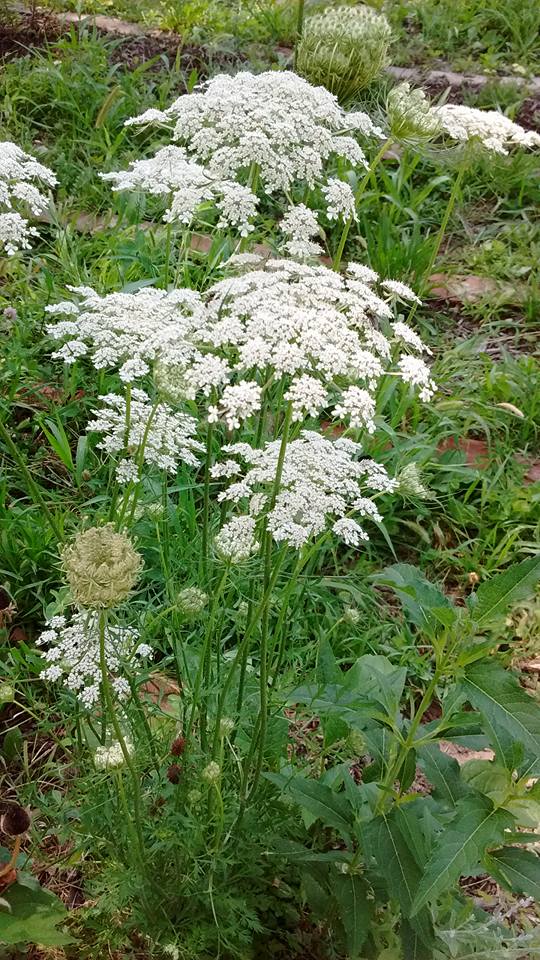
"Queen Anne’s Lace provides beneficial nectar to insects during this dry part of the summer when they don’t have many options. Caterpillars of the Eastern Black Swallowtail butterfly eat the leaves, bees and other insects drink the nectar, and predatory insects, such as the Green Lacewing, come to Queen Anne’s Lace to attack prey, such as aphids" according to Chiot's Run. (Click photo for more.)

“Queen Anne’s Lace provides beneficial nectar to insects… Caterpillars of the Eastern Black Swallowtail butterfly eat the leaves… and predatory insects come to Queen Anne’s Lace to attack prey,” according to Chiot’s Run. (Click photo for more.)

Some plants we call weeds and others we call ornamentals. Some we consider natives, wildflowers, edibles, or another elevated status. Some we designate as invasive, others as desirable.

What I realized yesterday: These divisions are more important to humans than the rest of nature, which seeks its own balance.

The plants called “weeds” are the ones we pull out. Still, the grasshoppers, bees, and spiders find food and shelter on plants of all stripes. They are the epitome of nonjudgment, our guides in an insectile anti-labeling initiative.

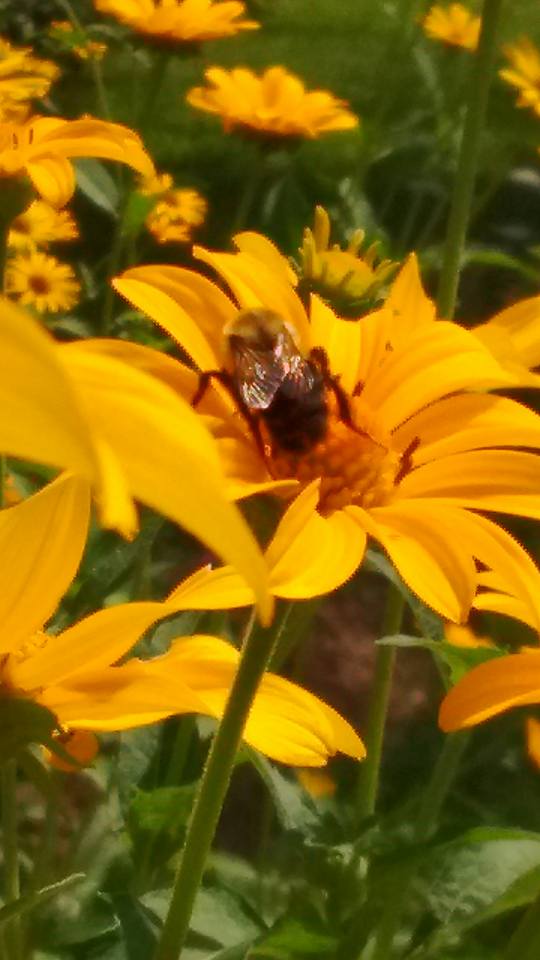
Friendly pollinator

Friendly pollinator

So often I am quick to judge something good or bad.

Just now I went to strike that sentence, gauging it too trite! As testament to my new commitment to allowing things to be messy and imperfect, I am leaving it there.

Lisa and I talked about this very thing: In my writing, I declared my intent to finish my book while letting go of the need for it to be “perfect, balanced, and comprehensive.” Lisa swept her arm toward the “weedy” labyrinth and said, “Here’s living proof that a project doesn’t have to be perfect—just look at it!”

What I saw: voluptuous plants abuzz with happy pollinators. Abundant living entities in ongoing conversation, all encircling the glorious hibiscus at the center. The idea of perfection doesn’t really apply when we’re partnering with life, does it? So it can be with writing.

I told Lisa that the labyrinth didn’t have to reach some ideal in order to be a marvelous contribution to the community. Uh, hello. Maybe I should write that down and stick it on my computer monitor.

Repeat after me: We don’t have to reach some ideal in order to be a marvelous contribution!

Transition and Transformation

Every writer should have a worm colony to eat her spent words. Especially if she’s grieving the loss of her beloved dog.

His name was Marley. We named him after the great Bob Marley. This was before "Marley and Me."

His name was Marley. We named him after the great Bob Marley. (This was before “Marley and Me.”)

I feed my drafts to the shredder when they’ve served their purpose. The shredder cross-cuts everything into bits the width of a highlighter’s stroke, the length of the tiniest paperclip. When the receptacle is full, I shower this ticker tape parade over one of four worm farms I’ve got going right now.

Worm pit after ticker tape parade

Worm pit after ticker tape parade, with rainwater.

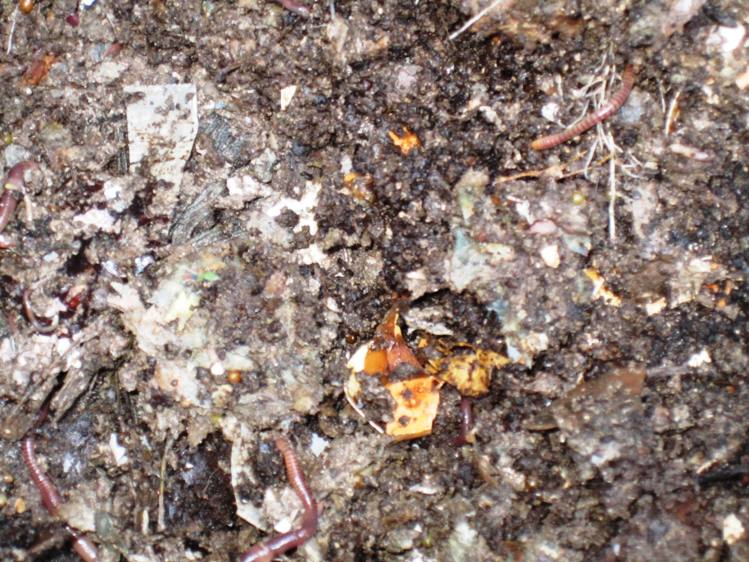
Are they actually eating my words or are they just nesting there, my happy, scrappy red wigglers, snug in moist paper and a bit of soil and leaves? With rotting vegetable parings for their buffet.

I wrote once long ago, or stole the idea, of everything in a writer’s life becoming compost. “It’s all material,” an early writing teacher told me. Now even my stilted phrases and test drafts and failed pieces have become compost.

I’m feeding the worms that in turn offer their pooped-out product to nourish my soil—soil in which we grow the food that feeds the writer who makes the words that shelter the worms. A closed loop.

Also in the worm bins? Junk mail, that clutters my desk until I go on a shredding rampage. Cardboard toilet paper rolls chopped into bits. Tea leaves from my tea ball. Shed leaves from houseplants. Newspapers. Anything else I can think of: Q tips, napkins, toothpicks, and other rarely used ephemera.

Also: Mats cut from the cat’s britches, tangled there over weeks of neglect while I worried over her brother, the dog. Tissues loaded with my snot and tears, from meltdowns over that same dog’s decline.

Moistened with rainwater, it all melts together into the special kind of slop that worms (I’m told) adore—sweetened with handfuls of veggie scraps and stale crackers and the like.

Worms at work

Worms at work

The dog died; the worms and time work together to turn something lost into something gained.

Sweet dreams, friend.

Sweet dreams, friend.