Elders Building a Healthier Future

They meet in Chase Legacy Center’s art room every Thursday for herbal tea and the deeper refreshment of conversation. Known as WeAct (When Elders Act, Communities Thrive), the group began as a natural living discussion circle, and evolved into a discussion/action group.

The weekly gathering of elders is convened by the decidedly youthful Greg Monzel. Today he’s harvested Echinacea and mint from the herb garden tended by the group just outside. With curved shears, he snips the big healthy blooms and fragrant leaves into a blue teakettle as people stroll in.

An herbalist, Greg offers his prodigious knowledge of wildcrafting and permaculture, but participants have a wealth of information too. The discussion moves in spirals, touching on plant medicine, gardening, and other homespun topics.

We explore the identification and uses of lamb’s quarters, with one member noting that this “weed” is high in iron. From another participant, we get the inside scoop on Distelrath Farms’ new cooperative model, which allows the farmer more time to pursue his mission: educating children.

From another, we learn of Taj Mahal’s original plan to be a farmer, and why he changed his mind: “He couldn’t figure out how you could keep from being poisoned by putting poison on the ground.” We lament the way conventional agriculture wages war on the land.

Comfrey root bearing a smile

Greg produces a section of comfrey root dug from his garden. A terrifically tough—and useful—plant, comfrey’s roots extend some 40 feet underground. He cuts the root into tiny pieces to send home with everyone. Each garden can benefit from nutrients pulled up from the depths.

After a while we take cups of bright-tasting tea outdoors to the raised beds designated for WeAct use. There’s the excitement of lifting carrots from the earth. We discuss uses of borage and alfalfa, remedies for mildew, and where to buy a hori hori. Greg urges us to take dill seeds and coriander seeds to plant or eat.

The sky is deep cloudless blue for the first time in days. We stand in the sunshine enjoying the cool morning breeze. It’s the kind of moment that you wish could last all day, and in fact Greg says it is the high point of his week. Too soon, the group disperses.
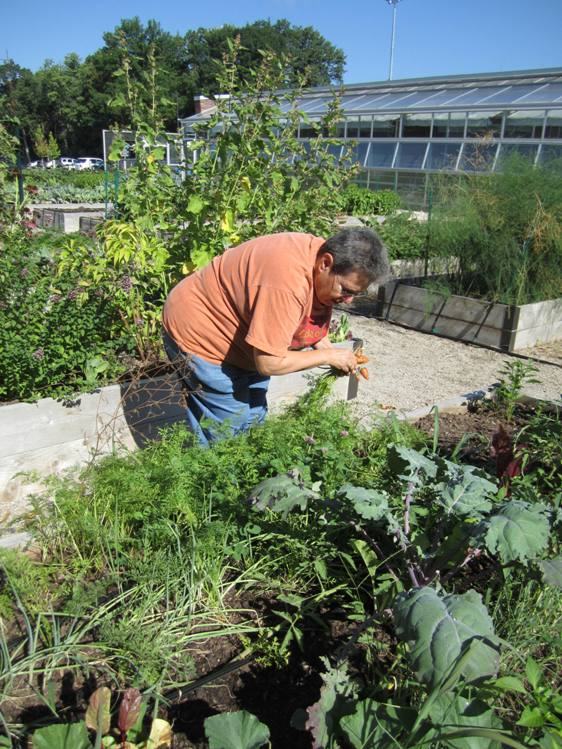
Harvesting carrots from WeAct's group vegetable bed

Harvesting carrots from WeAct’s shared vegetable bed

Though we don’t visit it on this day, WeAct also maintains a vegetable plot on the adjoining vocational high school campus near the Colonel’s Cupboard, a student-run restaurant. The group supports the school’s horticulture and culinary programs in gardening and preparing homegrown produce.

From the mission statement: “WeAct is an activist organization of elders (and elders in training) who meet weekly for continuing education and community engagement…We consider anyone age 50 and over an elder, though the group is also open to elders in training who may be under 50.”

Among the goals:

  • to reaffirm the wisdom of community elders
  • to advocate for the right to home-grown nutrition
  • to create awareness of community resilience and natural balance

How are the elders (and elders-in-training) in your community manifesting a healthy vision for the future?

Advice for Writing and Living

I’m home from the Midwest Writers Workshop, where the keynote speaker, mystery writer Hank Phillippi Ryan, shared “What I wish someone would have told me.”

By Kartikay Sahay via Flickr Creative Commons

By Kartikay Sahay via Flickr Creative Commons

The advice was writing-related, from how to deal with solitude (“You write alone, but you are not alone”) to the inevitability of self-doubt (“Before you burn your manuscript, make a copy.”) Still, I was struck by how much of her guidance also applies to those of us invested in the critical work of remaking the world.

First up: mention was made of the classic Bird by Bird by Anne Lamott. In which Anne’s brother, in grade school, waits to begin a report till the night before it is due. The topic? Birds of North America.

Not surprisingly, he comes nearly unglued in panic. Their father, a writer, counsels him, “Just take it bird by bird, buddy. Bird by bird.”

Then there’s this:

“What would you attempt to do if you knew you could not fail? Do that. Be brave.”

And finally, the need to be happy, to love what you are doing, and to enjoy the place where you find yourself. “This race goes to the stubborn and bullheaded, but it’s also wise to have a good time.”

I was planning to discourse on how these nuggets inform the life of a hopeful thrivalist, but my brain is pretty much a mashed potato right now. So how about this instead:

Discuss.

Coal: It’s So Yesterday

I confess that when I was asked to write a story about Indiana’s Beyond Coal movement for Indiana Living Green, part of me was a bit ho-hum at the prospect.

Sure, the two ladies leading the fight (Megan Anderson and Jodi Perras, my two profilees) are amazing specimens of fierce feminine energy, each hailing from a different generation, an interesting duo. And of course, I am totally down with clean energy.

It’s just: I’d rather write about yummy stuff, like food, or farming, or foraging. I am drawn to tales of those remaking the world in intriguing, innovative ways. That new emerging story is what energizes me. And sometimes the hard work of calling a halt to the old story seems so…tired.

By Arnold Paul, via Wikimedia Commons

By Arnold Paul, via Wikimedia Commons

I mean, we all know that coal is bad for the environment and our health. What more is there to say?

So I thought. Then I talked to Megan and Jodi, and got a first-hand glimpse of what’s at stake. I saw that not only are they pushing to retire these decrepit coal plants, they are holding a vision of an Indiana where residents are choosing from an array of clean energy options, even generating their own energy. An Indiana where people have secure jobs that they feel good about, contributing to a cleaner state. An Indiana on the cutting edge.

By Mhassan abdollahi, via Wikimedia Commons

By Mhassan abdollahi, via Wikimedia Commons

Now that’s exciting.

I was moved to hear Jodi talk about the group meditation where she visualized her descendants asking what she did to fix the climate crisis. Isn’t this something we all think about, what kind of world might be next?

I got fired up hearing their passion for righting the injustices wrought by Big Coal. I learned that children who have the misfortune to be born poor are disproportionately impacted by the health effects of coal—resulting in learning disabilities, asthma, autism, and lowered IQs.

How fair is it that poor kids are effectively trapped into a cycle of poverty because of lifelong difficulties linked to our state’s over-reliance on coal?

Then I learned that coal is ever more costly. And it just seems like a no-brainer from there.

Read the piece for the full scoop. You can join the Beyond Coal Indiana movement at the Sierra Club’s website or contact Megan Anderson at megan.anderson@sierraclub.org.

Where We Rarely Dwell

In my quest to be an engaged citizen, urban homesteader, radical homemaker, contributor to household coffers, writer, etc., I can get trapped in a life of busyness. I have so many goals. My days are full of checking the clock as I push myself to be more productive, to mark things off my  lists. (Yes, I have more than one list.)

One week before I fell ill, I was advised to take some unscheduled time every week. I never got the chance to try this radical experiment—because soon I was pretty much glued to the couch, in a haze of pain and exhaustion, just trying to get through my days. And even then, chafing at all that was left undone.

My cat Maggie enjoyed the couch time immensely.

My cat Maggie enjoyed the couch time immensely.

This is a typical pattern for me—I have to be forced to slow down. I suspect it’s not uncommon in our hyperproductive Western culture, this need to be sick or injured before we grant ourselves rest.

So when I listened to intuitive Lee Harris‘s monthly energy forecast this week, and heard him talk about slowing down, I had to laugh—it was so on-target. He said we must stop rushing about and go inside the body, where we rarely dwell. We’re so stimulated all the time that we don’t really know our inner selves.

And that’s a loss.

I like to think I’m fairly good at this: after all, I’ve studied mindfulness meditation! I practice yoga! I’ve done all kinds of personal healing! Yet, the fast track always, always hooks me, and I give short shrift to my dreamy, drifty side—until I have no other choice.

Harris says, “The ‘driving masculine’ side is not what we are needing as a world anymore. We have been hearing this for years, but it’s hard for us to change the program.”

I guess that’s why it takes enforced couch time before I can stop being so terribly driven.

Recently on a Transition US call about creating new stories, one of the panelists said something powerful: That we get tripped up if we try to remake the world in the context of an old, outdated story—meaning looking through the lens of competition, judgment, conflict, scarcity, and domination.

I’m reminded of the wisdom feminist poet Audre Lorde offered years ago: “The master’s tools will never dismantle the master’s house.” She was referring to racism and homophobia in the women’s movement, but it applies here too. How can we transcend the dominant culture’s destructiveness if we’re working from that old script—if we are subjugating our inner knowing (available only in stillness) to this constant striving and acting?

Stillness

Stillness

How, though—this is always my dilemma—how do I get important work done without this driven side of myself? Is there a new way of being that allows both the focus to finish (so satisfying: to finish!) and the freedom to swim about, aimlessly dreaming?

Perhaps, instead of a driver archetype, I could assume the gardener archetype. Cultivate change instead of push it. Would that work? What do you think?

Building a “Better Block”

Something’s happening this weekend that strikes me as just the kind of grassroots change that we so need right now.

It’s called Better Block, a one-day transformation of a city block into a living demonstration of a walkable, vibrant neighborhood center. A Better Block allows communities to experience a “complete streets” buildout process. People can develop “pop-up businesses” to show the potential revitalization that goes along with such an effort.

I read about my hometown’s expression of the movement in this Nuvo article, Real Time Urban Renewal, written by IUPUI grad student Ashley Kimmel. This Saturday from noon to 5pm, the Better Block event will “convert one block of the (East Washington Street) corridor into a vision for the future: a living scale model of how the street could look, feel and be cared for by the neighborhood.”

The benefits? According to the article, such an event:

  • moves beyond simply conceptualizing development to a three-dimensional encounter with possibilities,
  • “focuses on the ground-level experience rather than the top-down aerial map,”
  • offers an inexpensive way to use existing resources toward urban planning, and
  • creates the opportunity to open storefronts and reconfigure travel lanes “on a small, testable scale.”

With the immediate feedback available in this cost-efficient study, it seems like the motivation would be high to make the one-day experience a reality in the not-so-distant future. Why wait?

Neighborhood cleanup on the Pennsy. Photo by Heidi Unger.

Neighborhood cleanup on the Pennsy. Photo by Heidi Unger.

I recognize this plucky can-do spirit. It’s alive and well in my own community, where this weekend a group of neighbors will be building a new greenspace adjacent to the Pennsy Trail.

It’s the same chutzpah that drives City Repair in Portland, OR, where volunteers transform intersections, create community gathering places, and enrich civic life through public art.

I’m betting it’s happening in more neighborhoods than we realize. How about yours?

The Mighty Will Fall

In just a few hours the March Against Monsanto begins here in Indianapolis. On the march’s worldwide Facebook page, New Zealand, Australia and Japan are already representing. At last count nearly 300,000 people in 58 countries worldwide were committed to taking a stand today.

Why march? Pick your reason.

  • We march for freedom and self-determination in the face of Monsanto’s monopoly over the world’s food supply.
  • We march to protect both human health and the earth we love from dangerous genetically modified organisms.
  • We march to refute the insane notion that it is possible to patent life.
  • We march to protest the insidious cronyism in the U.S. government, where ex-Monsanto executives are in charge of ensuring the safety of what we ingest–and are designing laws that make Monsanto basically immune to any legal counterattack.

One of my sheroes, Vandana Shiva, says it all in this video.

I’ve said “we”–but disappointingly, my body is not yet back in marching shape. My marching will have to be done through these pixels, and through the seeds I plant and save, and through the petitions and letters I sign, the calls I make.

Funny thing: I thought I was brought down by something tiny, the fangs of a wee arachnid. Turns out it was something even smaller, the lowly bacterium.

More accurately, bacteria. That is, a community of bacterium. Right? My medical consult is sleeping at the moment, but I think that is right. A community of teeny tiny organisms has brought me pretty much to a standstill.

By Mkaercher, via Wikimedia Commons

By Mkaercher, via Wikimedia Commons

Do the words “small but mighty” come to mind?

What I take from this is the strength of the collective. Monsanto may be monied, powerful, backed by government insiders, seemingly invincible–but WE have each other. We have our passion and our deep concern for the future. We have our love, as Shiva says, for “freedom and democracy, love for the Earth, the soil, the seed.”

All of which gives us the capacity to fan out and fell this giant.

Let’s do this thing.

“To Spend my Days Serving”

I’ve been felled by a Brown Recluse spider bite or possibly a boil-gone-bad (staph infection), and no I won’t share a photo of the wound. I wouldn’t inflict that on anyone–except my crazy herbalist, who delights in such things.

Being a little less mobile than usual has given me a chance to catch up on my reading, at least in theory. I have a whole trayful of publications and other reading material I never seem to get to, and on top of the pile was the March-April issue of Branches Magazine. Ironically, it was themed Best Medicine (as is the current issue). The very first piece stopped me cold. I wish I could link to it but the periodical does not maintain online versions of articles.

“The Best Medicine: Joyful Living” is a first-person essay by David Forsell, president of Keep Indianapolis Beautiful, an action-oriented powerhouse here in my hometown. Think tree plantings and neighborhood cleanups, communities given resources and support to beautify their surroundings. My little juneberry tree who lifted my spirits the day after the Boston bombings? It came from that organization.

Forsell has a rare form of cancer that is “slow but relentless,” and he recently recovered from his 13th surgery to remove yet another tumor. He writes of the example of his mother, who had the same illness, and the search for meaning in the midst of physical suffering. Awareness of his mortality, he writes, has spurred him to make the most of his limited and precious time.

And isn’t this something we all might keep in mind–the certainty of our death–to live a more meaningful life?

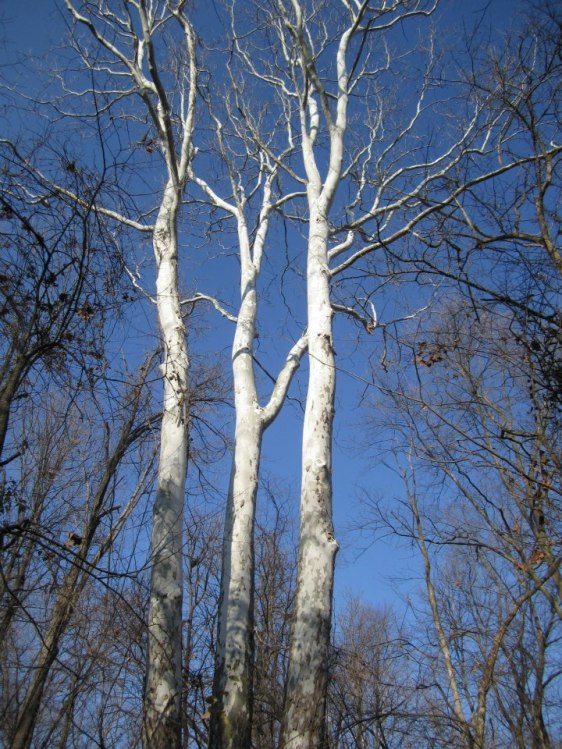
Sycamores in November

Sycamores in November

Forsell came to the Irvington Green Hour last summer to talk about trees with a bunch of us treehugger types, all of us concerned about the impact of the drought. I remember being struck by his authenticity and gentleness.

Here is a quote from this powerful essay:

“In more than two decades marked by surgeries and reminders of my mortality, I have realized I want to spend my days serving: having joy, and hoping I can help others have it too. I want to…heal that which is beautiful but broken or scarred or neglected or compromised in this world….”

He goes on to say that while he may not be able to stop the cancer, it is within his power to help heal the world.

There’s no greater gift than that.

To Shed our Fear

In light of my last post, this quote leapt out at me from the pages of The Blue Sweater, Jacqueline Novogratz’s visionary book. I’ve been a fan of Wangari Maathai since the early 1990s, when I read about her leadership of the Green Belt Movement. This grassroots initiative organizes women in rural Kenya to plant trees, combatting both deforestation and disempowerment.

By Demosh via Wikimedia Commons

The late Wangari Maathai holding a trophy awarded to her by the Kenya National Commission on Human Rights. By Demosh via Wikimedia Commons

“In the course of history, there comes a time
when humanity is called
to shift to a new level of consciousness,
to reach a higher moral ground.

A time when we have to shed our fear and give hope to each other.

That time is now.”

–Kenyan environmental and political activist Wangari Maathai, the first African woman to receive the Nobel Peace Prize

Inspiration from Across the Pond

© Scott Patterson | Dreamstime Stock Photos

© Scott Patterson | Dreamstime Stock Photos

I just found out about a forthcoming book called Stories of the Great Turning, which features first-person accounts of Brits who are transforming their lives in inspiring ways. According to Vala Publishers:

“These are the stories of just a few people who decided to act, in their own lives, in response to the challenges of climate change and environmental degradation, and found their own way to make a difference. They are not stories about celebrities, environmental geeks or gurus but honest accounts from people who…’just got on with it.’

It is a book that takes the question, ‘What can I do?’ and sets out to find some answers using one of our species’ most vital skills: the ability to tell stories in which to spread knowledge, ideas, inspiration and hope.”

Kindred spirits if there ever were. And there’s a foreword by beloved eco-activist Joanna Macy, and I think you know how much I adore her. (“Now is the time to clothe ourselves in our true authority.” –from the Foreword.)

I’m invited to the book launch next month. Exciting! It’s in Bristol, England, so I won’t be there, but still!