Building a “Better Block”

Something’s happening this weekend that strikes me as just the kind of grassroots change that we so need right now.

It’s called Better Block, a one-day transformation of a city block into a living demonstration of a walkable, vibrant neighborhood center. A Better Block allows communities to experience a “complete streets” buildout process. People can develop “pop-up businesses” to show the potential revitalization that goes along with such an effort.

I read about my hometown’s expression of the movement in this Nuvo article, Real Time Urban Renewal, written by IUPUI grad student Ashley Kimmel. This Saturday from noon to 5pm, the Better Block event will “convert one block of the (East Washington Street) corridor into a vision for the future: a living scale model of how the street could look, feel and be cared for by the neighborhood.”

The benefits? According to the article, such an event:

  • moves beyond simply conceptualizing development to a three-dimensional encounter with possibilities,
  • “focuses on the ground-level experience rather than the top-down aerial map,”
  • offers an inexpensive way to use existing resources toward urban planning, and
  • creates the opportunity to open storefronts and reconfigure travel lanes “on a small, testable scale.”

With the immediate feedback available in this cost-efficient study, it seems like the motivation would be high to make the one-day experience a reality in the not-so-distant future. Why wait?

Neighborhood cleanup on the Pennsy. Photo by Heidi Unger.

Neighborhood cleanup on the Pennsy. Photo by Heidi Unger.

I recognize this plucky can-do spirit. It’s alive and well in my own community, where this weekend a group of neighbors will be building a new greenspace adjacent to the Pennsy Trail.

It’s the same chutzpah that drives City Repair in Portland, OR, where volunteers transform intersections, create community gathering places, and enrich civic life through public art.

I’m betting it’s happening in more neighborhoods than we realize. How about yours?

Critical Mass

I was talking with a friend recently about the climate crisis. He’s one of the creators of Apocadocs, every day curating news of the major fix(es) we are in, so he’s understandably gloomy much of the time. But for a moment, his usual despairing tone took a different bent.

“I take comfort in flocking behavior,” he said, stating that a flock of birds doesn’t depend on some alpha male to make a decision about which way everyone will move. No: The flock flies in concert, each bird maintaining alignment with each other as they wheel across the sky.

Chris Upson, via Wikimedia Commons

Chris Upson, via Wikimedia Commons

My friend takes this as a hopeful sign that perhaps humans can make a much-needed shift by simply reaching critical mass. “And maybe it’s just 51 percent of us who need to get it, rather than 80 or 90 percent of us.”

Gaining critical mass at 51 percent certainly sounds possible. And perhaps we’re at 50.99 right now.

I’m further encouraged after reading EcoMind: Changing the Way We Think, to Create the World We Want, by the incomparable Frances Moore Lappe. This intensely inspiring (and mindblowing) book deserves its own post. But for now let me just quote this passage that jumped out at me, as it reinforces my friend’s view:

“While animal-behavior experts used to think that it was the dominant leader who made decisions for the whole herd, they’re discovering that it doesn’t always work that way. For instance, red deer, native to Britain, move only when 60 percent of the adults stand up. Whooper swans of northern Europe ‘vote’ by moving their heads, and African buffalo do so by the direction of the females’ gaze.”

By Stefan Ehrbar (Own work), via Wikimedia Commons

By Stefan Ehrbar (Own work), via Wikimedia Commons

How about it? Which way are we looking?

The Mighty Will Fall

In just a few hours the March Against Monsanto begins here in Indianapolis. On the march’s worldwide Facebook page, New Zealand, Australia and Japan are already representing. At last count nearly 300,000 people in 58 countries worldwide were committed to taking a stand today.

Why march? Pick your reason.

  • We march for freedom and self-determination in the face of Monsanto’s monopoly over the world’s food supply.
  • We march to protect both human health and the earth we love from dangerous genetically modified organisms.
  • We march to refute the insane notion that it is possible to patent life.
  • We march to protest the insidious cronyism in the U.S. government, where ex-Monsanto executives are in charge of ensuring the safety of what we ingest–and are designing laws that make Monsanto basically immune to any legal counterattack.

One of my sheroes, Vandana Shiva, says it all in this video.

I’ve said “we”–but disappointingly, my body is not yet back in marching shape. My marching will have to be done through these pixels, and through the seeds I plant and save, and through the petitions and letters I sign, the calls I make.

Funny thing: I thought I was brought down by something tiny, the fangs of a wee arachnid. Turns out it was something even smaller, the lowly bacterium.

More accurately, bacteria. That is, a community of bacterium. Right? My medical consult is sleeping at the moment, but I think that is right. A community of teeny tiny organisms has brought me pretty much to a standstill.

By Mkaercher, via Wikimedia Commons

By Mkaercher, via Wikimedia Commons

Do the words “small but mighty” come to mind?

What I take from this is the strength of the collective. Monsanto may be monied, powerful, backed by government insiders, seemingly invincible–but WE have each other. We have our passion and our deep concern for the future. We have our love, as Shiva says, for “freedom and democracy, love for the Earth, the soil, the seed.”

All of which gives us the capacity to fan out and fell this giant.

Let’s do this thing.

“To Spend my Days Serving”

I’ve been felled by a Brown Recluse spider bite or possibly a boil-gone-bad (staph infection), and no I won’t share a photo of the wound. I wouldn’t inflict that on anyone–except my crazy herbalist, who delights in such things.

Being a little less mobile than usual has given me a chance to catch up on my reading, at least in theory. I have a whole trayful of publications and other reading material I never seem to get to, and on top of the pile was the March-April issue of Branches Magazine. Ironically, it was themed Best Medicine (as is the current issue). The very first piece stopped me cold. I wish I could link to it but the periodical does not maintain online versions of articles.

“The Best Medicine: Joyful Living” is a first-person essay by David Forsell, president of Keep Indianapolis Beautiful, an action-oriented powerhouse here in my hometown. Think tree plantings and neighborhood cleanups, communities given resources and support to beautify their surroundings. My little juneberry tree who lifted my spirits the day after the Boston bombings? It came from that organization.

Forsell has a rare form of cancer that is “slow but relentless,” and he recently recovered from his 13th surgery to remove yet another tumor. He writes of the example of his mother, who had the same illness, and the search for meaning in the midst of physical suffering. Awareness of his mortality, he writes, has spurred him to make the most of his limited and precious time.

And isn’t this something we all might keep in mind–the certainty of our death–to live a more meaningful life?

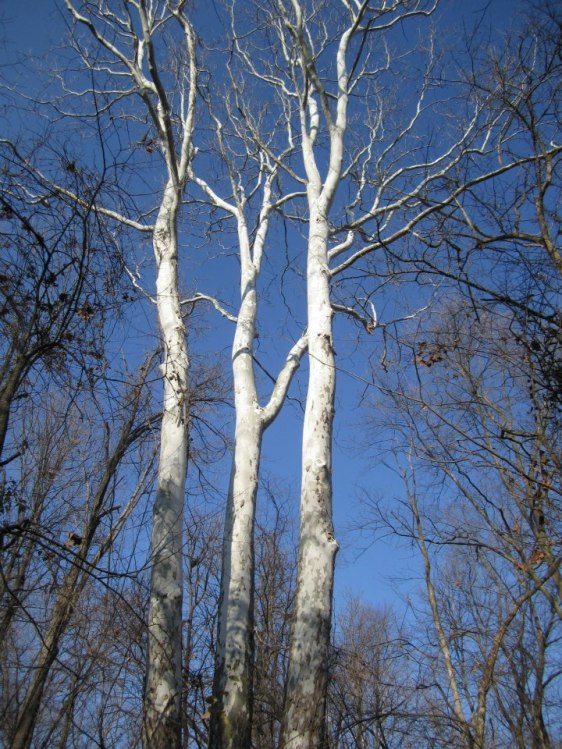
Sycamores in November

Sycamores in November

Forsell came to the Irvington Green Hour last summer to talk about trees with a bunch of us treehugger types, all of us concerned about the impact of the drought. I remember being struck by his authenticity and gentleness.

Here is a quote from this powerful essay:

“In more than two decades marked by surgeries and reminders of my mortality, I have realized I want to spend my days serving: having joy, and hoping I can help others have it too. I want to…heal that which is beautiful but broken or scarred or neglected or compromised in this world….”

He goes on to say that while he may not be able to stop the cancer, it is within his power to help heal the world.

There’s no greater gift than that.

Learning to Learn

Third in a series on education
Recently I spent a day with a Bloomington, IN homeschooling cooperative. Two families work together on homesteading projects on each others’ land. This allows their four children, ages 8 to 12, to learn by doing—while increasing their confidence and skills.

Projects range from seed saving to bike maintenance to creation of a family almanac. They’ve gone mushroom hunting, practiced knot skills, and (on rainy days) learned knitting and mending. They’re working on a fire pit and hoping to build a treehouse.

Reading and quizzing each other from a book called Moving Heavy Things

Reading and quizzing each other from a book called Moving Heavy Things

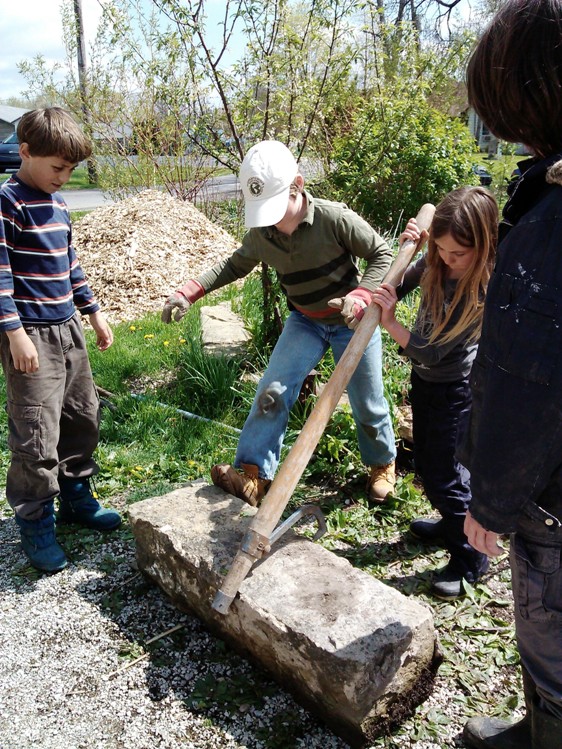
The day I was there, the students were studying how to move a heavy sandstone block down a sloping driveway from the front yard to the back. They were to place it into a rectangular hole in the dirt, forming part of an herb garden’s perimeter. The emphasis was on problem solving, collaborative effort, and applying their study of friction and levers.

Sawing PVC pipe to roll the plywood with the block on top (note that is just a practice stone, not the super-heavy one they were charged with moving)

Sawing PVC pipe to roll the plywood with the block on top (note that is just a practice stone, not the super-heavy one they were charged with moving)

This was no small task and involved an array of tools, including something I’d never heard of called a cant hook. The mom/teachers, Stacey and Dani, encouraged them to try out every idea and see what worked best. The kids worked by experimentation, reasoning, puzzling, trying, and talking—displaying remarkable tenacity through the whole process.

Using a cant hook to move the sandstone block

Using a cant hook to move the sandstone block

There was not one temper tantrum. I could see that the communication skills these kids develop through group projects will go a long way toward smoothing their way in the world—while also contributing to the healing of that same world.

Stacey says she’s motivated by a belief that children can be the instigators of deep change. “I try to not spend a lot of time in a fear/worry place (even though it is hard sometimes), and in doing this mentor joy, hope, the power we have, and that change is possible.  When children/adults have trust in themselves, self-empowerment and understanding of the world, beautiful things happen!”

“I think they are continually seeing how they make a difference and create change.”

Picking violets for our lunch salad

Picking violets for our lunch salad

By the end of my visit, the children had moved one monstrously heavy block into place in the back yard, where it will begin the delineation of an herb spiral. There was great cheering when the block was finally nestled into place.

As results-oriented as we are these days, this may not seem like much for several hours’ work. But in the process, they learned to learn, to cooperate, and to not fear failure.

Watching them, I wondered how my life would be different if I had had these sorts of experiences in my own childhood. I might consider myself in a different light now. I might be handy, of all things. At the very least I would be braver, less fearful of being wrong.

This concludes the education series, at least for now. (I could share much more about both the KI school and these homeschoolers, but that’s where the book comes in.)

KI EcoCenter: Transforming Education

Second in a series on education
KI EcoCenter, or Kheprw Institute, has been making change for nearly a decade in my hometown. In recent years, educator Khalil MwaAfrika came on board the community empowerment center to start an independent school. He was tired of discussing school reform while watching the educational system destroy African-American children, particularly boys.

Khepri, by Jeff Dahl via Wikimedia Commons

Khepri, by Jeff Dahl (GFDL or Creative Commons) via Wikimedia Commons

Instead of reform, he is invested in nothing less than education’s complete transformation. As  mentioned in a previous post, “Kheprw” was an Egyptian god with a scarab beetle head. This beetle was a symbol of rebirth in Egypt—so the center is fittingly named.

KI’s school offers a rigorous program for African-American students. Classes are very small, allowing a high degree of mentorship. Community members interact with the students every day in this intergenerational model.

MwaAfrika emphasizes that igniting a passion for learning is key. Instead of promoting a particular ideology, faculty create space for discourse and dialogue. In that environment the children learn critical thinking skills. They are encouraged to puzzle things out themselves.

In contrast with the traditional school system, here there is no need for the youngsters to feel they must give up their own rich culture in order to succeed.

This issue came up repeatedly at the center’s recent Real Talk Summit on urban education. Because our dominant culture is white/upper middle class, racism is the water we all swim in—leading to schools that don’t believe in children from other races and classes.

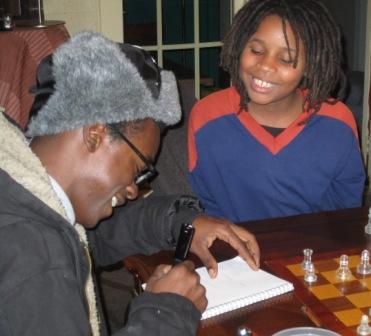
A faculty member and student at KI EcoCenter Community School

A faculty member and student at KI EcoCenter Community School

But KI is different. “We’ve set up an environment where (black students) can be themselves, where they can learn exponentially, where they never have to compromise who they are,” MwaAfrika says.

KI founder Imhotep Adisa notes, “The primary purpose of education is indoctrination. It’s not liberation.”

Part of that indoctrination is the consumerism that is jeopardizing the earth. “We’re at a very ugly place in the history of the planet,” he says. “Regardless of gender, race, and class, the old paradigm has accelerated this…We have to develop new tools for a new paradigm. We have to have the courage to say, ‘That’s not the world we want for ourselves and our children.’”

KI’s adults model that courage every day. Teaching youth to interface with the culture of power while retaining their identity is a critical aspect of their work.

Social enterprises are part of this, as the students work with KI’s bootstrappers (young adults) to develop the skills needed to thrive in a resource-strapped world.

Barrel at left is via KI's Express Yourself Rainbarrels enterprise, with my chosen artwork

Barrel at left is via KI’s Express Yourself Rainbarrels enterprise, with my chosen artwork

Above (at left) is the rainbarrel made by bootstrappers and students for my urban homestead, via the Express Yourself Rainbarrels enterprise. My partner added it to our rain catchment setup, just in time for big rains.

(Indy-area readers, check it out: Save on your water bill, display your artwork, and support a great organization all at the same time.)

Read more about KI’s work in my Indiana Living Green story.

Next: Bloomington’s homeschooling cooperative, exploring the homestead as learning environment.

Wake Up the Earth

Way back in 1979, disparate groups in the Boston neighborhood of Jamaica Plain rallied to protest an eight-lane highway extension that would have cut right through the community. The successful campaign made Jamaica Plain the first place in the entire country to stop such an “improvement.”

Since then, every first Saturday in May, the community has come together at Southwest Corridor Park, the location of the thwarted highway, for the Wake Up the Earth Festival and Parade. The event—happening this Saturday—celebrates what’s possible when people of many traditions, cultures, ages, and beliefs unite.

Spontaneous Celebrations organizes the Wake Up the Earth Festival and Parade every year, but the community makes it happen.

Spontaneous Celebrations organizes the Wake Up the Earth Festival and Parade every year, but the community makes it happen.

Organized by Jamaica Plain’s arts and cultural center Spontaneous Celebrations, the May Day celebration is based on English agrarian traditions. The phrase “Wake Up the Earth” originates from ancient beliefs about rousing the earth to ensure a good harvest.

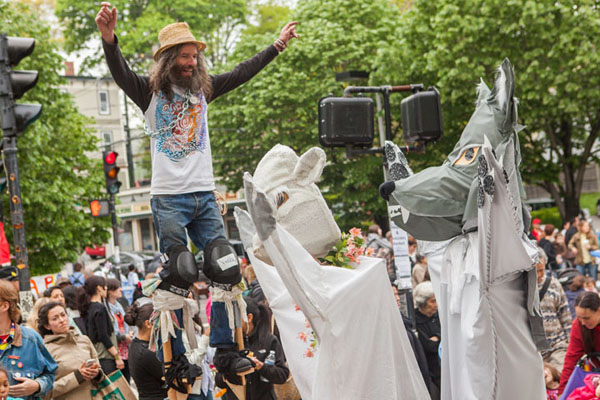
Spontaneous Celebrations’ program director Mark Pelletier described the opening festivities like this: Two processions form before the festival starts, a dual parade symbolizing bringing the two sides of the tracks together. After winding through the streets—separate colorful processions of stilt walkers, giant puppets, musical ensembles, and revelers of all ages—the parade converges at high noon at an intersection at the top of a hill. Everyone marches down toward the park together.

Revelers in the Wake Up the Earth Parade

Revelers in the Wake Up the Earth Parade

There paraders gather in a large circle, and the musicians find a mutual rhythm. The drummers sort out which beat to follow “and it rages along nicely,” Mark told me, “and then there’s everybody standing there facing one another.” I like to picture the various cultural groups in the urban neighborhood all decked out, everyone grinning at each other across the circle.

When the circle dissipates, about 10,000 people will partake of a smorgasbord of participatory fun over the next six hours.

Pageantry and puppetry abound at the Wake Up the Earth Festival

Pageantry and puppetry abound at the Wake Up the Earth Festival

Attendees can play on cardboard slides made from refrigerator boxes, or take part in the all-day drum circle. There’s a “wake up the body” area where people of all ages and shapes practice yoga. There’s an enchanted puppet forest, an amphitheatre with “homegrown circus stuff,” and of course music from every corner (seven stages!). Some 70 crafts vendors offer strictly handcrafted goods, and 25 food vendors sell cuisine from all over the world.

Every nonprofit in the community has a table at the festival, marrying jubilant celebration to civic engagement. It’s a day that brings just about everybody from Jamaica Plain out in a zany, colorful, spectacular celebration of culture and connectedness.

For Dutch-born Femke Rosenbaum, organizer of the very first Wake Up the Earth, this unleashing of imagination is her vision made manifest. “It was always my dream to involve the community in creating the festivals—not to just show up one day, but really to be the creators of it,” she told me.

Co-creation is a beautiful thing, especially in tough times. How does your community come together in celebration?

Images courtesy of Lucie Wicker Photography.

Meet the Mudgirls

I’m always intrigued by people who are able to take the more complicated aspects of modern life into their own hands. Maybe that’s because outside of your basic paring knife and garden trowel, my own hands are pretty fumbly. The realm of natural building just amazes me.

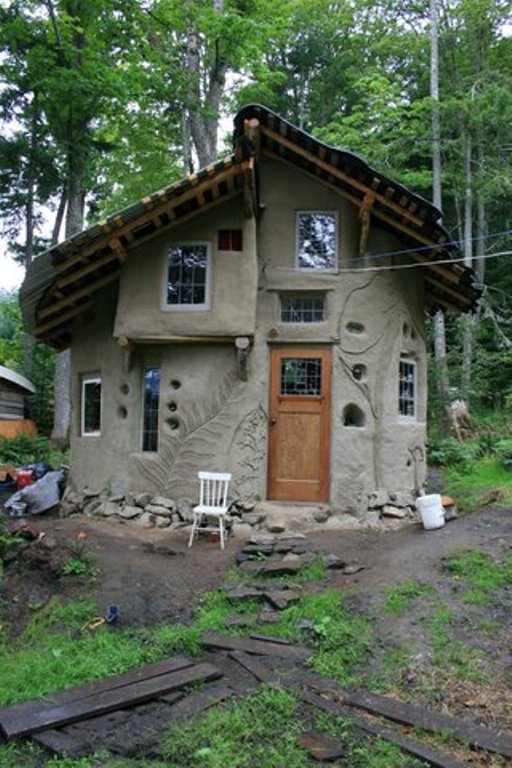
Round Cob House Built by the Mudgirls

Round cob house built by the Mudgirls

Natural building involves using materials occurring in nature (and sometimes recycled materials) to construct homes and outbuildings. For example, back in Too Many Tons I posted a video featuring a DIY builder from Indiana making bricks from mud. Materials are sourced locally—perhaps clay from a neighbor who’s digging a pond, sand from a nearby excavation, straw from a local farmer.

Recently I discovered a British Columbia-based women’s collective specializing in cob building (using a mix of clay and straw). Meet the Mudgirls.

The Mudgirls are a collective of women builders on the west coast of British Columbia, Canada

The Mudgirls are a collective of women builders on the west coast of British Columbia, Canada

For the past seven years they’ve worked together as independent builders, doing seasonal work throughout the Vancouver Island area. Though they started with only about 10 days of work in the early years, many now make their main summer income from this work.

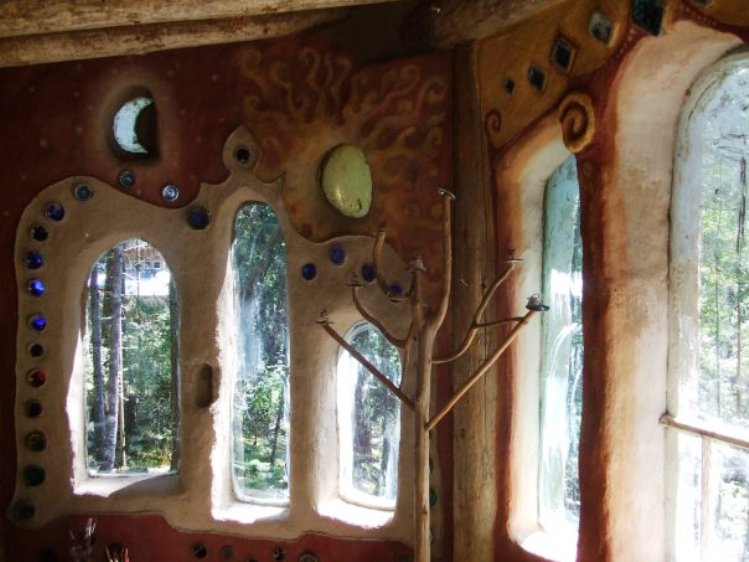
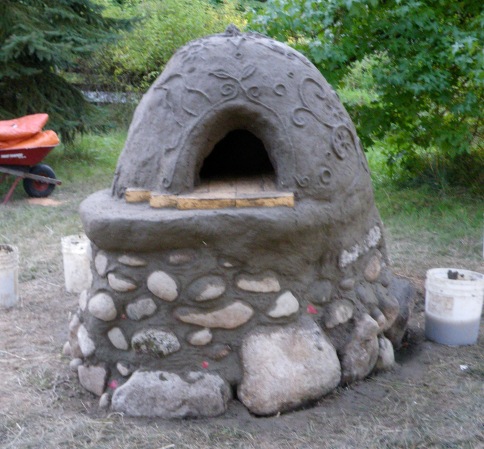
They’ve build cob ovens, cabins, sheds, fences, and outhouses. They also take their craft into conventional homes, using earthen plaster with beautiful results.

Interior of a Mudgirl-built home.

Interior of a Mudgirl-built home.

As a consensus-run group, they are trailblazing in other ways as well, showing a more egalitarian way to operate than the dominant paradigm’s business-as-usual. And they offer workshops at the most affordable rates in North America ($200 or less).

Mudgirl Rose Dickson, one of the founding members, was drawn to the collective because of her outlook as a feminist/environmentalist/artist. From the photos,* it’s clear that the Mudgirls’ work offers a creative outlet.

Cob Oven Made by Mudgirls

Cob oven made by Mudgirls

And these round structures are built to last, as witnessed by many such homes in England, still standing hundreds of years after their construction.

Not too long ago, a four-ton tree fell on a Mudgirl-built cob house—crashing through a bump-up of windows and earthen plaster and stopping at the cob wall. Rose reports, “No cracks in the wall from impact, and the guy who came to clear it off said a wooden house would have been crushed by the tree.”

A four-ton tree fell on this Mudgirl-built cob home, stopping at the cob wall

A tree fell on this Mudgirl-built cob home, stopping at the cob wall

Cob building is physically demanding and sometimes uncomfortable work (imagine a chilly spring day when you’re working in cold mud from sunup to sundown). But Rose relishes the chance to be outside, away from a desk, making something with her hands in the company of her dearest friends.

Mudgirls at work

Mudgirls at work

“If the weather’s cold, it can be kind of miserable,” she admits. “But if you’ve got a couple friends there who you’ve known for years and you’re joking and laughing, it makes it. That’s actually one key with natural building is the community. It takes more time, so the labor is a factor. But that’s part of why people do it together.”

This strikes me as the ultimate in do-it-with-others (DIWO). Has anyone out there had experience with communal natural building? I’d love to hear about it.

*Photos provided by Mudgirls.

In Troubled Times

This morning when I looked out my front window, I saw that the juneberry we planted two years ago was budding. Through the rain I could see the sketch of pale green buds dotting each limb, all the way out to the tips–with the promise of sweet berries contained in each one.

Buds that will open into a white blossom, eventually fruiting into delicious berries

Buds that will open into a white blossom, eventually fruiting into delicious berries

The young tree has made it through two of the hottest summers on record, and those tender buds gave my heavy heart a lift.

We planted it because we wanted to grow fruit on our lot, and we nurtured it with weekly waterings through crippling drought and heat. When the rain barrel went dry, I carried buckets from indoors, saving shower water, cooking water, and the dehumidifier’s daily emptying–occasionally breaking down and stretching the hose across the lawn to let it run for a slow hour.

There’s a passage I like from Buddhist teacher Thich Nhat Hanh, called Interbeing. It begins:

“If you are a poet, you will see clearly that there is a cloud floating in this sheet of paper…”

My tree contains multitudes. It has the memory of picking juneberries with my dad a few years ago, before he got sick, before he died, in the forgotten pocket park wedged between two busy streets. There were three small trees just loaded with juicy wine-colored berries. Dad picked from the high branches and left me the low ones. When the low limbs were picked clean, he pulled the ends of the high branches down so I could reach.

Also part of my tree is Jason, the neighbor who helped dig the hole and position the root ball on planting day. And Jerome, the young man who brought it to us through his work with Keep Indianapolis Beautiful. This year Jerome has parlayed his passion for trees into his own business as a certified arborist, Tree-Centric Solutions–pledging to not only plant, treat, and prune trees, but find uses for wood from trees that can’t be saved.

My juneberry even holds the “woman tree,” an old redbud whose upreaching shape I cherished. I called her that because she always looked so feminine to me. The woman tree was just beyond where the juneberry is now, and she had to come down because half the branches were dead. Taking her out meant we freed up room for a fruiting tree.

Irony: I learned that redbud flowers are edible just after we had ours cut down. I could have decorated so many salads with the woman tree’s bounty. Not only that, but Jerome’s service came too late for her: What I wouldn’t give to have something made from the wood of that beloved redbud!

So all that’s in this juneberry too: my regrets, my ignorance, my wishing things were otherwise. But mostly, these are outshone by pride and hope.

I share all this because in troubled times, sometimes things like this can help: a small tree in the rain, holding memories and care, covered in promise.

KI EcoCenter Leading in the Green Economy

A local community group near and dear to my heart will be represented at a national event next week. The executive director of Indy’s own KI EcoCenter, also known as Kheprw Institute, will be among the presenters at the Good Jobs, Green Jobs 2013 Conference in Washington, D.C.

About KI: When I first visited, I learned that “Kheprw” is a reference to an Egyptian god represented by a man with a scarab beetle head. The scarab beetle was a symbol of rebirth in ancient Egypt.

It seems a fitting title for this community empowerment center, which works at the intersection of social justice and environmental stewardship in the heart of an economically distressed neighborhood. Here it’s all about nurturing an ecologically sound way of life while creating economic opportunity through community engagement. The programming includes an eco-film series, job creation panels, open mic nights, youth empowerment events, and so much more.

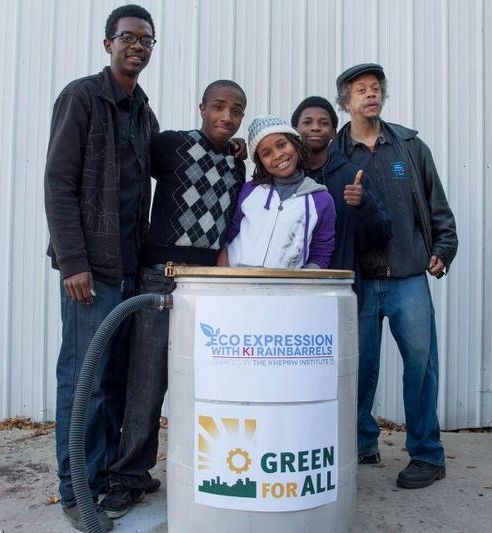
Mat, Rasul, Asli, William, and Imhotep show off an Express Yourself Rainbarrel

Young people in the KI school and mentorship program gain critical thinking skills as they practice social entrepreneurship.

I’ve met many of KI’s children and young adults and they’re not just tomorrow’s leaders—they’re today’s. They know firsthand that with the help of your community, your creativity, and your drive, you can make something from nothing. They’ve built garden beds and aquaponics tanks. They’ve started a paint store, a web services/graphic design enterprise, and a fair trade coffee shop. KI’s work has inculcated in them the confidence and skills they need to navigate the relationship-based economy—whether the goal is a money-maker or a service project or, better yet, both at once.

About the Conference: The theme for the three-day conference is “Let’s Get to Work: Climate Change, Infrastructure and Innovation.” Over 80 workshops will illuminate the possibilities of job creation through green infrastructure. (How refreshing: You mean we don’t have to unleash holy hell in the form of Canadian tar sands in the name of “job creation”?)

KI’s director Imhotep Adisa is a panelist for a workshop highlighting successful sustainable water infrastructure projects. He’ll share KI’s experience in the green economy and its latest social enterprise, Express Yourself Rainbarrels. (I absolutely love this project: The KI crew will customize a rainbarrel with your logo, design, or photograph. I can’t wait to see mine!)

I’ve written a piece for Indiana Living Green about the center that will be out next month. In the meantime, check out this video featuring their work. (Start at minute 3:50 for the segment on KI).