DIY Food, Medicine, Soil: There’s a Shroom for That

I am still thinking about the Radical Mycology Convergence, an incredibly enriching experience. My last post covered mainly big picture inspiration. Here’s some more hands-on stuff.

For someone who likes to pick wild berries and weeds, I’m terribly ignorant of wild mushrooms. I had no idea that I could eat the puffball mushrooms that occasionally pop up right here in urban yards (my own included).

By Nowa (Own work), via Wikimedia Commons

By Nowa (Own work), via Wikimedia Commons

In a workshop called “Foraging for Five Foolproof Fungi” we learned about morels, maitake, chicken of the woods, puffballs, and oyster mushrooms. I now desperately want to go mushroom hunting.

But fungi offer us way more than food. As anti-tumor agents and immune boosters, certain mushrooms are powerful medicine. I was excited to hear Peter McCoy speak about home cultivation techniques as a way to make these therapies more affordable.

He said that capsulated versions of medicinal mushrooms are simply mycelium grown on brown rice and dehydrated, with an expensive price tag slapped on them. He passed around a bag of myceliated grains—I think it was cooked rye that had been inoculated with a type of medicinal mushroom mycelium—that kind of looked like white popcorn all mashed together. This is home-cultivated medicine that you can eat (although it probably doesn’t taste like popcorn!)

Then there’s the way fungi can turn waste products into food. I blogged about an example of this last year—how coffee plantation waste, normally burned, can be fed to mushrooms.
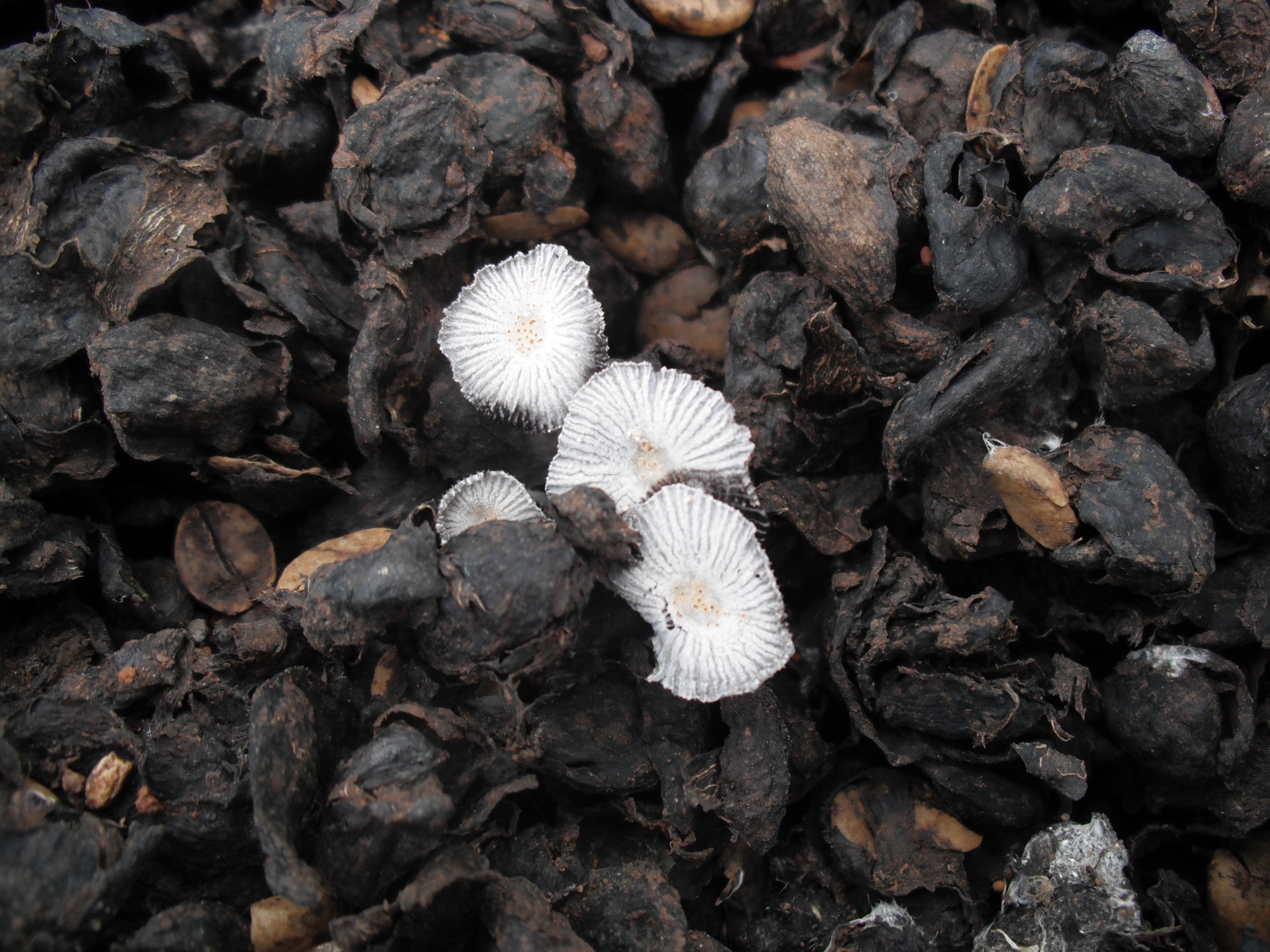
Coffee_pulp_mushroom

A mushroom growing on coffee pulp in south-west Rwanda, via Wikimedia Commons

It’s mind-boggling that a nutrient-dense superfood has so few demands; oyster mushrooms, for example, are 30 percent protein and can grow on cardboard! Even citydwellers with limited time and space can grow myceliated grains as a healthy, immune-boosting food.

And as soil helpers, fungi are critical. Below the soil surface many species of fungi are working their magic. But one species in particular, known as wine caps, has double benefit: They fruit with a deliciously edible mushroom, and they build soil tilth. They’re known as the garden mushroom for the way they can be cultivated right alongside garden vegetables.

"Stropharia aurantiaca". via Wikimedia Commons

“Stropharia aurantiaca,” via Wikimedia Commons

The upshot: My spouse and I have moved from this feeling of “it’s too overwhelming to take on a new project” to “let’s grow some mushrooms!”

We came home with plug spawn for chicken of the woods, and I’ve talked to my arborist friend about sending some logs my way this winter. (He said he’d love a few bits of spawn in exchange, and I’m happy to share!) We also want to try growing some winecaps in our garden beds. And since these are both spring projects—and who wants to wait?—we’ll probably grow oysters indoors from a kit this winter.

Stay tuned for reports on our experiments!

Can’t get enough radical mycology? Check out this interview with Peter at Permaculture Voices—the link has several videos showing hands-on home cultivation steps as well.
Fungi Offer a Model and a Hope

Last weekend’s Radical Mycology Convergence was an eye-opener to the mystery and power of the fungus kingdom.

signDid you know that fungi called endophytes live within plants, lending structure and resilience to the plant? “If we took away the fungal cells, we would see these scrawny, floppy little trees,” said Maia, one of the organizers.

Or that mycorrhizal fungi help plant roots take in nutrients in exchange for sugars? Trees in a forest benefit from this “silent stewardship role,” said Peter, an organizer and earlier contributor to this blog. He explained that the mycelium channels sugars to baby trees deep under the forest canopy to ensure their survival. Perhaps thinking of the “next seven spore generations.”

Or that only 10 percent of our cells is actually human—the rest bacterial and fungal? “We need to stop thinking of ourselves as singular organisms,” said Willoughby, another organizer. “We are walking ecosystems. We need to appreciate and nurture all these cells within us.”

From microscopic fungi, whose ecological role is often overlooked, to the 2500-acre honey mushroom in Oregon (largest living organism in the world), the message is clear: Fungi offer the human race a model and a hope.

Mycelium colonizing a log that's been inoculated with shiitake mushroom spore.

Mycelium colonizing a log that’s been inoculated with shiitake mushroom spore.

What struck me about the Radical Mycology Convergence was the deep respect for nature in general and fungi in particular. Here is a movement that is not about exploitive, extractive approaches to a “natural resource,” but rather: working with fungi as allies for the betterment of all life. That includes cultivating mushrooms for food sovereignty, medicine, and remediation.

The promise of mycoremediation is great, and Radical Mycology is all about spreading the tools for home cultivation. But as Peter emphasized, we need to be humble in our explorations. We don’t want to just burst onto a contaminated scene and “throw oyster mushrooms at it” without first observing the healing already taking place, organically, through the wisdom of the fungi naturally present.

“Who are we to say we know more than nature does?” he said. The time for presumptive action is over. We must first watch, learn, observe.

I learned so much more, but here’s one last thing: When a mushroom gets ready to reproduce, it sends out spores. A spore germinates into a hypha, a filament. It’s one strand of what eventually, with luck, becomes a mycelial network.

But that hypha is only one cell thick, and needs a partner, a genetic match. It works invisibly, underground. You can’t see it. If it comes together with another hypha, that’s when mycelium begins to branch in all directions through its environment. And finally, when conditions are right, it makes a beautiful fruiting body, a mushroom.

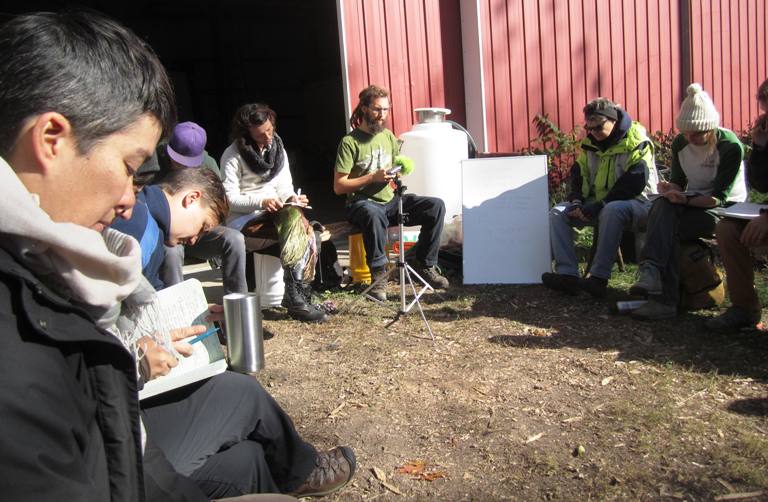
Cultivation workshop at the Radical Mycology Convergence (an event that one organizer likened to "the fruiting body of a mycelial network.")

Cultivation workshop at the Radical Mycology Convergence (an event that one organizer likened to “the fruiting body of a mycelial network.”)

A fitting metaphor for social change work, which is not always visible to the mainstream.

We may feel like we’re laboring in the dark, but when we connect with others—even starting with just one!—the network that results can produce something nourishing and healthy, a powerful gift that seems to show up “overnight.”

Lessons from the Ecovillage

Guest blogger Jami Gaither reports on her recent stay at Dancing Rabbit Ecovillage, located in Rutledge, MO.

Guest post by Jami Gaither

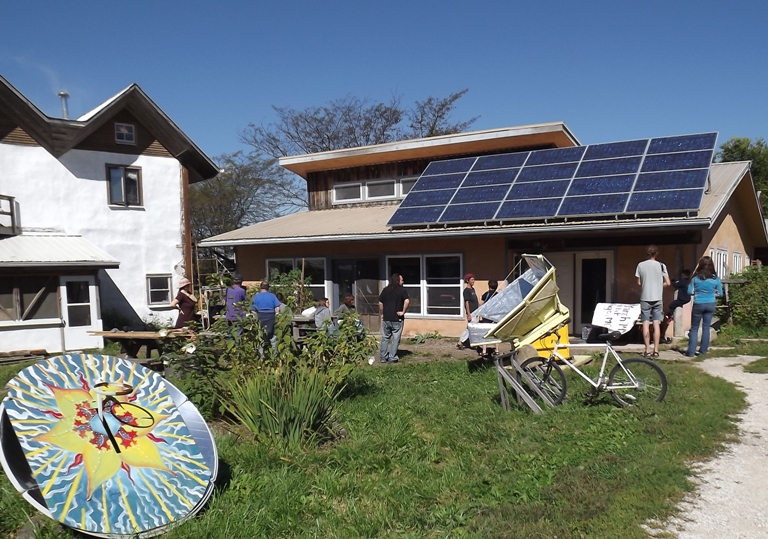
I expected my three-week Visitor Session at Dancing Rabbit Ecovillage to expose me to natural building, cisterns and alternative power. What I didn’t expect were the surprises I encountered.

Photo by Jami Gaither

Photo by Jami Gaither

The first surprise was the amazingly good vegan/vegetarian food. Who knew it could be so tasty, filling and energizing? We had meat for only three meals in three weeks. While I rarely eat fish, at my first dinner back in “concrete world” I ordered Mahi Mahi. This was the most attractive item on the menu and a healthy alternative to my usual chicken or pork. My time at Dancing Rabbit influenced how I see and consume food.

The limited and well-planned use of vehicles was another revelation. Each week, residents review the needed vehicle plans. Seventy people manage to share four vehicles: a Jetta, a Passat, a Leaf, and a large work truck with optional trailer. They do this by planning trips and combining them when possible. The cost for each trip is paid by the member taking it. The $0.65/mile covers the cost of the car, gas, insurance, and maintenance.

For example, a 125-mile round-trip from Dancing Rabbit to the Possibility Alliance, an educational homestead in La Plata, MO, cost me just over $20 ($81.25 divided by 4 riders). This initially seemed pricey to me. But I realized that minimizing the need for travel and sharing rides makes the cost of having a vehicle very reasonable.

The full schedules of members was a third recognition. “Rabbits,” as residents are known, are busy building homes (largely by hand) while raising food (via small-scale organic gardening) and children (some are home-schooled). They do all this in keeping with a commitment to the Dancing Rabbit mission:

To create a society, the size of a small town or village, made up of individuals and communities of various sizes and social structures, which allows and encourages its members to live sustainably. To encourage this sustainable society to grow to have the size and recognition necessary to have an influence on the global community by example, education, and research.

Members and residents spend a few to several hours per week on tasks that keep the community and co-ops functioning. Tasks range from clearing paths and dumping humey (humanure) buckets to cooking a meal for a food co-op. Many also pledge hours to committee work. Since discussions are consensus-based with open/clear/respectful communication by all, this important work can be some of the hardest to do.

Photo by Jami Gaither

Photo by Jami Gaither

This brings me to the biggest surprise of all: the commitment to interact using non-violent communication (NVC) and mediation. My NVC training was eye-opening; it takes much energy, commitment, honesty, and trust.

Some say that living in an intentional community is the most expensive, longest lasting personal development program you’ll ever experience. The community becomes a house of mirrors. Even in my short visit, I learned how my perspective and experience govern my words and deeds. Several interactions indicated I’d hit a nerve or spoken callously…unaware or inconsiderate of the perspective of the other. Working on self-improvement can be a long process.

Some argue that we do not have environmental problems, only communication problems that prevent us from using resources wisely and for the greatest good of the whole. The more we communicate, the closer we feel to others. That sense of connectedness encourages us to take care of others and be less self-focused.

Photo by Jami Gaither

Photo by Jami Gaither

I believe that with some effort, we can each make strides to be more self-aware and considerate. In time, we can interact more effectively and humanely with our fellow beings on Mother Earth.

Ohio native Jami Gaither is a recently retired metallurgical engineer now pursuing a lifestyle based on sustainability, simplicity and fun. While not yet certain of her life path to come, the process of exploring is keeping her enthralled. She lives in Minnesota with her husband Danny.

Reconnecting

Today I enjoyed time with two friends in two separate food-related endeavors. One of them crazy enough to get up early and go questing for a supposedly killer purslane haul. The other tenacious enough to spend several hours shredding produce in my kitchen to make two varieties of sauerkraut.

Two crocks of veggies are fermenting on my table right now.

A batch we made together another time.

A batch we made together another time.

The purslane was a little “gone by,” but we are salvaging it as chicken feed.

And in both cases, we had a great time together, reconnecting.

It made me think of something I just read in an e-newsletter from an eco-village called Dancing Rabbit.

Relearning harmony with the earth at this time in existence is a great undertaking, in a world where bug spray, Big Macs, smartphones, and petroleum are readily available.

Young Thoughtful

It is a great undertaking, I agree. Everything in our culture pulls in the opposite direction. But friends can ease the way. They make swimming upstream companionable.

What about you? In what ways do your friends join you in living a bit more lightly on the planet?

A Rural Rebirth, One Ag Business at a Time

Earlier this summer I visited Becca Selkirk at her Wayne County, IN farm, Unique 2 Eat, where she raises quail, chickens, and rabbits. She sells the eggs from her quail and chickens, along with rabbit meat. And she has two goats just for fun.

I was researching a story for Farm Indiana, having met her through Carthage Mill. (You might remember founder Anna Welch’s powerful guest post, “The Face of Resilience,” from a few months back.)

The mill is a sustainable agriculture business incubator, and its existence allowed Becca to expand into animal feed.

Becca Selkirk with a handful of her locally grown and milled feed.

Becca Selkirk with a handful of her locally grown and milled feed.

Using all organic and local ingredients, such as Fields of Agape‘s black bean halves and flax seeds, she’s developed a high-quality chicken feed. At 19 percent protein, her layer feed out-competes the industry standard. It’s all ground right onsite.

She markets her products at the mill and through Hoosier Harvest Market, the online marketplace that delivers small farmers’ and producers’ wares to several drop points.

I interviewed one Carthage resident who made the switch for his chickens and was thrilled with the result. “The quality of it’s great,” Devon Hamilton told me. “And my birds look healthier.” He says the price point is only slightly higher than what he was buying. And it’s worth it to him to know the ingredients were locally and sustainably raised.

Next on Becca's list is a formula for quail feed.

Next on Becca’s list is a formula for quail feed.

Plus, he wants to support the new venture. “I was there one day when Becca was mixing (the feed),” he says, “and she was working very hard. It’s very labor-intensive.” He feels that Becca has priced her feed appropriately, given everything that goes into it.

Becca is also one of the principals of local fertilizer maker Sterling Formulations, another company leasing space at Carthage Mill. And I just found out that she’s been able to expand into another new line. She’s cooking up ready-to-eat soups and developing a gluten-free pizza crust for “take-and-bake.”

She’s only been able to do this because of Carthage Mill: It has a commercial kitchen that’s certified for use in organic food production.

This is rural revitalization, one small ag business at a time.

Check out the full Farm Indiana story on Unique 2 Eat Farm. (Warning: adorable fuzzy animal photos involved—Josh Marshall‘s photography is terrific as always.) For more on Carthage Mill, see “Cooperative Offers Rural Rebirth,” my Acres USA story.


Now We’re Cooking…with Sunshine

We offered our solar cooking workshop last weekend to an enthusiastic “crowd” of 17. That’s the biggest group a Pogue’s Run Grocer class has ever attracted, so we were pleased.

Judy demonstrating how to make a lid for a box cooker.

Judy demonstrating how to make a lid for a box cooker.

Judy has developed a wooden model, but we’re still working out the kinks. So we focused the class on “the old workhorse,” our tried-and-true cardboard box cooker. We wanted to show that you can start cooking with sunshine using only cheap (or free!) materials.

Judy adapted the design out of our solar cookery bible, Cooking with Sunshine. And you can find DIY instructions online as well.

All it needs now is an arm to prop the reflector--and you can make this out of a wire hanger.

All it needs now is an arm to prop the reflector. You can make this out of a wire hanger.

One of the attendees, a firefighter, plans to make the box cooker at the firehouse. He has a big vegetable garden, and he brought us all kinds of herbs and veggies in thanks for the teaching. He was eager to try using up garden produce in all-day stews and soups.

And we discovered after the class was done that another of the attendees has already been experimenting with solar cooking quite a bit. He sent me this inspiring video, proving me wrong when I said, “No, you can’t solar cook in the winter, because the sun’s too low.” Check it out!

The company behind this innovative design is called Solar Clutch. Its mission is promoting solar cooking in high risk areas of the world. I hadn’t heard of Solar Clutch, but I’m proud to find my home state of Indiana producing such a company.

Perhaps solar cooking season doesn’t have to end on Sept. 15 after all!

Going Soil-Friendly

Do you ever think about the importance of the innumerable tiny creatures living underground, right under your feet? In just one tablespoon of soil, according to North Carolina State University’s Cooperative Extension Service, some 50 billion microbes are working away.

That’s if the soil is healthy.

By NoNomme (Own work) [CC0], via Wikimedia Commons

By NoNomme (Own work) [CC0], via Wikimedia Commons

I remember a conversation with an Ohio woman active in the environmental movement. She told me a story about a farmer who decided to switch his (conventionally farmed) cornfields to chemical-free produce. His seeds sprouted, but grew stunted and deformed.

The land had been blasted with petrochemicals year after year. Now there was nothing left to support a plant. No microbes. No nutrients.

But it doesn’t have to be that way.

My most recent Farm Indiana piece concerns a small agricultural fertilizer business called Sterling Formulations, led by a young man aptly named Vince Plowman.

Sterling Formulations’ team assesses farm fields and recommends soil-friendly additives depending on the particular needs of each field. They apply microbes and micronutrients to balance and nourish the soil that nourishes us.

Filling a container with earth-friendly fertilizer concentrate at Sterling Formulations' Shelbyville, IN plant.

Filling a container with earth-friendly fertilizer concentrate at Sterling Formulations’ Shelbyville, IN plant.

The team includes an Amish farmer who offers knowledge based on generations of experience. (My people!)

“The Amish have been farming organically for centuries, and quite successfully,” Vince told me. “They treat their soil right, and guess what, they’re getting yields comparable to conventional.”

He was surprised to learn that conventional farmers are as receptive to this message as organic growers. He said, “We found, in talking to a lot of conventional farmers, that so many of them are curious.”

Corn Field

Though he half-expected a derisive response from the conventional agribusiness side, so far that has not been the case. “What we found is they’re absolutely afraid…They don’t know how to do it (transition off chemicals), and they don’t have anyone to step them through the process of going to organics without absolutely killing themselves. They’re used to getting 200 bushels an acre, and they’re afraid they’re going to get 50 next year” if they stop using chemicals.

What comes next in that scenario isn’t pretty: they’d likely lose their farm. And many in that arena are supporting multiple families on the farm.

But Sterling Formulations is stepping into the gap. The goal is to help heal beleaguered soil through tailored applications of microbes and kelp-based fertilizers. Instead of petrochemicals that artificially prop up crops, these nutrients and tiny creatures create a living medium for plants.

This is one of the most exciting developments I’ve heard about in a long time. Farmers who want to stop using chemicals can get support in the switch—and stay profitable during the transition.

You can read more about Sterling Formulations in my Farm Indiana story.

Will Allen Visits Peaceful Grounds

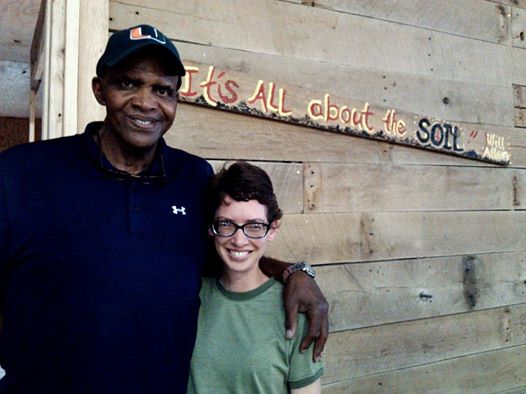
It was an honor to meet Growing Power founder Will Allen last weekend. The urban farming advocate was in town to support the work of his student Linda Proffitt at Peaceful Grounds. (Here’s my earlier post about this inspiring demonstration farm, which is a regional training center for Growing Power.)

This aphorism hangs on the wall at Peaceful Grounds.

This aphorism hangs on the wall at Peaceful Grounds.

The former pro basketball player told me that he learned how to broadcast seed as a child. He can pick up a handful of seed and not drop one of them. He has the muscle memory for broadcasting those seeds, whether arugula or chard or carrots—and all require different release rates. His sharecropper father taught him as a child, and all these years later, he retains the skill.

Now he sows great swaths of salad greens in his Milwaukee farm operations. Calling himself a “crusty old farmer,” he is the embodiment of Growing Power’s stated vision: “to inspire communities to build sustainable food systems that are equitable and ecologically sound, creating a just world, one food-secure community at a time.”

In 25 urban farm sites, on places like brownfields, school property, and land leased from corporations, the organization models how to get this done. The food is distributed through multiple channels, from Community Supported Agriculture accounts to a major distributor, Sysco. “Just another customer” is how he describes the corporation that ships GPI wares all over southeast Wisconsin.

Though the local food movement continues to make strides, there’s still a long way to go. Despite all the options—the CSAs, the farm stands, the farmers markets, the small mom and pop stores stocking local fare—Allen says up to 99 percent of the food eaten in major cities comes from 1500 miles away. “The vast majority of people will shop square,” he says, referring to big box stores.

Only $13 million of the U.S. food sector is generated by eco-agriculture—about the equivalent of three McDonalds. Growing Power represents 20 percent of that share. To fully transform the food system would require 50 million people to start growing food in their own yards, he says.

Turning the ship around has been the iconic Allen’s life work for the past 21 years.

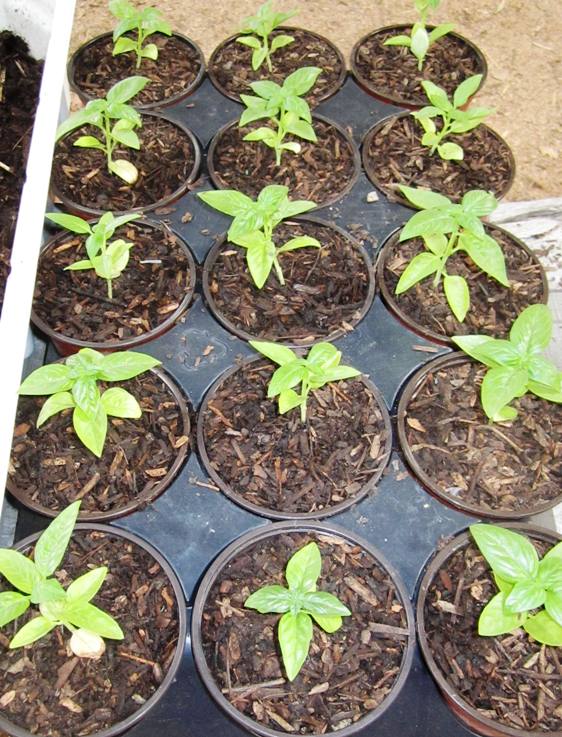
Basil sprouts at Peaceful Grounds, a regional training center for Will Allen's organization, Growing Power.

Basil sprouts at Peaceful Grounds, a regional training center for Will Allen’s organization, Growing Power.

He envisions for-profit businesses taking up the charge of urban food security, with nonprofits assuming a training and organizing role.

In his own organization, the people responsible for growing the food are extremely efficient, and training happens as a separate program. That’s a critical point, because farming isn’t easy. Efficiency is the name of the game.

“My crew comes from the community, and they live in the community, but they are professionals. Everybody thinks you can take interns and integrate them with professionals, but you can’t. You’ll lose money hand over fist.”

He's very tall.

That’s me on the right.

More of my conversation with Will Allen can be found in today’s Nuvo article.

Also check out Robb Smith’s terrific podcast interview over at DIY Food Supply.

Homegrown “Superfruit”

I saw this item for sale at my food co-op, Pogue’s Run Grocer, and it cracked me up.

Turkish Superfruit! Check it!

White mulberries, a “Turkish Superfruit,” only $5.99 for 4 ounces. What. A. Steal!

Just a week ago I spent a pleasant morning bicycling around the neighborhood with a friend. We stopped to pick from the mulberry trees that grow wild along the creek, meanwhile catching up on each others’ lives.

Mulberries are great in smoothies and crisps, and they are abundant, free, and nutritious (apparently a Superfruit, no less!). My friend and I were delighted with our harvest. Along with the usual purple, we found a white mulberry tree. It might be my imagination, but I always think the white berries are particularly sweet (though a bit less appetizing in appearance).

Superfruit from the hood. Free of charge. Bring your own bucket.

Superfruit from the hood. Free of charge. Bring your own bucket.

I once blogged about how homesteading (even on my modest scale) can make me feel like a chump because of all the extra work it takes to live “simply.” And how other times, I feel the tiniest bit smug, because—look! So much wealth on so little money.

Yeah, this is one of those smug times.

Peaceful Grounds

Monday morning a group of gardeners from the neighborhood had a private tour of Peaceful Grounds, Linda Proffitt’s endeavor at Marion County Fairgrounds, where the county fair is going on. (See my earlier post about her work here.) The vision and scope of this Global Peace Initiatives project astounded and inspired us.

The cattle barn at the Marion County fairgrounds is home to this volunteer-driven initiative.

The cattle barn at the Marion County fairgrounds is home to this volunteer-driven initiative.

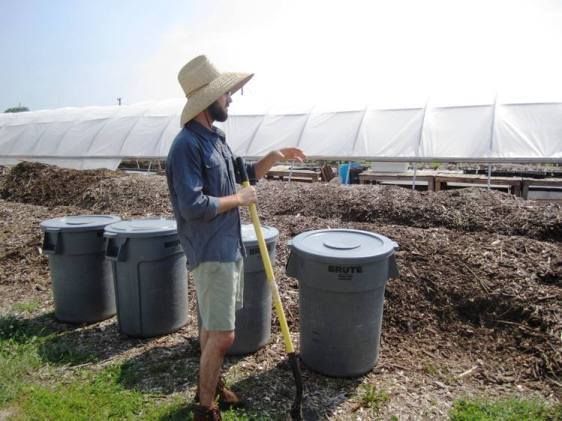
George Marshall, Linda’s intern, showed us around the farm, where mounds of wood chips are not just regular old wood chips but worm habitat.

George

George next to a hoop house that stayed warm all winter from heat given off by decomposition.

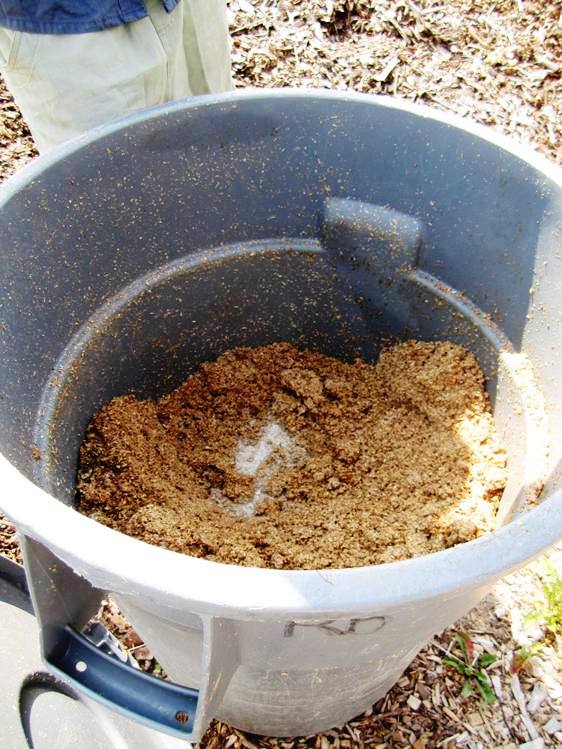
Peaceful Grounds takes beer mash from local brewers like Irvington’s own Black Acre and buries it in mulch to feed the herd of worms.

The spent grain is perfect worm food because barley fits easily into worms' tiny mouths.

The spent grain is perfect worm food because barley fits easily into worms’ tiny mouths.

Hand-painted signs that say “Worms at Work” and “Thank a Worm” testify to the importance of these little red wigglers.

IMG_3617

Digging up some of the underground workers to show us.

Volunteers mix 5 to 15 tons of mash with equal amounts of wood chips each week. Another mound incorporates dehydrated food waste from public hospital Eskenazi Health. Over time, these piles and rows are transformed into a viable medium for garden plants.

George showed us where vegetable and herb starts have been set right into these habitats.

broccoli

Broccoli planted in one of many windrows made by worms doing their work on wood chips and beer mash.

In a nifty closing of the loop, Linda has begun to raise hops to supply local brewers.

A few of Peaceful Grounds volunteer-planted crops.

A few more Peaceful Grounds volunteer-planted crops.

While we were walking down the raised beds (“windrows”) of basil and tomatoes, a fair official came up and asked for Linda. He wanted to introduce her to the people in charge of an elephant exhibit, so she could incorporate elephant dung in the farm operation. (“You never met a lady more excited about poop than Linda,” George joked.)

Inside the cattle barn is where kids and adults can come for hands-on fun with art and agriculture. It’s also where artists like Jamie Locke (another Irvington neighbor) demonstrate mandala making and other crafts—and where young volunteers from Handi-Capable Hands take charge of a gigantic tumbler that sifts the worm compost into two grades of product.

Heidi Unger took this photo of the tumbler, which is named Apollo and was donated by a local farmer who saw Linda on TV.

Heidi Unger took this photo of the tumbler, which is named Apollo and was donated by a local farmer who saw Linda on TV.

We went home with the finer grade, which is basically worm poo, to use as a powerful organic fertilizer. One tablespoon per plant will nourish it through a month, Linda says.

Worm castings make an excellent fertilizer. Now there's a local source!

Worm castings make an excellent fertilizer. Now we have a local source!

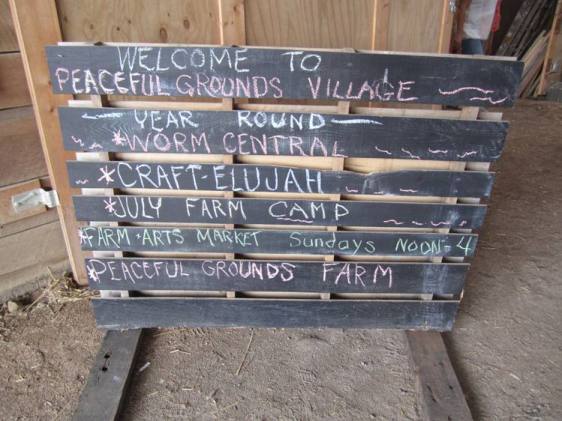
Before we left, we learned that Will Allen is going to visit the operation, which is a training outpost for his fabulous Growing Power organization. He will speak at 2pm Saturday and lead a workshop at 4pm, and will also preside over a ribbon cutting ceremony at noon on Sunday, when the Peaceful Grounds Farm and Arts Market kicks off.

IMG_3598I’d love to see more interaction between local urban gardeners and this facility, which is just a stone’s throw from Irvington’s back door. Right now the county fair is in full swing, but the possibilities extend beyond its closing date. Linda is running a Farm Camp for kids starting July 7, and is happy to host volunteers at any time.

By the way, she offered to set me up with an interview with Will Allen. I’m thrilled to meet this man I admire so much. I’m crowdsourcing interview questions. What would you ask the grandfather of urban gardening, if you could?