Radical Fungi Are My Favorite Teachers

Guest Post by Peter McCoy

When I get asked why I started the Radical Mycology project, I often say that it was to share the lessons that mushrooms have taught me.

Turkey tail logs

Turkey tail logs

Since I started studying mushrooms as a teenager, I have always seen mycology (the study of fungal biology) as an endlessly fascinating and thought-provoking science. Whether I am using them as a nutritious food source or as a potent medicine, I am always honored to taste their wonderful flavors and alluring textures. Hunting mushrooms in the woods, I love to watch them grow, knowing that they are cleaning the forest soil, protecting plants from disease, and turning decaying matter into fresh topsoil so new plants can thrive.

And using them as remediators, I am awed by the mushrooms’ ability to break down and eliminate some of the most toxic industrial compounds in the world.

Grassroots Bioeremediation workshop with Leila Darwish at the Radical Mycology Convergence

Grassroots Bioremediation workshop with Leila Darwish at the Radical Mycology Convergence

Seeing how the densely branched mycelial networks of mushrooms share nutrients among plants, I also find a wonderful example for humans to follow when working to collaborate with their communities. Further, the incredible spore loads that mushrooms drop in the fall are designed to adapt to any given environment, demonstrating the ability to adjust to challenges and remain resilient during hard times.

These same attributes provide a model for how humans can best relate to each other, whether on a personal or societal level. By mimicking mushroom mycelium, cooperative businesses and housing projects work more efficiently by spreading out tasks and networking with affiliated organizations.

Fungi are also highly symbiotic with most organisms on the planet, so we find, yet again, the importance of collaboration among creatures throughout the fungal kingdom. In essence, fungi act in countless ways as grand harmonizers of the Earth, something that humans can aspire toward to live in balance with their surroundings.
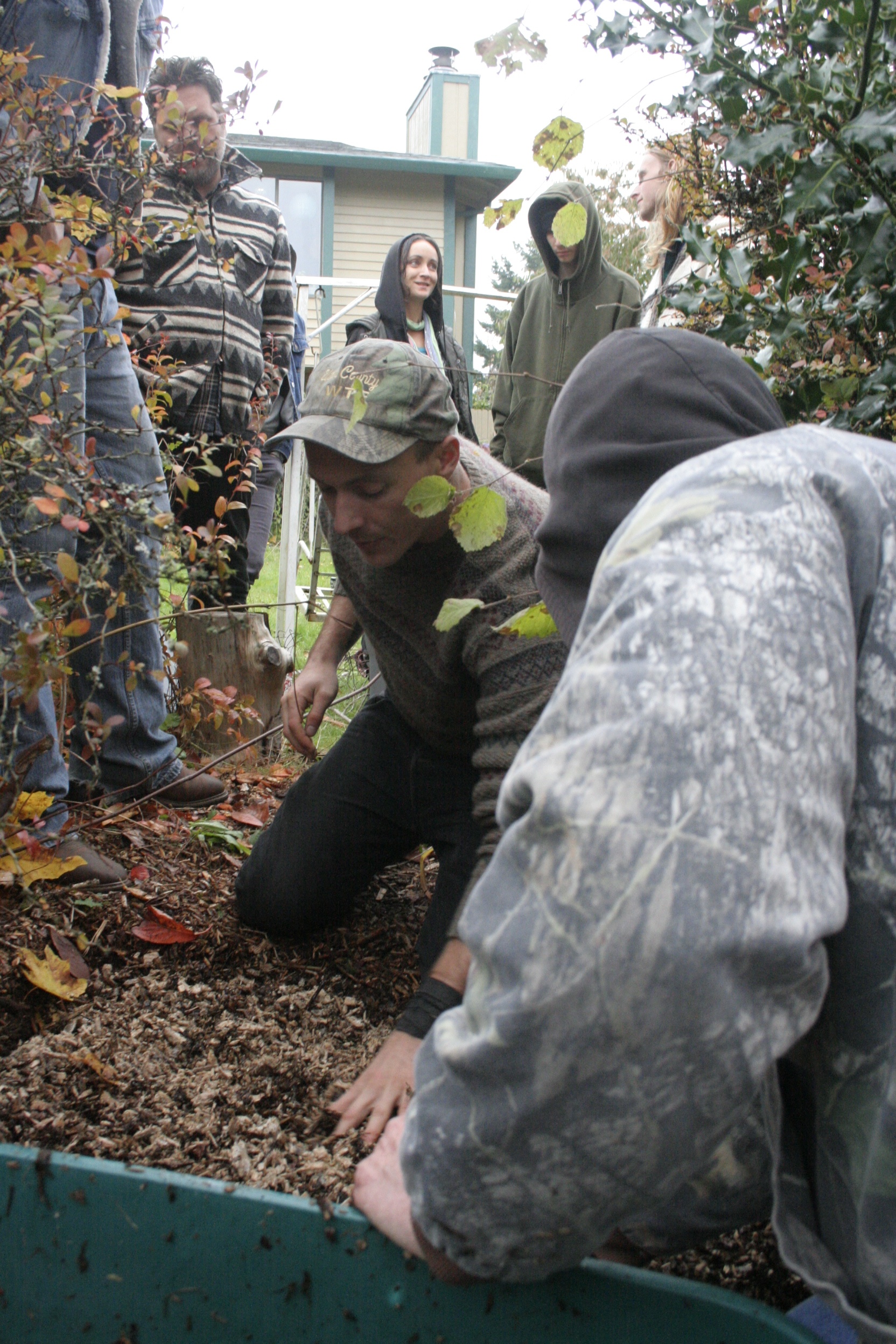
King Stropharia bed installation at Peter's Mushroom Cultivation & Application Course in Olympia, WA

King Stropharia bed installation at Peter’s Mushroom Cultivation & Application Course in Olympia, WA

The Radical Mycology project revolves around just this philosophy: that by studying, working with, and learning from the fungal kingdom, humans can best find solutions to problems of personal, societal, and ecological health. To this end Radical Mycology has put a lot of energy into providing free education to the public on the benefits of fungi.

Our website (radicalmycology.com) is a database of all things mycological. We offer two free publications we have written, Radical Mycology and Mushroom Cultivation For Remediation, as well as instructional videos and protocols for mushroom cultivation.

Nameko Bed installation at Demeter's Permaculture Garden in Olympia, WA

Nameko Bed installation at Demeter’s Permaculture Garden in Olympia, WA

We organize regular multi-day events on mushroom cultivation and its practical applications (the Radical Mycology Convergences), with another being planned for the spring of 2014. And since 2011, two Radical Mycology-inspired volunteer clubs have sprung up in San Francisco, CA and Olympia, WA. These groups teach free workshops about simple and practical mushroom cultivation and community resilience.

The next and biggest project for Radical Mycology is writing a book exploring the theory, practice, and applications of mushrooms for personal, societal, and ecological change. We are currently in the midst of an Indiegogo crowdfunding campaign to fund the book. Our campaign page will soon be up and running. Stop by the Radical Mycology website to learn more about our work.

Update: The Radical Mycology Book fundraiser is underway! This unique book on the uses of mushrooms and other fungi for personal, societal, and ecological wellbeing will be a powerful resource for the geek and do-gooder inside us all and we are excited to bring this dream to the rest of the world.

You can view the live campaign here:

http://bit.ly/radmycogogo

Book Offers a Vision of the Possible

I’ve had this book out from the library the past few weeks, but after test-driving it, I just emailed Kathleen at Bookmamas to ask her to order it for me. It’s a keeper. Here’s my review:

Wendy Tremayne’s The Good Life Lab: Radical Experiments in Hands-on Living gives a powerful example of a reimagined world in the shape of one couple’s desert homesteading adventures.

Prickly pear, an example of the desert bounty gathered by Tremayne. Photo by Jon Sullivan [Public domain], via Wikimedia Commons

Prickly pear, an example of the desert bounty gathered by Tremayne. Photo by Jon Sullivan [Public domain], via Wikimedia Commons

Many of us work toward self-sufficiency (or better, community-wide resilience, broadening the circle from homestead to neighborhood). But we’re hampered by the need to make money to prop up our lifestyles, cutting into the time we have to learn and practice new skills. Wendy and partner Mikey demonstrate what is possible by leaping into a completely new way of life. They cash out their retirement accounts (a prescient move, before the crash) and transplant themselves into Truth or Consequences, NM to build a new life.

And build they do: using waste materials and nature’s bounty, they craft a beautiful, abundant, interconnected home base that allows them to live their deepest values.

In contrast to some “green lifestyle” books that focus on giving up luxuries for the earth’s sake, this book offers an exuberant romp through the reclamation of life’s biggest gifts: time, beauty, creativity, connection, purpose. More than just a memoir, it is an invitation to adopt the “maker” mindset. Tremayne’s lyrical descriptions of the spiritual aspects of this journey, coupled with the gorgeous, whimsical artwork and photographs, make this an inspirational book.

The author (who founded Swap-O-Rama-Rama, a community-based textile repurposing/skill sharing extravaganza) observes, “When all of life is for sale, it is a revolutionary act to become a maker of things.” She describes “life in the waste stream” as the ultimate freedom.

“By relying on waste, on what nature provides, and on ourselves, we gave the world a chance to demonstrate abundance. By becoming makers of things, we let our creativity become a transformative link between the free materials available to us and the finished goods that made our lives better.”

She notes that mistakes are part of this process, and describes combatting the inevitable “I can’t do that” by simply taking the next step. For those of us who consider ourselves less than handy (ahem), the book offers both challenge and a roadmap. The last section, in fact, provides concrete steps toward reclaiming the building blocks of life, covering food, power generation, fuel, and shelter.

The physical book itself embodies the new world by its very design, in which art and joy and utility are married into a brilliant manifesto.

In short: Stop what you are doing and order one now from your local independent bookstore, people!

(Can’t wait till your book arrives? Hungry for more after reading it? Check out Wendy and Mikey’s blog at Holy Scrap.)

From the Low Food Chain Chronicles

Weeks ago, months really, I pledged to try sardines in an effort to eat lower on the food chain. I went out and bought a tin of skinless, boneless sardines. I asked for your serving suggestions. I browsed recipes. I learned that you can fry them (“the bones get crispy!” said food blogger friend Melissa, which gave me pause), or put them in a potato salad, or mix them into pasta. Or just eat them on a cracker.

I got inspired.

Then I put the tin in the pantry. And there it sat. And whenever I reached in for baking powder or pasta or whatnot, I would think, Oh yeah, sardines, I promised I would eat those. For the blog. And then I would close the door again posthaste.

I am proud to tell you that yesterday I actually pried that sucker open. And I didn’t stop there. I actually ate sardines.

Yesterday's lunch.

Yesterday’s lunch.

I’m here to report that these little fishies, which feed the farm-raised fish so many of us prefer…really aren’t that bad! The smell is a bit oceanic, but taste is mainly salty, at least when mashed in small (microscopic) amounts on a lovely sesame rye cracker.

I was worried the mouthfeel would be slimy, because just look at the sheen on those puppies. But they were actually quite palatable.

I had lactofermented veggies on the side, figuring two strong flavors would cancel each other out. You can never have too many cultured veggies, and these collards and cabbages were homegrown and -cultured.

Unfortunately I had to move indoors to eat because my cat was so interested in the meal.

"I'd be happy to finish those sardines off for you." --Kitley

“I’d be happy to finish those sardines off for you.” –Kitley

I told myself that if lunch turned out to be a train wreck, I’d put a good taste back in my mouth with dessert: zucchini cornbread baked in the solar cooker. Not just any cornbread but blue cornbread. Over homemade yogurt with organic Indiana blueberries.

Sorry I don’t have a photo for you. I was too excited about eating it to pause and snap.

Meanwhile the salad balanced the sardine experiment nicely. I’ve said it before: I know this isn’t a food blog, but still I must share the ingredients of this super-duper salad:

  • Grated zucchini, because it’s summer and everything we eat must include zucchini from the garden in some form.
  • Oxalis, purslane, sorrel leaves, chives, catnip, young dandelion leaves, and possibly other things I can’t remember, gathered from the yard (and the neighbor’s yard, but who’s looking?)
  • Sungold cherry tomatoes, first of the season and sweet as can be. I’ve waited all year!
  • Pumpkin seeds toasted in the solar cooker.
  • Nettle seeds. Herbalist Greg Monzel says these are “one of the only herbs that can restore compromised kidney function,” not that I really need that. And they’re too small to give much more than the teeniest little crunch. But I like using every part of the nettle patch, so I can tell Judy, “I’m still harvesting from it!” when she threatens to whack it down.

What culinary adventures are you having this summer?

Why Forage?

Trout lily was one of the first wild plants I learned to harvest from the greenspace across the street from my house. There’s a thriving colony that appears in a rough circle at the base of a redbud tree for a month or so before fading back into the earth as ephemerals do.

By Jason Hollinger (Dimpled Trout Lily  Uploaded by Amada44), via Wikimedia Commons

By Jason Hollinger (Dimpled Trout Lily Uploaded by Amada44), via Wikimedia Commons

Sometimes I feel quite fringy bending down in early spring to pick the tender leaves before moving on to check the basswood tree and other faves. Even in my groovy neighborhood, it’s somewhat marginal behavior to pick salad leaves off the ground in a public space.

Then I read something like this:

“Some people think that it’s silly to go for an invigorating walk on a May morning and come home with a lush heap of delicious gourmet vegetables when it would only take slightly longer to drive to the grocery store and spend hard-earned cash to get weeks-old inferior produce with half the nutritional value, doused with deadly chemicals.

I see their point, but I’m sticking with wild food just because it’s a lot more fun.”

–Samuel Thayer, in Nature’s Garden: A Guide to Identifying, Harvesting, and Preparing Edible Wild Plants

Reading on, I find that not only trout lily leaves but bulbs are edible–and are in fact tastier than the leaves.

Hello shovel, goodbye self-consciousness. (I would make sure not to decimate the colony of course. Thayer says responsible harvest practices allow trout lily colonies to thrive.)

What about you: What’s your favorite gourmet wild vegetable to forage, or have you tried any yet?

Postcard from FoodCon

Friday’s FoodCon was a thrill. I haven’t heard the final tally of attendees, but there was a steady stream of bright-eyed folks. I met so many people with interesting stories about foraging (which, as I explained to one non-native English speaker, is like hunting, only for plants).

Swapping foraging stories with a foodcon attendee

Swapping foraging stories with a foodcon attendee

People spoke of making elderberry syrup for winter colds and congestion, of becoming more accustomed to the taste of bitter greens to the point of craving them, and of eating oxalis as kids.

One little girl said she likes to eat clover petals, which brought back my own flower-eating past: My friends and I used to pick the blooms off my dad’s tall phlox and suck the nectar, pretending it was a special elixir.

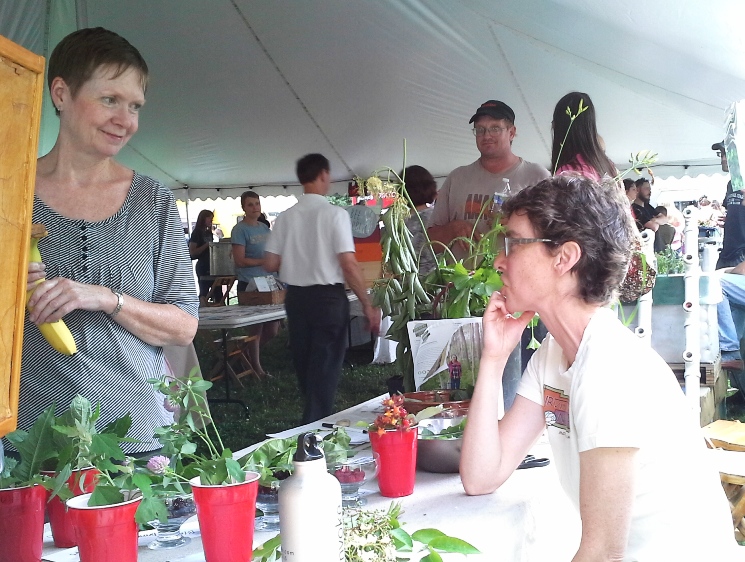
Most of my exhibit consisted of weeds picked that morning. All are available in the typical urban yard or garden. “If you can’t beat ‘em, eat ‘em,” was my line.

Trees are a source of unexpected nutrition too: Even seasoned foragers were surprised to learn that basswood tree leaves are great in salads.

Trees are a source of unexpected nutrition too: Even seasoned foragers were surprised to learn that basswood tree leaves are great in salads.

I told the uninitiated to start by topping a salad with the tangy, tender oxalis, which is prevalent in urban yards. Then see if, like me, they don’t get completely hooked on picking stuff from their yards to bring in to the dinner table.

Wet tablecloth

My tablecloth got all wet after an early gust of wind blew a few cups over. But it didn’t matter: check that wilty salad!

Japanese wineberries (at the right edge of the above photo) were the star of the show. Though one website calls this bramble fruit a “bio-bully” for being invasive, the berries are dazzling little gems that are sweeter than should be legal. (Last year I learned the identity of this mysterious bramble I’d found just as the buds were forming. I was anticipating some happy picking, then they perished in the drought. This year: bountiful harvest.)

Some were amazed that you can actually eat mulberries, asking incredulously, “What do you do with them?” while others were right there with me on the “nature’s candy” point.

A friend and I had biked around the neighborhood questing for these berries.

A friend and I had biked around the neighborhood questing for these berries.

Things I learned: There’s a “Poke Salad Annie” song, and you can eat milkweed flowers, and four hours of talking makes one hoarse.

The solar cooker got lots of interest too, though generally more as a novelty from what I could gather (my partner Judy fielded most of those questions, bless her).

As far as the other exhibitors, I was able to make a quick circuit late in the evening and talk to the folks from Wolf-Beach Farm, as well as friends at the “dumpster diving/dumpster dining” booth and the “making easy meals in 5 minutes” table. (These were all people I had referred to the organizer.)

I also found a couple standouts in the resilience arena. I’ll report on them in an upcoming post. Some great innovators there, helping people break their dependence on a shaky centralized food system that is wreaking havoc on both planetary and personal health.

Forage Ahead!

Today I joined my friend Greg Monzel of Monzel Herbs on one of his terrific plant walks. The rain held off as we tramped the lanes and fields of Distelrath Farms, an urban farm and the source of my weekly CSA allotment.

As an herbalist, Greg focuses these guided tours on both edible and medicinal plants. After you’ve hung around with him for a little while, you get a new appreciation for the things people normally dig out of their gardens. It seems that everywhere under our feet, there’s nourishment and healing.

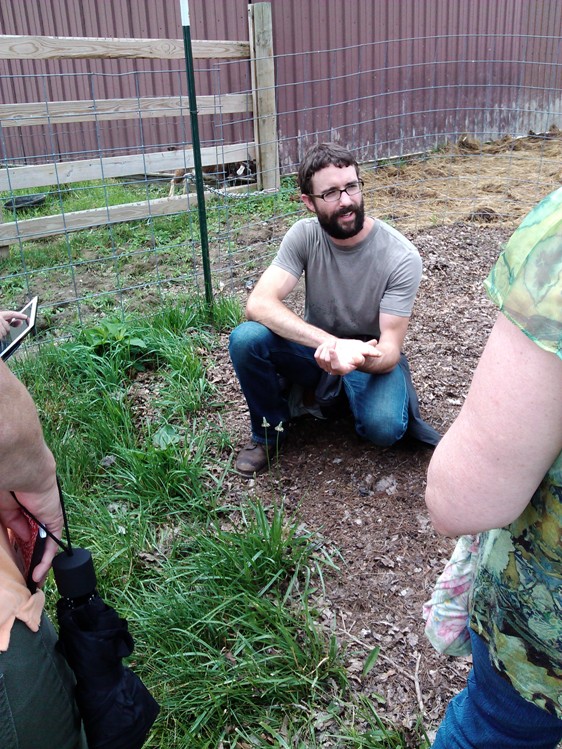
Greg teaches us about plantain and its many uses

Greg teaches us about plantain and its many uses

Plaintain, for example, is good for eczema, wounds, and other skin issues, while its seeds are a “poor man’s psyllium.” I doubt I have the patience to collect its seeds, but I like the idea of whipping up a bunch of leaves in the blender with olive oil to make an infusion. I have some off-and-on rashy stuff on my hands, so I might try that.

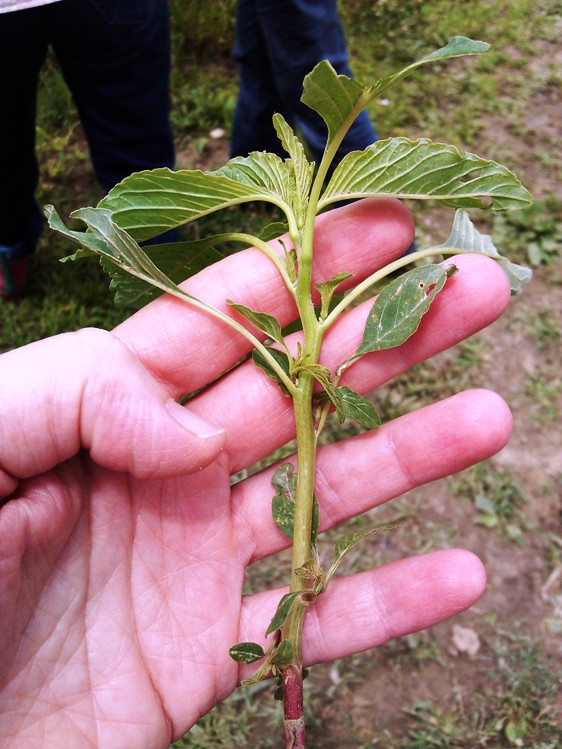
Amaranth, drought-tolerant and tasty

Amaranth, drought-tolerant and tasty

More tasty than the bitter plantain is amaranth. It is an amazingly hardy summer salad green as well as a source of protein-rich “grain” (actually the seeds).

I’ve never collected the seeds, but I adore amaranth as a green. My partner was introduced to it in Tanzania years ago. There it was called red root and sauteed in a dish called Sukuma Weeki.

When the drought hit us last year, amaranth didn’t even notice. So this year I bought amaranth seeds to plant for a steady and convenient supply. As soon as my lettuce is done–any day now–I’m sowing amaranth in preparation for a dryer, hotter July and August. I can almost taste that late summer salad of amaranth and purslane, a heat-loving succulent high in omega-3 fatty acids. Most people pull both as a weed.

Greg, by the way, says weeds are a state of mind. Many of the things we consider noxious weeds were actually brought here because of their usefulness. Now they populate areas where the soil has been disturbed, working as “succession plants” that naturally build soil fertility.

Knotweed, AKA smartweed

Knotweed, AKA smartweed

Here’s knotweed, for example, also known as smartweed. I remember seeing this pretty little bloom in my dad’s raspberry patch and wondering what it was. I learned today that it is in the buckwheat family. Its leaves and seeds are edible and loaded with resveratrol, a potent antioxidant.

And did you know that you can harvest the seeds of the ubiquitous clover and save them in a jar, for indoor sprouting at some later, leaner date? It’s mind-boggling to realize there is free food all around us, even in the city, that could potentially nourish us in good times and bad.

I’ve learned so much from Greg, starting when I interviewed him for an Edible Indy story on gathering wild foods. Though I’m not nearly as experienced as he is, next Friday, July 5, I’ll have a table on foraging at FoodCon IV, a fabulous event that attracts a thousand or more people every year. I’m beyond excited to be part of it.