Unfurling

Happy belated Earth Day. Today I’m in a bit of a spring swoon. I fall in love with the world this time of year. I find myself looking more closely than usual, feeling wonder and deep gratitude.

For lunch I had a salad of farmers market greens, augmented by a few trout lily leaves. Several large colonies appear every April across the street from our house for a short time before fading back into the earth.

We’d dug our Jerusalem artichokes last week, so I cleaned one up and cut it into crispy little rounds for my salad. While I was scrubbing the dirt off, it occurred to me that something about Jerusalem artichokes is just flat amazing. All that sweetness growing deep underground.
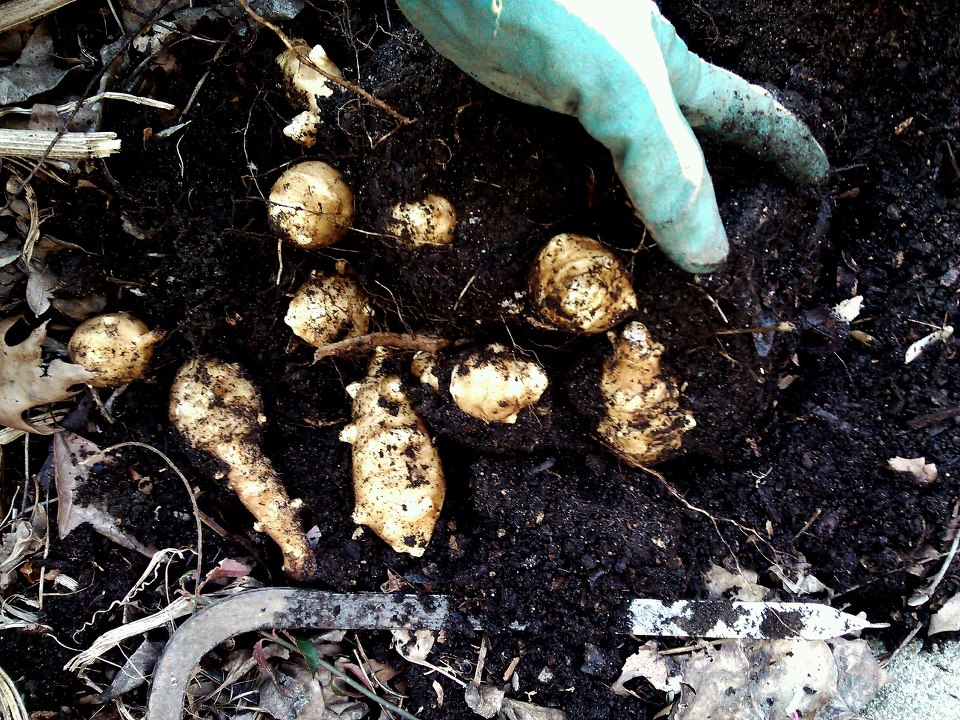
Jerusalem artichokes, aka sunchokes, from our garden

Jerusalem artichokes, aka sunchokes, from our garden

The tops of the plants are dead; we left the ‘chokes in the ground all winter. Yet here they are on my plate, ready to complement the sharp tang of mustard and dandelion and arugula.

I feel especially tender toward trees this spring. Probably because winter was longer and harsher than usual. Snow and ice buried us for several months. Many branches cracked under the burden; some trees split in half.

So it seems more miraculous than ever to see trees pushing new leaves and buds and blooms. Every day on my walks, there’s beauty surrounding me.  The tulip trees are especially dear, with these new baby leaves, furry like does’ ears, unfurling.

New tulip tree leaves, via Wikimedia Commons

New tulip tree leaves, via Wikimedia Commons

It just hit me, watching this happen—slowly, slowly, but still the growth is there—how really astounding it is that a tree can make leaves and blooms and seeds. Think of it: the tree, a hard wood thing, somehow pushes out softness and color.

I suppose I could review the science behind it: phloem and xylem, was it? In any case it’s miraculous. There are channels within that rough brown case—it’s alive!

Did I ever tell the story of my cousin who was raised in the Caribbean? When she came to visit Indiana relatives in the winter, she was appalled to see all the “dead trees” standing around. “Why don’t you cut all those dead trees down?” she asked my dad, to his great amusement.

Sometimes what seems to be dead is only in a state of deep rest. Waiting for the right time to stretch up and out, touch the sunlight again.

What is unfurling in your spring?

Like to Eat? Thank a Bee.

Kate Franzman, beekeeper and urban farmer

Kate Franzman, beekeeper and urban farmer

Kate Franzman is one of many fabulous people who keep the “indie” in Indianapolis. Concerned about the die-off of honeybees, she started Bee Public with a goal of increasing the number of honeybees in our city. The organization has placed hives at several urban farms, including one right in my neighborhood.

She’s a writer too, and her first-person story is featured in the current issue of Indianapolis Monthly. I generally don’t shrink from bees myself, but her description of capturing a swarm as a novice beekeeper is truly impressive.

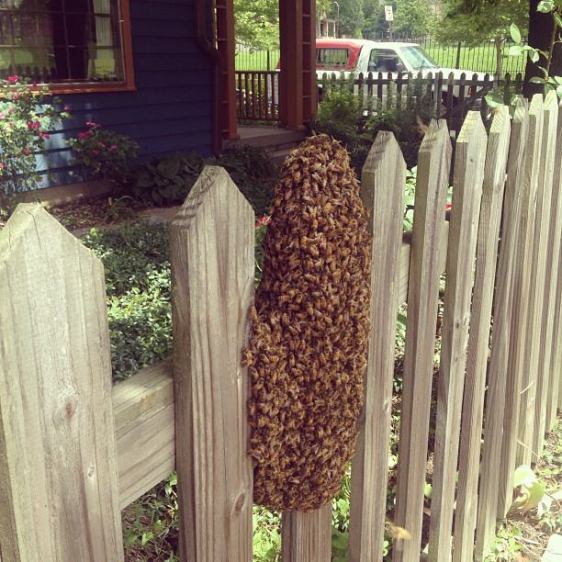
Swarm on a fence post in summer 2013. Kate scooped them by (gloved) hand into a box before transporting them to their new home at South Circle Farm.

Swarm on a fence post in summer 2013. Kate scooped them by (gloved) hand into a box before transporting them to their new home at South Circle Farm.

Her passion for these pollinators leads her to give talks and workshops emphasizing their importance. “Since 2006, we’ve lost more than one-third of our honeybee colonies nationwide, due in major part to Colony Collapse Disorder, an alarming phenomenon that occurs when the bees mysteriously desert their hive and die,” she writes.

“One out of every three bites of food we eat was made possible by a bee. So no bees, no food.”

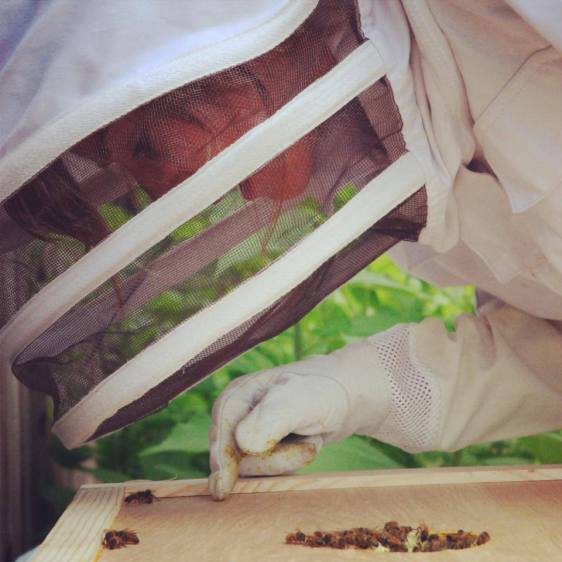
Kate and a few of the creatures on whom our lives depend

Kate and a few of the creatures on whom our lives depend

The unusually harsh winter killed all the bees in Bee Public’s hives, so Kate initiated a crowdfunding campaign to raise money to replace the honeybees. The response has been one of “unprecedented generosity,” prompting her to pledge to purchase replacement bees for other urban farmers and expand the network of hives.

On May 10 at Pogue’s Run Grocer, Kate will present Bees 101, an overview of how to create a bee-friendly backyard. And if you want to take it further, Bee Public offers consulting and hive setup for local restaurants, community gardens, and urban farms. There’s even a sponsorship option for people not in a position to have a hive. Check out Bee Public’s site and Facebook page!

All photos courtesy of Bee Public.

To Belong

Winter aconites blooming in March 2013

Winter aconites blooming in March 2013

“As the globalized, placeless world spreads,
and as progress is increasingly defined as the ability to look out of a hotel window in any city and see the same corporate logos lit up in familiar neon,
it could be that the most radical thing to do
is to belong.”

Paul Kingsnorth, Real England

Relocalizing the Food System

I love writing stories about food and farming. The people I meet are so passionate about their work. Almost everyone I interview is invested in reforming the broken food system. Bonus: They give me tasty things to eat.

Here’s a rundown of the treats I’ve sampled just in the past few weeks.

  • Cissy, a woman who’s long been the vanguard of Indiana’s organic movement, gave me some intensely flavorful pickles she made from cucumbers raised in her kitchen garden. I washed it down a glass of homemade kombucha that couldn’t be beat.
  • Jim, a farmer in Owen County, sent me home with a bunch of carrots he pulled from the wet earth like a late winter miracle.
  • Anna, a farmer in Rush County, gave me a huge jar of rolled wheat that her cooperative had grown and milled. (I used some in banana bread I baked for my weekly writing date—my writer buddies pronounced it wonderful.)
Checking out a display of LocalFolks Foods at Moore Corner Store while on assignment

Checking out a display of LocalFolks Foods at Moore Corner Store while on assignment

And a couple weeks ago, at Moore Corner Store, proprietor Jasen Moore offered me a taste of ketchup made by Indiana’s own LocalFolks Foods.

I’m no ketchup connoisseur, and in fact we never purchase it. But if I were a fan of this most American of condiments, I would never buy a national brand again. LocalFolks’ is sweetened with sugar, not the genetically modified scariness that comprises high-fructose corn syrup.

I happened to be in the natural food store when Hoosier Microgreens’ Alex Sulanke came along to introduce his product. So I got to munch uber-fresh sprouts of radish, cabbage, kale, arugula, and mustard from “the smallest farm in Indiana” (120 square feet).

Moore Corner Store is in the business of connecting small farmers and food entrepreneurs to the consumer. Though its hours are limited at present, this shop and others like it fill a critical role in relocalizing our food system.

For Jasen and his wife Sara, Moore Corner Store is more than just a business. It’s a mission. Jasen told me the enterprise arose out of concern for the state of our economy. Big box stores have fragmented communities and hurt the little guy.

Moore2“But a store like this…supports the local economy, minimizes carbon footprint, puts actual nutritious food on your plate, and it’s close to home.” The Moores live just up the street from the shop, though both must spend time elsewhere to make ends meet.

I just saw a documentary called Down to Earth in which the iconoclastic farmer Joel Salatin (made famous in Michael Pollan’s Omnivore’s Dilemma) made an important point: Your purchase of a farmer’s product might be the thing that keeps that farm afloat another week.

Is it worth changing our habits to spend a little more of our money at a farmers’ market or a shop like the Moores’? I would say yes. What about you? Have you connected with a small farmer, producer, or locally owned shop lately?

Check out my piece on Moore Corner Store here.

Portal to the Wider World

“An environment-based education movement―at all levels of education―will help students realize that school isn’t supposed to be a polite form of incarceration, but a portal to the wider world.”

―Richard Louv, author of Last Child in the Woods: Saving Our Children from Nature-Deficit Disorder

A few weeks ago I had the chance to stop in on a special activity at Avon’s Hickory Elementary School. Jen Davies from Avon Outdoor Learning Center—a total rock star in the kids’ eyes—had come to talk minerals. By day’s end 120 children would make the connection between minerals and something they encounter every day, toothpaste.

In each hour-long session, Jen touched on Coke cans’ recyclability, Lunchables’ sodium content, Crest’s new products—and the broad appeal of minty-tasting toothpaste.

Discussing the sodium content of common foods.

Discussing the sodium content of common foods.

Throughout, Jen telegraphed the absolute awesomeness of minerals. These third-graders were right there with her.

This time of year, most of Jen’s work takes place in the classroom, but the Outdoor Learning Center is true to its name in every other season (and on some milder winter days).

Jen Davies leads a group of small learners on a winter outing to catch snowflakes and look at their shapes.

Jen Davies leads a group of small learners on a winter outing to catch snowflakes and look at their shapes. Photo courtesy of Avon OLC.

On seven acres belonging to the Avon School Corporation, students encounter the real-world stuff that makes science, math, and history come alive. Over 9,100 students, parents and faculty members visited the OLC in 2012-13, exploring two miles of trails and habitats spanning prairie, woodland, and wetland. A beehive and 7,000-square foot vegetable garden—tended by a garden club of 85 budding gardeners—offer further learning opportunities.

Back at Hickory Elementary, Jen divided the kids into groups and funneled them to one of four tables to make toothpaste. At one table they measured a half teaspoon calcium carbonate with a quarter teaspoon baking soda, according to the recipe. At the next, they could handle crystals, stones, and a Coke can in the “mineral museum.”

Geologist-in-the-making

Geologist-in-the-making

The final two stations were the most exciting: droppers to add the coloring and flavoring of their choice.

Adding flavoring with help from a volunteer.

Adding flavoring with help from a volunteer.

Would it be tutti-frutti, traditional mint, or maybe cherry, coco-lemon, or some other variation? And what color should it be? Tints of cherries, neon green, and ice blue bloomed in the paper cups.

blue

Blue proved to be a popular color.

Wrapping up, Jen told them, “Minerals are really cool—you might decide on a career using this, where you can do something like make toothpaste.”

When I spoke to her afterward about why she’s so passionate about her work, she told me she wants the children “to see themselves as part of this amazing whole.”

“We are all just circles within connections within circles. We need healthy soil and clean water and clean air to be able to thrive. The choices we make on a daily basis affect not only us but everything around us.”

Sadly, Avon OLC faced major budget cuts in 2011. Jen has been raising money and finding grants to pay her own salary. Late last year word went out that funding had dried up—without help, her position would be gone by this month. Since then several thousand dollars have been raised. It’s enough to keep her, for now, until the end of the school year, but the future is uncertain.

As Jen wrote me in an email, “It’s just so innovatively unusual for a public school district to have such a resource, we are giving it all we have to keep going.  When kids bring me their entire piggy bank, how can I not try everything I can think of?”

Several fundraisers are in the works to keep the center going. Visit the center’s site to see how you can help.

Update: After I posted this, Jen was awarded the 2013 Donald H. Lawson Award for Conservation Education from the Hendricks County Soil & Water Conservation District.

My Dad, Who Made the World Better, Take 3

Tomorrow, Feb. 2, used to be just Groundhog Day to me. Once I keyed into the seasonal festival days celebrated in ancient times, I knew Feb. 2 as Imbolc—a day to take a walk and look for the first signs of spring.

But now it’s forever associated with my dad, who left this world on Feb. 2, 2012. On that day the snowdrops bloomed and the sandhill cranes flew low. I like to think that his spirit took stock of those harbingers of spring—and that they released him to fly away.

It broke Dad’s heart to leave us, and he hated to leave all his wonderful volunteer work behind. Since his retirement he’d launched all kinds of projects. Possibly the hardest thing to give up was his connection with schoolchildren.

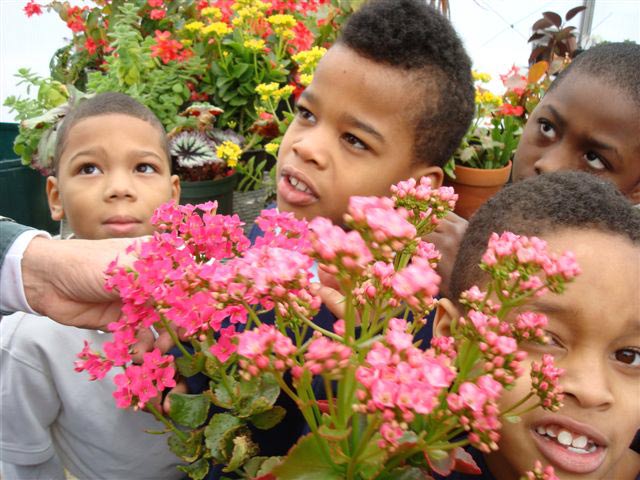
You can't see Dad but you can see how the kids looked at him.

You can’t see Dad but you can see how the kids looked at him.

It all started when he began tending the grounds of Cold Spring School, the environmental education magnet, just because it looked like somebody ought to.

Dad doing what came naturally.

Dad doing what came naturally.

Because he took an interest, he eventually found himself in stewardship of the school’s greenhouse. This was a dream come true for him. (I remember many times in my childhood, he would talk about his dream of putting up a greenhouse.) His passion made it easy to engage the classes who came in for units on seeds, soil, and other such things.

Dad showing grade schoolers the wonders of aloe in the greenhouse.

Dad showing grade schoolers the wonders of aloe in the greenhouse.

After he got sick, when confronted with kudos for his volunteering, Dad liked to say, “I was just having fun.”

Having fun on a wet day at Cold Spring School.

Having fun on a wet day at Cold Spring School.

Just looking at these photos again, I’m swamped with sadness.

No one can fill the void he left. But maybe by having our own brand of fun, we can each take up a tiny spot of it. As the days get imperceptibly longer, what can we bring to the earth, to each other?

Photos courtesy of Friends of Cold Spring School.

When Crisis Threatens

Thanks to a review in Permaculture Activist magazine, I found a little book called Small Stories, Big Changes: Agents of Change on the Frontlines of Sustainability. It’s a collection of inspiring voices from the community resilience movement. Each chapter is written by someone actively engaged in the world’s remaking.

Here’s a passage from the very first chapter that gives you a taste.

Goat milking, by V Becker, via flickr Commons

Goat milking, by V Becker, via flickr Commons

“(A) community of busy farmers, gardeners, goat-milkers, trail-builders, engineers, scientists, windmill climbers and solar installers…have led our society’s journey toward sustainability…

They are leaders because their excitement is stronger than their fear.

Logically, when crisis threatens we need to subdue our fear in order to take constructive action. But taking action also somehow diminishes our fear…Once we get busy we’re not as scared any more.

Perhaps we don’t control the forces changing our climate when we grow a few vegetables, but we do influence those forces, and I think the activity profoundly changes our perspective. The situation immediately seems more manageable when we begin to manage.”

—Bryan Welch, publisher of Mother Earth News

Photo by julochka, via flickr Commons

Photo by julochka, via flickr Commons

Have you found this to be true? I have, especially when I’ve gotten “the help of a few believers, supporters, and friends who light the way through the dark nights,” as David Orr describes elsewhere in the book. When I am at my lowest is usually when I’ve fallen away from hands-in-dirt activities for whatever reason, or when I’m feeling isolated. It’s easy to fall into this trap in winter especially.

But when I’m pulling together with neighbors to scheme a project or clean up my block or make a big batch of sauerkraut, I feel ready to face anything.

What about you? I’d love to hear about action you’ve taken—and how it impacts your anxiety level about the state of the world.

Reflection

Though we gathered with a few friends the night of the Solstice to welcome the return of the light, the days don’t seem measurably longer yet, and the clouds are hanging low this  afternoon.

As the Irish blogger Bridget put it in her post on the longest night, “We need this period of darkness to recoup our energies…spend time with friends and family…to just be. Soon enough we will feel the need to get our hands in the soil and once again plant the seeds and tend the crops.”

This time of year is tailor-made for reflection and dreaming. The deep darkness, the cold and drear outside, the ending of one cycle and the beginning of another. In the midst of holiday bustle, all I’ve wanted to do is pull a blanket up around my chin and stare out the window with a pen in my hand. Or a book. Or just a cup of tea.

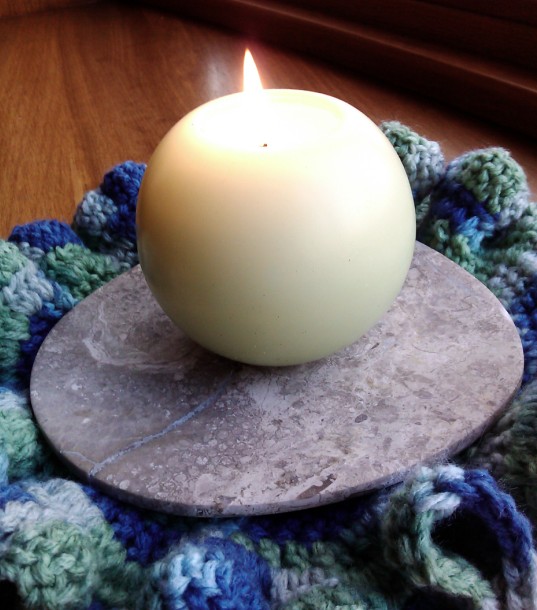
candleOver and over, I find my awareness turning to the heaviness of the physical body and the fact that it really isn’t solid. Neurofeedback researcher Les Fehmi taught me that we are actually just clouds of particles floating in and permeated by a vast space.

And my pen idles. Sometimes more words are not what is needed.

A Field to Fork Market

“In Indiana, we can grow so much of our own food. We really could be sustainable now,” says Kevin Logan, MD. Though we can’t grow mangoes or bananas, he believes we could cultivate everything we need for regional self-sufficiency.

INgredients Field to Fork Market, a new shop he opened in partnership with wife Jacqueline and old friend Tom Wiles, is exerting influence on both supply and demand. To stimulate the market for good clean food, the deli demonstrates how to use local produce like bok choy and spaghetti squash. Meanwhile the proprietors are coordinating with the many farmers and producers capable of feeding our region, in anticipation of the 2014 growing season.

I had the pleasure of talking with the three of them when I wrote this Nuvo piece on the store. It’s located in a refurbished Taco Bell, and full of items grown or produced in Indiana.

Pie pumpkins and gourds from local farmers at INgredients.

Pie pumpkins and gourds from local farmers at INgredients.

“I feel like we’re going to have to get back to community,” Logan says. “And food choices are one way that we do that.”

The trio plan to hold classes on every stage of food growing, storing, cooking, and preserving, to help people gain garden knowhow and kitchen skills. Both fermenting and cheese making classes are in the offing.

All in all this shop is a great addition to community resilience efforts in my town.

Radical Fungi Are My Favorite Teachers

Guest Post by Peter McCoy

When I get asked why I started the Radical Mycology project, I often say that it was to share the lessons that mushrooms have taught me.

Turkey tail logs

Turkey tail logs

Since I started studying mushrooms as a teenager, I have always seen mycology (the study of fungal biology) as an endlessly fascinating and thought-provoking science. Whether I am using them as a nutritious food source or as a potent medicine, I am always honored to taste their wonderful flavors and alluring textures. Hunting mushrooms in the woods, I love to watch them grow, knowing that they are cleaning the forest soil, protecting plants from disease, and turning decaying matter into fresh topsoil so new plants can thrive.

And using them as remediators, I am awed by the mushrooms’ ability to break down and eliminate some of the most toxic industrial compounds in the world.

Grassroots Bioeremediation workshop with Leila Darwish at the Radical Mycology Convergence

Grassroots Bioremediation workshop with Leila Darwish at the Radical Mycology Convergence

Seeing how the densely branched mycelial networks of mushrooms share nutrients among plants, I also find a wonderful example for humans to follow when working to collaborate with their communities. Further, the incredible spore loads that mushrooms drop in the fall are designed to adapt to any given environment, demonstrating the ability to adjust to challenges and remain resilient during hard times.

These same attributes provide a model for how humans can best relate to each other, whether on a personal or societal level. By mimicking mushroom mycelium, cooperative businesses and housing projects work more efficiently by spreading out tasks and networking with affiliated organizations.

Fungi are also highly symbiotic with most organisms on the planet, so we find, yet again, the importance of collaboration among creatures throughout the fungal kingdom. In essence, fungi act in countless ways as grand harmonizers of the Earth, something that humans can aspire toward to live in balance with their surroundings.

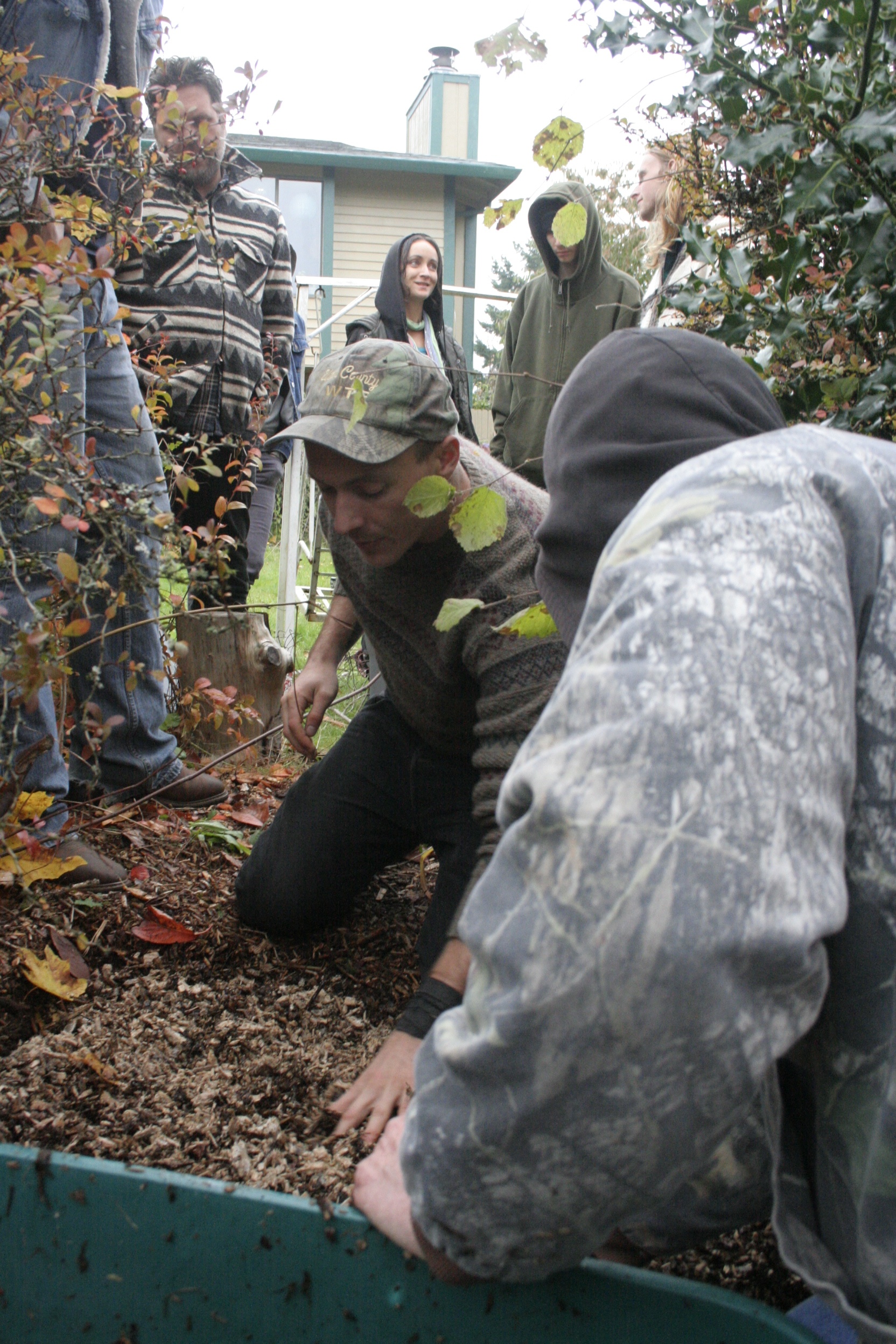
King Stropharia bed installation at Peter's Mushroom Cultivation & Application Course in Olympia, WA

King Stropharia bed installation at Peter’s Mushroom Cultivation & Application Course in Olympia, WA

The Radical Mycology project revolves around just this philosophy: that by studying, working with, and learning from the fungal kingdom, humans can best find solutions to problems of personal, societal, and ecological health. To this end Radical Mycology has put a lot of energy into providing free education to the public on the benefits of fungi.

Our website (radicalmycology.com) is a database of all things mycological. We offer two free publications we have written, Radical Mycology and Mushroom Cultivation For Remediation, as well as instructional videos and protocols for mushroom cultivation.

Nameko Bed installation at Demeter's Permaculture Garden in Olympia, WA

Nameko Bed installation at Demeter’s Permaculture Garden in Olympia, WA

We organize regular multi-day events on mushroom cultivation and its practical applications (the Radical Mycology Convergences), with another being planned for the spring of 2014. And since 2011, two Radical Mycology-inspired volunteer clubs have sprung up in San Francisco, CA and Olympia, WA. These groups teach free workshops about simple and practical mushroom cultivation and community resilience.

The next and biggest project for Radical Mycology is writing a book exploring the theory, practice, and applications of mushrooms for personal, societal, and ecological change. We are currently in the midst of an Indiegogo crowdfunding campaign to fund the book. Our campaign page will soon be up and running. Stop by the Radical Mycology website to learn more about our work.

Update: The Radical Mycology Book fundraiser is underway! This unique book on the uses of mushrooms and other fungi for personal, societal, and ecological wellbeing will be a powerful resource for the geek and do-gooder inside us all and we are excited to bring this dream to the rest of the world.

You can view the live campaign here:

http://bit.ly/radmycogogo