How

“How do we apologize to the plants, the oceans, the air? The Mexicans?”

Asked by a dear friend who came to this country decades ago, wearing skin that makes her a target to some—and now more than ever.

I don’t know the answer.

I can say a mantra learned from the Hawaiian healing tradition of ho’opono pono. I take full responsibility. Please forgive me. I love you. Thank you.

Everything that comes up to confront me is a part of me already, says this tradition. So I take responsibility for it all.

With this mantra comes a sense of settling, and sometimes a bit of clarity. Perhaps an idea arises that may or may not by Divinely inspired: I will join the local Amnesty International group and write letters on behalf of prisoners of conscience. I will volunteer with Exodus Refugee, which works to resettle displaced people in my community. I will look up what Charles Eisenstein  and Starhawk have to say.

Or sometimes it’s an idea like: I will take my dog to the park and reconnect to trees and earth and sky.

img_20161111_150100764

Opal and the Wise Old Oak.

Or simply: I will sit and feel into my body. I will allow my heart to be heard.

I will take this deep breath in, and let it go, and know that no one can steal my peace from me, because I make it myself and receive it as I ask.

Yes, all of these and more. And I still don’t know the answer.

Affiliation

This came out of my pen a while ago, and I just found it again. It seems timely.

Humans need to feel ourselves as part of a whole. We build our belonging in so many ways. By joining a fantasy football league, or playing games online, or joining a militia, or marching in anti-war demonstrations (or anti-Monsanto, which some would say amounts to the same thing). We join a political party and cling to it.

That’s what we do—as humans we can’t live without affiliation.

What if our affiliation took the form of something much grander, and more lasting, than any of these? What if our affiliation were to the whole of the earth, and its affiliation were to the whole of the universe, and all the galaxies were aligned in some grand plan?

Well it seems foolish to suggest it when so much is going wrong today, but a chill in my scalp, a prickle up and down the roots of my hair, says yes, you are on the right track here.

So it’s just that easy? How quickly, when I get up from my desk, do I forget that All is One. I bump my elbow and curse the wall. I have too much to do and hate all of it. I don’t want to be uncomfortable or cold or pressured. I cringe at the things I say. I knee-jerk at the things others say, my buttons pushed.

I forget who I am, a small but seriously important child of the universe, like everyone around me, like every single ant larva buried in the wee hill that showed up in the compost my neighbor spread for me under the hydrangeas. All of us.

It matters not how big the brain or how advanced the architecture or how wordy the language. All of us are children of the same divine womb.

We never know what we are part of. We are just one tiny life form in the Milky Way galaxy. Here we are, a light among lights. Lit by sunlight, lit by spirit.

Beatuiful lights

Photo by Rory MacLeod, via Flickr commons

And we don’t always realize this, we don’t realize that our light can be part of a greater force that is gathering, that is gaining momentum, because all we see are images of the sad and mean and painful and violent. The people doing small good things every day do not get much of a mouthpiece.

I don’t even mean environmental actions and the like. The briefest smile of connection might light someone else’s heart. I’ve written this before, many times. I am happy to think it. Not because it lets me off the hook for the big things but because it means every moment of my day can have an impact. It gives me something to do about the pain that crashes at my door every day. I can breathe it and love it. I don’t need to turn away and I don’t need to feel helpless anymore. I am a part of the healing force of nature now. That’s my affiliation.

And I do know it, some of the time. I don’t know what impact I’m really having. But it doesn’t matter.

We never know what we are part of until we just ride the wave to the shore and crash with our friends in a pile of floppety fish.

On Peace Day

This was my favorite moment of the Peace Day gathering last week at Rivoli Park Labyrinth: when young Elijah piped up with an innocent question. He’s 9, and his mother Alicia Oskay was leading us in some gentle postures and breathing. When she mentioned how yoga brings more peacefulness, in keeping with International Day of Peace, Elijah stage whispered, “Is that a thing?”

img_5090-880x1024

Alicia and her son Elijah modeling hip stretches.

Why yes, young sir. Your mother did not make it up. This Peace Day business is for real. According to the website, “Peace Day provides a globally shared date for all humanity to commit to Peace above all differences and to contribute to building a Culture of Peace.”

International Day of Peace is observed around the world each year on September 21st, ever since it was established in 1981 by a unanimous United Nations resolution. In recent years, people observing the day have begun using the hashtag #peaceday to share stories of random acts of kindness and inspirational quotes on social media.

Locally, about 25 people came together at Rivoli Park Labyrinth to mark the day. This pocket park in a vacant lot, founded by Lisa Boyles, has hosted many other meaningful gatherings.

img_5088-1024x768

View of the labyrinth from my forward bend.

After yoga, Lisa invited all of us to make #PeaceDay signs for our walk through the Rivoli Park neighborhood with local law enforcement. (For everyone making a sign, she banked a half hour on TimeBank Indy, our local hours-bartering exchange network.)

20160921_175955-576x1024

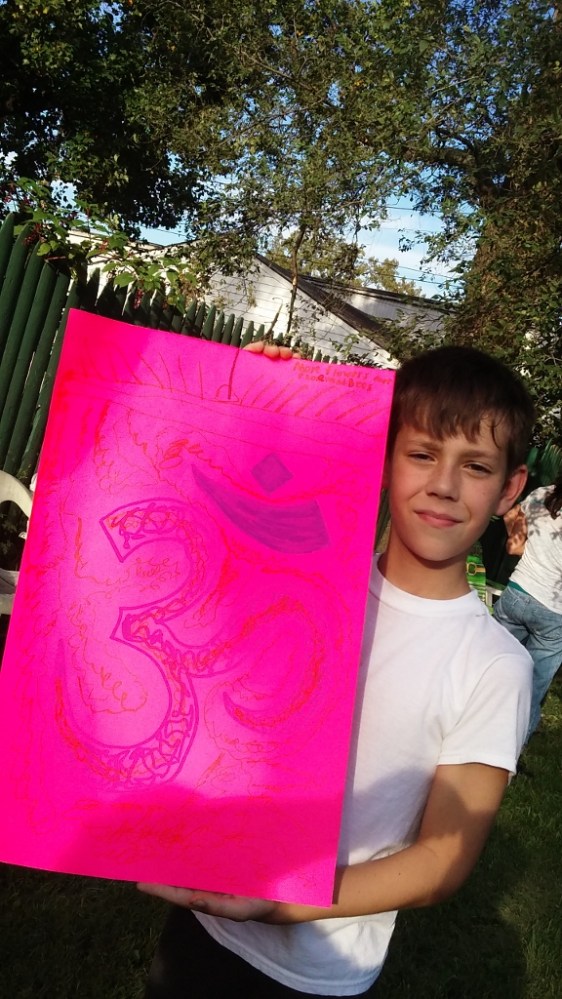
Elijah shows the poster he and his mother created.

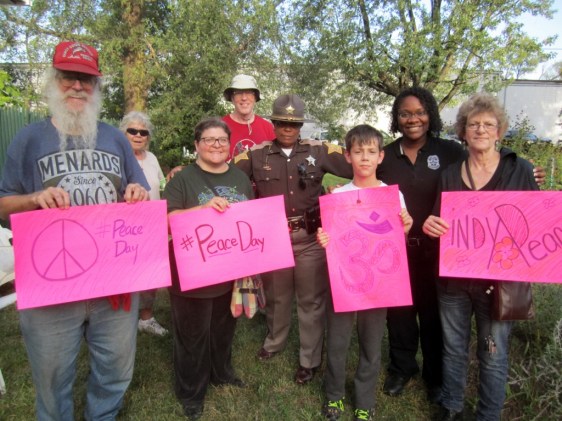
Both the Indianapolis Metropolitan Police Department and the Marion County Sheriff’s Department were represented in our little march. We drew honks and waves and fist pumps from passing drivers, and one woman on foot offered several God-bless-yous.

img_5097-1024x768

Getting ready to walk the neighborhood.

We returned to the pocket park to share food and conversation, and walk the labyrinth at our leisure. For more details on the day, find an IndyStar photo essay here.

Lisa has coordinated the labyrinth’s fans into various neighborhood projects over the years. Coming up this week is Indy Do Day—an annual three-day citywide service blitz, set for Sept. 29, 30, and Oct. 1. The Rivoli Park Labyrinth was installed on Indy Do Day on October 10, 2013.

“I would like the tradition of doing service and giving back to continue,” she says, emphasizing that everyone is encouraged to find an Indy Do Day opportunity to spread some good in the community. She herself plans to offer her time packing snack bags for children in a low-income neighborhood alongside a group called #gRoE , Inc.

Projects like these can be found by searching the website of Indy Do Day.

Sing Light

At the International Women’s Writing Guild‘s annual conference, I was drawn to a spiritual warriorship workshop. Here I found women both tender and fierce. From various spiritual backgrounds, we all were seeking to keep our hearts open in the face of the world’s pain. We meditated together, read, wrote and shed tears together.

One day the reading was Wendell Berry’s haunting  Work Song Part 2: A Vision, which speaks of “a long time after we are dead” when “memory will grow into legend, legend into song, song into sacrament.” The future, and what it might look like, if we are wise.

IMG_3691 (767x1024)

Our writing prompt was : What I want to sing into this world is…

Here’s what came from that free write. (Read Wendell’s marvelous poem first!)

What I want to sing into this world is…
That we must breathe our despair and eat our fear. Then allow the alchemy of respiration, digestion, and elimination to work on our pain and terror until a new thing emerges on this earth. I want to sing a song of light—and yet allow darkness to be felt and seen. (Without awareness of what is hard and mean and forced, we forget the impoverished place that births our better future.) Sing light that doesn’t fear the dark but turns toward it, welcoming the whole story of our unfolding humanity. Find a way to rock the darkness like a neglected child, to give it the kind of love it’s never known.


And you: What do you want to sing into this world?

I’ll Meet You There

“It’s been a long time since I felt that sense of wholeness,” she told me. “Just to reconnect to something spiritual feels incredible.” I’d just talked her through a grounding and expanding meditation, one that I use myself to connect to Source.

Sunlight. Revisited.

Photo by Rishi Bandopadhay, via Flickr Creative Commons

This young woman was one of about 30 I worked with Tuesday night at a collaborative “Art and Insight” event. Other participants, upon opening their eyes, said they felt themselves floating, or they gained perspective over their petty concerns, or they felt as refreshed as if they’d had a nice long sleep.

Guiding people to spaciousness was a gift to my own energy. I thought I might feel drained afterward, doing so many consecutive mini-interventions—but instead, I was on a high. (The only thing that would have increased my high? If I’d had time to enjoy my beautiful collaborators’ offerings—spirit animal readings by Elizabeth Camp of Zen Within and reiki from Amy Barr of The Healing Room. Not to mention henna by Carrie of Eastside Gypsies. Next time!)

This work makes me so happy. I never expected to find a vocation that felt as natural as writing. But I love sharing ways that people can regain their footing in a rocky world.

So many of us are walking around in trauma these days as we face up to our collective shadow. Nothing seems certain anymore; institutions that once appeared solid are crumbling one by one. It can feel, as intuitive Lee Harris once put it, like we have lost our handrail.

In troubled times, it’s so helpful to reach out to each other, reach down to the earth, reach beyond to the cosmos, and experience ourselves as intertwined with All That Is.

IMG_3593 (1024x766)

That sense of interconnectedness is what helps me return to a space of possibility and openness instead of shutting down.

I used to consider this kind of thing “self-care,” which seems to relegate it to the “optional, somewhat privileged” category of activities, on a par with green drinks and Pilates. Certainly not mission-critical, like the shovel-in-dirt projects that remake the world.

However, I see now that the world is made up of people on a path, and that clearing out and opening up on an individual level is absolutely critical if we want to thrive here. Before the remaking of the world comes the reimagining, which can’t happen with eyes that see the same old way.

So how do we build a new world—safer, saner, more compassionate, more just, peaceful, resilient? There are so many problems, so many slippery arguments. There’s so much shouting, so much pain.

We can start by opening our hearts and looking into each other’s eyes.

Or in preparation for that, we can look at a flower, or a beetle, or a cat, or a tree.

in shade best

Or in preparation for that, we can feel the marvel of our lungs filling with air as we draw breath.

We can start anywhere. Sweep our little corner.

Out beyond ideas of wrongdoing and rightdoing, there is a field. I will meet you there.

—Rumi

Note: Please sign up for my e-newsletter if you want to receive notices of upcoming similar events. And consider joining me at Empath 101, where I will share energetic tools to manage sensitivity.
Pollination Takes Many Forms

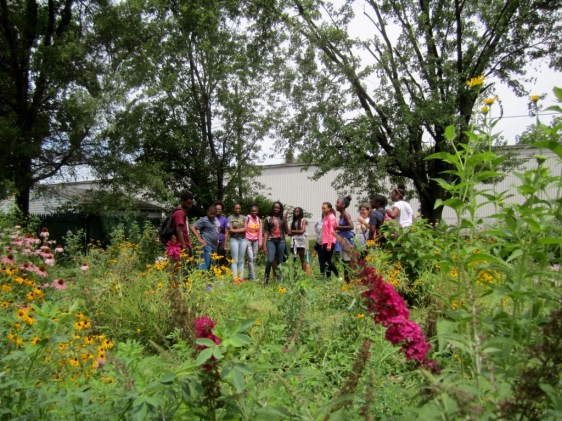
Recently a group of middle-schoolers from Edna Martin Christian Center‘s teen program came to Rivoli Park Labyrinth to find out what the pocket park is all about.

IMG_4988 (1024x749)

Walking the labyrinth

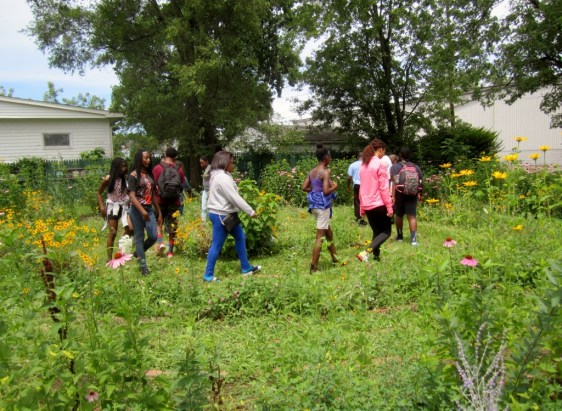
The park’s founder, Lisa Boyles, led the youth on a walk through the labyrinth, which is beautifully ringed by wildflowers this summer.

IMG_4960 (1024x769)

bumblebee

Sharp-eyed kids spotted some of the critters that make the park their home.

IMG_4972 (1024x767)

on the butterfly bush

As a certified wildlife habitat, the park provides food, cover, water, and nesting places for creeping and flying insects, toads, birds, and small mammals–and it is managed with sustainable gardening practices that are wildlife-friendly. (Lisa recently saw a falcon with a mouse in its talons, high in one of the trees.)

IMG_4995 (1024x768)

View from the butterfly bush

After the walk we talked about why it’s so important to support pollinators … without which it would be difficult to find actual food. When one of the boys said something about licking a flower, we picked red clover petals so everyone could try a sip of nectar. Tasty!

Soon the park will be designated a Monarch Waystation with the addition of milkweed, which monarch caterpillars eat. The kids got to sow milkweed seeds in small pots to take home and start their own monarch-friendly habitats.

IMG_5006 (767x1024)

Starting milkweed seed in peat pots.

Each teen also went home with a kit to make a butterfly feeder and instructions to make more nectar (1 part sugar to 1 part water, heated until sugar dissolves, then cooled).

A simple butterfly feeder.

A simple butterfly feeder.

Lisa notes that you can also attract butterflies with fruit. Butterflies are reported to love oranges, watermelons, mangoes, kiwis and apples. Fruit slices can be put on a plate with some water, or they can also be added to the sugar water feeders for added variety for the butterflies.

Pollination takes many forms. Insects pollinate flowers, while a woman like Lisa pollinates young lives by sharing a quiet space in the middle of the city’s hubbub.

IMG_4993 (1024x768)

A contemplative moment in the center of the labyrinth

All are welcome to explore Rivoli Park Labyrinth’s beauty, spread a blanket for a picnic, or walk the labyrinth anytime between dawn and dusk.

For more information on creating a certified wildlife habitat, see the National Wildlife Federation’s Gardening for Wildlife site.

This is Humanity

Charles Eisenstein, in this interview, challenges me to something more radical than empathy. What if we believe everything we read and hear? Not in the sense of “That’s Absolute Truth,” but in the sense of: This is what’s real for this person.

It’s a difficult assignment, because it requires giving up being right. But practicing it would open up the potential for new learning.

What life circumstances could I imagine that would give rise to the various stories I hear? What enculturation/emotions/experiences underlie people’s opinions? Or the scenarios being played out, which are expressions of the stories people know to be true?

What stories must be firmly in place for so many African-Americans to be brutalized and killed at the hands of authorities, so often with impunity?

As this writer posits, “America has conditioned society to regard us (African-Americans) as beasts, superhuman, faster, and stronger. So when we are killed, it’s easy to rationalize and accept.”

That’s one possible story. A painful one. Giving rise to the need for all of us to say, unequivocally, Black Lives Matter.

This morning in meditation I saw a flower with countless small petals. One bloom, many petals: This is humanity. A flower doesn’t have to be told that it’s insanity to pluck out some petals. It is all one whole, one body.

IMG_4950 (853x1024)

From my journal after one such shooting:

Is it possible that I carry all the permutations of humanity in my cells, in a more literal way than I ever imagined?

What if: I am the police officer who killed the black teenager. And I am the teenager who died. I am the crowd that formed. I am the mother. I am the judge, the jury, the media, the Facebook storm, the Twittersphere.

All of these are within me and I must must must love them now. The young woman wanting to smash up stores in anger. The older folks grieving. The Fox News people spinning. The truckers in the truck stop, the teens at the mall, the babies in wombs ready to be born into a quaking world. The deflection. The pain. The heartache. The horror.

The fear. Everywhere fear. I am that. And I must love that.

I am the return, too. The opening.

Can we imagine a story that would solidify our shared humanity, and our mutuality, and our need for everyone to feel safe and respected as they walk through the world?

Catching Abundance

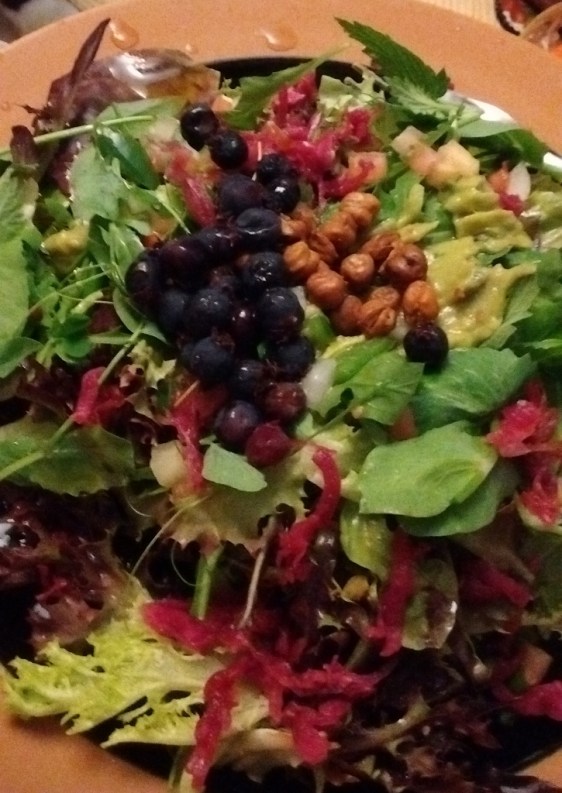
One day early in June, I looked down at my salad plate and realized my good fortune.

IMG_20160613_203841863 (725x1024)

The abundant salad

I saw that an incredible number of friends and acquaintances had contributed to my meal. Here were lettuces I’d purchased as seedlings from a farmer friend. Serviceberries I’d picked from a neighbor’s tree. Roasted chickpeas given to me by another neighbor, and guacamole from yet another neighbor. I dressed it with a drizzle of superspecialyummo high-end olive oil that another neighbor-friend gave me, along with beet kraut from local fermenters Fermenti Artisan.

I mean, seriously now.

And that’s not even mentioning the contributions of all the nonhuman cocreators of my food, the bees and tiny bugs, the sunshine and rain and minerals and fungi and soil itself.

IMG_20160609_200830515 (576x1024)

Dan’s tree was loaded. Enough for birds and neighbors to enjoy, while still filling his freezer.

This time of year especially, the sheer plenitude just delights. That is, if we let it.

Nance Klehm of The Ground Rules calls it “catching abundance”—the idea that our job is to show up and appreciate, and make use of, what we are freely given.

IMG_20160626_185540693 (1024x576)

I picked these yesterday. Blackberries, red raspberries, wild black raspberries, mulberries, and a couple Alpine strawberries.

It can be food, but it can be other things too. Recently I’ve felt grateful for an abundance of ideas, an abundance of encouragement and support, an abundance of beauty, on and on.

One night, at bedtime, I saw the quarter moon reflected in my neighbor’s window. I let myself be awed.

Gratitude opens the door to awe and wonder, two emotions that promote loving-kindness, so essential in this jaded age. (This article posits that “chronic awe deprivation has had a hand in … making us more individualistic, more self-focused, more materialistic and less connected to others… We need to actively seek out awe-inspiring moments in our everyday lives.”)

Contacting this state then, which I also call spaciousness, is not just the icing on the cake. It may be the entire smorgasbord.

Saturday I took a space at a wellness expo, where I asked people where they encounter spaciousness, or what it means to them. Many generously contributed to my inquiry, as you can see.

IMG_20160627_135622548 (1024x668)

I invited people to contemplate spaciousness and add a thought to this board. I caught an abundance of responses!

A few of the answers:

  • Expansion ♥
  • In the green of nature
  • Simplicity
  • Freedom to be me!
  • Contentment ♥
  • Awareness
  • Love!
  • Open heart ♥
  • Unlimited
  • The stillness inside of myself

And my personal favorite, a drawing of a tree. (Yes! Thank you, Tree!)

I bow in gratitude to the people willing to scribble something for me, and to those willing to pause a bit longer and try out my uber-short meditation for grounding and expanding. What a privilege to encounter so many openhearted souls.

What about you? What is your experience of spaciousness,  or where do you encounter awe and wonder? Are you catching the abundance in your life?

Magnify Love

Do your little bit of good where you are; it’s those little bits of good put together that overwhelm the world.

—Desmond Tutu

Here in the U.S., we’re feeling the reverberations of yet another mass shooting. Some call it the deadliest in our nation’s history. Even as I unplug from the news cycle, I’m energetically affected by the pain and anguish, the anger and fear.

Sadness is mostly what I feel when I think of the shooting. When I remember to, I turn toward the sadness, feel it in my body, notice the wish to numb it, alongside the urge to amass information in support of my personal philosophy about these types of tragedies.

I “embrace, allow, include,” as I’ve been coached in mindfulness training. I open up room for all my responses and attend to them with kindness. In that space I can consider right action.

All of which gives me more compassion for others on their own path.

I like to believe that humanity is evolving in a positive direction, appearances (seemingly) to the contrary. The horrible things that happen always grab our focus, fuel our outrage. It’s the same with the inflammatory things said by some pundits and politicians: Our attention gets hooked by ugly things that seem to confirm the awfulness of everything. And the ugliness magnifies.

A wise yoga/meditation instructor recently reminded me that our brains are wired to notice the snake amidst the flowers. Danger! Alert! We fixate on the negative. It’s biological.

Flower (1024x768)

No snake, just flower.

Mindfulness meditation creates an opening for a new practice to emerge. It offers a brief space—the length of a breath—in which we can begin to choose.

I wonder: what if we train our attention on something other than the horror? Not to look away blithely denying injustice, but turning toward the little acts of love and solidarity, small exchanges of soul happening every day. Is it a copout, born of privilege, to even suggest such a thing? Or is it an opening?

Some schools of Buddhism teach that the material world is nothing other than a construct of mind. What mind do I wish to inhabit?

Illusion (768x1024)

What do I choose to magnify with my attention?

We’re Walking Ecosystems: Notes on Collaboration

Lately I’ve been thinking about collaboration. I envision a world where nations, geographic regions, cities, neighborhoods, and affinity groups find an ease and flow in working together.

11285902014_240074a727_z

Photo credit Michael Mayer, via Flickr Creative Commons

Maybe it seems pie-in-the-sky, but we have a model for that kind of collaboration. It’s right here, as close as our own skin. Modern science now confirms that the human body is a collaboration in itself.

Some 90 percent of our cells are—get this—not human. They’re bacterial, or fungal, or even viral. Don’t be afraid! They mean us no harm. We’re their habitat. A walking community. A microbiome.

If we keep balance within the community of our cells—I’m talking happy bacteria and fungi here—we generally enjoy good health, and recover from illness more quickly.

This Brainscape article explains it all so well—the ecosystems within us, each with their own unique microorganisms. These wee “microbiota” do all kinds of things for us in exchange for giving them a suitable environment to thrive. They help with digestion, brain activity, and immune function, just for starters.

Most curiously, our mitochondria—an organelle within cells that is responsible for converting digested food into energy—contains DNA that is…not human. “These organelles came from outside of us, down a separate evolutionary path.”

17104540588_afc2a615dc_z

Mitochondria (red) are organelles found in most cells. They generate a cell’s chemical energy. Credit: NICHD/U. Manor, via Flickr Creative Commons

At the microscopic level, human life depends on a symbiotic relationship.

From the article:

“When Charles Darwin wrote On the Origin of Species, the dominant theory soon came to be survival of the fittest: a rat race for domination and survival. But both of these examples — mitochondria and our internal biota — point toward another means by which life thrives and evolves: symbiosis.”

I find that fascinating, and also telling.

Of course, zoom in tighter on the cells of our body—and what are they? Whirling clouds of particles. There’s nothing solid to us.

We’re made of space, basically. Our lives reliant on organisms we have always vilified or at the very least, ignored.

Knowing that, is it possible to see the human community in a different way?