“We Must Care About our Public Spaces”

As promised, here is a followup to last week’s post on the value of public art.

At Foundation East’s artist meet-and-greet I met Irvington resident Holly Combs. She’s half of the husband-and-wife duo who painted several traffic signal boxes around Irvington. While I was talking with her, a neighbor stopped to say that she honked and waved whenever she passed the couple working out in the cold on their boxes.

Holly thanked her, saying, “Do you know what it meant to us when people honked and waved? Yeah, it was cold but we didn’t feel it. When you’re joyful in what you do, you’re not even cold.” Then she handed us each a “You are beautiful” sticker.

That seems to sum up Holly, whose passion is obvious when she speaks of her various projects. For example, Street Styles. It’s a youth program she started that uses street art and graffiti as the foundation for exploring art fundamentals.

With her husband Dave, she also founded the Department of Public Words. DPW’s mission is to put uplifting messages in surprising places, all to tell people “they’re awesome, beautiful, worthy, and wonderful,” as Holly puts it.

They first tried it a few years back when the economy tanked and the Combs’ gallery and art magazine were hard hit.

Photo courtesy of Department of Public Words.

Photo courtesy of Department of Public Words

“When you lose everything, you’re fearless, thinking ‘I can do anything,’” Holly told me. She painted You Are Beautiful in block letters high on a prominent building in the Fountain Square neighborhood because it was a message she herself needed.

Since then they’ve put the same message on a building on East Tenth Street. I pass it often and it never fails to make me smile.

Photo courtesy of Department of Public Words

Photo courtesy of Department of Public Words

Sometimes I’ve walked my dog past the Combs’ house in summer (though I didn’t know it was theirs) to find You Are Beautiful scrawled in chalk on the sidewalk.

The You Are Beautiful campaign is part of a global initiative started by Matthew Hoffman (those stickers were the first manifestation). Right now the couple are raising money to continue inspiring people with positive words all over town.

With Street Styles, Holly works with youth in the juvenile justice system, many of whom have illegally painted graffiti. “I tell my juvenile offenders, ‘You go to jail for doing that and I get paid $100 an hour: who’s the boss?’” She brings the disenfranchised youth into the process of creating street art in hopes of channeling their desire for self-expression.

I asked Holly how she felt about the vandalized signal boxes, since one of theirs was targeted. “Yes, our box got paint poured on it. Just out of meanness. Sad. But I see public art as a conversation with the public,” she told me in a Facebook chat.

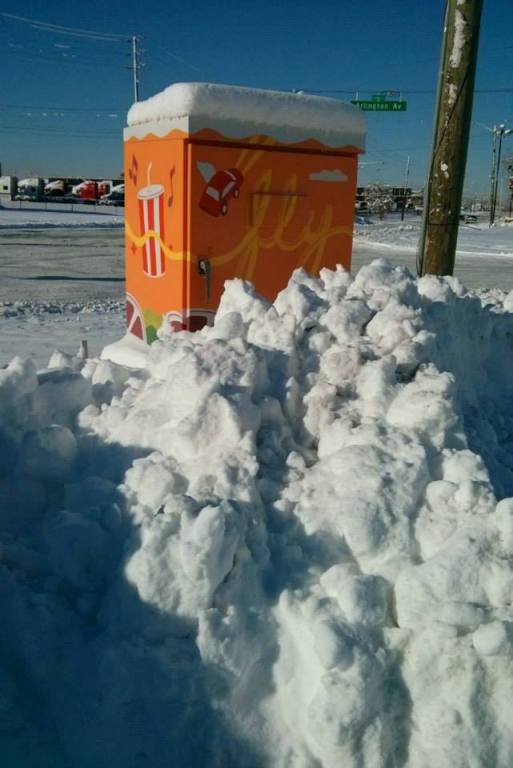
One of the Combs' traffic signal boxes. Photo by Vishant Shah.

One of the Combs’ traffic signal boxes. Photo by Vishant Shah.

The offenders in her program say that if a community doesn’t seem to care about a neighborhood, it’s seen as an invitation.

“(We) must care about our public spaces to help encourage others to care about them too. I always say, “Blank walls want me.’”

In fact, my neighborhood started the signal box project after a police officer spoke to our Crimewatch group about Crime Prevention Through Environmental Design (CPTED). Officer Shane Foley talked about CPTED’s landscaping and lighting design principles—and how modifying the built environment can deter criminals.

The group already had a history of litter cleanups and beautification efforts, and CPTED theory made a lot of sense. The traffic signal box art seemed a natural progression.

Another of the Combs' boxes. Photo by Vishant Shah.

Another of the Combs’ boxes. Photo by Vishant Shah.

These boxes belong to the whole community, and no setback is going to slow the public art movement now. With the help of a fundraising campaign, Vishant and cofounder Aaron Story plan to have all the boxes protected with a coat of clear coat by May.

Local artists, funders, and dreamers are invited to contact Foundation East about partnering on future eastside Indy public art projects.
Public Art Unites the Community

Public art is one of those things that’s more than the sum of its parts. Here in my neighborhood, the humble traffic signal box—a four-foot-tall aluminum cabinet that had never before registered on my radar—seems to be the start of something big.

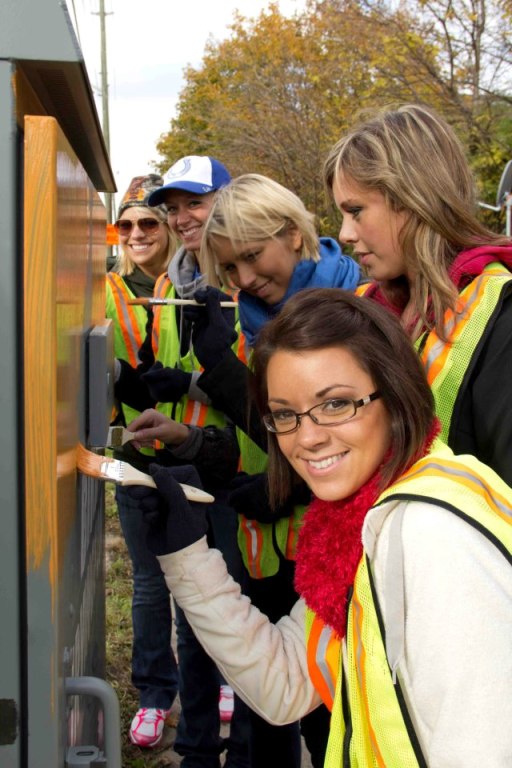
In 2012 I was one of the volunteers painting Irvington’s first seven signal boxes as part of the Great Indy Cleanup.

These Colts cheerleaders helped us get the job done.

These Colts cheerleaders helped us get the job done. Photo by Heidi Unger.

Each design had been submitted by artists like Morgan Hauth, shown here putting finishing touches on one of her pieces.

Touching up

Morgan Hauth touching up. Photo by Heidi Unger.

By 2013, Foundation East, the brainchild of Vishant Shah and Aaron Story, had formed with a goal of transforming eastside Indy neighborhoods through public art. Building on the success of the traffic signal box project, the duo enlisted six artists to paint another round.

Oil painter Rita Spalding at work on one of her signal boxes.

Oil painter Rita Spalding at work on one of her signal boxes. Photo by Charmaine Edwards.

A total of 19 boxes now brighten the main thoroughfares of my community.

Sadly, some disrespectful souls targeted a couple of these landmarks. Two boxes were vandalized early Dec. 31, prompting outrage among neighbors. A third more recently had a bucket of paint splashed on it.

It’s infuriating, but I take my cue from Rita, who has more reason than anyone to be outraged—her luminous painting was among those defaced. She told the Indianapolis Star that morning, “I’m not angry. It just really makes me think about what’s going on in that kid’s life.”

Later that day she wiped off the graffiti. Several neighbors met her at the box to help out if needed, but it turned out to be easier than she expected, because she’d applied a layer of clear coat finish.

Foundation East founders Aaron and Vishant say the outcry shows how important these boxes have become. They invited the community to meet the artists and show their support this week.

I went to the gathering, finding it packed to the gills with neighbors eager to thank the artists and scribble their ideas on a white board. (Paint the water tower, build a vertical garden structure on the library lawn, install a sculpture on my street!)

Many also chipped in for a “clear coat fund” to give all the boxes the same treatment as Rita’s.

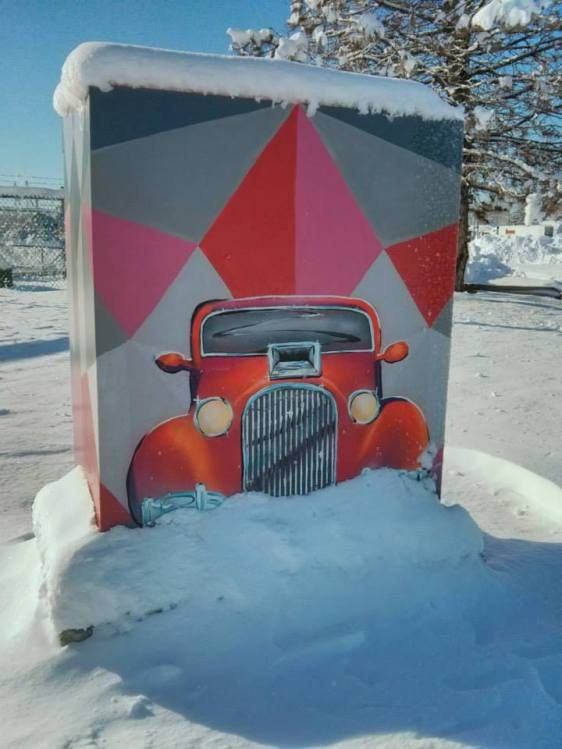
Homage to car culture

Homage to car culture, by Andrew Severns. Follow this artist at @severnscanon. Photo by Vishant Shah.

I talked to several residents there who mentioned Irvington’s history as a hub of creative and intellectual stimulation, with Butler University’s campus located here until 1928. In the 1920s and 30s, a group of acclaimed painters known simply as the Irvington Group drew national attention.

Apparently our neighborhood’s reputation as a quirky haven for eccentrics also dates back 100 years—Irvington is described in an October 1903 Indianapolis Star article as “the classic suburb which has an interesting way of turning up all kinds of freaks and strange things generally.”  (This was before the city grew to swallow up the suburb, but we retain our unique character.)

Signal box in Arctic Vortex aftermath

Erin Kelsch’s Signal box in Arctic Vortex aftermath. Photo by Vishant Shah.

Kathleen Angelone, owner of Bookmamas, says that’s exactly the kind of neighborhood she wants—and the art definitely adds to the vibe. “I think public art is vital to any community because it makes it beautiful. It denominates where the community is and gives it character.”

“And it is civilized. I want to live in a civilized community where people are interested in art and music and learning, not just their day to day jobs.”

Tribute to farm heritage

Dave and Holly Combs’ tribute to farm heritage. Photo by Vishant Shah.

Russian-born Svetlana, an oil painter, told me that public art played a role in her childhood desire to paint. “There are statues everywhere in Russia; you’re just surrounded by art,” she said. “That gave me a lot of creativity and imagination.”

Two years ago she moved to Irvington, where color is starting to pop in unexpected places. “I think it’s wonderful that there is art for people to view without going to a museum.”

Aaron and Vishant invite local artists, funders, and dreamers to contact them about partnering on future eastside Indy public art projects.

My next blog post will have more about the role of public art in placemaking, youth engagement, and crime prevention.

When Crisis Threatens

Thanks to a review in Permaculture Activist magazine, I found a little book called Small Stories, Big Changes: Agents of Change on the Frontlines of Sustainability. It’s a collection of inspiring voices from the community resilience movement. Each chapter is written by someone actively engaged in the world’s remaking.

Here’s a passage from the very first chapter that gives you a taste.

Goat milking, by V Becker, via flickr Commons

Goat milking, by V Becker, via flickr Commons

“(A) community of busy farmers, gardeners, goat-milkers, trail-builders, engineers, scientists, windmill climbers and solar installers…have led our society’s journey toward sustainability…

They are leaders because their excitement is stronger than their fear.

Logically, when crisis threatens we need to subdue our fear in order to take constructive action. But taking action also somehow diminishes our fear…Once we get busy we’re not as scared any more.

Perhaps we don’t control the forces changing our climate when we grow a few vegetables, but we do influence those forces, and I think the activity profoundly changes our perspective. The situation immediately seems more manageable when we begin to manage.”

—Bryan Welch, publisher of Mother Earth News

Photo by julochka, via flickr Commons

Photo by julochka, via flickr Commons

Have you found this to be true? I have, especially when I’ve gotten “the help of a few believers, supporters, and friends who light the way through the dark nights,” as David Orr describes elsewhere in the book. When I am at my lowest is usually when I’ve fallen away from hands-in-dirt activities for whatever reason, or when I’m feeling isolated. It’s easy to fall into this trap in winter especially.

But when I’m pulling together with neighbors to scheme a project or clean up my block or make a big batch of sauerkraut, I feel ready to face anything.

What about you? I’d love to hear about action you’ve taken—and how it impacts your anxiety level about the state of the world.

Restoring the Land

IMG_20140110_101420

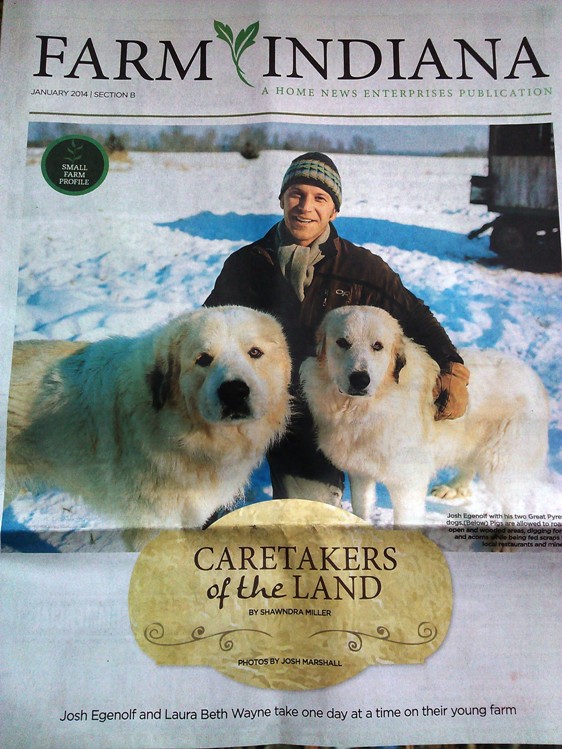
Cover page of my Farm Indiana profile of WE Farm

Dr. Lisa Harris remembers well the first conversation with the young man who would come to farm her land—they talked for hours, almost an entire day. “I was so impressed with how deliberate and thoughtful he was,” she told me.

Dr. Harris is Eskenazi Health’s medical director, a vegetarian with a lifelong interest in eating healthy food. As I learned when I wrote about WE Farm for Farm Indiana, she leases her Owen County property to Josh Egenolf and Laura Beth Wayne’s pastured beef cattle, poultry, and pork operation.

“Most people in the United States do eat meat,” she said. “So if I can be part of something that gives people access to meat from animals that have lived well, it seems like a perfect opportunity.”

Like many of us, Dr. Harris tries to live as lightly as possible, and Josh’s plans to make her land productive really spoke to that goal. “What Josh is doing,” she said, “is in every sense helping to improve the land.” WE Farm’s integrated, rotational grazing plan means the animals work in concert with nature to restore pastureland—all the while sequestering carbon and nitrogen in the soil.

The day I visited the farm last November in preparation for my Farm Indiana story, four happy dogs ran in front of the pickup truck as we drove up the lane to tend the livestock. Owen County is picturesque, with wooded hills and deep valleys. Josh showed me the steep woodlot where the hogs are periodically turned loose to forage for acorns and pawpaws. They also help him clear out understory invasives, just by doing what pigs do.

Breeder pigs enjoying their mineral rations on a frosty November morning.

Breeder pigs enjoying their mineral rations on a frosty November morning.

Josh was raised on a farm just a few miles up the road, and he treasures the richness of his a rural childhood. Giving that experience to his own child (and another on the way) is a big reason why he moved back to the area after pursuing his doctorate in ecology at the University of Georgia.

Also, he wanted to be put what he’d learned there into practice. Agriculture, he told me, has enormous potential for creating meaningful environmental change.

He said, “In 2007 I read The Omnivore’s Dilemma. Before that it never occurred to me that there might be anything troublesome about the way meat was produced, other than animal welfare stuff. That’s very clear to me…you shouldn’t treat your animals poorly. They need to be respected. But it didn’t occur to me that there was a single thing wrong with them eating grain and (even) industrial byproducts.”

He knows that many people still don’t realize the environmental and health issues that accompany feeding grain to meat animals, but a growing customer base tells him how many people value pastured meat. “It’s like an awakening that needs to happen.”

Josh and Laura Beth strive to keep the business as local as possible, keeping close to home in all their dealings. For more on their endeavors, check out my Farm Indiana story and the WE Farm website.

Communal

When the sun comes up on these clear mornings, the sky behind the snowcovered trees tints palest tangerine. There’s a beautiful stillness in a frozen world.

Daybreak in the Arctic Vortex

Daybreak in the Arctic Vortex

Something about going through an extreme weather event is lovely in its communal nature. For the second day we are snowed in. We can’t drive out of our alley, and any outings on foot are necessarily short because of extreme wind chills.

So we’ve been keeping tabs on the goings-on in our little burg via a Facebook neighbors’ group.

The dangerous cold and deep snow have given us a glimpse of just how neighborly people are in our quirky neighborhood. I have seen many a plea for help go answered, and many an unsolicited offer appear. Just now someone offered to pick up items on her way home from work if anyone is in dire need. Earlier there was a shout-out to “the awesome guy driving a Caterpillar bobcat and helping people dig out their cars from the aftermath of the plows.”

Someone even asked for—and got—advice on how to get her dog to do his business in this brutal weather. I didn’t read the entire thread, but apparently it was a hoot, discussing canine toileting habits in great detail.

People are offering safe havens, rides to emergency rooms and shelters, and space heaters for those whose furnaces are on the blink. They’re doing for each other in large and small ways—taking baked goods over, walking each other through the crises of burst pipes and power outages, helping everyone feel less alone.

I’m sure this behavior is replicated in many places, much of it never posted anywhere. I didn’t post that the fellow on the corner shoveled not just his walk but the neighbor’s between us, and the guy on the alley behind us helped clear our driveway, but they did, and I thank them.

Dangerous and beautiful

Dangerous and beautiful

Even though I’m tired of being clenched up from cold, tired of the worry over potentially losing power or the furnace konking out (again), part of me relishes these days, both for the astonishing view out my window and for the weird conviviality online.

Part of me wants to put off snowmelt, with its godawful mud and piles of blackened leftover snow. Part of me never wants this communal experience to end.

To Live Passionately

A writer friend and I were talking this morning about our goals for the new year. She said she had but one resolution for 2014: “Forget fear.” Except she used another, shall we say, more pithy F-word for her intention around fear.

Later, scanning through my notebook from the past few months, I came across this passage from Nov. 7, which followed a week of extreme doldrums:

Tired of being unconscious, but scared to wake up! Yet that fear seems foolish in light of the many ways we could bite the dust—globally/regionally/personally, calamitously/suddenly/slowly—oh so many options for becoming vapor, energy, disembodied once more. [I was thinking of the Oct. 25 earthquake off Japan’s coast near Fukushima, among other things.]

FukushimaIsHere-Sticker_1So keeping that in mind, how do I live? I want to live passionately.

Did you hear about the child for whom Make-a-Wish is transforming San Francisco into Gotham City, so he can be Batkid?

Photo by Bhautik Joshi, via flickr Commons

Photo by Bhautik Joshi, via flickr Commons

You see where I’m going with this. In our dying we become superheroes.

Thinking of the Buddhist injunction to remember the unalterable fact of our own death, I ended up musing: What do we have to lose?—the exact phrase my friend used this morning.

It seems ridiculous to dither about in fear and worry when we could be gone at any moment. And meanwhile all of life is calling us to be a force for good.

So how about it? Shall we create a passionate, conscious, fearless, superheroic 2014?

Let Us Discover Our Wealth

Photo by robleto, via flickr Commons

Photo by robleto, via flickr Commons

The opposite of poverty isn’t property. The opposite of both poverty and property is community. For in community we become rich: rich in friends, in neighbours, in colleagues, in comrades, in brothers and sisters.

Together, as a community, we can help ourselves in most of our difficulties. For after all, there are enough people and enough ideas, capabilities and energies to be had. They are only lying fallow, or are stunted and suppressed.

So let us discover our wealth; let us discover our solidarity; let us build up communities; let us take our lives into our own hands, and at long last out of the hands of the people who want to dominate and exploit.

—Theologian Juergen Moltmann

Eve Ensler on Reconnecting, Re-conjuring and Re-conceiving

A friend recommended Krista Tippett’s recent On Being interview with playwright/performer/social activist Eve Ensler. Last week while preparing food for our Thanksgiving meal, I listened to the unedited podcast. (The interview is full of insights, but I’ve pulled out a few highlights for you here.)

Photo of Eve Ensler by Justin Hoch, via Wikimedia Commons

Photo of Eve Ensler by Justin Hoch, via Wikimedia Commons

Ensler is the genius behind the iconoclastic play “The Vagina Monologues.” Her focus on female physicality and power has led her to some phenomenal projects. For example, in the Congo she helped create a refuge for women and girls surviving gender violence. It’s called City of Joy.

Congolese_woman

Congolese rape survivor. By L. Werchick, via Wikimedia Commons

She’s a much-needed voice for a heart-centered, embodied ethic. I love what she says about the power of reconnecting with our physical selves and each other:

“The more people get plugged back into their bodies, each other, the more impossible it will for us to be dominated and occupied.”

She speaks of being both playful and careful as we begin to reconnect. Most of us are not used to this level of caring for our fellow humans.

“In the same way that we don’t see trees, we don’t see each other. We don’t see how traumatized people are, tender people are. I think sometimes if one were fully awake, one would do nothing in one’s day except stop on the road, on the people you meet, because you would see their pain…We walk past everyone. Sometimes it just crushes my heart.”

When Tippett responds that we don’t stop because we can’t bear letting in that much pain, Ensler notes that others’ pain is part of us already. We can’t avoid it, because we are all one. “So that when you stop to actually acknowledge it, you’re actually allowing it to move as opposed to be frozen in you.”

This reminded me of my energy healer friend Merry Henn-Lecordier, who showed me how to welcome uncomfortable feelings in order to allow their release.

Merry Henn-Lecordier is a trailblazer in the field of energy medicine.

Merry Henn-Lecordier is a trailblazer in the field of energy medicine.

Merry taught me the importance of regularly clearing stuck emotion by speaking directly to it, in love and compassion. For example, I might say something like: Anger, I see you. I feel you. I love you. I understand. I welcome you, anger. I approve of you, and I approve of the circumstances that caused you to be stuck in my energy field. You are welcome here. And I’m ready to move you now. (I modeled this blessing after phrases Merry herself uses.)

Then, again following Merry’s example, I ask for help moving the anger (or overwhelm or despair or anxiety or what-have-you) from my energy field, releasing it and transmuting it into love.

It’s remarkably transformative to do this simple ritual, intending compassion for all my emotional states. The lightness I feel in its wake gives me hope that Ensler could be right when she calls us “people of the second wind.”

“This could be (humanity’s) second wind, but it requires a radical re-conjuring and re-conceiving of the story…And I absolutely believe it’s possible, but enough people have to believe it’s possible and be willing to kind of move with this wind that is trying to come in, trying to pass through us right now.

Ensler’s latest memoir, In the Body of the World, depicting her journey with cancer, is high on my reading list.

A Field to Fork Market

“In Indiana, we can grow so much of our own food. We really could be sustainable now,” says Kevin Logan, MD. Though we can’t grow mangoes or bananas, he believes we could cultivate everything we need for regional self-sufficiency.

INgredients Field to Fork Market, a new shop he opened in partnership with wife Jacqueline and old friend Tom Wiles, is exerting influence on both supply and demand. To stimulate the market for good clean food, the deli demonstrates how to use local produce like bok choy and spaghetti squash. Meanwhile the proprietors are coordinating with the many farmers and producers capable of feeding our region, in anticipation of the 2014 growing season.

I had the pleasure of talking with the three of them when I wrote this Nuvo piece on the store. It’s located in a refurbished Taco Bell, and full of items grown or produced in Indiana.

Pie pumpkins and gourds from local farmers at INgredients.

Pie pumpkins and gourds from local farmers at INgredients.

“I feel like we’re going to have to get back to community,” Logan says. “And food choices are one way that we do that.”

The trio plan to hold classes on every stage of food growing, storing, cooking, and preserving, to help people gain garden knowhow and kitchen skills. Both fermenting and cheese making classes are in the offing.

All in all this shop is a great addition to community resilience efforts in my town.