On Being Rooted

A summer memory: The question my dad asked me when he got home from work, if it had rained earlier in the day. “Did it rain hard enough to get wet under the trees?”

Always, the answer was a shrug. I didn’t have much patience for Dad’s concerns. Watering wilty plants, pulling weeds, noticing—those were his purview, not mine.

Now I find myself checking, whenever it rains, whether the earth is wet under the trees.

ChivesAnd when I come home from a week away, my eye is immediately drawn to what’s changed in the landscape. “Oh, the daylilies are blooming,” I might be heard to say, slowing to see orange blossoms in a neighbor’s flower bed. It’s the kind of comment that would have made roll my eyes in my youth.

It is different as an adult, living in one place for a long time. You come to feel an ownership not just of your yard but your entire street, the tree canopy above the neighborhood, the pavement, the dirt itself. Even if you don’t know all your neighbors, you smile at the faces you know, and regard warily those you don’t. You want the best for your little corner, so you pick up litter and throw it in the nearest receptacle, you pick up after your dog, you try to keep the storm drains free of debris.

At least that’s how it is with me and my neighborhood.

And my partner and I love where we live. We don’t plan to leave; we’ve settled in more and more each year. It’s true our yard has its limitations: We can’t keep ducks. We have only so much sunlight for our garden beds. We have no room to try hugelkultur.

But over the years, the source of our sustenance has expanded to include the broader community.
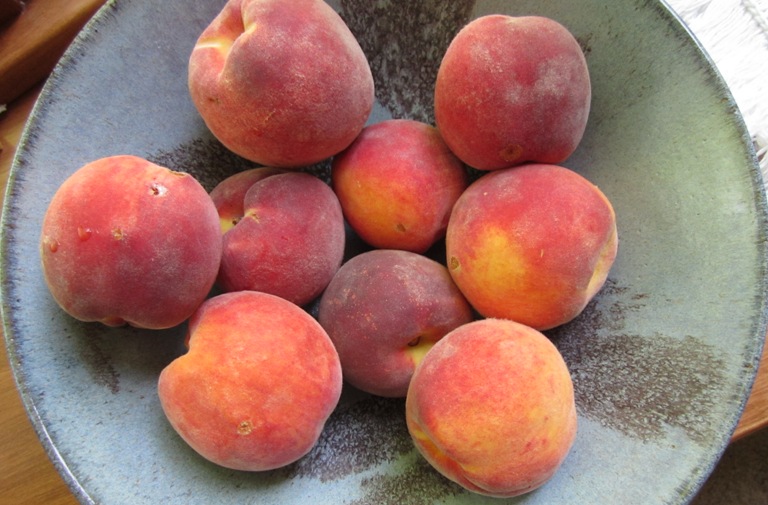
PeachesI buy eggs each week from a chicken-keeping neighbor, who also shares fruit from her orchard. Last year we tended a community garden, and this year we’re experimenting with straw bale gardening on a friend’s property. And one of my favorite activities is to forage for food along my street. I bring home salad greens and berries by the bucketful. (“Nature’s candy,” I hear my Dad’s voice saying, and sometimes say myself, gobbling mulberries.)

There’s a lovely rootedness to this life. I guess it’s possible to live for years in one place and never meet the neighbors, never put a hand into the soil, never sit outside. People drive into an attached garage and disappear into a house that serves as…what? a haven for the inner circle? a locus of entertainment? a fortress against the world?

That seems so sad to me, a kind of disembodiment—though I too appreciate a haven, crave entertainment, and need security. But to live only inside the house sounds like a terribly constrained existence, no matter what kind of diverting electronics are humming within its walls.

Dad used to spend every long summer evening outdoors puttering. It was a mystery what he did out there. As an adult I understand. He was tending, noticing, relating. Getting rooted.
My Dad, Who Made the World Better

Father’s Day meant a pilgrimage to a few places special to my Dad, who died last year. His handprints are all over this town, but I chose a couple places with personal meaning:

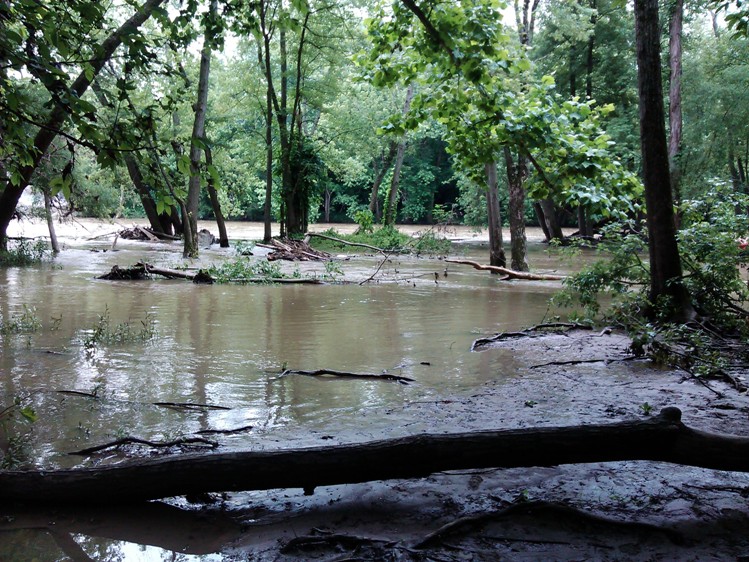
1. Holliday Park, down by the river. Because he used to take the grandkids out into the water with a seine to see what they could catch. Also, he kayaked that river many a time. (Once with me. I was not in the best shape then, and he ended up tying a rope to my kayak and towing me into the wind, all the way back to our put-in place.)

IMG_20130616_161417

The water is not this muddy and high in my memories of Dad taking the grandkids out. All the rain lately.

2. Holliday Park Nature Center. Just to visit his brick.

We honored Dad with this walkway brick at Holliday Park Nature Center on his retirement.

We honored Dad with this walkway brick at Holliday Park Nature Center on his retirement.

3. A pocket park where he and I picked juneberries. Sweet memory. I picked yesterday in his honor.

In truth, Dad is ghosting about the edges of nearly every blog post I write. I see him in the anonymous man in the Keystone Pipeline protest photo—he used to wear that kind of cap, and he marched for important causes. I see him in Keith Johnson, sharing his passion for the natural world.

And I see him in David Forsell, facing death too soon, knowing that what counts is giving back.

A few months before he died, he received the Hoosier Environmental Council ‘s Land Steward of the Year award for his volunteer work (though “work” is a misnomer—he often said, “I’m just having fun.”) A sampling of his fun:

  • He started a multi-year restoration project to return Indiana State Museum’s Turner Gardens to Indiana native prairie (still going on now).
  • At Cold Spring School, he was “chief gardener” and caretaker of the greenhouse, introducing grade schoolers to the marvels of the garden.
  • He took student groups on rafting trips, and led them on tours of natural places.
  • He spearheaded Indiana Native Plant and Wildflower Society’s Letha’s Youth Outdoors Fund, funding field trips to get schoolchildren out into nature.
My dad at the kitchen sink. You can't tell but he's wearing his favorite "Life is Good" Shirt, the one with the dog wearing the backpack.

My dad at the kitchen sink in 2010. Strong as an ox. You can’t tell but he’s wearing his favorite “Life is Good” shirt.

Now and then my mail brings evidence of his impact, and it always makes me happy and sad. Two examples:

From Friends of Cold Spring School: The fifth-graders have adopted the prairie he led students in planting around “Mr. Donovan’s Greenhouse.”

From Indiana Native Plant and Wildflower Society: At Dad’s urging, a Gary-area nonprofit working with urban youth applied for funds to visit the Indiana Dunes National Lakeshore—a wild place largely unexplored by these kids (who live less than a mile away!). The funding allowed 40 young people to experience the beauty of this national park.

I remember when he met these folks and encouraged them to seek funding. It was at the Hoosier Environmental Council luncheon where he received the award. He was quite frail by then, but still networking, still advocating for kids and nature. It didn’t matter that the title of INPAWS “Youth Outreach chair” had long since passed to someone else.

That’s my Dad to a T. Sure do miss him.

Addendum: I forgot to include this recent piece published in the Boiler Journal, describing a day soon after he was diagnosed with terminal cancer.

Where We Rarely Dwell

In my quest to be an engaged citizen, urban homesteader, radical homemaker, contributor to household coffers, writer, etc., I can get trapped in a life of busyness. I have so many goals. My days are full of checking the clock as I push myself to be more productive, to mark things off my  lists. (Yes, I have more than one list.)

One week before I fell ill, I was advised to take some unscheduled time every week. I never got the chance to try this radical experiment—because soon I was pretty much glued to the couch, in a haze of pain and exhaustion, just trying to get through my days. And even then, chafing at all that was left undone.

My cat Maggie enjoyed the couch time immensely.

My cat Maggie enjoyed the couch time immensely.

This is a typical pattern for me—I have to be forced to slow down. I suspect it’s not uncommon in our hyperproductive Western culture, this need to be sick or injured before we grant ourselves rest.

So when I listened to intuitive Lee Harris‘s monthly energy forecast this week, and heard him talk about slowing down, I had to laugh—it was so on-target. He said we must stop rushing about and go inside the body, where we rarely dwell. We’re so stimulated all the time that we don’t really know our inner selves.

And that’s a loss.

I like to think I’m fairly good at this: after all, I’ve studied mindfulness meditation! I practice yoga! I’ve done all kinds of personal healing! Yet, the fast track always, always hooks me, and I give short shrift to my dreamy, drifty side—until I have no other choice.

Harris says, “The ‘driving masculine’ side is not what we are needing as a world anymore. We have been hearing this for years, but it’s hard for us to change the program.”

I guess that’s why it takes enforced couch time before I can stop being so terribly driven.

Recently on a Transition US call about creating new stories, one of the panelists said something powerful: That we get tripped up if we try to remake the world in the context of an old, outdated story—meaning looking through the lens of competition, judgment, conflict, scarcity, and domination.

I’m reminded of the wisdom feminist poet Audre Lorde offered years ago: “The master’s tools will never dismantle the master’s house.” She was referring to racism and homophobia in the women’s movement, but it applies here too. How can we transcend the dominant culture’s destructiveness if we’re working from that old script—if we are subjugating our inner knowing (available only in stillness) to this constant striving and acting?

Stillness

Stillness

How, though—this is always my dilemma—how do I get important work done without this driven side of myself? Is there a new way of being that allows both the focus to finish (so satisfying: to finish!) and the freedom to swim about, aimlessly dreaming?

Perhaps, instead of a driver archetype, I could assume the gardener archetype. Cultivate change instead of push it. Would that work? What do you think?

Their Courage Becomes our Courage

As I mentioned in a previous post, I recently devoured Frances Moore Lappe’s brilliant new book EcoMind. I now have a clearer sense of the risk people are taking when they first begin to step off Status Quo Railways and change the way they live.

It’s deeply ingrained in each of us as humans to to look and act like everyone else in our tribe. This has been a matter of survival since Day One of our species: Stay with the pack, or perish!

No wonder so many are hesitant to follow a different drumbeat than the dominant culture’s. Lappe cites experiments showing that subjects went along with the wider group’s opinion–even when it went against what they could see with their own eyes.

It can be quite powerful to join a movement, but what if the movement looks fringy and wrong to the people closest to us? It’s a big risk.

That’s where the power of relationship comes in.

Because those same experiments showed that “all it took was one truth-teller to enable people to be true to themselves.”

“Knowing this,” Lappe writes, “we can choose to seek out those who share our passion, those who encourage us to risk for what we believe in.”

In fact, there are neurological changes that take place when we observe others’ actions. “Mirror neurons” in our brains start firing–as if we ourselves were taking those same actions!

In this way the courage of others becomes our courage.

I have had several such exemplars in my life, people who showed me what it means to live a life of passion and integrity, with the lightest of footprints. Here is a photo of one of them, Keith Johnson of Renaissance Farm.

Keith Johnson, sharing the beauty and abundance of Renaissance Farm

Keith Johnson, sharing the beauty and abundance of Renaissance Farm

Keith and his partner Peter Bane (who gave me my introduction to Permaculture) model a generous, resourceful, earth-sustaining way of life. It’s a way of life that will be ever more essential as we face the uncertainties of the future.

The photo above was taken in May when a friend and I drove down to Bloomington for Renaissance Farm’s plant sale. Though it was raining, Keith delighted in showing us the glories of spring on the suburban farmstead. The unveiling of a fig tree was particularly thrilling. As I recall, Keith insisted we take some of his surplus bok choy harvest, and when I swooned over the taste of chocolate mint, he pulled a clump right out of the ground and gave it to me to plant at home.

People like Peter and Keith give us all more faith in our own ability to heal the earth, to live in such abundance that we just have to share.

They offer me (and others like me) the assurance that Deepak Chopra talks about in this quote:

The famous adage is wrong: The journey of a thousand miles doesn’t begin with the first step. It begins with the assurance that you can take the first step. 

Building a “Better Block”

Something’s happening this weekend that strikes me as just the kind of grassroots change that we so need right now.

It’s called Better Block, a one-day transformation of a city block into a living demonstration of a walkable, vibrant neighborhood center. A Better Block allows communities to experience a “complete streets” buildout process. People can develop “pop-up businesses” to show the potential revitalization that goes along with such an effort.

I read about my hometown’s expression of the movement in this Nuvo article, Real Time Urban Renewal, written by IUPUI grad student Ashley Kimmel. This Saturday from noon to 5pm, the Better Block event will “convert one block of the (East Washington Street) corridor into a vision for the future: a living scale model of how the street could look, feel and be cared for by the neighborhood.”

The benefits? According to the article, such an event:

  • moves beyond simply conceptualizing development to a three-dimensional encounter with possibilities,
  • “focuses on the ground-level experience rather than the top-down aerial map,”
  • offers an inexpensive way to use existing resources toward urban planning, and
  • creates the opportunity to open storefronts and reconfigure travel lanes “on a small, testable scale.”

With the immediate feedback available in this cost-efficient study, it seems like the motivation would be high to make the one-day experience a reality in the not-so-distant future. Why wait?

Neighborhood cleanup on the Pennsy. Photo by Heidi Unger.

Neighborhood cleanup on the Pennsy. Photo by Heidi Unger.

I recognize this plucky can-do spirit. It’s alive and well in my own community, where this weekend a group of neighbors will be building a new greenspace adjacent to the Pennsy Trail.

It’s the same chutzpah that drives City Repair in Portland, OR, where volunteers transform intersections, create community gathering places, and enrich civic life through public art.

I’m betting it’s happening in more neighborhoods than we realize. How about yours?

A Precious Gift

Still climbing Staph Hill here, so enjoy a perspective-giving passage from a book called Evolutionary Enlightenment while I recuperate.

“When you think objectively about how much work went into creating your own capacity to have the experience you are having in this very moment—fourteen billion years of hard work—then it might even begin to strike you as immoral to spend too much time sitting around and worrying about the fears and desires of your personal ego.

By ESA/Herschel/PACS/SPIRE/J [Public domain], via Wikimedia Commons

By ESA/Herschel/PACS/SPIRE/J [Public domain], via Wikimedia Commons

Surely the purpose of all that cosmic effort and creativity and positivity—from nothing to energy to light to matter to life to consciousness to you—could not possibly have been just for that.

When you awaken to the evolutionary process and its endless creativity, and you discover how profound and complex the structure of our universe is, you start to recognize and appreciate, at a soul level, what a precious gift it is to be here.

Andrew Cohen

The Mighty Will Fall

In just a few hours the March Against Monsanto begins here in Indianapolis. On the march’s worldwide Facebook page, New Zealand, Australia and Japan are already representing. At last count nearly 300,000 people in 58 countries worldwide were committed to taking a stand today.

Why march? Pick your reason.

  • We march for freedom and self-determination in the face of Monsanto’s monopoly over the world’s food supply.
  • We march to protect both human health and the earth we love from dangerous genetically modified organisms.
  • We march to refute the insane notion that it is possible to patent life.
  • We march to protest the insidious cronyism in the U.S. government, where ex-Monsanto executives are in charge of ensuring the safety of what we ingest–and are designing laws that make Monsanto basically immune to any legal counterattack.

One of my sheroes, Vandana Shiva, says it all in this video.

I’ve said “we”–but disappointingly, my body is not yet back in marching shape. My marching will have to be done through these pixels, and through the seeds I plant and save, and through the petitions and letters I sign, the calls I make.

Funny thing: I thought I was brought down by something tiny, the fangs of a wee arachnid. Turns out it was something even smaller, the lowly bacterium.

More accurately, bacteria. That is, a community of bacterium. Right? My medical consult is sleeping at the moment, but I think that is right. A community of teeny tiny organisms has brought me pretty much to a standstill.

By Mkaercher, via Wikimedia Commons

By Mkaercher, via Wikimedia Commons

Do the words “small but mighty” come to mind?

What I take from this is the strength of the collective. Monsanto may be monied, powerful, backed by government insiders, seemingly invincible–but WE have each other. We have our passion and our deep concern for the future. We have our love, as Shiva says, for “freedom and democracy, love for the Earth, the soil, the seed.”

All of which gives us the capacity to fan out and fell this giant.

Let’s do this thing.

“To Spend my Days Serving”

I’ve been felled by a Brown Recluse spider bite or possibly a boil-gone-bad (staph infection), and no I won’t share a photo of the wound. I wouldn’t inflict that on anyone–except my crazy herbalist, who delights in such things.

Being a little less mobile than usual has given me a chance to catch up on my reading, at least in theory. I have a whole trayful of publications and other reading material I never seem to get to, and on top of the pile was the March-April issue of Branches Magazine. Ironically, it was themed Best Medicine (as is the current issue). The very first piece stopped me cold. I wish I could link to it but the periodical does not maintain online versions of articles.

“The Best Medicine: Joyful Living” is a first-person essay by David Forsell, president of Keep Indianapolis Beautiful, an action-oriented powerhouse here in my hometown. Think tree plantings and neighborhood cleanups, communities given resources and support to beautify their surroundings. My little juneberry tree who lifted my spirits the day after the Boston bombings? It came from that organization.

Forsell has a rare form of cancer that is “slow but relentless,” and he recently recovered from his 13th surgery to remove yet another tumor. He writes of the example of his mother, who had the same illness, and the search for meaning in the midst of physical suffering. Awareness of his mortality, he writes, has spurred him to make the most of his limited and precious time.

And isn’t this something we all might keep in mind–the certainty of our death–to live a more meaningful life?

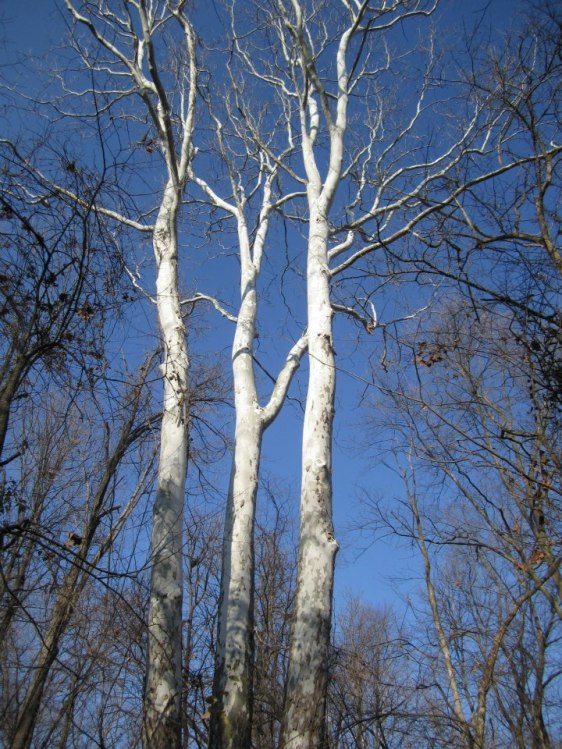
Sycamores in November

Sycamores in November

Forsell came to the Irvington Green Hour last summer to talk about trees with a bunch of us treehugger types, all of us concerned about the impact of the drought. I remember being struck by his authenticity and gentleness.

Here is a quote from this powerful essay:

“In more than two decades marked by surgeries and reminders of my mortality, I have realized I want to spend my days serving: having joy, and hoping I can help others have it too. I want to…heal that which is beautiful but broken or scarred or neglected or compromised in this world….”

He goes on to say that while he may not be able to stop the cancer, it is within his power to help heal the world.

There’s no greater gift than that.

To Shed our Fear

In light of my last post, this quote leapt out at me from the pages of The Blue Sweater, Jacqueline Novogratz’s visionary book. I’ve been a fan of Wangari Maathai since the early 1990s, when I read about her leadership of the Green Belt Movement. This grassroots initiative organizes women in rural Kenya to plant trees, combatting both deforestation and disempowerment.

By Demosh via Wikimedia Commons

The late Wangari Maathai holding a trophy awarded to her by the Kenya National Commission on Human Rights. By Demosh via Wikimedia Commons

“In the course of history, there comes a time
when humanity is called
to shift to a new level of consciousness,
to reach a higher moral ground.

A time when we have to shed our fear and give hope to each other.

That time is now.”

–Kenyan environmental and political activist Wangari Maathai, the first African woman to receive the Nobel Peace Prize

Learning to Learn

Third in a series on education
Recently I spent a day with a Bloomington, IN homeschooling cooperative. Two families work together on homesteading projects on each others’ land. This allows their four children, ages 8 to 12, to learn by doing—while increasing their confidence and skills.

Projects range from seed saving to bike maintenance to creation of a family almanac. They’ve gone mushroom hunting, practiced knot skills, and (on rainy days) learned knitting and mending. They’re working on a fire pit and hoping to build a treehouse.

Reading and quizzing each other from a book called Moving Heavy Things

Reading and quizzing each other from a book called Moving Heavy Things

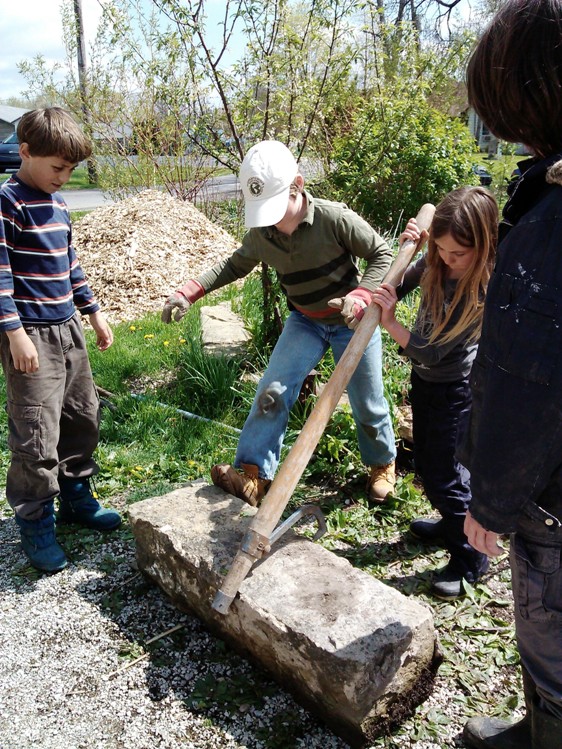
The day I was there, the students were studying how to move a heavy sandstone block down a sloping driveway from the front yard to the back. They were to place it into a rectangular hole in the dirt, forming part of an herb garden’s perimeter. The emphasis was on problem solving, collaborative effort, and applying their study of friction and levers.

Sawing PVC pipe to roll the plywood with the block on top (note that is just a practice stone, not the super-heavy one they were charged with moving)

Sawing PVC pipe to roll the plywood with the block on top (note that is just a practice stone, not the super-heavy one they were charged with moving)

This was no small task and involved an array of tools, including something I’d never heard of called a cant hook. The mom/teachers, Stacey and Dani, encouraged them to try out every idea and see what worked best. The kids worked by experimentation, reasoning, puzzling, trying, and talking—displaying remarkable tenacity through the whole process.

Using a cant hook to move the sandstone block

Using a cant hook to move the sandstone block

There was not one temper tantrum. I could see that the communication skills these kids develop through group projects will go a long way toward smoothing their way in the world—while also contributing to the healing of that same world.

Stacey says she’s motivated by a belief that children can be the instigators of deep change. “I try to not spend a lot of time in a fear/worry place (even though it is hard sometimes), and in doing this mentor joy, hope, the power we have, and that change is possible.  When children/adults have trust in themselves, self-empowerment and understanding of the world, beautiful things happen!”

“I think they are continually seeing how they make a difference and create change.”

Picking violets for our lunch salad

Picking violets for our lunch salad

By the end of my visit, the children had moved one monstrously heavy block into place in the back yard, where it will begin the delineation of an herb spiral. There was great cheering when the block was finally nestled into place.

As results-oriented as we are these days, this may not seem like much for several hours’ work. But in the process, they learned to learn, to cooperate, and to not fear failure.

Watching them, I wondered how my life would be different if I had had these sorts of experiences in my own childhood. I might consider myself in a different light now. I might be handy, of all things. At the very least I would be braver, less fearful of being wrong.

This concludes the education series, at least for now. (I could share much more about both the KI school and these homeschoolers, but that’s where the book comes in.)