KI EcoCenter Leading in the Green Economy

A local community group near and dear to my heart will be represented at a national event next week. The executive director of Indy’s own KI EcoCenter, also known as Kheprw Institute, will be among the presenters at the Good Jobs, Green Jobs 2013 Conference in Washington, D.C.

About KI: When I first visited, I learned that “Kheprw” is a reference to an Egyptian god represented by a man with a scarab beetle head. The scarab beetle was a symbol of rebirth in ancient Egypt.

It seems a fitting title for this community empowerment center, which works at the intersection of social justice and environmental stewardship in the heart of an economically distressed neighborhood. Here it’s all about nurturing an ecologically sound way of life while creating economic opportunity through community engagement. The programming includes an eco-film series, job creation panels, open mic nights, youth empowerment events, and so much more.
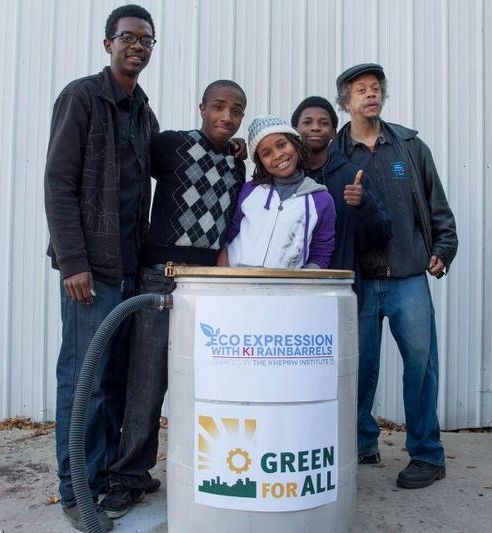
Mat, Rasul, Asli, William, and Imhotep show off an Express Yourself Rainbarrel

Young people in the KI school and mentorship program gain critical thinking skills as they practice social entrepreneurship.

I’ve met many of KI’s children and young adults and they’re not just tomorrow’s leaders—they’re today’s. They know firsthand that with the help of your community, your creativity, and your drive, you can make something from nothing. They’ve built garden beds and aquaponics tanks. They’ve started a paint store, a web services/graphic design enterprise, and a fair trade coffee shop. KI’s work has inculcated in them the confidence and skills they need to navigate the relationship-based economy—whether the goal is a money-maker or a service project or, better yet, both at once.

About the Conference: The theme for the three-day conference is “Let’s Get to Work: Climate Change, Infrastructure and Innovation.” Over 80 workshops will illuminate the possibilities of job creation through green infrastructure. (How refreshing: You mean we don’t have to unleash holy hell in the form of Canadian tar sands in the name of “job creation”?)

KI’s director Imhotep Adisa is a panelist for a workshop highlighting successful sustainable water infrastructure projects. He’ll share KI’s experience in the green economy and its latest social enterprise, Express Yourself Rainbarrels. (I absolutely love this project: The KI crew will customize a rainbarrel with your logo, design, or photograph. I can’t wait to see mine!)

I’ve written a piece for Indiana Living Green about the center that will be out next month. In the meantime, check out this video featuring their work. (Start at minute 3:50 for the segment on KI).

An Appeal Denied

Update: Community Access Television has posted a video of the April 3 Board of Zoning Appeals meeting. Minutes have not been posted on the BZA site yet.

Last night I met up with friends to drive to Bloomington, IN for a Board of Zoning Appeals meeting. We were among 80 others there championing permaculture designers/teachers Peter Bane and Keith Johnson, who were pursuing variances for their small suburban lot. Since last summer, they’ve been mired in a conflict with Monroe County, primarily about placement and square footage of structures at Renaissance Farm.

The main issue was that they didn’t follow proper procedures, but they were under the impression that agricultural buildings are exempt from the process. I won’t go into detail about the legalities as that’s not the purpose of my blog—but you can refer to the meeting materials.

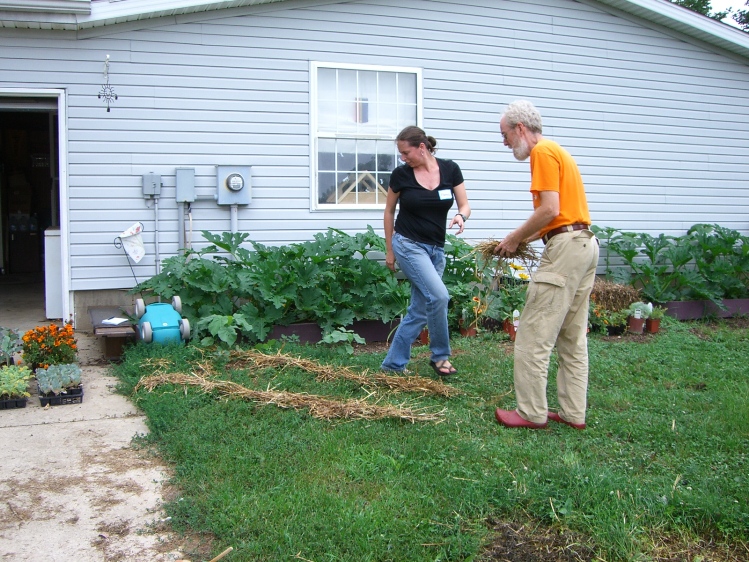
Peter Bane with co-teacher Rhonda Baird laying out a garden path during 2007 permaculture class

Peter Bane with co-teacher Rhonda Baird laying out a garden path, 2007 permaculture class

It was moving to hear the 30-plus testimonies of Peter and Keith’s impact. (I first met Peter in 2007 at a one-day permaculture overview class, and his passion infected me with the need to come right home and plant my entire lot in food.)

The intergenerational crowd was made up of neighbors, IU profs and grads, pastors, farmers, small business owners, a newspaper editor, a City Councilman, and young Bloomington natives who moved away and then returned, largely because they wanted to learn from these luminaries.

Neighbor after neighbor told of the duo’s generosity in sharing both knowledge and produce. Many have started gardening themselves. One said she travels all over the country; when she tells people she lives on the same street as these renowned Permaculture designers, “they are in awe.”

A sampling of comments:

“Everything they are doing is a practical and immediate way of changing the world for the better.”

“They are showing that young people can have a viable future in spite of the climatic, economic, environmental, and other issues facing us.”

“It’s beyond sustainable, it’s regenerative.”

A maypop planted along our fence, one of many plantings inspired by permaculture

A maypop planted along our fence, one of many plantings inspired by Keith and Peter’s work

There seemed to be an understanding in the room, even among officials, that we are at a crossroads. One supporter told them, “I am sympathetic to you who must uphold laws that support suburban sprawl and ignore what the future requires of us.” Another said, “We are living in a world where the rules are changing.” Another warned that big timber, big ag, and mining will dominate rural areas if we don’t change our ways.

But apparently these are not the concerns of a body pledged to oversee existing laws, faulty as they are.

After four hours the board approved all but one variance—a critical one. The barn must be moved about 10 feet from its current position to be in compliance.

It was a shock. Especially after board member Jerry Pittsford, who expressed dismay that Peter and Keith had circumvented the process, had said, “I like rules, but I’m finding very little that tells me the rules need to be followed here.”

There were a number of reasons to approve the variance and only one to deny it—the fact that they did not consult with the county and submit the proper paperwork. Even as the board expressed admiration for Peter and Keith’s work, they could not get past that lapse.

It’s unclear what the next step is for Renaissance Farm, but whatever comes, I hope these two visionaries were bolstered by the outpouring of love and appreciation from neighbors, former students, and admirers.

Inspiration from Across the Pond

© Scott Patterson | Dreamstime Stock Photos

© Scott Patterson | Dreamstime Stock Photos

I just found out about a forthcoming book called Stories of the Great Turning, which features first-person accounts of Brits who are transforming their lives in inspiring ways. According to Vala Publishers:

“These are the stories of just a few people who decided to act, in their own lives, in response to the challenges of climate change and environmental degradation, and found their own way to make a difference. They are not stories about celebrities, environmental geeks or gurus but honest accounts from people who…’just got on with it.’

It is a book that takes the question, ‘What can I do?’ and sets out to find some answers using one of our species’ most vital skills: the ability to tell stories in which to spread knowledge, ideas, inspiration and hope.”

Kindred spirits if there ever were. And there’s a foreword by beloved eco-activist Joanna Macy, and I think you know how much I adore her. (“Now is the time to clothe ourselves in our true authority.” –from the Foreword.)

I’m invited to the book launch next month. Exciting! It’s in Bristol, England, so I won’t be there, but still!

The Quiet in the Land Gets Loud

Mom had a dream in which I was kidnapped in South America and she spent her retirement money to find me. When found, I had grown so accustomed to living among the jungle people, I didn’t understand why I should keep my breasts covered.

I asked her, are you worried about me exposing myself, perhaps through this new blog? She didn’t think so.

But it’s a perfectly legitimate concern, one I deal with all the time in my own head as I try to rise to the occasion here. My cultural background is Mennonite, and there are a lot of prohibitions against standing out. My Amish forebears were “the quiet in the land,” the “plain people.”

And though less strict than the Amish, Mennonites are still big on humility. We aren’t supposed to shine too much, or get too high on ourselves, or in general stick our necks out too much. There’s safety in the tribe, in being like everyone else.

Lancaster County Amish 02

By it:Utente:TheCadExpert (GFDL or CC-BY-SA-3.0), via Wikimedia Commons

Of course, being “plain” in the Amish sense means that even while everyone looks the same within the tribe, you stand out against the larger culture in a big way. Your dress, your home, your whole way of life is a rebuke of the world’s fancy-yet-empty ways.

Nonconformism is in fact one of the central tenets of the Anabaptist faith, and I absorbed that ethic as a Mennonite child. To be in the world but not of the world—that was the ideal.

Which may be why I naturally view the dominant culture with a critical eye.

Recently I read Seth Godin’s Tribes: We Need You to Lead Us, and it showed me that we all need to be leaders now. It helped me to take my place as such, to step into this somewhat uncomfortable role. Writing is the gift I have to offer, so I write in service of the world I want to manifest–even if it means going against the ancestral voices that tell me to keep my head down.

Over the last several years I’ve led groups in various successful community endeavors, such as the Irvington SkillShare. So claiming “leadership” shouldn’t be such a stretch, but somehow it still is. (As a teen I heard my peers talk about attending “leadership camp,” and I knew I’d sooner tear my toenails out one by one than do such a thing. Leadership was for kids with confidence. Kids who didn’t mind speechifying. Kids who didn’t need to be humble.)

But there’s an urgency about this time, a sense that we need all hands on deck. We can’t afford to shirk that responsibility out of an ingrained belief that it’s dangerous to stick our necks out. We can’t afford “I’m not enough, I’m just a dumb /fill in the blank/.”

Enough of that. It’s time to get in the game. Let the “quiet in the land” get loud.

What’s your gift, and how are you becoming the leader we need today?

Toward a More Mindful and Resilient Country

A friend recommended the book A Mindful Nation, by U.S. Congressman Tim Ryan, and I’ve just begun to browse through it. As a student of mindfulness practices, I’m curious how a politician applies these precepts to our national life. Here’s a powerful passage from the first chapter:

Let’s get rid of the phony concept of an America based on materialism, consumerism, and looking out for number one, where financial chicanery is our proudest accomplishment to show the world…

There is no dignity in the idea that anything worthwhile has to be purchased.

It shouldn’t be all that difficult to get us to move beyond this ethos, given how unhappy Americans have become.

If we slow down and find some space away from the daily chatter that tells us how to think, who to be, and what to buy, we can discover our capacity for resilience.

Ryan equates resilience with values like:

  • self-reliance
  • diligence
  • frugality
  • pragmatism
  • hard work
  • innovation
  • community
Pioneer Days. Photo from US National Archives

Pioneer Days. Photo from US National Archives

He calls these, somewhat nostalgically, “the values that made this country great.”

I tend to think more in terms of global citizenry myself, but I think his patriotic slant will have wide appeal, and he does have a point about the hollowness of much of our current national character. Why, he asks, do we collectively rise to the occasion of caring and compassion only in moments of great crisis, such as during and immediately after 9/11? Can we bring this generosity of spirit to our everyday lives?

Ryan believes that a good starting point lies in each of us addressing our personal fears and doubts through the simple practice of paying attention.

I’m curious about this. So let me ask: What place does mindfulness have in your life and work? What place should it have in our national life? And do you think individually bringing kindness to the present moment can change a nation for the better?

What is Community Resilience?

So what do we mean by community resilience, anyway? There are several ways of looking at it.

© Egidijus Mika | Dreamstime Stock Photos

© Egidijus Mika | Dreamstime Stock Photos

1. Community resilience means taking a do-it-with-others (DIWO) response to these threats:

  • global warming
  • food insecurity
  • the end of cheap oil, or “peak oil”
  • economic distress

2. Community resilience is the ability to:

3. Community resilience requires:

4. Resilience differs from sustainability because it presupposes:

5. Resilience and resourcefulness are Siamese twins. The question to ask is, “How do you turn yourself into the resource you need at all times?” –Diop Adisa from KI EcoCenter

6. (Joke) Resilience is code for “we’re screwed.” —Apocadoc Jim Poyser, editor of Indiana Living Green*

*This is actually the PG-rated version of Jim’s definition.

What is your preferred definition of community resilience? And how does your community stack up?

Too Many Tons

There’s a moment in Barbara Kingsolver’s devastating new novel, Flight Behavior, where the protagonist realizes the craziness built into our globalized economy. Dellarobia and her husband are in the dollar store, trying to buy a “real Christmas” for their children on $50. Every toy is Chinese-made, plastic, and depressingly cheesy. She tries to find something, anything, that won’t fall apart immediately, and muses:

“There had to be armies of factory workers making this slapdash stuff, underpaid people cranking out things for underpaid people to buy and use up, living their lives mostly to cancel each other out.”

I recently learned something horrifying from this video featuring Society for Organizational Learning founder Peter Senge: It takes a ton of raw materials each day to sustain the American lifestyle. Per person.

extraction

© David Coleman | Dreamstime Stock Photos

I don’t know about you, but it guts me to envision a ton of earthly extraction happening on my behalf—today, tomorrow, and the next day and the next, until the whole house of cards collapses. Or until we demand something different.

Do we really need to buy into this waste?

All that energy that goes into making money to be able to buy stuff? If we could divert a fraction of that into work that sustains us, we might see the merry-go-round start to slow.

I met a young mother recently who had made some changes after asking herself, “Why am I spending money to buy food when I could grow my own? Money doesn’t grow on trees, but food does.” Visionary Charles Eisenstein, Radical Homemaker Shannon Hayes, and countless others have said it: It’s time to rethink, regroup, relocalize.

My partner is cutting her workplace hours this year to spend more time gardening and making things. These projects enrich her life and leave something tangible, and they mean—yes!—fewer trips to the store to buy goods made or grown by someone else.

Sure, we still do our share of purchasing. We’re not immune to the consumer culture. I just got my very first smartphone, after all, with much gnashing of teeth. But we are coming to see ourselves less as consumers and more as small-scale producers, or self-provisioners, or urban farmers. The more we make, produce, grow, and repair with our own hands, the less money we require to live.

One group is working in a big way to break the cycle. Open Source Ecology was started by a young farmer who was frustrated by repeated tractor breakdowns. It bothered him that corporations keep their designs secret and build obsolescence into their products. So he decided to take matters into his own hands.

Now he’s working with others to develop 50 industrial machines to cover every need of a local-level sustainable economy. The open source part is revolutionary: Their designs are available for anyone to use and adapt.

Here’s a three-minute video showing how it all works. There’s a builder from Indiana using one of the machines to make bricks. I love this!

Build yourself. | Tristan Copley Smith from Focus Forward Films on Vimeo.

What about you—how are you slowing the merry-go-round?

A New Narrative

Welcome to my blog!

I admit I have had my reservations about jumping (back) into the blogosphere. Do we really need one more blog clamoring at us in this noisy world?

But there are so many overwhelming issues staring us in the face every day: climate change, resource depletion, species loss, overpopulation, economic strife, deforestation, dying oceans, diminishing water, crumbling infrastructures, an insane food system. These seemingly insurmountable problems add up to a runaway freight train of cataclysm. What gets lost in the clamor is stories of people taking meaningful action–just when we most need to hear their voices.

My research on the community resilience movement has shown me that people everywhere are working to make things better. And not only does the wider society need to know about this, but those of us bucking the system desperately need to hear from other people on this road. There’s a deep hunger to connect with the bigger movement.

Farmers Market SkillShare

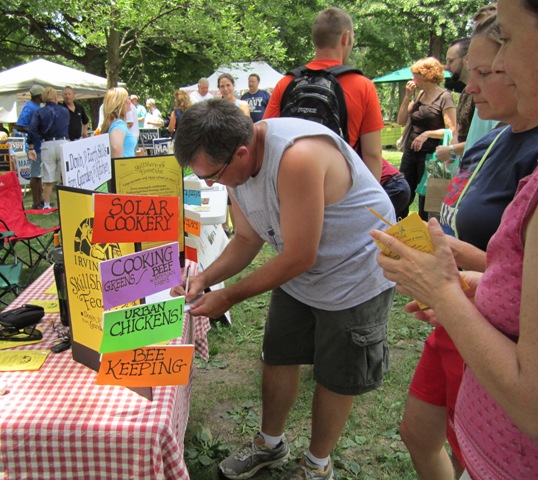
Building community at the Irvington Farmers Market

Speaking for myself, being in community is one key to keeping my spirits up in this age of crisis. I can find that connection with a handful of trusted neighbors gathered at my local brew pub for the Irvington Green Initiative’s monthly Green Hour. I can find it with some 40,000 strangers, marching in the Forward on Climate rally in DC.

It heals me to talk with people who share similar concerns. It energizes me to hear what they are doing to “sweep their little corner” as a friend puts it. It seems natural to put some of this exciting stuff in a public forum for others to enjoy.

It also seems critical to counter the potential futures we are shown in so many books and movies.

The vision of life on a burned out earth drives each of us into fear whether we’re conscious of it or not. On some level we all know that without our life support system—this precious planet—we are doomed. Every movie or novel that shows a dystopian world of hardship reinforces our terror. It’s an emotion that can drive us into walled-up bunkers, whether physical or emotional. Fear shuts down hope and creativity—two things we need in abundance right now.

But there is another focus we can hold: that of cooperation, of compassion, of joining together in a grand and timely mobilization of energies. What if we were to unleash all our creativity, letting go of the need to hold one “right” way? What if we focused on what connects instead of divides? We could leap into this possibility: that together, we can make radical changes that remake the world.

The goal of this site is to show how people are turning their attention to what works, or what might work, instead of focusing on what’s irrevocably broken. There’s no shortage of brilliance in the human spirit—the force that brought us the iPad, the genome map, the Hubble Telecope.

No, there’s no shortage of mental power. Ask anyone who’s stayed up all night worrying about where we might be headed.

What we do lack is vision, a new narrative. That’s where this site comes in. Join me. I hope you’ll feel free to comment on my blog or contact me here with your thoughts and feedback. I hope to hear your stories.