Resilient Communities and People: How Yoga Can Help

Guest post by Gaynell Collier-Magar

Hi everyone! I am so honored to be a guest blogger on Shawndra’s amazing website. Shawndra is one of my Irvington Wellness Center yoga students. She has a beautiful, thoughtful practice, both on and off of the mat. She personifies how yoga can help with resiliency in life.

Yoga is a 5000-year-old tradition of practices (the Eight Limbs) to reduce suffering and still the mind. It is not a religion. However, the practices have been incorporated by many religions: Buddhism, Hinduism, and contemplative Christianity to name a few.

The physical practice or “asana” (“seat”) is meant to create resiliency in the body and mind to enable sitting in meditation for long periods of time. Unfortunately, in the West, the physical practice is often perceived as the path to buns of steel, pretzel poses, and very thin 20-something bodies.

The first lines of the Yoga Sutras state: “Now, the teachings of yoga. Yoga is to still the patternings of consciousness”. The Sutras explain how our habitual ways of thinking create suffering and how we can remedy this.

When we are reimagining a future for our communities, yoga could be a useful tool.

Photo by Jenny Spadafora

Photo by Jenny Spadafora, via Flickr Commons

So how does this happen? In the physical practice, it begins with being in the present moment—in the body and the breath. To get a feel for what I mean, try this:

Notice how you are sitting now. Are you slumping? Good…notice how you feel heavy in your body. Now, sit up straight, feel your bottom sitting in your chair, feel your feet on the floor, and lift your chest. Do you feel any lighter in your body? Slump again and notice. Sit up again and notice. Now close your eyes, put your hands on the tops of your thighs and take three deep, slow breaths. Focus on the exhale.

What was your mind doing? Chances are it wasn’t making a to-do list, obsessing about the person at work who drives you crazy, or yearning after a piece of chocolate. You begin to get a glimpse of the mind becoming more still—an experience that increases in depth and length with further practice.

The practice is to notice what is happening in the present moment, practice non-reaction, and return to the present moment. Neuroscience is showing that these practices literally re-wire the brain.

Two of the liabilities of community work are burnout and lack of fresh ideas. Our ego-driven “monkey mind” robs us of tremendous energy and creativity. As we engage in practices that still the mind, we create a mindspace in which to think outside the box—and the energy to act accordingly.

Photo by TZA, via Flickr Commons

Photo by TZA, via Flickr Commons

We also create a mind that is equanimous and unattached, yet deeply caring. We create a mind that is focused and in the present moment. We create a mind that is resilient.

It is not a leap of consciousness nor faith to realize how resilient minds can create resilient communities. The Buddha said, “All that we are is a result of what we have thought. The mind is everything. What we think we become.”

Gaynell has been a yoga practitioner for over 14 years. She was certified as a Vinyasa yoga instructor in 2009 by Rolf Gates and is a registered yoga teacher with Yoga Alliance. She is certified to teach adaptive yoga to people with physical disabilities, having studied with Matthew Sanford of Mind Body Solutions. She has taught Vinyasa, adaptive, and 12-step recovery yoga classes in Indianapolis and Cozumel, Mexico in Spanish and English. She holds a Bachelor’s Degree in Social Work and owns her own landscaping business, Growing Connection.

Join Gaynell and other terrific instructors at Shine Out Yoga Celebration, July 11-12 in Indianapolis, benefiting Mighty Lotus.

Evidence of the Shift

Final in a series

I’ve often written here about feeling overwhelmed, feeling helpless, feeling despairing. At times it seemed the news was all bad.

The Maldives, one of the island nations imperiled by rising seas. Photo by Nevit Dilman, via Wikimedia Commons.

The Maldives, one of the island nations imperiled by rising seas. Photo by Nevit Dilman, via Wikimedia Commons.

At times I feel besieged by evidence that we as a species are beyond hope. Sometimes all I hear is the lowest common denominator outshouting all reason. Sometimes all I see is fear feeding on fear, a downward spiral with no bottom.

Then along comes a hopeful story of human connection, small but significant.

Bethann was at the zoo with her daughter when she heard a man say, “You heard the one about the two Mexicans?” As it happens, Bethann has adopted two children who are not Caucasian. The man had his own young son with him. Bethann stepped up, with nervous heart, determined to make a difference.

Here’s the story in her own words:

“While at the zoo with Bo this morning, a guy with a toddler (loudly) told a joke that started with ‘How many Mexicans does it take…’ I found a moment when he was separated from his group and pointed to Bo and said ‘See that kid? She’s mine and she’s incredible. I can see you love your kid a lot. But, every time you tell one of those jokes, you teach your kid that it’s OK to treat my kid like crap. And, I am sure you don’t mean to teach your child to hurt others, but that is exactly what you just did there.’ He actually quietly said ‘I understand.’ God willing, there will be one more person on this earth who thinks before he teaches his kid to hate.”

Photo by Debbie L., via Flickr Commons

Photo by Debbie L., via Flickr Commons

How stunning that this man, instead of lashing out or being defensive, very quietly said, “I understand.”

To me this is evidence of the shift that Julia Bystrova of Transition US described, the widespread awakening that is already happening. I see it in the way Bethann stood in her center and spoke quietly but strongly to hold this man accountable. I see it in the way she allowed him room to hear her. I see it in his respectful and surprising response.

What evidence have you encountered of this kind of transformation? I’d love to hear your stories.

Confronting the Shadow

Second in a series

Consciousness shift is one thing, but what do we do about systemic ills?

I asked Julia Bystrova of Transition US about the governmental corruption holding us back from systemic policy-level changes—the big changes we are going to need, if we have a prayer of surviving the linked crises facing us. She had an interesting answer.

She pointed out that a healthy consciousness shift is already manifesting on the local level—witness sensible policy changes in cities all over the country. In LA, for example, a group called Tree People convinced their city that urban forestry is key to watershed management.

Photo by Lida, via Flickr Commons.

Photo by Lida, via Flickr Commons.

More than 1000 mayors have endorsed the US Conference of Mayors Climate Protection Agreement, vowing to reduce carbon emissions in their cities below 1990 levels, in line with the Kyoto Protocol.

And my own city, right smack in the middle of the stolid Midwest, shows some movement. This year we are gaining both a bike share and an electric car share program.

But beyond the local level where we can see real change happening, the picture looks bleak. As Julia put it, much of our larger governmental machine was “hijacked by corporate pirates.” These titans are not interested in seeing communities flourish on a local scale—not when there are profits to be had.

Greed and control are their modus operandi. Their greed is so extreme that they are willingly sacrificing people’s lives. And they’re deliberately sacrificing the life of the planet.

“That’s what we’re up against,” Julia told me. “We’re up against this darkness. It’s very classic, very mythological…It’s like this classic tale (that) I believe we are living out.”

But spiritually awake people can shine a light on the collective shadow. That’s what these madmen, as Julia calls them, represent: our collective shadow. It’s up to us to gain the maturity to stand our ground, in love and compassion, in the presence of this darkness.

In psychological work, the shadow is the unacknowledged, hated part of ourselves that rules our behavior—unless we turn toward it with love.

It’s time to look at such perpetrators in the face, with full awareness, unafraid.

Rebirth, by Jason Samfield, via Flickr Commons.

Rebirth, by Jason Samfield, via Flickr Commons.

Julia believes that more and more of us are reaching this level of awakening. If we confront them from a high level of integrity, institutions entrenched in corrupt power will crumble.

Again, a powerful vision to hold.

Next: Evidence of the shift.

Inner Transition As Key to Collective Work

First in a series of three

In my last post I suggested that an internal shift is as critical as the external changes we so desperately need. I’d like to explore that idea further in this series.

While in California last fall I had a conversation with Julia Bystrova, who was developing a series of “inner transition” tools with Transition US.

The Transition movement is a worldwide push to bring communities into a relocalized post-oil economy. The idea is to reduce consumption and embrace local energy, while building food security and resilience.

Transition Linithgow. Photo by John Lord, via Flickr Commons.

Transition Linithgow. Photo by John Lord, via Flickr Commons.

Julia told me that this movement suffers from a particular conflict: Some people want to jump right in and work on projects, while others prioritize the internal transformation process. The first camp gets impatient with the second, which has often been marginalized. Working groups often struggle to collaborate effectively, caught up in conflicts and divisions.

The solution is to give “inner tools” their due, Julia says. Both external output and internal process are valid. And as Julia says, the external is a mirror of the internal. “There needs to be group process that accepts both in a way that is complementary, because we need both.”

Mapping the Transition. Photo by Chris Hill

Mapping the Transition. Photo by Chris Hill, via Flickr Commons.

I tend to agree, having been involved in some groups that struggle to find cohesiveness. Group dynamics are tricky. To my mind, conflict is likely to persist until we each are willing to be present to our own emotional states.

If we walk through life largely unconscious of what triggers our pain, we’ll always be in a reactive mode. People push our buttons, we react, and conflicts escalate, all because we can’t take look honestly at the storms raging within us.

And it’s crucial that we find a way to work together.

Julia Bystrova and author Mary Pipher both say that we are all doing important work now. Even if we think we’re removed from the front lines, we’re not. Because the central task of our time is just that: working toward a healthier ecosystem and a just economy.

Julia believes that societal transformation can happen fast. She envisions a cascade effect that will be breathtaking in its global reach.

She told me that a certain threshold of consciousness is already on its way. With each of us lighting the spark of countless others, Julia believes we will see the world transformed.

Swallowtail. Photo by Heidi Unger.

Swallowtail. Photo by Heidi Unger.

Mary Pipher also expects widespread transformation. As people open to their deepest feelings about the state of the world, she says a shift in consciousness is inevitable. All those awakening hearts will simply mandate deep change.

So much of the news we hear is bad. In some parts of the world, it’s possible for a woman to be stoned to death, or for schoolgirls to be abducted en masse, while here at home mass shootings no longer arouse outrage. Meanwhile an island nation is projected to be entirely underwater by 2020 as Antarctic shrinks. Monarch butterflies are reaching Mexico in drastically reduced numbers—part of “the sixth extinction.

Stories like these can swamp me in despair. But these women’s vision of transformation holds the antidote to hopelessness.

Next: Confronting the shadow.

Yoga: Leading with the Heart

I’ve practiced yoga for many years, starting in my 20s. My practice fell off in my 30s, around the time my health went wonky. For a long stretch, whenever I attended a class or practiced at home, the result was exhaustion and pain.

But in the last several years I’ve come back to yoga as I’ve rebuilt my health. Now I see my weekly Irvington Wellness Center class with Gaynell Collier-Magar as one of the pillars of my spiritual and physical self-care regimen.

Photo by Lyn Talley, via flickr Commons

Not a picture from our class. Photo by Lyn Talley, via flickr Commons

In Gaynell’s classes, you won’t find that punctilious solemnity that infects some yoga classes. She teaches with a lightness and authenticity that nourishes all comers. And she brings her whole self to teaching. I love that she doesn’t take herself too seriously. Nor does she shy away from the spiritual underpinnings of yogic practice.

Week after week, she nudges us to experience the support of unseen energies around us, to feel into our physical bodies and the air around them.

As we move into a standing posture, Gaynell might say something like, “Lead with your heart; allow your heart to move toward the wall…and now [a smile in her voice], loosening the grip with which you normally hold your life, raise your arms overhead.” Which makes us laugh in self-recognition while carefully forming our bodies into the shape she models.

Photo by Ariane, via flickr Commons

Not a picture of our class or anyone I know. Photo by Ariane, via flickr Commons.

Sometimes it takes stillness to open us to the love that’s all around us. It happened in last week’s class when I found myself holding a posture called the Half Pigeon. This pose has us fold the torso over a bent knee while stretched out face-down on the mat.

Gaynell queues up her play lists with care, and for this extended hold of Half Pigeon, she played a song celebrating the Divine Mother. The vocalist sang her tribute with piercing simplicity. With my forehead pressed to the mat, I felt tears well up from deep inside.

In previous years I might have cried in yoga classes out of grief, out of frustration, out of anger at my body (or at the instructor). Sometimes I cried from plain old weariness and physical pain.

But my heart is full now, and my body and spirit feel replete. My tears are not expressions of hurt. I weep because I feel steeped in love and gratitude.

Photo by Nicolas L., via flickr Commons

Photo by Nicolas L., via flickr Commons

Have you felt that—that opening in your heart center like a flower’s petals unfurling? I hope you have. I wish it for everyone.

I used to believe (or part of me shouted loudly enough to make me think I should believe) that an open heart was less essential than, say, large dramatic projects. It was the outer stuff that would change the world, not the inner.

Now I tend to think that this infusion of love is foundational to any external work, and that any worldchanging shift must manifest on both an internal and an external level.

Gaynell’s own writing will take a turn on this blog in coming weeks. Stay tuned to learn her perspective on how yoga supports resilient communities.

Building Soil, Growing Food, Nurturing Relationships

I just listened to a podcast interview with Linda Proffitt, founder and executive director of Global Peace Initiatives here in Indianapolis. I’ve known Linda since the days I was responsible for Nuvo Newsweekly’s monthly social justice calendar. Back then I called her regularly to find out about GPI’s peace hikes and other activities, and I was always impressed with her programming.

Since that time GPI’s work has exploded onto the local resilience scene. They started by helping church groups grow food for the hungry, bringing countless volunteers together to experience the transformational power of service initiatives.

peasIn 2011, the organization began a new partnership with one of the most influential forces in the urban farming movement. Will Allen and his team at Growing Power designated GPI as a regional training center for Central Indiana. Spring of 2012 saw a well-attended “From the Ground Up” workshop at Peaceful Grounds, GPI’s newly formed center for agriculture and sustainability.

If you have a chance to listen to the podcast, you might be struck (like me) by the idea that produce is just one output of Peaceful Grounds. There’s also soil, which is foundational. And then there’s relationships.

People coming together to cooperatively grow food can form some powerful ties. And that’s what it’s all about at Peaceful Grounds.

Sharing worms with youthful visitors

Sharing worms with youthful visitors

Now at the Marion County Fairgrounds, Peaceful Grounds is about to start a weekly farm and arts market, Sundays from noon to 4 starting June 1.

GPI’s work is featured in a chapter of the new book Deep-Rooted Wisdom by Augustus Jenkins Farmer. The chapter is called “Stop Tilling the Soil”—and worm composting is a big part of the system at Peaceful Grounds. (I was thrilled learn that the worms eat brew mash from my local microbrewery, Black Acre, located right here in Irvington.)

Linda will be the guest speaker at next Tuesday’s Green Hour, a project of the Irvington Green Initiative. If you’re in town, come out and join us to hear all about this vital work.

Photos courtesy of Global Peace Initiatives.

I Heart My Garden Tower

Faithful readers of this blog will remember last year’s midseason efforts with a new gardening technology. Due to some missteps and a late start, I had pretty low yields. But this spring the Garden Tower Project, offering a vertical garden design with worm composting right in the tower, is my best friend.

I’m following the instructions this time and fertilizing with organic fish emulsion till my worms get going, and I can already tell a big difference.

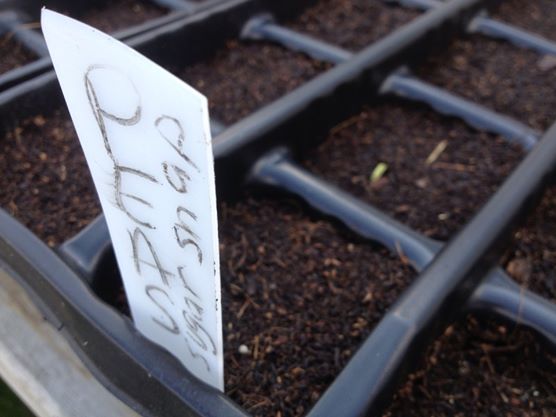
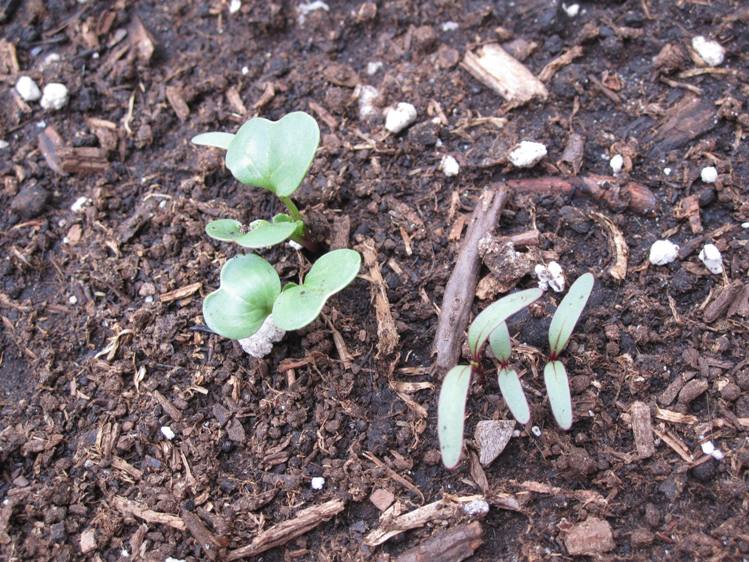
I sowed radish and beet seeds in the top of the Tower over a month ago, and it was so exciting when they sprouted.

I sowed radish and beet seeds in the top of the Tower over a month ago, and it was so exciting when they sprouted.

In late March I bought starts from two of my favorite farmers at the winter farmers market, Stout’s Melody Acres and KG Acres.

Sweet little chard seedling in one of the pockets.

Sweet little chard seedling in one of the pockets.

This year I’m not asking each pocket to hold more than one plant (last year I was loath to thin my babies, resulting in spindly, sad specimens).

Beautiful lettuce (before I thinned).

Beautiful lettuce (actually two plants, before I thinned).

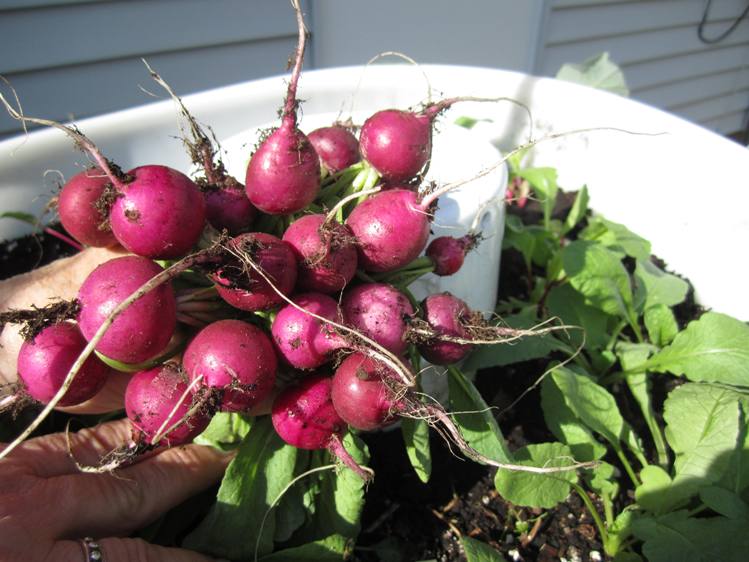
Soon I was able to eat my thinnings. Just last week, I harvested a bumper crop of radishes.

And the radishes are still coming!

And the radishes are still coming!

This week I’ve made my salads solely from my own garden (with a few foraged weeds for good measure), and I’ve begun snipping kale leaves to use in green smoothies.

top

More radishes on the way. And here come the beets! I will probably slip a tomato or pepper plant in here before too long.

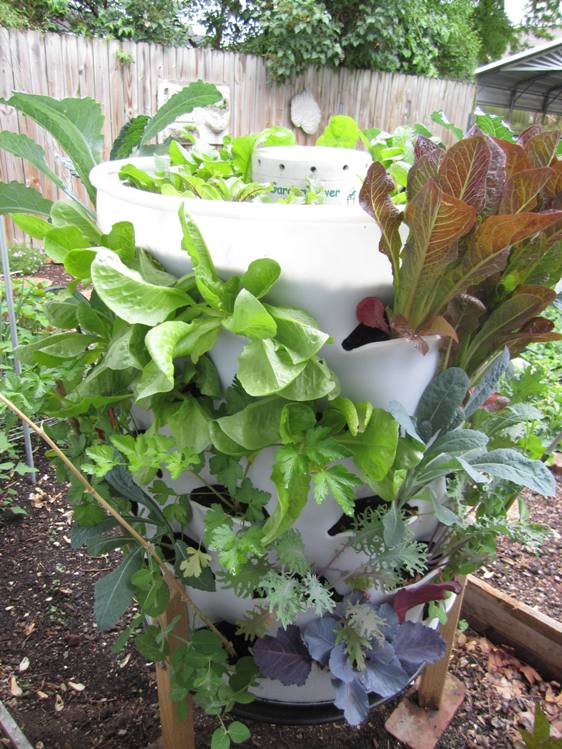
Here’s what my Garden Tower looked like before I started majorly harvesting a few days ago.

Still room for a cucumber or zucchini seeding on the bottom row. (Yes I do love my greens!)

Still room for a cucumber or zucchini seeding on the bottom row, where that one pea sprout is lagging behind.

And another view.

Yes I do love my greens-- of all kinds!

Yes I do love my greens– of all kinds!

I learned more about the Garden Tower Project when I wrote a piece on it for the May issue of Farm Indiana. I was impressed with the vision of the project’s three partners. For example, at some point in the future they hope to switch from a petroleum-based plastic to plant-based.

According to partner Joel Grant, the type of polyethylene used in the Tower is simple to produce from plant-based sources. “You can produce polyethylene nearly as easily as biodiesel,” the environmental scientist says. “It takes more processing but…in some countries people solely manufacture it out of plant products.”

For more on the Garden Tower Project, visit their webpage or see my story in Farm Indiana (navigate to page 24).

Now I’m off to saute up some chard and radish greens for dinner!

Farming Females

Last month I enjoyed interviewing several women for a special section in Farm Indiana on women in agriculture. While some didn’t consider themselves farmers, all had valuable perspectives about what it means to bring a female sensibility to agriculture.

Many spoke of women’s connection to the earth as something deep and primal. Several compared the nurturing of plants and animals to caring for children.

And Kay Niedenthal, an urban farmer in Indianapolis, might have been talking about our procreative power when she said, “It’s like magic to make something from nothing. To start with dirt and a seed and then have a meal.”

Anna Welch of Fields of Agape in a field being prepared for hull-less oats.

Anna Welch of Fields of Agape in a field being prepared for hull-less oats. (The periodical has a much better photo of Anna by the terrific photographer Josh Marshall.)

I was intrigued by the fact that Anita Spencer of Homestead Growers didn’t start out growing organically. She and her husband were Miracle-Gro fans at the start. When a friend asked if they’d ever considered going organic, she said, “We laughed at her!”

But that question planted a seed all its own. They took a look at the contents of the famed formulation and realized they didn’t want all those chemicals in their bodies and those of their children. Nor did they want to sell produce grown that way.

Now Anita is proud to offer high-quality, chemical-free food to her customers through both Homestead Growers and its spinoff line of tomato sauces, Local Folks Foods.

(As a side note, this anecdote showed me how questions can spur behavior change, even the questions don’t seem well-received. I resolve to ask more questions!)

For the full story, including seven mini-profiles of women in agriculture and Josh Marshall’s beautiful photos, see the current issue of Farm Indiana (page A8).

Celebrating International Permaculture Day

Today is International Permaculture Day. Guest blogger Thomas Tlusty wrote the following piece exploring his connection to Permaculture, and its power.

Guest Post by Thomas Tlusty, founding partner of The Garden Tower Project

Two years ago, I saw sketches of a device that I felt certain had the potential to revolutionize urban agriculture. I had long been interested in the economics and environmental impact of our food system. So the design piqued my curiosity and unleashed my desire to have a positive impact in my own lifetime.

The Garden Tower is a water-saving, worm-friendly, uber-productive vertical gardening aid.

The Garden Tower is a water-saving, worm-friendly, uber-productive vertical gardening aid.

Since that fateful reveal, my life has been transformed. The Garden Tower Project reignited my passion, and I began rethinking current food production/distribution models. My eyes were opened to the plethora of pioneers, visionaries and everyday folks who are practicing, teaching, and studying Permaculture and sustainable farming/lifestyles.

I am inspired by those who inspire others. I’m thinking of luminaries like Bill Mollison, David Holmgren, and Will Allen. I’m also thinking of many less well-known but still pivotal figures, such as:

  • Community Slow Food Educators
  • Permaculture Design Educators
  • Elementary School Science Educators
  • Organic Gardening Instructors

I am a relative newcomer to this work. Yet I feel a kinship with those who aspire to build community and develop our inherent natural resources in a straightforward manner.

I’m troubled by the unbinding of our culture from its roots. Western civilization is “circling the drain” as we surpass our fragile planet’s carrying capacity (in our current mode of operation).

Permaculture (to me) represents an entirely sane alternative to the path on which we find ourselves today. Permaculture principles contain not only the seeds of hope but a catalyst for change. In practice, these concepts could improve the lives of untold millions and positively influence the course of our future on this planet.

I find hope in people working together in communities, sharing education and experience. And teaching our children well is our first and best hope.

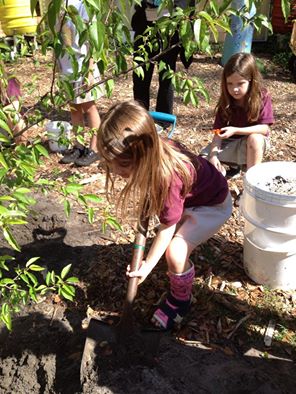
A child at  Learning Gate Community School prepares soil despite the cast on her leg. Thomas captions this photo “Our Hope For Mending a Broken Future.”

Our Hope For Mending a Broken Future: A child at Learning Gate Community School in Lutz, Florida, prepares soil despite the cast on her leg. Instructor: Cissy Brady Stanko

Permaculture engenders ideas and conversations around topics like environmental science, vermiculture, organic gardening, eco-art, and eco-psychology. And connections grounded in Permaculture positively transcend any political, socio-economic, racial, or gender barriers that have been erected in the past or could possibly be constructed in the future.

In my endeavors, I have developed friendships through online Permaculture forums and related Facebook pages. The connections range from the casual and conversational to the inspirational and uplifting. Together they raise me from the deep morass that had grown like a thick moss over my heart’s desire.

I’m now acting on a long-felt wish to accomplish something meaningful and utterly critical: addressing our outdated and increasingly toxic food production/distribution system. Without action and intent, habits will remain the same. Permaculture shows us the way to a very different future.

Thomas Tlusty was raised in Lombard, IL. Thomas was active in social justice and interested in food issues from a young age. In his late teens to early twenties, he worked at the Chicago Board of Trade (in Agricultural Commodities) for a leading grain exporter. The Ellettsville, IN resident has been a practicing Certified Natural Health Professional and is currently an Active Isolated Stretching Therapist in private practice. Thomas is a founding partner in the Garden Tower Project.