Drawing the Line

Saturday I took part in a local expression of a nationwide day of action, 350.org’s Draw the Line. About 40 of us came out to demonstrate resistance to the proposed Keystone XL pipeline.

KI EcoCenter hosted the Indy event in partnership with Earth Charter Indiana. These two stellar groups both work at the intersection of environmental, social, and economic concerns.

Photo by KI EcoCenter

Photo by KI EcoCenter

Alvin, one of the organizers, started us off with a wholistic assessment of what we were about: creating a new world, beyond the issue of the pipeline or tar sands or even fossil fuels.

“Keystone XL is a symbol of the past…We’re saying no, we want something different for our world,” Alvin said.

In the ensuing discussion, there was talk of reining in corporate greed, making companies pay the true cost of production, reforming the way election campaigns are financed, and other policy changes.

But many people brought up the need for internal as well as external shifts. How are we making the old reality obsolete by creating a new reality, as Buckminster Fuller advised?

Photo by KI EcoCenter

Photo by KI EcoCenter

Some of the insights:

We need to build a united movement that encompasses social justice, because climate change disproportionately affects the poorest of the poor. —Rosemary

We have to shift away from the value we put on money. Companies value money and profits more than our own lives. We have to focus on the intangible side of life, such as happiness that comes from having a healthy place to live. —Keenan

Photo by KI EcoCenter

Photo by KI EcoCenter

The problem stems from the idea of separation—that we’re separate from each other, separate from the earth, separate from the animals. But we are one. —Marion

We need to change the definition of the good life. —Tom

We need to take responsibility for what we carry within so we don’t pollute the world with negativity. Anything inside us that fears and hates is that which is in common with what is feared. It’s important to notice—because when you notice things, they lose power. —Phoebe
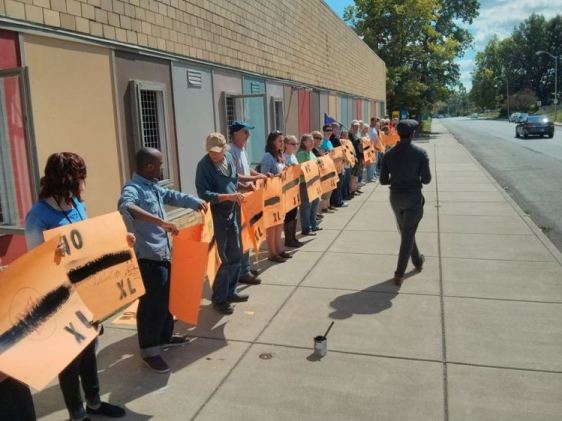
Photo by KI EcoCenter

Photo by KI EcoCenter

At the end of the discussion, we lined up outside the center with signs we had made, and a KI EcoCenter intern drew a black line across to represent our line in the (tar) sands.

Though I much prefer creating the new world to protesting what needs to fall away, I do believe it’s important to stand up and be counted. I’m glad Indy was represented in the movement, however small our number. And we didn’t stand alone. These photos of the line’s reach (into hundreds of cities, drawn by thousands of activists) at 350.org’s flickr stream are inspiring.

To Be Hopeful in Bad Times

Howard Zinn, by Jim from Stevens Point, WI, USA, via Wikimedia Commons

Howard Zinn, by Jim from Stevens Point, WI, USA, via Wikimedia Commons

On this Labor Day, here’s a quote from a celebrated historian, the voice of the common people.

“To be hopeful in bad times is not just foolishly romantic. It is based on the fact that human history is a history not only of cruelty but also of compassion, sacrifice, courage, kindness.

What we choose to emphasize in this complex history will determine our lives. If we see only the worst, it destroys our capacity to do something. If we remember those times and places—and there are so many—where people have behaved magnificently, this gives us the energy to act, and at least the possibility of sending this spinning top of a world in a different direction.

And if we do act, in however small a way, we don’t have to wait for some grand utopian future. The future is an infinite succession of presents, and to live now as we think human beings should live, in defiance of all that is bad around us, is itself a marvelous victory.”

—Howard Zinn, from You Can’t Be Neutral On A Moving Train, 1994

To a Young Cicada

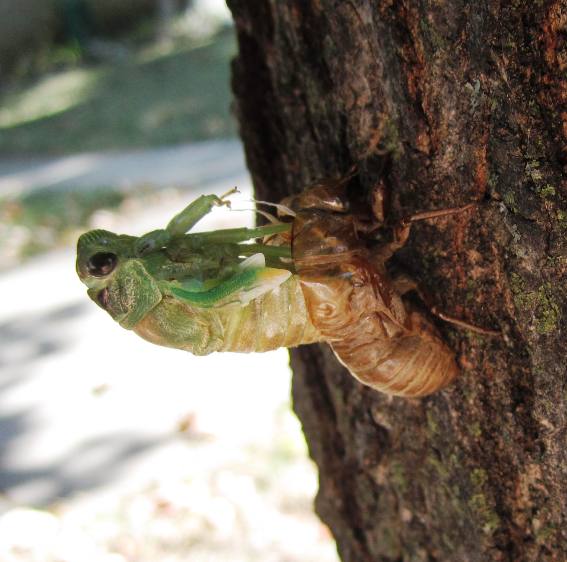
I looked for you today. There on the trunk of the maple tree, surrounded by the carapaces of your siblings, you’d been left behind. You were still unzipping your old skin and squeezing out. I saw your convulsive twitch, your jointed limbs, your staring eyes. Your struggle to be born. Your excruciating vulnerability in the moment of leaving your armor.

top viewI know you from your song, the vibrating sine wave soundtrack of every August of my life. Your evening crescendo drowns out human words spoken under the trees.

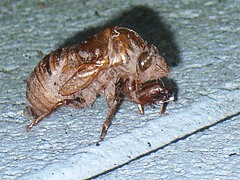
cicada shell

I know you from your shell, the source of childhood torment. Yesterday I picked one off a raspberry with shivering fingers, reliving the horror of such husks left by a prankster brother: on my pillow, my bookshelf, my lightswitch.

I know you from your rare jittering bounce on the ground, a curiosity for the dog, an opportunity for the cat. And once you turned up at my back door after I wrote a poem in which you starred. You looked at me as if to say, You rang?

cicadaBut I’ve never seen you like this, in the act of slow-motion vaulting into your new shape.

for blogDoes it hurt, this freeze-frame backflip into airborne freedom? It looks like it would hurt.

Maybe it hurts like a numbed limb awakening, the flow of blood returning. A rightness in the pain. A sensing that what comes next is flight.

Do you look back at that exoskeleton that used to house you, once you’ve finally juddered free? That hull too small to contain you? No. The buzzing symphony pulls you up to the treetops. You ready your instrument.

From the Low Food Chain Chronicles

Weeks ago, months really, I pledged to try sardines in an effort to eat lower on the food chain. I went out and bought a tin of skinless, boneless sardines. I asked for your serving suggestions. I browsed recipes. I learned that you can fry them (“the bones get crispy!” said food blogger friend Melissa, which gave me pause), or put them in a potato salad, or mix them into pasta. Or just eat them on a cracker.

I got inspired.

Then I put the tin in the pantry. And there it sat. And whenever I reached in for baking powder or pasta or whatnot, I would think, Oh yeah, sardines, I promised I would eat those. For the blog. And then I would close the door again posthaste.

I am proud to tell you that yesterday I actually pried that sucker open. And I didn’t stop there. I actually ate sardines.

Yesterday's lunch.

Yesterday’s lunch.

I’m here to report that these little fishies, which feed the farm-raised fish so many of us prefer…really aren’t that bad! The smell is a bit oceanic, but taste is mainly salty, at least when mashed in small (microscopic) amounts on a lovely sesame rye cracker.

I was worried the mouthfeel would be slimy, because just look at the sheen on those puppies. But they were actually quite palatable.

I had lactofermented veggies on the side, figuring two strong flavors would cancel each other out. You can never have too many cultured veggies, and these collards and cabbages were homegrown and -cultured.

Unfortunately I had to move indoors to eat because my cat was so interested in the meal.

"I'd be happy to finish those sardines off for you." --Kitley

“I’d be happy to finish those sardines off for you.” –Kitley

I told myself that if lunch turned out to be a train wreck, I’d put a good taste back in my mouth with dessert: zucchini cornbread baked in the solar cooker. Not just any cornbread but blue cornbread. Over homemade yogurt with organic Indiana blueberries.

Sorry I don’t have a photo for you. I was too excited about eating it to pause and snap.

Meanwhile the salad balanced the sardine experiment nicely. I’ve said it before: I know this isn’t a food blog, but still I must share the ingredients of this super-duper salad:

  • Grated zucchini, because it’s summer and everything we eat must include zucchini from the garden in some form.
  • Oxalis, purslane, sorrel leaves, chives, catnip, young dandelion leaves, and possibly other things I can’t remember, gathered from the yard (and the neighbor’s yard, but who’s looking?)
  • Sungold cherry tomatoes, first of the season and sweet as can be. I’ve waited all year!
  • Pumpkin seeds toasted in the solar cooker.
  • Nettle seeds. Herbalist Greg Monzel says these are “one of the only herbs that can restore compromised kidney function,” not that I really need that. And they’re too small to give much more than the teeniest little crunch. But I like using every part of the nettle patch, so I can tell Judy, “I’m still harvesting from it!” when she threatens to whack it down.

What culinary adventures are you having this summer?

Releasing and Emerging

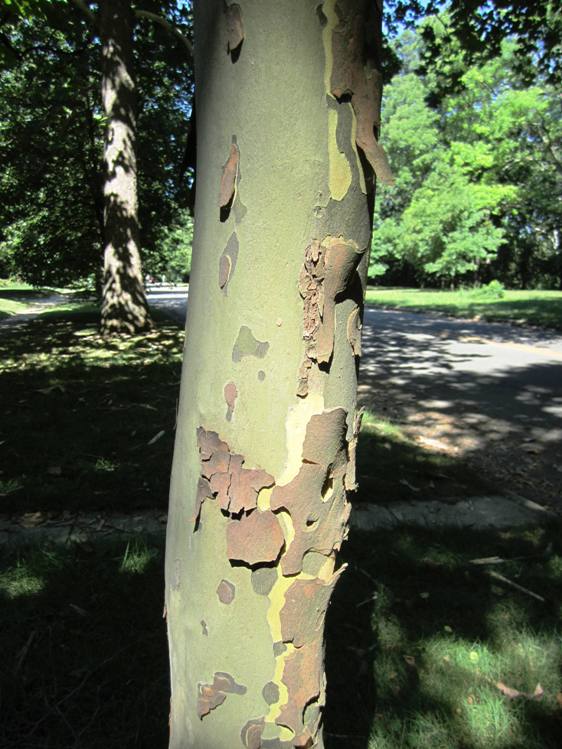
Along my street, the sycamores are shedding. Great scrolls of bark pile in drifts around each trunk’s base. The new “skin” is a tender green. It’s like the trees have hit a sudden growth spurt.

Seeing this always makes me wonder what I myself need to release in order to grow.

Sycamore in process of shedding

Sycamore in process of shedding

Lately I’ve been thinking about the concept of emergence, introduced to me by an Ohio group called Simply Living. Emergence happens when networks form around a common vision, allowing powerful social change movements to arise seemingly overnight. Witness the local food movement.

The term also appears in Marjorie Kelly’s book Owning Our Future: The Emerging Ownership Revolution. She contrasts the phenomenon with top-down policies imposed on a community. Instead, change emerges organically at the local level, rooted in community need.

Once again, it’s trusting the power of smallness.

Simply Living notes that emergence requires “staying present with the work at hand, yet paying attention to emerging opportunities.”

It’s a tough thing to discern, in both working groups and in individual endeavors. Clearly we can’t do everything. What to pursue, what to leave aside? Which brings me back to those sycamores.

My own life has taken a few twists of late, leading to surprises and unexpected opportunities—emergence on the microcosmic scale.

Two examples.

I didn’t expect to take on a new cat just now. He appeared on the block, scared and wounded, spatting with the other neighborhood roustabouts. I befriended him, took him for veterinary attention and a certain necessary procedure.

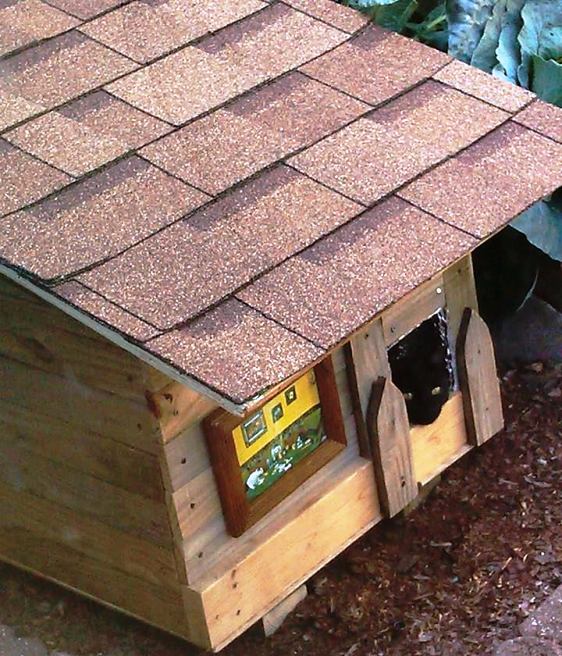
Note the cats playing poker in the "picture window."

Note the cats playing poker in the “picture window.”

Now Kitley’s fully claimed me—and the little house Judy built for him using (mostly) upcycled materials. He can’t come indoors due to her allergies, so she made him a bachelor pad that’s the envy of the entire Feline Nation, or should be. He lifts my heart, racing up to me to touch noses when I’m puttering outside. He makes me laugh when I’m caught in some bleak mental loop of my own making. And then I’m renewed.

I wouldn’t have thought of keeping him as an outdoor kitty, if not for a friend’s chance comment about home-built cat shelters.

Then there was FoodCon. I was a last minute pinch hitter with foraging and solar cookery tables, which led to a friend recommending me to the organizer of Bluegrass Bioneers. Suddenly I’m a teacher in the “reskilling” portion of the weekend. (Happening Oct. 25-27 in Louisville, KY. Psyched!)

More difficult is the paring away. As I embrace emerging opportunities, I must also release what no longer serves, whether it be plans, possessions, or projects.

I’ve always hated that I can’t do every single project that draws me. “Life constantly reaches out into novelty,” says physicist and systems theorist Fritjof Capra. It also prunes away what is no longer needed. I’m working on allowing space for these twin aspects of growth in my own life.

And you? What’s emerging for you and your community?

Lessons from Sugar Man

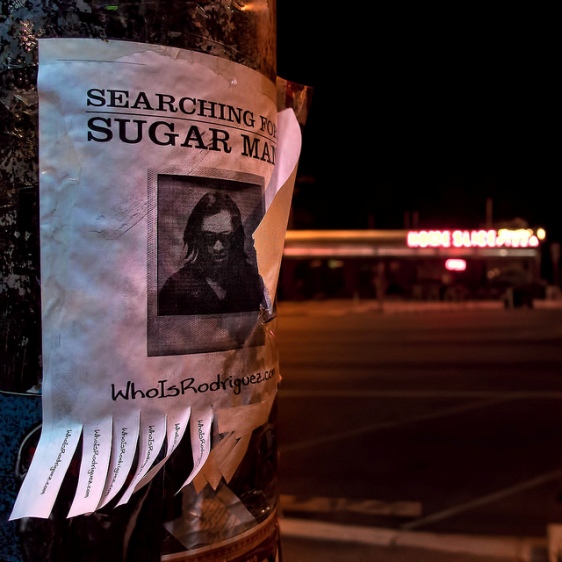
The documentary Searching for Sugar Man came up in conversation with friends last night. If you haven’t seen this Oscar-winning gem, go immediately to your preferred film source and get it. (Immediately after you finish reading this!)

Photo by David Ingram

Photo by David Ingram, via Flickr Creative Commons

I won’t give too much away, because the joy of this film is experiencing the discovery. In brief: Rodriguez, a Detroit musician whose lyrics and style rivaled Dylan’s, made two records in the early 70s. Both flopped. End of story—as far as anyone knew in the U.S.

But in sequestered South Africa, where apartheid had a stranglehold, his anti-establishment message galvanized a generation. There Rodriguez became a superstar—and a mystery. Rumors circulated about a dramatic onstage suicide, involving self-immolation or a gun. Because South Africa was cut off from the rest of the world, in those pre-Internet days, there was little to go on. Who was he, and how did he die?

The story unfolds from there.

In our case, the film sparked a discussion about the impossibility of ever knowing the impact of your deeds.

Clayton said he recently talked with his young son about what it means to be a good person, and how important it is to get off your duff and do something. “You can’t just sit around your house and say you’re a good person. You have to get out and make a positive effort.”

And it doesn’t matter if you fail, because the simple fact of your trying may inspire someone else, Clayton believes.

To my mind, “positive effort” could be as simple as a kind word or smile. We don’t know how these little things might bolster someone facing an inward darkness, or outward danger.

I seem to write about this often: that acts we think of as small actually have great power. Most of us, living our lives in defined spaces, consider our influence very small. Our lives seem circumscribed by smallness; we go to and fro, following our routines, taking care of the details that make up a life.

We may feel that we are too insignificant to make a difference in the fate of our planet and our race.

Yet everyone can do small things with great love, and who can know the ripple effect? Especially if we work in tandem with others.

Photo by Lisuebie, via Flickr Creative Commons

Photo by Lisuebie, via Flickr Creative Commons

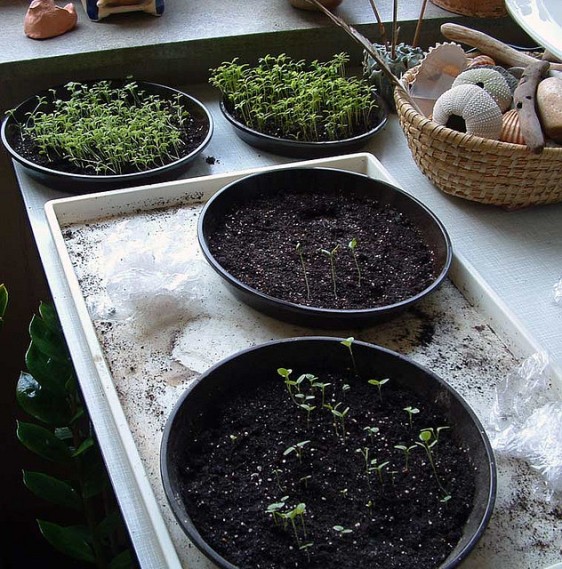
The row we plant might be just the encouragement our elderly neighbor needs to start seeds on a windowsill. Which might nudge her granddaughter to visit a farmers market and buy a farmer’s tomatoes, and one of those funny-looking squashes while she’s at it. Maybe she’ll come back in ensuing weeks and bring her children and a friend, buying more locally grown food. Which shows the farmer that his produce is desired, and keeps him from throwing in the towel after a tough summer.

Think about it.

(And seriously, see the film. Then watch the “making of” extra. If you’ve ever been so discouraged that you nearly gave up a dream, you’ll connect to the story behind the film.)

Building Resilience One Vertical Garden at a Time

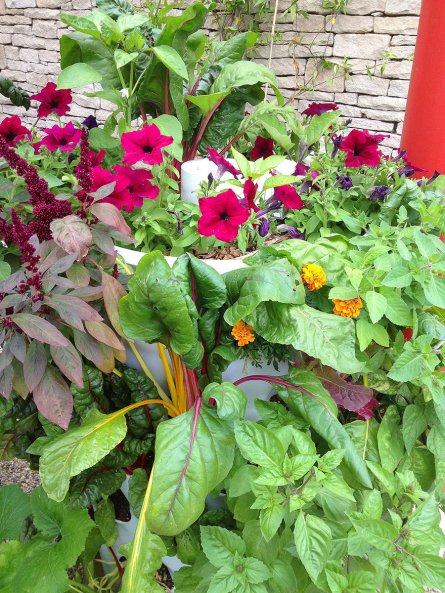
At FoodCon I met two of the people behind the innovative Bloomington-based Garden Tower Project. Check out their garden-in-a-barrel design with built-in worm composting. Up to 50 plants can be planted in this unique vertical garden.

Garden Tower on Planting Day

Garden Tower on Planting Day

The center tube is perforated down the entire length, allowing red wiggler worms to travel between the compost tube and the soil. Kitchen waste goes into the center tube and turns into compost and worm castings. Bonus: The protection of the soil in the barrel means the worms can survive through the winter.

How genius is that–worm composting right in your container garden?
Finished compost, with happy worms

Finished compost, with happy worms

From the website:

“In an era of rapidly rising food prices and industrial farming practices that strip our food of nutrients essential for good health, we believe the Garden Tower is one small step in empowering people towards their own food security.”
The company hopes to nurture a community of growers. They’ll soon launch GrowingCircles.org as a space for networking and collaboration among those with an interest in the Garden Tower Project’s mission. The goal is expanding food self-sufficiency, promoting homegrown vegetables and herbs that are:
  • organic
  • non-GMO
  • low-input
  • ecologically sustainable

Tom Tlusty tells me that the Garden Tower’s unique design capitalizes on “evaporative cooling and a large thermal mass”–making it possible to plant in hot temperatures normally prohibitive in a traditional garden plot.

So… it’s not too late to start gardening this season!

Top view of the Garden Tower.

Top view of the Garden Tower.

I’m so excited about this design that I ordered my own Garden Tower, and I’m picking it up from the Good Earth later today. I’m psyched to sow some crops I didn’t have room for, like beans and carrots. I’ll also scour local garden centers for leftover seedlings (probably quite sad and stressed by now, but maybe a little TLC would bring them along).

It’s nearly time to start fall crops, like kale, lettuce, peas, and spinach. That’s something I always intend to do and never seem to manage in the thick of late summer. But this is the year, with my sweet new protected microclimate as incentive.

Plus I’ll finally have livestock on my homestead, if only in the form of worms. I’m in heaven!

Time to harvest from the Garden Tower

Time to harvest from the Garden Tower

The only drawback I can see is the need for potting soil to ensure that the growing medium is not compacted in the barrel. I hate buying bagged soil for so many reasons. I’ve seen recipes for homemade potting soil. But being eager to jump in, I probably will break down and purchase. (If you’ve found a good peat-free variety available on the market, please leave it in the comments.)

The inventors believe their design will allow people of all abilities to garden in any clime. According to Garden Tower users in the arid Grand Canyon region, this model results in immense water savings. Tom says they used ten times less water with the Garden Tower than their traditional plot or raised bed.

Really can’t wait to dig in!

All photos courtesy of The Garden Tower Project.

A Precious Gift

Still climbing Staph Hill here, so enjoy a perspective-giving passage from a book called Evolutionary Enlightenment while I recuperate.

“When you think objectively about how much work went into creating your own capacity to have the experience you are having in this very moment—fourteen billion years of hard work—then it might even begin to strike you as immoral to spend too much time sitting around and worrying about the fears and desires of your personal ego.

By ESA/Herschel/PACS/SPIRE/J [Public domain], via Wikimedia Commons

By ESA/Herschel/PACS/SPIRE/J [Public domain], via Wikimedia Commons

Surely the purpose of all that cosmic effort and creativity and positivity—from nothing to energy to light to matter to life to consciousness to you—could not possibly have been just for that.

When you awaken to the evolutionary process and its endless creativity, and you discover how profound and complex the structure of our universe is, you start to recognize and appreciate, at a soul level, what a precious gift it is to be here.

Andrew Cohen

The Mighty Will Fall

In just a few hours the March Against Monsanto begins here in Indianapolis. On the march’s worldwide Facebook page, New Zealand, Australia and Japan are already representing. At last count nearly 300,000 people in 58 countries worldwide were committed to taking a stand today.

Why march? Pick your reason.

  • We march for freedom and self-determination in the face of Monsanto’s monopoly over the world’s food supply.
  • We march to protect both human health and the earth we love from dangerous genetically modified organisms.
  • We march to refute the insane notion that it is possible to patent life.
  • We march to protest the insidious cronyism in the U.S. government, where ex-Monsanto executives are in charge of ensuring the safety of what we ingest–and are designing laws that make Monsanto basically immune to any legal counterattack.

One of my sheroes, Vandana Shiva, says it all in this video.

I’ve said “we”–but disappointingly, my body is not yet back in marching shape. My marching will have to be done through these pixels, and through the seeds I plant and save, and through the petitions and letters I sign, the calls I make.

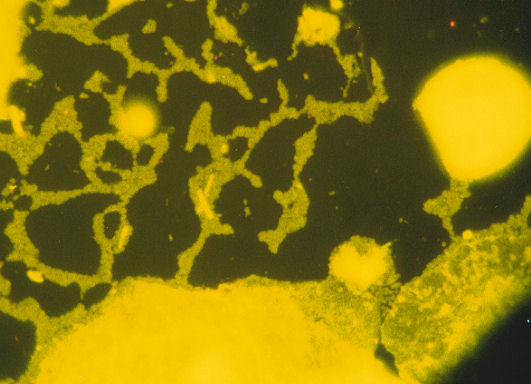
Funny thing: I thought I was brought down by something tiny, the fangs of a wee arachnid. Turns out it was something even smaller, the lowly bacterium.

More accurately, bacteria. That is, a community of bacterium. Right? My medical consult is sleeping at the moment, but I think that is right. A community of teeny tiny organisms has brought me pretty much to a standstill.

By Mkaercher, via Wikimedia Commons

By Mkaercher, via Wikimedia Commons

Do the words “small but mighty” come to mind?

What I take from this is the strength of the collective. Monsanto may be monied, powerful, backed by government insiders, seemingly invincible–but WE have each other. We have our passion and our deep concern for the future. We have our love, as Shiva says, for “freedom and democracy, love for the Earth, the soil, the seed.”

All of which gives us the capacity to fan out and fell this giant.

Let’s do this thing.

Learning to Learn

Third in a series on education
Recently I spent a day with a Bloomington, IN homeschooling cooperative. Two families work together on homesteading projects on each others’ land. This allows their four children, ages 8 to 12, to learn by doing—while increasing their confidence and skills.

Projects range from seed saving to bike maintenance to creation of a family almanac. They’ve gone mushroom hunting, practiced knot skills, and (on rainy days) learned knitting and mending. They’re working on a fire pit and hoping to build a treehouse.

Reading and quizzing each other from a book called Moving Heavy Things

Reading and quizzing each other from a book called Moving Heavy Things

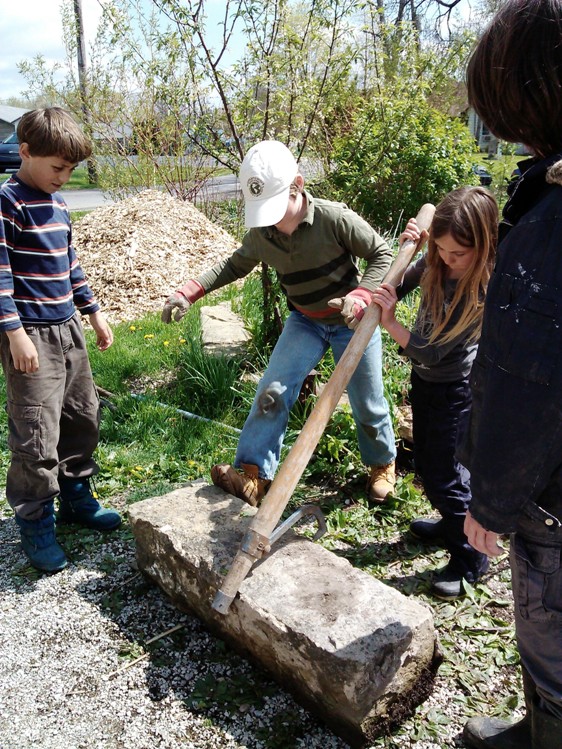
The day I was there, the students were studying how to move a heavy sandstone block down a sloping driveway from the front yard to the back. They were to place it into a rectangular hole in the dirt, forming part of an herb garden’s perimeter. The emphasis was on problem solving, collaborative effort, and applying their study of friction and levers.

Sawing PVC pipe to roll the plywood with the block on top (note that is just a practice stone, not the super-heavy one they were charged with moving)

Sawing PVC pipe to roll the plywood with the block on top (note that is just a practice stone, not the super-heavy one they were charged with moving)

This was no small task and involved an array of tools, including something I’d never heard of called a cant hook. The mom/teachers, Stacey and Dani, encouraged them to try out every idea and see what worked best. The kids worked by experimentation, reasoning, puzzling, trying, and talking—displaying remarkable tenacity through the whole process.

Using a cant hook to move the sandstone block

Using a cant hook to move the sandstone block

There was not one temper tantrum. I could see that the communication skills these kids develop through group projects will go a long way toward smoothing their way in the world—while also contributing to the healing of that same world.

Stacey says she’s motivated by a belief that children can be the instigators of deep change. “I try to not spend a lot of time in a fear/worry place (even though it is hard sometimes), and in doing this mentor joy, hope, the power we have, and that change is possible.  When children/adults have trust in themselves, self-empowerment and understanding of the world, beautiful things happen!”

“I think they are continually seeing how they make a difference and create change.”

Picking violets for our lunch salad

Picking violets for our lunch salad

By the end of my visit, the children had moved one monstrously heavy block into place in the back yard, where it will begin the delineation of an herb spiral. There was great cheering when the block was finally nestled into place.

As results-oriented as we are these days, this may not seem like much for several hours’ work. But in the process, they learned to learn, to cooperate, and to not fear failure.

Watching them, I wondered how my life would be different if I had had these sorts of experiences in my own childhood. I might consider myself in a different light now. I might be handy, of all things. At the very least I would be braver, less fearful of being wrong.

This concludes the education series, at least for now. (I could share much more about both the KI school and these homeschoolers, but that’s where the book comes in.)