A Little Help from the Fungus Kingdom

Yesterday I went on a quest for the fabled fungus that’s been mopping up petrochemicals from a food co-op’s parking lot. Olympia Food Co-op‘s eastside store was the place. I timed my visit just right, happening upon a crew of landscapers working the butterfly and bird garden.
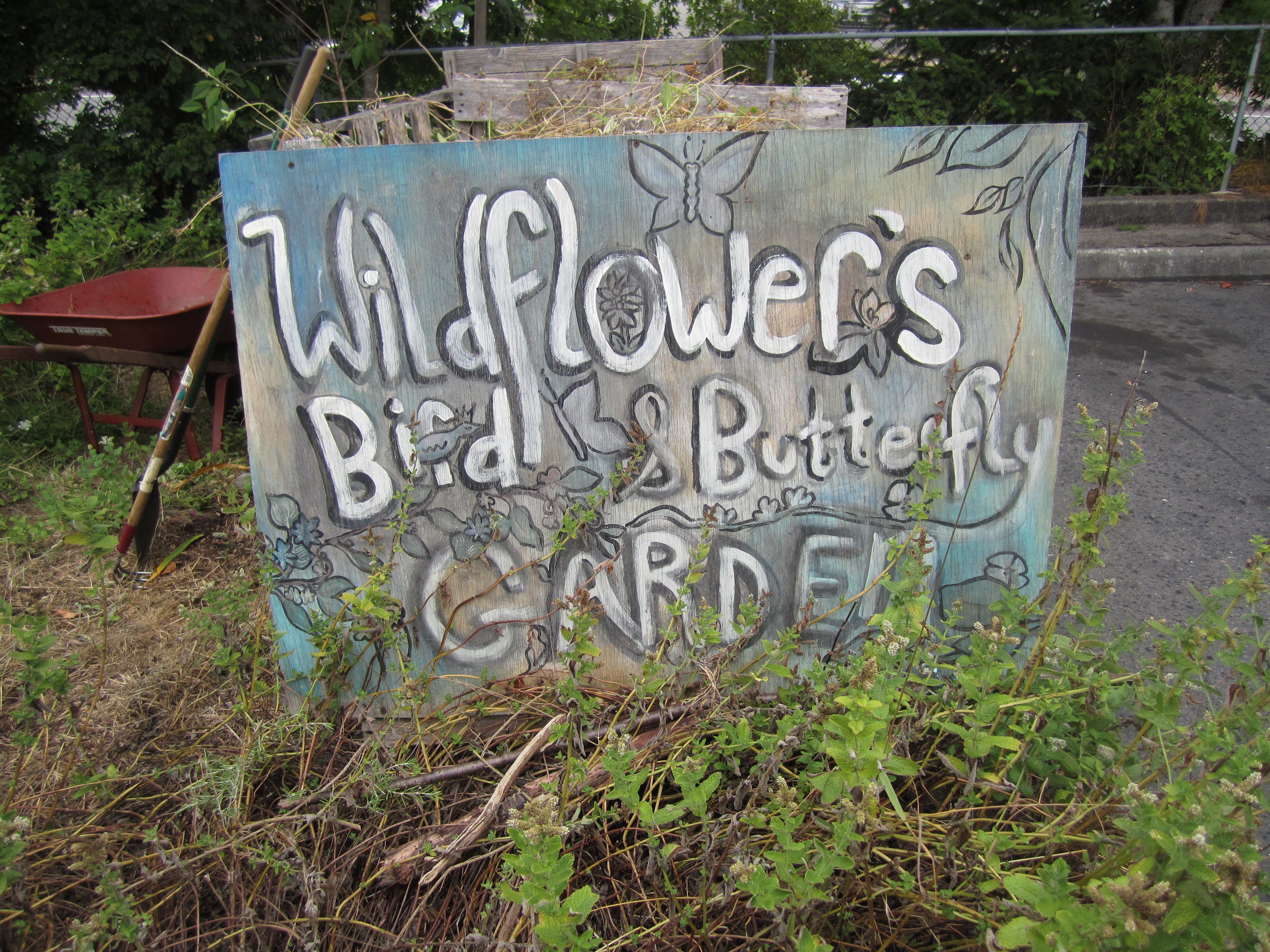
The grounds of this food co-op include a sweet garden meant to attract pollinators.

Outside the food co-op is a sweet garden meant to attract pollinators (and people).

Sarika, the co-op’s landscape coordinator, jumped at the chance to tell me about the project. The mycoremediation began five years ago in partnership with Olympia Mycelial Network. Oyster mushrooms are able to digest petrochemicals into harmless compounds. So the drainage ditch of the parking lot contains several burlap bags full of oyster mushroom mycelium.

Bags filled with oyster mushroom mycelium.

Bags filled with oyster mushroom mycelium.

The idea is to filter the oil before it hits the drain down by the sidewalk.

Ever wonder where the runoff disappears to when it enters a drain like this?

Ever wonder where the runoff disappears to when it enters a drain like this?

I also met Brittany and Jordan, two young Louisiana-born “WWOOFers” volunteering with Sarika. They are traveling around the country with another friend, exploring farming innovations and learning how they can be of use to our beautiful planet. (Check out their adventures at Traveling Tripod.)

Jordan, Sarika, and Brittany

Jordan, Sarika, and Brittany

Brittany waxed eloquent about the role of mushrooms—this critical work is all about ensuring “clean water for everyone.”

Signage showing the overview of the mycoremediation

Signage showing an overview of the fungi’s work

Having been in the Pacific Northwest for almost a month, I’m beginning to grasp the extreme sensitivity of Puget Sound. This project represents just one small but significant effort to right the wrongs of our polluting ways.

Hood Canal, a basin of Puget Sound, as seen from Potlatch Beach on a moody day.

Hood Canal, a basin of Puget Sound, as seen from Potlatch Beach on a moody day.

The possibilities are staggering. Peter McCoy, who last year contributed a guest post about radical mycology, first told me about this project over a year ago. Finally seeing those humble mushroom bags doing their work brought tears to my eyes.

Sarika is looking into funding to pursue farther-reaching remediation. And the Radical Mycology Collective, of which Olympia Mycelial Network is a part, is launching its fall tour today. I can’t wait till the big Radical Mycology Convergence, taking place in Orangeville, IL this October!

Good to Grow

Guest post by Luke Taylor, who started a business called Good to Grow with his wife, Emily

Luke and Emily Taylor

Luke and Emily Taylor

Based out of Irvington, on the east side of Indianapolis, Good to Grow aims to harness the power of community to revolutionize the way we interact with overlooked natural resources.

What does it look like to “harness the power of community?” And what are these overlooked natural resources?

The power of community is a shared vision, and many hands. Our vision is one that makes it easy for neighbors to make choices that not only benefit their community, but also themselves. Choices like saving their food waste to create compost—and collecting rainwater to reduce water bills and strain on municipal utilities.

Good to Grow's custom-built water barrel towers enable urban gardeners to save large amounts of rainwater.

Good to Grow’s custom-built water barrel towers enable urban gardeners to save large amounts of rainwater.

Some might call this “being green,” or recycling. I am happy thinking of it as purely selfish.

If you have altruistic notions of saving the world one recycled cardboard box at a time, great! Continue seeking out ways to heal your part of the world through changes large and small. Your community needs more people like you.

Many in your community, however, need a layup. (Editor’s note: a layup, for the basketball-uninitiated, is the easiest of shots, more difficult to miss than make.) These folks will only choose to recycle if they are standing next to a bin or a forest ranger is looking in their direction.

Or if they receive something free as a reward. In short, they need incentive.

Developing an incentive framework to support behavior change is our goal at Irvington’s Good to Grow.

A bucket ready to receive a neighbor's vegetable scraps.

A bucket ready to receive a neighbor’s vegetable scraps.

One such framework is Irvington’s composting program. Already being championed by 16 households, this initiative’s ultimate goal is to collect compostable food waste and distribute finished compost (a valuable organic fertilizer) at the very same time. The idea is to connect beneficial behavior as seamlessly as possible with valuable incentive and convenience.

It is my hope that this idea encourages communities to create incentive frameworks of their own!

Luke Taylor moved to Irvington, Indianapolis with his wife Emily in early 2013. They chose this neighborhood mostly because of its strong sense of community. The Taylors wanted to be a part of it, and to encourage its growth. With Good to Grow as the vessel for delivery, they have a vision for Irvington that will amplify and enrich our local resources, bringing together an already blossoming Indianapolis community. One day, they dream to be able to enrich other Indianapolis communities in the same way by sharing the Good to Grow framework.

Building with the Mudgirls

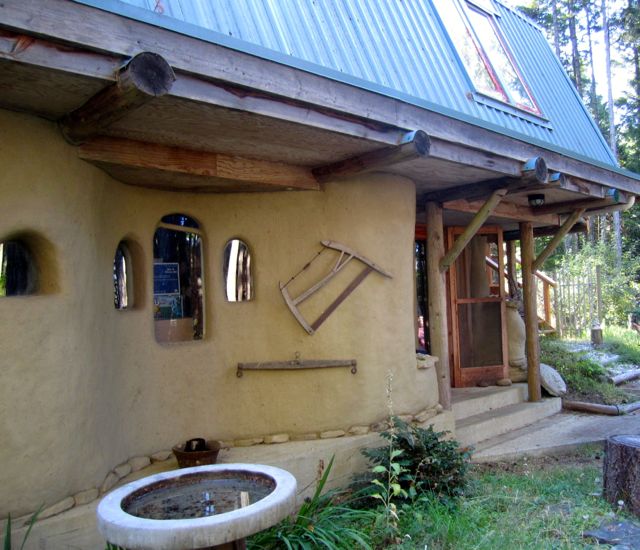
I spent part of last week at a workshop offered by the Mudgirls, a natural building collective in British Columbia.

The Mudgirls strive to live lightly on the earth while sharing skills among themselves and the wider community. And when it comes to resilience, building shelter from earthen materials is about as serious as you can get. This is a group that embodies the reimagined world, and a powerful DIWO (do-it-with-others) spirit.

The Mudgirls do their work in child- and mother-friendly style.

The Mudgirls do their work in child- and mother-friendly style.

Collective member Rose hosted our workshop on cooperatively owned land on Denman Island. We camped in the forest by night and bartered our labor for instruction by day. About 15 others took part, bringing enthusiasm and good humor to the work.

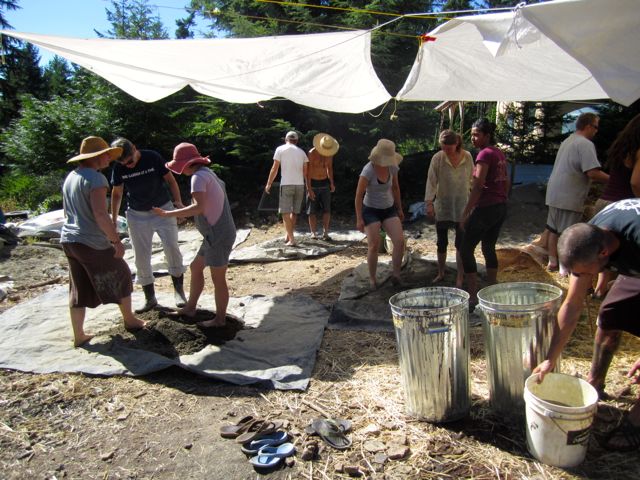
Some of our group making cob, a mix of clay, sand, straw, and water.

Some of our group making cob, a mix of clay, sand, straw, and water.

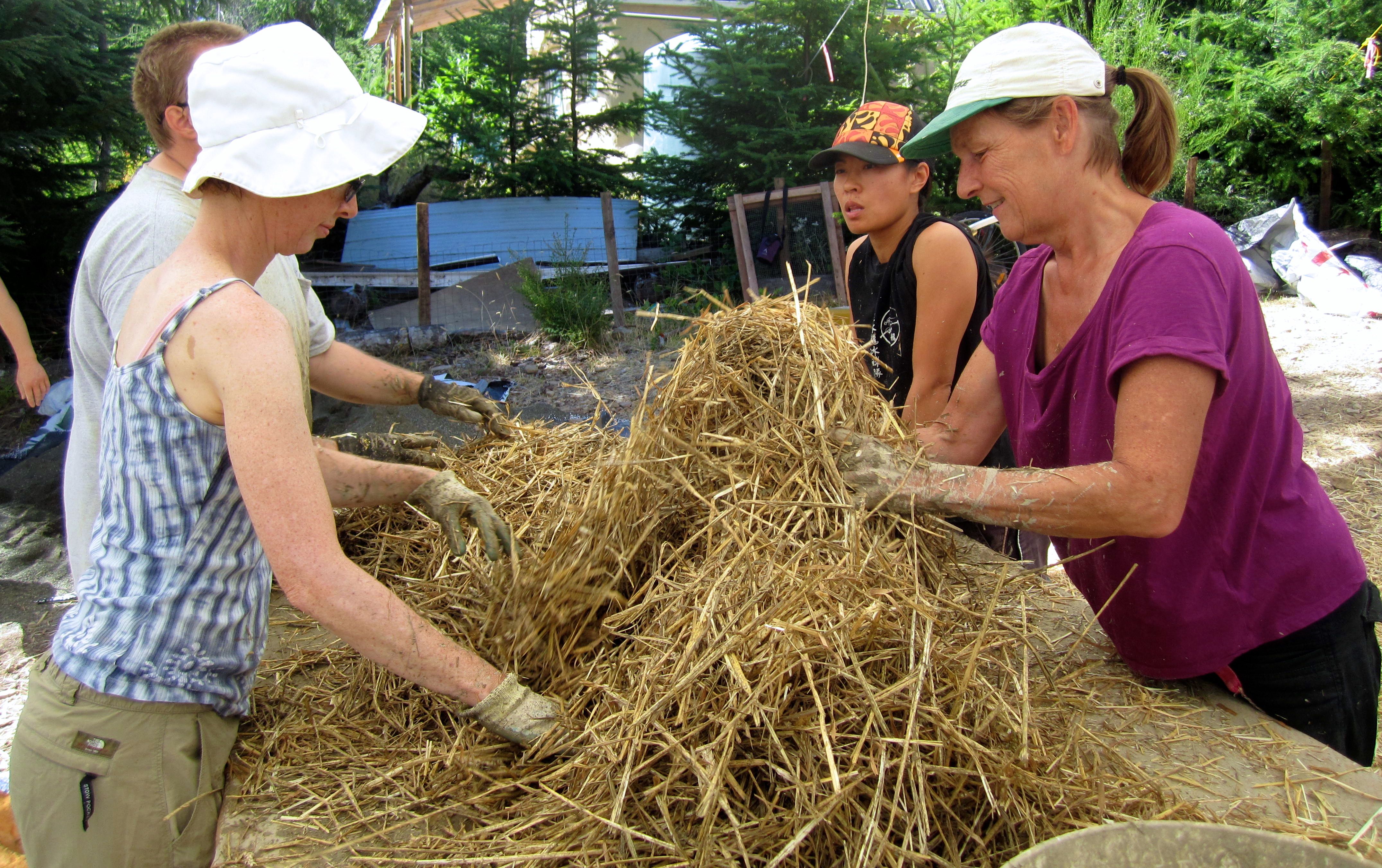
Rose is converting an existing structure on the land into a home for herself and her family. Using temporary plywood forms, we packed the walls with insulating material called slip straw. We made this insulation from straw and a clay-and-water slurry.

Making "slip straw" to insulate the walls. (Spot the pasty writer?)

Making “slip straw” to insulate the walls. (Spot the pasty writer?)

In a few weeks the walls will be dry enough to plaster.

house

House with slip straw insulation in the walls. The plywood is temporary, just to create a form to pack the slip straw in.

A hand-laid stone foundation forms the base for a cob-walled addition. (The team that worked on setting the stone found it a lesson in patience.)

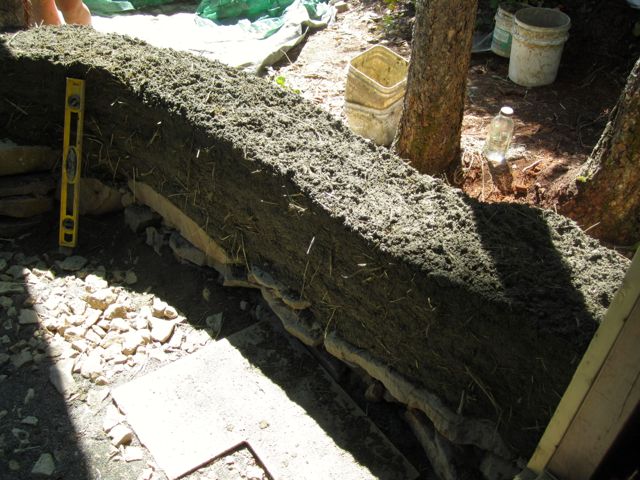
Wall taking shape on top of the stone foundation

Wall taking shape on top of the stone foundation

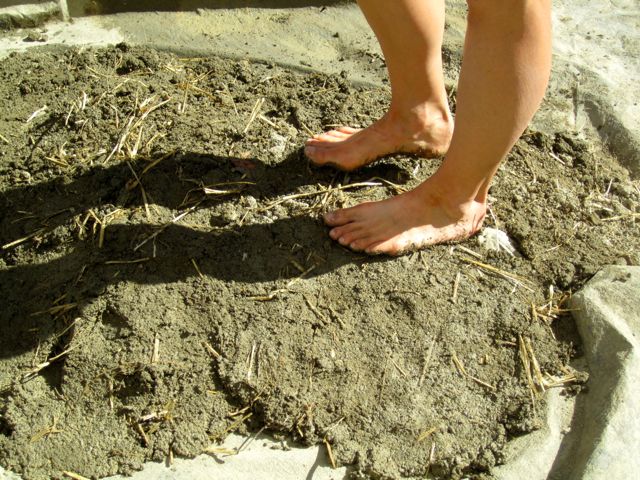
We all helped mix the cob, which is a blend of clay, sand, and water, with a sprinkling of straw. While clay has compressive strength, it lacks tensile strength–the role of the straw. We learned that the straw has a similar job as rebar in concrete, adding internal structure to the dense material.

Mixing a batch of cob.

Mixing a batch of cob.

Building the wall was perhaps the most exciting task.

Building the wall

Building the wall

Some people made it look easy. But I’m still not sure the section I worked on could be called plumb!

Room addition taking form, with window.

Room addition taking form, with window.

I asked Molly, one of the Mudgirls who helped with instruction, how the Mudgirls mission fits into the broader picture of ecological and societal upheaval. Beyond  her passion for natural building, she told me, what excites her is the community that’s being nurtured.

Molly mixing clay slip with a giant eggbeater-type tool.

Molly mixing clay slip with a giant eggbeater-type tool.

The women of the collective have known each other for years and have a solid commitment to each other. They make decisions by consensus, taking the time to talk things out (though in recent years the talks are shorter as the big issues have been resolved). Members all know that they have each others’ best interest at heart, and each agrees to take responsibility for her own needs and desires.

Molly said that people who come to workshops often reconnect at later events, forming lasting friendships. So community extends beyond the core collective. She sees participants as pollinators, taking our inspiration beyond the islands of British Columbia.

Example of a finished cob house (actually this one's a hybrid).

Example of a finished cob exterior.

For me the experience was all about the freedom to try something new. I had to grant myself compassion for the learning curve, and work on forgiving my body its frailties. The Mudgirls’ supportive environment made that possible.

And it was thrilling to help build an actual home. These hands that spend so much time on a keyboard are part of Rose’s homestead now.

Going Soil-Friendly

Do you ever think about the importance of the innumerable tiny creatures living underground, right under your feet? In just one tablespoon of soil, according to North Carolina State University’s Cooperative Extension Service, some 50 billion microbes are working away.

That’s if the soil is healthy.

By NoNomme (Own work) [CC0], via Wikimedia Commons

By NoNomme (Own work) [CC0], via Wikimedia Commons

I remember a conversation with an Ohio woman active in the environmental movement. She told me a story about a farmer who decided to switch his (conventionally farmed) cornfields to chemical-free produce. His seeds sprouted, but grew stunted and deformed.

The land had been blasted with petrochemicals year after year. Now there was nothing left to support a plant. No microbes. No nutrients.

But it doesn’t have to be that way.

My most recent Farm Indiana piece concerns a small agricultural fertilizer business called Sterling Formulations, led by a young man aptly named Vince Plowman.

Sterling Formulations’ team assesses farm fields and recommends soil-friendly additives depending on the particular needs of each field. They apply microbes and micronutrients to balance and nourish the soil that nourishes us.

Filling a container with earth-friendly fertilizer concentrate at Sterling Formulations' Shelbyville, IN plant.

Filling a container with earth-friendly fertilizer concentrate at Sterling Formulations’ Shelbyville, IN plant.

The team includes an Amish farmer who offers knowledge based on generations of experience. (My people!)

“The Amish have been farming organically for centuries, and quite successfully,” Vince told me. “They treat their soil right, and guess what, they’re getting yields comparable to conventional.”

He was surprised to learn that conventional farmers are as receptive to this message as organic growers. He said, “We found, in talking to a lot of conventional farmers, that so many of them are curious.”

Corn Field

Though he half-expected a derisive response from the conventional agribusiness side, so far that has not been the case. “What we found is they’re absolutely afraid…They don’t know how to do it (transition off chemicals), and they don’t have anyone to step them through the process of going to organics without absolutely killing themselves. They’re used to getting 200 bushels an acre, and they’re afraid they’re going to get 50 next year” if they stop using chemicals.

What comes next in that scenario isn’t pretty: they’d likely lose their farm. And many in that arena are supporting multiple families on the farm.

But Sterling Formulations is stepping into the gap. The goal is to help heal beleaguered soil through tailored applications of microbes and kelp-based fertilizers. Instead of petrochemicals that artificially prop up crops, these nutrients and tiny creatures create a living medium for plants.

This is one of the most exciting developments I’ve heard about in a long time. Farmers who want to stop using chemicals can get support in the switch—and stay profitable during the transition.

You can read more about Sterling Formulations in my Farm Indiana story.

Will Allen Visits Peaceful Grounds

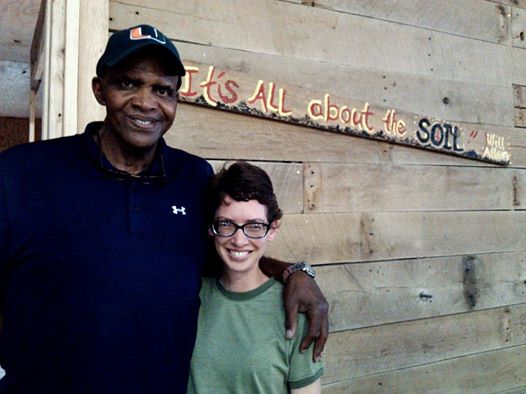
It was an honor to meet Growing Power founder Will Allen last weekend. The urban farming advocate was in town to support the work of his student Linda Proffitt at Peaceful Grounds. (Here’s my earlier post about this inspiring demonstration farm, which is a regional training center for Growing Power.)

This aphorism hangs on the wall at Peaceful Grounds.

This aphorism hangs on the wall at Peaceful Grounds.

The former pro basketball player told me that he learned how to broadcast seed as a child. He can pick up a handful of seed and not drop one of them. He has the muscle memory for broadcasting those seeds, whether arugula or chard or carrots—and all require different release rates. His sharecropper father taught him as a child, and all these years later, he retains the skill.

Now he sows great swaths of salad greens in his Milwaukee farm operations. Calling himself a “crusty old farmer,” he is the embodiment of Growing Power’s stated vision: “to inspire communities to build sustainable food systems that are equitable and ecologically sound, creating a just world, one food-secure community at a time.”

In 25 urban farm sites, on places like brownfields, school property, and land leased from corporations, the organization models how to get this done. The food is distributed through multiple channels, from Community Supported Agriculture accounts to a major distributor, Sysco. “Just another customer” is how he describes the corporation that ships GPI wares all over southeast Wisconsin.

Though the local food movement continues to make strides, there’s still a long way to go. Despite all the options—the CSAs, the farm stands, the farmers markets, the small mom and pop stores stocking local fare—Allen says up to 99 percent of the food eaten in major cities comes from 1500 miles away. “The vast majority of people will shop square,” he says, referring to big box stores.

Only $13 million of the U.S. food sector is generated by eco-agriculture—about the equivalent of three McDonalds. Growing Power represents 20 percent of that share. To fully transform the food system would require 50 million people to start growing food in their own yards, he says.

Turning the ship around has been the iconic Allen’s life work for the past 21 years.

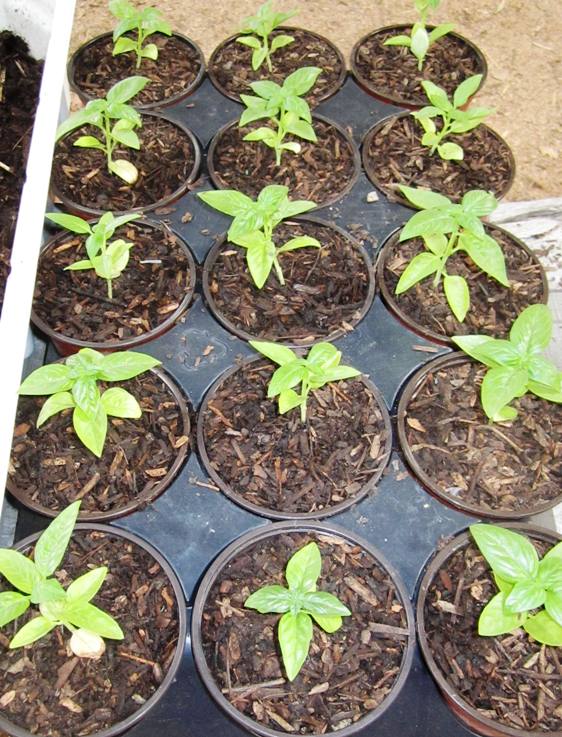
Basil sprouts at Peaceful Grounds, a regional training center for Will Allen's organization, Growing Power.

Basil sprouts at Peaceful Grounds, a regional training center for Will Allen’s organization, Growing Power.

He envisions for-profit businesses taking up the charge of urban food security, with nonprofits assuming a training and organizing role.

In his own organization, the people responsible for growing the food are extremely efficient, and training happens as a separate program. That’s a critical point, because farming isn’t easy. Efficiency is the name of the game.

“My crew comes from the community, and they live in the community, but they are professionals. Everybody thinks you can take interns and integrate them with professionals, but you can’t. You’ll lose money hand over fist.”

He's very tall.

That’s me on the right.

More of my conversation with Will Allen can be found in today’s Nuvo article.

Also check out Robb Smith’s terrific podcast interview over at DIY Food Supply.

Homegrown “Superfruit”

I saw this item for sale at my food co-op, Pogue’s Run Grocer, and it cracked me up.

Turkish Superfruit! Check it!

White mulberries, a “Turkish Superfruit,” only $5.99 for 4 ounces. What. A. Steal!

Just a week ago I spent a pleasant morning bicycling around the neighborhood with a friend. We stopped to pick from the mulberry trees that grow wild along the creek, meanwhile catching up on each others’ lives.

Mulberries are great in smoothies and crisps, and they are abundant, free, and nutritious (apparently a Superfruit, no less!). My friend and I were delighted with our harvest. Along with the usual purple, we found a white mulberry tree. It might be my imagination, but I always think the white berries are particularly sweet (though a bit less appetizing in appearance).

Superfruit from the hood. Free of charge. Bring your own bucket.

Superfruit from the hood. Free of charge. Bring your own bucket.

I once blogged about how homesteading (even on my modest scale) can make me feel like a chump because of all the extra work it takes to live “simply.” And how other times, I feel the tiniest bit smug, because—look! So much wealth on so little money.

Yeah, this is one of those smug times.

Peaceful Grounds

Monday morning a group of gardeners from the neighborhood had a private tour of Peaceful Grounds, Linda Proffitt’s endeavor at Marion County Fairgrounds, where the county fair is going on. (See my earlier post about her work here.) The vision and scope of this Global Peace Initiatives project astounded and inspired us.

The cattle barn at the Marion County fairgrounds is home to this volunteer-driven initiative.

The cattle barn at the Marion County fairgrounds is home to this volunteer-driven initiative.

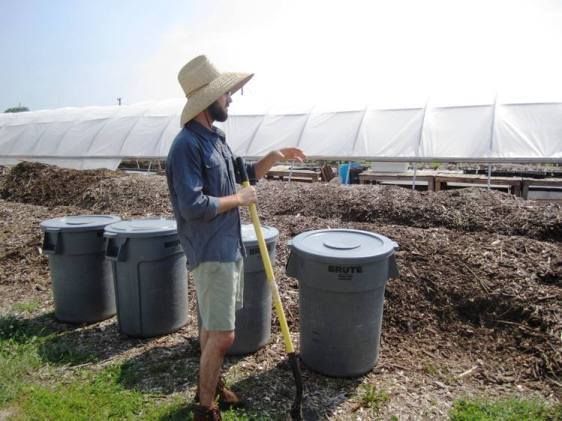
George Marshall, Linda’s intern, showed us around the farm, where mounds of wood chips are not just regular old wood chips but worm habitat.

George

George next to a hoop house that stayed warm all winter from heat given off by decomposition.

Peaceful Grounds takes beer mash from local brewers like Irvington’s own Black Acre and buries it in mulch to feed the herd of worms.

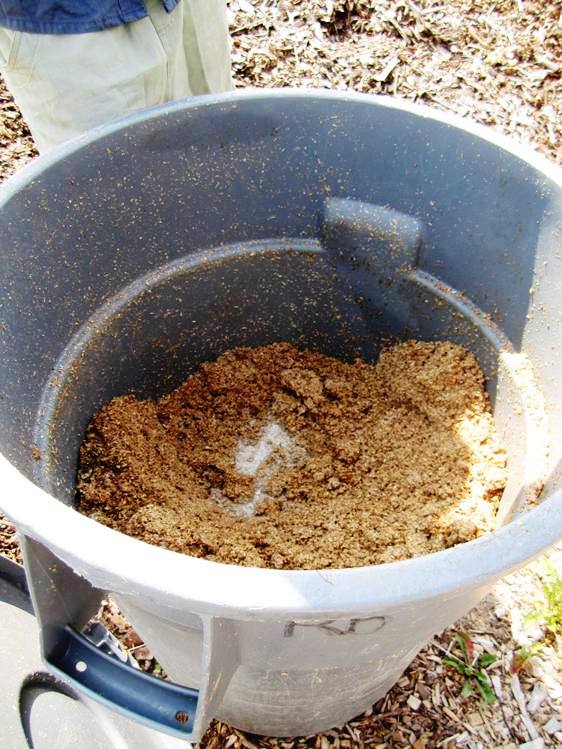
The spent grain is perfect worm food because barley fits easily into worms' tiny mouths.

The spent grain is perfect worm food because barley fits easily into worms’ tiny mouths.

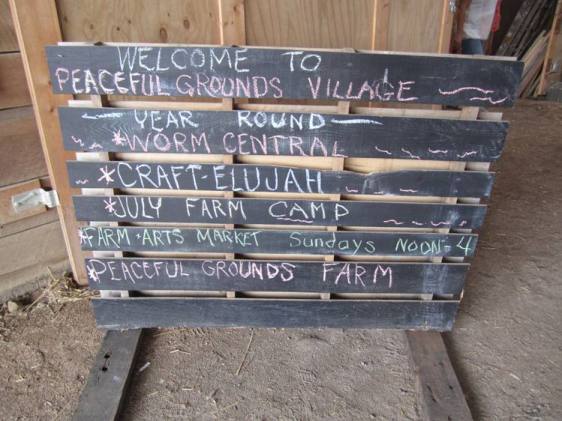
Hand-painted signs that say “Worms at Work” and “Thank a Worm” testify to the importance of these little red wigglers.

IMG_3617

Digging up some of the underground workers to show us.

Volunteers mix 5 to 15 tons of mash with equal amounts of wood chips each week. Another mound incorporates dehydrated food waste from public hospital Eskenazi Health. Over time, these piles and rows are transformed into a viable medium for garden plants.

George showed us where vegetable and herb starts have been set right into these habitats.

broccoli

Broccoli planted in one of many windrows made by worms doing their work on wood chips and beer mash.

In a nifty closing of the loop, Linda has begun to raise hops to supply local brewers.

A few of Peaceful Grounds volunteer-planted crops.

A few more Peaceful Grounds volunteer-planted crops.

While we were walking down the raised beds (“windrows”) of basil and tomatoes, a fair official came up and asked for Linda. He wanted to introduce her to the people in charge of an elephant exhibit, so she could incorporate elephant dung in the farm operation. (“You never met a lady more excited about poop than Linda,” George joked.)

Inside the cattle barn is where kids and adults can come for hands-on fun with art and agriculture. It’s also where artists like Jamie Locke (another Irvington neighbor) demonstrate mandala making and other crafts—and where young volunteers from Handi-Capable Hands take charge of a gigantic tumbler that sifts the worm compost into two grades of product.

Heidi Unger took this photo of the tumbler, which is named Apollo and was donated by a local farmer who saw Linda on TV.

Heidi Unger took this photo of the tumbler, which is named Apollo and was donated by a local farmer who saw Linda on TV.

We went home with the finer grade, which is basically worm poo, to use as a powerful organic fertilizer. One tablespoon per plant will nourish it through a month, Linda says.

Worm castings make an excellent fertilizer. Now there's a local source!

Worm castings make an excellent fertilizer. Now we have a local source!

Before we left, we learned that Will Allen is going to visit the operation, which is a training outpost for his fabulous Growing Power organization. He will speak at 2pm Saturday and lead a workshop at 4pm, and will also preside over a ribbon cutting ceremony at noon on Sunday, when the Peaceful Grounds Farm and Arts Market kicks off.

IMG_3598I’d love to see more interaction between local urban gardeners and this facility, which is just a stone’s throw from Irvington’s back door. Right now the county fair is in full swing, but the possibilities extend beyond its closing date. Linda is running a Farm Camp for kids starting July 7, and is happy to host volunteers at any time.

By the way, she offered to set me up with an interview with Will Allen. I’m thrilled to meet this man I admire so much. I’m crowdsourcing interview questions. What would you ask the grandfather of urban gardening, if you could?

On the Solstice, Contemplating Home

On the longest day of the year, one week after leaving Playa, I’ve been thinking about all that “home” means to me. I loved Oregon’s pristine natural beauty. But I couldn’t wait to come home and walk the tree-lined streets of my neighborhood. Taking my dog Marley for a walk was high on my list on my first morning back.

It’s not perfect here. There’s litter, unlike in Lake County, OR, and sadly many of the neighborhood ash trees are not treated for emerald ash borer, so they are dying—a distressing sight. Poison ivy is rampant in untended corners. Plus it’s really damned humid. But I still walk along with my heart singing “home,” loving the big sycamores and tulip poplars, enjoying all those daylilies and clematis vines, sampling a mulberry here and there.

And getting the latest scoop. Down the street, my big softie neighbor still has the pit bull who wandered into his yard—the one he swore he wouldn’t keep. Farther on, the retiree who always complimented me on my dog (Lord, how that poodle can prance) tells me he and his wife are moving to a condo after 47 years here, but a young family up the street will be moving in. I learn about another neighbor’s dog’s bout with pneumonia. And so on.

Walking is one of the ways I savor my neighborhood, but it’s not the only way. About the second thing I did that day was ride my bike with Judy to the kickoff of the Irvington Folk Festival, a weeklong extravaganza that opened with an outdoor bluegrass concert. I’m no bluegrass aficionado, though I love a good Rocky Top as much as the next person. What I went for, and got, was the people.

In the crowd were Rosemary, and also Laura, two women who helped me found the Irvington Green Initiative years ago. Also our neighbor Pat, who told us of a possible grant for a native plant/foraging project we’ve been scheming.

We sat with Heidi and Mike, longtime gardening buddies who happened to bike up at the same time as we did, midconcert. Behind us were Jerome and his family. That was fortuitous, because I could update him on our sweetgum tree. (Arborist Jerome has a business called Tree-Centric, which I’ve blogged about before. A few weeks ago he assessed our ailing sweetgum, taking soil samples and cutting away girdling roots. The cost of his professional expertise? A loaf of homebaked bread.)

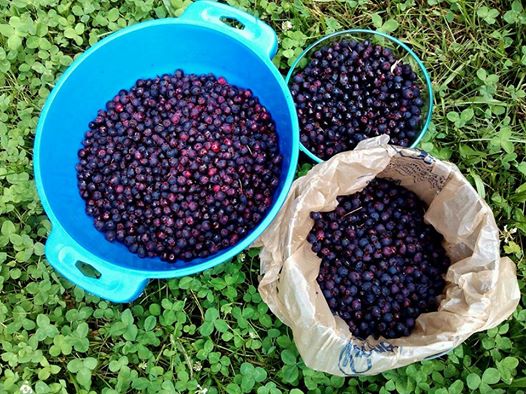
Jerome offered both his strawberry patch and serviceberry grove for picking. Though the strawberries were done, here's the lovely haul of serviceberries my friends and I made that morning.

Jerome offered both his strawberry patch and serviceberry grove for picking. Though the strawberries were done, here’s the lovely haul of serviceberries my friends and I made that morning.

Somehow, over the years, my roots have grown deep in this place. I grieve with friends who lost their 13-year-old German Shepherd, one of a gang of Marley met in the park as a pup. I pick mulberries and serviceberries (some from Jerome’s yard) while chatting with good friends. My yoga buddies welcome me back vociferously. I barter for Thai massage from a neighbor.

All that, plus (last night) hearing local musicians rock out, after eating at the new deli that sources everything it can locally.

How did I get so lucky? I don’t know, but I’ll contemplate the answer while biking to the park for the folk festival’s finale (and, bonus: alternative gift fair).

All I Cannot Save

Monarch sipping on liatris, by Gene Wilburn, via Flickr Commons.

Monarch sipping on liatris, by Gene Wilburn, via Flickr Commons.

My heart is moved by all I cannot save

So much has been destroyed

I have to cast my lot with those who, age after age,

Perversely, with no extraordinary

Power, reconstitute the world.

—Feminist poet Adrienne Rich

Resilient Communities and People: How Yoga Can Help

Guest post by Gaynell Collier-Magar

Hi everyone! I am so honored to be a guest blogger on Shawndra’s amazing website. Shawndra is one of my Irvington Wellness Center yoga students. She has a beautiful, thoughtful practice, both on and off of the mat. She personifies how yoga can help with resiliency in life.

Yoga is a 5000-year-old tradition of practices (the Eight Limbs) to reduce suffering and still the mind. It is not a religion. However, the practices have been incorporated by many religions: Buddhism, Hinduism, and contemplative Christianity to name a few.

The physical practice or “asana” (“seat”) is meant to create resiliency in the body and mind to enable sitting in meditation for long periods of time. Unfortunately, in the West, the physical practice is often perceived as the path to buns of steel, pretzel poses, and very thin 20-something bodies.

The first lines of the Yoga Sutras state: “Now, the teachings of yoga. Yoga is to still the patternings of consciousness”. The Sutras explain how our habitual ways of thinking create suffering and how we can remedy this.

When we are reimagining a future for our communities, yoga could be a useful tool.

Photo by Jenny Spadafora

Photo by Jenny Spadafora, via Flickr Commons

So how does this happen? In the physical practice, it begins with being in the present moment—in the body and the breath. To get a feel for what I mean, try this:

Notice how you are sitting now. Are you slumping? Good…notice how you feel heavy in your body. Now, sit up straight, feel your bottom sitting in your chair, feel your feet on the floor, and lift your chest. Do you feel any lighter in your body? Slump again and notice. Sit up again and notice. Now close your eyes, put your hands on the tops of your thighs and take three deep, slow breaths. Focus on the exhale.

What was your mind doing? Chances are it wasn’t making a to-do list, obsessing about the person at work who drives you crazy, or yearning after a piece of chocolate. You begin to get a glimpse of the mind becoming more still—an experience that increases in depth and length with further practice.

The practice is to notice what is happening in the present moment, practice non-reaction, and return to the present moment. Neuroscience is showing that these practices literally re-wire the brain.

Two of the liabilities of community work are burnout and lack of fresh ideas. Our ego-driven “monkey mind” robs us of tremendous energy and creativity. As we engage in practices that still the mind, we create a mindspace in which to think outside the box—and the energy to act accordingly.

Photo by TZA, via Flickr Commons

Photo by TZA, via Flickr Commons

We also create a mind that is equanimous and unattached, yet deeply caring. We create a mind that is focused and in the present moment. We create a mind that is resilient.

It is not a leap of consciousness nor faith to realize how resilient minds can create resilient communities. The Buddha said, “All that we are is a result of what we have thought. The mind is everything. What we think we become.”

Gaynell has been a yoga practitioner for over 14 years. She was certified as a Vinyasa yoga instructor in 2009 by Rolf Gates and is a registered yoga teacher with Yoga Alliance. She is certified to teach adaptive yoga to people with physical disabilities, having studied with Matthew Sanford of Mind Body Solutions. She has taught Vinyasa, adaptive, and 12-step recovery yoga classes in Indianapolis and Cozumel, Mexico in Spanish and English. She holds a Bachelor’s Degree in Social Work and owns her own landscaping business, Growing Connection.

Join Gaynell and other terrific instructors at Shine Out Yoga Celebration, July 11-12 in Indianapolis, benefiting Mighty Lotus.