Now We’re Cooking…with Sunshine

We offered our solar cooking workshop last weekend to an enthusiastic “crowd” of 17. That’s the biggest group a Pogue’s Run Grocer class has ever attracted, so we were pleased.

Judy demonstrating how to make a lid for a box cooker.

Judy demonstrating how to make a lid for a box cooker.

Judy has developed a wooden model, but we’re still working out the kinks. So we focused the class on “the old workhorse,” our tried-and-true cardboard box cooker. We wanted to show that you can start cooking with sunshine using only cheap (or free!) materials.

Judy adapted the design out of our solar cookery bible, Cooking with Sunshine. And you can find DIY instructions online as well.

All it needs now is an arm to prop the reflector--and you can make this out of a wire hanger.

All it needs now is an arm to prop the reflector. You can make this out of a wire hanger.

One of the attendees, a firefighter, plans to make the box cooker at the firehouse. He has a big vegetable garden, and he brought us all kinds of herbs and veggies in thanks for the teaching. He was eager to try using up garden produce in all-day stews and soups.

And we discovered after the class was done that another of the attendees has already been experimenting with solar cooking quite a bit. He sent me this inspiring video, proving me wrong when I said, “No, you can’t solar cook in the winter, because the sun’s too low.” Check it out!

The company behind this innovative design is called Solar Clutch. Its mission is promoting solar cooking in high risk areas of the world. I hadn’t heard of Solar Clutch, but I’m proud to find my home state of Indiana producing such a company.

Perhaps solar cooking season doesn’t have to end on Sept. 15 after all!

Lighting a Candle

So much sadness, trauma, pain, anger, fear is showing up in the personal news of my friends and in the wider news of recent weeks. But  here is a prayer for all of us, a message from an intuitive who grew up in war-torn Lebanon:

“I am lighting a candle in my heart for everyone… everyone… everyone. My heart is ablaze. My tears of joy, tears of sadness, tears of humility, and tears of hope bring this burn to a sizzle…only to find out that these candles are magical…they never go out.

By Luca Casartelli (Own work) via Wikimedia Commons

By Luca Casartelli (Own work) via Wikimedia Commons

Remember those special birthday cake candles that could not be stopped? The ones you blow out and they light up again? Ah, I am relieved that the light of my heart is infinite and eternal… has no borders… and ripples, boundless.

Now that love is set to permanent, I can really do my magic.”

—Iva of Sophia Speaks

How I Spent my Summer Vacation

After traveling for nearly a month, this homebody is glad to be back to my little haven of domesticity. This time I visited Washington State with a side trip to British Columbia.

If you follow the blog, you know a little bit about my adventures, but here are some more highlights.

In Bellingham I learned about Sustainable Connections’ Think Local First campaign. This ingenious program rewards local businesses for earth-friendly business practices by raising their profile in the community.

We decided to experience this local biz thing for ourselves.

Checking out goat cheese options (that's our old friend Laurie in the foreground.)

Checking out goat cheese options at the Bellingham Farmers Market (that’s our old friend Laurie in the foreground.)

Craft beer, ice cream made from local berries, a killer bookstore, and a festive Saturday farmers market showed us a bit of the region’s specialties.

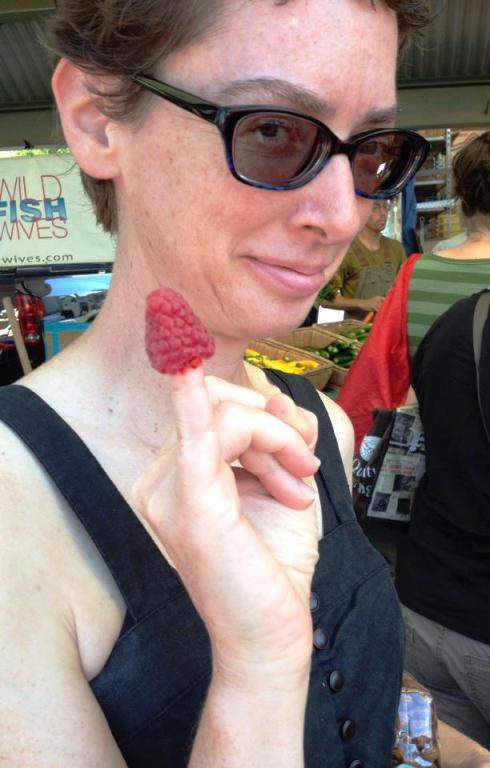
Biggest raspberry evah

Biggest raspberry evah

From Bellingham we ventured north to Denman Island in British Columbia for the Mudgirls workshop.

My new friend Millie, tamping slip straw at the Mudgirls workshop.

My new friend Millie, tamping slip straw at the Mudgirls workshop.

Then it was back to the U.S. for a two-week writing residency at Hypatia-in-the-Woods in Shelton, WA. This experience was a bit different from previous residencies which I shared with other artist types: I was the sole resident of a lovely cottage nested deep in the cedar forest.

The labyrinth on the grounds, a magical place

The labyrinth on the grounds, a magical place to commune with deer, birds, trees, and insects

The solitude gave me lots of focused time to write. I also learned how much I value having someone within hollering distance, as I had a few challenging moments in the intense isolation. I was thankful for the board, who kindly made sure I had some conviviality to balance out the quiet.

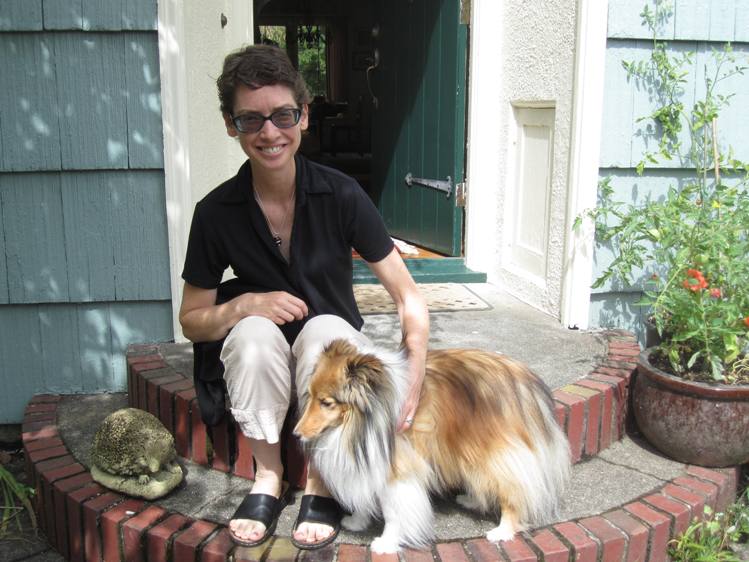
Other people's dogs, such as the director's Sheltie, Ceela, helped me deal with the lonesomeness of not having my dog with me.

Other people’s dogs, such as the director’s Sheltie, Ceela, helped me deal with the lonesomeness of not having my dog with me.

A high point: connecting with Olympia Mycelial Network, a group I’ve admired from afar. I helped them with an installation of bioluminescent mushroom mycelium, which was a thrill.

We gathered by the cob oven on the Commons at Fertile Ground. After a quick tutorial, we created a path from wood chips inoculated with panellis (bitter oyster) mycelium. The hope is that this path will glow in the dark as the mycelium gets established.

Peter McCoy, who blogged here about starting the Radical Mycology project, walked us newbies through the process for growing mycelium.

Peter showing me grain spawn and mycelium sugar that he propagated at home. Now I want to try it!

Peter showing me grain spawn and mycelium sugar that he propagated at home. Now I want to try it!

After that inspiring evening, I had to visit Olympia Food Coop, where the group earlier helped install mycelium that consumes petrochemicals.

I feel so lucky to have had the chance to learn from such innovative people and projects. I’m glad to be back to my laundry-hanging, solar-cooking, dog-walking routine though. I have several fun writing assignments coming up that I’ll tell you about later.

Note: Speaking of solar cooking: We’re offering a workshop this Sunday from 2-3pm at Pogue’s Run Grocer on that very topic. RSVP here if you can make it!

A Little Help from the Fungus Kingdom

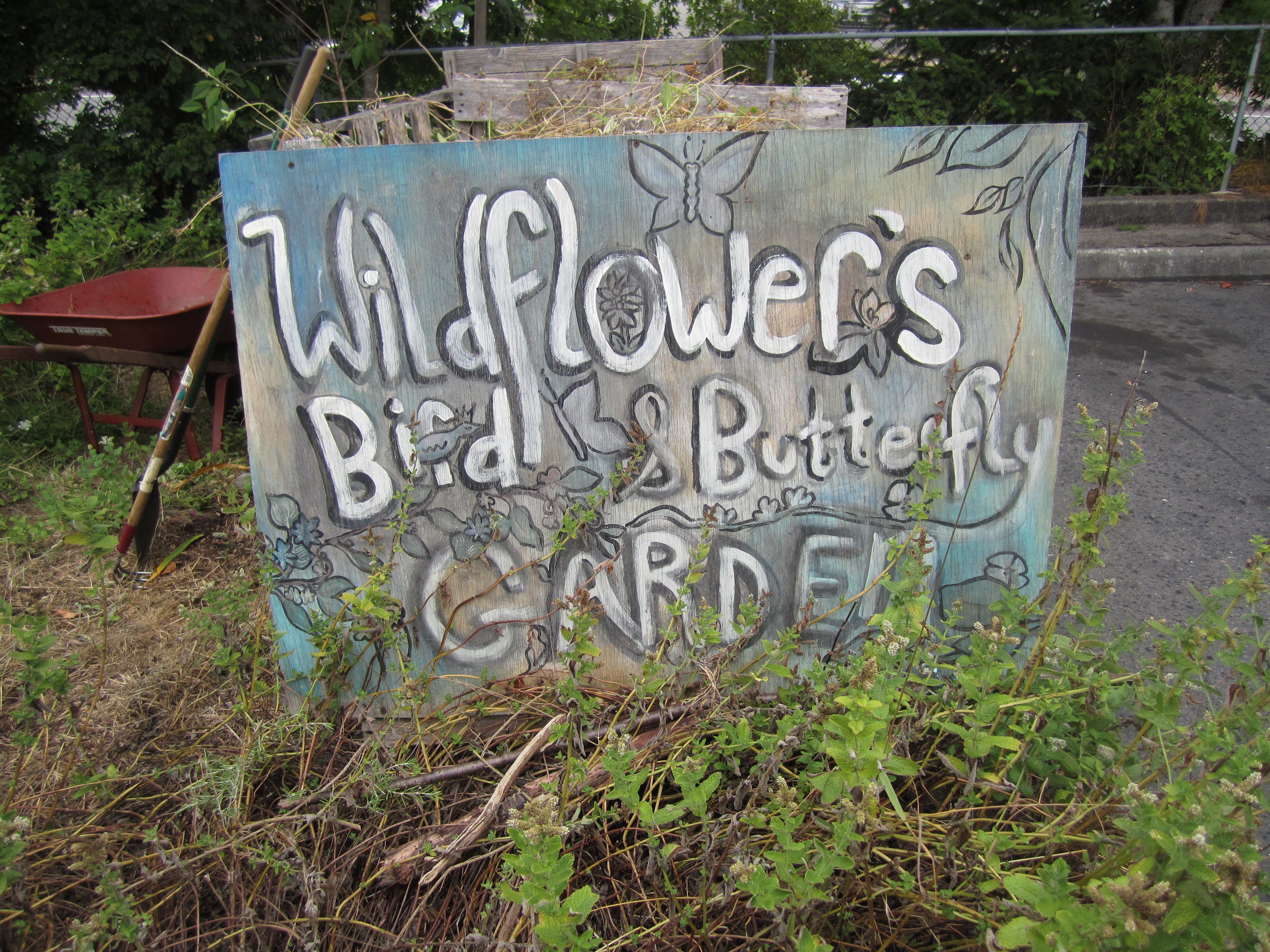
Yesterday I went on a quest for the fabled fungus that’s been mopping up petrochemicals from a food co-op’s parking lot. Olympia Food Co-op‘s eastside store was the place. I timed my visit just right, happening upon a crew of landscapers working the butterfly and bird garden.

The grounds of this food co-op include a sweet garden meant to attract pollinators.

Outside the food co-op is a sweet garden meant to attract pollinators (and people).

Sarika, the co-op’s landscape coordinator, jumped at the chance to tell me about the project. The mycoremediation began five years ago in partnership with Olympia Mycelial Network. Oyster mushrooms are able to digest petrochemicals into harmless compounds. So the drainage ditch of the parking lot contains several burlap bags full of oyster mushroom mycelium.

Bags filled with oyster mushroom mycelium.

Bags filled with oyster mushroom mycelium.

The idea is to filter the oil before it hits the drain down by the sidewalk.

Ever wonder where the runoff disappears to when it enters a drain like this?

Ever wonder where the runoff disappears to when it enters a drain like this?

I also met Brittany and Jordan, two young Louisiana-born “WWOOFers” volunteering with Sarika. They are traveling around the country with another friend, exploring farming innovations and learning how they can be of use to our beautiful planet. (Check out their adventures at Traveling Tripod.)

Jordan, Sarika, and Brittany

Jordan, Sarika, and Brittany

Brittany waxed eloquent about the role of mushrooms—this critical work is all about ensuring “clean water for everyone.”

Signage showing the overview of the mycoremediation

Signage showing an overview of the fungi’s work

Having been in the Pacific Northwest for almost a month, I’m beginning to grasp the extreme sensitivity of Puget Sound. This project represents just one small but significant effort to right the wrongs of our polluting ways.

Hood Canal, a basin of Puget Sound, as seen from Potlatch Beach on a moody day.

Hood Canal, a basin of Puget Sound, as seen from Potlatch Beach on a moody day.

The possibilities are staggering. Peter McCoy, who last year contributed a guest post about radical mycology, first told me about this project over a year ago. Finally seeing those humble mushroom bags doing their work brought tears to my eyes.

Sarika is looking into funding to pursue farther-reaching remediation. And the Radical Mycology Collective, of which Olympia Mycelial Network is a part, is launching its fall tour today. I can’t wait till the big Radical Mycology Convergence, taking place in Orangeville, IL this October!

Good to Grow

Guest post by Luke Taylor, who started a business called Good to Grow with his wife, Emily

Luke and Emily Taylor

Luke and Emily Taylor

Based out of Irvington, on the east side of Indianapolis, Good to Grow aims to harness the power of community to revolutionize the way we interact with overlooked natural resources.

What does it look like to “harness the power of community?” And what are these overlooked natural resources?

The power of community is a shared vision, and many hands. Our vision is one that makes it easy for neighbors to make choices that not only benefit their community, but also themselves. Choices like saving their food waste to create compost—and collecting rainwater to reduce water bills and strain on municipal utilities.

Good to Grow's custom-built water barrel towers enable urban gardeners to save large amounts of rainwater.

Good to Grow’s custom-built water barrel towers enable urban gardeners to save large amounts of rainwater.

Some might call this “being green,” or recycling. I am happy thinking of it as purely selfish.

If you have altruistic notions of saving the world one recycled cardboard box at a time, great! Continue seeking out ways to heal your part of the world through changes large and small. Your community needs more people like you.

Many in your community, however, need a layup. (Editor’s note: a layup, for the basketball-uninitiated, is the easiest of shots, more difficult to miss than make.) These folks will only choose to recycle if they are standing next to a bin or a forest ranger is looking in their direction.

Or if they receive something free as a reward. In short, they need incentive.

Developing an incentive framework to support behavior change is our goal at Irvington’s Good to Grow.

A bucket ready to receive a neighbor's vegetable scraps.

A bucket ready to receive a neighbor’s vegetable scraps.

One such framework is Irvington’s composting program. Already being championed by 16 households, this initiative’s ultimate goal is to collect compostable food waste and distribute finished compost (a valuable organic fertilizer) at the very same time. The idea is to connect beneficial behavior as seamlessly as possible with valuable incentive and convenience.

It is my hope that this idea encourages communities to create incentive frameworks of their own!

Luke Taylor moved to Irvington, Indianapolis with his wife Emily in early 2013. They chose this neighborhood mostly because of its strong sense of community. The Taylors wanted to be a part of it, and to encourage its growth. With Good to Grow as the vessel for delivery, they have a vision for Irvington that will amplify and enrich our local resources, bringing together an already blossoming Indianapolis community. One day, they dream to be able to enrich other Indianapolis communities in the same way by sharing the Good to Grow framework.

Building with the Mudgirls

I spent part of last week at a workshop offered by the Mudgirls, a natural building collective in British Columbia.

The Mudgirls strive to live lightly on the earth while sharing skills among themselves and the wider community. And when it comes to resilience, building shelter from earthen materials is about as serious as you can get. This is a group that embodies the reimagined world, and a powerful DIWO (do-it-with-others) spirit.
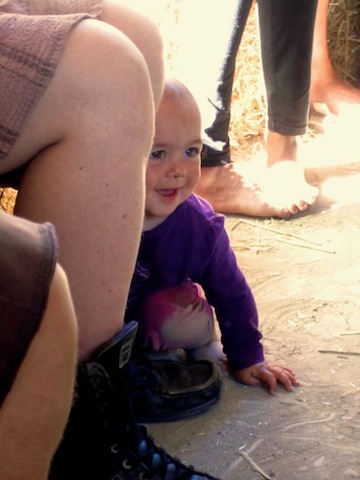
The Mudgirls do their work in child- and mother-friendly style.

The Mudgirls do their work in child- and mother-friendly style.

Collective member Rose hosted our workshop on cooperatively owned land on Denman Island. We camped in the forest by night and bartered our labor for instruction by day. About 15 others took part, bringing enthusiasm and good humor to the work.

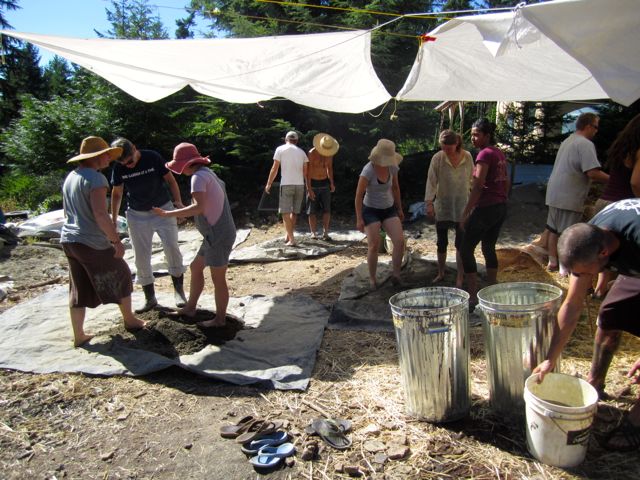
Some of our group making cob, a mix of clay, sand, straw, and water.

Some of our group making cob, a mix of clay, sand, straw, and water.

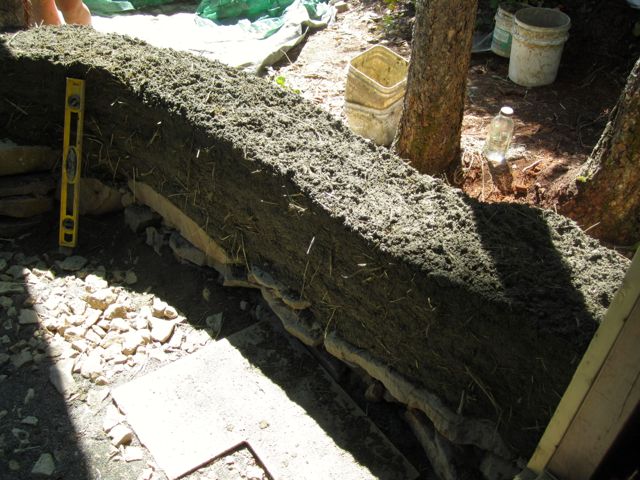
Rose is converting an existing structure on the land into a home for herself and her family. Using temporary plywood forms, we packed the walls with insulating material called slip straw. We made this insulation from straw and a clay-and-water slurry.

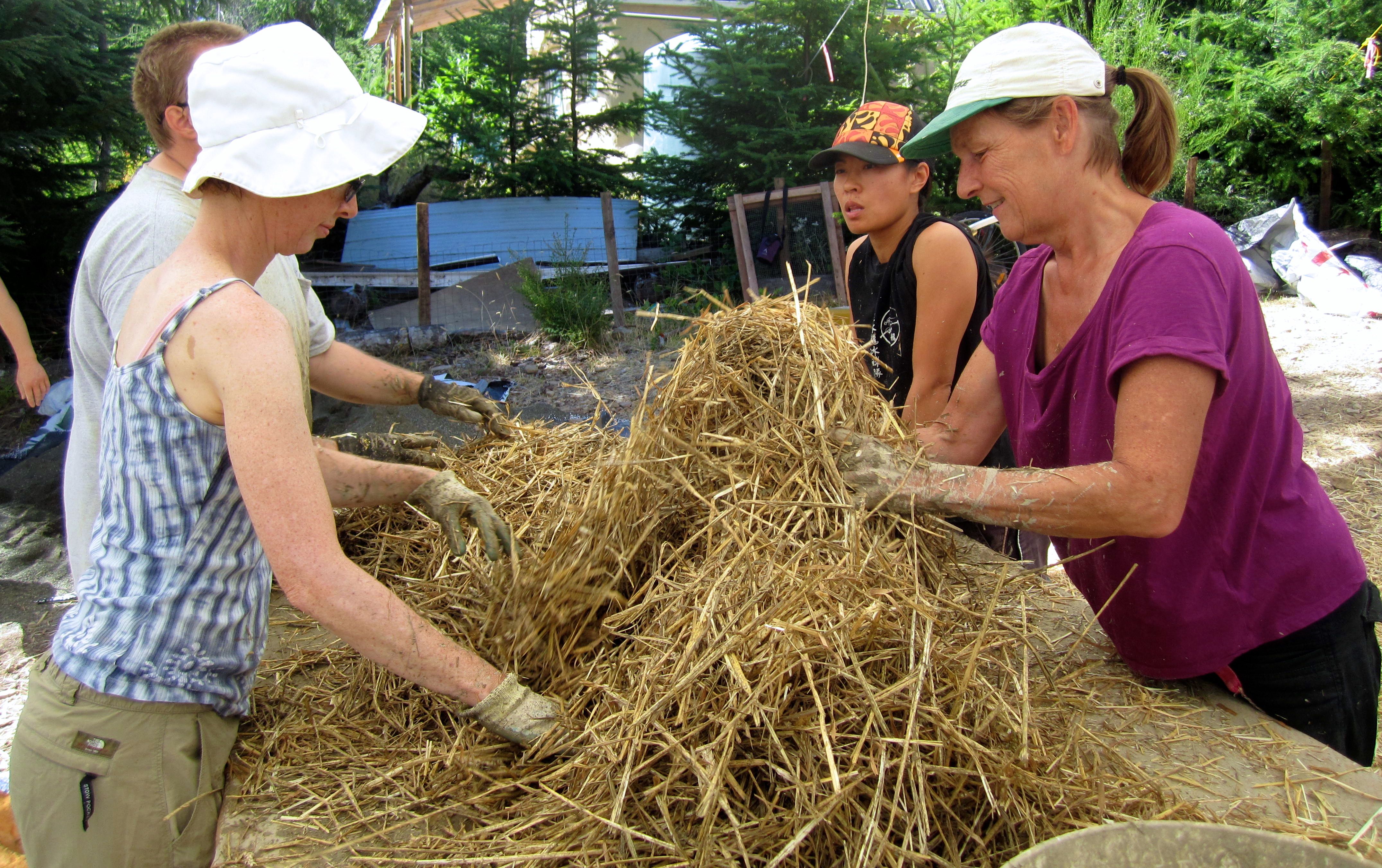
Making "slip straw" to insulate the walls. (Spot the pasty writer?)

Making “slip straw” to insulate the walls. (Spot the pasty writer?)

In a few weeks the walls will be dry enough to plaster.
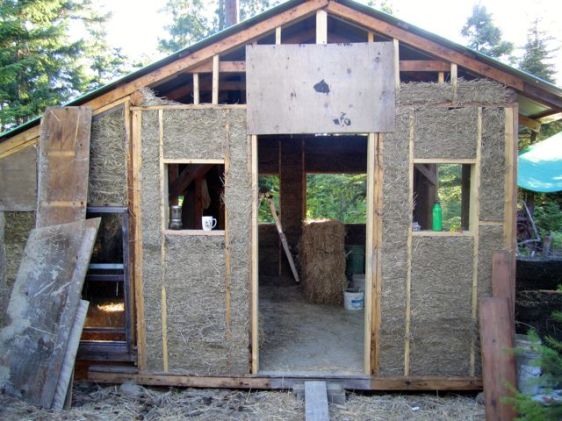
house

House with slip straw insulation in the walls. The plywood is temporary, just to create a form to pack the slip straw in.

A hand-laid stone foundation forms the base for a cob-walled addition. (The team that worked on setting the stone found it a lesson in patience.)
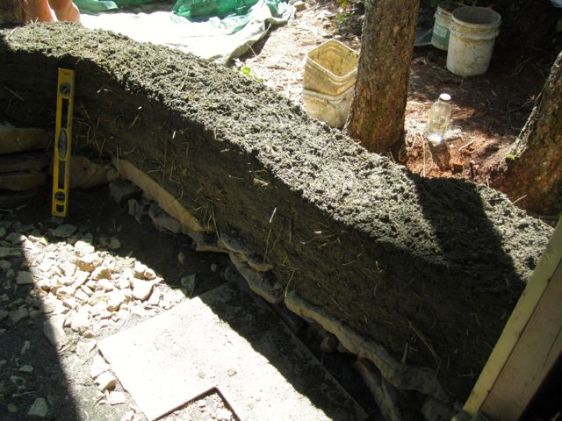
Wall taking shape on top of the stone foundation

Wall taking shape on top of the stone foundation

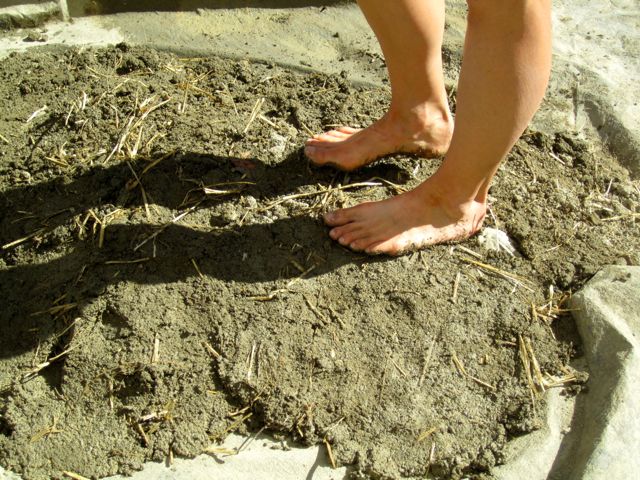
We all helped mix the cob, which is a blend of clay, sand, and water, with a sprinkling of straw. While clay has compressive strength, it lacks tensile strength–the role of the straw. We learned that the straw has a similar job as rebar in concrete, adding internal structure to the dense material.
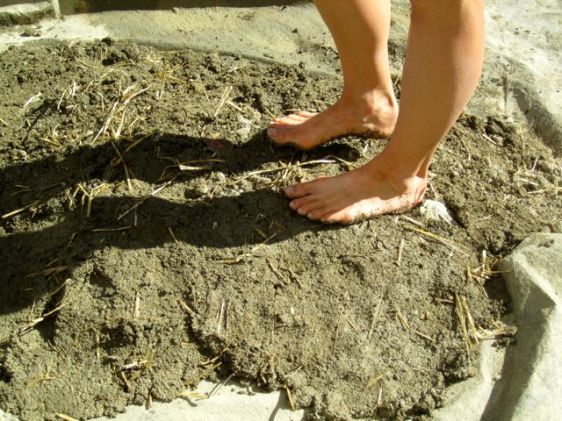
Mixing a batch of cob.

Mixing a batch of cob.

Building the wall was perhaps the most exciting task.
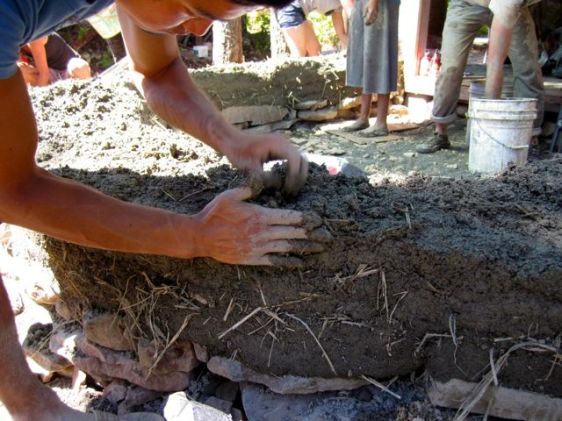
Building the wall

Building the wall

Some people made it look easy. But I’m still not sure the section I worked on could be called plumb!
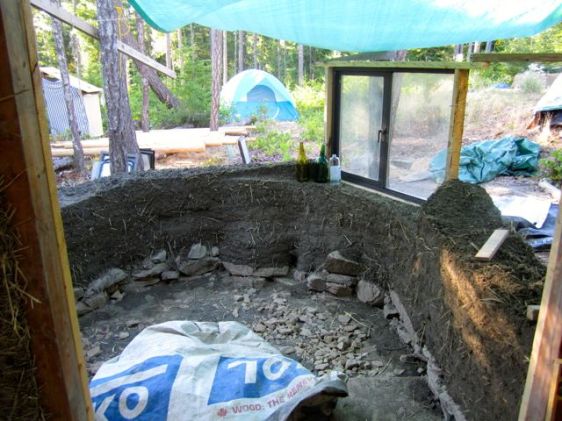
Room addition taking form, with window.

Room addition taking form, with window.

I asked Molly, one of the Mudgirls who helped with instruction, how the Mudgirls mission fits into the broader picture of ecological and societal upheaval. Beyond  her passion for natural building, she told me, what excites her is the community that’s being nurtured.

Molly mixing clay slip with a giant eggbeater-type tool.

Molly mixing clay slip with a giant eggbeater-type tool.

The women of the collective have known each other for years and have a solid commitment to each other. They make decisions by consensus, taking the time to talk things out (though in recent years the talks are shorter as the big issues have been resolved). Members all know that they have each others’ best interest at heart, and each agrees to take responsibility for her own needs and desires.

Molly said that people who come to workshops often reconnect at later events, forming lasting friendships. So community extends beyond the core collective. She sees participants as pollinators, taking our inspiration beyond the islands of British Columbia.
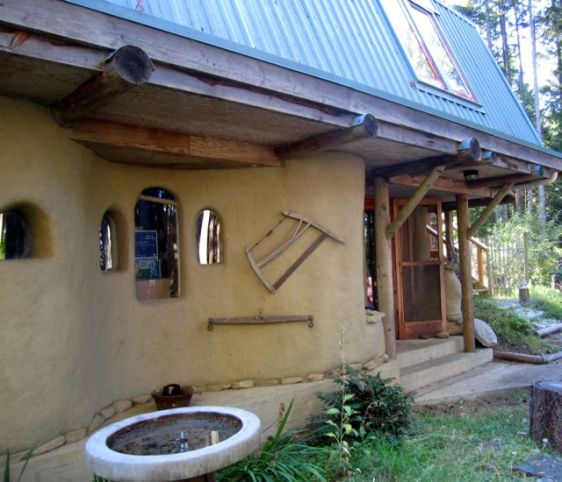
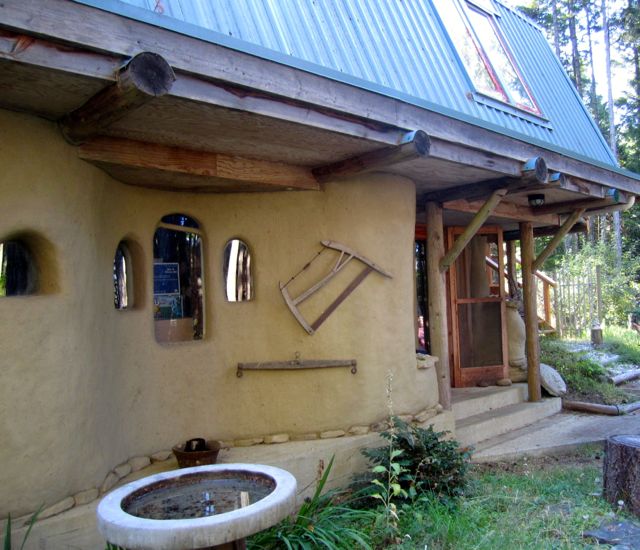
Example of a finished cob house (actually this one's a hybrid).

Example of a finished cob exterior.

For me the experience was all about the freedom to try something new. I had to grant myself compassion for the learning curve, and work on forgiving my body its frailties. The Mudgirls’ supportive environment made that possible.

And it was thrilling to help build an actual home. These hands that spend so much time on a keyboard are part of Rose’s homestead now.